Wild Plants of Malta & Gozo - Plant: Bellis sylvestris (Southern Daisy)

Southern Daisy

Bellis sylvestris / Southern Daisy / Margerita salvaġġa

Contents Links


Nomenclature

Botanical Data

Description

General Information

Photo Gallery

Further Info & Links

Buy Seeds and Docs

Submit own info
about this plant

Give a small Donation Online

FORUM

Copyright Info


Main Index

 
Visitor hits (Nov-2003)

Nomenclature

Species name:

Bellis sylvestris   Cirillo

Author(s):

Domenico Maria Leone Cirillo;
   Italy, 1739-1799

General names:

Southern Daisy, Wood Daisy

Maltese name:

Margerita salvaġġa

Plant Family:

Asteraceae/ Compositae   (Daisy (Sunflower) Family)

Name Derivation:

Bellis = pretty (Latin)
sylvestris = growing in woods, forest-loving (Latin)

Synonyms:

Bellis silvestris

Remarks:

-


Botanical Data

PLANT STRUCTURE:

Characteristic

Growth Form

Branching

Surface

Description

Erect :

Upright, vertically straight up well clear off the ground.
Basal Branching :

Branches are mostly present at the basal part of the stem.

Pubescent :

Covered with soft short hairs often pointing downwards.

General
Picture

Wild Plants of the Mediterranean Islands of Malta  - Copyright Stephen Mifsud / Maltawildplants.com / Malta (2002-2007) Wild Plants of the Mediterranean Islands of Malta  - Copyright Stephen Mifsud / Maltawildplants.com / Malta (2002-2007) Wild Plants of the Mediterranean Islands of Malta  - Copyright Stephen Mifsud / Maltawildplants.com / Malta (2002-2007)

LEAVES:

Characteristic

Arrangement

Attachment

Venation

Description

Basal Rosette :

A cluster of leaves in a circular arrangement at the base of the plant.

Stalked / Petiolate :

Hanging out by a slender leaf-stalk.

Single :

One central main vein (midrib) along leaf axis. There is often one or two veins brancing from the midrib.

General
Picture

Wild Plants of the Mediterranean Islands of Malta  - Copyright Stephen Mifsud / Maltawildplants.com / Malta (2002-2007) Wild Plants of the Mediterranean Islands of Malta  - Copyright Stephen Mifsud / Maltawildplants.com / Malta (2002-2007) Wild Plants of the Mediterranean Islands of Malta  - Copyright Stephen Mifsud / Maltawildplants.com / Malta (2002-2007)
 

Characteristic

Leaf Shape

Leaf Margin

Remarks

Description

Spatulate :

Spoon shaped, having a broad rounded apex and a narrow base but not very thin.

Serrate :

Sharp pointed teeth, oblique (inclined) to the margin, pointing apically like a saw.

General
Picture

Wild Plants of the Mediterranean Islands of Malta  - Copyright Stephen Mifsud / Maltawildplants.com / Malta (2002-2007) Wild Plants of the Mediterranean Islands of Malta  - Copyright Stephen Mifsud / Maltawildplants.com / Malta (2002-2007) Wild Plants of the Mediterranean Islands of Malta  - Copyright Stephen Mifsud / Maltawildplants.com / Malta (2002-2007)

FLOWERS:

Characteristic

Colour

Basic Flower Type

No. of Petals

No. of Sepals

Description

White

Petals are flushed in violet towards the upper part; more visible at the lower face.

Ray petals around disc florets :

Flowers made up many petals (ray florets) radiating around numerous, packed, tiny flowers (disc florets) seated on a common receptacle.

40-50

Referring to the ray florets.

18-22

Referring to the phyllaries of the involucre.

General
Picture

  Wild Plants of the Mediterranean Islands of Malta  - Copyright Stephen Mifsud / Maltawildplants.com / Malta (2002-2007) Wild Plants of the Mediterranean Islands of Malta  - Copyright Stephen Mifsud / Maltawildplants.com / Malta (2002-2007) Wild Plants of the Mediterranean Islands of Malta  - Copyright Stephen Mifsud / Maltawildplants.com / Malta (2002-2007)
 

Characteristic

Inflorescence

Description

Ovary

Stamens

Description

Single and Terminal :

Single, solitary flower at the apex of the stem or flower branch.

White radiating flower heads consists of a cluster of central yellow florets (maturing from circumference to center) and numerous (about 50) radiating slender, white petals which often have purple tips, especially at the underside.

Inferior :

Ovary situated below the flower parts (the calyx, corolla, and androecium). In other words, these are attached above the ovary.

5, Syngenesious :

Anthers fused together, forming a ring or collar around the central style of every disc floret. Filaments are usually free. Stamens are usually not visible by the naked eye.

General
Picture

Wild Plants of the Mediterranean Islands of Malta  - Copyright Stephen Mifsud / Maltawildplants.com / Malta (2002-2007) Wild Plants of the Mediterranean Islands of Malta  - Copyright Stephen Mifsud / Maltawildplants.com / Malta (2002-2007) Wild Plants of the Mediterranean Islands of Malta  - Copyright Stephen Mifsud / Maltawildplants.com / Malta (2002-2007) Wild Plants of the Mediterranean Islands of Malta  - Copyright Stephen Mifsud / Maltawildplants.com / Malta (2002-2007)
 

Characteristic

Scent

Average Flower Size

Pollen Colour

Other Notes

Description

YES

Mild sweet scent.

25-35mm

Yellow

-


SEEDS:

Characteristic

No. Per Fruit

Shape

Size

Colour

Description

160-200

(per flower head).

Achene without Pappus :

A simple, one-seeded, often tooth-shaped fruit without any wind disperal mechanism (pappus). They are found in collective numbers attached to a common receptacle.

1.5mm

Brown

General
Picture

Wild Plants of the Mediterranean Islands of Malta  - Copyright Stephen Mifsud / Maltawildplants.com / Malta (2002-2007) Wild Plants of the Mediterranean Islands of Malta  - Copyright Stephen Mifsud / Maltawildplants.com / Malta (2002-2007) Wild Plants of the Mediterranean Islands of Malta  - Copyright Stephen Mifsud / Maltawildplants.com / Malta (2002-2007) Wild Plants of the Mediterranean Islands of Malta  - Copyright Stephen Mifsud / Maltawildplants.com / Malta (2002-2007)

FRUIT AND OTHER BOTANICAL DATA:

Characteristic

Fruit Type

Colour of Fruit

Subterranean Parts

Other Notes

Description

Achenes without pappus :

A group of achenes which have no pappus for wind dispersal. Usually found closely-seated one beside each other on a common flat or dome-shaped receptacle.

Brown

Taproot :

A rooting system where there is the main descending root of a plant having a single dominant large structure from which a network of smaller and long roots emerge.

-

General
Picture

Wild Plants of the Mediterranean Islands of Malta  - Copyright Stephen Mifsud / Maltawildplants.com / Malta (2002-2007) Wild Plants of the Mediterranean Islands of Malta  - Copyright Stephen Mifsud / Maltawildplants.com / Malta (2002-2007) Wild Plants of the Mediterranean Islands of Malta  - Copyright Stephen Mifsud / Maltawildplants.com / Malta (2002-2007) Wild Plants of the Mediterranean Islands of Malta  - Copyright Stephen Mifsud / Maltawildplants.com / Malta (2002-2007)

Plant Description

Life Cycle:

Perennial

Habitat:

Under trees (= woods), thickets, damp soil gathered inside rock gaps and pits but not on bare rock. Prefers partial / total shade.

Frequency:

Common

Sources in Malta:

Not very common but locally frequent. Found under trees at limits of Buskett (near Sculpture's Lodge), and garigues near Verdala Palace. Also scattered in Mtahleb, Bingemma, Girgenti, Wied Encita and Wied il-Ghasel.

Plant Height:

16-30cm.

Flowering Time:

Oct - Mar

Poison:

Not Poisonous


This perennial plant consists of a basal rosette of leaves and one to few flowering stalks about 25-30cm long. The flowering stem is grayish- mauve to olive green in colour, covered with short hair and holds a solitary flower heads. The flower stalks are not branched.

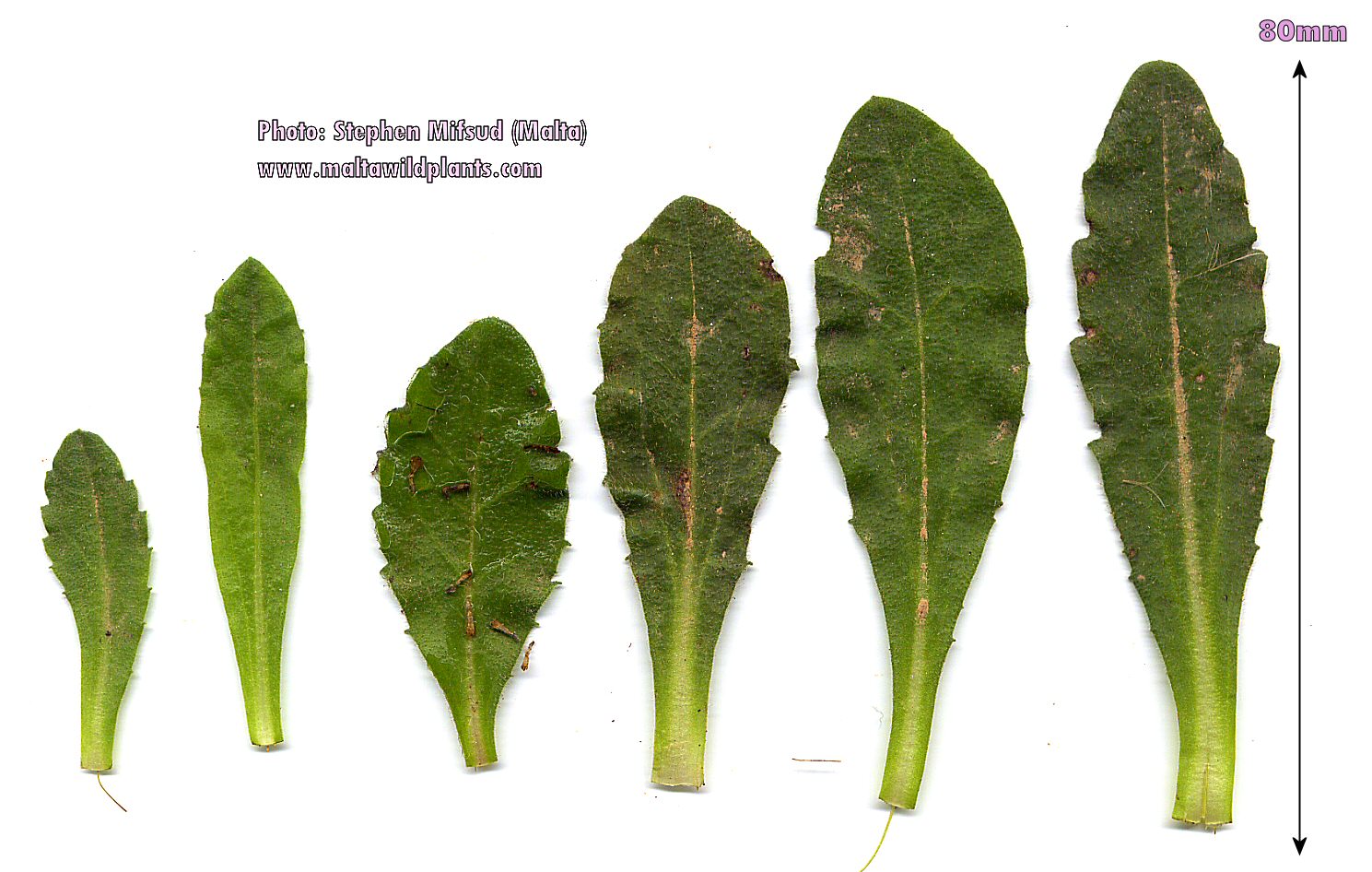
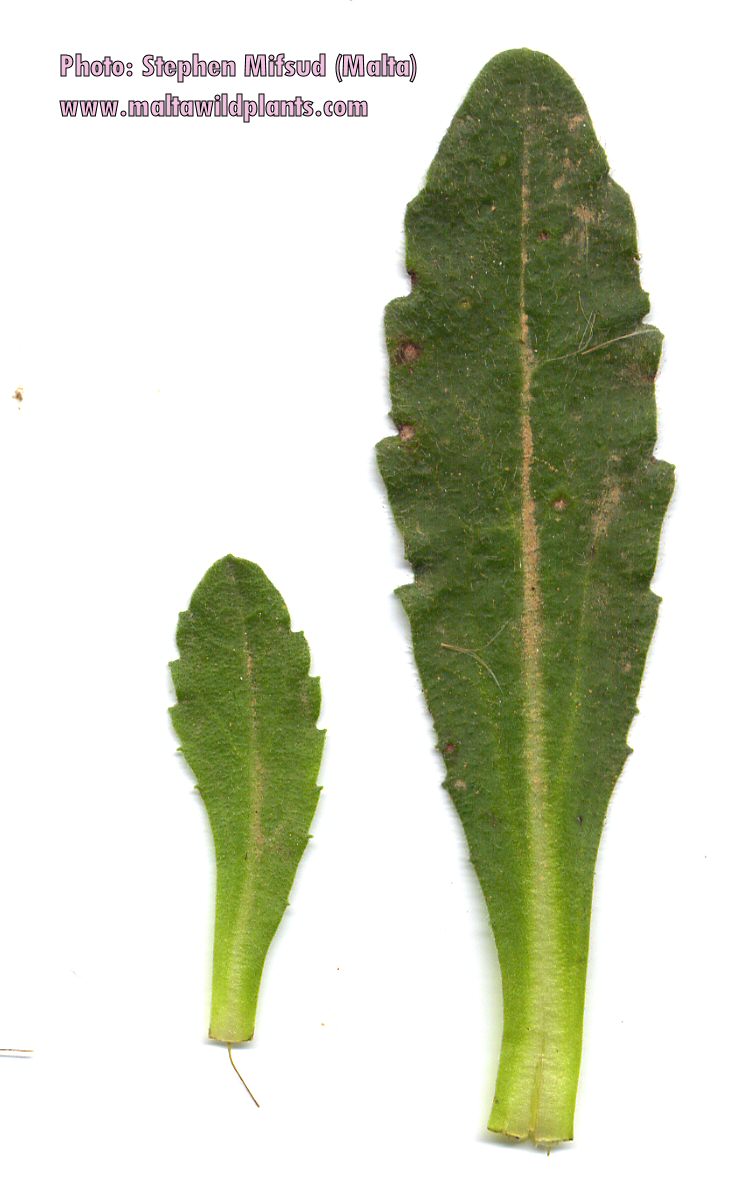
The leaves are arranged as a basal rosette few cms above ground level. They have an elongated spoon shape (oblong-spatulate) and have a smooth or more often slightly serrated outline. Leaves are also hairy, have winged stalks, and are usually between 5 to 8 cm long and approximately 2cm broad. One may see 1, 2 or 3 branching veins from the main central vein (midrib). This is one important feature which distinguish it from the common daisy (Bellis perennis) which have only a central midrib without branching veins.

The diameter of the flower head is between 30-40mm and it consists of a yellow center made up by few hundreds of disc florets, and a white radiating petals (ray florets). There is about 45-50 slender, silky, petals, and quite often they have a purple-flushed tip (20%-50% of the petal length). The purple tinge is more prominent at the underside face of the petal than the upper face. Sometimes, petals have most of the underside purple while the upper face is all white. There is large variety on the ratio and position of purple-ness in the petals. Another observation is that the pure white flowers (with no purple tinge) have the tendancy to be larger (longer petals), and more symmetrically attractive. Flowers close up as soon as the light conditions gets dim, such as during cloudy weather and well before sunset.

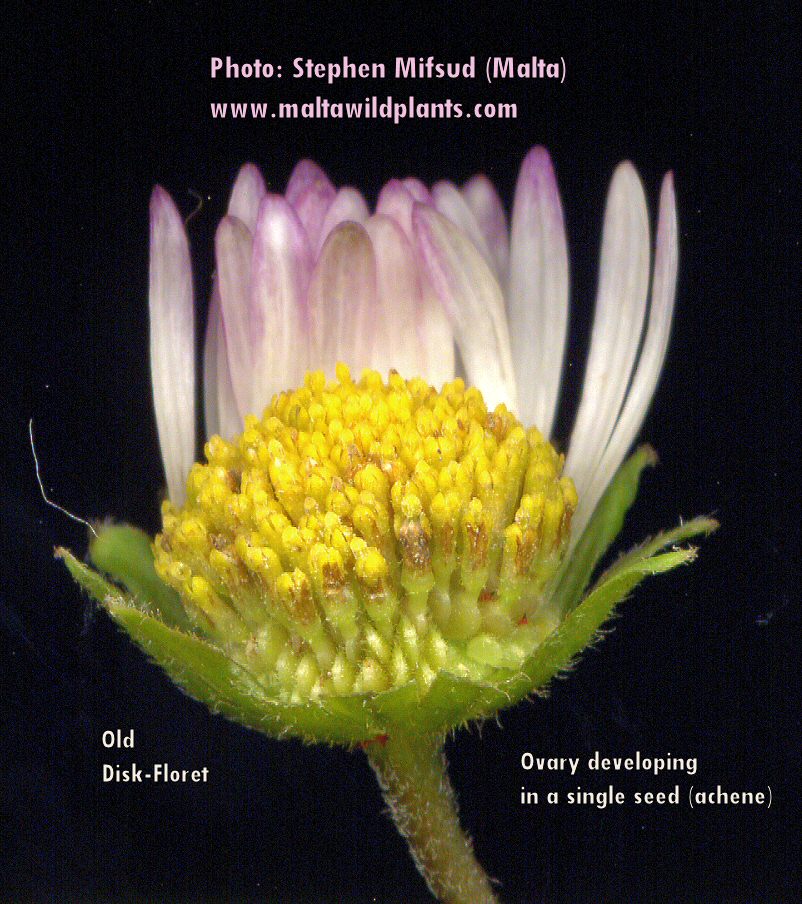
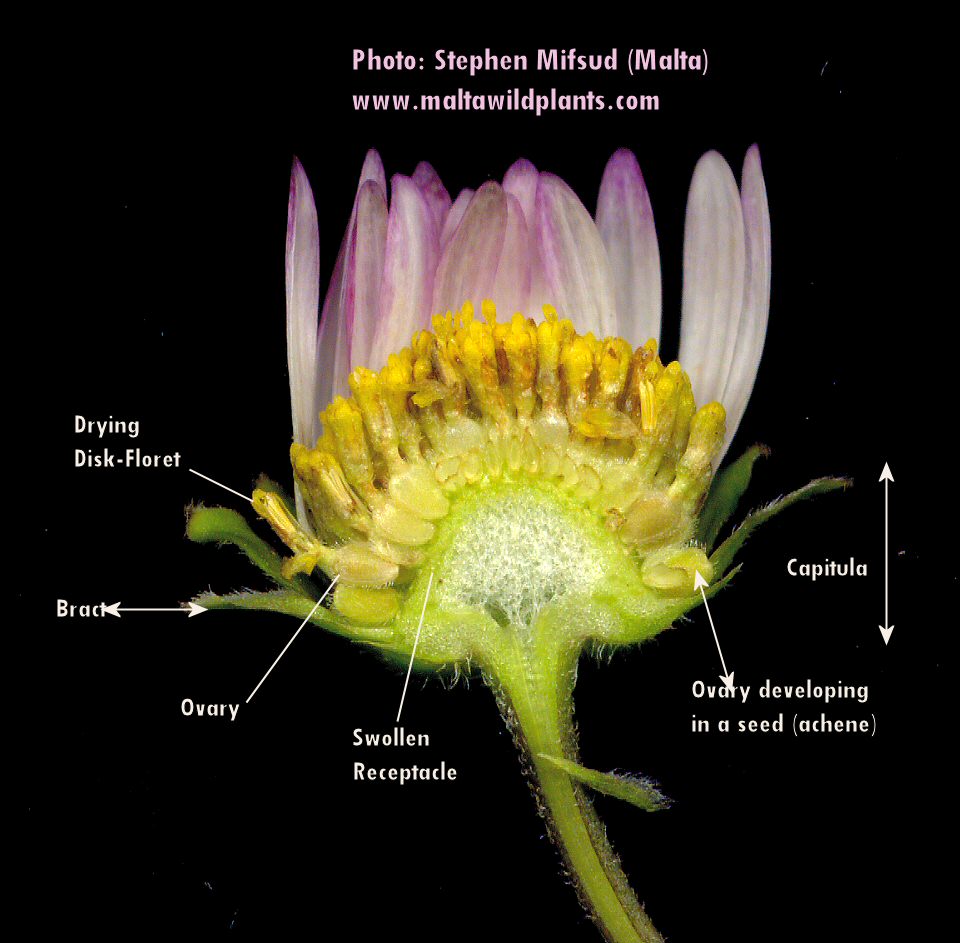
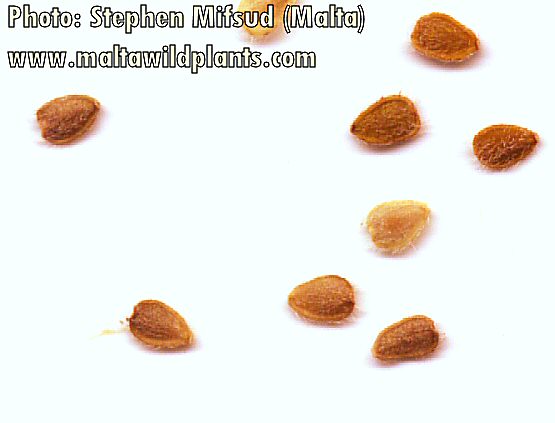
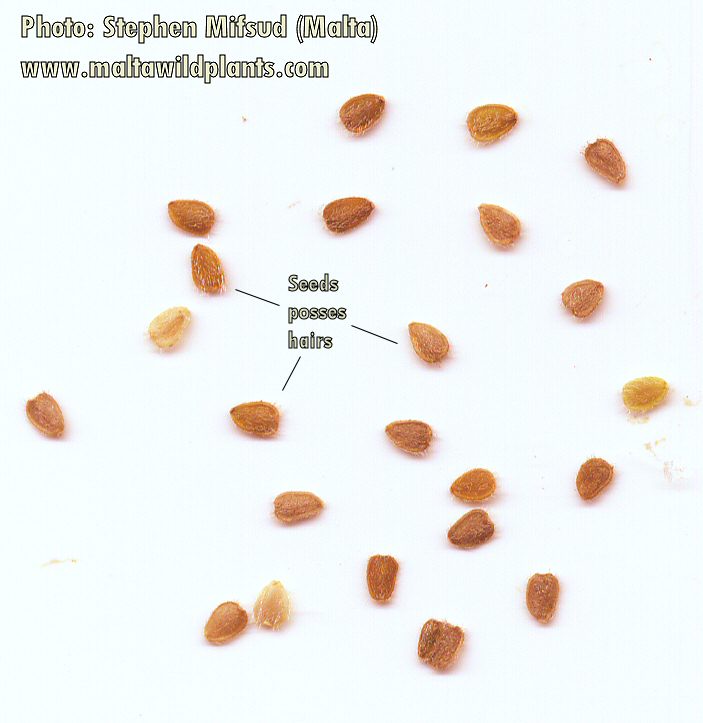
Each disc-floret have an underlying ovary, in which fertilisation can take place to develop into the seed. The wall of the ovary become the outer coat of the seed and in such cases, the seed is referred to as an achene. Achenes lacks pappus and there is no obvious means of seed dispersal. Probably seeds are carried around in the soil by insects such as ants. The seeds are slightly hairy, brown in colour, flattened (tooth-like shape) and 1.5mm long.


Additional Information


Edible Uses

Leaves - raw or cooked  [2, 7, 52, 115]. The flavour is somewhat acrid   [4]. A pleasant sour flavour according to another report   [238] whilst a third says that they are mild and agreeable and are used in salads   [217]. The daisy is occasionally used as a potherb   [183].

Flower buds and petals - raw   [144, 183]. Eaten in sandwiches, soups and salads   [183].


Medicinal Uses

The following properties are taken from the source - Plants for a future   [WWW-02] which where described for the common wild daisy (B. perennis). Since B. perennis and B. sylvestris are very closely related, it is very probable that both share the same medicinal properties.

Anodyne used to relieve pain.    [WWW-32]
Antispasmodic used to relieve or prevent spasms (especially of the smooth muscles)    [WWW-32]
Antitussive used to suppress or relieve coughing.    [WWW-32]
AntiCancer used in the treatment of cancer; "anticancer drug"; "an antineoplastic effect".    [WWW-32]
Demulcent a medication (in the form of an oil or salve etc.) that soothes inflamed or injured skin.    [WWW-32]
Digestive used to aid digestion, as a food or medicine.    [WWW-32]
Emollient substances resembling cream that have a soothing and moisturising effect when applied to the skin.    [WWW-32]
Expectorant used to induce the ejection of mucus, phlegm, and other fluids from the lungs and air passages by coughing or spitting.    [WWW-32]
Laxative Having the effect of loosening or opening the intestines, hence stimulating evacuation of feces and so relieving from constipation.    [WWW-32]
Ophthalmic relating to the eye; hence have medicinal properties for the health of the eye.    [WWW-32]
Purgative a purging medicine; stimulates evacuation of the bowels.    [WWW-32]
Tonic a medicine that strengthens and invigorates hence restores normal tone to tissues or to stimulate the appetite.    [WWW-32]


Daisies are a popular domestic remedy with a wide range of applications   [7]. They are a traditional wound herb   [238] and are also said to be especially useful in treating delicate and listless children  [7]. Recent research (1994) has been looking at the possibility of using the plant in HIV therapy   [238]. The herb is mildly anodyne, antispasmodic, antitussive, demulcent, digestive, emollient, expectorant, laxative, ophthalmic, purgative and tonic   [7, 9, 21]. The fresh or dried flowering heads are normally used   [9]. An infusion is used in the treatment of catarrh, rheumatism, arthritis, liver and kidney disorders, as a blood purifier etc   [9].

In 1771 Dr. Hill said that an infusion of the leaves was 'excellent against Hectic Fevers. The Daisy was an ingredient of an ointment much used in the fourteenth century for wounds, gout and fevers.   [WWW-03]

The daisy once had a great reputation as a cure for fresh wounds   [4]. An ointment made from the leaves is applied externally to wounds, bruises etc   [4, 232] whilst a distilled water is used internally to treat inflammatory disorders of the liver   [4]. Chewing the fresh leaves is said to be a cure for mouth ulcers   [244]. Daisies also have a reputation for effectiveness in treating breast cancers   [7].

Daisy is useful for coughs and catarrh, and for all conditions that manifest in these forms, Daisy may be used freely and safely. It has a reputation of value in arthritis and rheumatism as well as in liver and kidney problems. Due to its astringency it is also useful for diarrhoea.  [WWW-08] The flowers and leaves are normally used fresh in decoctions, ointments and poultices   [238].

A strong decoction of the roots has been recommended for the treatment of scorbutic complaints and eczema, though it needs to be taken for some time before its effect becomes obvious   [244]. A mild decoction may ease complaints of the respiratory tract, rheumatic pains and painful or heavy menstruation   [244].

The plant, harvested when in flower, is used as a homeopathic remedy   [232]. Its use is especially indicated in the treatment of bruising etc   [232].

Active Compounds

According to reference   [WWW-08] the flower heads (fresh or dried) have the following active components:

  • Saponins
  • Tannin
  • Essential oil
  • Flavones
  • Bitter principle
  • Mucilage.


Other Uses

An insect repellent spray can be made from an infusion of the leaves   [57]. On account of the acrid juice contained in the leaves, no cattle will touch it, nor insects attack it.   [WWW-03]

Curiosities and Sayings

The roots, too, have a penetrating pungency, containing some tannic acid, and there was once a popular superstition that if they be boiled in milk and the liquid given to puppies, the animals will grow no bigger.   [WWW-03]

According to some old writers, the generic name is derived from the Latin bellus (pretty or charming), though others say its name is from a dryad named Belidis. The common name is a corruption of the old English name 'day's-eye,' and is used by Chaucer in that sense: 'Well by reason men it call maie  
The Daisie, or else the Eye of the Daie.'   [WWW-03]

There is a common proverb associated with the flower and its abundance in spring and early summer: 'When you can put your foot on seven daisies summer is come.'   [WWW-03]

Personal Observations


Purple tipped flowers vs pure white flowers
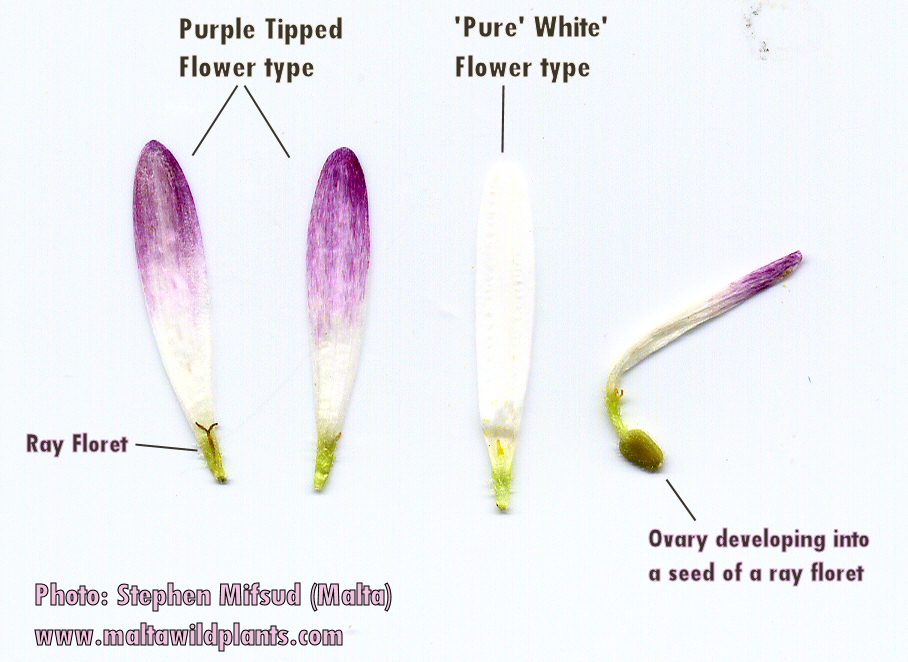
It was noted that there are two types of flowers according to the colour of the rays (petals):
i) those which are totally white without any tinge of purple,
ii) those which are white and have purple tipped petals, and often most of the underside face of the petal is also purple.

It appeared that the white flower forms are larger, the rays are more symmetrically arranged and flowers looks to be 'healthier'. The purple tipped flowers have shorter and slightly more broad rays, and somehow looks disorganized in the sense that there is some ray missing (gap) , or not well opened, or rays of unequal length - all of which makes the flower looses symmetry and so it is less attractive. The white ones are more often perfectly balanced. [SM]

Pests/larvae living on the flower
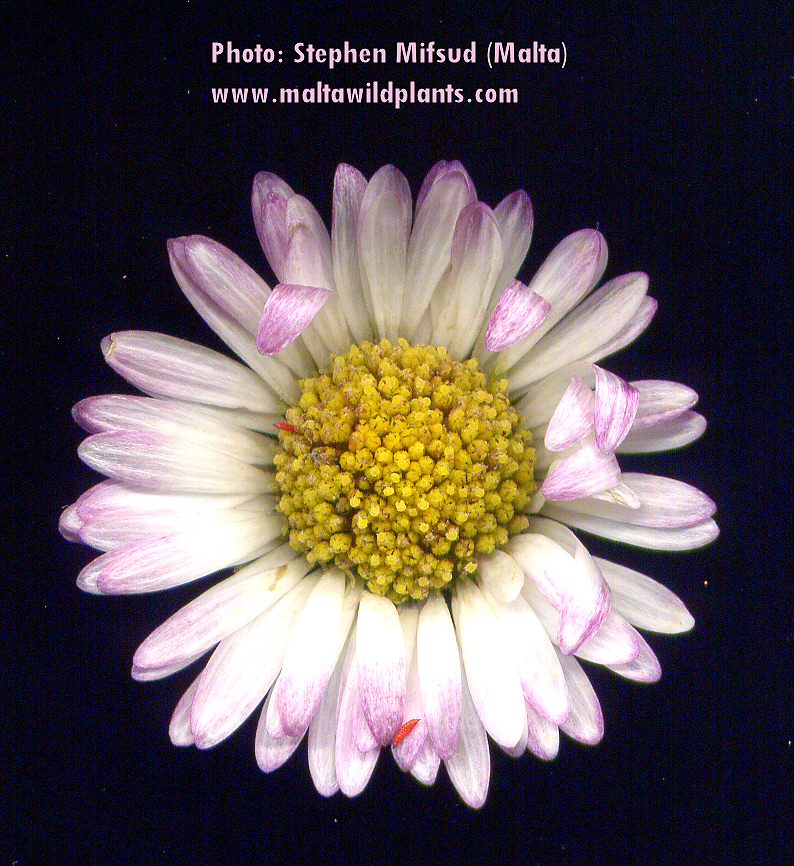
While taking photos of the flower heads, tiny worms roaming in the flower's capitula were observed. The worms may not measure more than 2mm and what's distinctive in them is that they are bright red. Probably, it is a form of larvae. This scanned photo accidentally shows some of these larvae. If someone have information about these larvae please contact me so as to include the new information (with credits). [SM]

Flower and light
Like other daisies, the southern daisy opens fully in bright sunlight, and starts to close down when the light gets dim. Just before sunset, or when the sun is covered with some clouds, the flowers are partially close. At night or dull / rainy weather the flowers will close. Another feature is that the flower head turns so that it faces directly the sun. [SM]

Similar species
B. sylvestris can be easily mistaken with a similar Bellis species - the common daisy = B. perennis. The arrangement of leaves, flower head, and general appearance of both plants are similar. However there are few differences between the two plants which are described in the table below. Another daisy species, the Bellis annua, is included in the table for comparison purposes - it should be easily be not mistaken with B. perennis and B. sylvestris since it seldom have purple tipped flowers. Another point to mention is that the habitat in Malta is not favourable to the perennial B. perennis and it is very unlikely that they survive all year round, esp. in the hottest season of summer. The B. sylvestris is a stronger and a more adapted species to warm climates like Malta. [SM]
Feature B. sylvestris B. perennis B. annua
Average plant height 30cm 15cm 8cm
Leaf arrangement Rosette Rosette Alternately branching leaves
Leaf shape Oblong spatulate with winged stalks Spatulate (more roundish than elongated) and slender stalks Spatulate (more roundish than elongated) and slender stalks
Leaf veins One central mid vein with 1 to 3 branching sub-veins One central mid-vein only One central mid-vein only
Flower head diameter 30-40mm 15-30mm 10-15mm
Purple tipped petals Common Common Rare


Photo Gallery

Bellis sylvestris (Southern Daisy) - CLICK TO ENLARGE PHOTO Bellis sylvestris (Southern Daisy) - CLICK TO ENLARGE PHOTO Bellis sylvestris (Southern Daisy) - CLICK TO ENLARGE PHOTO Bellis sylvestris (Southern Daisy) - CLICK TO ENLARGE PHOTO
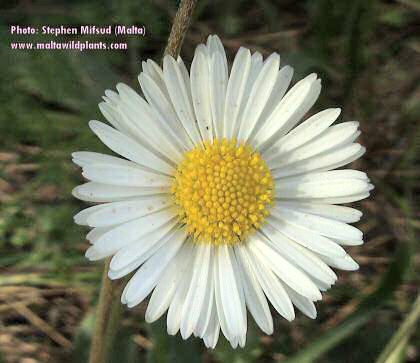
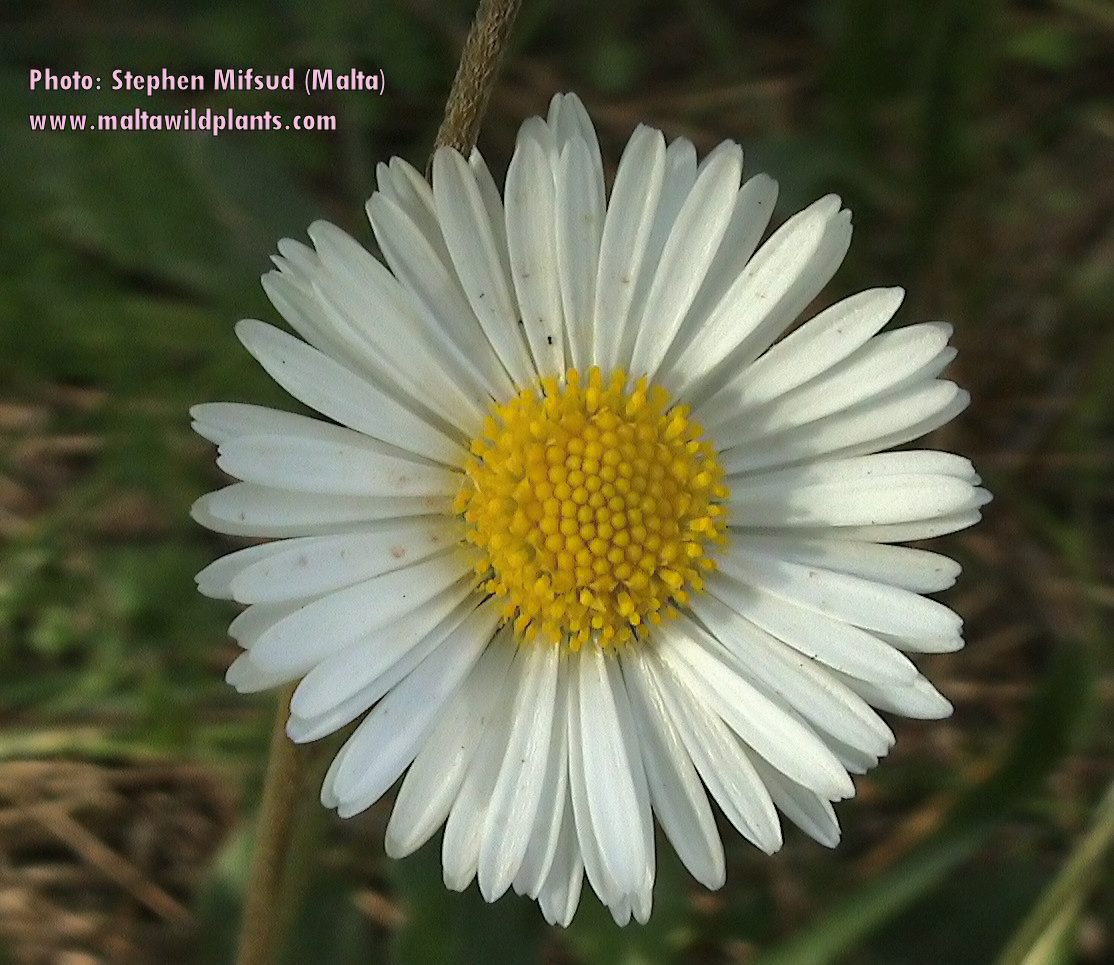
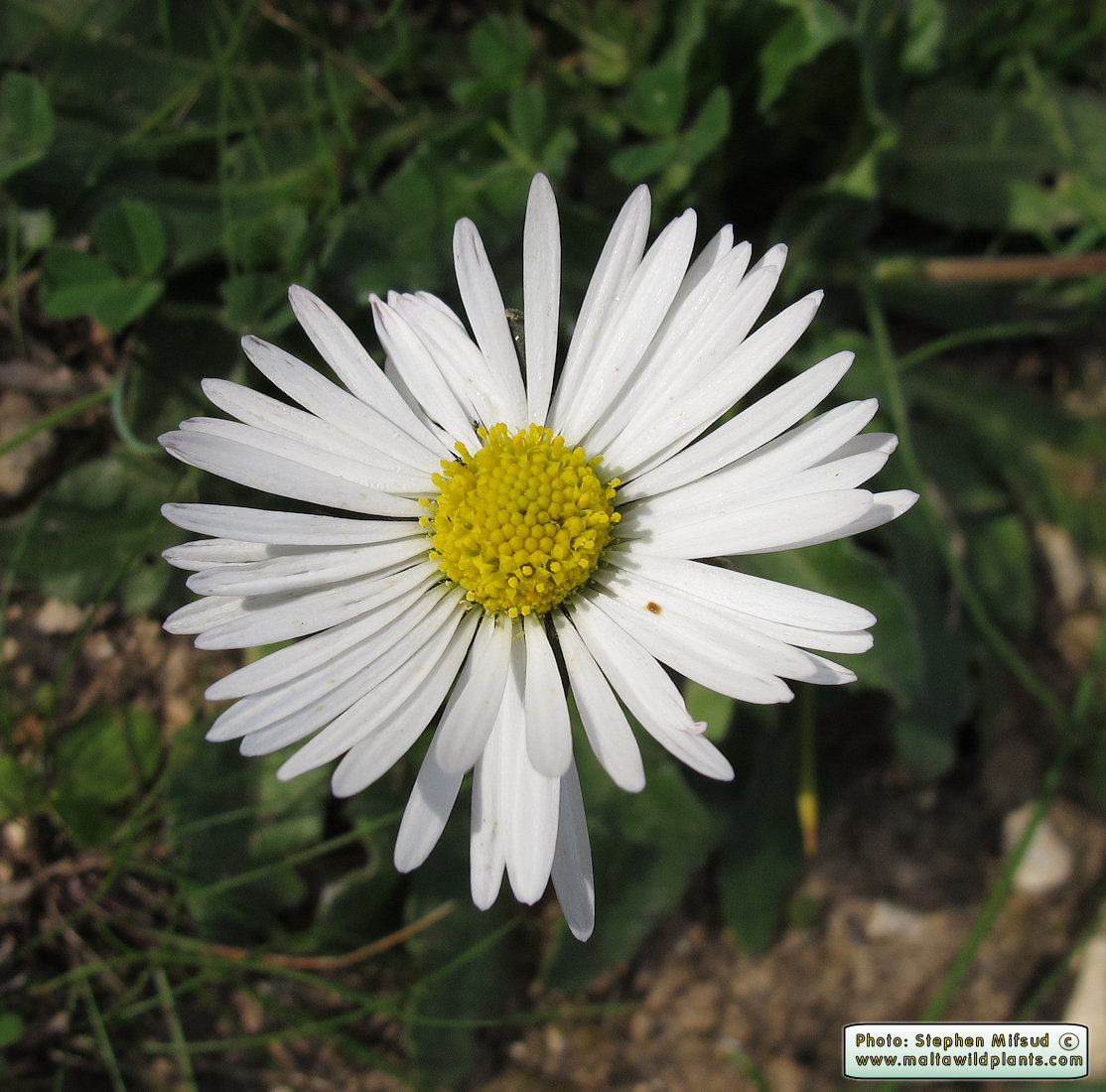
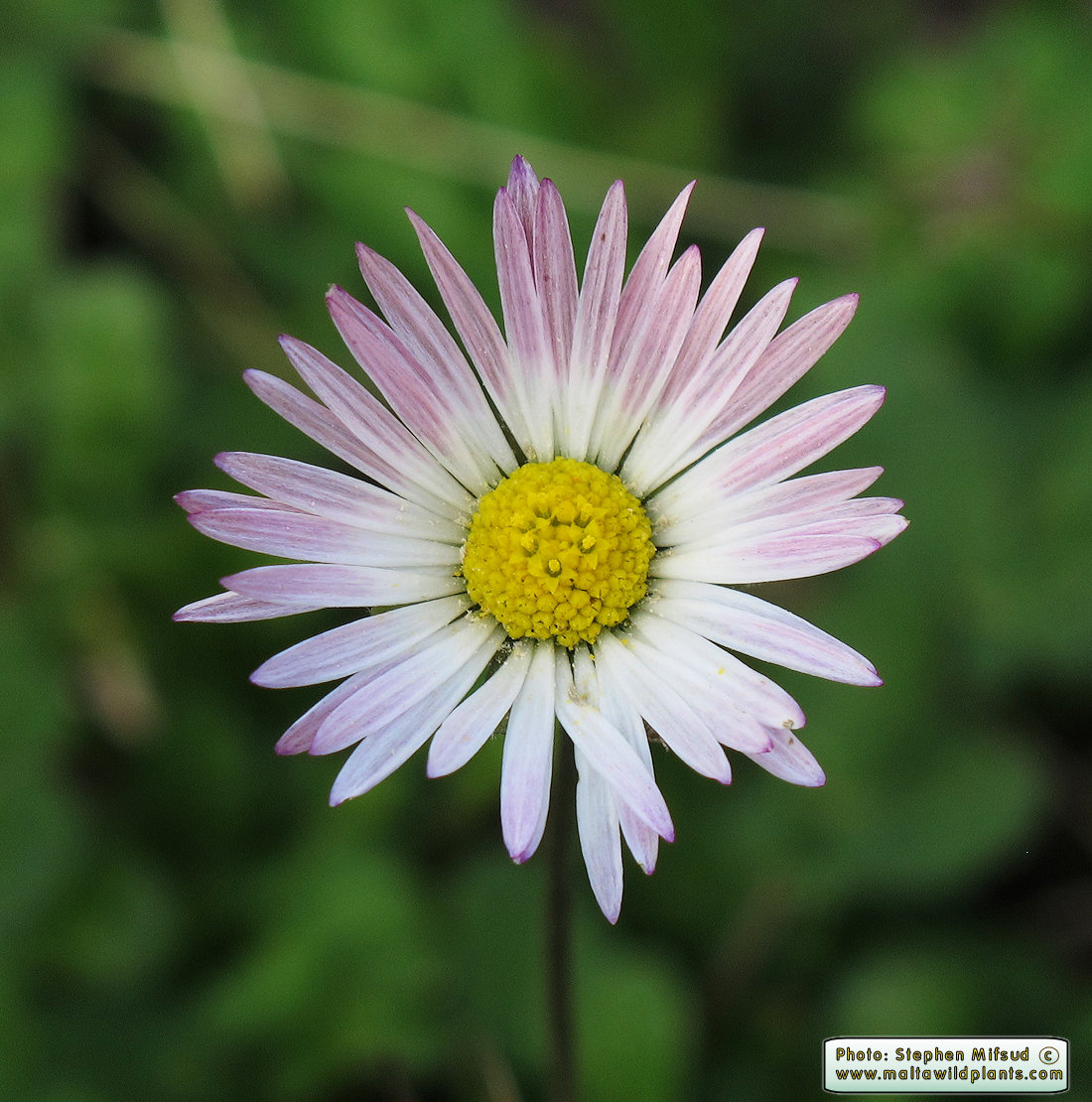
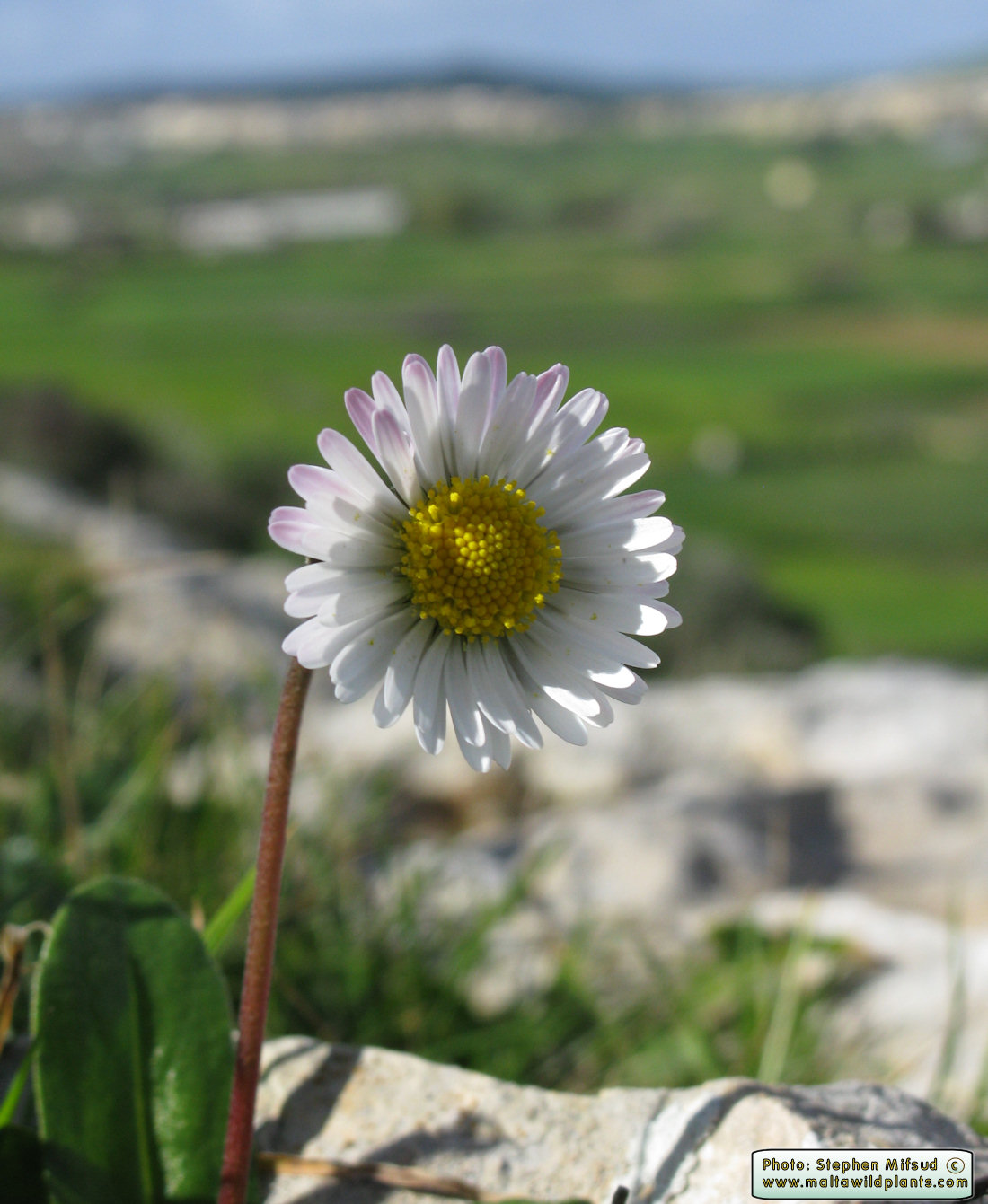
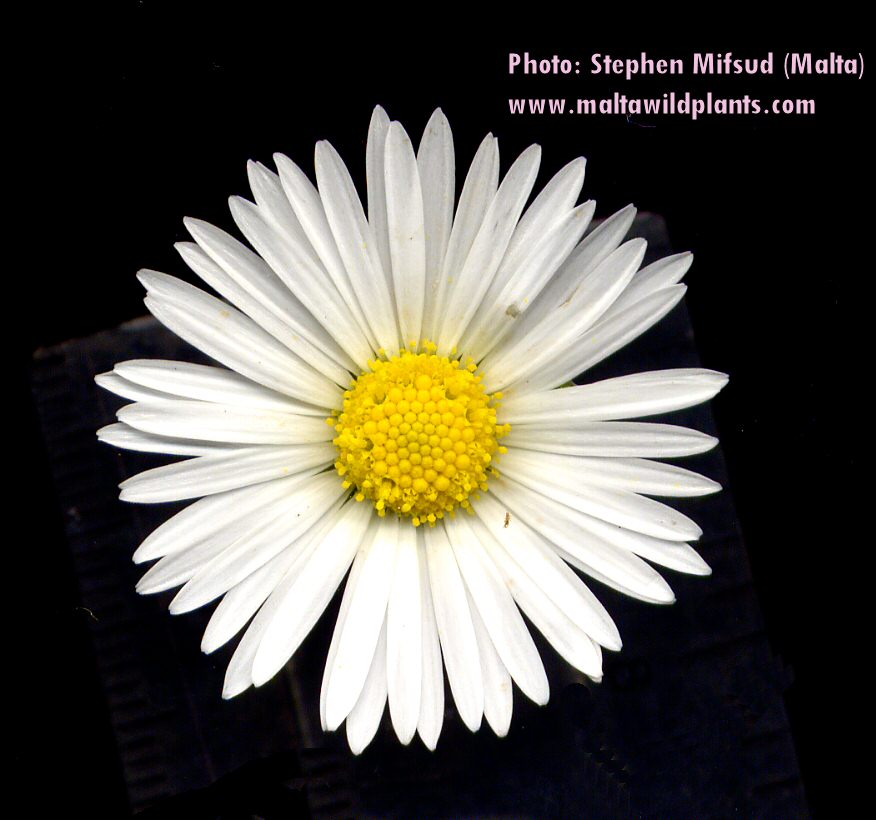
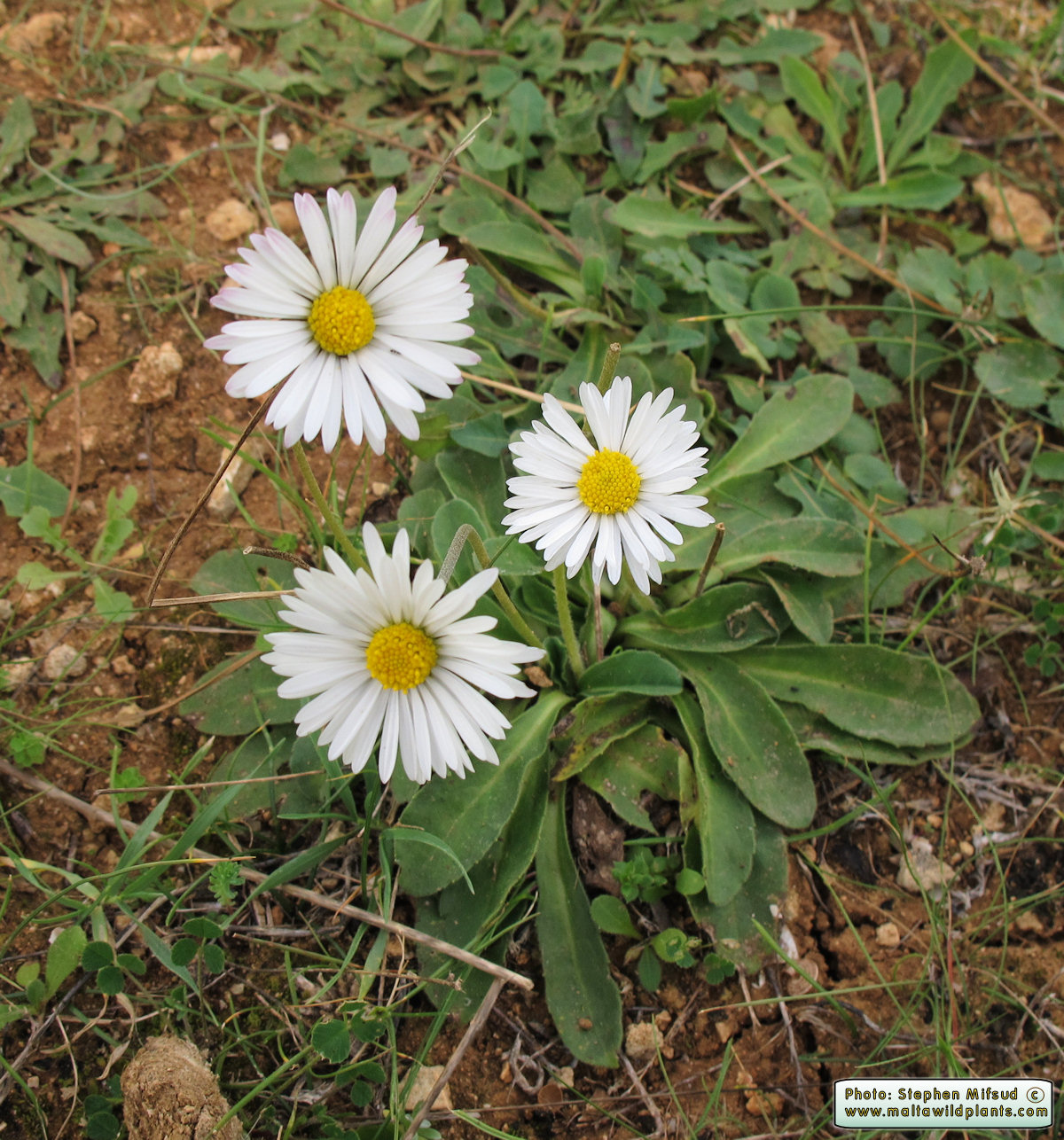
Photo of flower head. This flower do not have purple tipped petals but it is 'pure' white. Diameter of flower head is between 25 - 35mm.
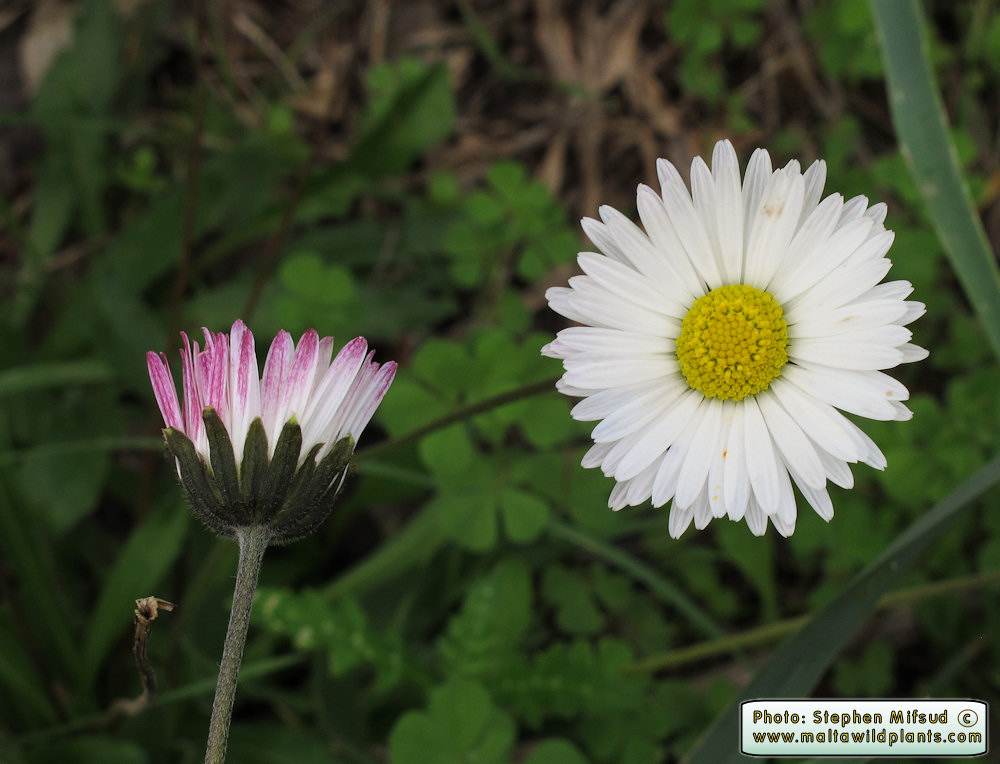
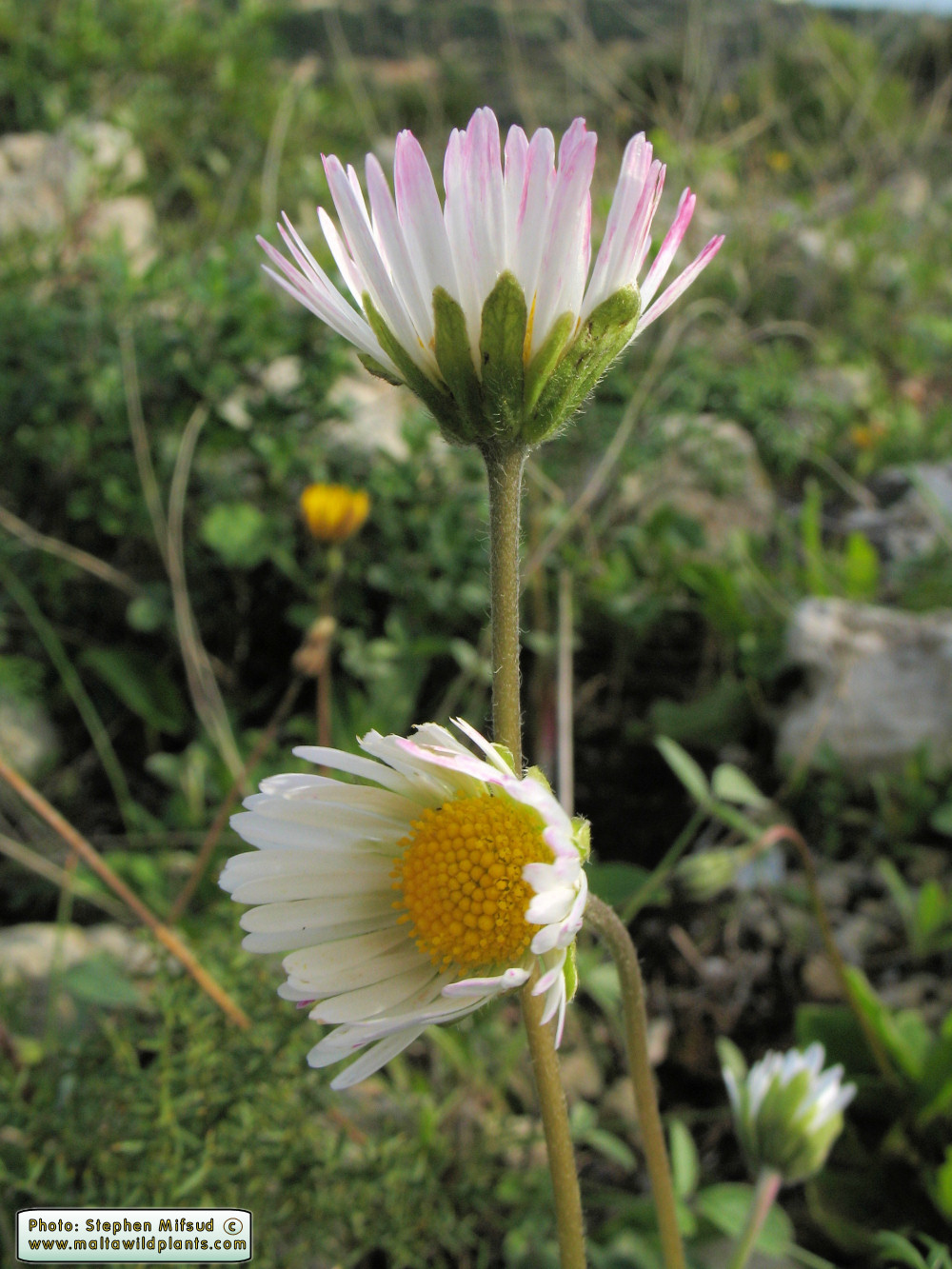
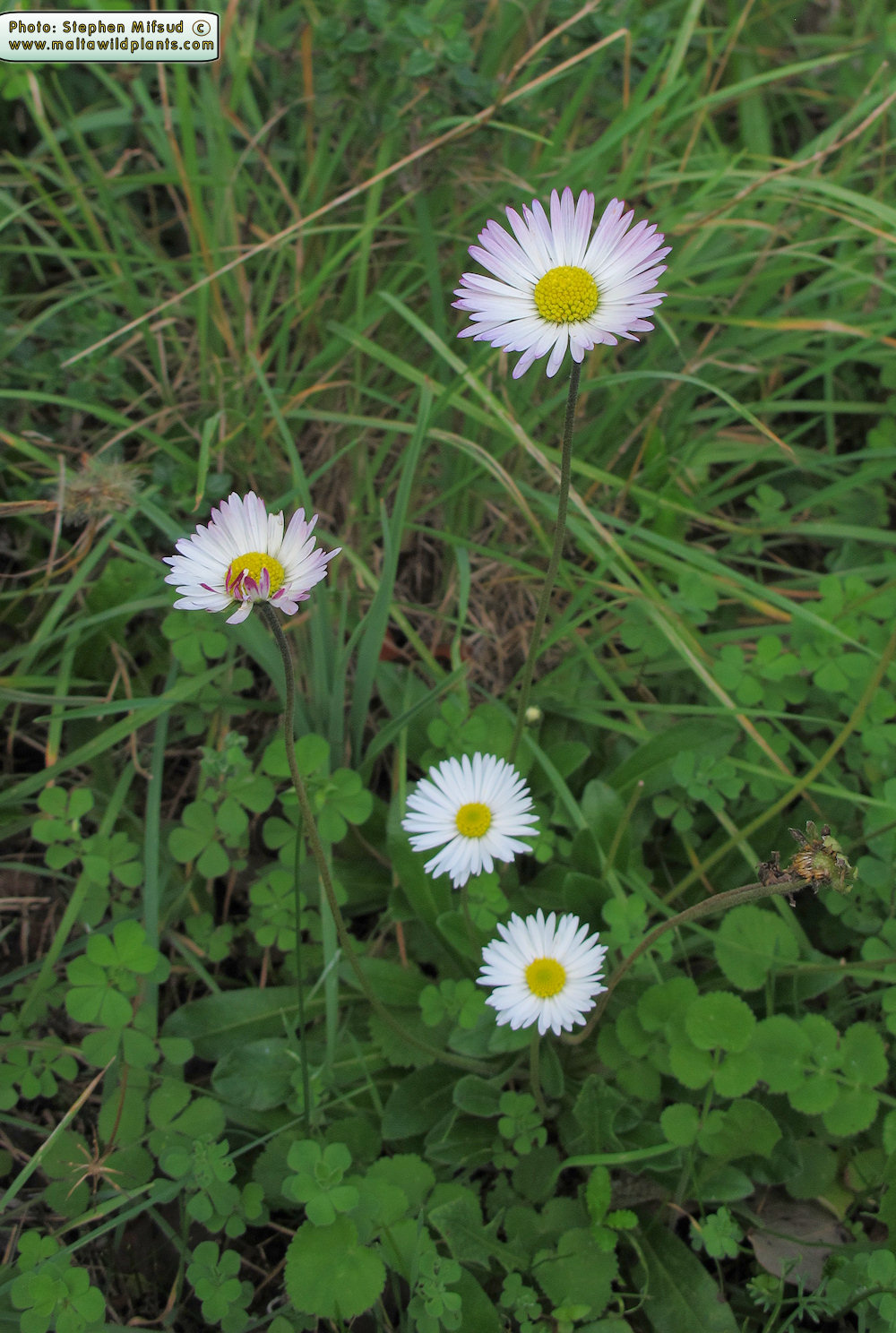
Photo of typical flower heads. Yellow center of disc florets and numerous radiating white petals, often with slight purple tinged tips.
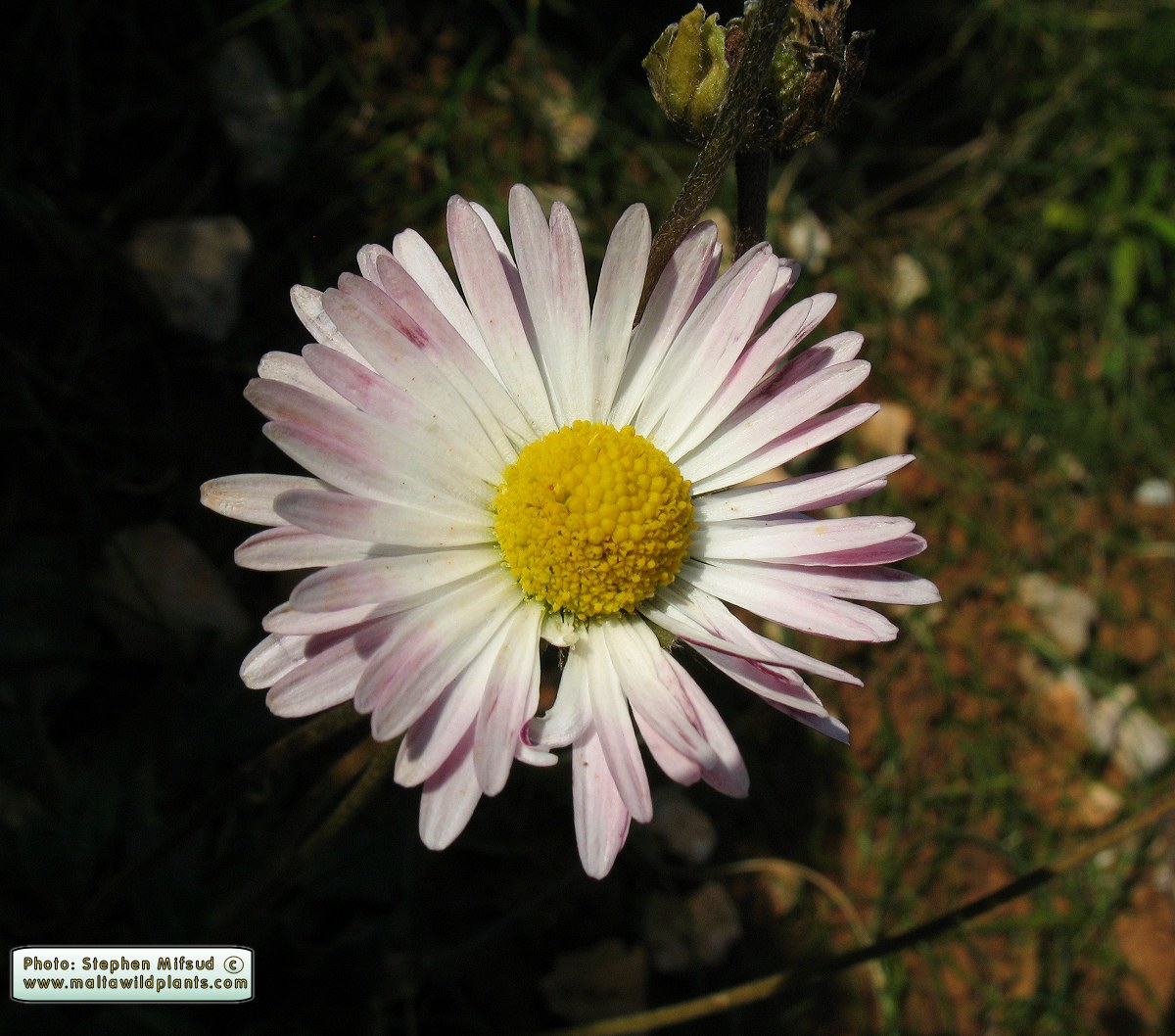
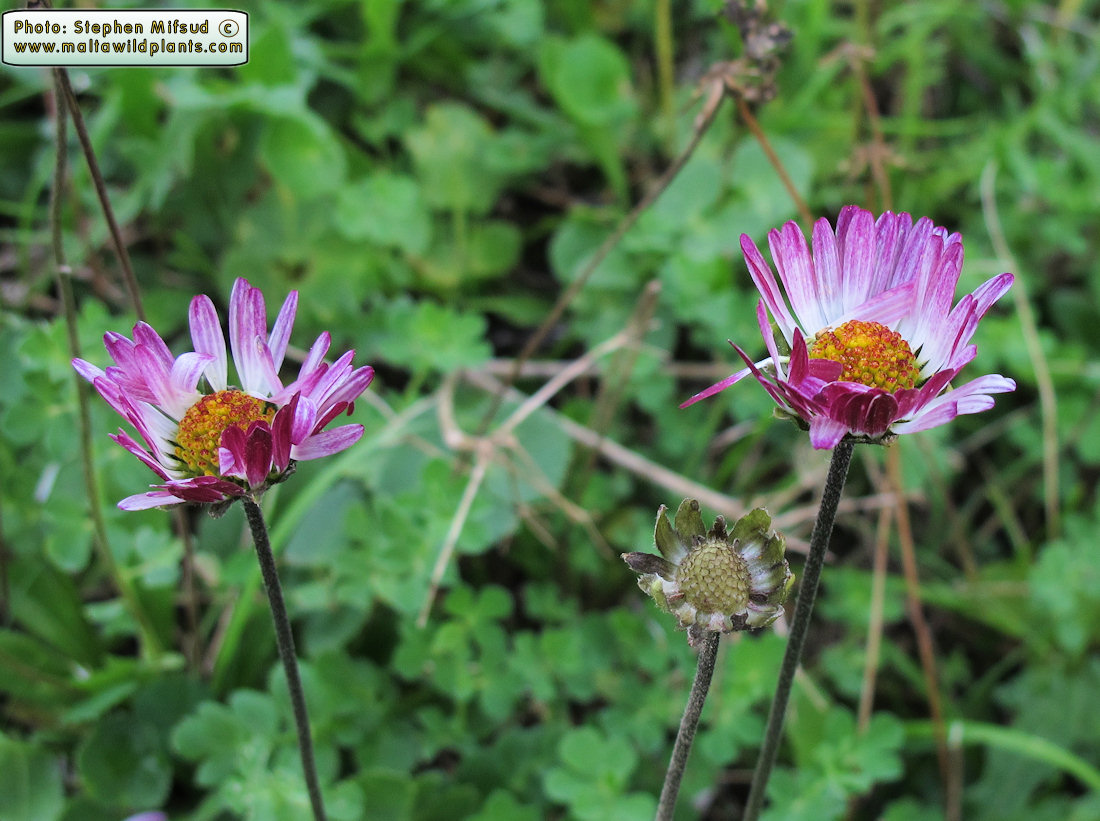
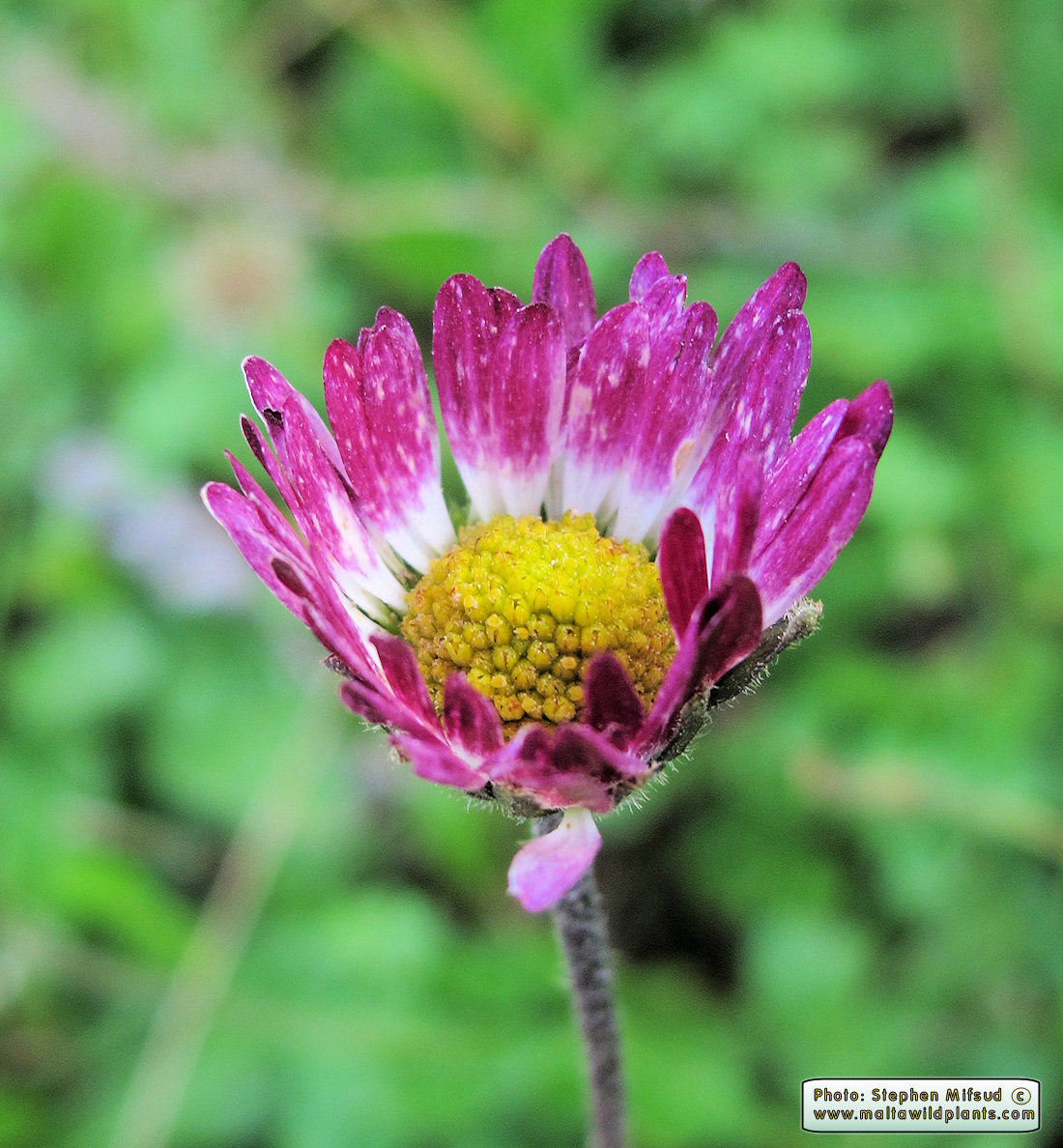
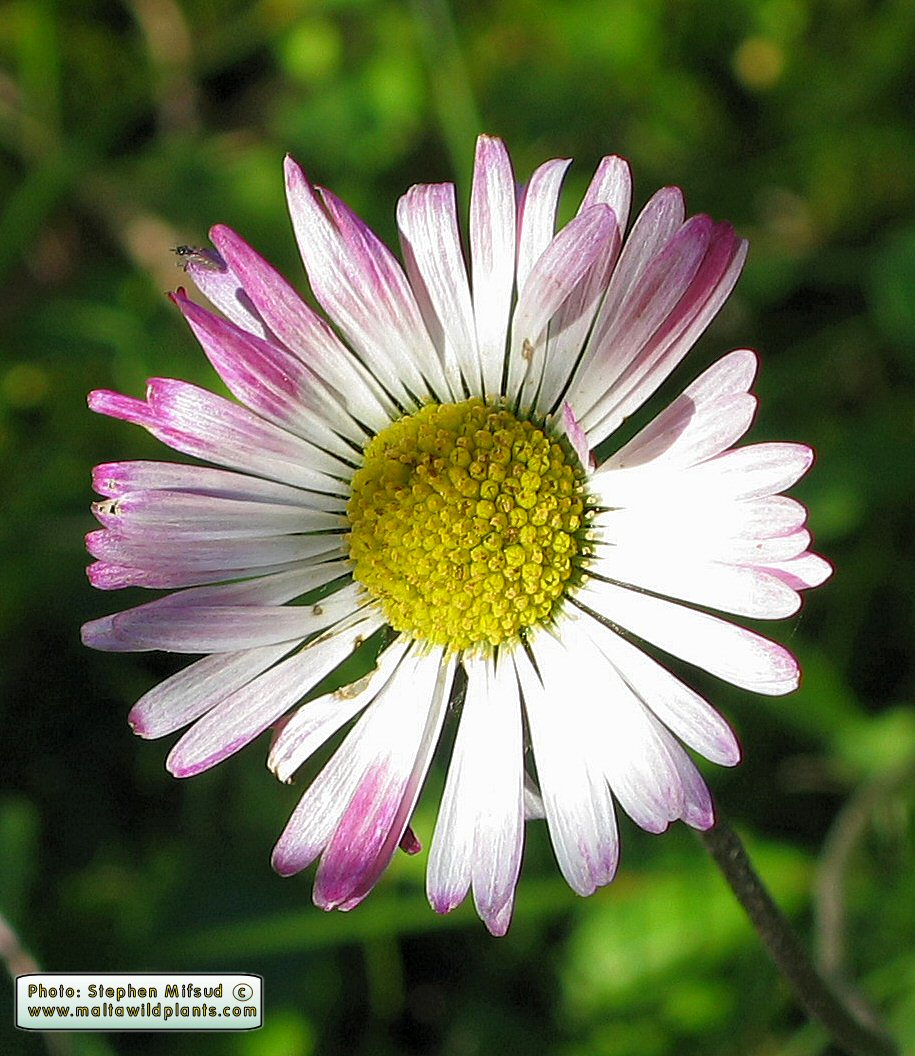
Photo of a flower head with characteristic purple tipped petals. The underside of the petal is usually contains a larger area of purple colour.
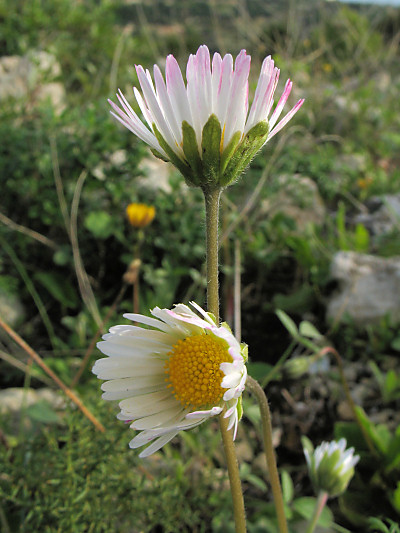
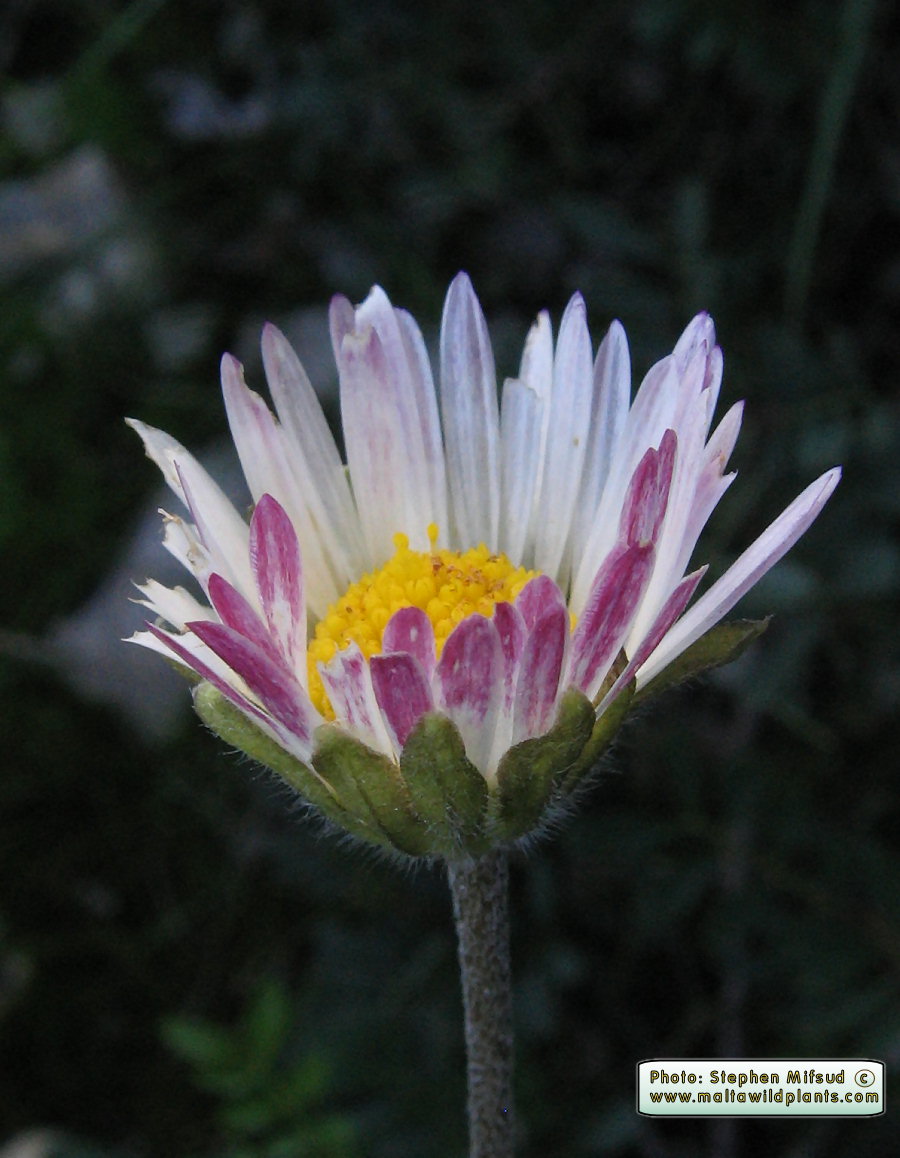
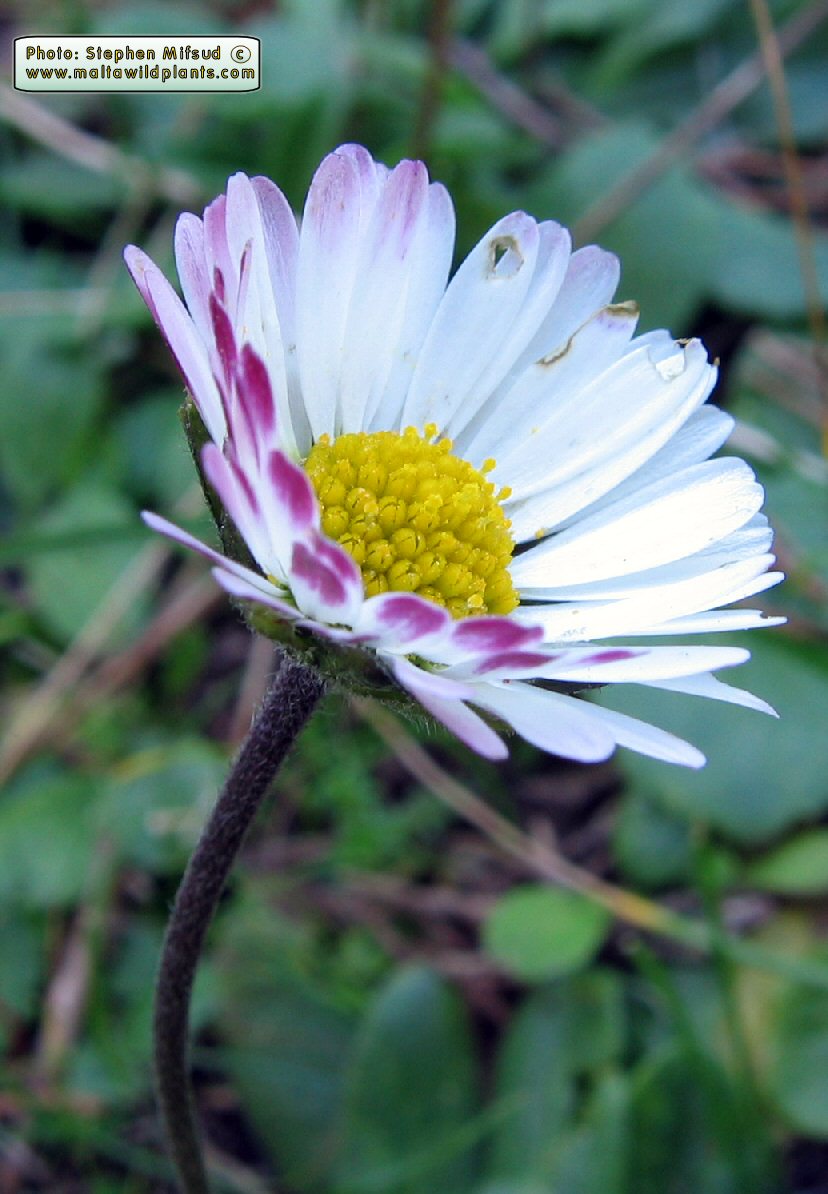
Photo of flower (side view) showing the purple petals being more colourful towards the tip.
Bellis sylvestris (Southern Daisy) - CLICK TO ENLARGE PHOTO Bellis sylvestris (Southern Daisy) - CLICK TO ENLARGE PHOTO Bellis sylvestris (Southern Daisy) - CLICK TO ENLARGE PHOTO Bellis sylvestris (Southern Daisy) - CLICK TO ENLARGE PHOTO
Photo of flower (side view) showing that the purple colour is more strong at the underside of the petals.
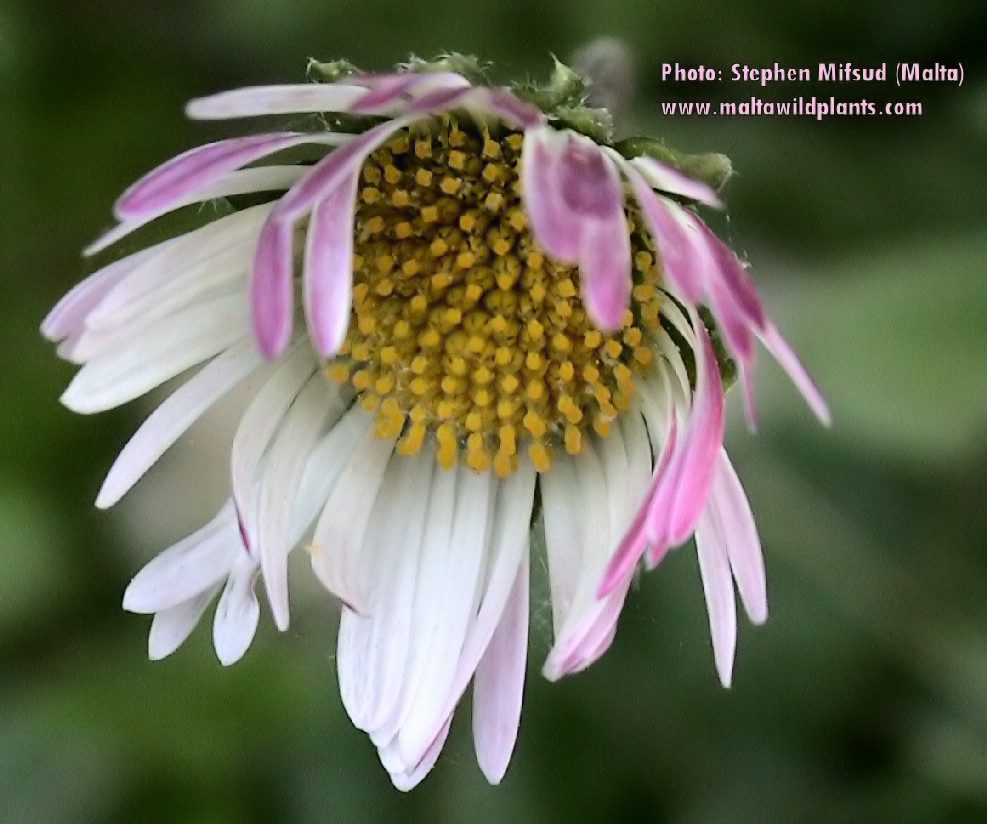
Close up photo of flower with prominent purple tipped petals. As it can be seen in this gallery there is considerable variation between the amount of purpleness between flowers.
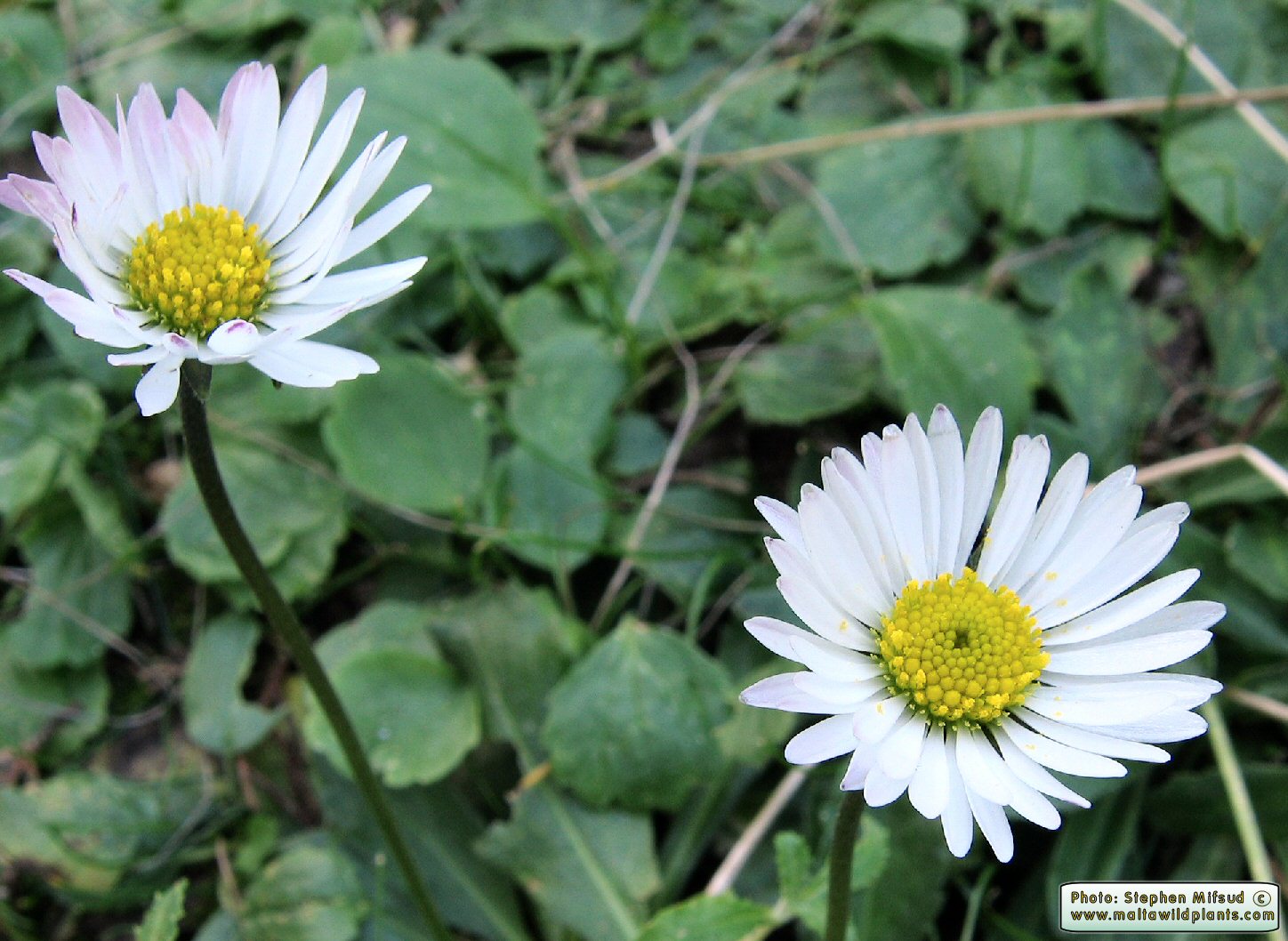
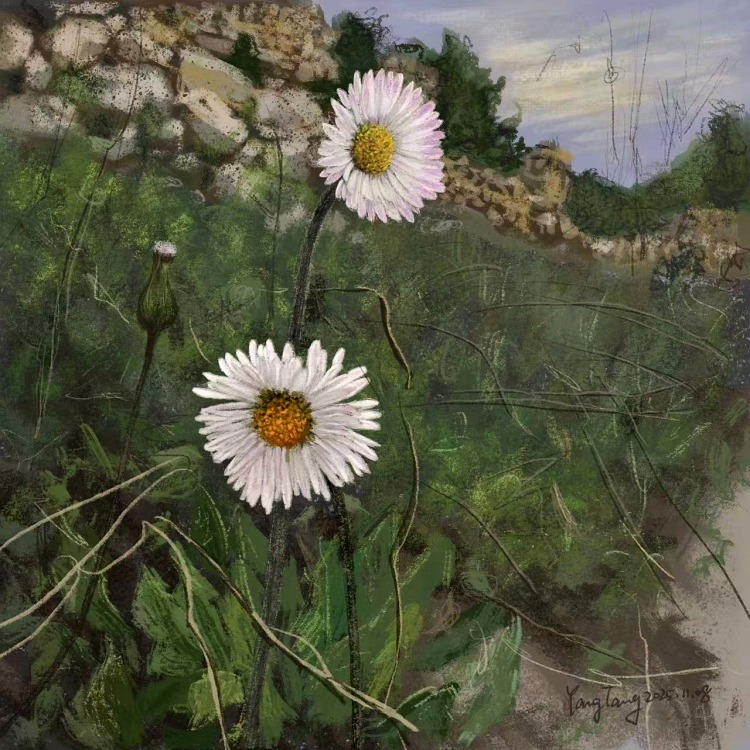
Photo of 2 flowers of Bellis sylvestris having a typical daisy-like structure and found in many locations around the Maltese islands during Autumn and Winter.
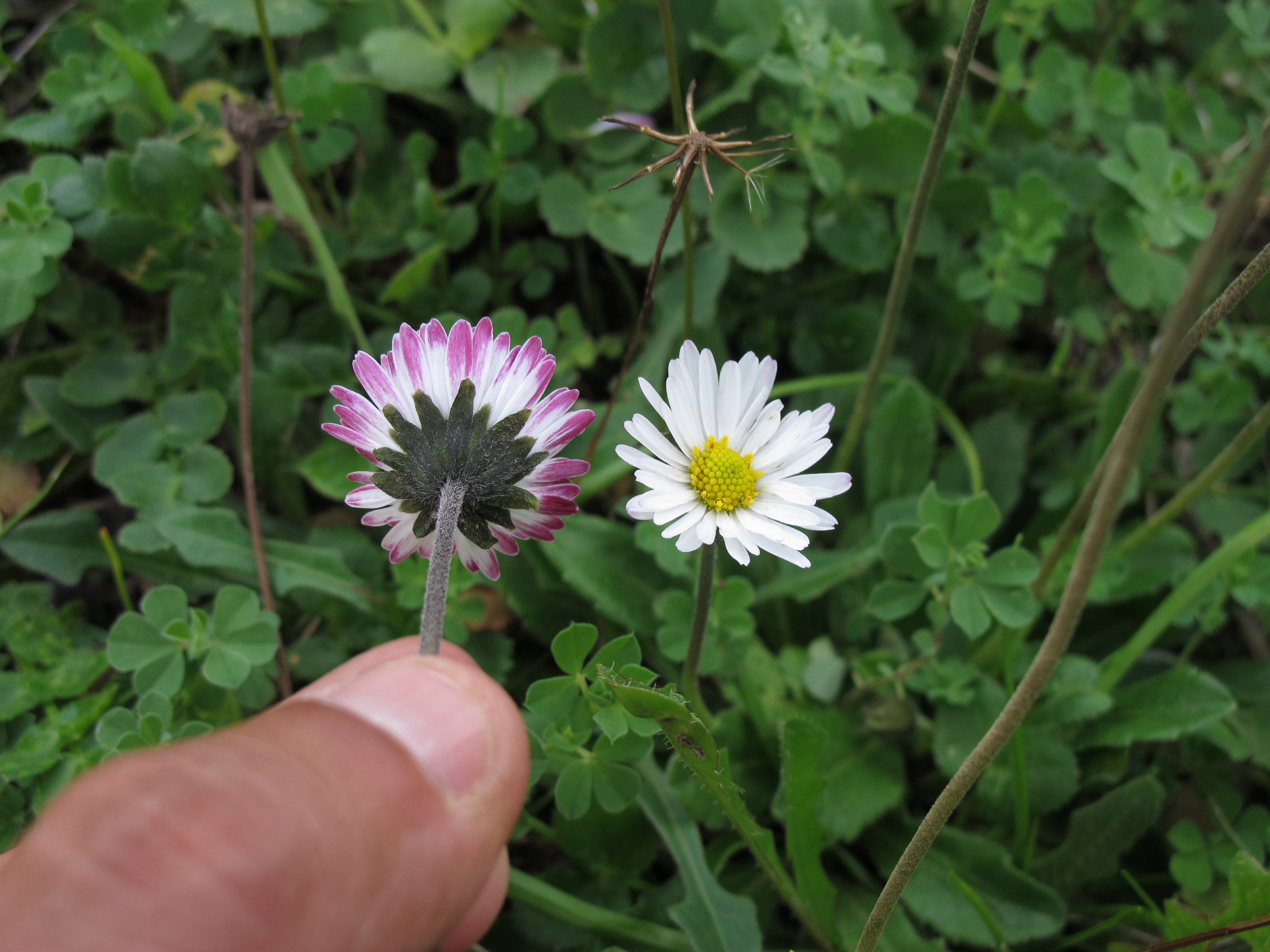
Photo of flower showing the colour of the petals. Lower face is purple-tinged while the upper is normally white (no purpleness).
Bellis sylvestris (Southern Daisy) - CLICK TO ENLARGE PHOTO Bellis sylvestris (Southern Daisy) - CLICK TO ENLARGE PHOTO Bellis sylvestris (Southern Daisy) - CLICK TO ENLARGE PHOTO Bellis sylvestris (Southern Daisy) - CLICK TO ENLARGE PHOTO
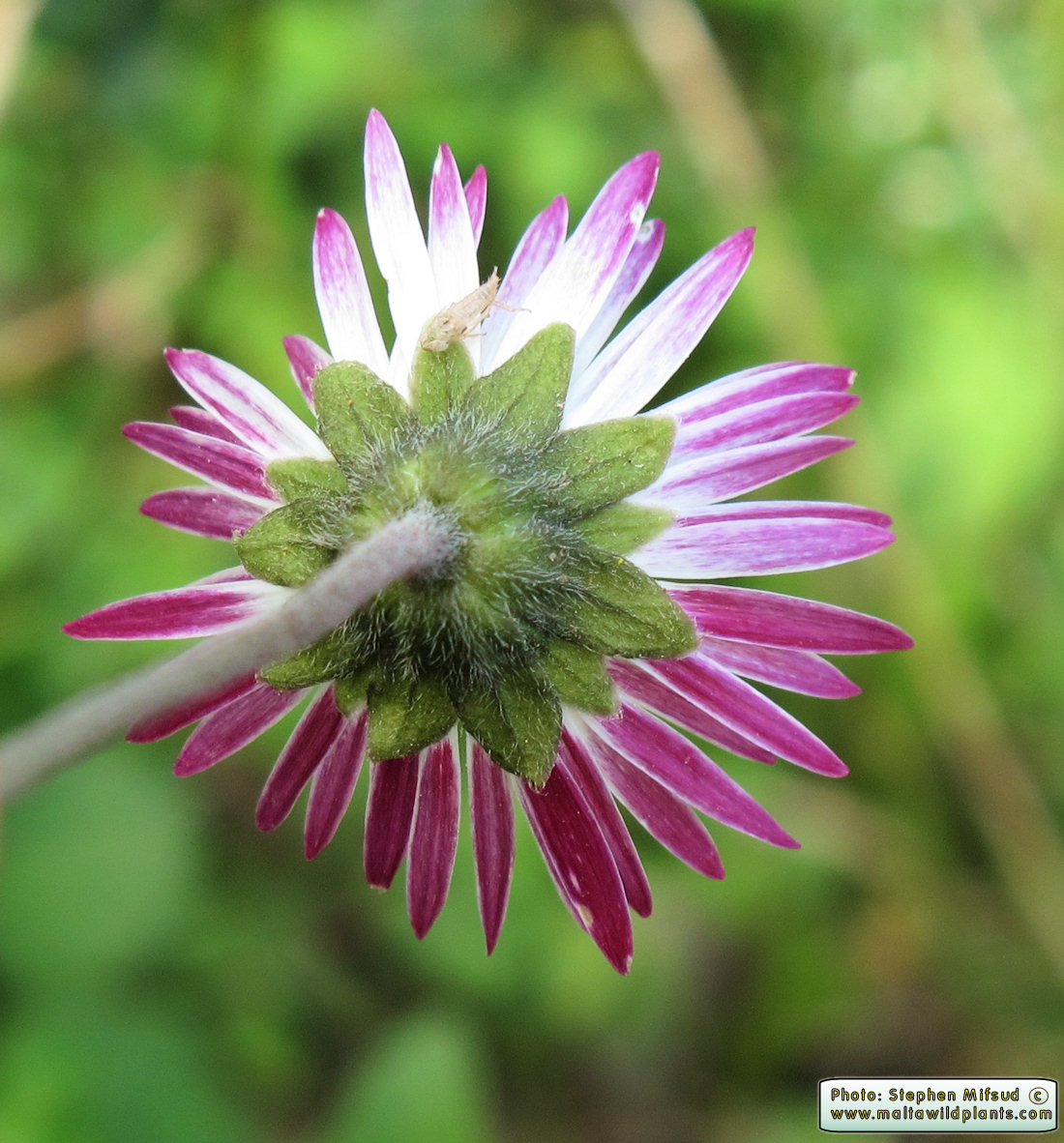
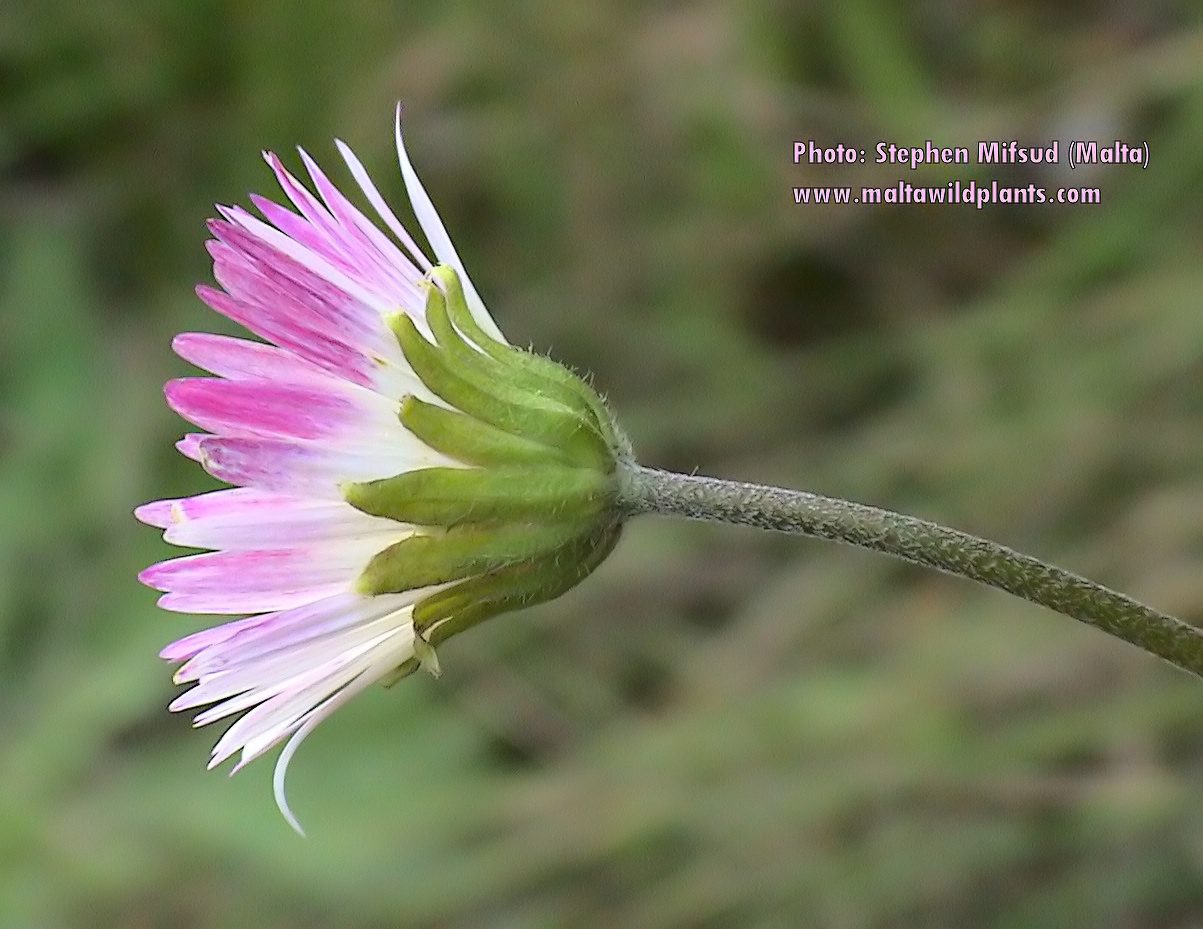
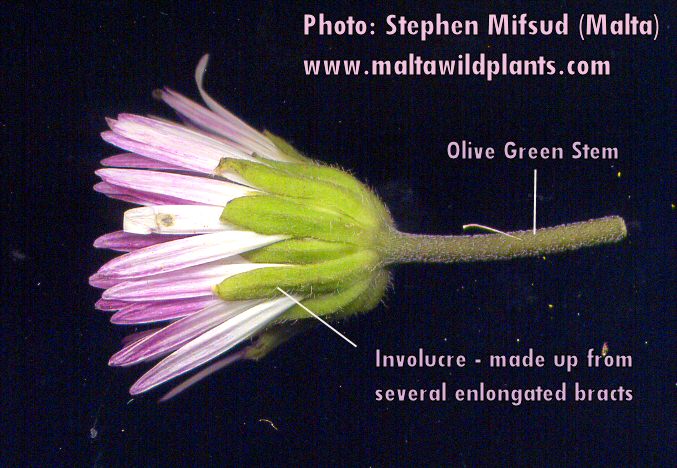
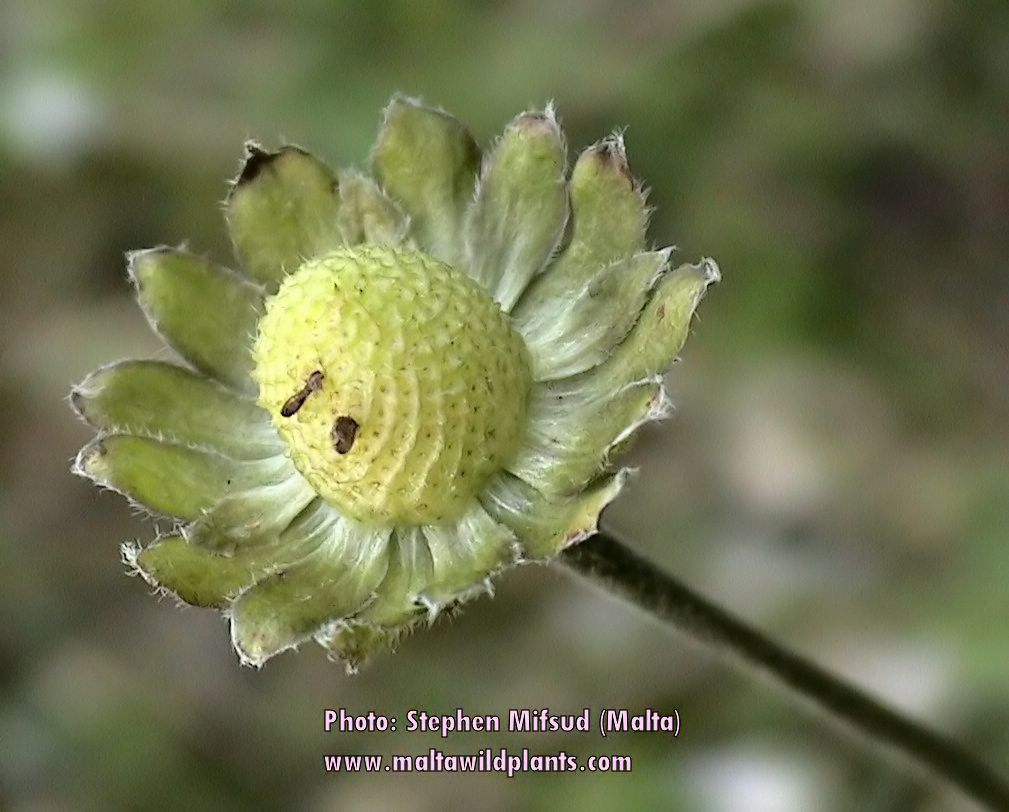
Photo of flower (underside view) showing the star-shaped involucre made up of several finger like phyllaries.
Young blossoming flower with very contrasting purple and white colours at the opposite faces of the petals.
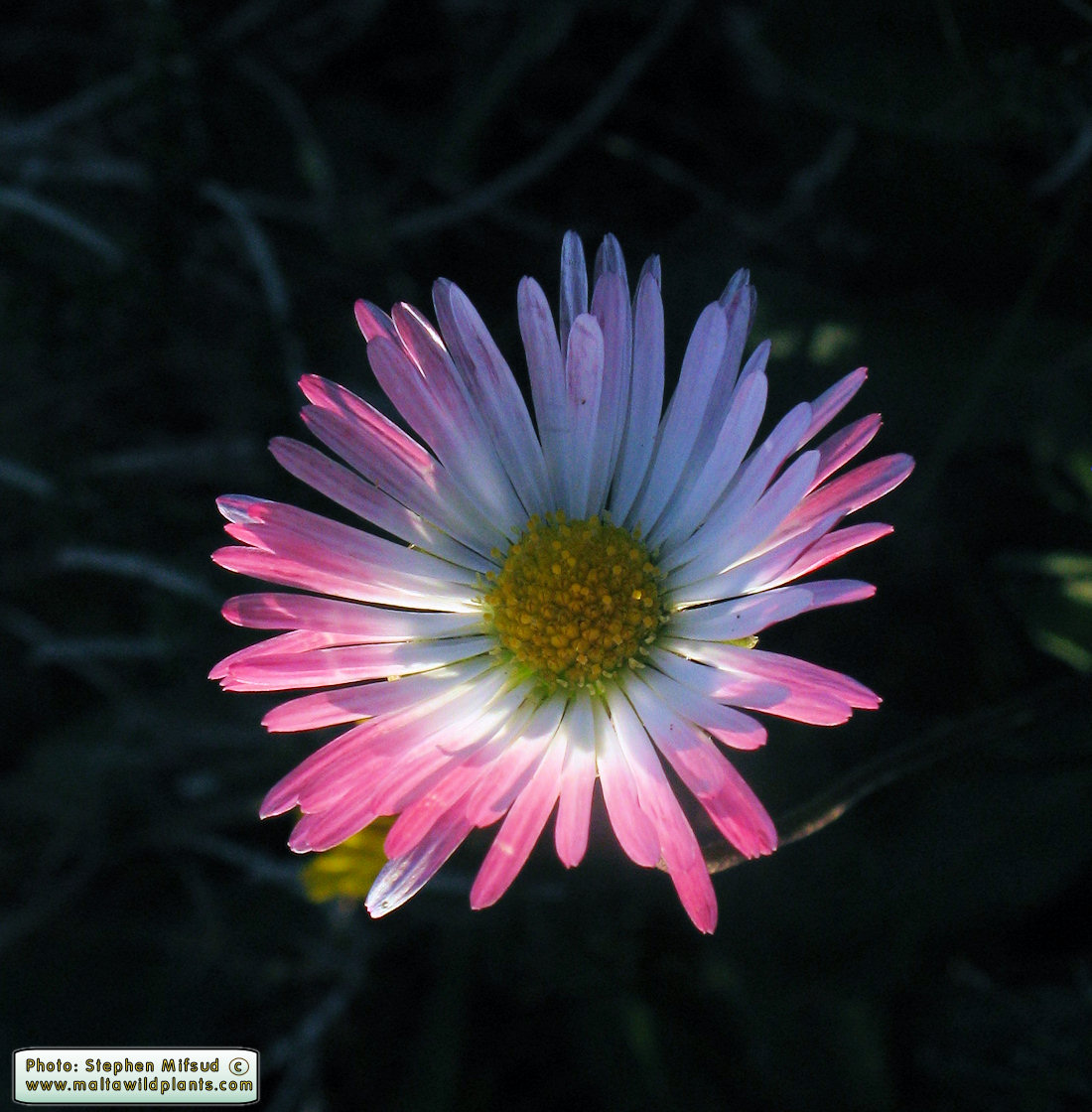
Scanned image of purple-tipped flower head against a dark background.
Scanned image of pure white flower head against a dark background. The white type seems to have more long and slender petals.
Bellis sylvestris (Southern Daisy) - CLICK TO ENLARGE PHOTO Bellis sylvestris (Southern Daisy) - CLICK TO ENLARGE PHOTO Bellis sylvestris (Southern Daisy) - CLICK TO ENLARGE PHOTO Bellis sylvestris (Southern Daisy) - CLICK TO ENLARGE PHOTO
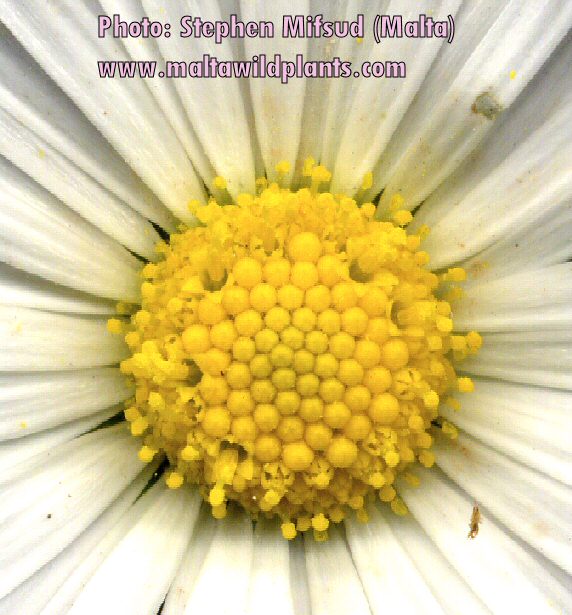
Close up photo of center of flower head (the capitula) showing the numerous yellow disc florets - a characteristic feature of the Compositaee family. The florets that open first are those at the periphery and the opening moves progressively towards the center.
Scanned side-view image of flower showing involucre, stem (both hairy) and petals.
Scanned image of the two types of petals. As it can be seen the petals also arise from disk-florets which like disc florets, they have fertilization function and produce seeds. These are modified disk-florets in the sense that they possess a ray (the petal) and are referred to as ray florets.
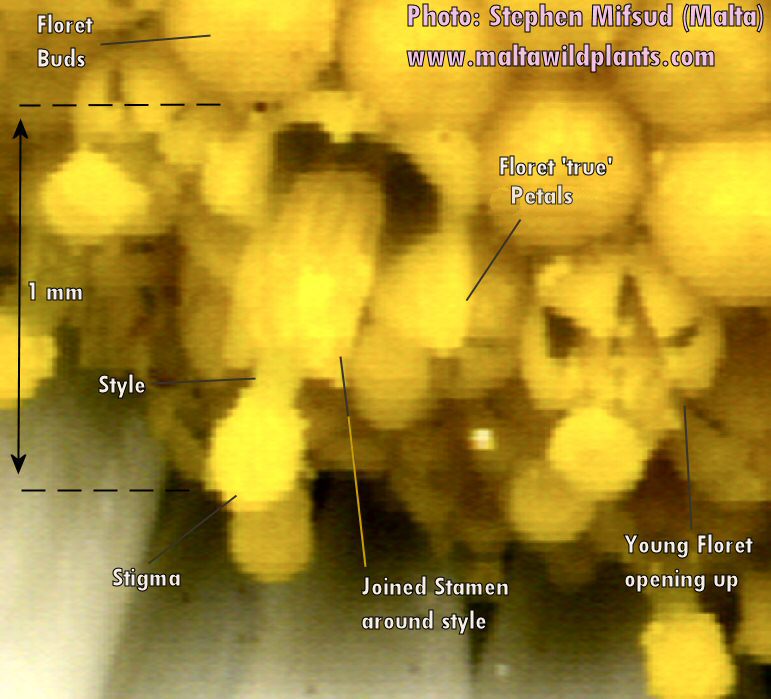
Highly magnified (x200) image of disc florets under light microscope. This is the true fertilising flower unit. Like flowers, disc florets possess stigma, style, stamens, sepals, and ovaries. They are initially buds and open up when they are mature.
Bellis sylvestris (Southern Daisy) - CLICK TO ENLARGE PHOTO Bellis sylvestris (Southern Daisy) - CLICK TO ENLARGE PHOTO Bellis sylvestris (Southern Daisy) - CLICK TO ENLARGE PHOTO Bellis sylvestris (Southern Daisy) - CLICK TO ENLARGE PHOTO
Close up of receptacle showing old disc florets and green ovaries which develops into seeds.
Dissected flower head showing the swollen receptacle, on which the ovaries are lied on with their old disc florets at the top.
Photo of receptacle in situ with seeds already dropped off. The receptacle of the Southern Daisy is of the swollen type.
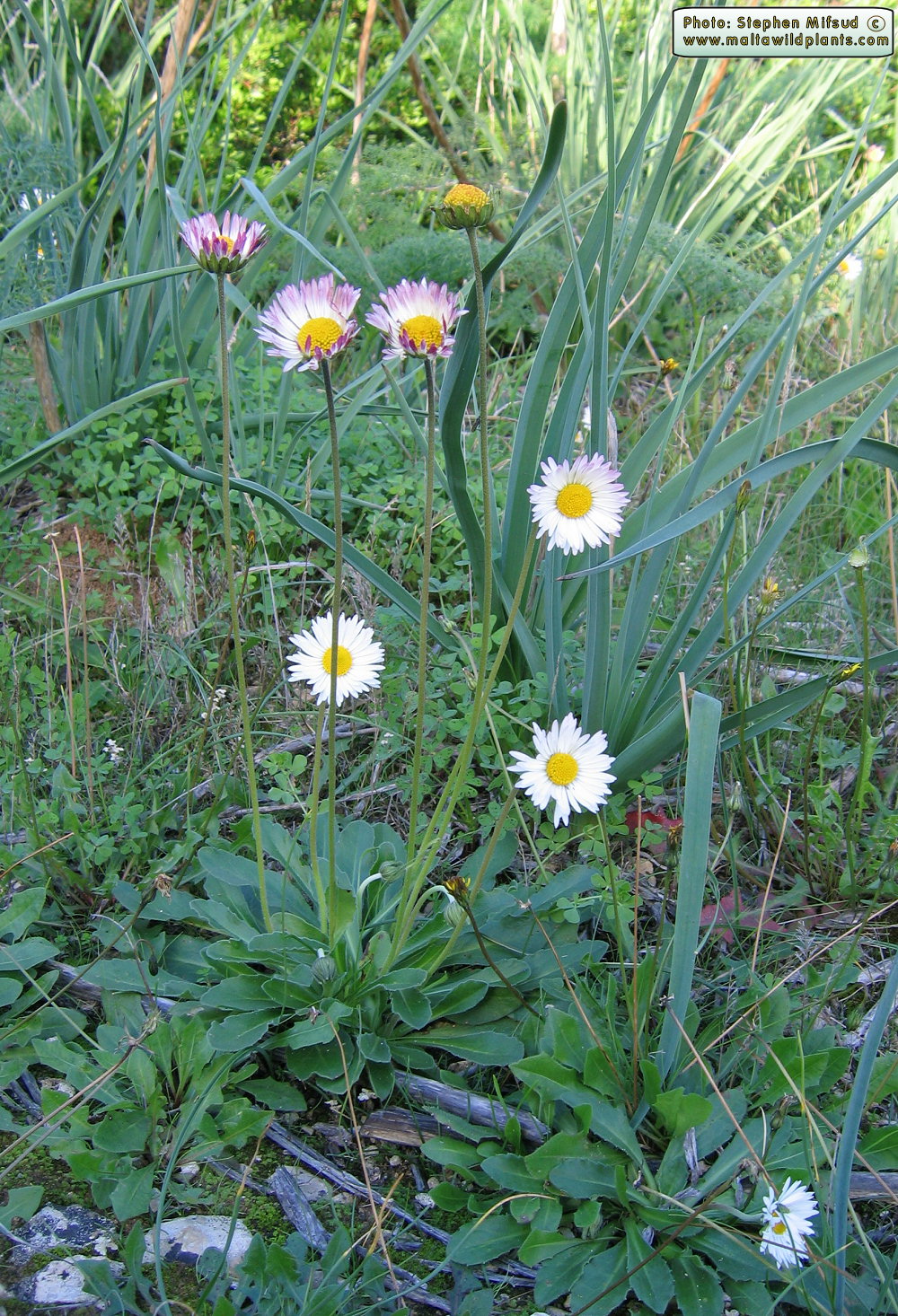
General picture of the plant in situ. Low rosette of leaves with erect stems bearing a single flower head.
Bellis sylvestris (Southern Daisy) - CLICK TO ENLARGE PHOTO Bellis sylvestris (Southern Daisy) - CLICK TO ENLARGE PHOTO Bellis sylvestris (Southern Daisy) - CLICK TO ENLARGE PHOTO Bellis sylvestris (Southern Daisy) - CLICK TO ENLARGE PHOTO
Scanned image of various leaves. They are generally spoon shaped (spatulate) and most of the times, have a serrated outline. They are often hairy.
Scanned and magnified image of typical leaves.
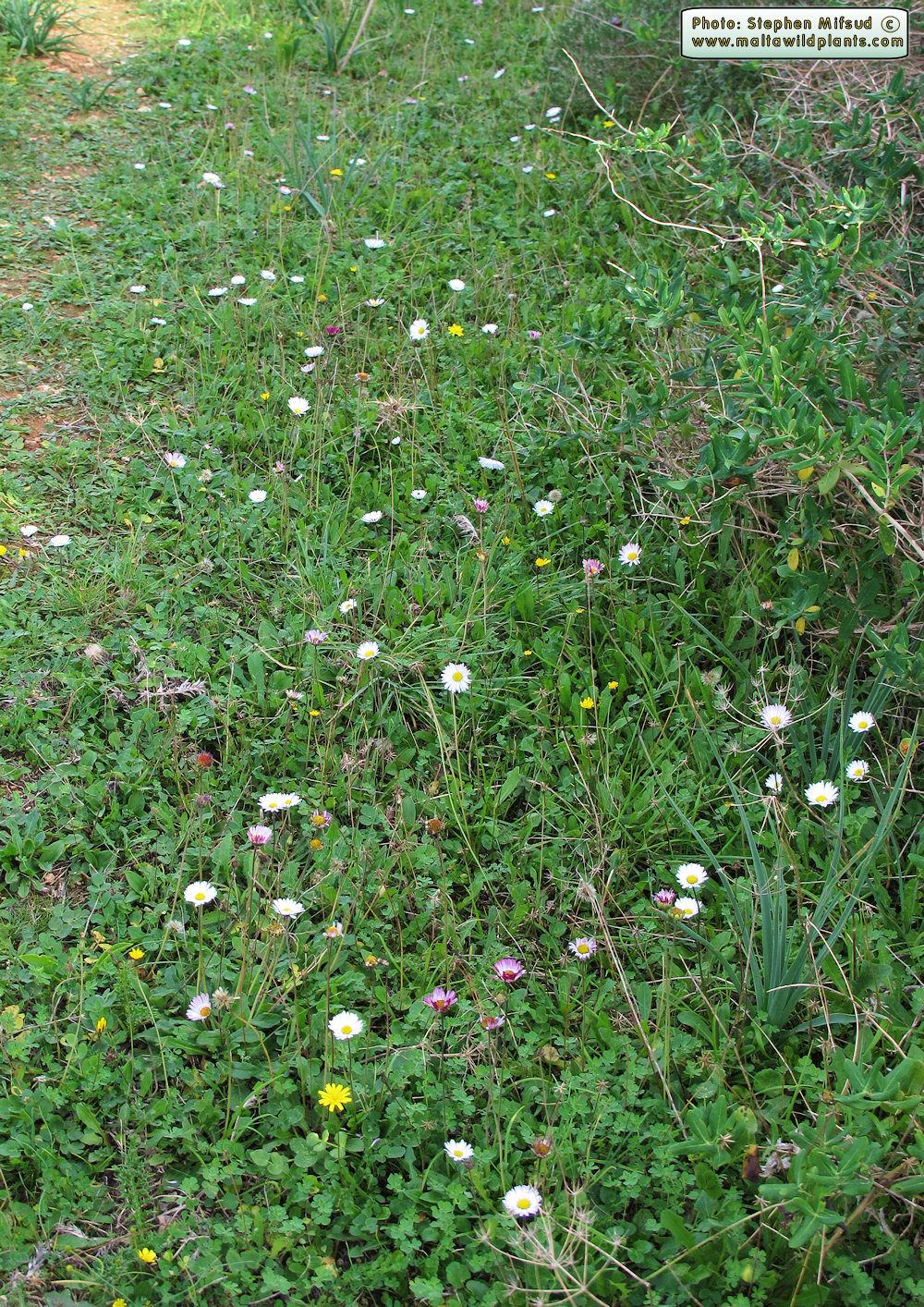
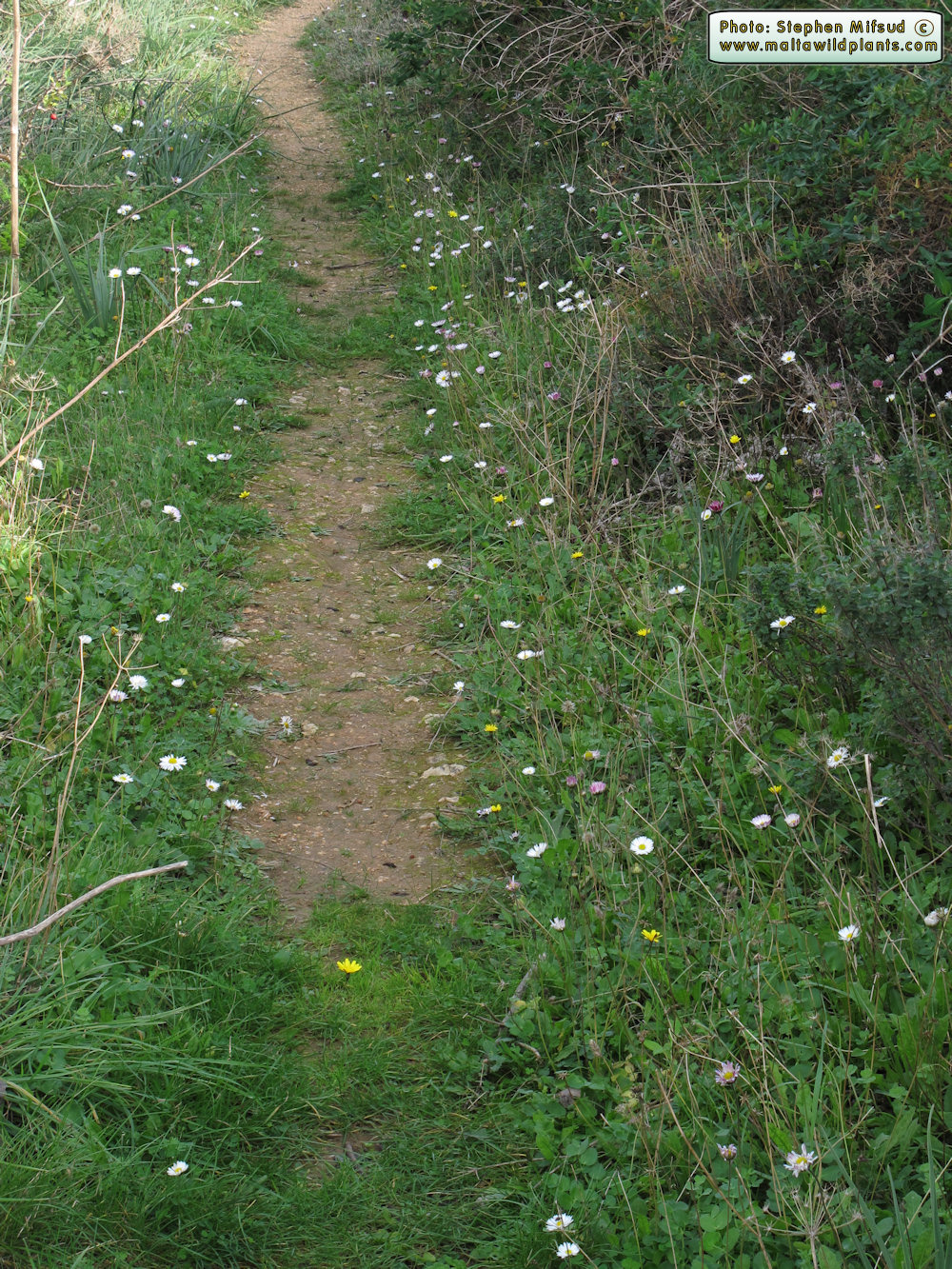
Normal habitat of the plant. These daisies were found on little soil patches over or in rock pits / gaps. They like damp places and shade.
Another photo of the normal habitat of the plant, near Buskett, Malta.
Bellis sylvestris (Southern Daisy) - CLICK TO ENLARGE PHOTO Bellis sylvestris (Southern Daisy) - CLICK TO ENLARGE PHOTO Bellis sylvestris (Southern Daisy) - CLICK TO ENLARGE PHOTO Bellis sylvestris (Southern Daisy) - CLICK TO ENLARGE PHOTO
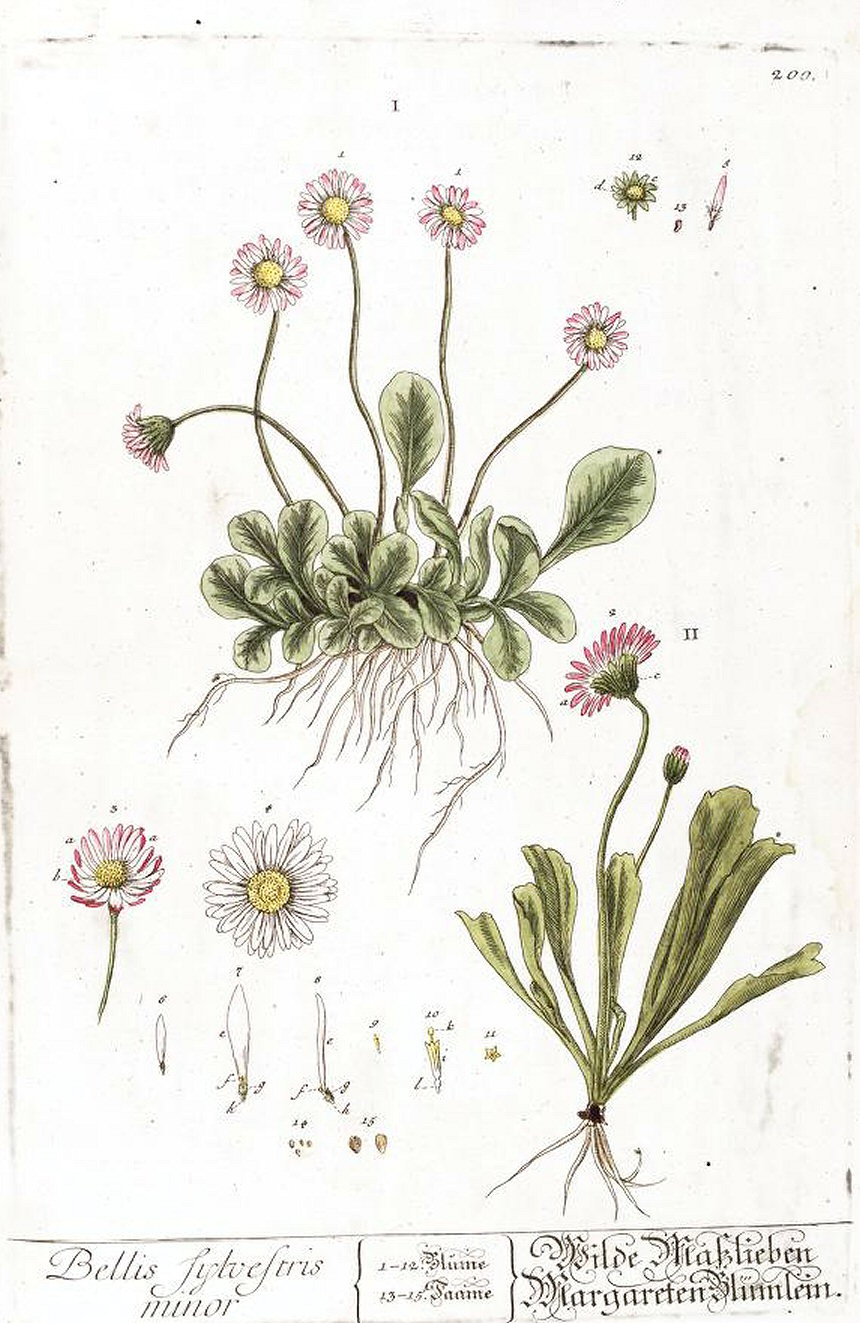
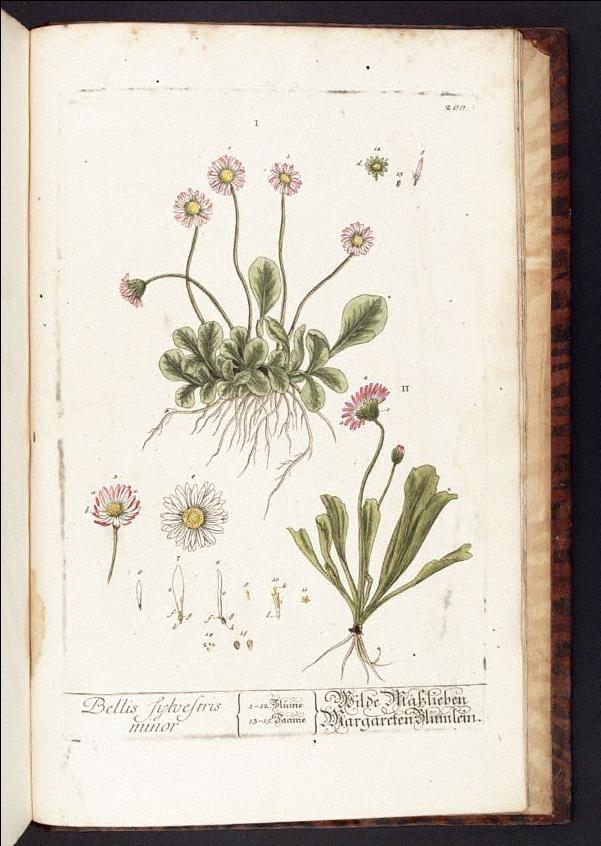
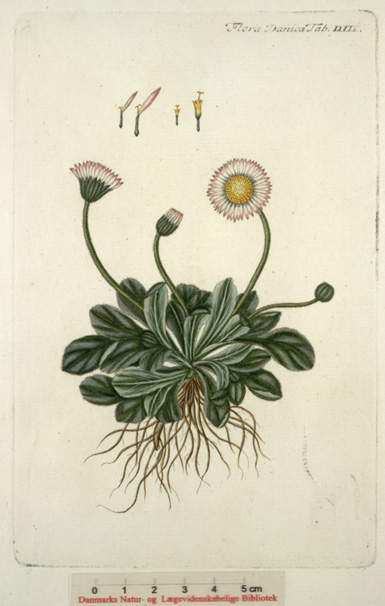
Illustration of the plant taken from © 1995-2005 Missouri Botanical Garden.
Photo of plant which briefly consists of a basal rosette of leaves, long, erect flower stalks and a conspicuous dasiy-like flowers.
Scanned image of seeds. They do not have a pappus so they are not dispersed by wind. Note the few whitish hair they have.
Magnified scanned image of seeds. They are teeth shaped and are brown in colour.
Bellis sylvestris (Southern Daisy) - CLICK TO ENLARGE PHOTO      
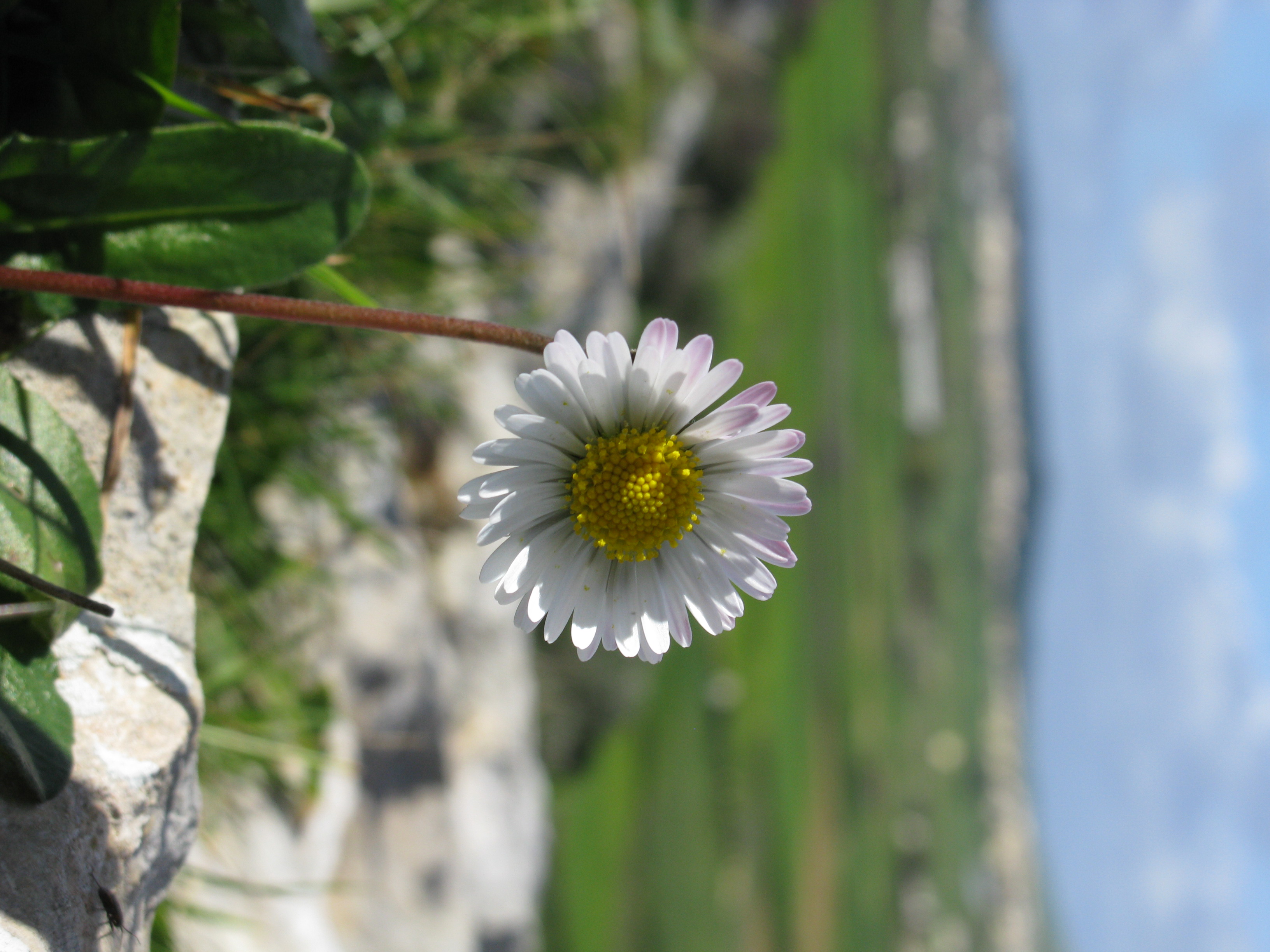
Photo of the attractive flower.
-
-
-

Further Information and Links

Medicinal properties and symptoms of the common daisy by John Henry Clarke M.D. -
Search for Bellis sylvestris on the FORUM of MaltaWildPlants.com


Buy from and support MaltaWildPlants.com

Buy Seeds from Maltawildplants.com Buy samples of seeds of certain wild plants for your studies, trials, research, etc. Not all species' seeds can be exported (depending on Maltese regulations), and availability depends on season of species. So, before any payment, you are kindly asked to fill in the online quotation/order form by which I can contact you back for availability and charges. Buy Seeds from Maltawildplants.com   Online Quotation

Buy Seeds from Maltawildplants.com   Online Payment
Buy Documents from Maltawildplants.com Buy documents related to Maltese Wild Plants such as the list of references, full profile, or other docs you request. Buy Documents from Maltawildplants.com   Online Payment
Buy Images  from Maltawildplants.com Buy any of my own copyright images found in this large collection of Maltese flora. You should first select the image you want to buy and input its corresponding code (found beneath each individual photo) in the online ordering form. Buy Seeds from Maltawildplants.com   Online Payment
Buy Seeds from Maltawildplants.com Kindly donate any sum of money (from 2USD / 2Euro) to help us covering some expenses needed to maintain Maltawildplants.com. Please bear in mind how much hard work such a large and up-to-date website needs to arrive directly to you home, office or library. Your kind donations are both greatly appreciated and recorded for future reference. Donors asking help will have first que preference for assistance and special attention. Buy Seeds from Maltawildplants.com   Online Donation


Submit More Information

Use the form below to submit more information about this plant or a related species. If the data is taken from a book, journal, website, etc, please provide the corresponding reference / website address as indicated in the form. If it is your own observation, then your name will be cited. Your Email address will never be displayed online, it is just for internal communication.


For plant species that are marked as rare, you can also report other locations in Malta where you have seen this species.

Finally you can report any mistakes or errors found on the plant profile for necessary corrections. This will help to improve the website's acuracy.


To have more details about each particular field, just move your mouse on it and wait for the help message to pop up

* = required fields.
Plant Species:  *
Your name:   *
Your Email:   *
Fill any of the following 3 sections below (A, B or/and C) and send the form. - Thank you.
 
A:  Additional Information about this plant species
Own observations:
Info from published material (books, jounals, website):

Reference of published material:

 
B:   Where have you seen this plant on the Maltese Islands?
Locations in Malta or Gozo where you have encountered this plant.
Mostly applies for rare plants.


1:        2:   
3:       4:   
5:       6:   

Try to be as concise as possible. Examples: Dingli Cliffs (near chapel), Wied Incita (Zebbug side), Triq il-Kbira (Qormi), Barriera ta\' Abdul (Xlendi), Fields near Salib tal-gholja (Siggiewi). GPS bearings are also welcomed!
 
C:  Corrections for mistakes and errors in this plant profile.
Section of this plant Profile page where you found an error (select one)

What is the error/mistake
What should be its correction


All material and data on this webpage is under the copyright of the author of this site - Stephen Mifsud / www.MaltaWildPlants.com / Malta. (2002-2008)
This research project about the flora of Malta is sponsored by:
Middlesea Insurance p.l.c. A Fund established to help in the amelioration and enhancement of the environment in Malta and to take initiatives that enhance awareness on environmental issues amongst the public Empty space for sponsor Empty space for sponsor Benefit companies get by sponsoring this project