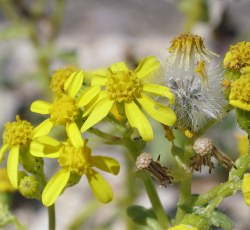
Coastal Ragwort

Senecio leucanthemifolius / Coastal Ragwort / Kromb Tax-Xatt
This plant is brought to you by one of the project's sponsors:
HSBC Cares for the Environment Fund
More sponsors are needed for this project [ click here ]

Contents Links


Nomenclature

Botanical Data

Description

General Information

Photo Gallery

Further Info & Links

Buy Seeds and Docs

Submit own info
about this plant

Give a small Donation Online

FORUM

Copyright Info


Main Index

 
Visitor hits (Dec-2006)

Nomenclature

Species name:

Senecio leucanthemifolius   Poir.

Author(s):

Jean Louis Marie Poiret;
   France, 1755-1834

General names:

Coastal Ragwort

Maltese name:

Kromb Tax-Xatt

Plant Family:

Asteraceae/ Compositae   (Daisy (Sunflower) Family)

Name Derivation:

Senecio = from "Senex" meaning an old man referring to hairy parts of flowers, stalks and seeds (Latin)
leucanthemifolius = Having leaves resembling species of the Genus Leucanthemum - the Oxe-eye daisies. (Latin)

Synonyms:

Senecio glaucus, S. crassifolius, S. humilis, S. marmorae, S. peduncularis, S. salzmannii, S. vernalis, S. vernus

Remarks:

-


Botanical Data

PLANT STRUCTURE:

Characteristic

Growth Form

Branching

Surface

Description

Erect :

Upright, vertically straight up well clear off the ground.

Basal Branching :

Branches are mostly present at the basal part of the stem.

Glabrous :

Smooth; without any hairs, bristles or other projections.

General
Picture

Wild Plants of the Mediterranean Islands of Malta  - Copyright Stephen Mifsud / Maltawildplants.com / Malta (2002-2007) Wild Plants of the Mediterranean Islands of Malta  - Copyright Stephen Mifsud / Maltawildplants.com / Malta (2002-2007) Wild Plants of the Mediterranean Islands of Malta  - Copyright Stephen Mifsud / Maltawildplants.com / Malta (2002-2007)

LEAVES:

Characteristic

Arrangement

Attachment

Venation

Description

Alternate :

Growing at different positions along the stem axis.

Sessile :

Growing directly from the stem; without a stalk.

None :

No prominent venation visible.

General
Picture

Wild Plants of the Mediterranean Islands of Malta  - Copyright Stephen Mifsud / Maltawildplants.com / Malta (2002-2007) Wild Plants of the Mediterranean Islands of Malta  - Copyright Stephen Mifsud / Maltawildplants.com / Malta (2002-2007) Wild Plants of the Mediterranean Islands of Malta  - Copyright Stephen Mifsud / Maltawildplants.com / Malta (2002-2007)
 

Characteristic

Leaf Shape

Leaf Margin

Remarks

Description

Irregular Pinnate Lobes (Terminal lobe being largest) :

Compound arrangement of several lobes of various sizes and depths with the lowest being the smallest and most independent (deeply lobed), and the upper terminal lobe being the largest.

Dentate :

With sharp teeth perpendicular to the margin.

Succulent:

A plant having fleshy stems or leaves, often adapted to conserve water in an extremely dry habitat (xeric habitat).

General
Picture

Wild Plants of the Mediterranean Islands of Malta  - Copyright Stephen Mifsud / Maltawildplants.com / Malta (2002-2007) Wild Plants of the Mediterranean Islands of Malta  - Copyright Stephen Mifsud / Maltawildplants.com / Malta (2002-2007) Wild Plants of the Mediterranean Islands of Malta  - Copyright Stephen Mifsud / Maltawildplants.com / Malta (2002-2007)

FLOWERS:

Characteristic

Colour

Basic Flower Type

No. of Petals

No. of Sepals

Description

Yellow

Ray petals around disc florets :

Flowers made up many petals (ray florets) radiating around numerous, packed, tiny flowers (disc florets) seated on a common receptacle.

5-8

Referring to the ray florets.

24-36

Referring to the phyllaries of the involucre.

General
Picture

  Wild Plants of the Mediterranean Islands of Malta  - Copyright Stephen Mifsud / Maltawildplants.com / Malta (2002-2007) Wild Plants of the Mediterranean Islands of Malta  - Copyright Stephen Mifsud / Maltawildplants.com / Malta (2002-2007) Wild Plants of the Mediterranean Islands of Malta  - Copyright Stephen Mifsud / Maltawildplants.com / Malta (2002-2007)
 

Characteristic

Inflorescence

Description

Ovary

Stamens

Description

Corymb :

False umbel formed by individual pedicels of different lengths originating from stem alternately and forming a flat-top cluster.

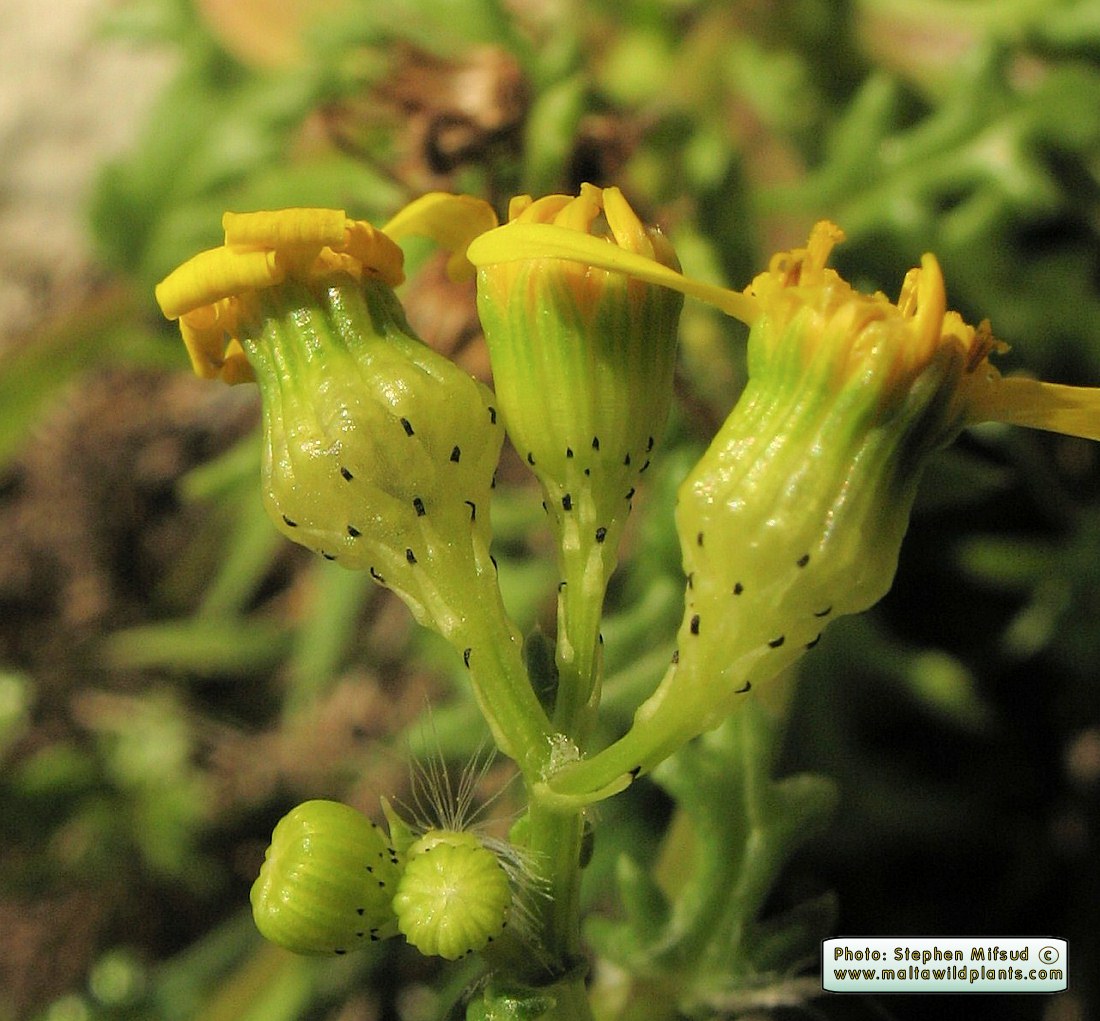
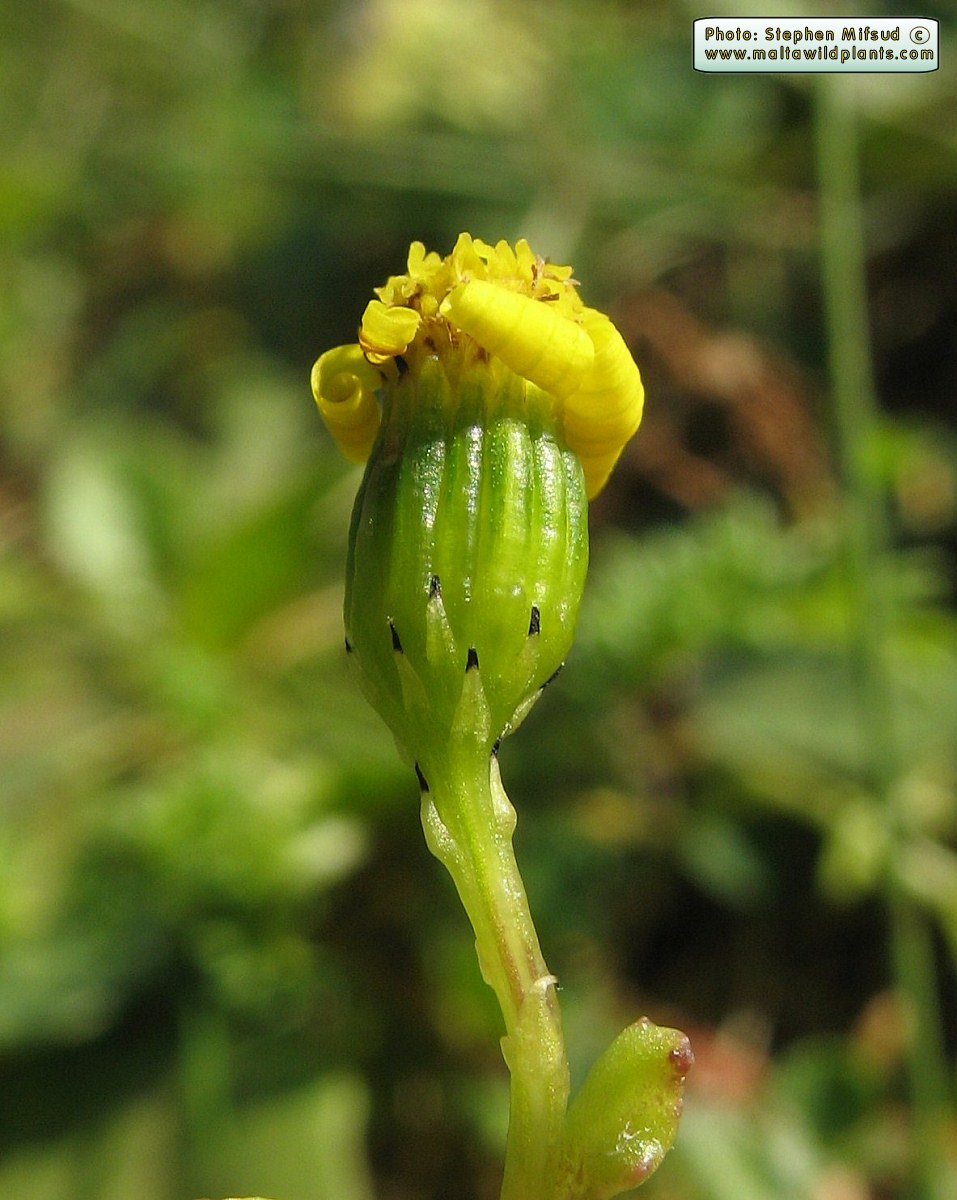
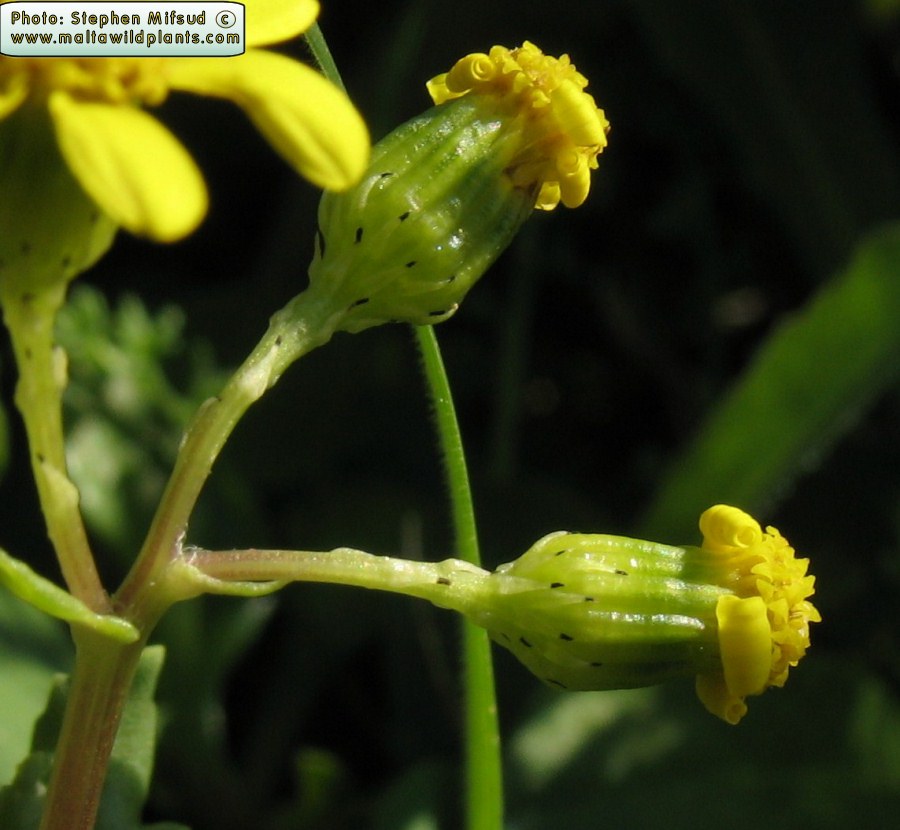
Cylindrical green involucre composed of 3 (or 4) layers of narrow phyllaries of which the lower 2 having a black tip. The capitulum (flower head) consists of few yellow ray florets ('petals') that are well spaced from each other and a central small disk of tiny florets of the same colour as the 'petals'.

Inferior :

Ovary situated below the flower parts (the calyx, corolla, and androecium). In other words, these are attached above the ovary.

5, Syngenesious :

Anthers fused together, forming a ring or collar around the central style of every disc floret. Filaments are usually free. Stamens are usually not visible by the naked eye.

General
Picture

Wild Plants of the Mediterranean Islands of Malta  - Copyright Stephen Mifsud / Maltawildplants.com / Malta (2002-2007) Wild Plants of the Mediterranean Islands of Malta  - Copyright Stephen Mifsud / Maltawildplants.com / Malta (2002-2007) Wild Plants of the Mediterranean Islands of Malta  - Copyright Stephen Mifsud / Maltawildplants.com / Malta (2002-2007) Wild Plants of the Mediterranean Islands of Malta  - Copyright Stephen Mifsud / Maltawildplants.com / Malta (2002-2007)
 

Characteristic

Scent

Average Flower Size

Pollen Colour

Other Notes

Description

Faint sweet smell

15-25mm x 8 mm

(diameter x involucral length).

Yellow

-


SEEDS:

Characteristic

No. Per Fruit

Shape

Size

Colour

Description

40-60

Achene with Pappus :

A simple one-seeded fruit which has an apical structure of radiating fine light bristles (called pappus) which aid the seed to disperse away by wind. Fruit are found in collective numbers attached to a common receptacle.

2-3mm

(excluding pappus).

Light brown

Seeds covered with very fine, silvery-white, appressed hairs.

General
Picture

Wild Plants of the Mediterranean Islands of Malta  - Copyright Stephen Mifsud / Maltawildplants.com / Malta (2002-2007) Wild Plants of the Mediterranean Islands of Malta  - Copyright Stephen Mifsud / Maltawildplants.com / Malta (2002-2007) Wild Plants of the Mediterranean Islands of Malta  - Copyright Stephen Mifsud / Maltawildplants.com / Malta (2002-2007) Wild Plants of the Mediterranean Islands of Malta  - Copyright Stephen Mifsud / Maltawildplants.com / Malta (2002-2007)

FRUIT AND OTHER BOTANICAL DATA:

Characteristic

Fruit Type

Colour of Fruit

Subterranean Parts

Other Notes

Description

Numerous achenes with pappus :

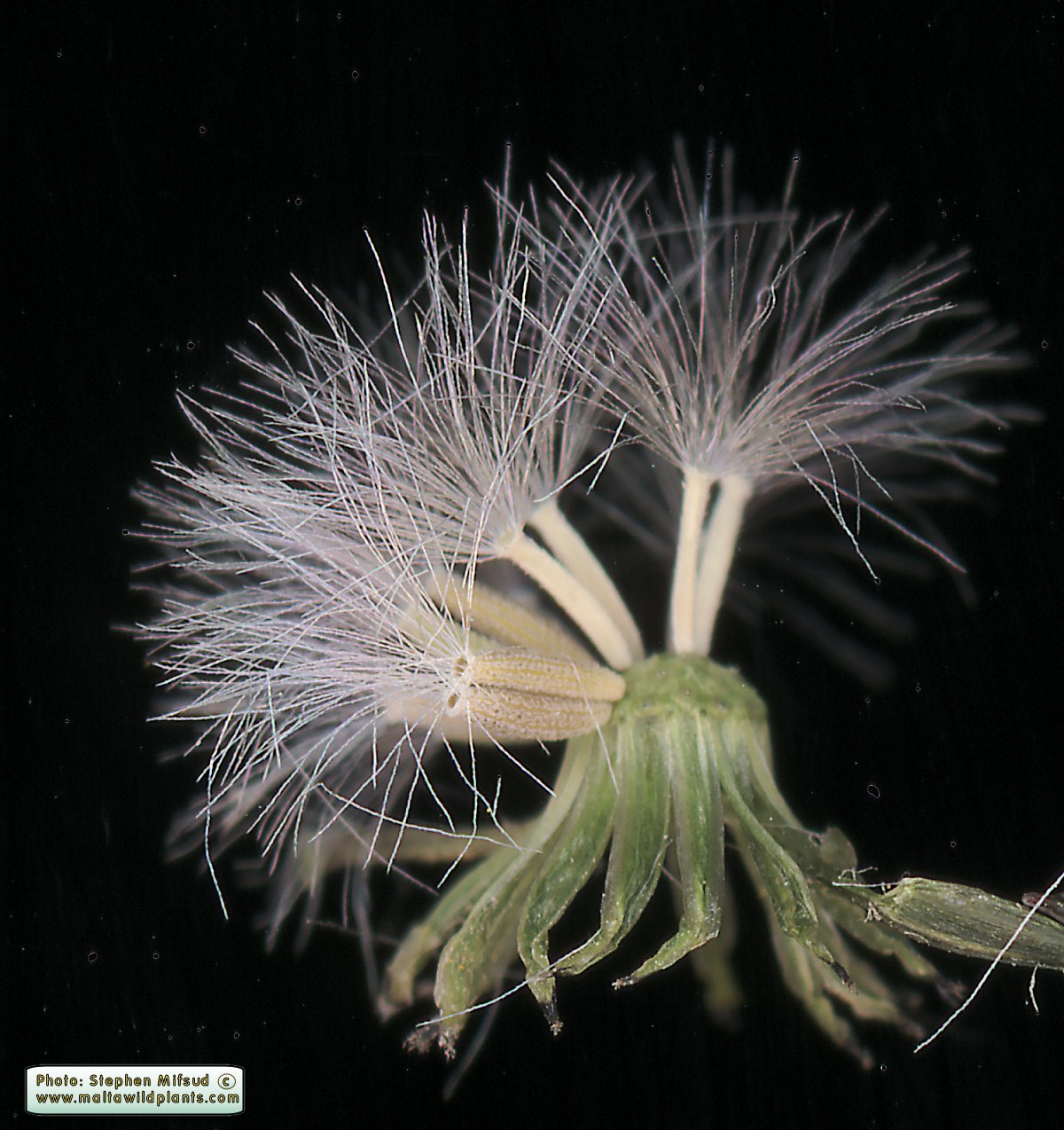
A collection of achenes with a bristly pappus forming a soft spherical structure. The radiating achenes are attached to a common receptacle and when mature they detach and get dispersed by wind.

White

(Referring to the pappi of the collective fruit head).

Taproot :

A rooting system where there is the main descending root of a plant having a single dominant large structure from which a network of smaller and long roots emerge.

-

General
Picture

Wild Plants of the Mediterranean Islands of Malta  - Copyright Stephen Mifsud / Maltawildplants.com / Malta (2002-2007) Wild Plants of the Mediterranean Islands of Malta  - Copyright Stephen Mifsud / Maltawildplants.com / Malta (2002-2007) Wild Plants of the Mediterranean Islands of Malta  - Copyright Stephen Mifsud / Maltawildplants.com / Malta (2002-2007) Wild Plants of the Mediterranean Islands of Malta  - Copyright Stephen Mifsud / Maltawildplants.com / Malta (2002-2007)

Plant Description

Life Cycle:

Annual

Habitat:

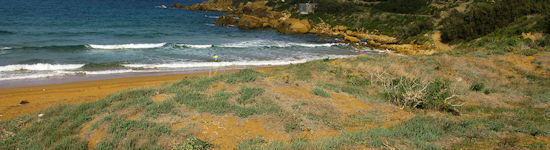
Garigue and rocky sites near the coast

Frequency:

Infrequent

Sources in Malta:

Locally frequent in Gozo but rather rare in Malta. Found abundantly at Dwejra, Xlendi and Ta' Cenc.

Plant Height:

10-30cm.

Flowering Time:

Dec - Mar

Poison:

Poisonous like other Senecio species

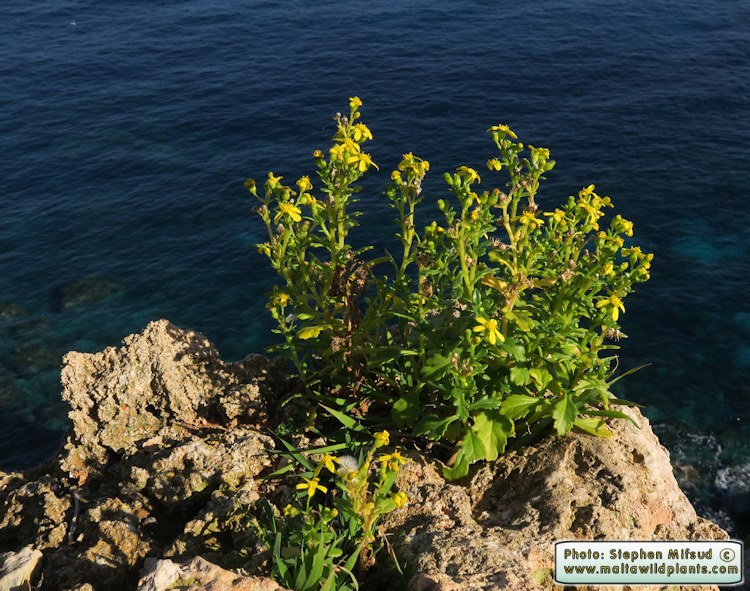
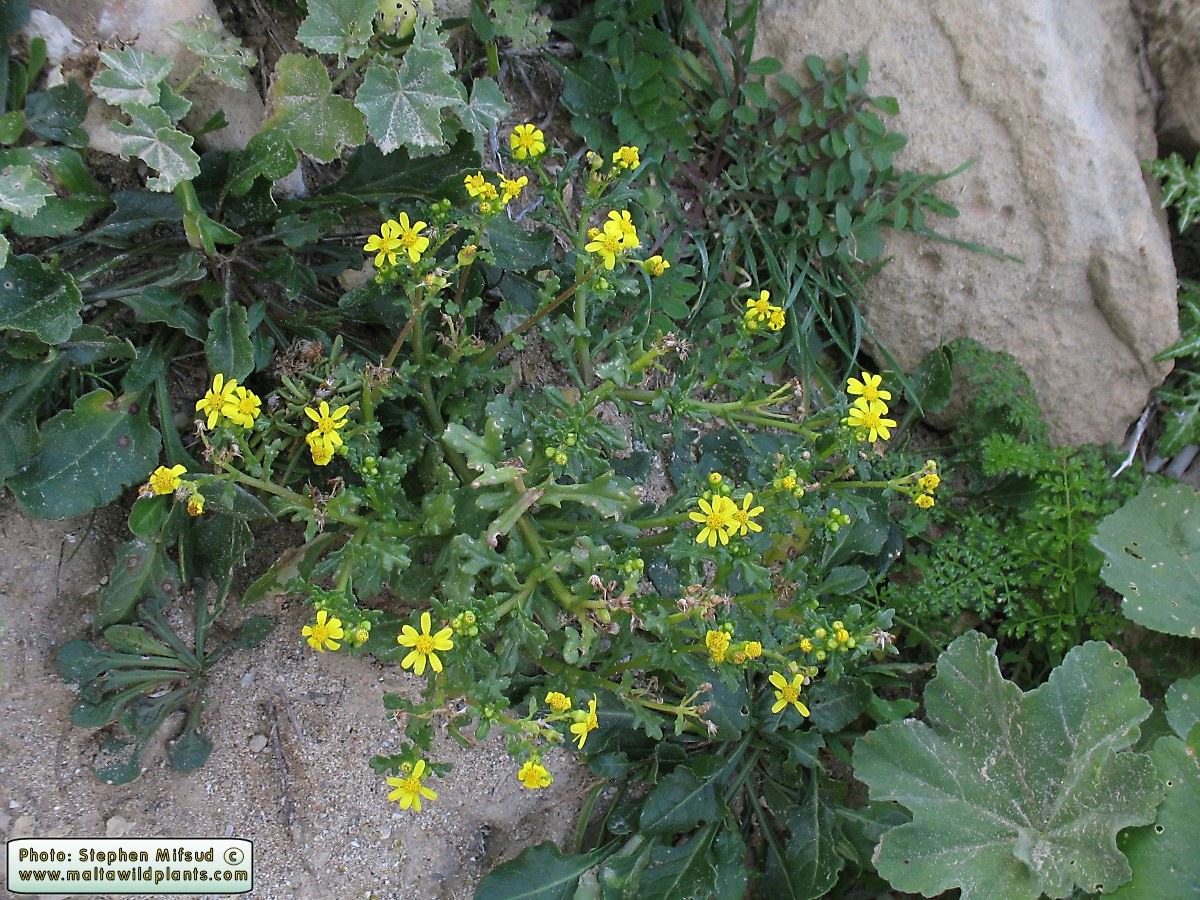
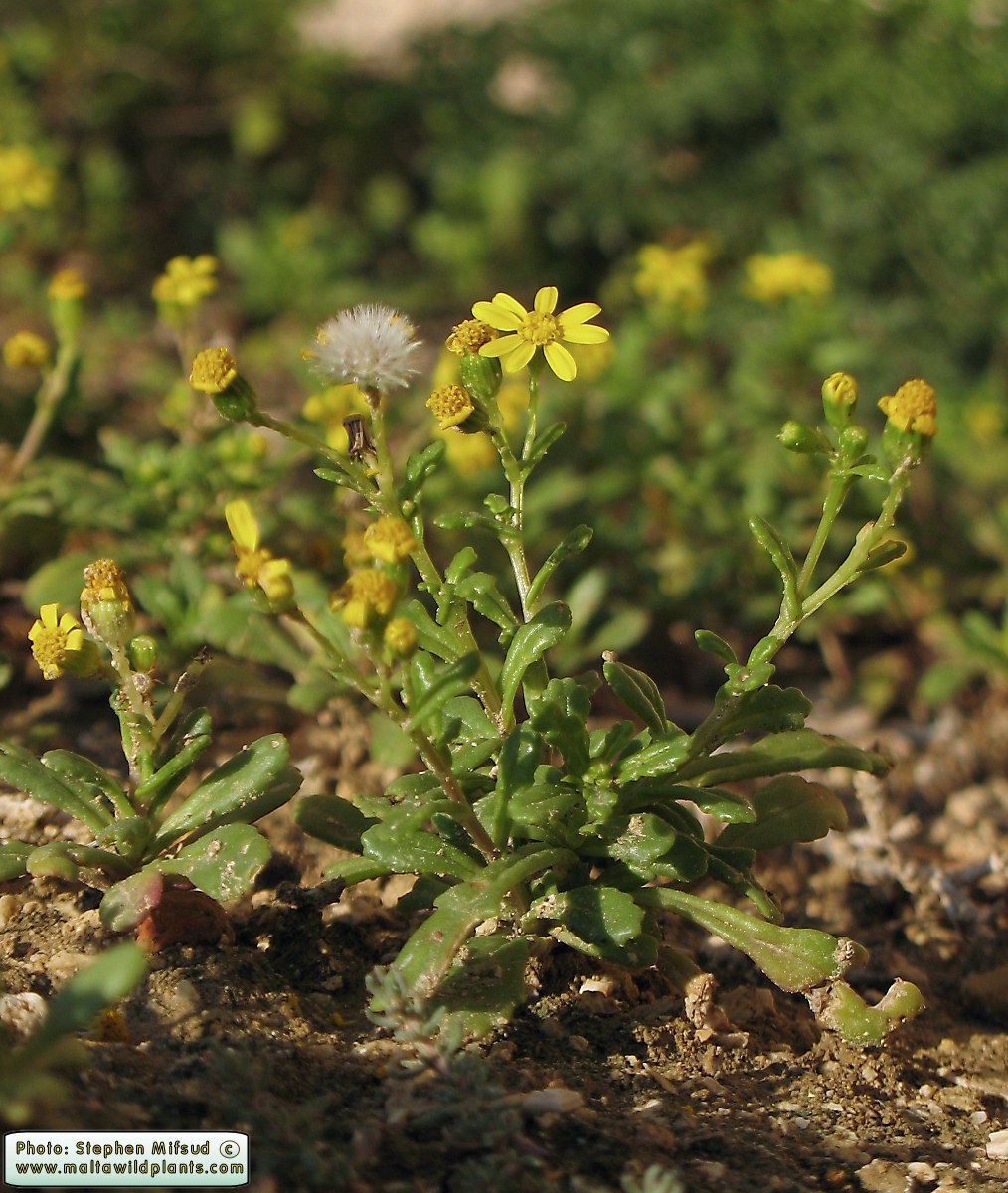
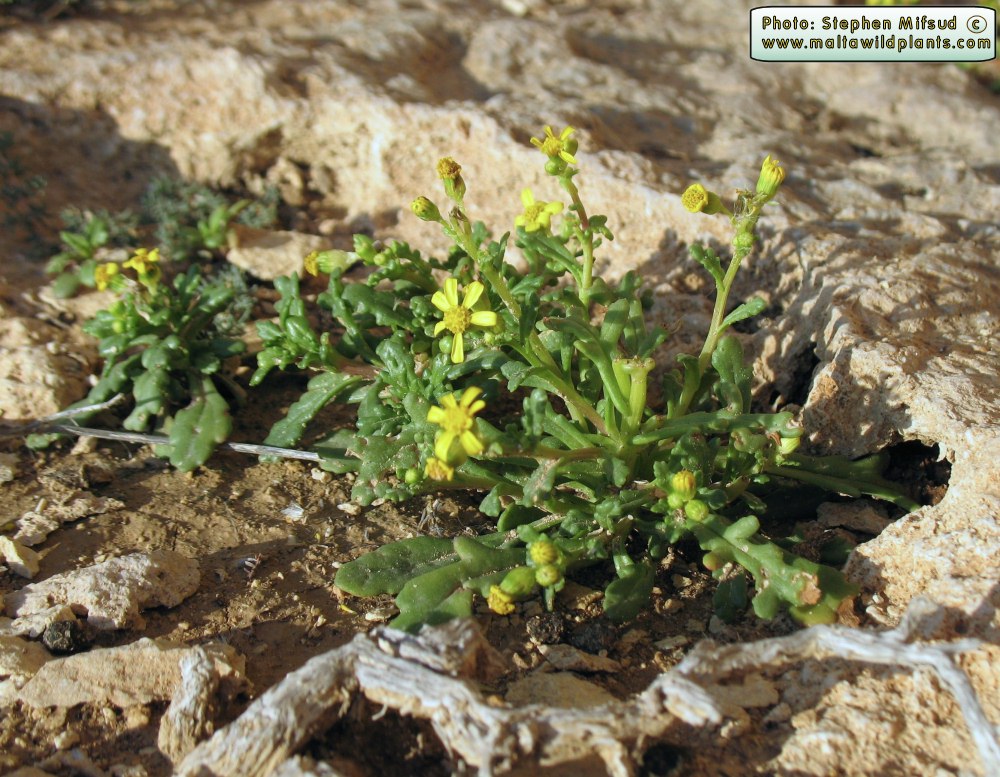
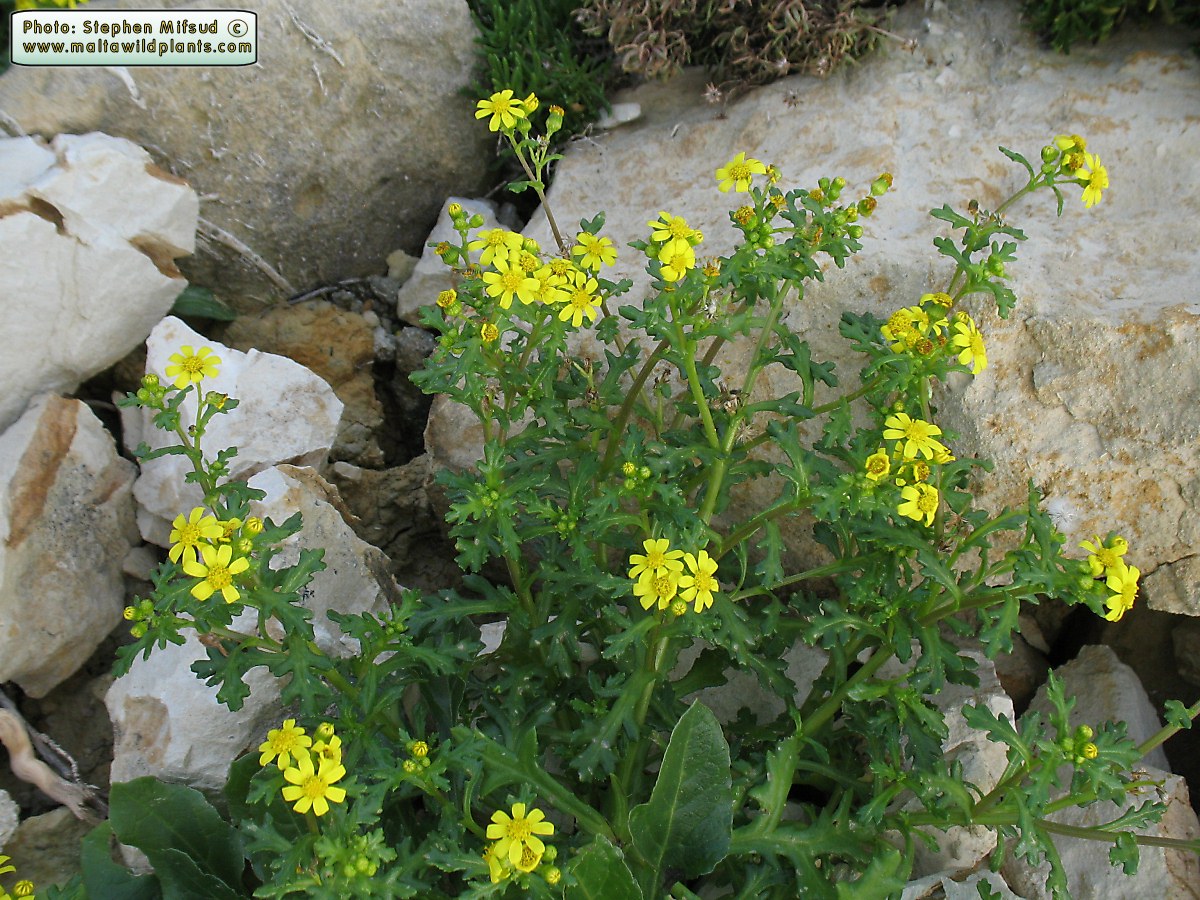
An erect, low growing, herbaceous plant that forms branches from its basal part. It is often found as a glabrous plant but some specimen may have sparsely floccose hairs.

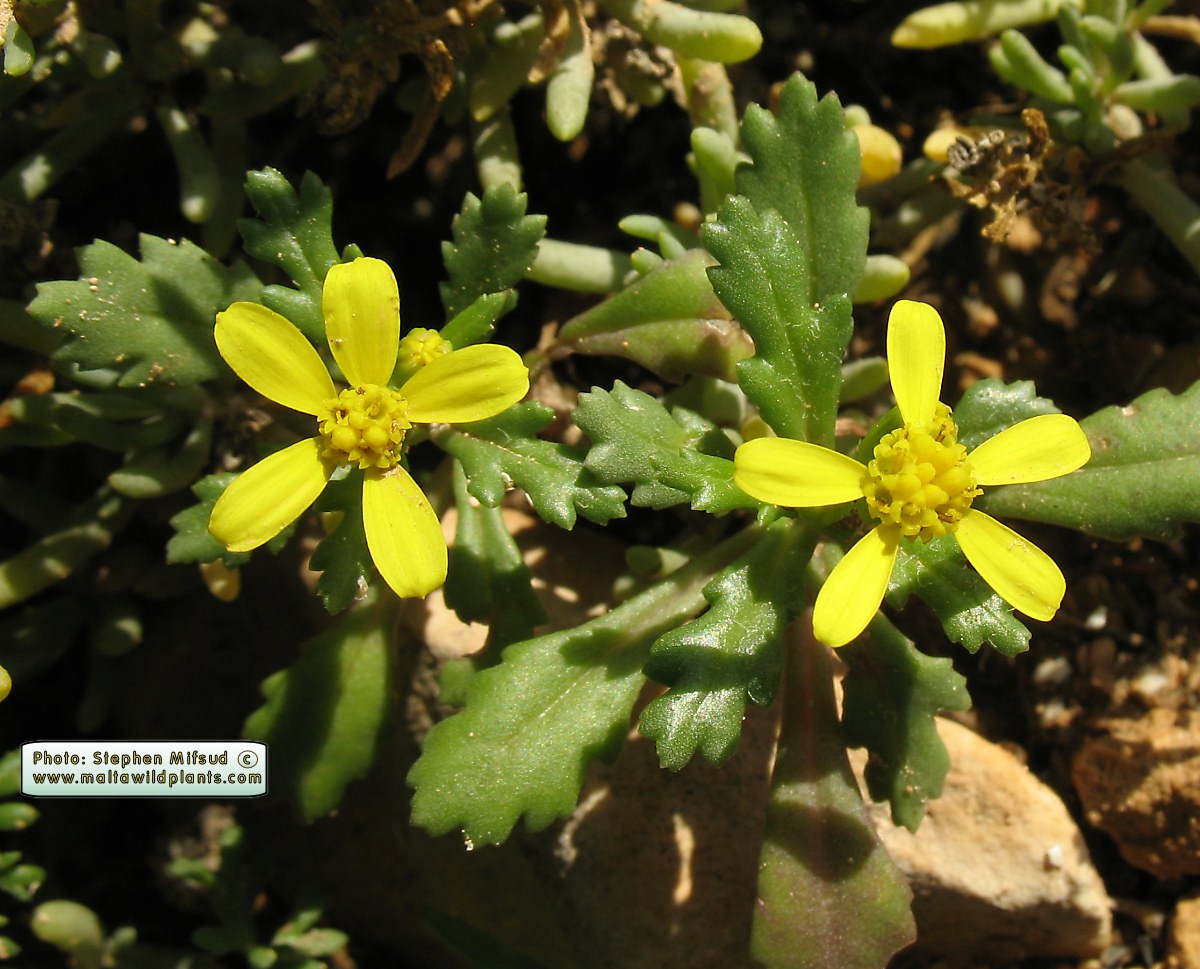
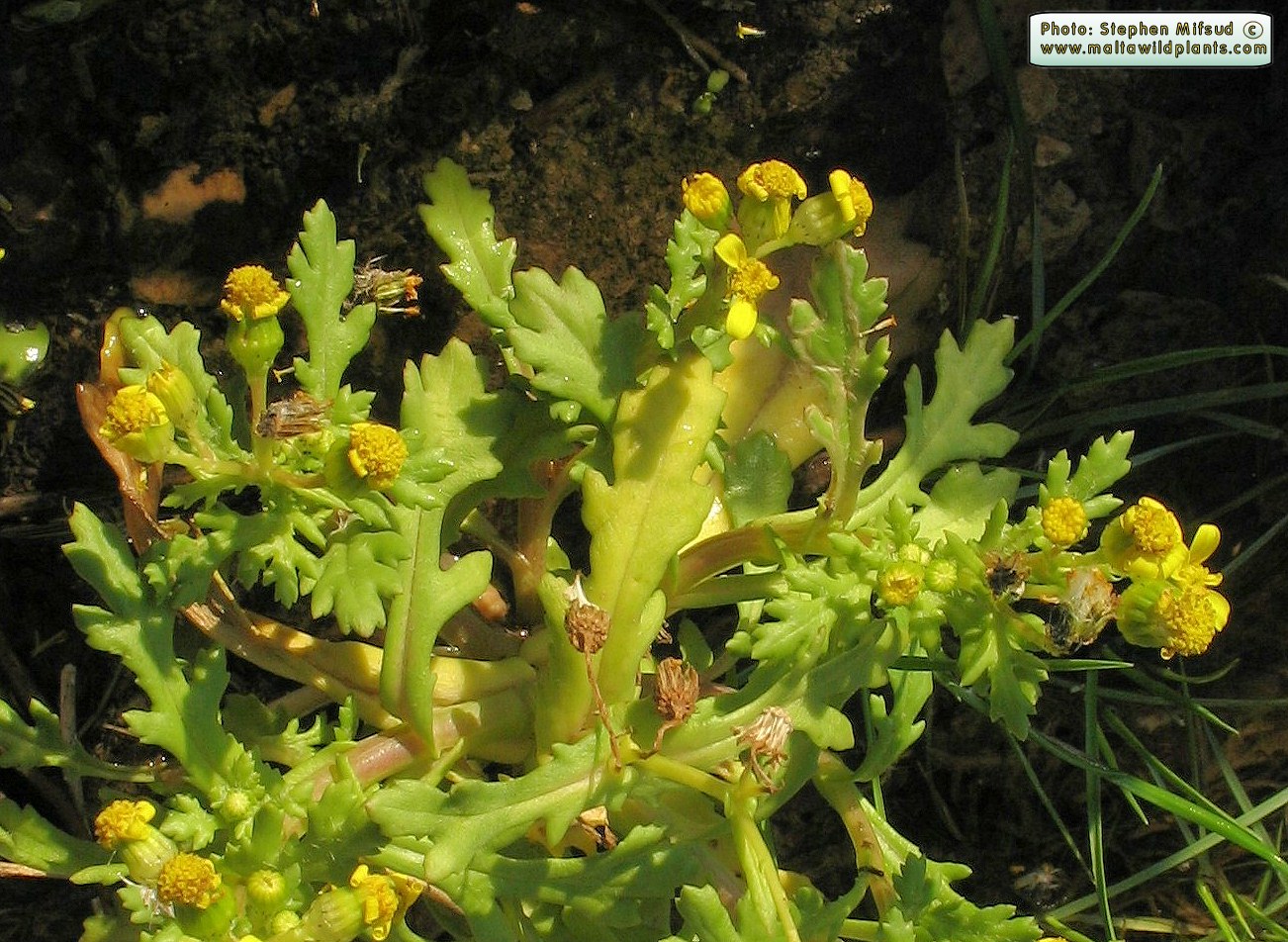
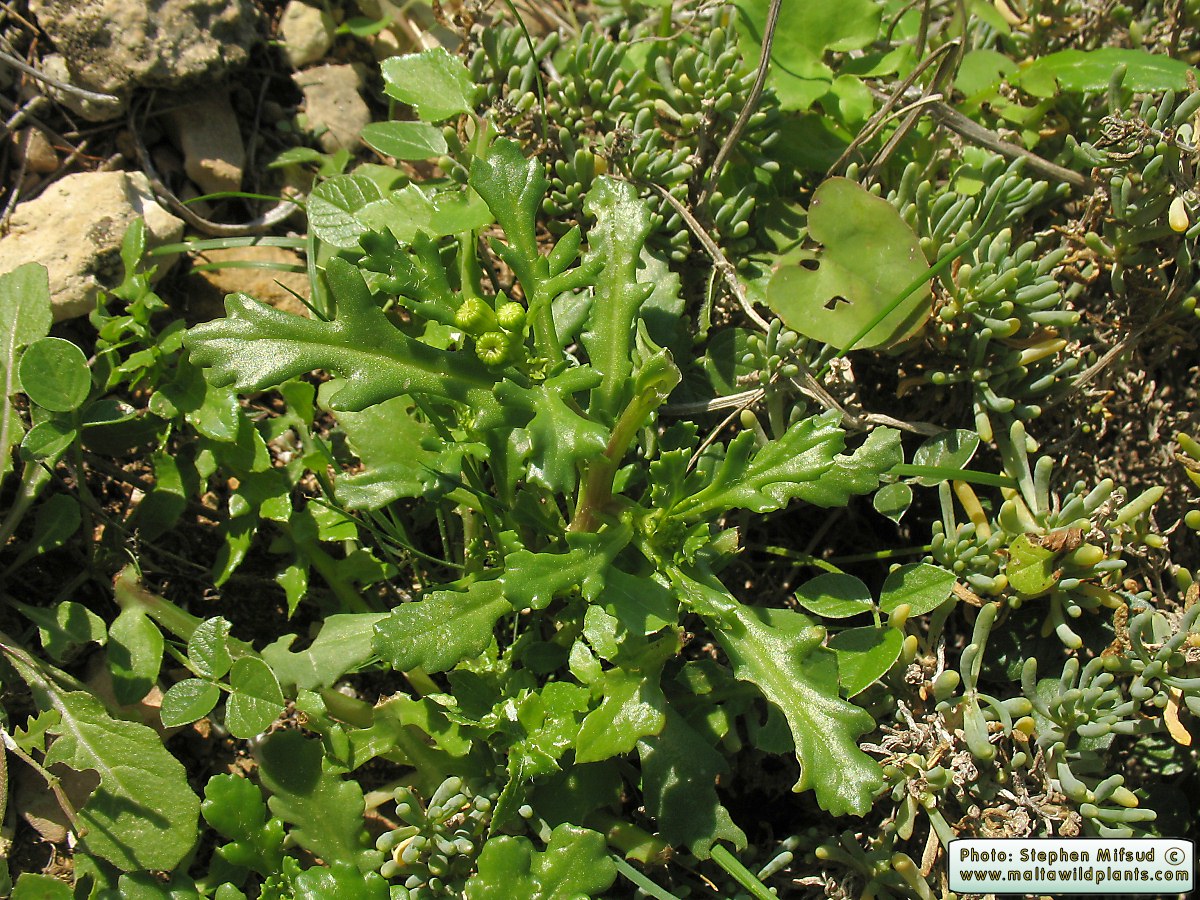
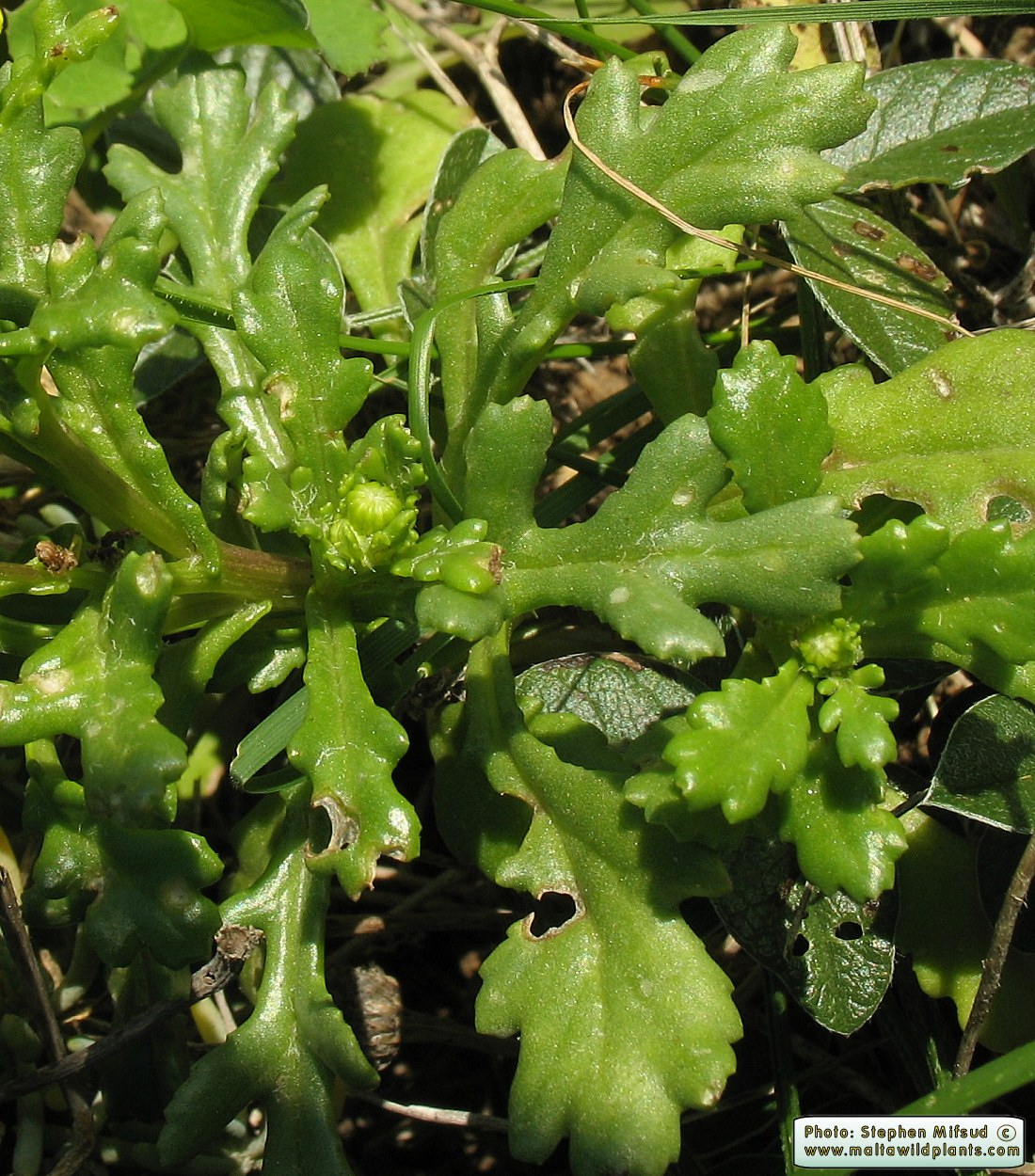
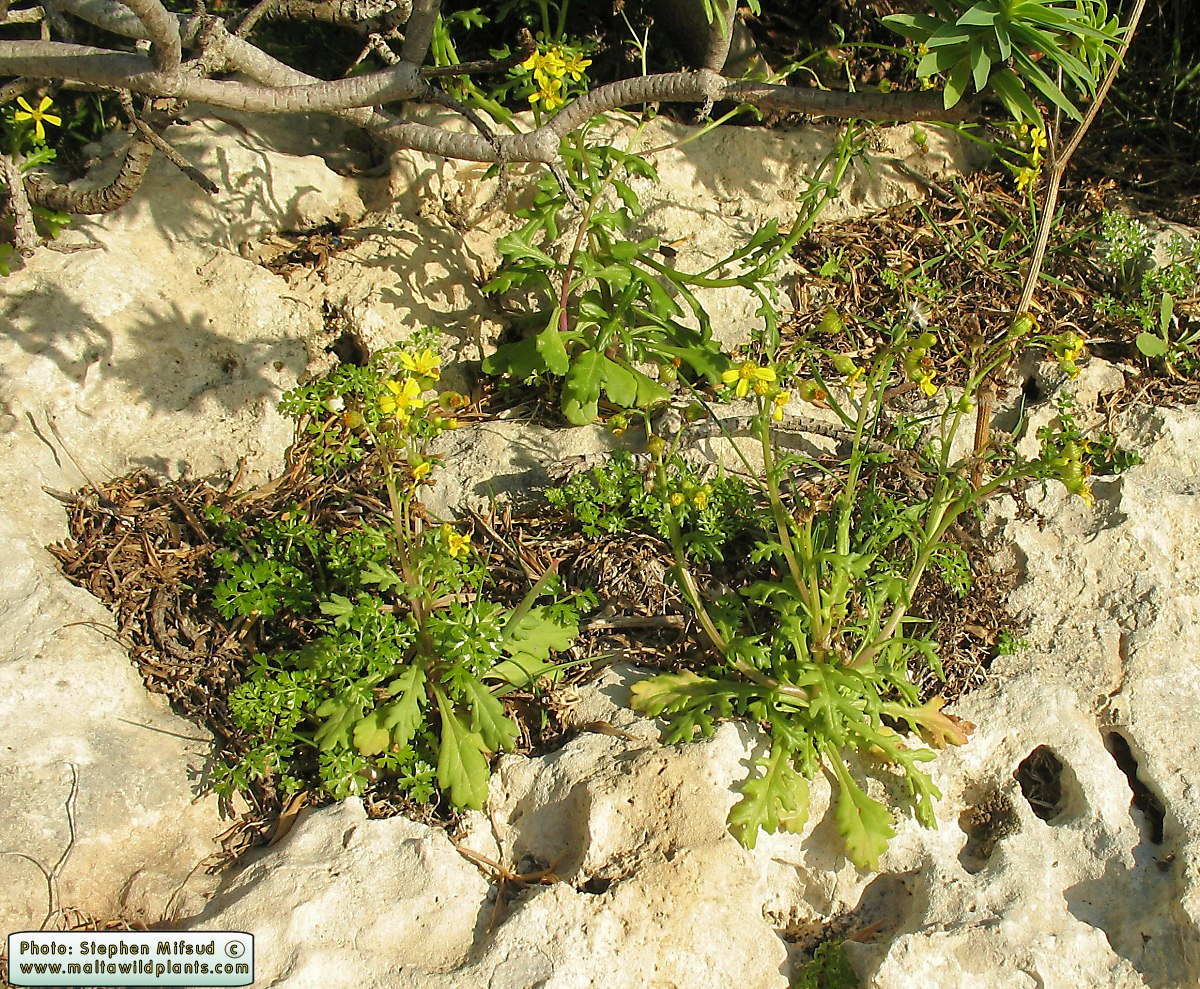
Senecio leucanthemifolius It forms many fleshy (succulent) leaves that have deep, broad lobes often arranged in an opposite arrangement. The breadth and depth of the lobes is irregular from leaf to leaf. Leaf outline is furthermore irregularly, bluntly dentate, especially at the terminal part of leaves or in cauline leaves. Leaves are sessile (except basal ones), alternate and have small, reduced auricles (flaps) at the base which goes approximately half-way around the stem perimeter.

The inflorescence is a corymb-like one with few (3-7) flowers that have stalks coming from a common point, or sometimes, from the stalk of another 'parent' flower. The flowering stalks which are about 15-20mm long, are erect and so the plant does not form drooping flowers as in Senecio vulgaris.

The flowers consists of a cup-shaped involucre made up of a group of green, narrow phyllaries (involucral bracts). There are 3 or 4 rows of phyllaries and those forming the lower 2 rows are shorter (2-3mm), triangular in shape and have a black pointed tip. The terminal row is composed of phyllaries that are linear-oblong in shape, compact and about 6-7mm long.

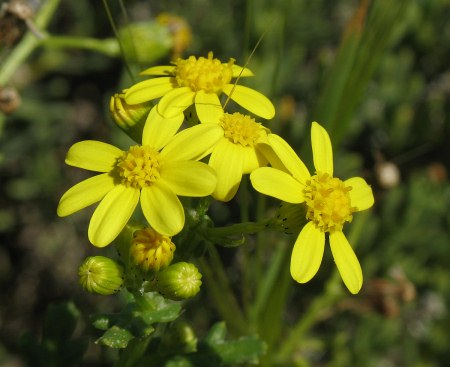
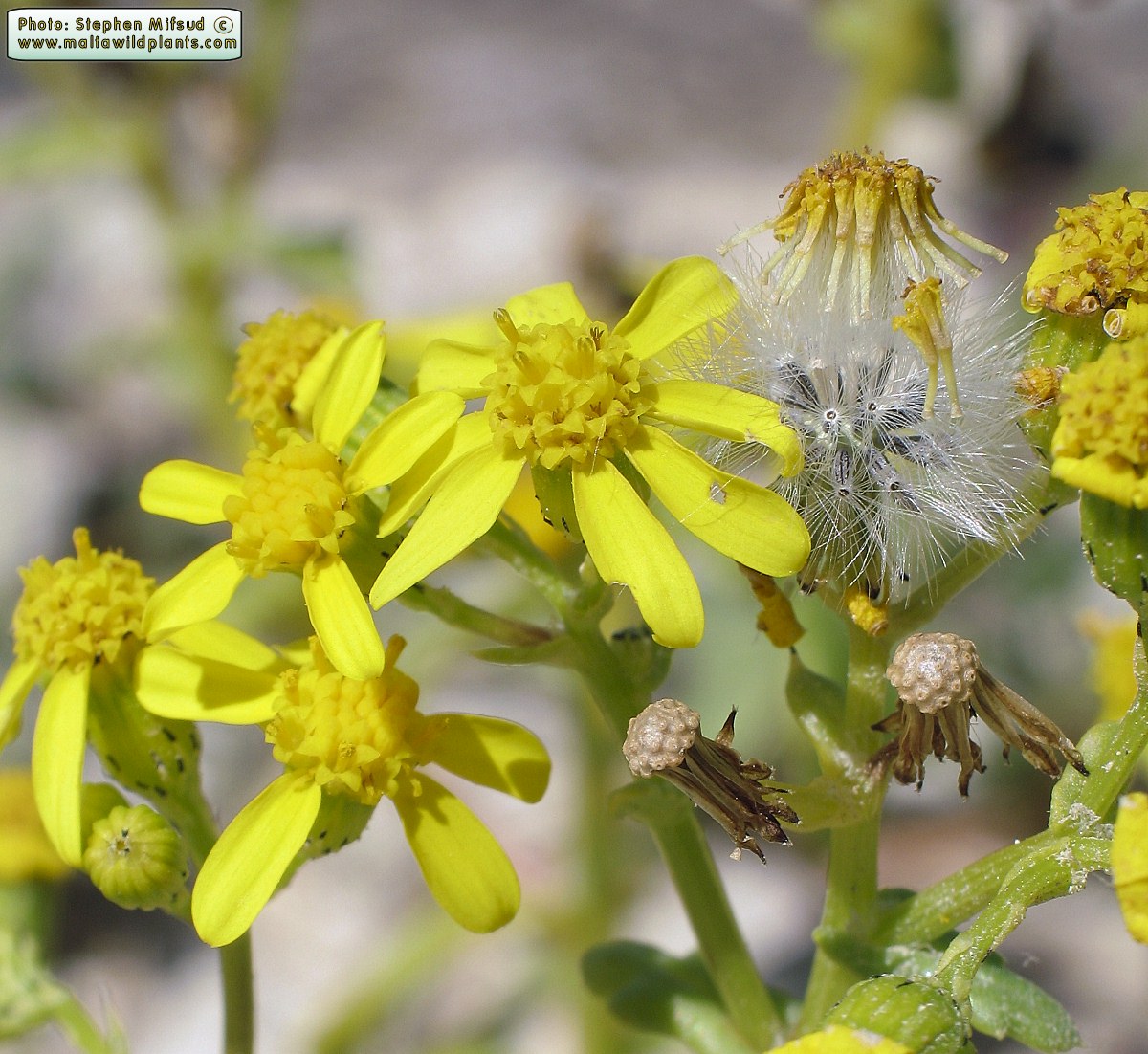
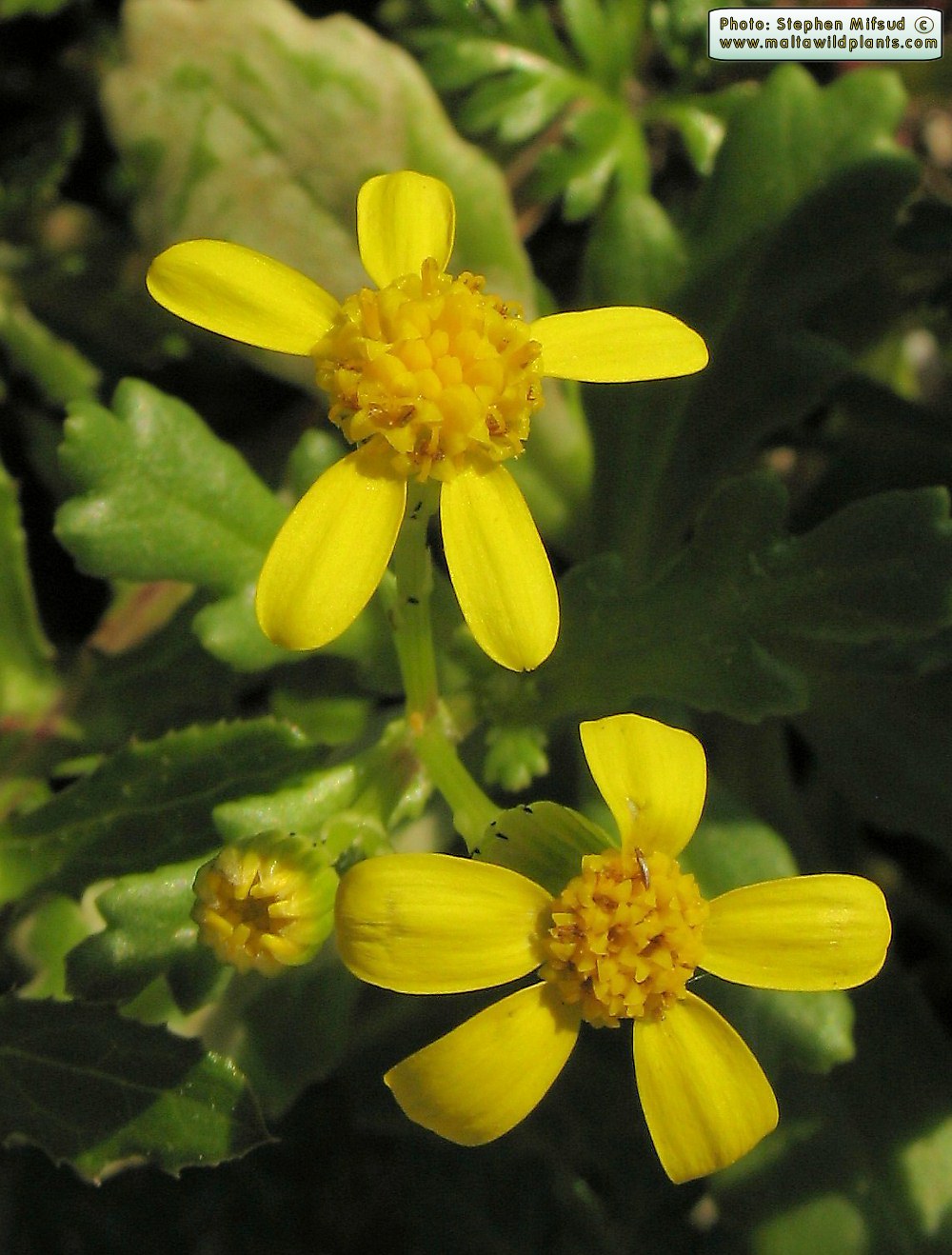
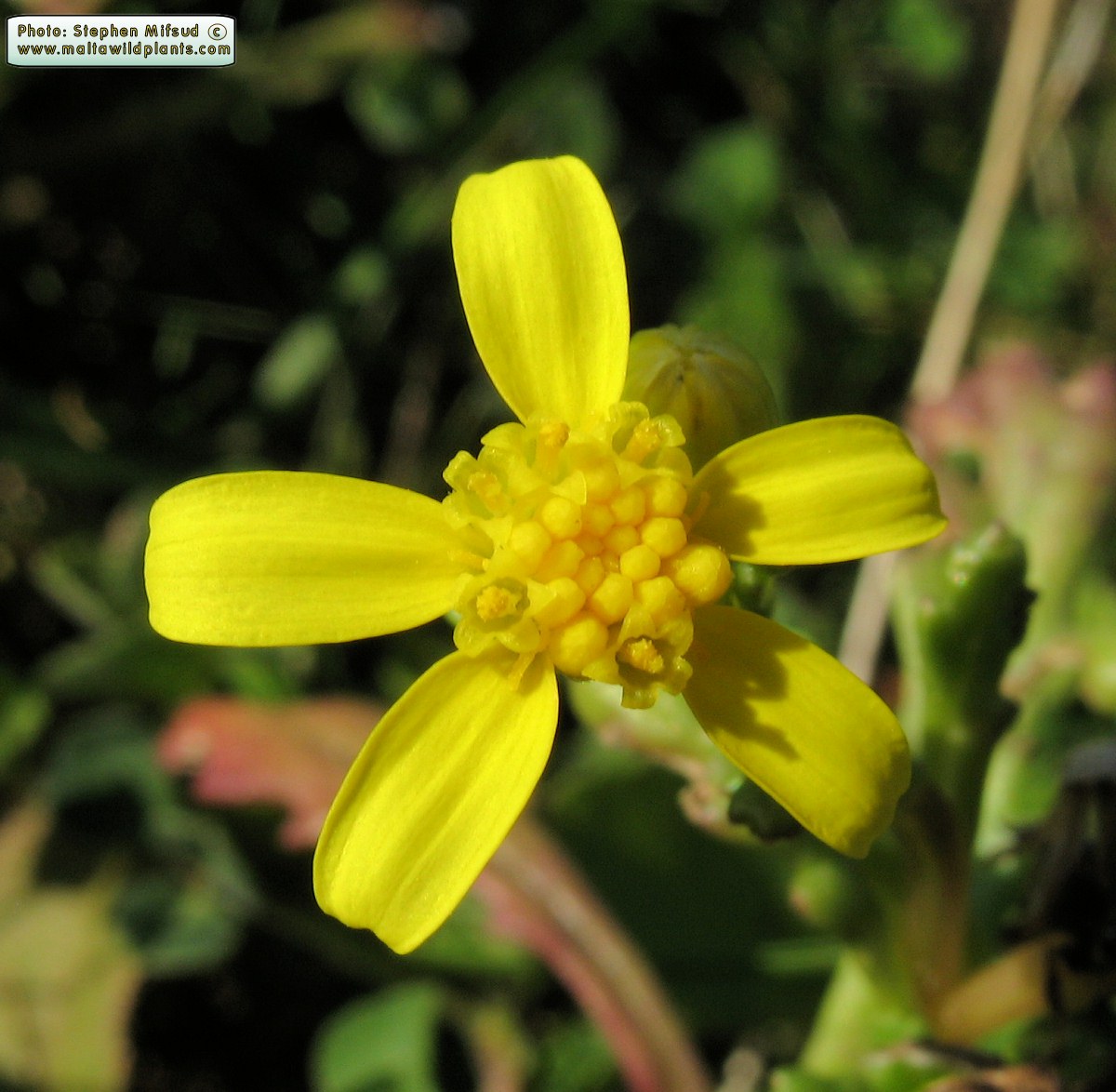
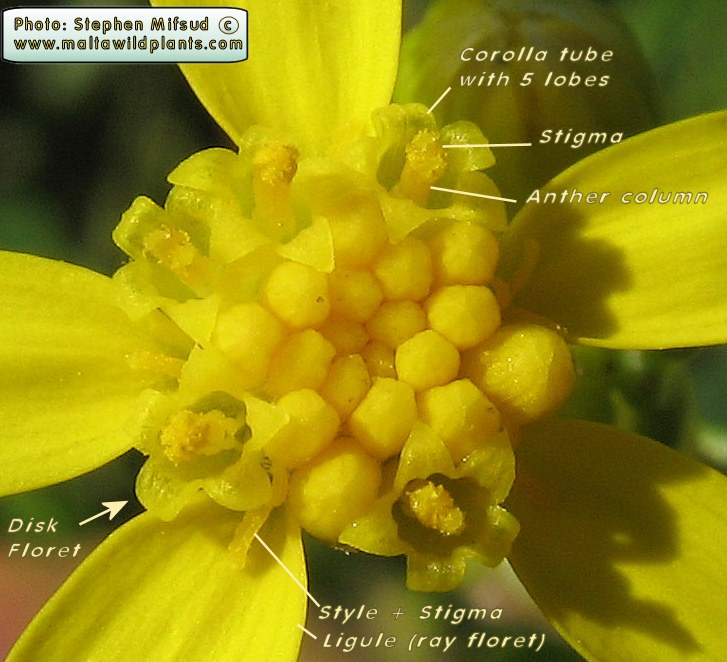
The involucre supports 5 to 8 (sometimes more), bright yellow, ray florets or 'petals' situated around a central disk of disk florets. The ray florets (also known as ligules) are the best distinguishing feature to identify this plant from Senecio vulgaris and Senecio pygmaeus which both have a rather similar foliage and growth form but they lack ligules completely. The diameter of the capitulum varies between 15-25mm. Disk florets have a 5-lobed tubular corolla from which the style protrudes out by 1-2mm. 5 fused anthers are arranged as a collar around the style and produce yolk-yellow pollen. Ray florets and disk florets are concolorous (of same colour).

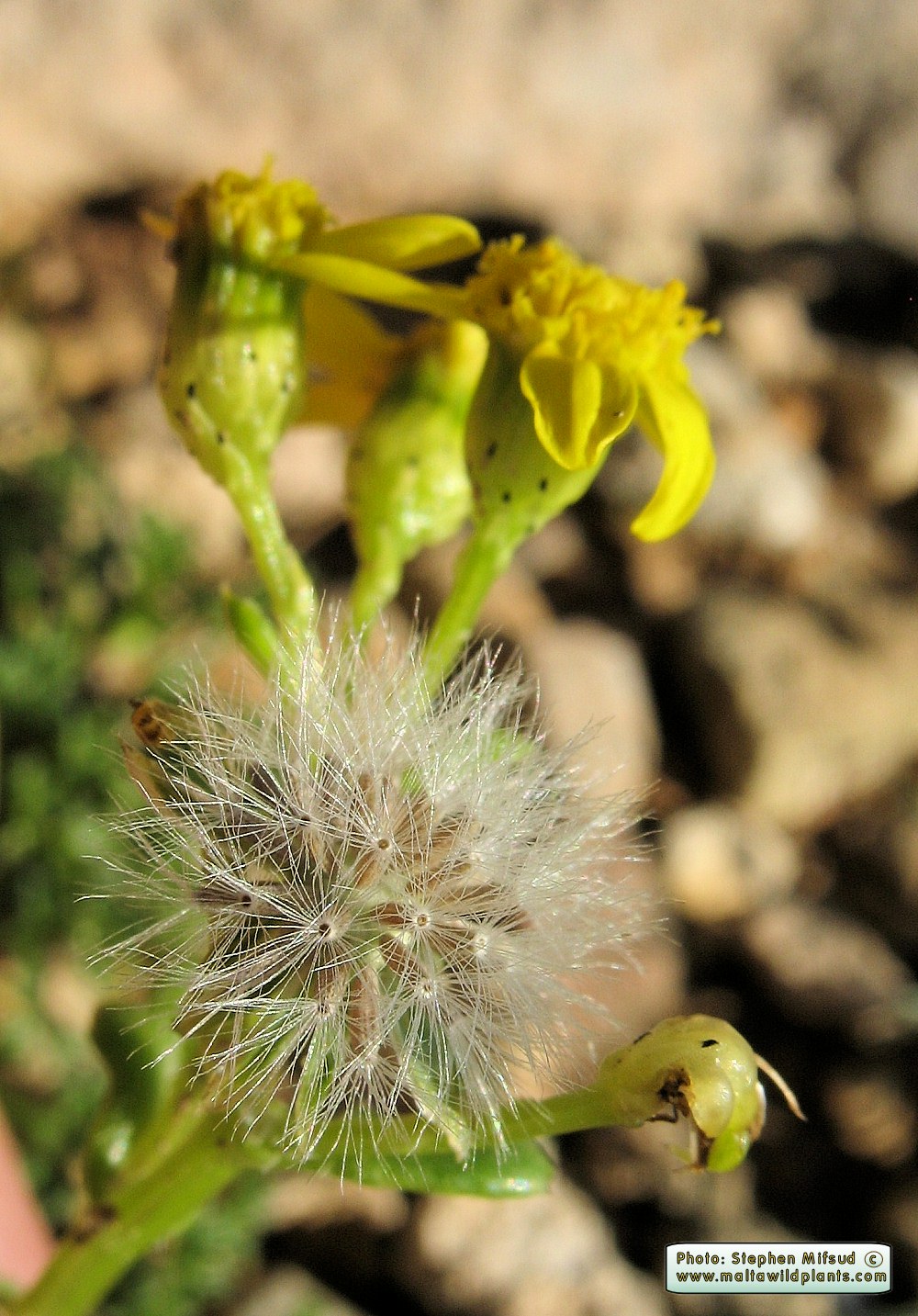
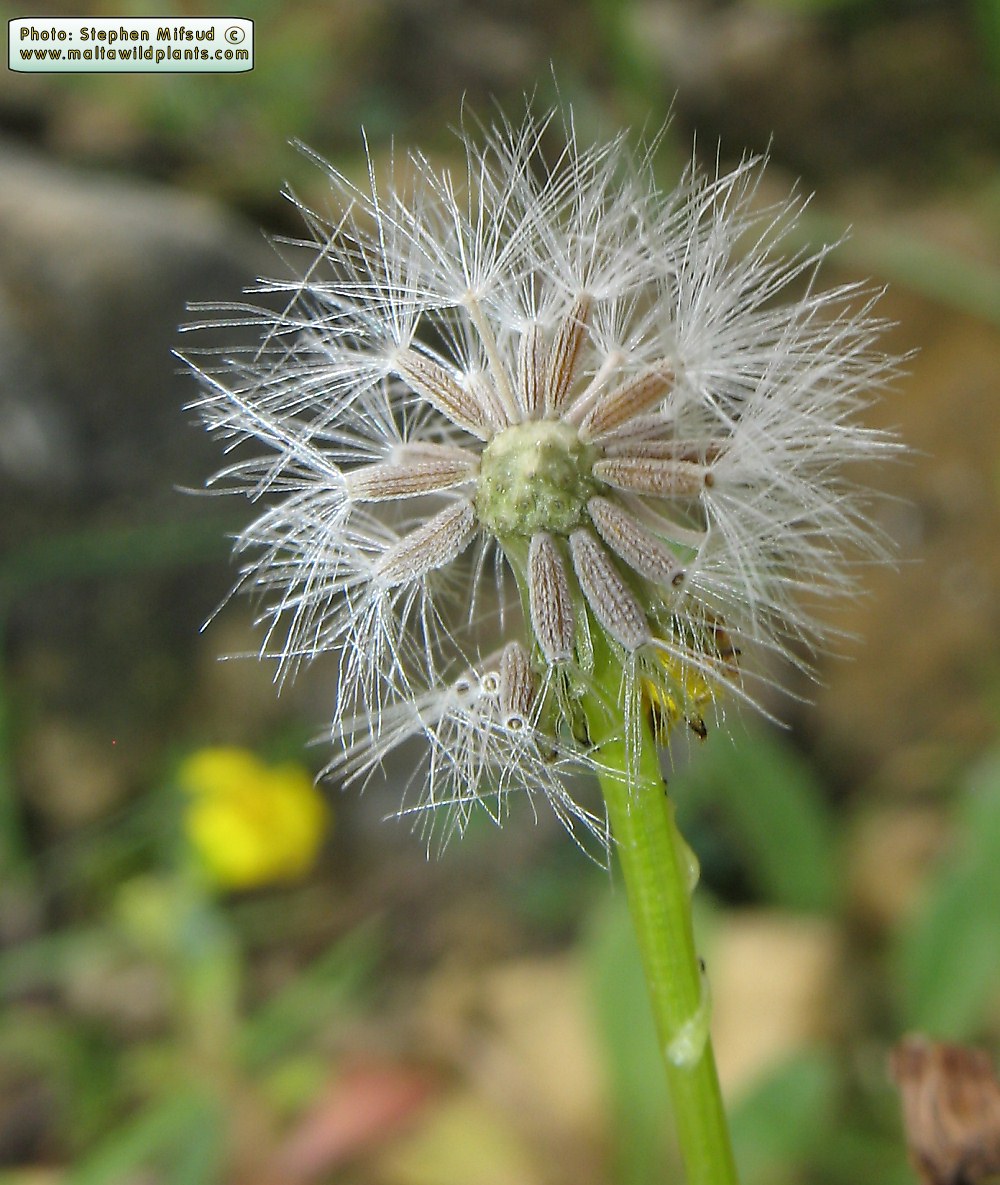
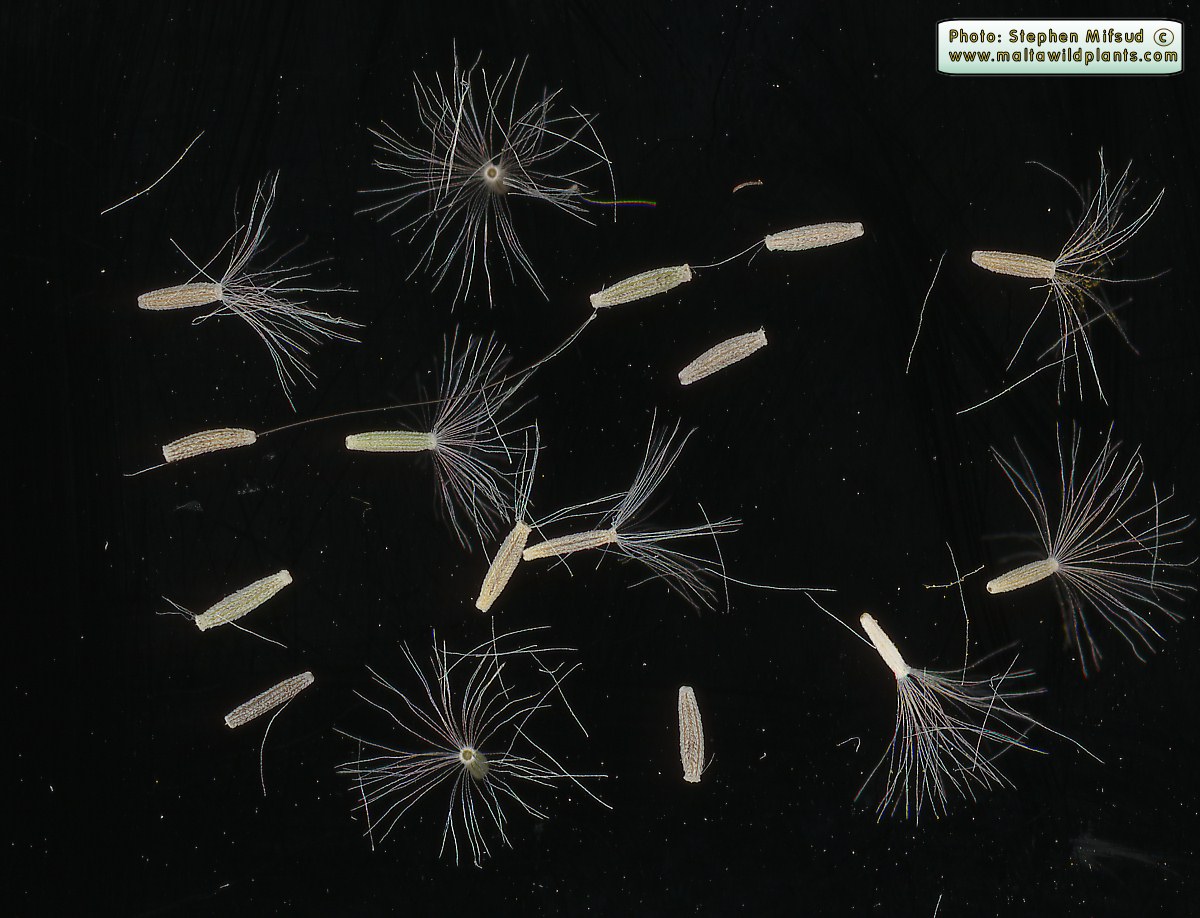
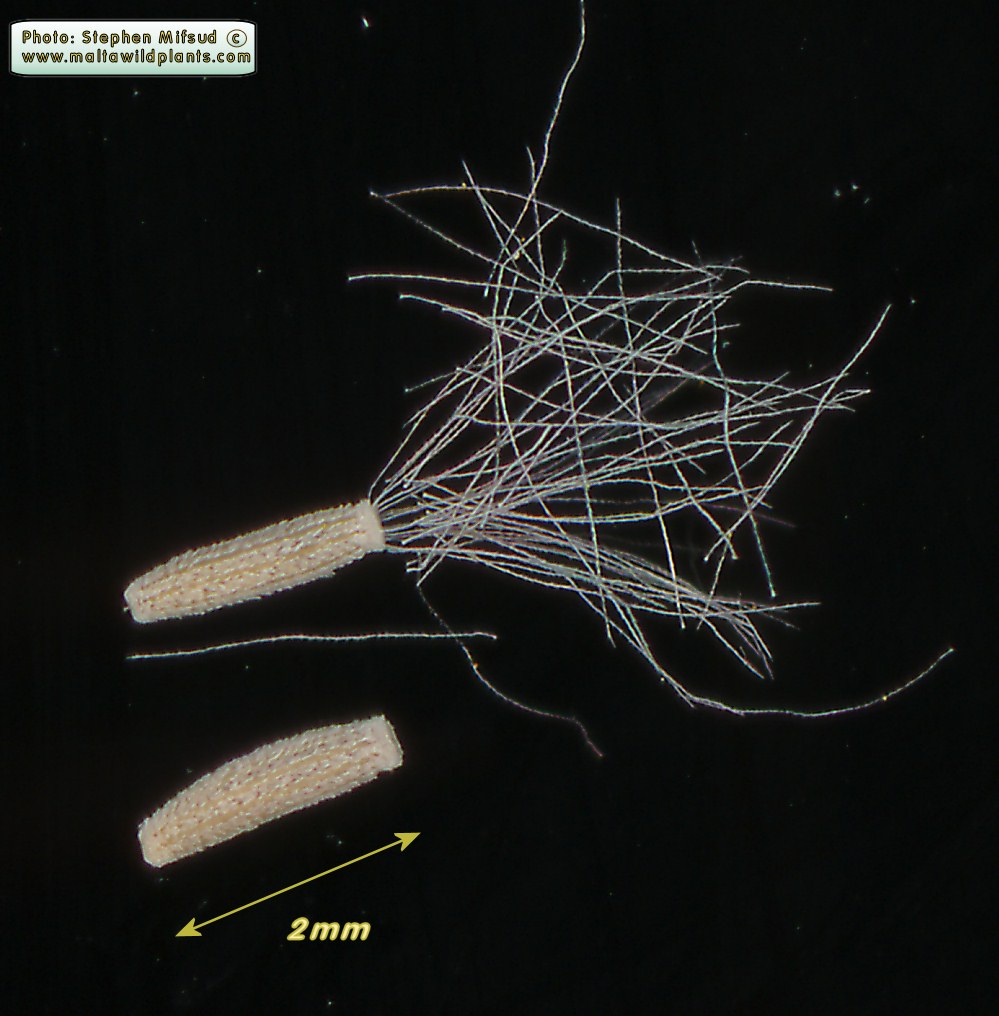
Senecio leucanthemifolius Both types of florets can be fertilised to form a single-seeded fruit known as an achene. The achenes are linear in shape, 2-2.5mm long, greyish brown in colour and have longitudinal ribs at which tiny, appressed, white hair is present. At the terminal part of the achene is found a simple, beakless pappus made of whorls of bristles that are 3-4mm long. Roughly, there are about 40-60 achenes per head collectively forming what looks as a white ball of bristles, about 2cm across. When mature seeds get loose and disperse away by wind.


Additional Information


Nativity and distribution

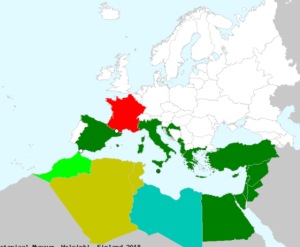
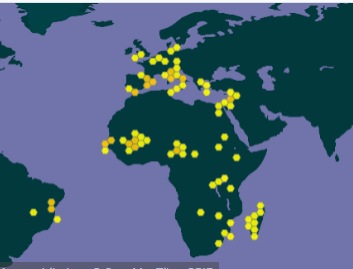
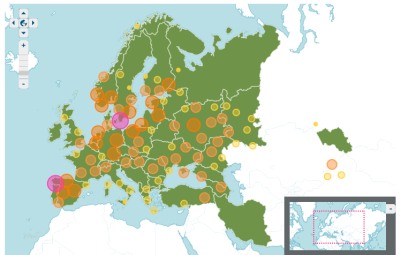
The plant comes presumably from Central-or Southern Russia and has spread only in the course of last century to Central-Europe; is spreading towards the West and North. [WWW-21] On the other hand, reference [383] gives the Mediterranean region as the origin. The species is fairly widely distributed in the western and central Mediterranean region and mainly in coastal regions, also occurring in southern Portugal. It was originally described from Algeria (North Africa) [50]

Possible causes of morphological variation in an endemic Moroccan groundsel (Senecio leucanthemifolius var. casablancae): evidence from chloroplast DNA and random amplified polymorphic DNA markers

Genetic variation was assessed in Senecio leucanthemifolius var. casablancae (Compositae), a Moroccan Atlantic coast endemic, in order to examine possible causes of atypical leaf morphology in three populations south of the known range. Evidence for introgression from S. glaucus ssp. coronopifolius and/or divergence was investigated with molecular markers. Both random amplified polymorphic DNA (RAPD) and chloroplast (cp) DNA restriction fragment length polymorphism (RFLP) differentiated the species well. Some evidence that hybridization may have occurred between the two species was provided by cpDNA markers. However, biparentally inherited RAPD markers failed to provide any support for the hypothesis that intermediate leaf morphologies in atypical populations arose through hybridization. Consequently, they are most likely to have arisen via divergence caused by drift and/or selection. Genetic distances among populations of S. leucanthemifolius were significant in all but one case. Isolation by distance was indicated by a significant positive correlation between genetic and geographical distances (r = 0.68, P = 0.01, Mantel test). These results suggest that long-distance achene dispersal is rare, despite the presence of a well-developed pappus. The observed loss of pappus at achene maturity may explain this unexpected result. Due to the morphological distinction of var. casablancae from other varieties of S. leucanthemifolius, we suggest elevation to species rank and treatment of the atypical material at infraspecific rank. [385]

In-vitro antiproliferative effects on human tumour cell lines of extracts and jacaranone from Senecio leucanthemifolius

We have studied the cytotoxic activity of extracts and jacaranone from Senecio leucanthemifolius Poiret. Extracts from S. leucanthemifolius were able to inhibit the in-vitro proliferation of a series of human tumour cell lines. The dichloromethane extract demonstrated effective cytotoxic activity with an IC50 of 20.1 g mL-1 on the large cell carcinoma cell line COR-L23. The ethyl acetate extract showed an IC50 value of 5.0 g mL-1 and the butanol extract an IC50 value of 6.4 g mL-1 on the same cell line. A major active constituent of the dichloromethane extract was shown to be jacaranone, which was demonstrated to have a very strong activity against all of the tumour cell lines with IC50 values between 2.86 and 3.85 g mL-1, although it did not account for all the activity observed. Constituents of S. leucanthemifolius extracts were identified by GC/MS analysis and NMR. [386]

Toxicity

One study that mentions 2 toxic alkaloids isolated from Senecio leucanthemifolius was found. The abstract reads that 2 pyrrolizidine alkaloids were isolated from Senecio leucanthemifolius and six from Senecio rodriguezii of which their structures were determined by spectroscopic methods. The toxins are •Integerrimine • Senecionine • Seneciphylline • Seneciphyllinine (acetylseneciphylline) • Senkirkine and • Acetylsenkirkine but the abstract did not mention which two were specifically derived from Senecio leucanthemifolius. [384]. Apart from this, one has to bear in mind hat this species belongs to a genus that contains a number of plants with a cumulative poisonous effect on the liver [65].

Variability

This is a rather variable plant and several synonyms and varieties has been described. The list below gives most of the varieties found for Senecio leucanthemifolius:

  1. S. leucanthemifolius var. fradinii
  2. S. leucanthemifolius var. leucanthemifolius
  3. S. leucanthemifolius var. major
  4. S. leucanthemifolius var. pectinatus
  5. S. leucanthemifolius var. vernalis
  6. S. leucanthemifolius var. vernus


The list of synonyms is longer and the most important ones can be found in the nomenclature part of this profile. [SM]

Personal Observations


Populations in Malta tend to have few ray florets.
While studying and photographing several flowers of Senecio leucanthemifolius found on the Maltese islands, I have found that the number of ligules (ray florets), is in most cases between 5 to 8. 5 liguled flowers are very common in the South and West coast of Gozo. Most of the studies where done in begining of Winter, so I don't know if at warmer months, more ligules are formed in the flowers.

When looking at images of flowers of this plant available on the net, I noted that they have more ligules than those in Malta, approximately between 8-13. This is just a personal observation, and maybe there should be some study to find ut iff our population might classify as an own subspecies or variety, given the fact that this plant is rather variable and exhibits itself in numerous subspecies, varieties and synonyms.

To highlight this observation, below are 5 links pointing to 5 images of Senecio leucanthemifolius from different locations in Europs (france, Spain, taly..) which demostates flowers with 8-13 ray florets.

Image 1 (National Park of Port-Cros, France)
Image 2 (Canary Islands)
Image 3 (Salses Pond, France)
Image 4 (Univ. of Paris)
Image 5 (Manfredonia (Italy))
Image 6 (Italy)

Photo Gallery

Senecio leucanthemifolius (Coastal Ragwort) - CLICK TO ENLARGE PHOTO Senecio leucanthemifolius (Coastal Ragwort) - CLICK TO ENLARGE PHOTO Senecio leucanthemifolius (Coastal Ragwort) - CLICK TO ENLARGE PHOTO Senecio leucanthemifolius (Coastal Ragwort) - CLICK TO ENLARGE PHOTO
Photo of the bright yellow flowers borne as a corymb-like inflorescence that are produce from December to April.
Photo of the flowers that are formed in large numbers mostly around Feb-May.
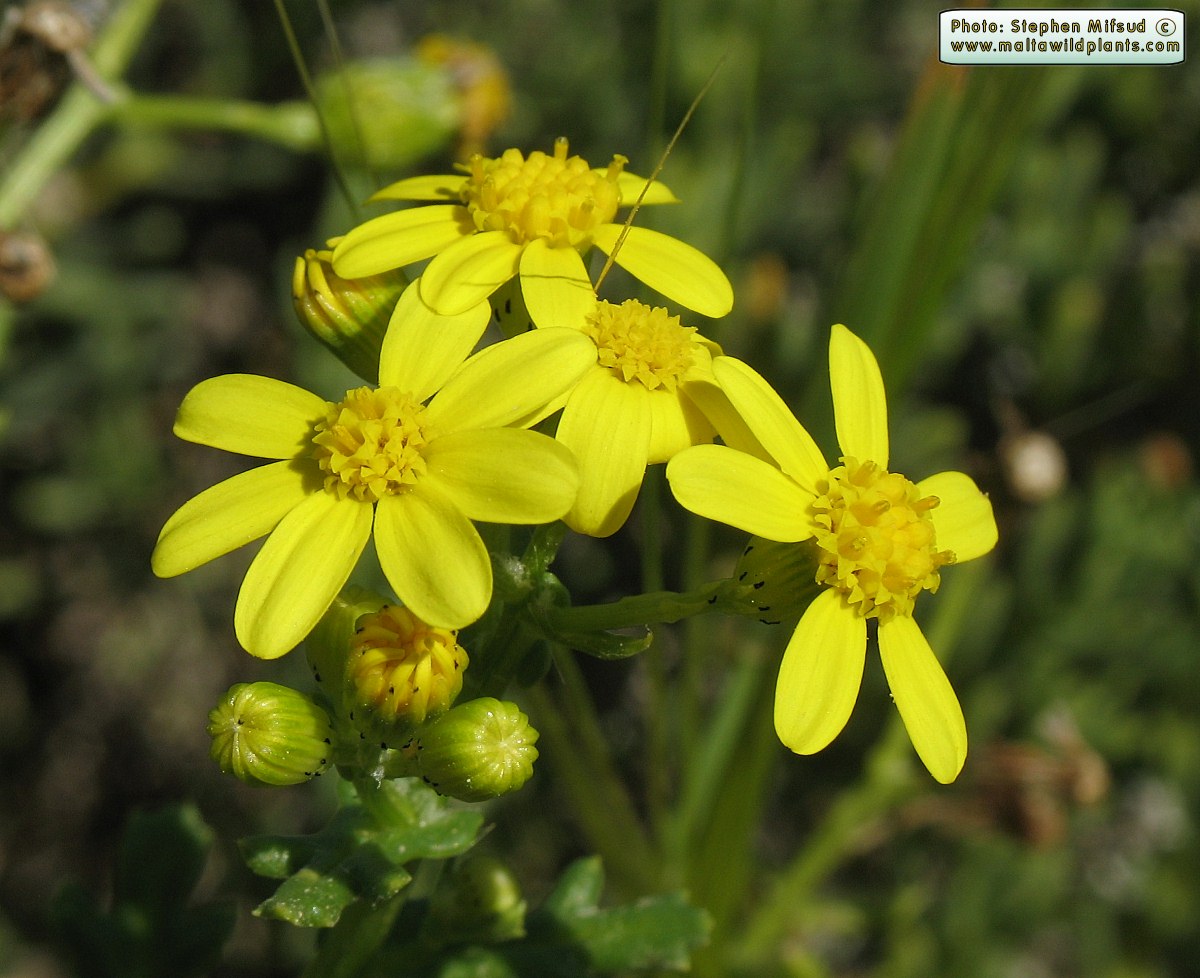
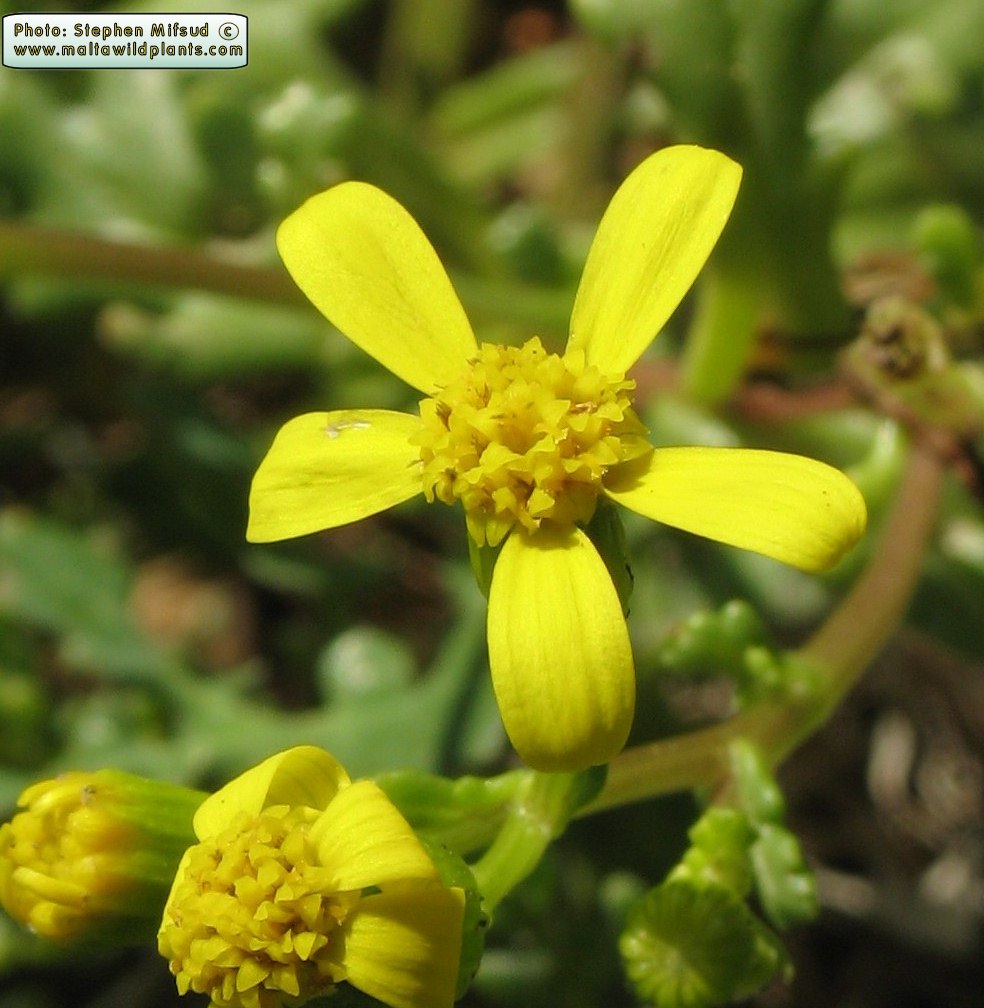
Photo of 2 flowers which basically consists of a central disk with closely packed disk-florets, and a few ligules (petals) that are well spaced from each other. The number of ligules varies approximately between 5-8.
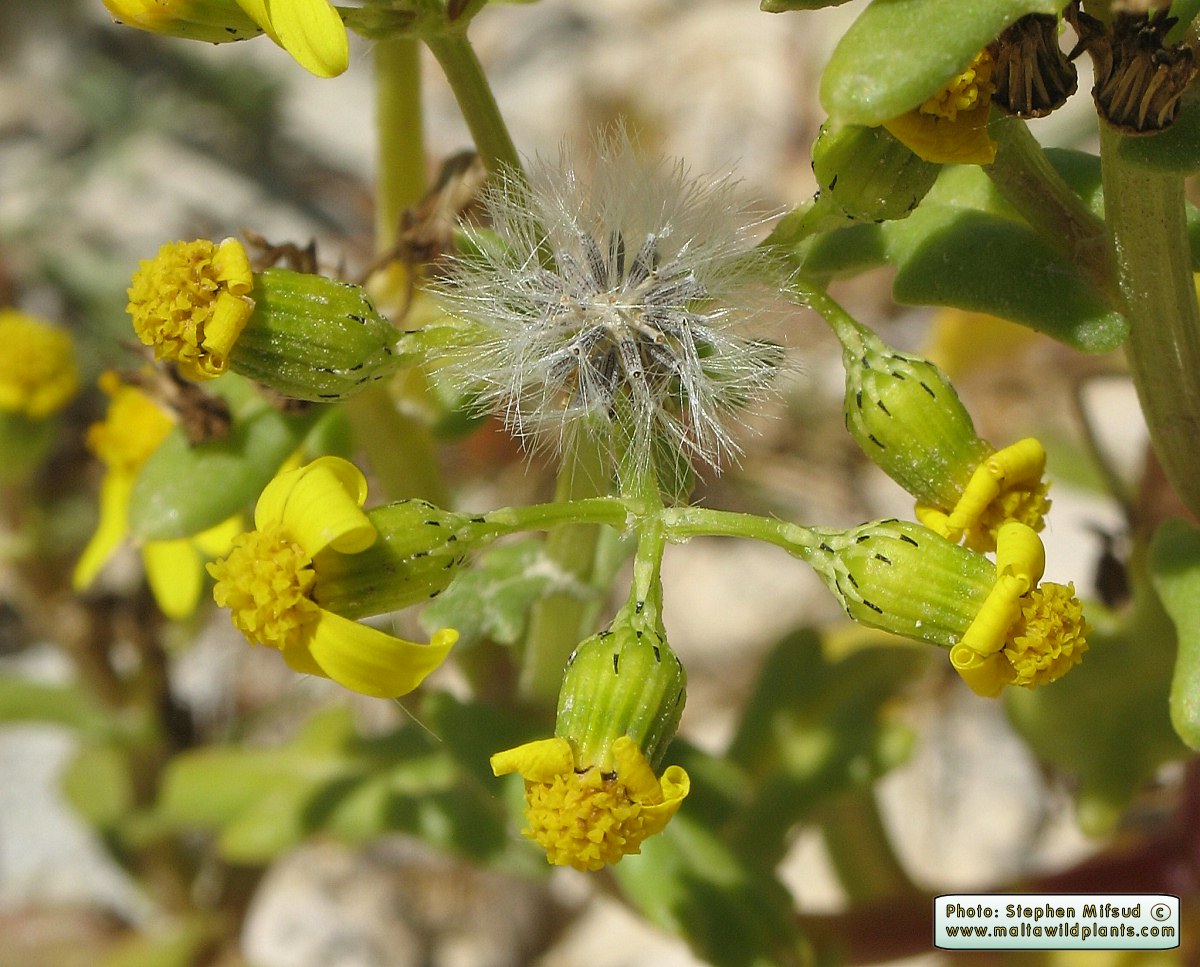
Photo of two flowers, where the upper one is the younger one since the blossomed disk florets are at the periphery, with the central one still closed in buds. The lower flower has no buds but all florets are in blossom.
Senecio leucanthemifolius (Coastal Ragwort) - CLICK TO ENLARGE PHOTO Senecio leucanthemifolius (Coastal Ragwort) - CLICK TO ENLARGE PHOTO Senecio leucanthemifolius (Coastal Ragwort) - CLICK TO ENLARGE PHOTO Senecio leucanthemifolius (Coastal Ragwort) - CLICK TO ENLARGE PHOTO
Close up photo of the flower, showing the structure of the disk florets. Each floret is composed of a corolla tube with 5 lobes. The style protrudes out by 1-2mm, around which there is the anther collar, composed of 5 fused anthers that produces yolk-yellow pollen.
Photo of another flower showing well the structural details of the central disk florets. Every disk and ray floret produces one seed after getting fertilised.
Macro photo of the central disk with annotations describing the structural parts of the disk and ray florets.
Photo of flowering plant found in Dwejra in Jan 2007.
Senecio leucanthemifolius (Coastal Ragwort) - CLICK TO ENLARGE PHOTO Senecio leucanthemifolius (Coastal Ragwort) - CLICK TO ENLARGE PHOTO Senecio leucanthemifolius (Coastal Ragwort) - CLICK TO ENLARGE PHOTO Senecio leucanthemifolius (Coastal Ragwort) - CLICK TO ENLARGE PHOTO
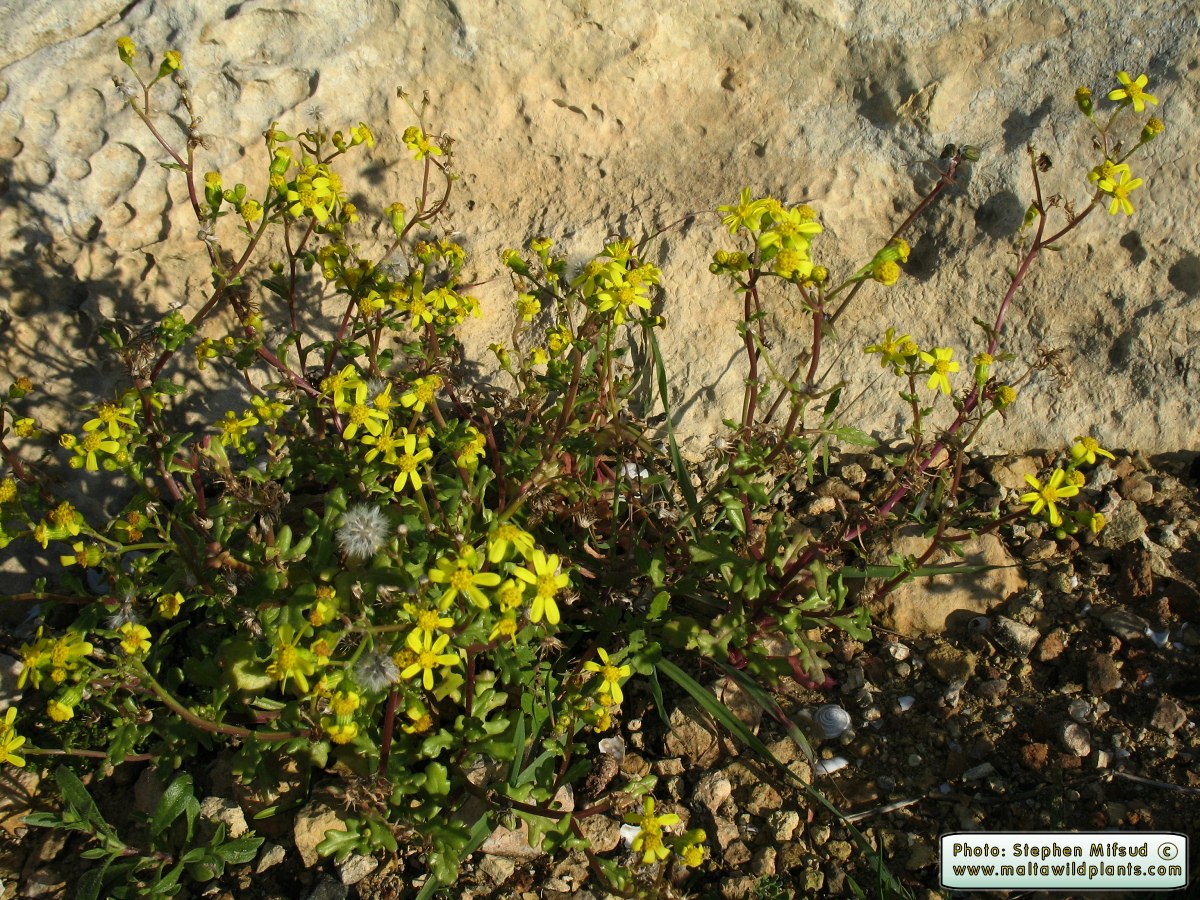
Photo of plant(s) with plenty of flowers. An interesting fact is that many flowers have 5 or 8 petals in Malta, wheras image sources on the internet show that they usually have more. For example in this specimen, most flowers have 8 petals, while in the next photo, the specimen has 5 petals.
Photo of plant specimen where many of the flowers have 5 petals. Compare with previous photo where the specimen has mostly 8-petalled flowers.
Photo of flowers (lateral view), showing the green, cup-shaped involucre made up of many, small, compact, bract-like structures called phyllaries arranged in 3-4 rows. Involucre is about 8mm long. Sometimes the phyllaries are called involucral bracts.
Photo of involucre. The lower row of phyllaries are triangular with a black tip. The phyllaries of the uppermost row are linear-oblong and about twice to thrice as long as those of the lower rows.
Senecio leucanthemifolius (Coastal Ragwort) - CLICK TO ENLARGE PHOTO Senecio leucanthemifolius (Coastal Ragwort) - CLICK TO ENLARGE PHOTO Senecio leucanthemifolius (Coastal Ragwort) - CLICK TO ENLARGE PHOTO Senecio leucanthemifolius (Coastal Ragwort) - CLICK TO ENLARGE PHOTO
Photo of 2 involucres, held by pedicels about 15mm long. As the rest of the plant, the inflorescence is glabrous (hairless).
Photo of fleshy leaves which are produced in large numbers. They are coarsely pinnate or lobed with margins having large blunt teeth.
Photo of leaves showing their lobed structure. Adult leaves are more deeply lobed from the cauline ones.
Close up photo of leaves. In this photo one can note more their thick, succulent structure.
Senecio leucanthemifolius (Coastal Ragwort) - CLICK TO ENLARGE PHOTO Senecio leucanthemifolius (Coastal Ragwort) - CLICK TO ENLARGE PHOTO Senecio leucanthemifolius (Coastal Ragwort) - CLICK TO ENLARGE PHOTO Senecio leucanthemifolius (Coastal Ragwort) - CLICK TO ENLARGE PHOTO
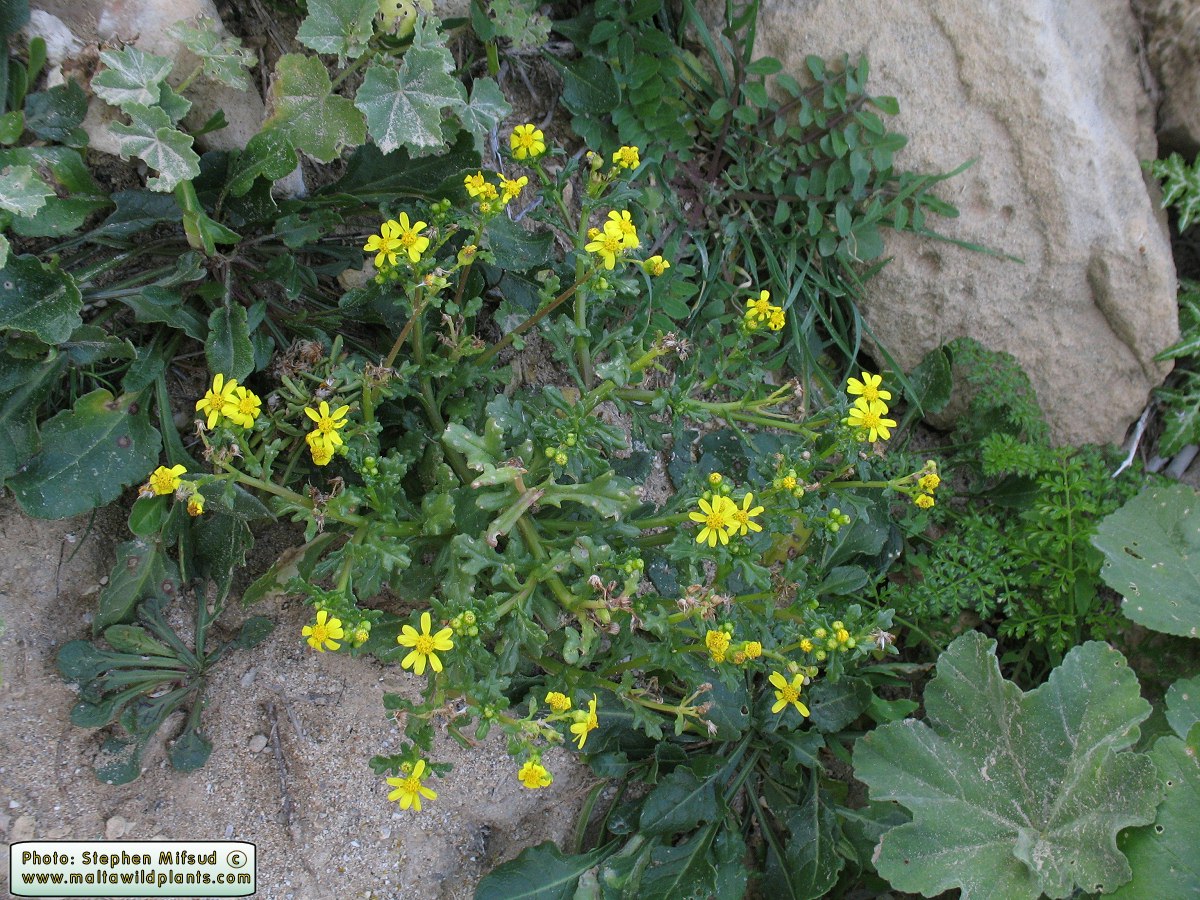
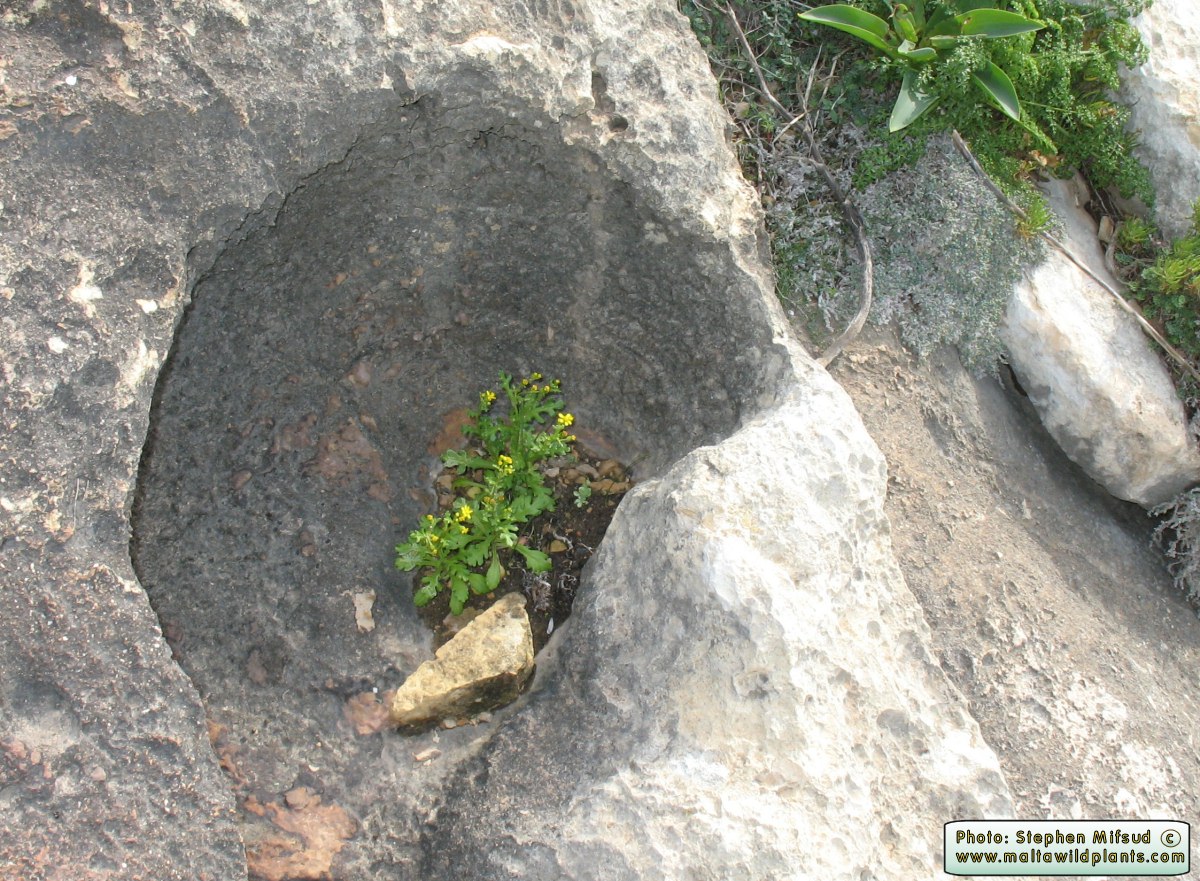
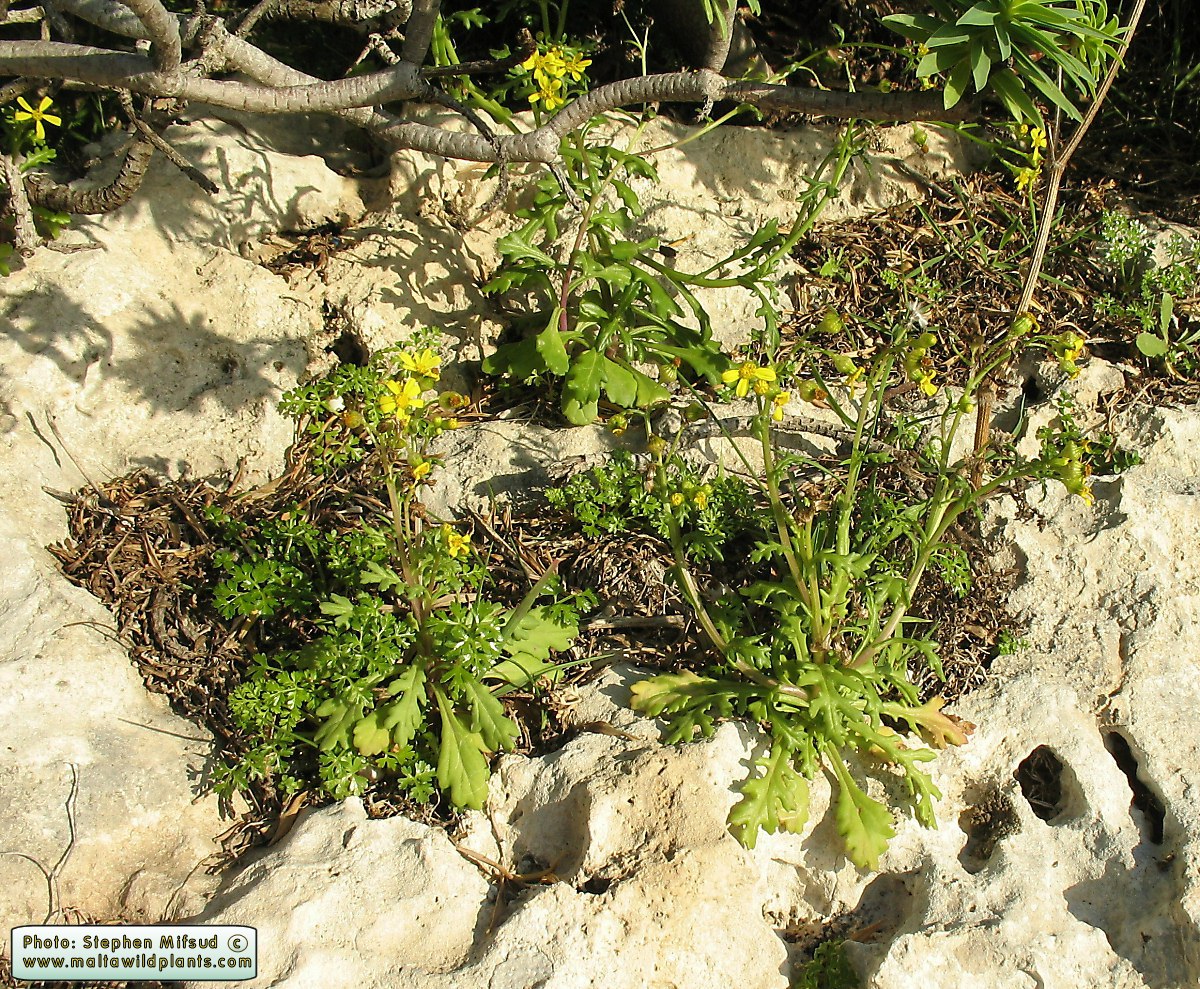
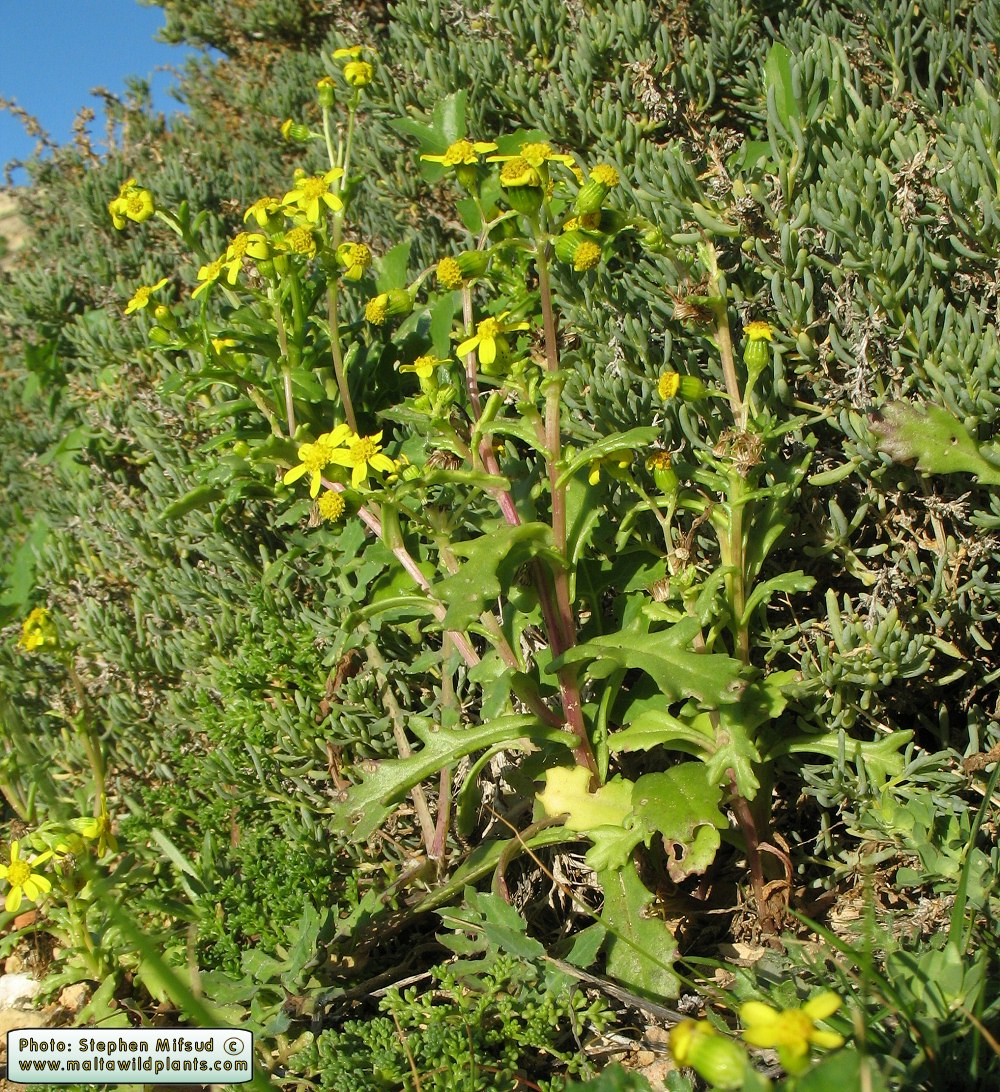
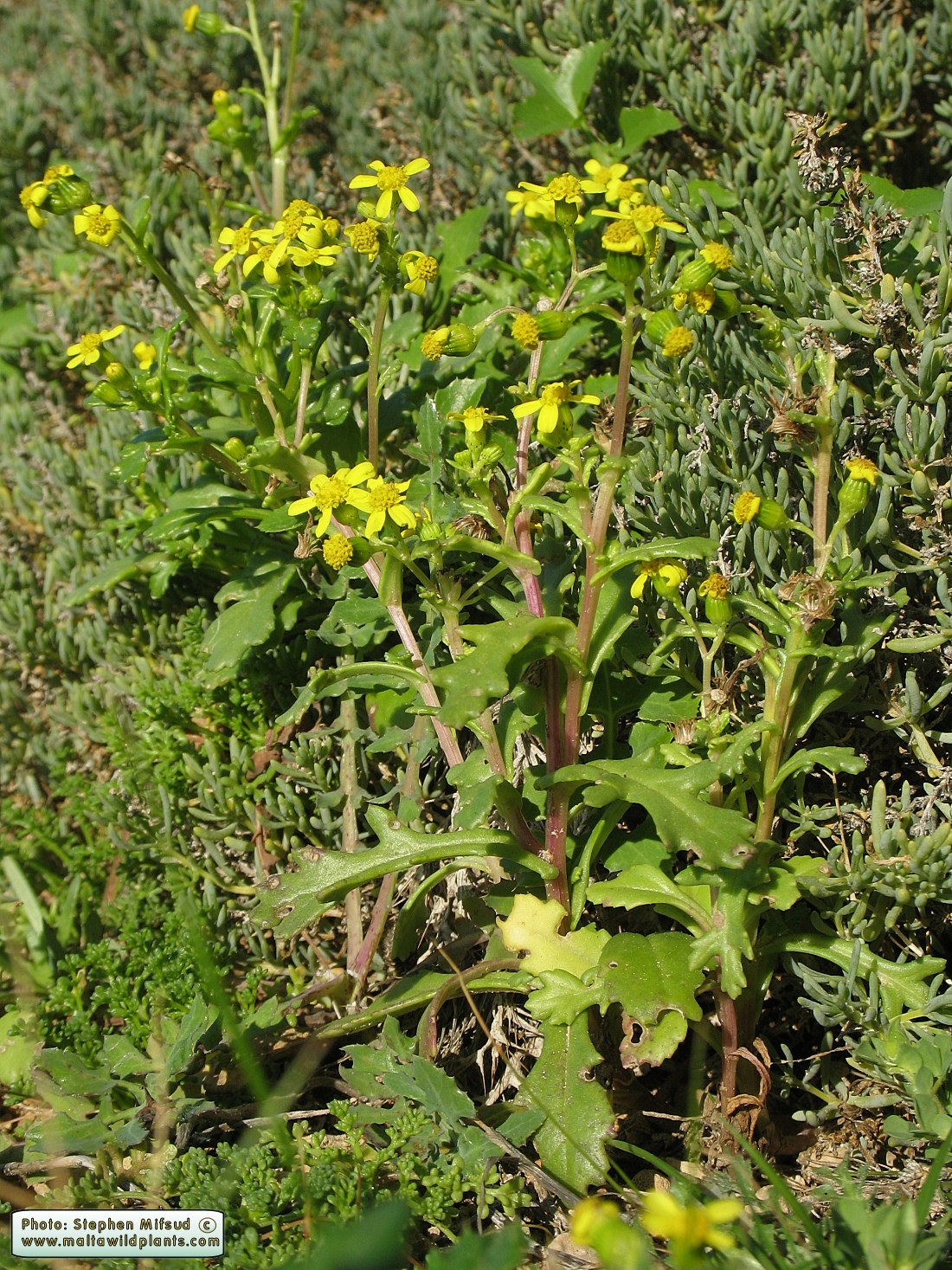
Photo showing habit of this plant, that is garigue and rock gaps. The plant seems to prefer coastal areas, and is mostly found at the Southern and Western coastal areas of Gozo.
Photo of the low growing, erect plants on soil patches in rocks.
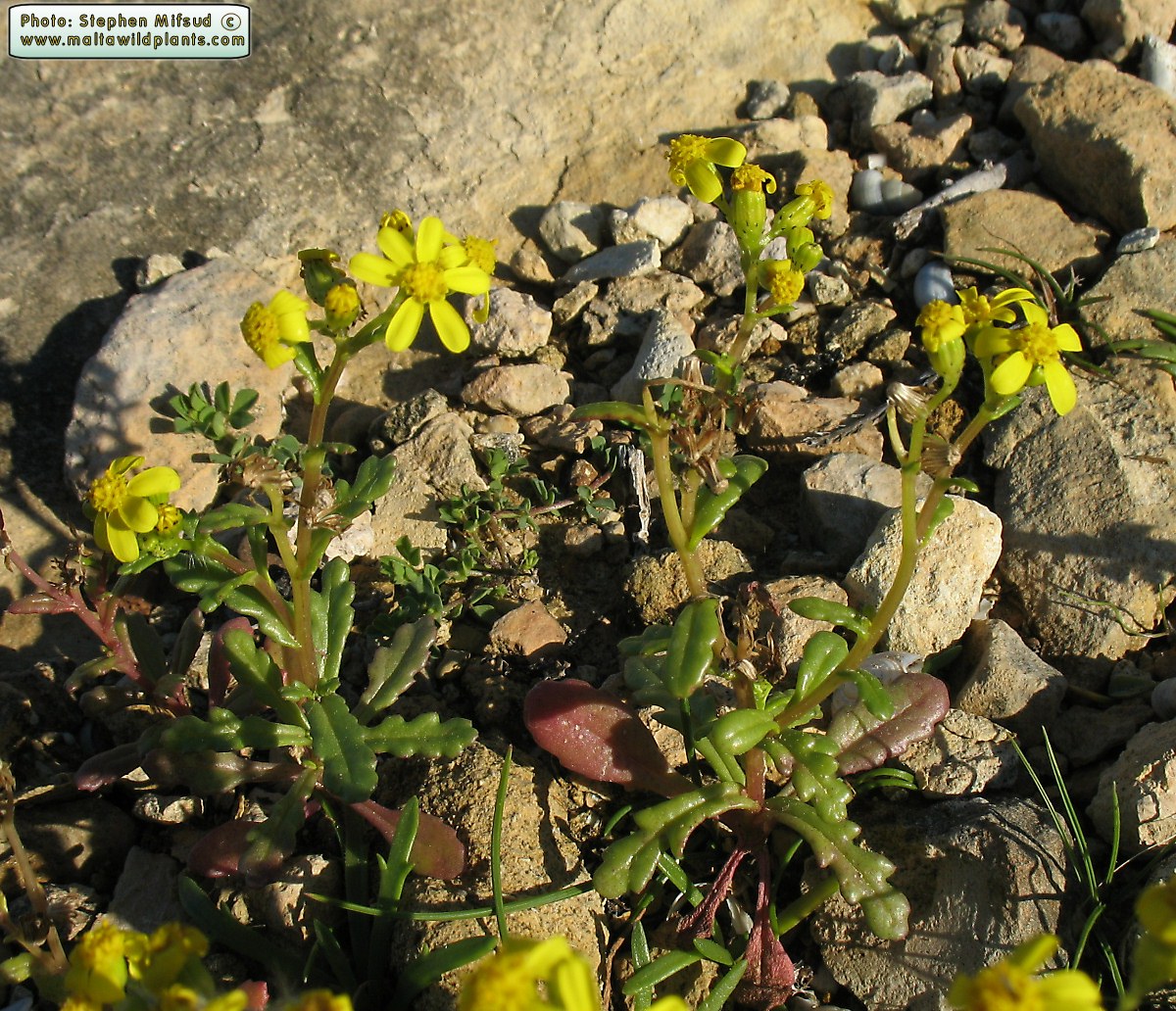
Photo of a small plant (lateral view) which as shown, branches at the lower part.
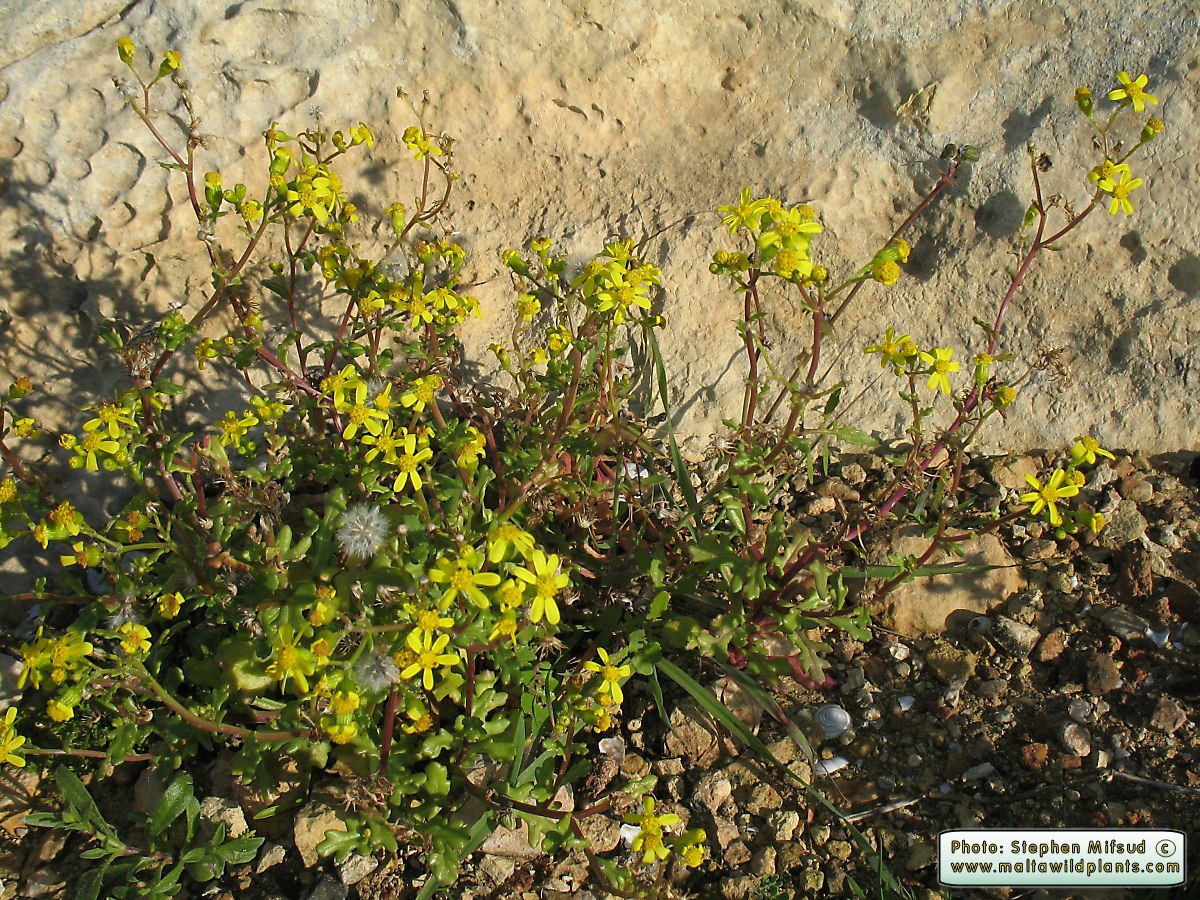
Photo of plants found at Dwejra, a site where this species is found frequently.
Senecio leucanthemifolius (Coastal Ragwort) - CLICK TO ENLARGE PHOTO Senecio leucanthemifolius (Coastal Ragwort) - CLICK TO ENLARGE PHOTO Senecio leucanthemifolius (Coastal Ragwort) - CLICK TO ENLARGE PHOTO Senecio leucanthemifolius (Coastal Ragwort) - CLICK TO ENLARGE PHOTO
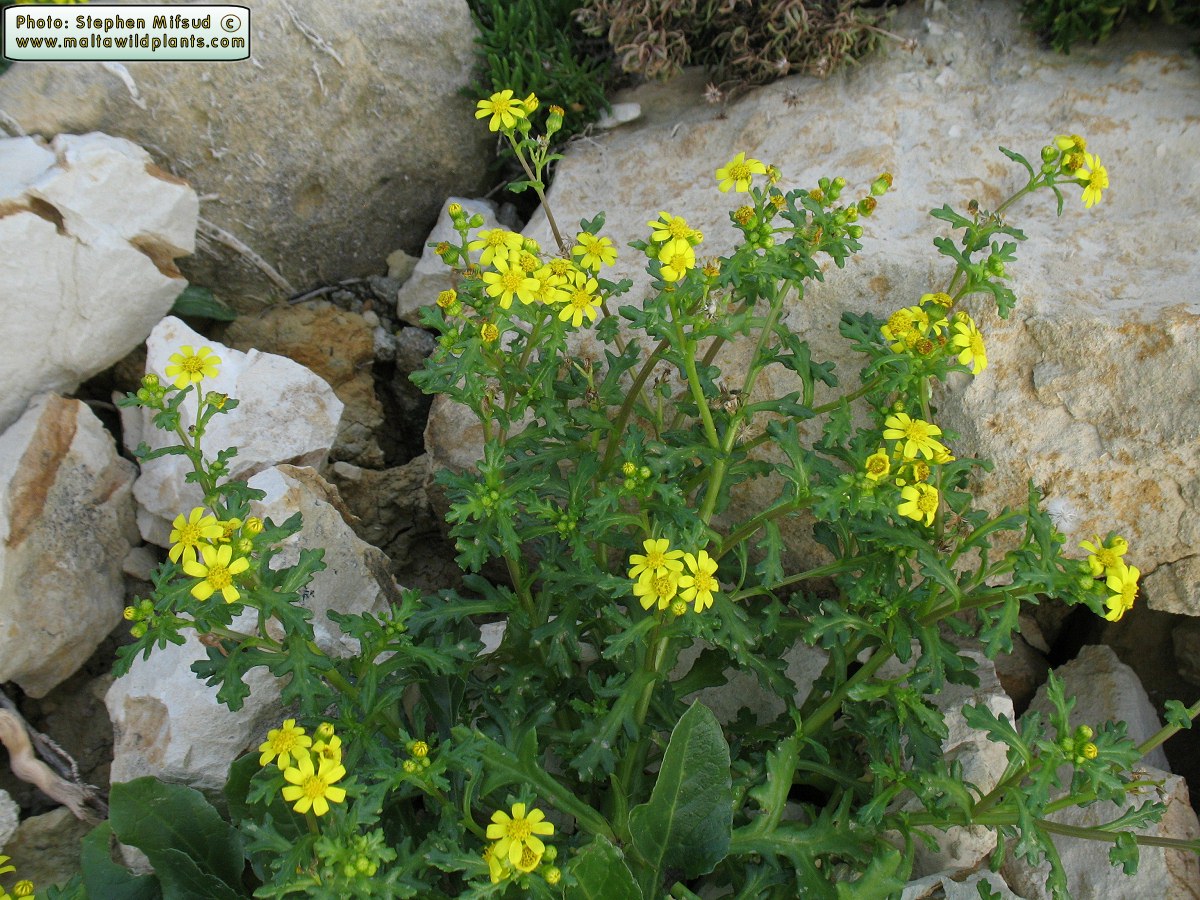
Photo of another plant that forms fleshy and lobed leaves and small, daisy-like, yellow flower heads (capitula).
Photo of 2 small plants growing in a rocky habitat.
Photo of a small population of plants mostly with flowers having 5-6 petals.
Photo of a mature plant showing its fleshy leaves and bright yellow flowers.
Senecio leucanthemifolius (Coastal Ragwort) - CLICK TO ENLARGE PHOTO Senecio leucanthemifolius (Coastal Ragwort) - CLICK TO ENLARGE PHOTO Senecio leucanthemifolius (Coastal Ragwort) - CLICK TO ENLARGE PHOTO Senecio leucanthemifolius (Coastal Ragwort) - CLICK TO ENLARGE PHOTO
Photo of plant with flowers having 8 petals. As observed elsewhere in this profile, the number of petals seems to vary between 5-8 in Maltese specimen.
Photo of the fruit, a bristly ball made up of some 30-60 achenes (seeds) sitting on a common receptacle.
Photo of several flowers and a fruit.
Close up photo of the fruit, showing the individual seeds each having a simple pappus (set of bristles) which serves as a parachute to carry and disperse the seeds by wind.
Senecio leucanthemifolius (Coastal Ragwort) - CLICK TO ENLARGE PHOTO Senecio leucanthemifolius (Coastal Ragwort) - CLICK TO ENLARGE PHOTO Senecio leucanthemifolius (Coastal Ragwort) - CLICK TO ENLARGE PHOTO  
Scanned image of fruiting structure, showing few of the achenes attached to the receptacle.
Scanned image of seeds, some with the pappus removed. The pappus is beaklessand a simple one - just few whorls of unbranched bristles from the apex of the achene.
Magnified scanned image of 2 seeds (one without the pappus). The linear seed consists of several longitudinal ribs on which there is numerous, tiny, white hairs appressed down rather than spreading out. Bristles 3-4mm long.
-

Further Information and Links

Proposal to conserve the name Senecio leucanthemifolius against S.varicosus by Bertil Nordenstam (pdf) Photo of Senecio leucanthemifolius ssp. rodriguezii
Photo of Senecio leucanthemifolius var. pectinatus Guss. Profile with photos of Senecio leucanthemifolius var. vernalis Waldst. & Kit. (Swedish text)
Seed drawings from US National Seed Herbarium Seed drawings from US National Seed Herbarium
Search for Senecio leucanthemifolius on the FORUM of MaltaWildPlants.com


Buy from and support MaltaWildPlants.com

Buy Seeds from Maltawildplants.com Buy samples of seeds of certain wild plants for your studies, trials, research, etc. Not all species' seeds can be exported (depending on Maltese regulations), and availability depends on season of species. So, before any payment, you are kindly asked to fill in the online quotation/order form by which I can contact you back for availability and charges. Buy Seeds from Maltawildplants.com   Online Quotation

Buy Seeds from Maltawildplants.com   Online Payment
Buy Documents from Maltawildplants.com Buy documents related to Maltese Wild Plants such as the list of references, full profile, or other docs you request. Buy Documents from Maltawildplants.com   Online Payment
Buy Images  from Maltawildplants.com Buy any of my own copyright images found in this large collection of Maltese flora. You should first select the image you want to buy and input its corresponding code (found beneath each individual photo) in the online ordering form. Buy Seeds from Maltawildplants.com   Online Payment
Buy Seeds from Maltawildplants.com Kindly donate any sum of money (from 2USD / 2Euro) to help us covering some expenses needed to maintain Maltawildplants.com. Please bear in mind how much hard work such a large and up-to-date website needs to arrive directly to you home, office or library. Your kind donations are both greatly appreciated and recorded for future reference. Donors asking help will have first que preference for assistance and special attention. Buy Seeds from Maltawildplants.com   Online Donation


Submit More Information

Use the form below to submit more information about this plant or a related species. If the data is taken from a book, journal, website, etc, please provide the corresponding reference / website address as indicated in the form. If it is your own observation, then your name will be cited. Your Email address will never be displayed online, it is just for internal communication.


For plant species that are marked as rare, you can also report other locations in Malta where you have seen this species.

Finally you can report any mistakes or errors found on the plant profile for necessary corrections. This will help to improve the website's acuracy.


To have more details about each particular field, just move your mouse on it and wait for the help message to pop up

* = required fields.
Plant Species:  *
Your name:   *
Your Email:   *
Fill any of the following 3 sections below (A, B or/and C) and send the form. - Thank you.
 
A:  Additional Information about this plant species
Own observations:
Info from published material (books, jounals, website):

Reference of published material:

 
B:   Where have you seen this plant on the Maltese Islands?
Locations in Malta or Gozo where you have encountered this plant.
Mostly applies for rare plants.


1:        2:   
3:       4:   
5:       6:   

Try to be as concise as possible. Examples: Dingli Cliffs (near chapel), Wied Incita (Zebbug side), Triq il-Kbira (Qormi), Barriera ta\' Abdul (Xlendi), Fields near Salib tal-gholja (Siggiewi). GPS bearings are also welcomed!
 
C:  Corrections for mistakes and errors in this plant profile.
Section of this plant Profile page where you found an error (select one)

What is the error/mistake
What should be its correction


All material and data on this webpage is under the copyright of the author of this site - Stephen Mifsud / www.MaltaWildPlants.com / Malta. (2002-2008)
This research project about the flora of Malta is sponsored by:
Middlesea Insurance p.l.c. A Fund established to help in the amelioration and enhancement of the environment in Malta and to take initiatives that enhance awareness on environmental issues amongst the public Empty space for sponsor Empty space for sponsor Benefit companies get by sponsoring this project