Wild Plants of Malta & Gozo - Plant: Sinapis alba (White Mustard)
  Hyoseris frutescens   MaltaWildPlants.com - A website dedicated to the flora of Malta  

   
HOME  - Index of Plant FamiliesA to Z INDEX - Species list aided with query filter toolsNEWS - Lateset news from the author & web updatesCOMMUNICATE ( Emails, Comments, Donations, etc)


White Mustard

Sinapis alba / White Mustard / Mustarda
This plant is brought to you by one of the project's sponsors:
Malta Nature Tours
More sponsors are needed for this project [ click here ]
Visitor hits (Mar-2003)

Nomenclature

Species name:

  L.

Author(s):

Carl von Linné;
   Sweden, 1707-1778

Common names:

White Mustard, Yellow Mustard

Maltese name:

Mustarda, Mustarda Bajda

Plant Family:

Brassicaceae/ Cruciferae   (Mustard (Cress) Family)

Name Derivation:

Sinapis = Mustard (Latin)
alba = White, probably referring to the white appearance of the fruit pods due to their long white hair. (Latin)

Synonyms:

Brassica alba, Brassica hirta

Remarks:

-


Morphology

PLANT STRUCTURE:

Characteristic

Growth Form

Branching

Surface

Description

Erect :

Upright, vertically straight up well clear off the ground.

Highly Branched :

Numerous branches and sub-branches are present but the common main stem is usually tall and well visible.

Setose :

Having thick or prominent bristles.

General
Picture

Wild Plants of the Mediterranean Islands of Malta  - Copyright Stephen Mifsud / Maltawildplants.com / Malta (2002-2009) Wild Plants of the Mediterranean Islands of Malta  - Copyright Stephen Mifsud / Maltawildplants.com / Malta (2002-2009) Wild Plants of the Mediterranean Islands of Malta  - Copyright Stephen Mifsud / Maltawildplants.com / Malta (2002-2009)

LEAVES:

Characteristic

Arrangement

Attachment

Venation

Description

Alternate :

Growing at different positions along the stem axis.

Stalked / Petiolate :

Hanging out by a slender leaf-stalk.

Pinnate venation :

Lateral veins which diverge from the midrib towards the leaf marhins.

General
Picture

Wild Plants of the Mediterranean Islands of Malta  - Copyright Stephen Mifsud / Maltawildplants.com / Malta (2002-2009) Wild Plants of the Mediterranean Islands of Malta  - Copyright Stephen Mifsud / Maltawildplants.com / Malta (2002-2009) Wild Plants of the Mediterranean Islands of Malta  - Copyright Stephen Mifsud / Maltawildplants.com / Malta (2002-2009)
 

Characteristic

Leaf Shape

Leaf Margin

Remarks

Description

Irregular Pinnate Lobes (Terminal lobe being largest) :

Compound arrangement of several lobes of various sizes and depths with the lowest being the smallest and most independent (deeply lobed), and the upper terminal lobe being the largest.

Serrate :

Sharp pointed teeth, oblique (inclined) to the margin, pointing apically like a saw.

Leaf bristles

Leaves contain short, white bristles especially on their veins.

General
Picture

Wild Plants of the Mediterranean Islands of Malta  - Copyright Stephen Mifsud / Maltawildplants.com / Malta (2002-2009) Wild Plants of the Mediterranean Islands of Malta  - Copyright Stephen Mifsud / Maltawildplants.com / Malta (2002-2009) Wild Plants of the Mediterranean Islands of Malta  - Copyright Stephen Mifsud / Maltawildplants.com / Malta (2002-2009)

FLOWERS:

Characteristic

Colour

Basic Flower Type

No. of Petals

No. of Sepals

Description

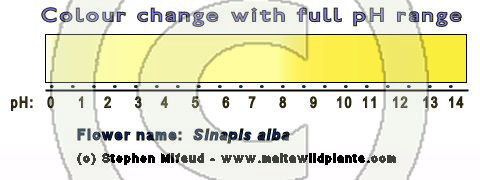
Pale Yellow

Sometimes described as Sulphur yellow.

Cruciform :

A flower with four petals at right angles to each other forming a shape of a cross.

4

4

Thin, rod-shaped sepals, spread out perpendicularly to flower stalk.

General
Picture

  Wild Plants of the Mediterranean Islands of Malta  - Copyright Stephen Mifsud / Maltawildplants.com / Malta (2002-2009) Wild Plants of the Mediterranean Islands of Malta  - Copyright Stephen Mifsud / Maltawildplants.com / Malta (2002-2009) Wild Plants of the Mediterranean Islands of Malta  - Copyright Stephen Mifsud / Maltawildplants.com / Malta (2002-2009)
 

Characteristic

Inflorescence

Description

Ovary

Stamens

Description

Raceme :

Simple, elongated, indeterminate cluster with stalked flowers.

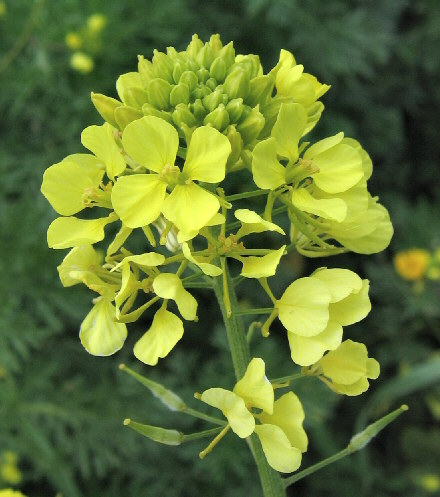
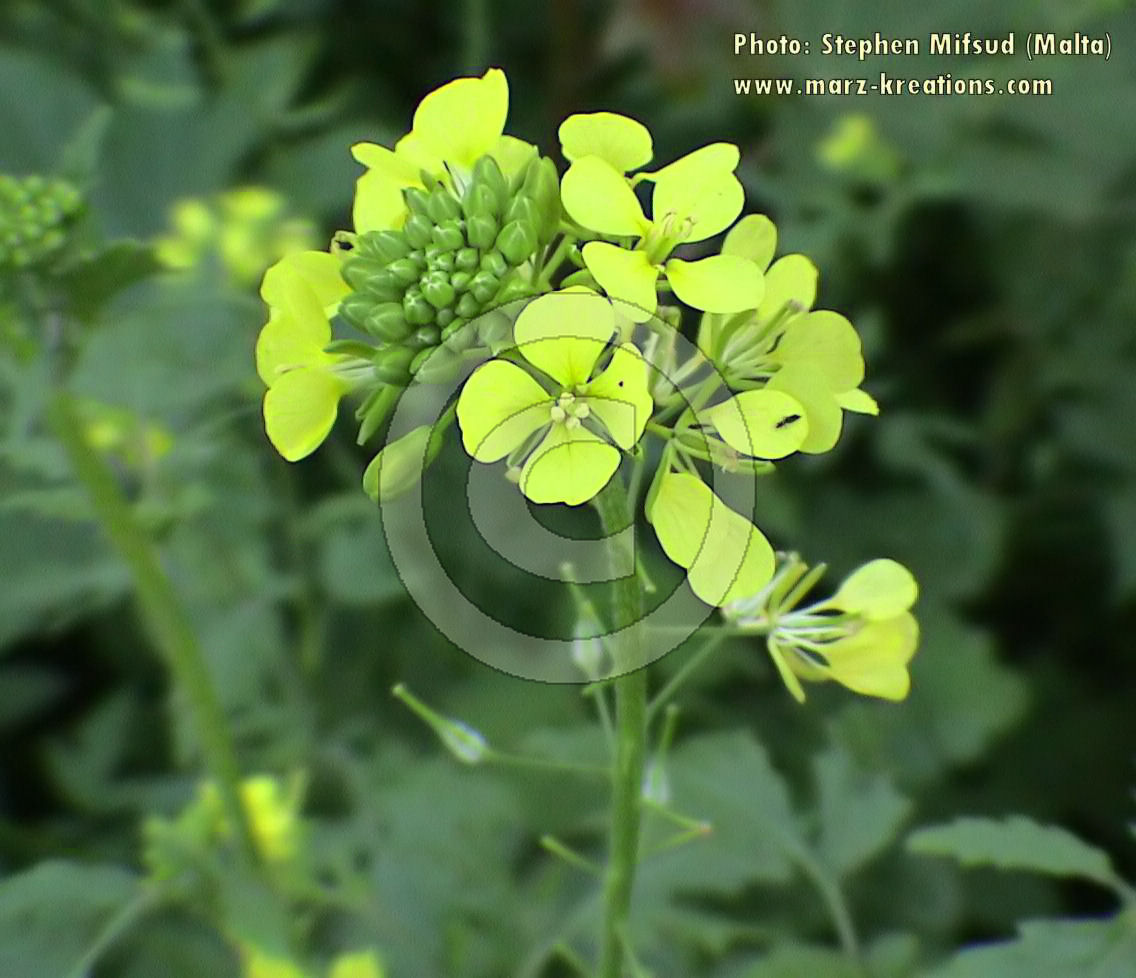
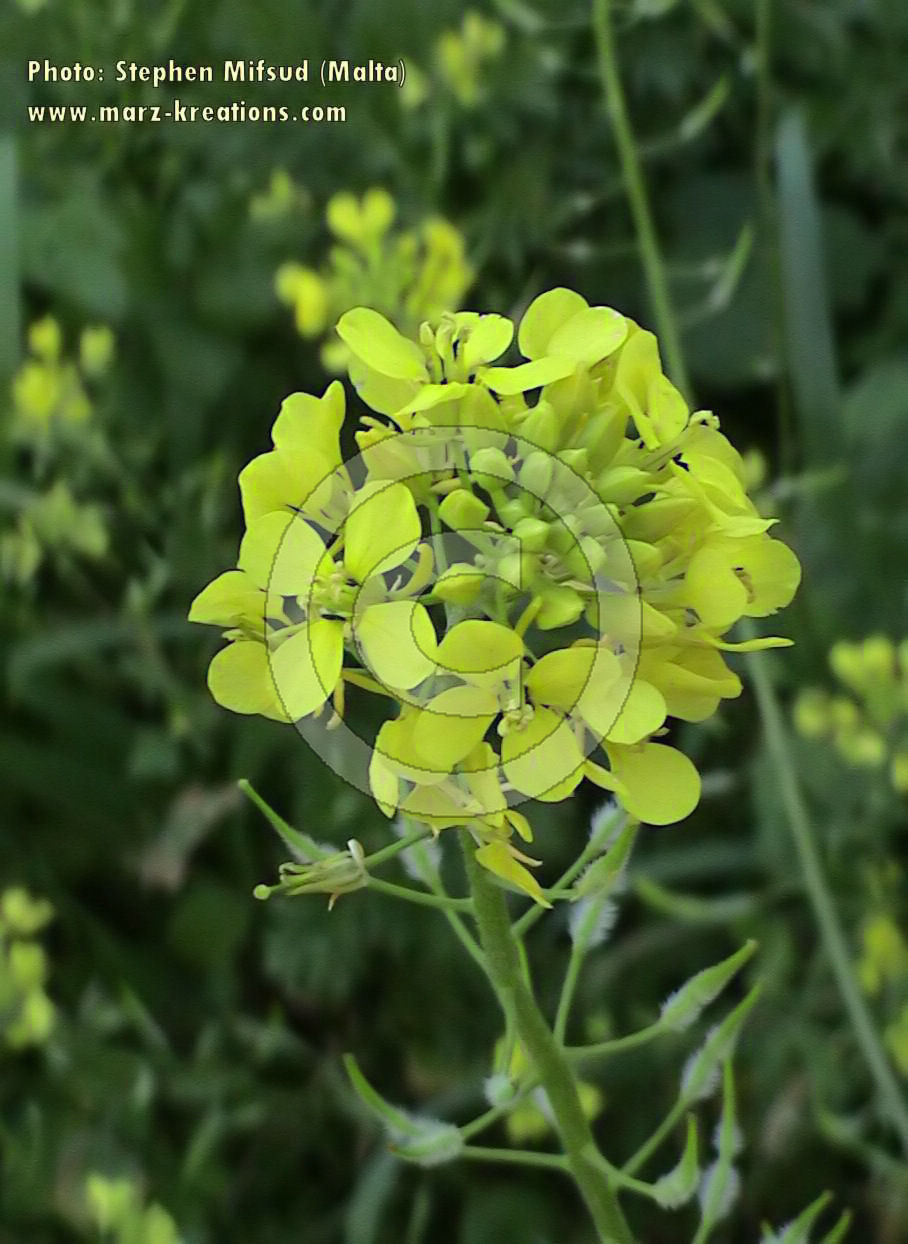
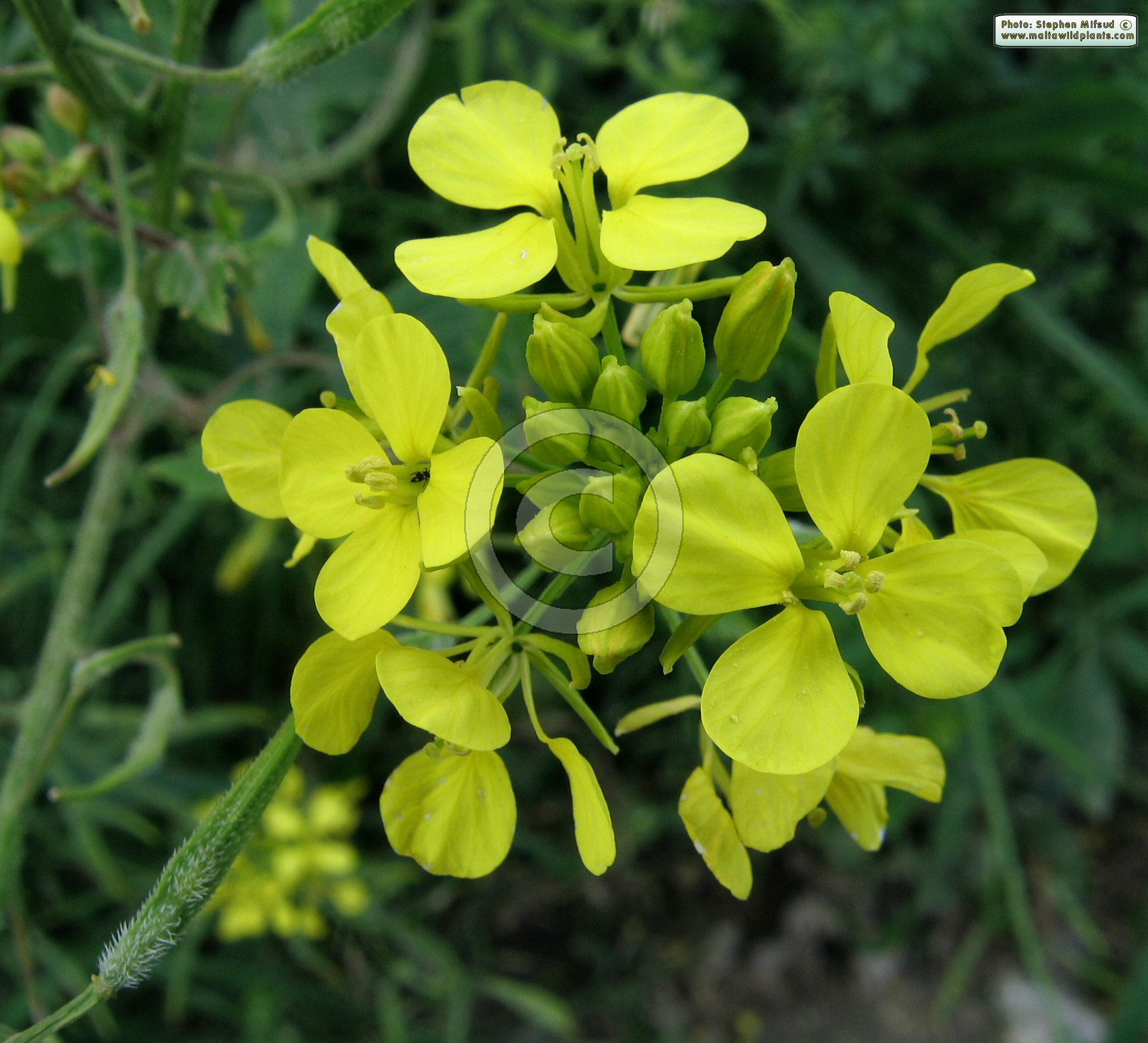
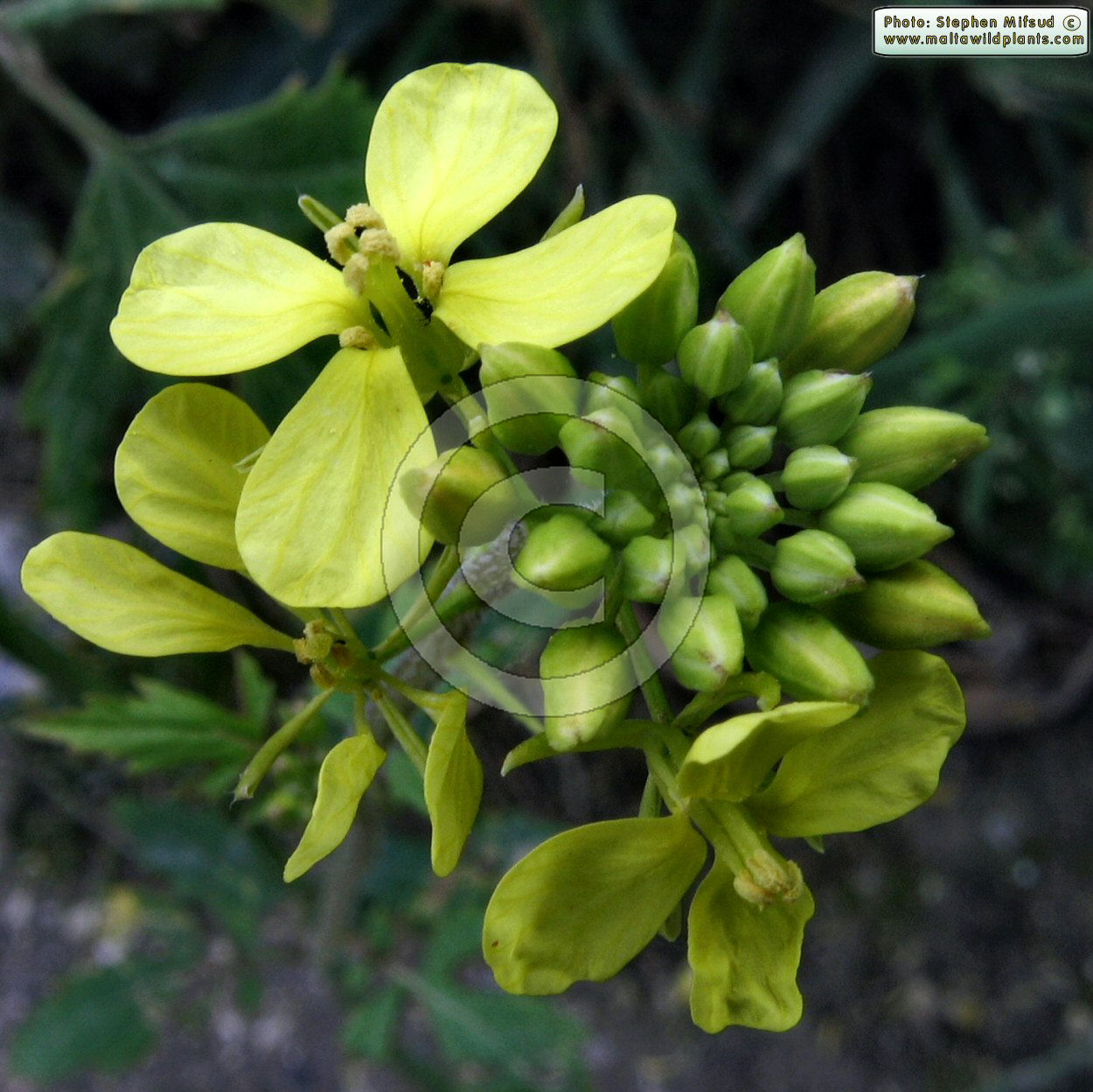
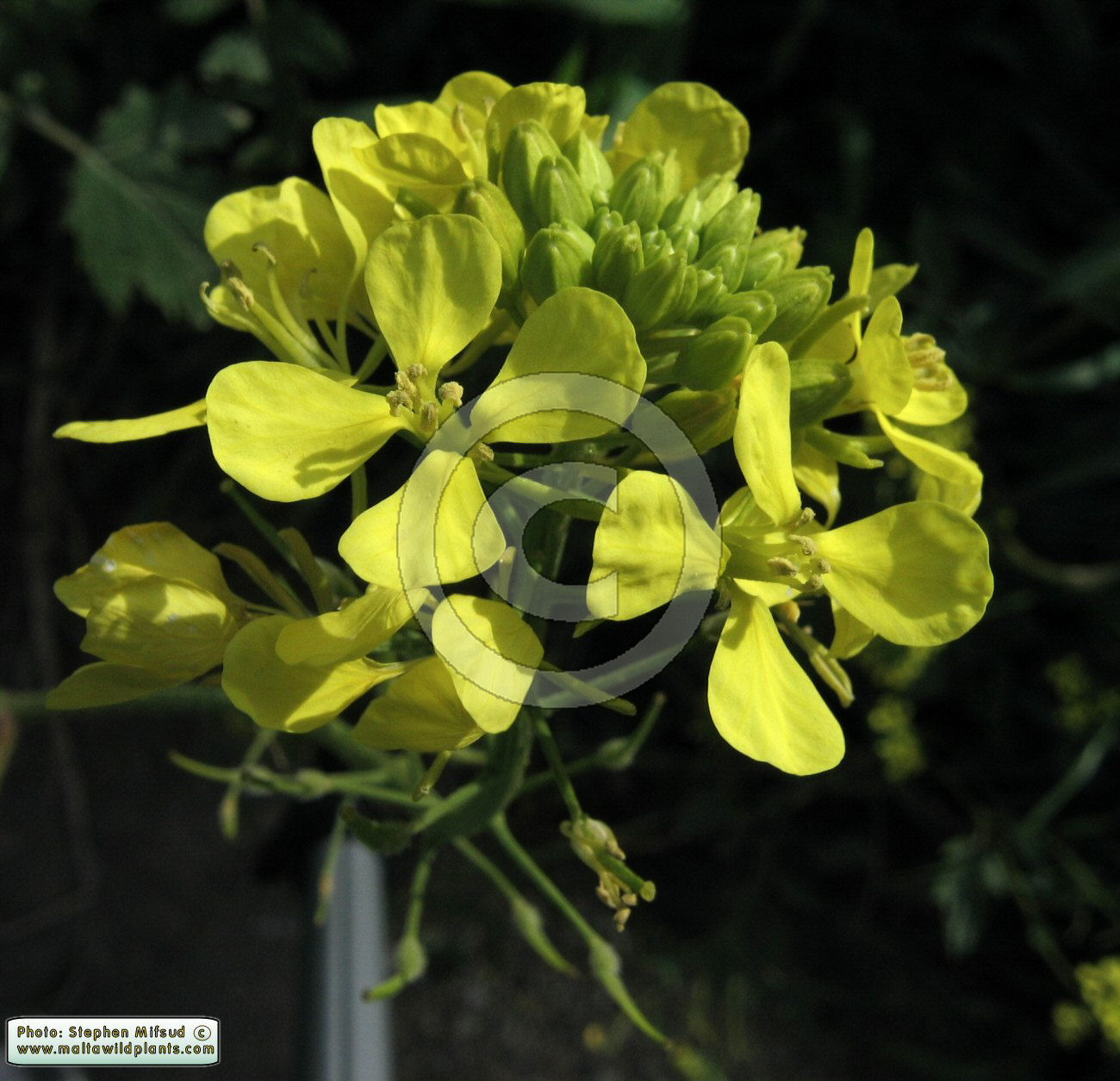
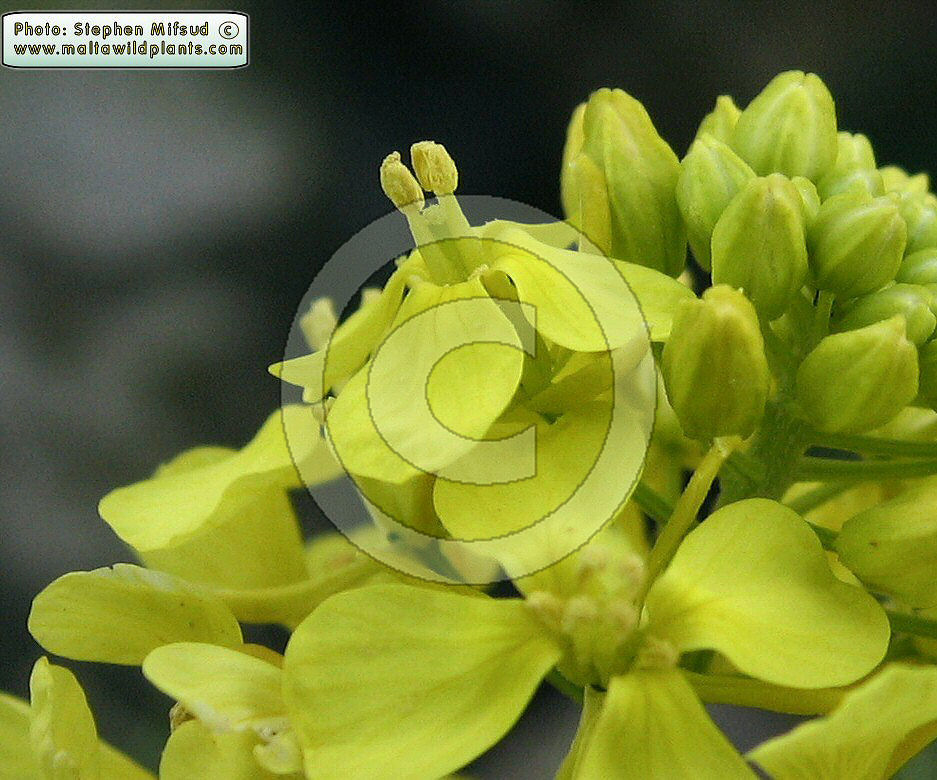
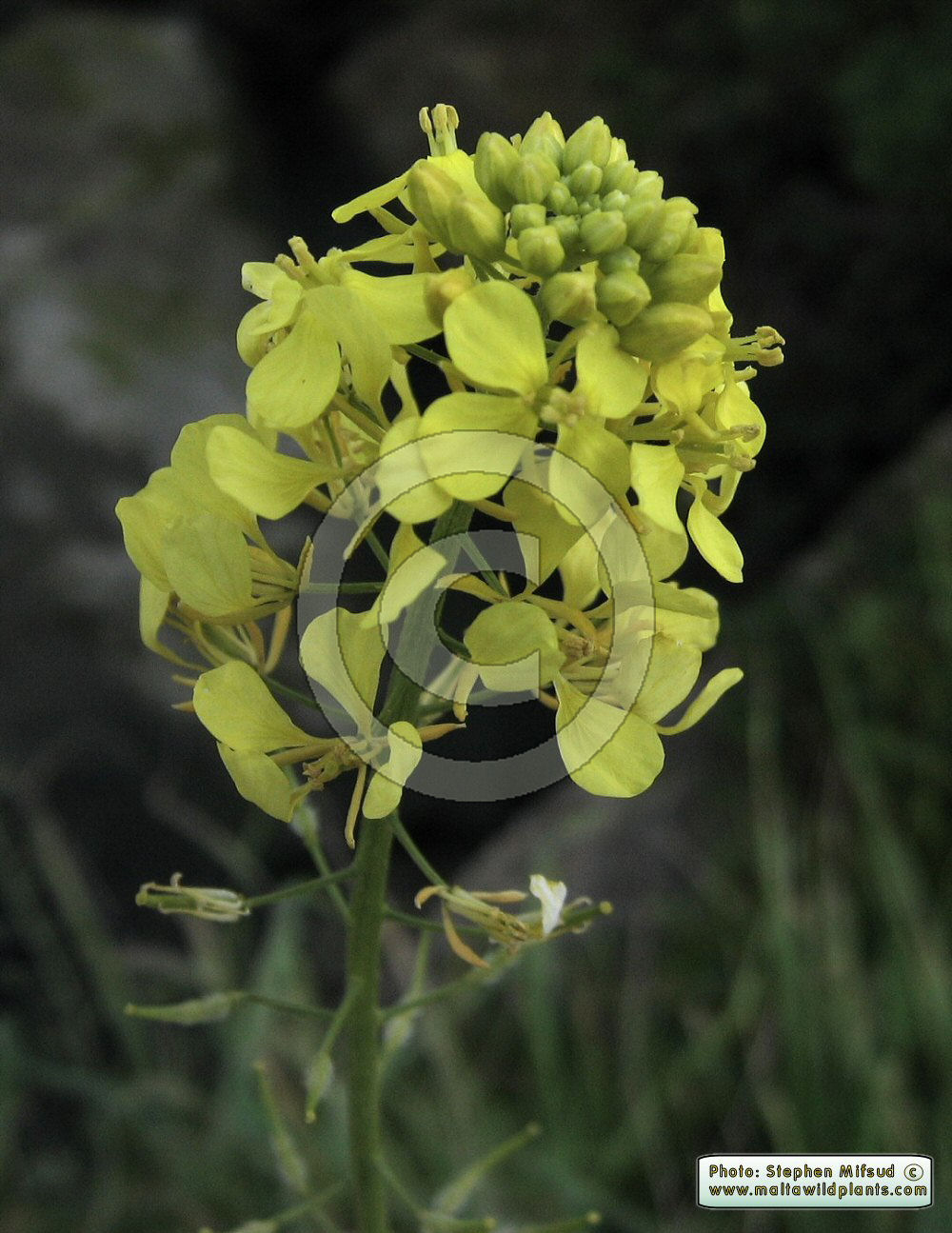
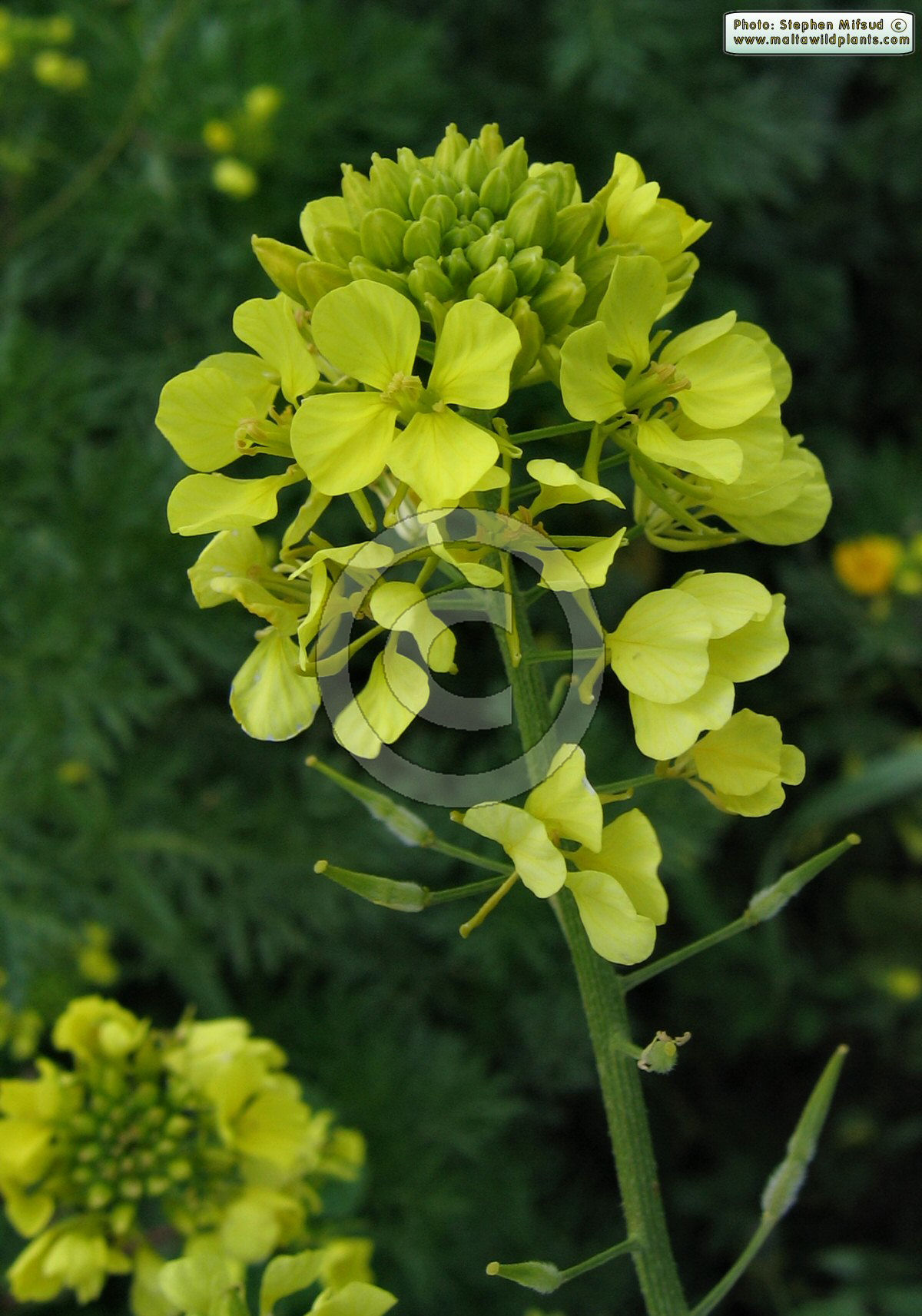
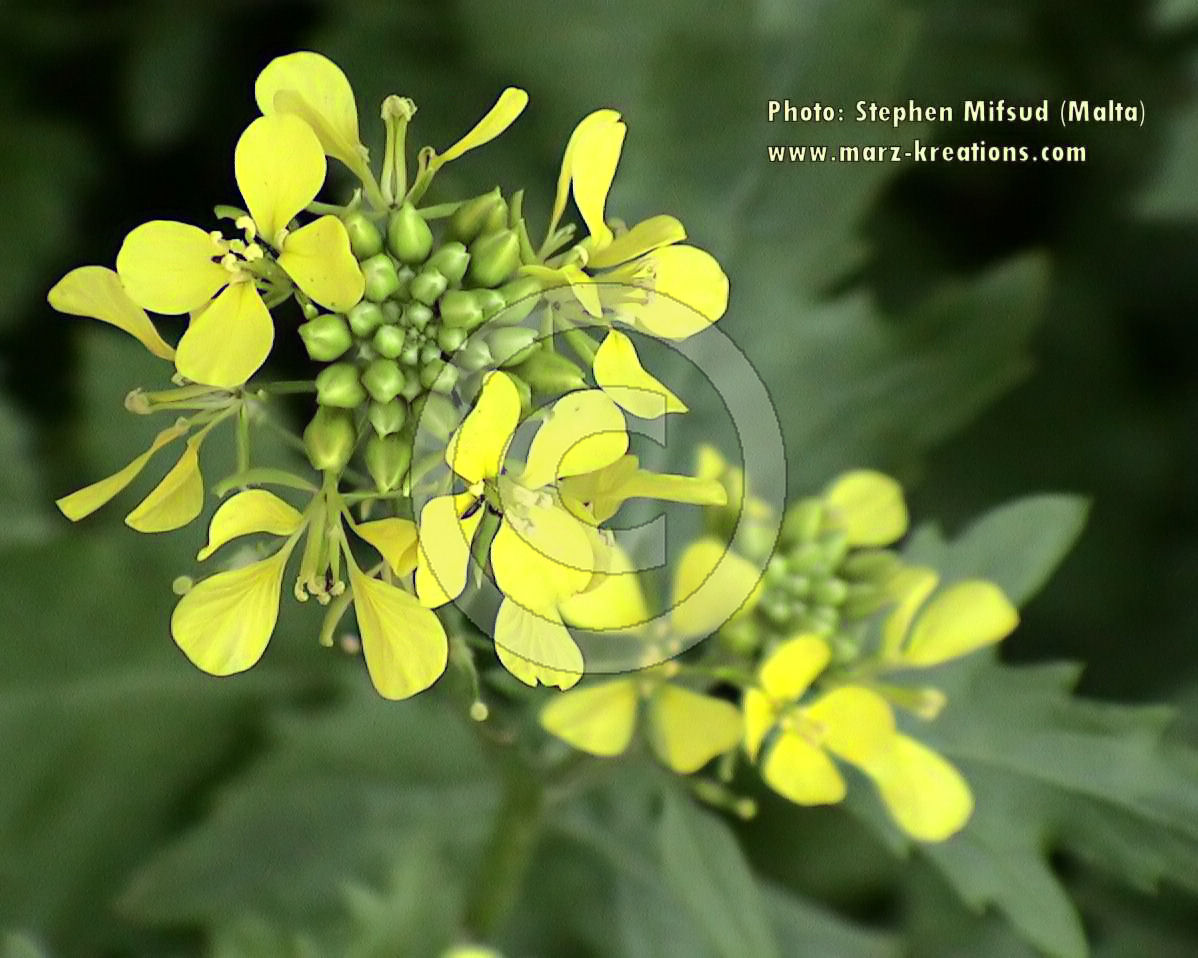
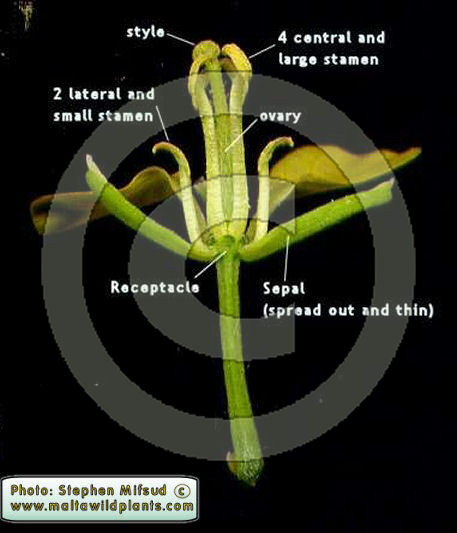
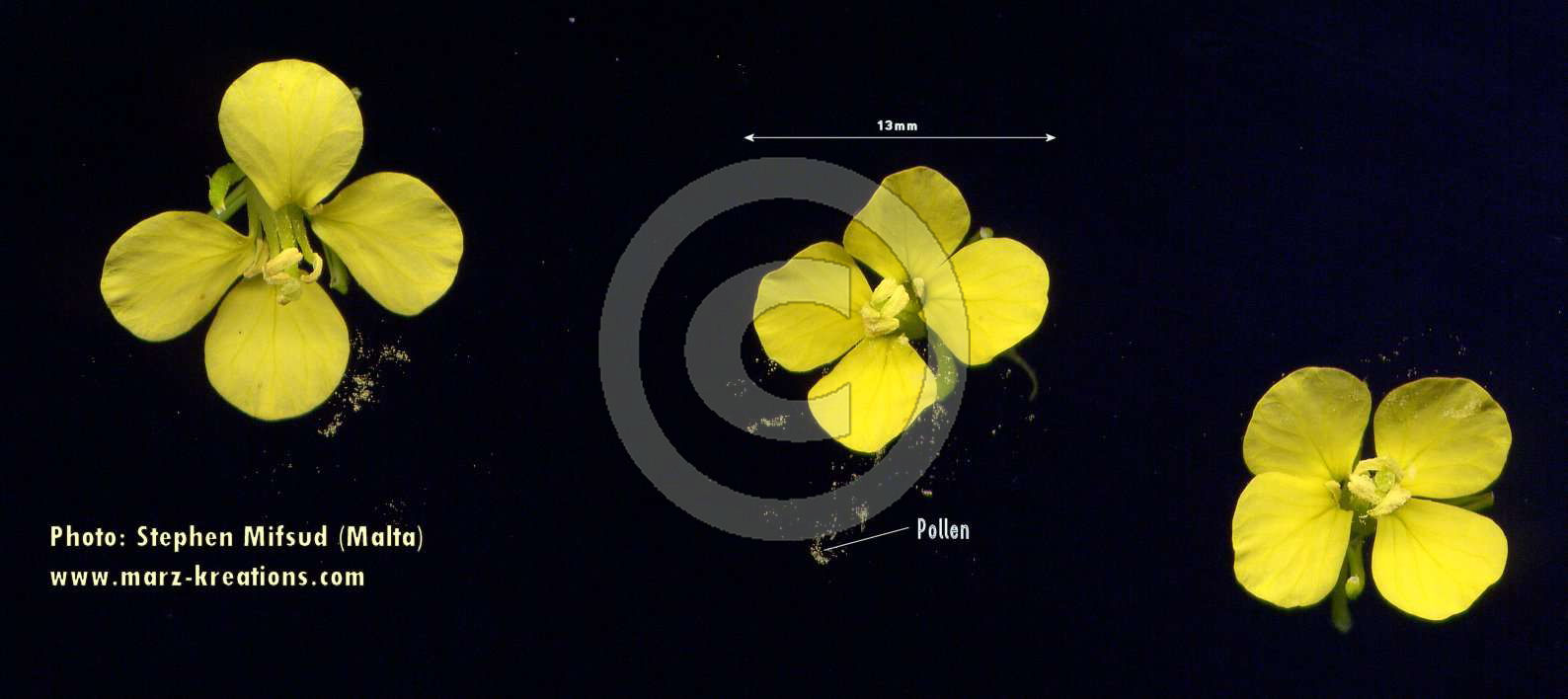
The plant forms cluster of numerous pale yellow flowers (about 13mm across) at the apex of the branching stems. Every flower consists of 4 oval, non-overlapping yellow petals arranged diagonally to each other, 6 stamens and a central pistil with swollen stigma. When young the flowers are cup shaped, but with time the petals spread out like a shape of a cross.

Superior :

Ovary situated above the flower parts (the calyx, corolla, and androecium). In other words, these are attached below the ovary.

6, Tetradynamous :

Having four long stamens (located centrally) and two shorter ones (located laterally).

General
Picture

Wild Plants of the Mediterranean Islands of Malta  - Copyright Stephen Mifsud / Maltawildplants.com / Malta (2002-2009) Wild Plants of the Mediterranean Islands of Malta  - Copyright Stephen Mifsud / Maltawildplants.com / Malta (2002-2009) Wild Plants of the Mediterranean Islands of Malta  - Copyright Stephen Mifsud / Maltawildplants.com / Malta (2002-2009) Wild Plants of the Mediterranean Islands of Malta  - Copyright Stephen Mifsud / Maltawildplants.com / Malta (2002-2009)
 

Characteristic

Scent

Average Flower Size

Pollen Colour

Other Notes

Description

Mild

Possess a faint sweet smell, which to some extent resembles Anisette.

13mm

Yellow

-


SEEDS:

Characteristic

No. Per Fruit

Shape

Size

Colour

Description

3-5

Globular

Spherical shape, like a small bead.

2-3mm

Dark Reddish Brown

General
Picture

Wild Plants of the Mediterranean Islands of Malta  - Copyright Stephen Mifsud / Maltawildplants.com / Malta (2002-2009) Wild Plants of the Mediterranean Islands of Malta  - Copyright Stephen Mifsud / Maltawildplants.com / Malta (2002-2009) Wild Plants of the Mediterranean Islands of Malta  - Copyright Stephen Mifsud / Maltawildplants.com / Malta (2002-2009) Wild Plants of the Mediterranean Islands of Malta  - Copyright Stephen Mifsud / Maltawildplants.com / Malta (2002-2009)

FRUIT AND OTHER BOTANICAL DATA:

Characteristic

Fruit Type

Colour of Fruit

Subterranean Parts

Other Notes

Description

Siliqua :

A dry dehiscent pod-like fruit which is longer, often many times than broad, so having the shape of an elongated pouch.

Green

Turns straw-colour or brown when seed pod is ripe and dries out.

Taproot :

A rooting system where there is the main descending root of a plant having a single dominant large structure from which a network of smaller and long roots emerge.

-

General
Picture

Wild Plants of the Mediterranean Islands of Malta  - Copyright Stephen Mifsud / Maltawildplants.com / Malta (2002-2009) Wild Plants of the Mediterranean Islands of Malta  - Copyright Stephen Mifsud / Maltawildplants.com / Malta (2002-2009) Wild Plants of the Mediterranean Islands of Malta  - Copyright Stephen Mifsud / Maltawildplants.com / Malta (2002-2009) Wild Plants of the Mediterranean Islands of Malta  - Copyright Stephen Mifsud / Maltawildplants.com / Malta (2002-2009)

Specifications & Description

Life Cycle:

Annual.

Habitat:

Uncultivated fields and wasteland especially on calcareous soils.

Frequency:

Frequent

Localities in Malta:

Not very common. Found as a crop escape near certain fields that cultivated this plant in the previous years as under the 'English Bridge' at Mtarfa, Qormi and Zebbug.

Plant Height:

70-140cm.

Flowering Period:

Dec - May

Poison:

The seed contains substances that irritate the skin and mucous membranes. The plant is possibly poisonous once the seed pods have formed.

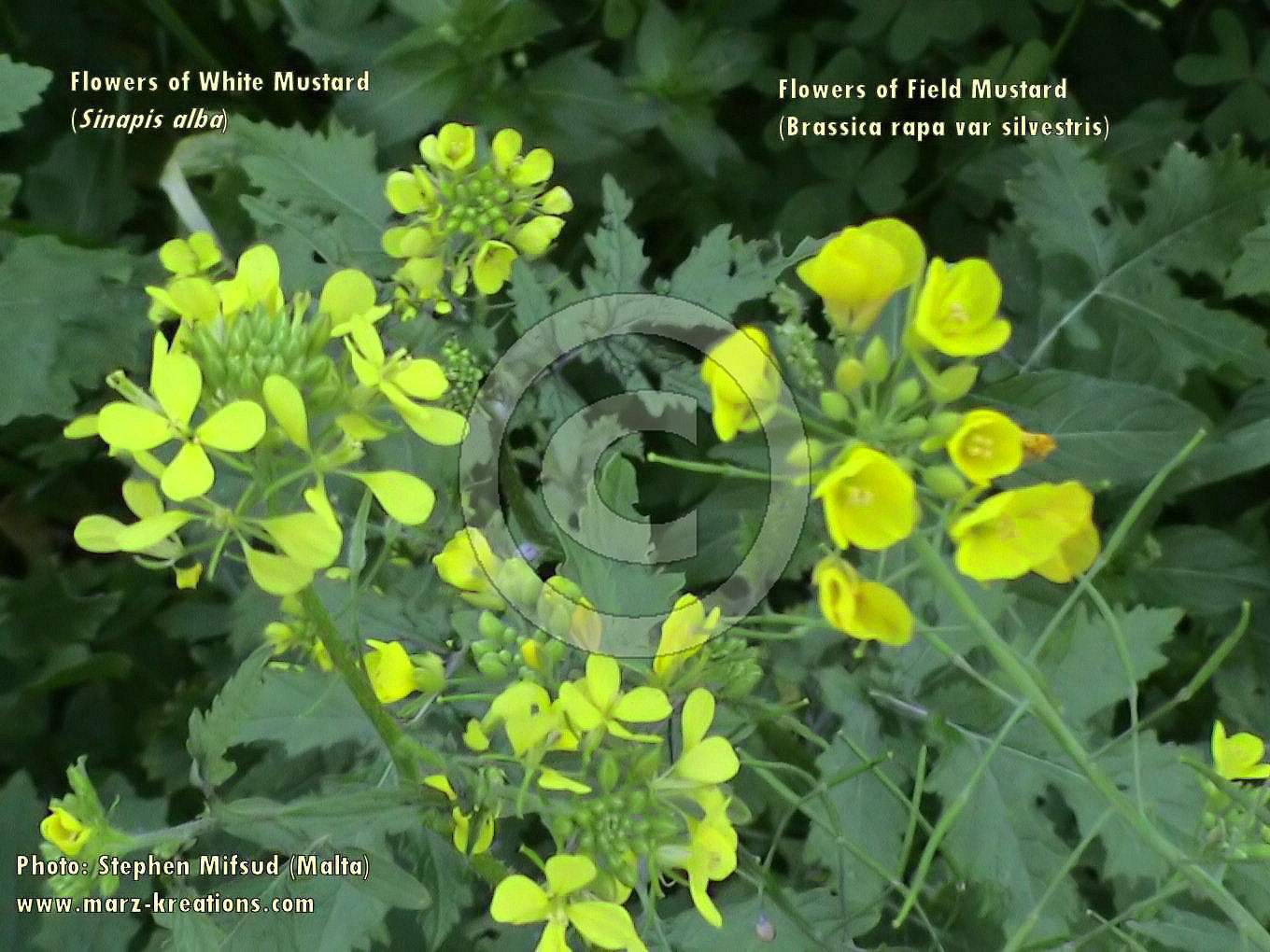
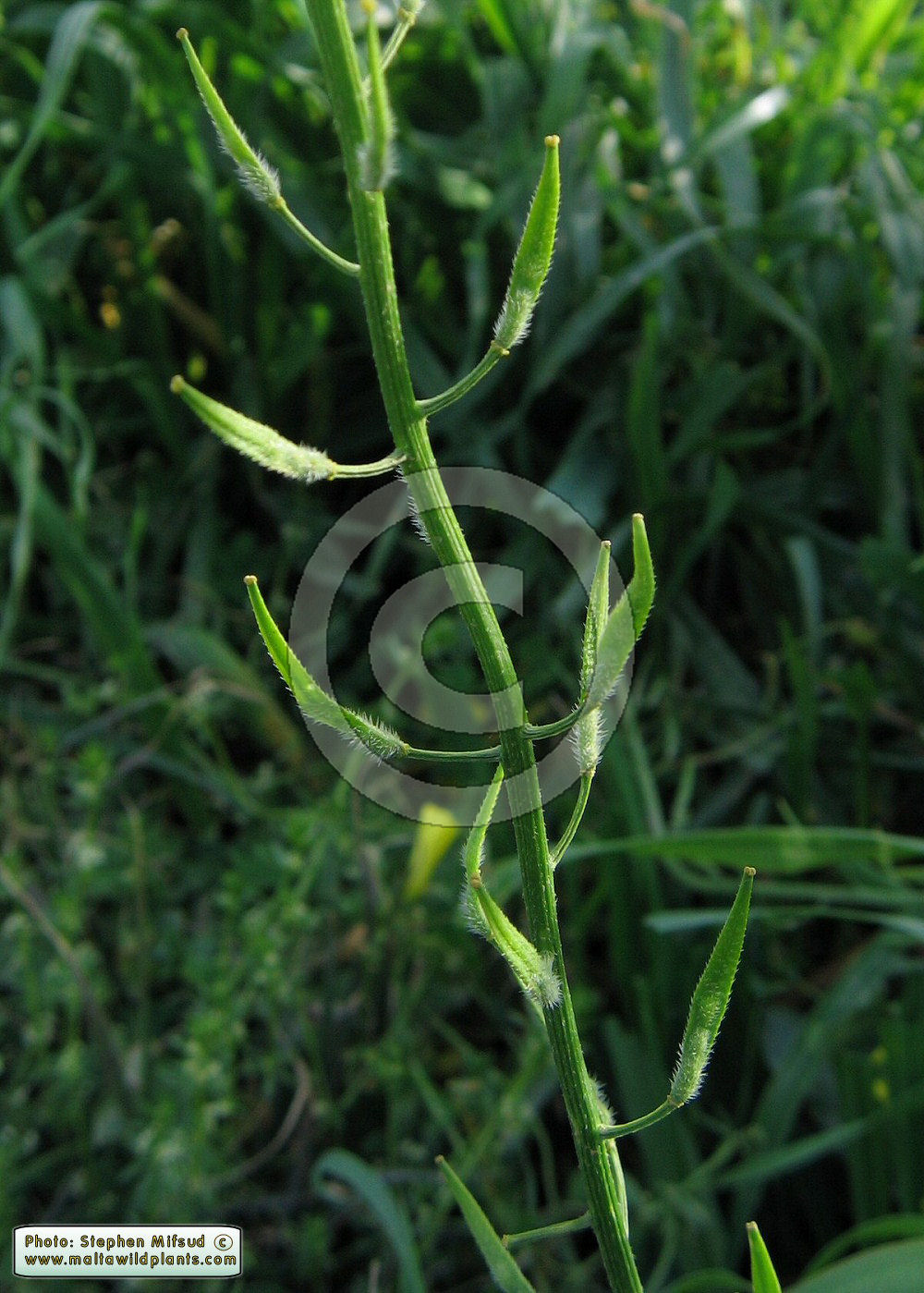
A fleshy anual plant growing mostly in fields and calcium rich soils. At a glance, the plant looks alike the yellow-flowered Cruciferae found in Malta (eg: Brassica rapa subsp silvestris), but it has a specific characteristic which distinguishes it from them. this is the fruit pod which looks glowing white in light due to the presence of white bristles, at least half the length of the fruit. Hence the name of the plant (white mustard) may have originated from this fact.

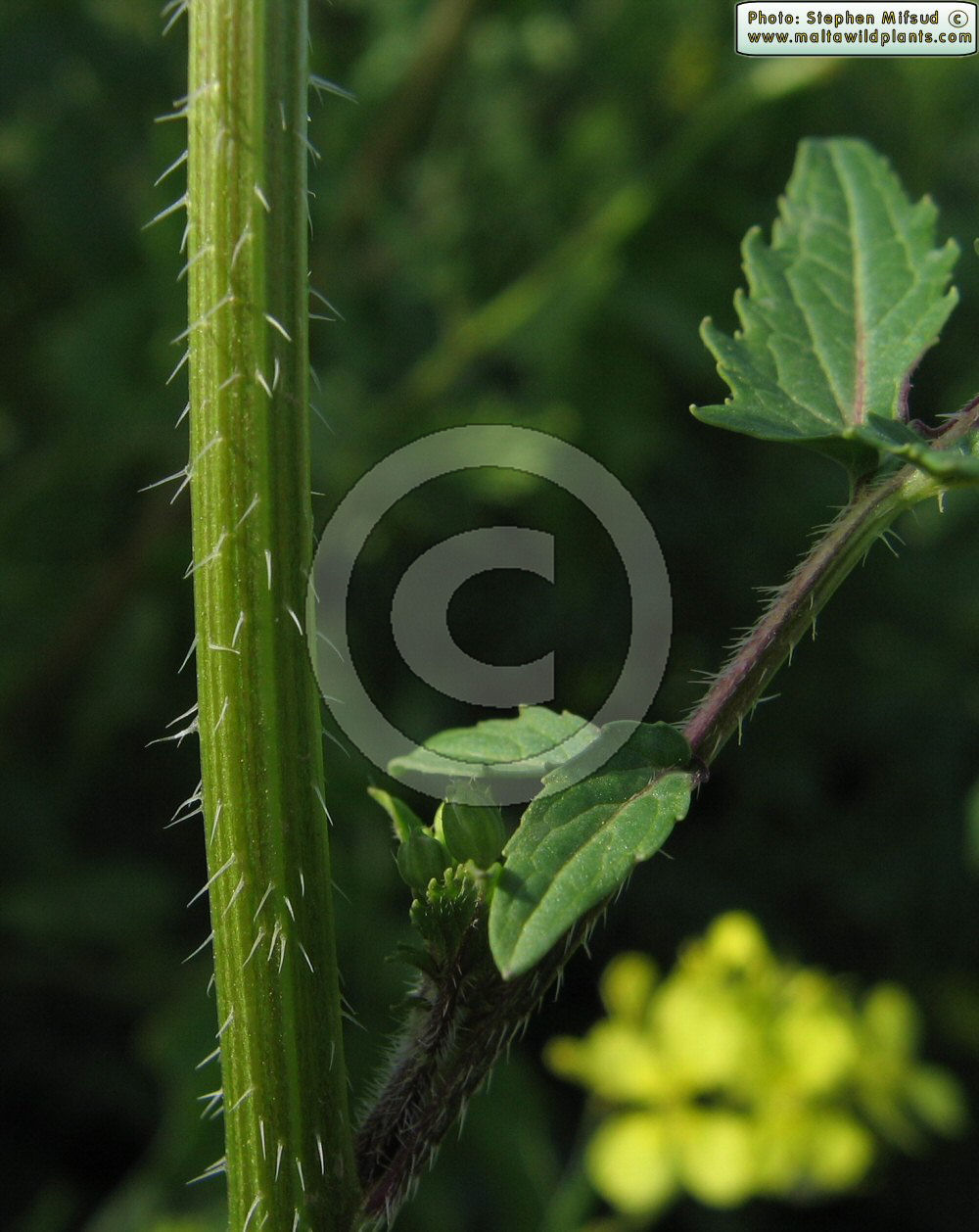
The stem is longitudinally ribbed and has short white bristles all its length. The bristles are not hard or spiny.

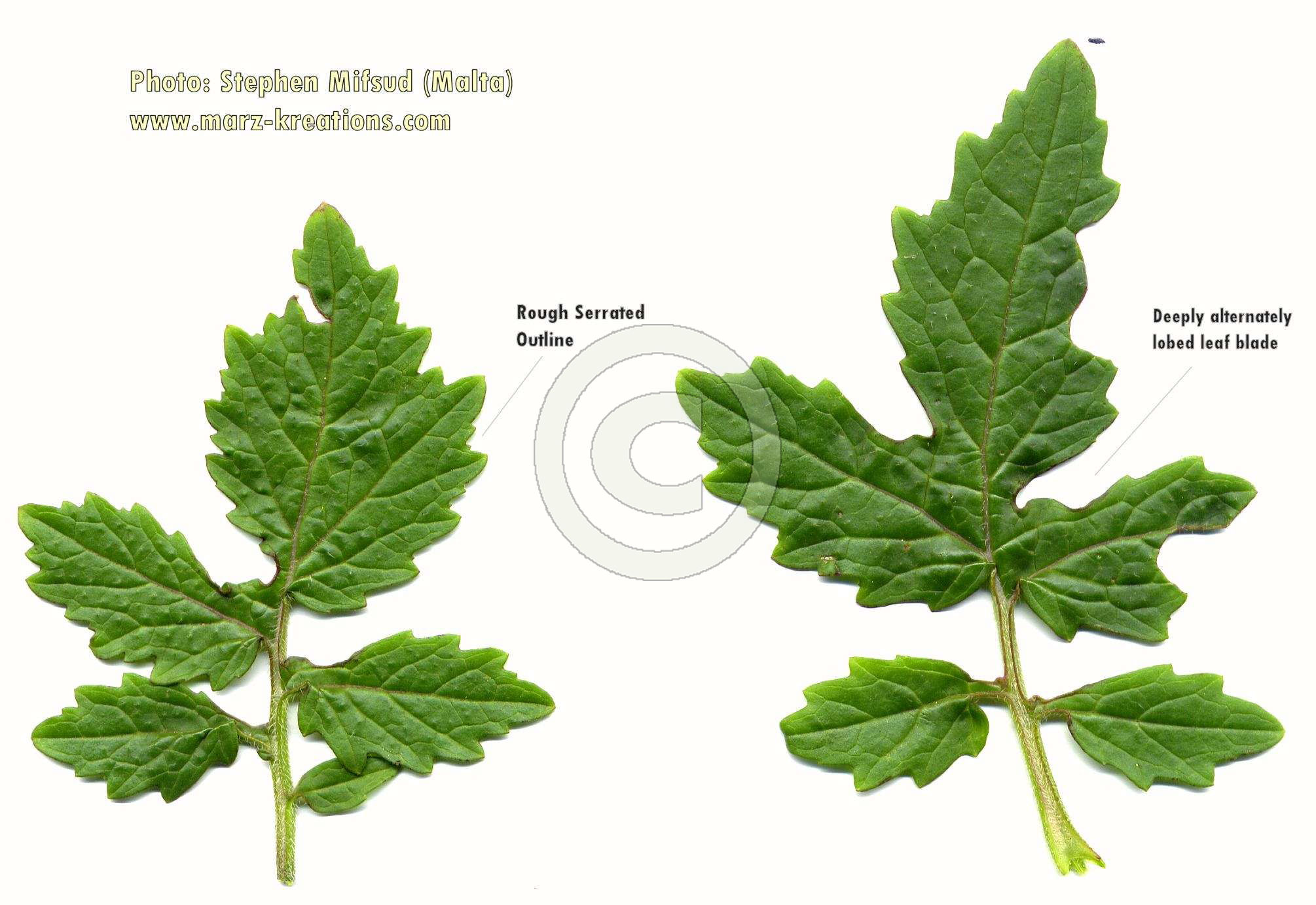
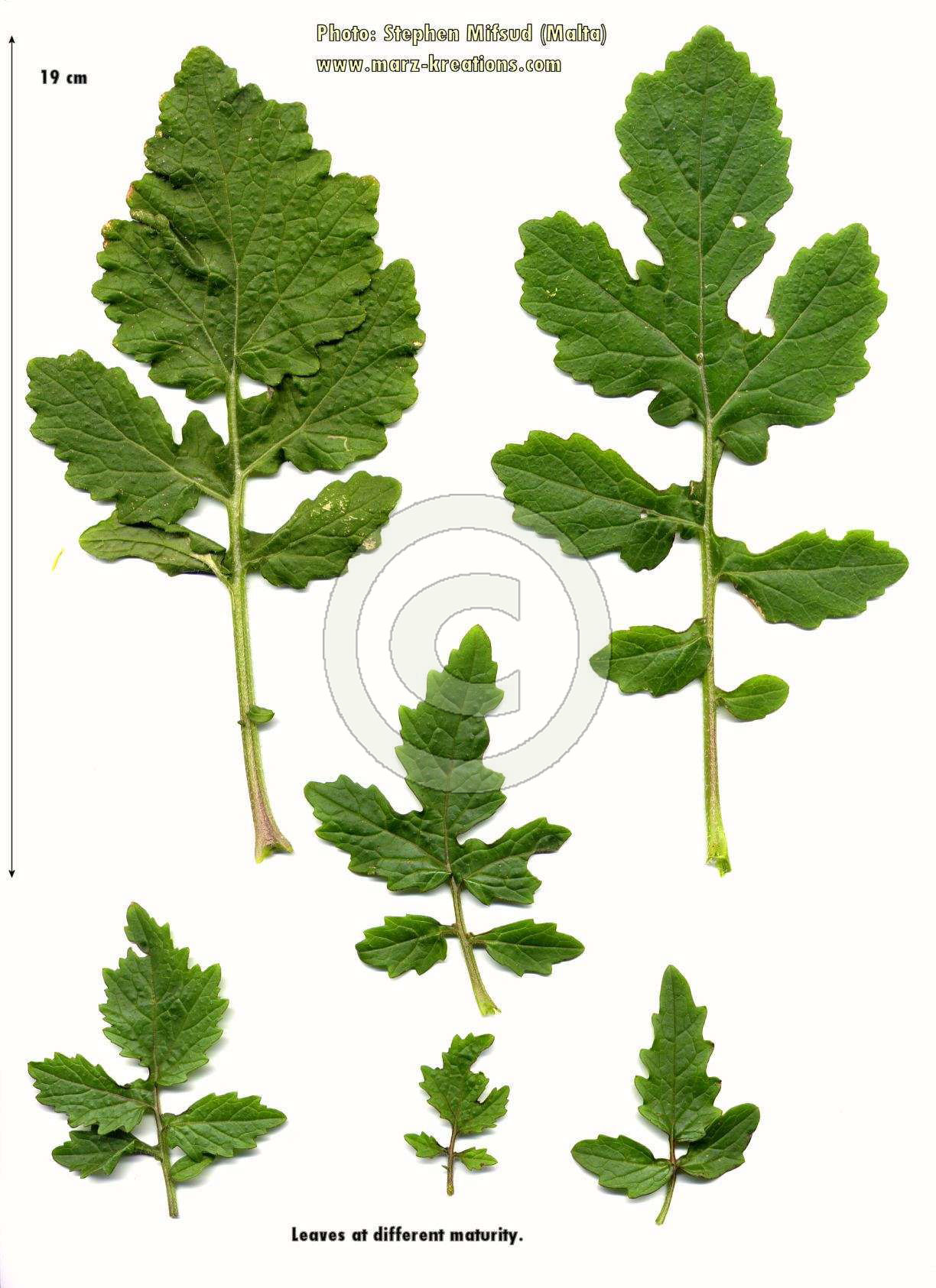
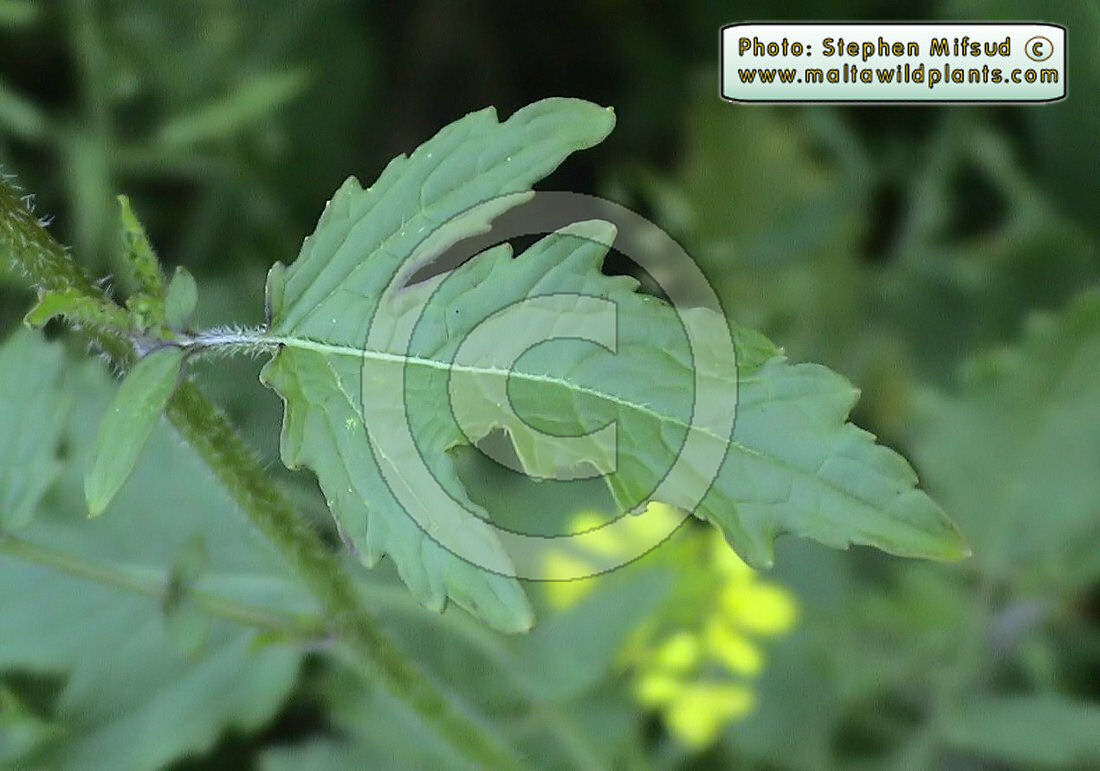
The leaves are quite complex and different from the other Sinapis species; they are all stalked and have one or two pairs of leaf lobes at the base of the compound leaf followed by a much larger, terminal, deeply lobed leaf. The development of the structure of this compound leaf can be explained as follows. First there is a single stalked young leaf which starts to form lateral indentations at its lower part. These indents grow deep up to the midrib until eventually they form separate leaf lobes independent from the parent leaf. As a result these lobes become an opposite pair of small independent leaflets at the base. Usually two pairs of leaflets are formed this way along the leaf axis (rachis). Adult leaves can grow up to 20cm long. The general outline of the leaflets and main leaf is coarse serrated (saw like) and the leaf has prominent veins that may contain few short bristles.

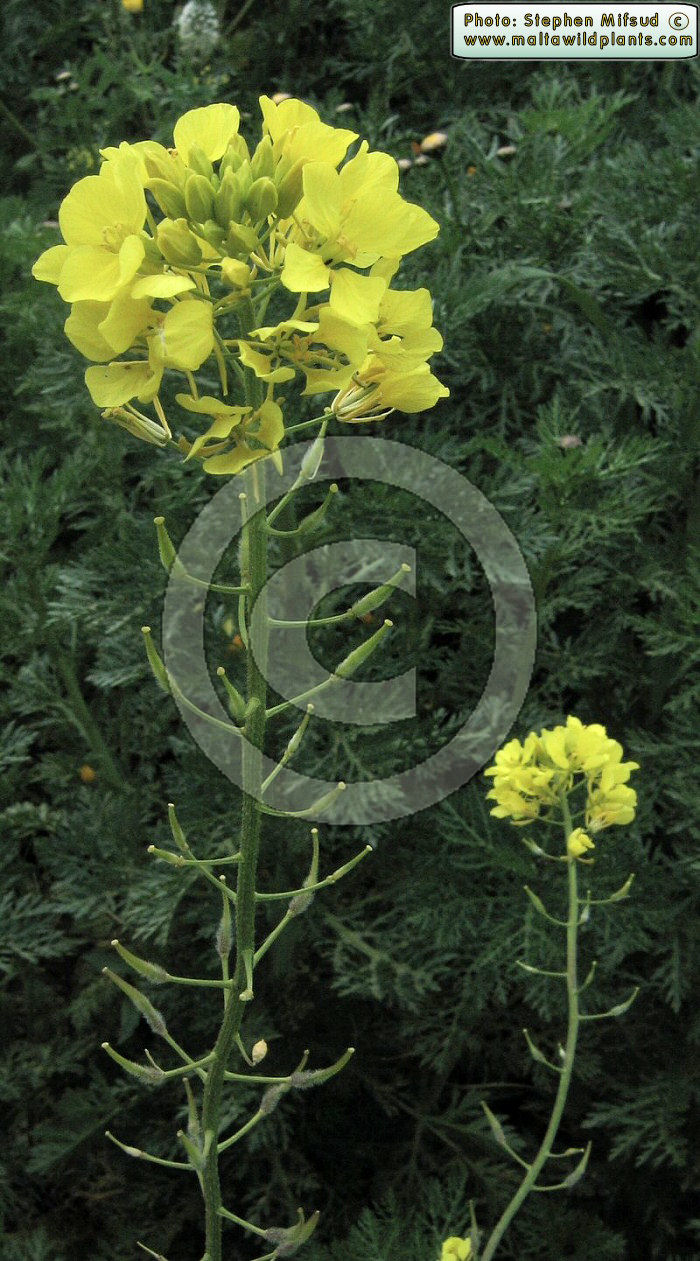
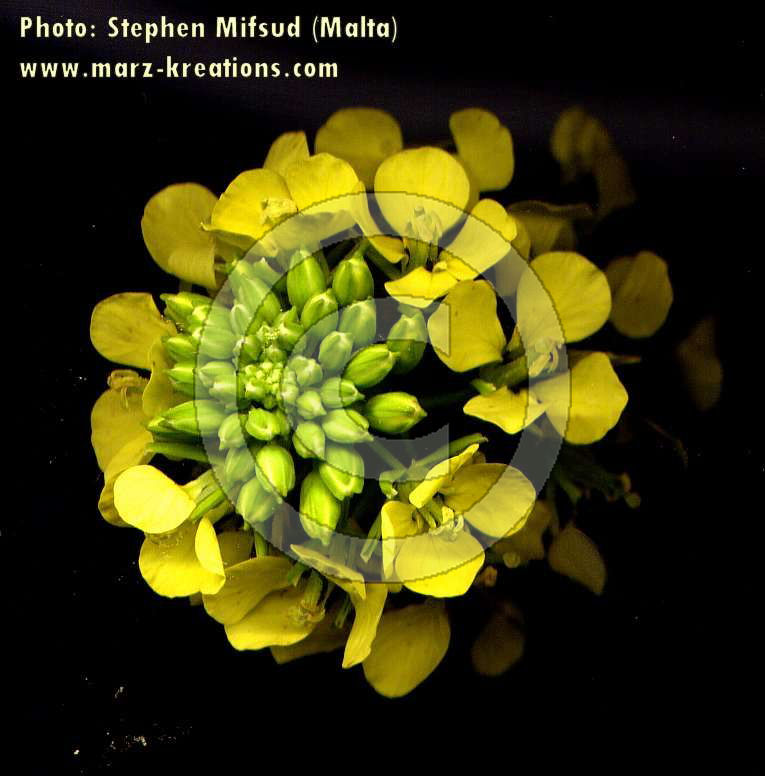
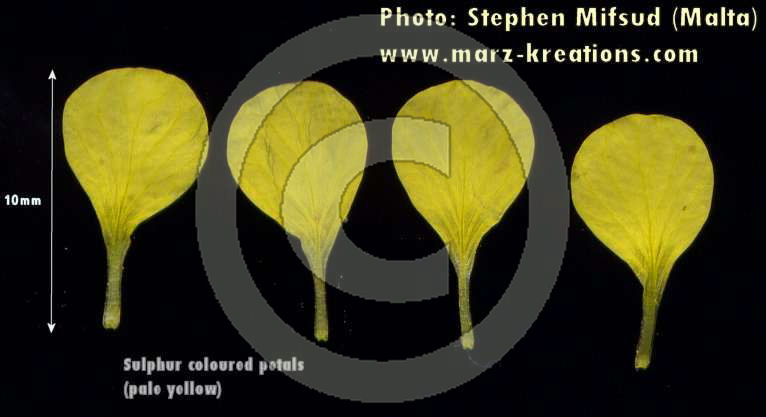
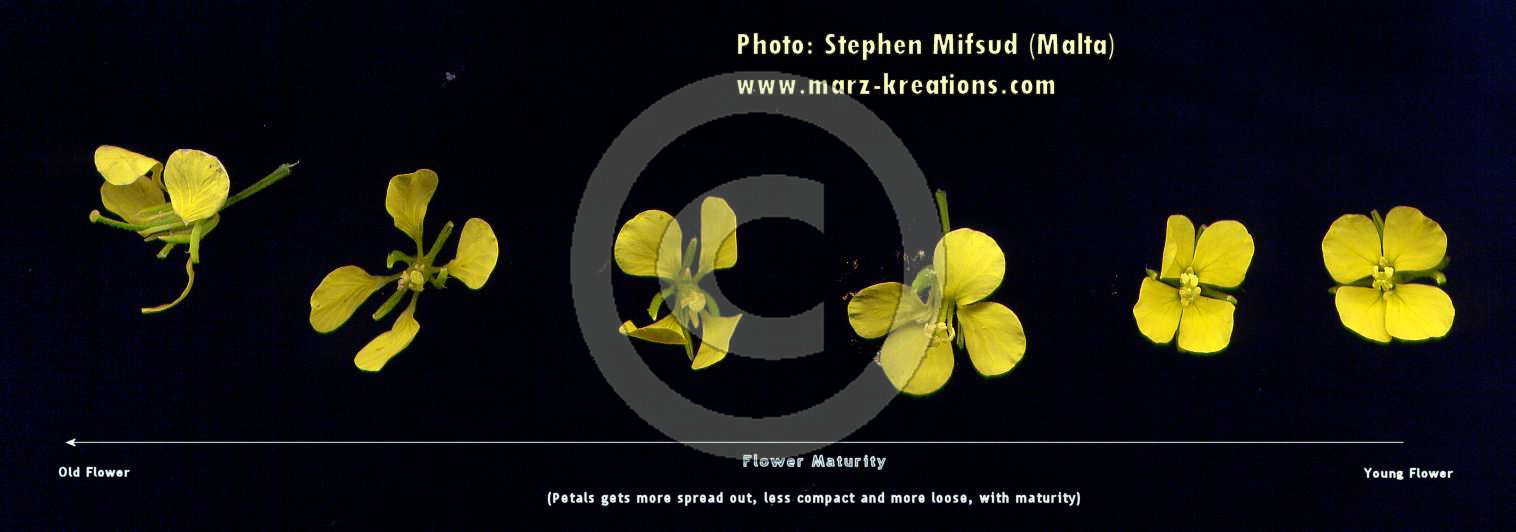
The flower does not differ very much from the other yellow Cruciferae species in Malta. It is somehow more pale in colour (Sulphur colour), and the sepals are rod like and spread perpendicular to the flower stalk. The inflorescence is a raceme with 5-10 flowers open at a time. The young flowers are more compact and bowl-shaped with slightly overlapping petals, while the adult flowers get flatter and are at right angles to each other hence forming a shape of a cross.

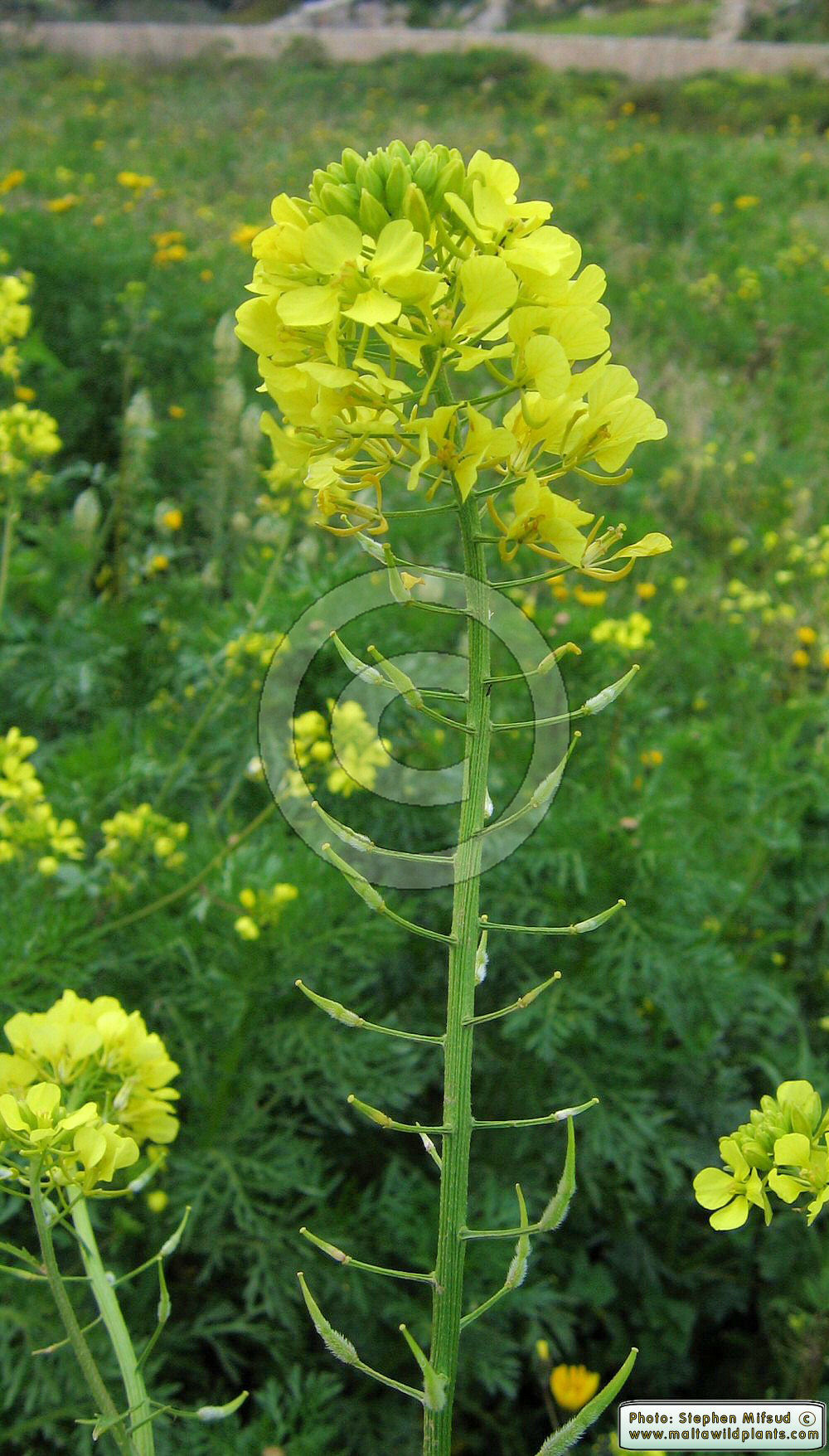
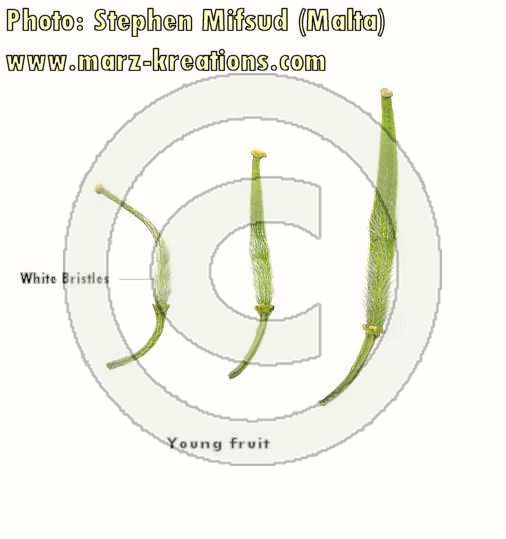
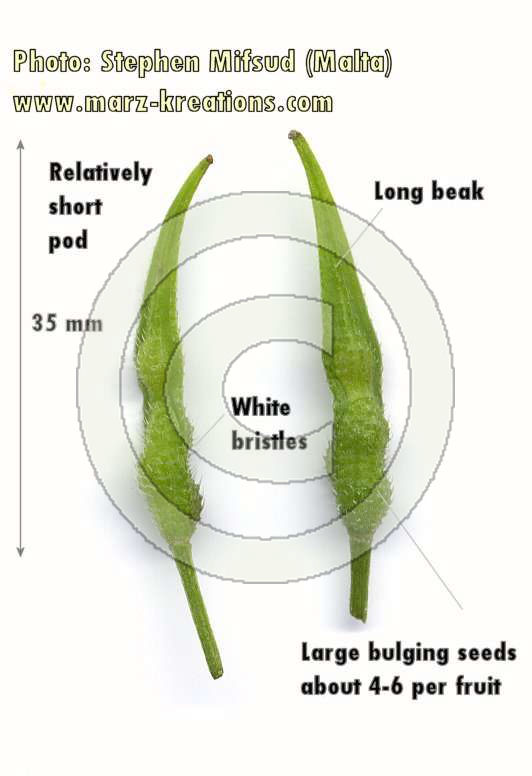
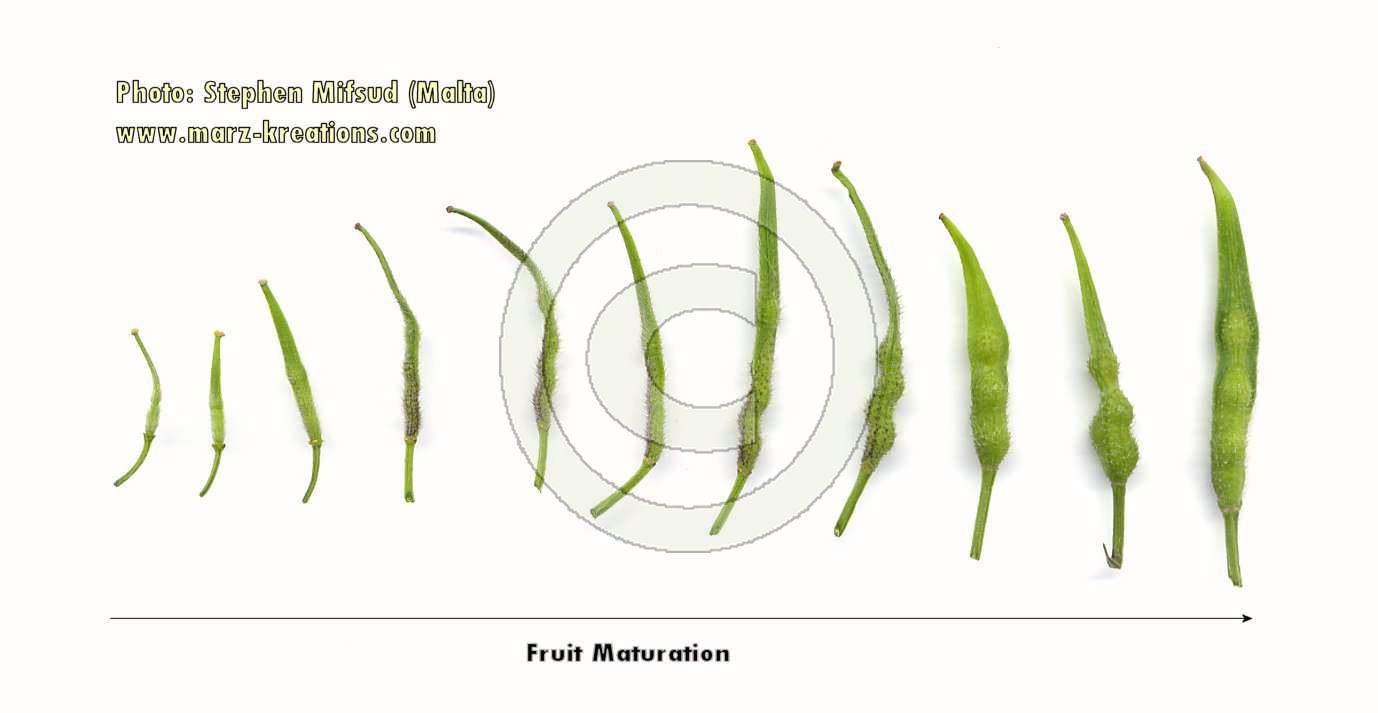
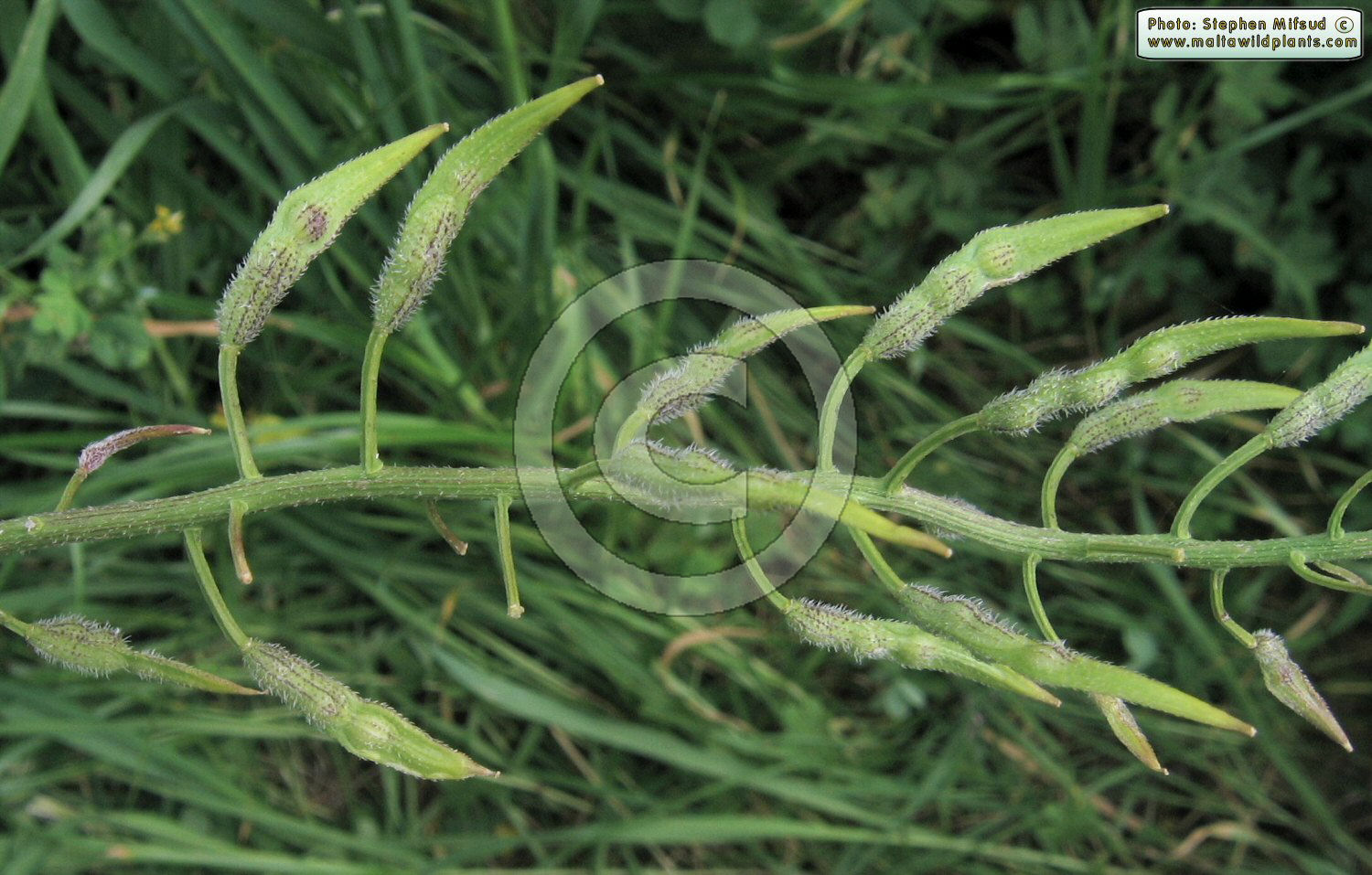
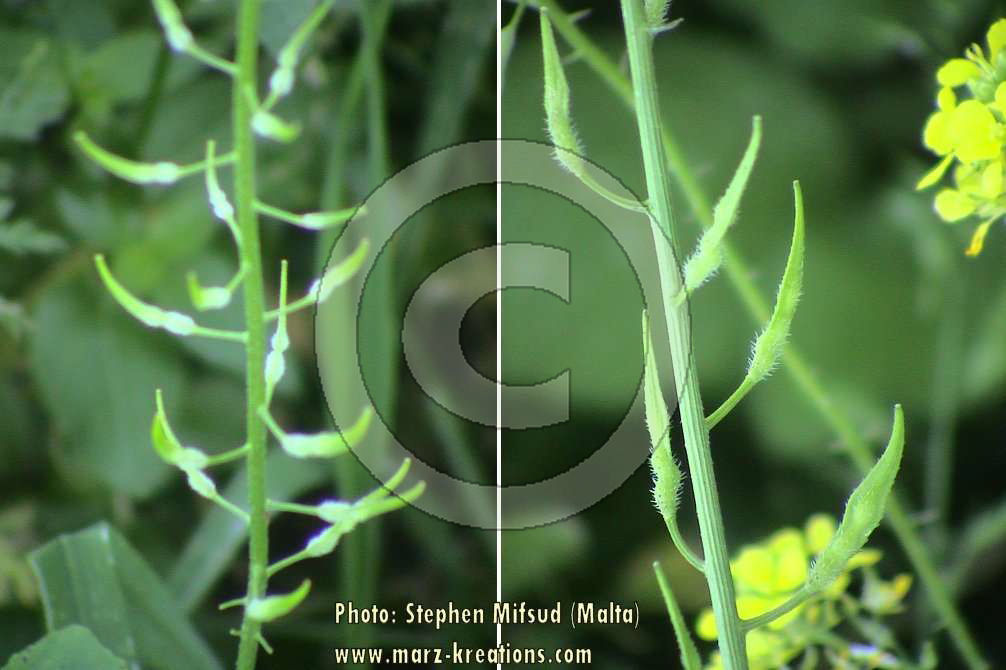
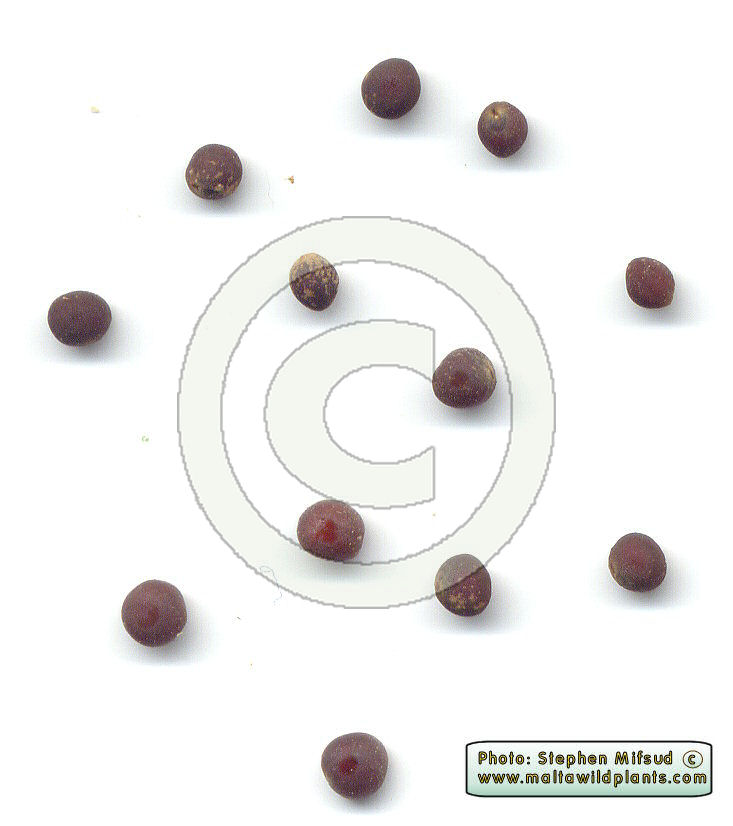
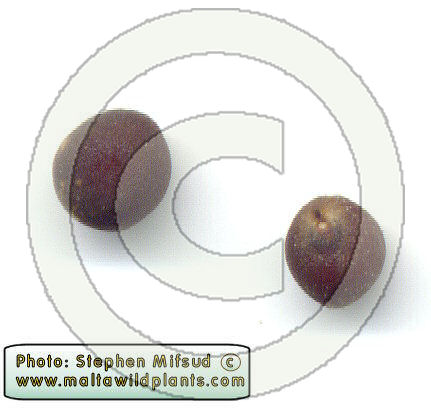
The fruit, 3-5 seeded siliqua, are the most distinctive part of the plant. These are not very long, and possess a curved (sabre-shaped) beak, about 50% the length of the whole siliqua. The lower part of the fruit is bulging with the seeds inside. The outer walls of the fruit body have numerous fine, white bristles, which appear to glow white in sunshine. Seeds are globular in shape, about 2-3mm across and are dark reddish-brown in colour. There is usually 3 or 5 seeds per seed pod arranged in one or two pairs in the body of the fruit and one in the beak. Longer pods would have more pairs of seeds in their body, but there is always only one seed in the beak.


Information and Details


Edible Uses

Leaves - raw or cooked [2, 5, 14, 52]. A hot pungent flavour, especially if eaten raw [KF]. Young leaves are used as a flavouring in mixed salads, whilst older leaves are used as a potherb [183].

Seed - sprouted and eaten raw [1, 34, 37, 52]. The seed takes about 4 days to be ready [244]. A hot flavour, it is often used in salads. A nutritional analysis is available [218].

The seed can be ground into a powder and used as a food flavouring [17, 34, 89, 171], it is the 'white mustard' of commerce [100, 105]. This is milder than the black mustard obtained from Brassica nigra [183]. The pungency of mustard develops when cold water is added to the ground-up seed - an enzyme (myrosin) acts on a glycoside (sinigrin) to produce a sulphur compound. The reaction takes 10 - 15 minutes. Mixing with hot water or vinegar, or adding salt, inhibits the enzyme and produces a mild bitter mustard [238].

Chemical composition of seeds [218]

Seed (Dry weight) In grams per 100g weight of food:
Water: 0
Calories: 500
Protein: 27.2
Fat: 35
Carbohydrate: 34
Fibre: 6
Ash: 4.5

In milligrams per 100g weight of food:
Calcium: 500
Phosphorus: 800
Iron: 16
Sodium: 5
Potassium: 732
VitaminA: 400
Thiamine: 0.5
Riboflavin: 0.37
Niacin: 8
VitaminC: 0


Notes: These are median figures of a range given in the report.     [218]

Important drugs found in seeds

A bland, fixed oil, average of 25 per cent; the glucoside sinalbin, the most important constituent, and myrosin, an enzyme which converts sinalbin into an acrid (p-hydroxybenzyl isothiocyanate ), and other bodies. Volatile oil of mustard is not obtained from white mustard [WWW-09]

Medicinal Uses

The seed is:
Antibacterial Destroys or prevents the growth of bacteria    [WWW-32]
Anti-fungal Destroys or prevents the growth of fungi    [WWW-32]
Appetizer Stimulate or increase the appetite    [WWW-32]
Carminative Aids in expelling gas from the intestinal tract    [WWW-32]
Diaphoretic Used to produce perspiration    [WWW-32]
Digestive Aids digestions, hence breaking down of food and uptake of nutrients    [271]
Diuretic Promotes the flow of urine and also lowers blood pressure    [WWW-32]
Emetic Induces vomiting and hence emptying of the stomach    [WWW-32]
Expectorant Used to induce the ejection of mucus, phlegm, and other fluids from the lungs and air passages by coughing or spitting.    [WWW-32]
Rubefacient Reddens skin by increasing blood supply to it.    [WWW-32]
Stimulant Increases the normal activity of body organs    [271]


The seed has a cathartic ( cleansing and purging of the intestines and bowels [271] ) action due to hydrolytic liberation of hydrogen sulphide [218]. In China it is used in the treatment of coughs with profuse phlegm and tuberculosis, pleurisy [176]. The seed is seldom used internally as a medicine in the west [238]. Externally it is usually made into mustard plasters (using the ground seed), poultices or added to the bath water. It is used in the treatment of respiratory infections, arthritic joints, chilblains and skin eruptions, etc. [238]. At a ratio of 1:3, the seed has an inhibitory action on the growth of fungus [176]. Care should be exercised in using this remedy because the seed contains substances that are extremely irritant to the skin and mucous membranes [238].

The leaves are carminative [218] ( inducing the expulsion of gas from the stomach and intestines [WWW-06] ).

The rubefacient action causes a mild irritation to the skin, stimulating the circulation in that area and relieving muscular and skeletal pain. Its stimulating, diaphoretic action can be utilized in the way that Cayenne and Ginger are. For feverishness, colds, and influenza, white mustard may be taken as a tea or ground and sprinkled into a bath. The stimulation of circulation will aid chilblains as well as the conditions already mentioned. An infusion or poultice of Mustard will aid in cases of bronchitis. [WWW-08]

Poultice: Mustard is most commonly used as a poultice which can be made by mixing 100 grams (4 ounces) of freshly ground mustard seeds with warm water (at about 45 degrees C) to form a thick paste. This is spread on a piece of cloth the size of the body area that is to be covered. To stop the paste sticking to the skin, lay a dampened gauze on the skin. Apply the cloth and remove after 1 minute. The skin may be reddened by this treatment which can be eased by applying olive oil afterward. [WWW-08]

Infusion: Pour a cup of boiling water onto 1 teaspoonful of mustard flour and leave to infuse for 5 minutes. This may be drunk three times a day. [WWW-08]

Foot bath: Make an infusion using 1 tablespoon of bruised seeds to 1 litre (2 pints) of boiling water. [WWW-08]

Other Uses

The seed contains up to 35% of a semi-drying oil [74]. It is used as a lubricant and for lighting etc [21, 46, 57, 61].

The plant can be grown as a green manure crop [17, 89]. It is very fast growing, producing a good bulk in just a few weeks from seed, but it is shallow rooted so does not do so well in dry periods [87]. It is also susceptible to all the diseases of the cabbage family such as club-root so is best avoided if this is likely to be a problem [17].

Mustard cultivation allows the soil to rest temporarily, in order to restore the fertility of the ground. Consequently, it is often planted in a field where durum wheat has been sown for two consecutive years. Linseed (flax), millet and rape-seed are also grown on fallow ground. [WWW-07]

Cultivation Notes

Prefers a light well-drained soil [52]. Succeeds on most soils when growing in a sunny position [238].

White mustard is sometimes cultivated, both in the garden and commercially, for its edible seed [4, 183]. There are some named varieties [183]. It is a very fast growing plant, but requires plenty of moisture for optimum growth [87].
White mustard is sometimes also grown as a seed sprout, usually with cress seeds (Lepidium sativum) to supply mustard and cress. This is a mixture of the two types of sprouted seeds, used when about 7 - 10 days old [KF]. The mustard seed should be sown three days before the cress seed [238].

The plant is not very deep rooted [87], it self-sows freely when in a suitable site [14].

Personal Observations

Location of the plant in Malta
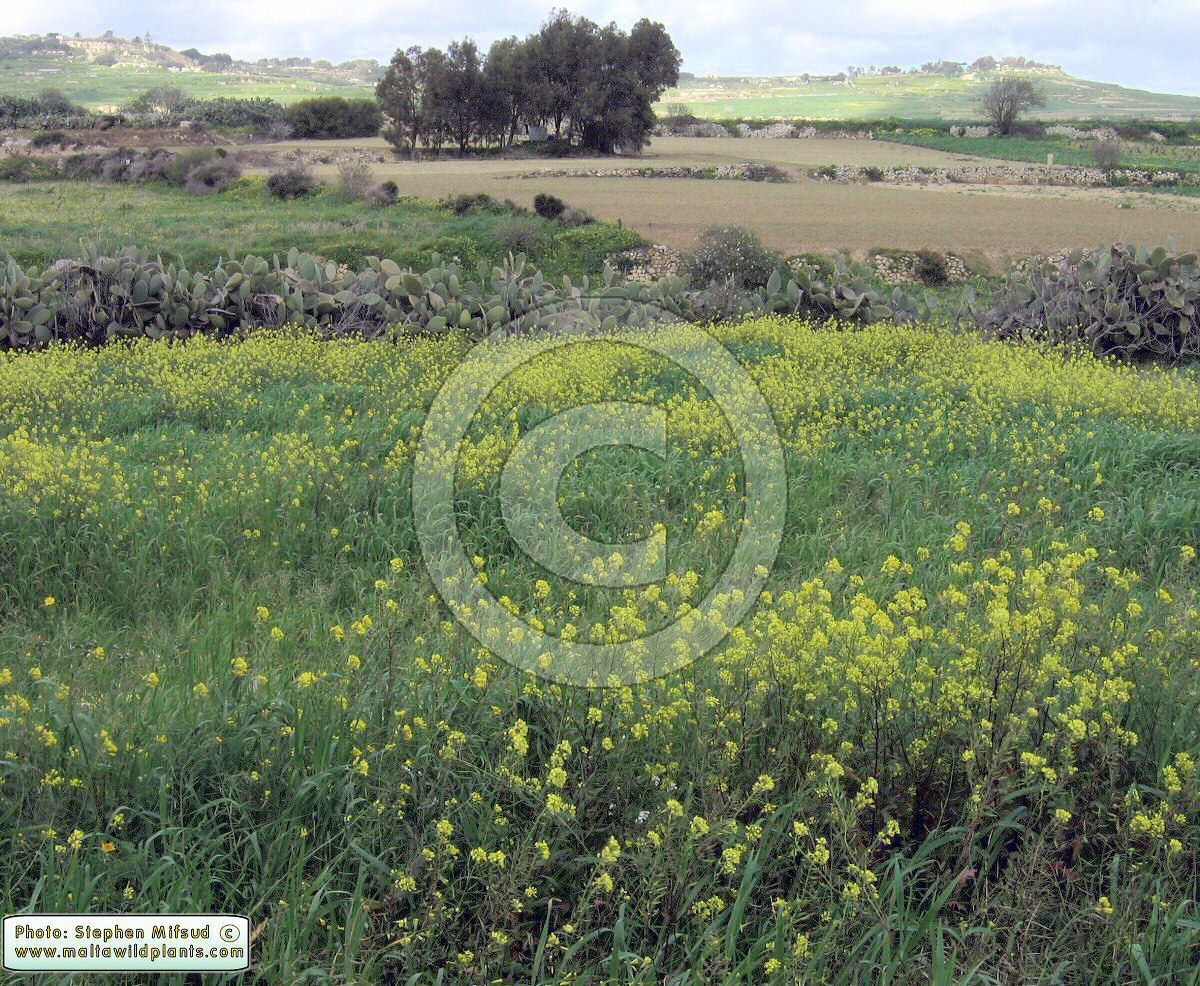
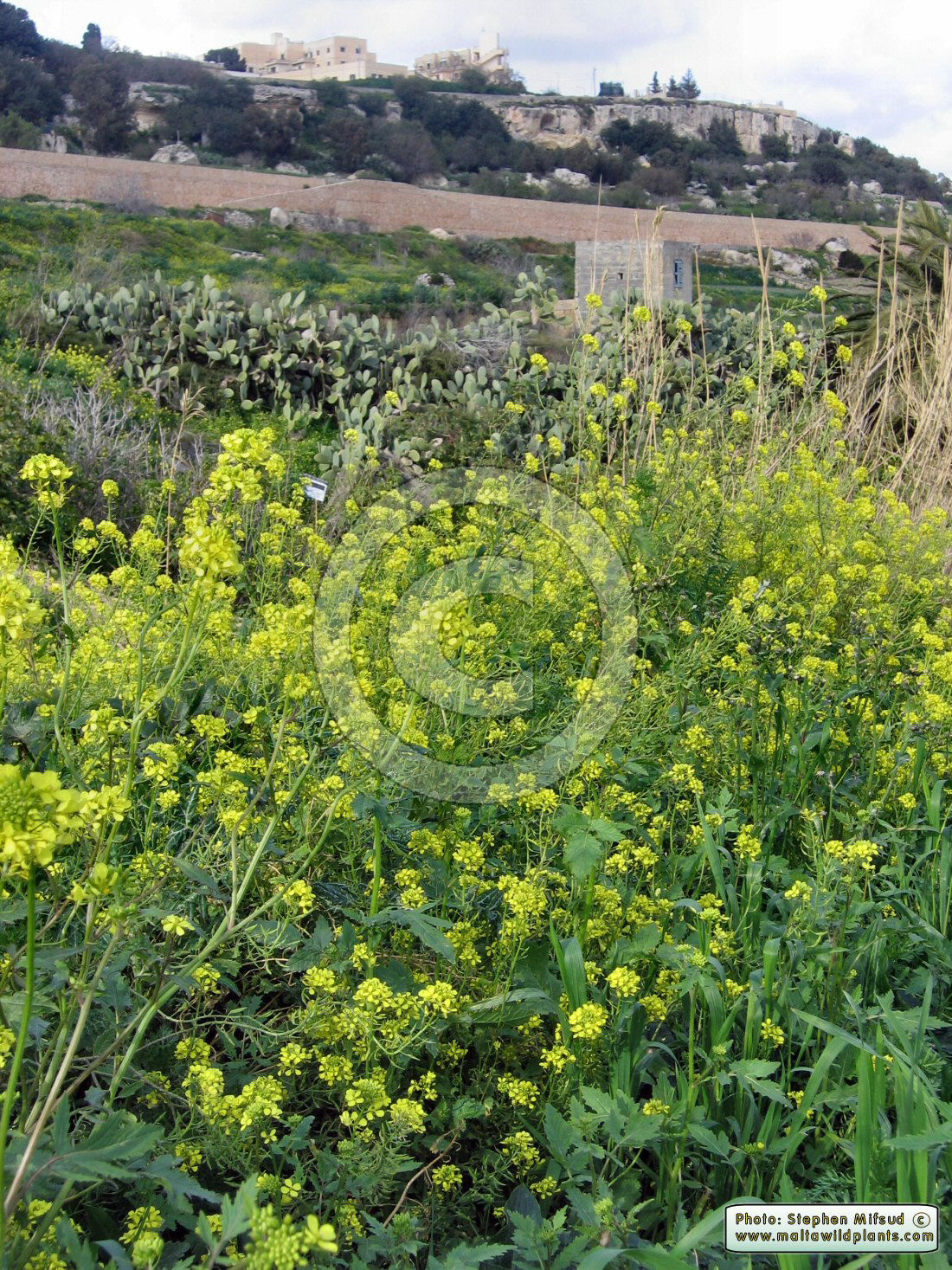
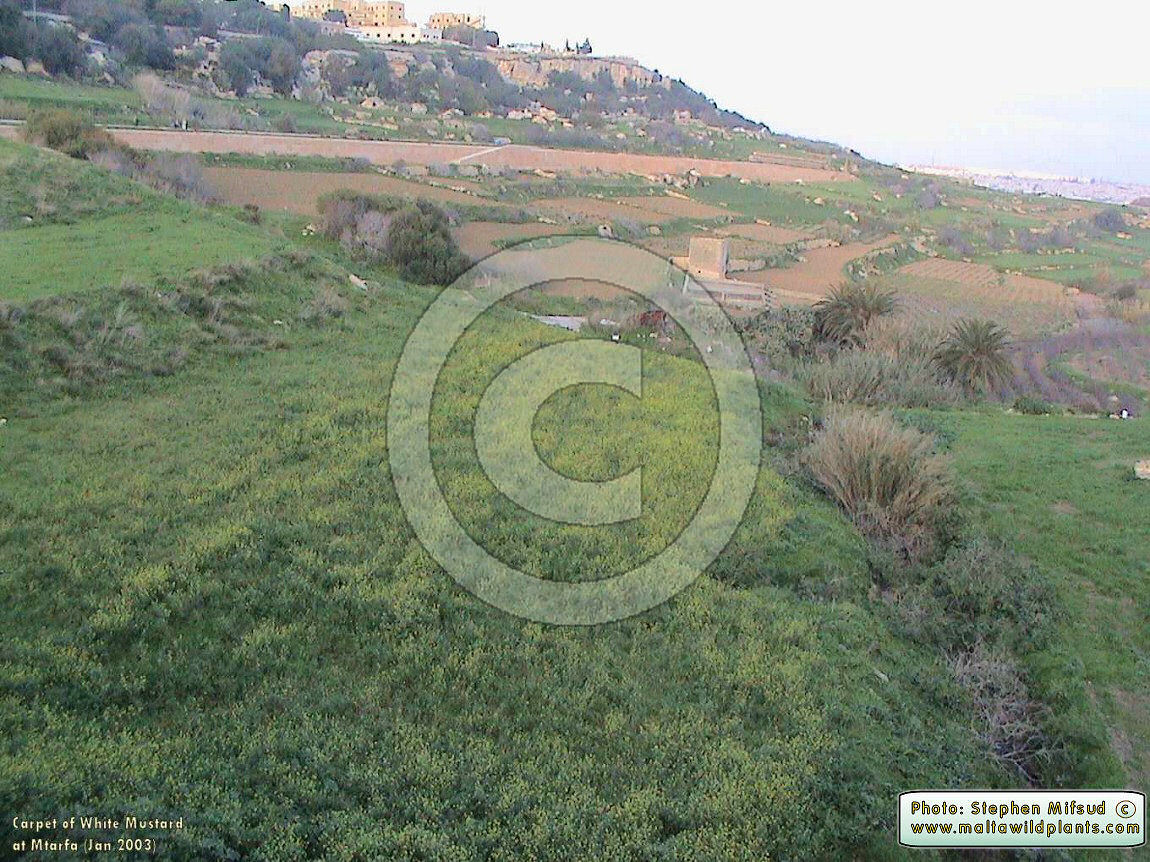
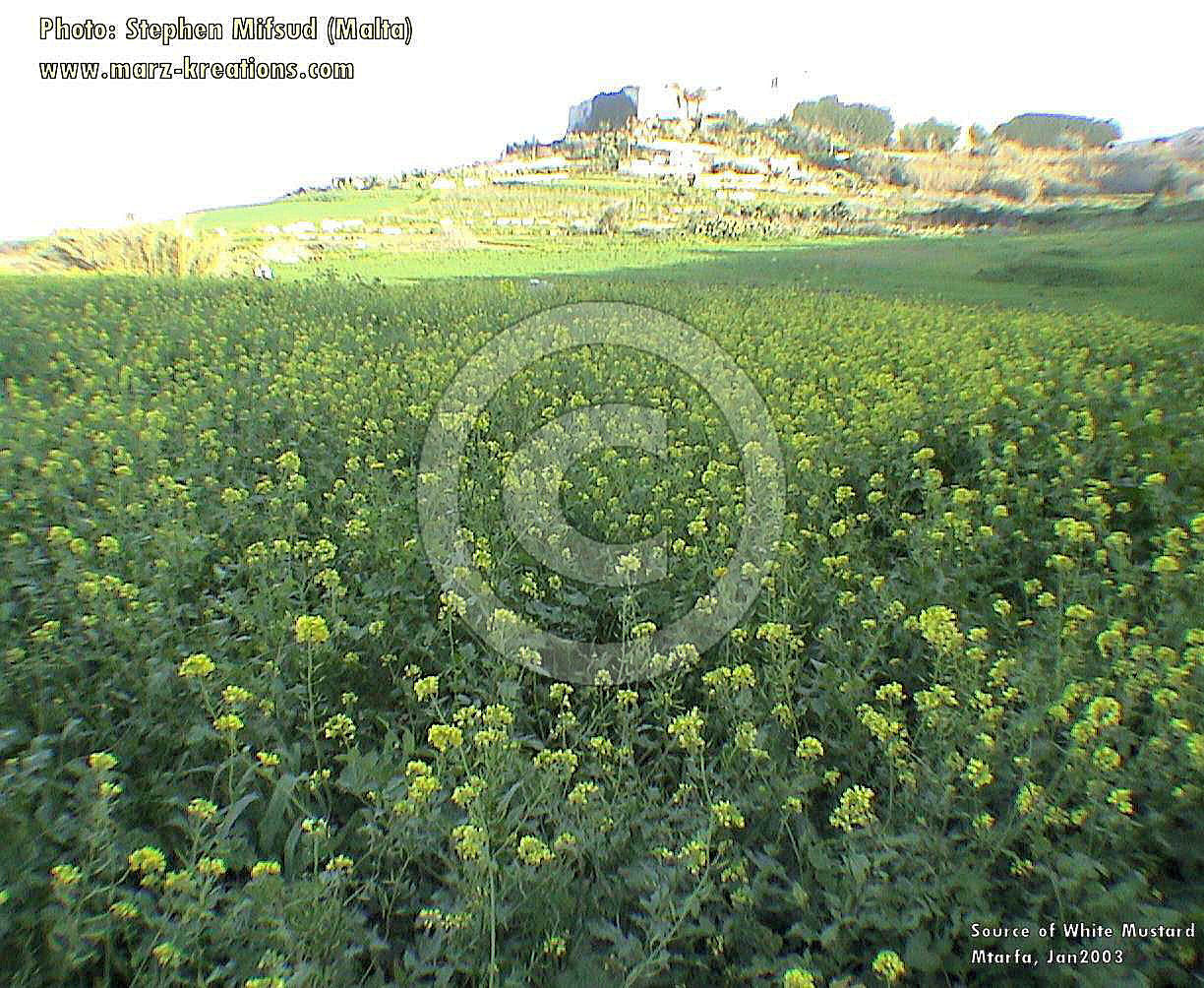
This plant is not very common in Malta as other yellow-flowered Cruciferae such as the Diplotaxis tenuifolia or Brassica rapa subsp. silvestris. One has to look for this plant near areas of cultivated fields, as escapes from seeds of the previous year from cultivated fields. This plant is often cultivated as a crop in Malta for production of Mustard. Such plants are often found in lanes near fields, or in the periphery of fields. A good location in Malta is around fields at Mtarfa, near the 'English bridge'. (see photo below). One or two of these fields were cropped with white mustard in 2003 but not in 2004. In the latter year some plant escapes could be found at the periphery and borders of these fields.    [SM]


Photo Gallery

Sinapis alba (White Mustard) - CLICK TO ENLARGE PHOTO Sinapis alba (White Mustard) - CLICK TO ENLARGE PHOTO Sinapis alba (White Mustard) - CLICK TO ENLARGE PHOTO Sinapis alba (White Mustard) - CLICK TO ENLARGE PHOTO
IMAGE: SNPAL-01
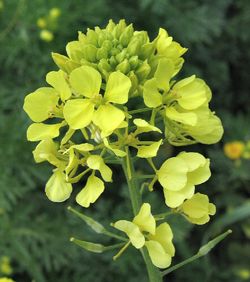
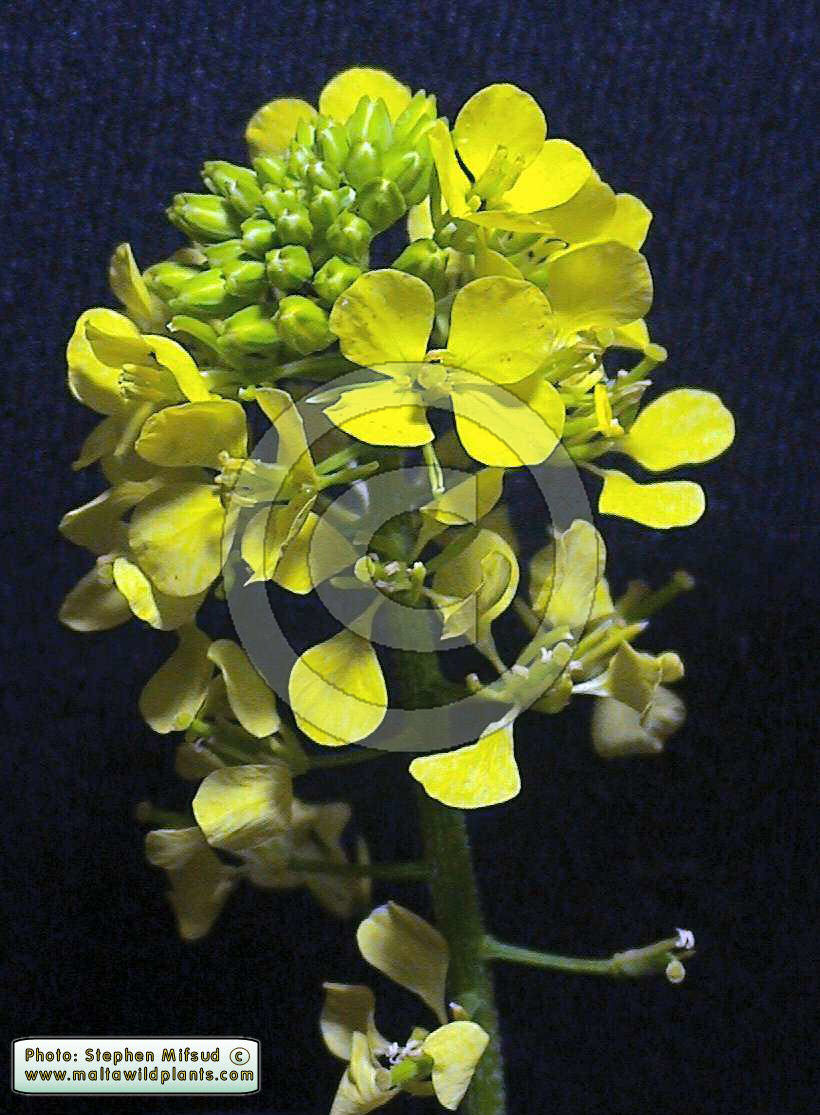
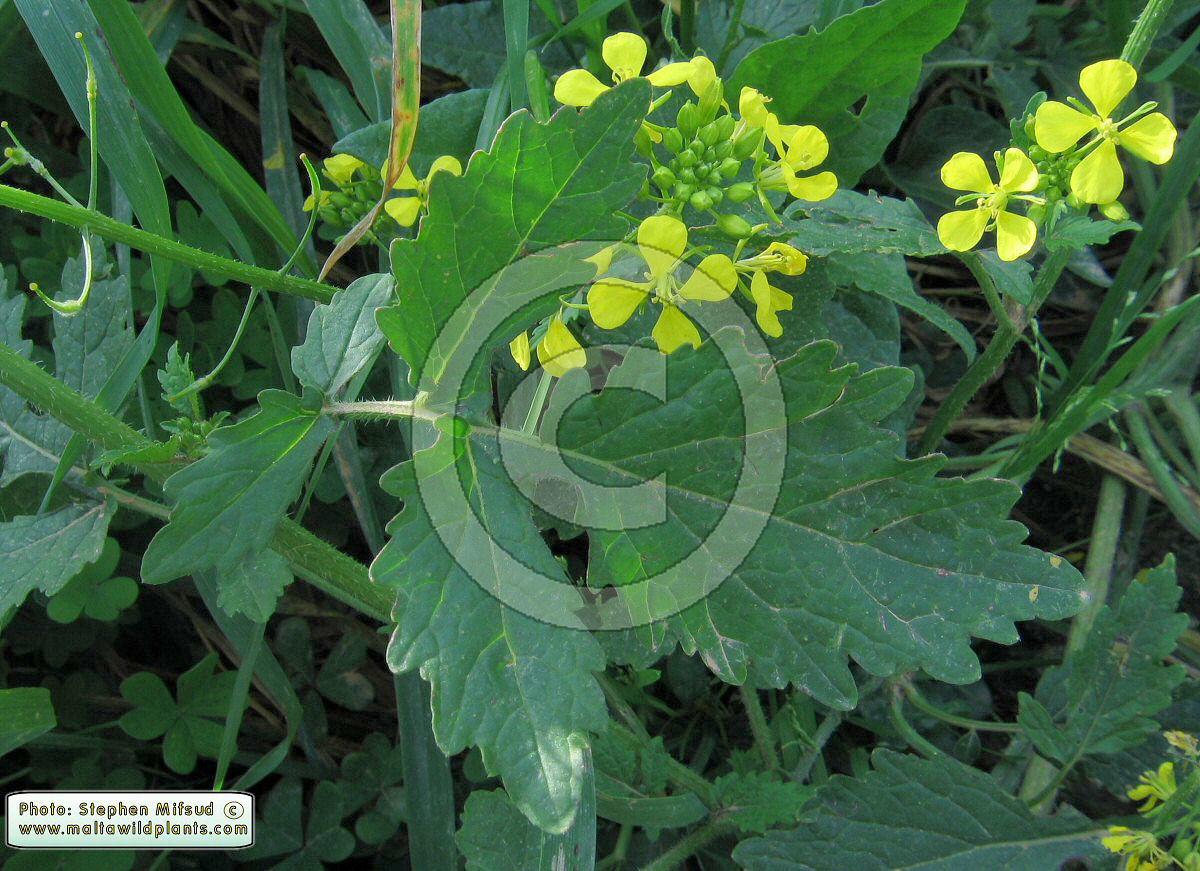
Close up photo of 3 flowers in the densely packed inflorescence with numerous green buds.
IMAGE: SNPAL-02
Close up photo of a flower which consists of 4 spreading sepals, 4 cross shaped sulphur yellow flowers, 6 stamens and a central green pistil.
IMAGE: SNPAL-03
Photo of flower inflorescence. Compared to other common, yellow-flowered cruciferae species in Malta, this species produces large number of buds and open-flowers per flowering stem.
IMAGE: SNPAL-04
Close up photo of a flower in the cluster showing in detail the 4 long stamens and the central style with a swollen stigma. The other 2 lateral stamens are hidden in this photo.
Sinapis alba (White Mustard) - CLICK TO ENLARGE PHOTO Sinapis alba (White Mustard) - CLICK TO ENLARGE PHOTO Sinapis alba (White Mustard) - CLICK TO ENLARGE PHOTO Sinapis alba (White Mustard) - CLICK TO ENLARGE PHOTO
IMAGE: SNPAL-05
Photo of the inflorescence which is a raceme bearing 5-12 stalked flowers, and numerous buds at the apex. Petals of old flowers become more loose and spaced from each other.
IMAGE: SNPAL-06
Photo of the flowering stem showing the densely packed inflorescences and the numerous and separated stacks of siliqua (fruiting pods). Each plant produces plenty of such flowering stems.
IMAGE: SNPAL-07
Photo of the flowering stem (rachis).
IMAGE: SNPAL-08
Scanned image of three flowers against a dark background. Stamens produce plenty of pale yellow pollen.
Sinapis alba (White Mustard) - CLICK TO ENLARGE PHOTO Sinapis alba (White Mustard) - CLICK TO ENLARGE PHOTO Sinapis alba (White Mustard) - CLICK TO ENLARGE PHOTO Sinapis alba (White Mustard) - CLICK TO ENLARGE PHOTO
IMAGE: SNPAL-09
Annotated and scanned image of a longitudinal dissection of the flower. This clearly shows the arrangement of the 6 tetradynamous stamens, that is 2 lateral and short and 4 central and long, with the pistil in the center of the latter.
IMAGE: SNPAL-10
Scanned image of the numerous buds found at the very tip of the raceme. The slender sepals of the calyx do not manage to cover completely the flower parts of the bud.
IMAGE: SNPAL-11
Scanned image of buds and some flowers.
IMAGE: SNPAL-12
Scanned image of several flowers at increasing maturity levels (right to left). Petals slightly overlap only in young flowers; Generally flowers do not have overlapping petals.
Sinapis alba (White Mustard) - CLICK TO ENLARGE PHOTO Sinapis alba (White Mustard) - CLICK TO ENLARGE PHOTO Sinapis alba (White Mustard) - CLICK TO ENLARGE PHOTO Sinapis alba (White Mustard) - CLICK TO ENLARGE PHOTO
IMAGE: SNPAL-13
Scanned image of the circular shaped petals, about 10mm in length.
IMAGE: SNPAL-14
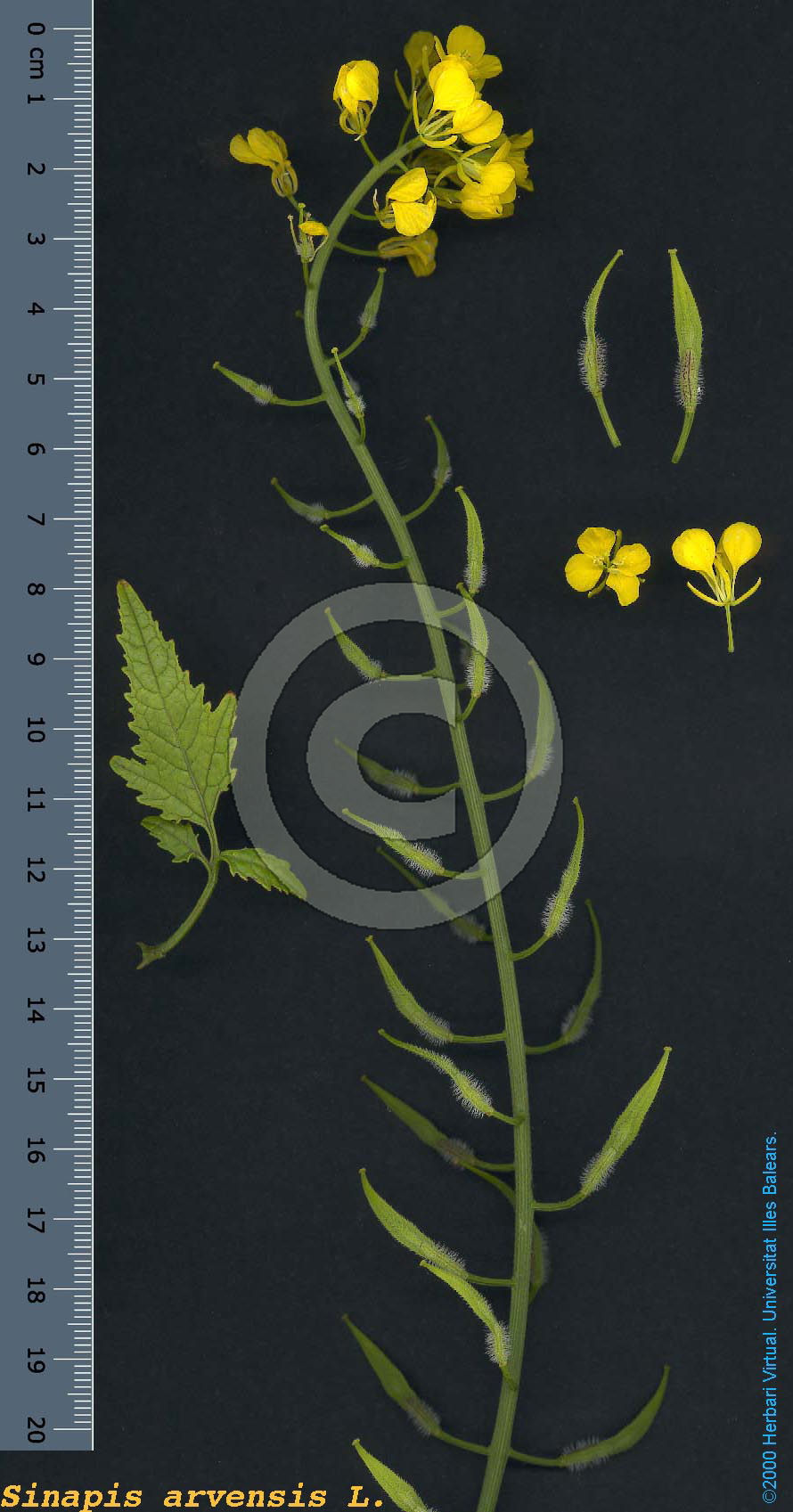
Scanned image of the long flowering stem with numerous fruit pods (siliqua) and a flowering cluster at the top.
IMAGE: SNPAL-15
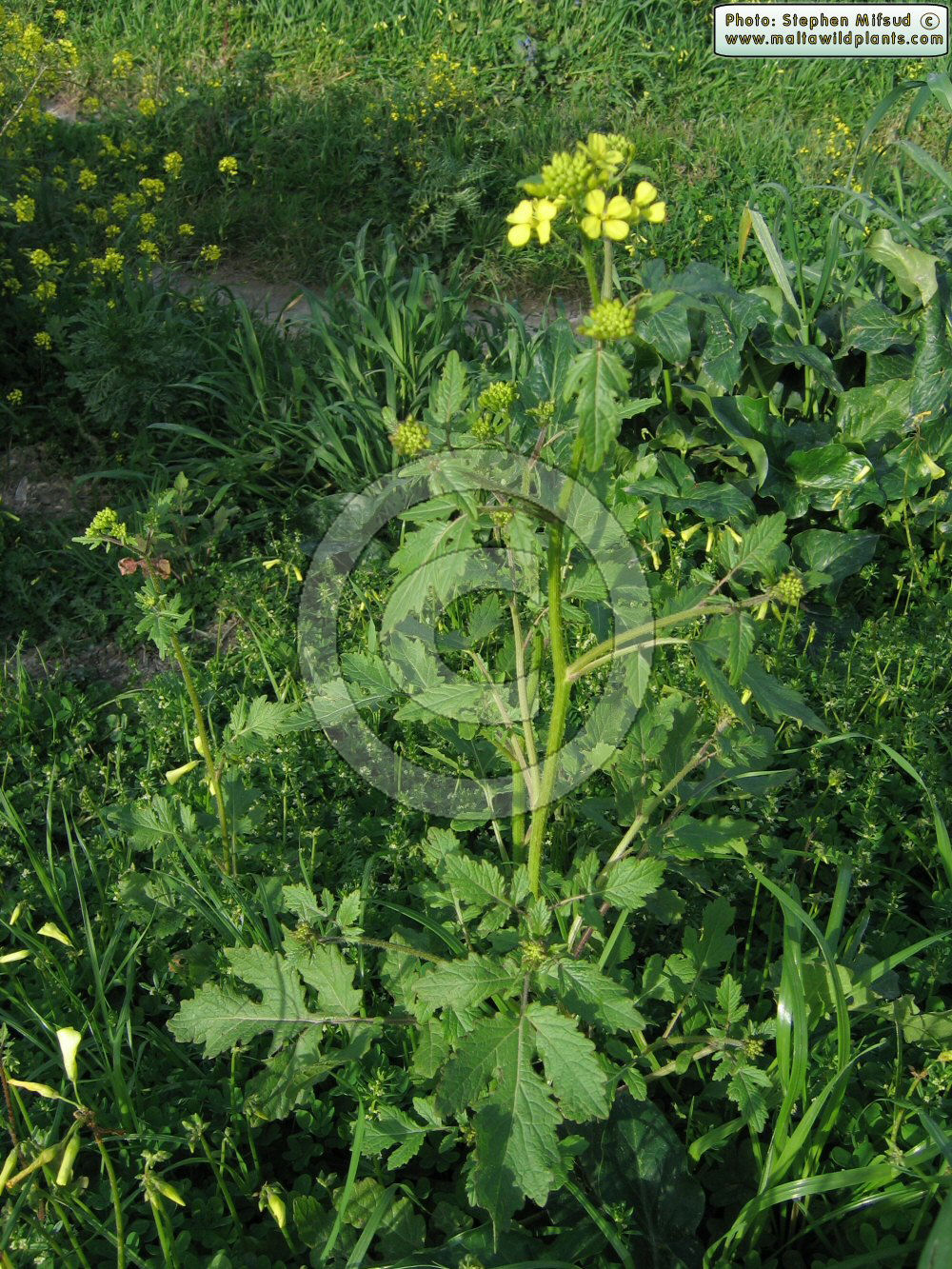
Photo of a young plant in situ.
IMAGE: SNPAL-16
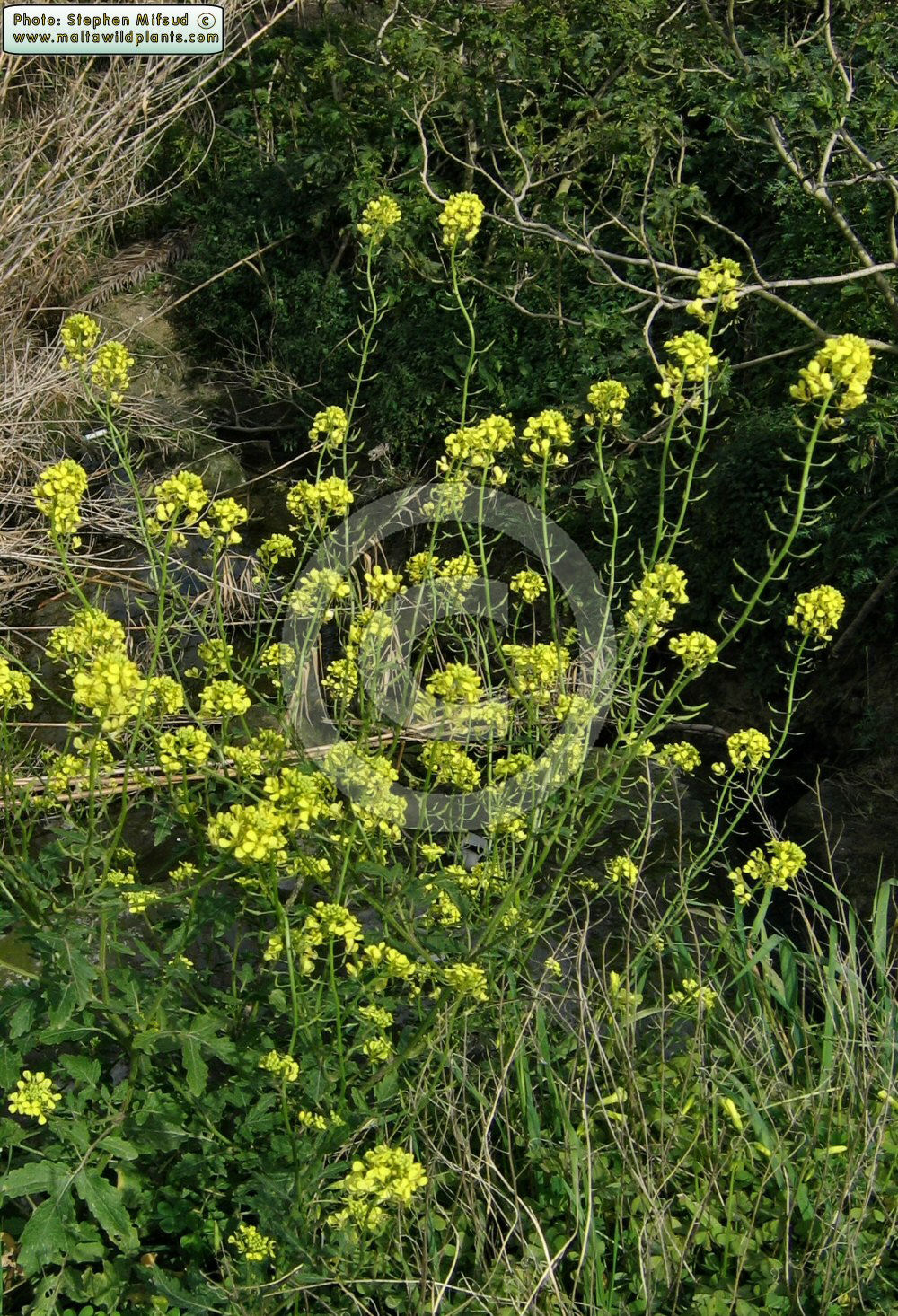
Photo of plant showing its several flowering stems. They have several spreading, white-looking fruit pods and topped with yellow inflorescences.
Sinapis alba (White Mustard) - CLICK TO ENLARGE PHOTO Sinapis alba (White Mustard) - CLICK TO ENLARGE PHOTO Sinapis alba (White Mustard) - CLICK TO ENLARGE PHOTO Sinapis alba (White Mustard) - CLICK TO ENLARGE PHOTO
IMAGE: SNPAL-17
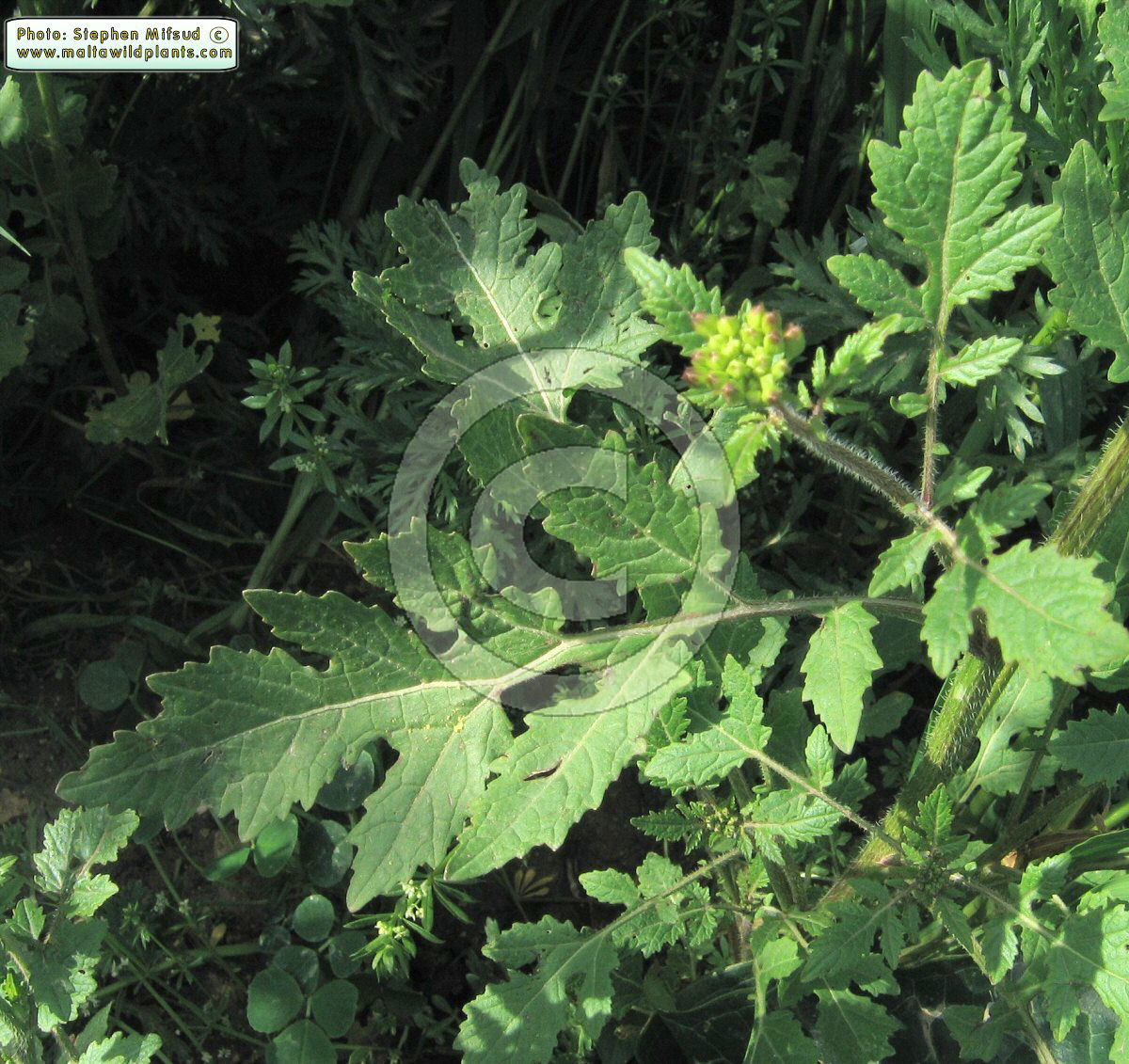
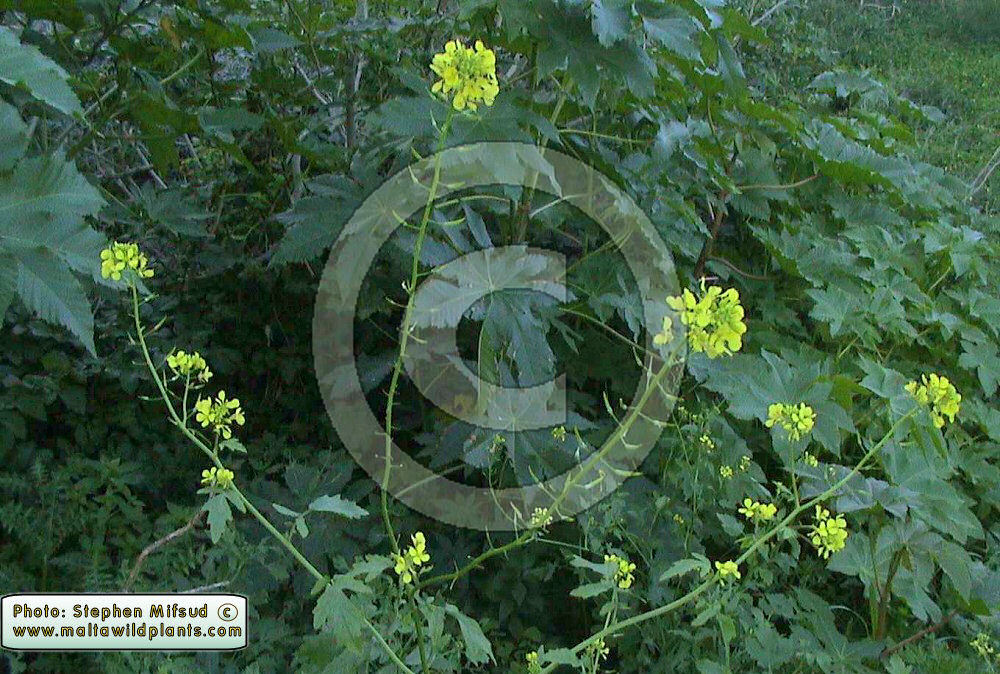
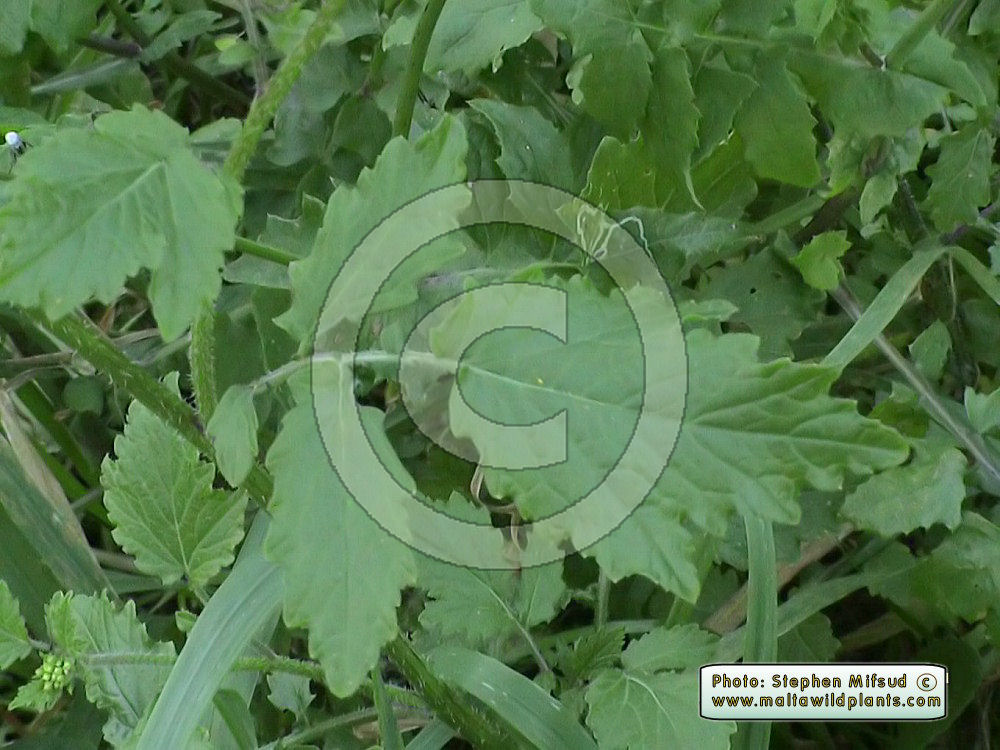
Photo of the leaves of the plant. They are lobed and have a serrated, non- spiny margin.
IMAGE: SNPAL-18
Photo of a leaf blade in situ.
IMAGE: SNPAL-19
Scanned image of various leaves of the plant. They are generally stalked, multi-lobed - with the largest leaf lobe being at the apex of the leaf, have a serrated outline and usually possess some white bristles.
IMAGE: SNPAL-20
Magnified scanned image of two typical leaves.
Sinapis alba (White Mustard) - CLICK TO ENLARGE PHOTO Sinapis alba (White Mustard) - CLICK TO ENLARGE PHOTO Sinapis alba (White Mustard) - CLICK TO ENLARGE PHOTO Sinapis alba (White Mustard) - CLICK TO ENLARGE PHOTO
IMAGE: SNPAL-21
Photo of the flowering stems bearing its developing fruit pods. The pods have a coat of white bristles, particularly dense at the lower part of the fruit. As it can be seen in the unfocused photo (left), this makes the fruit appear white and hence the name of the plant - White Mustard.
IMAGE: SNPAL-22
Close up photo of few siliqua (fruiting pods) in situ.
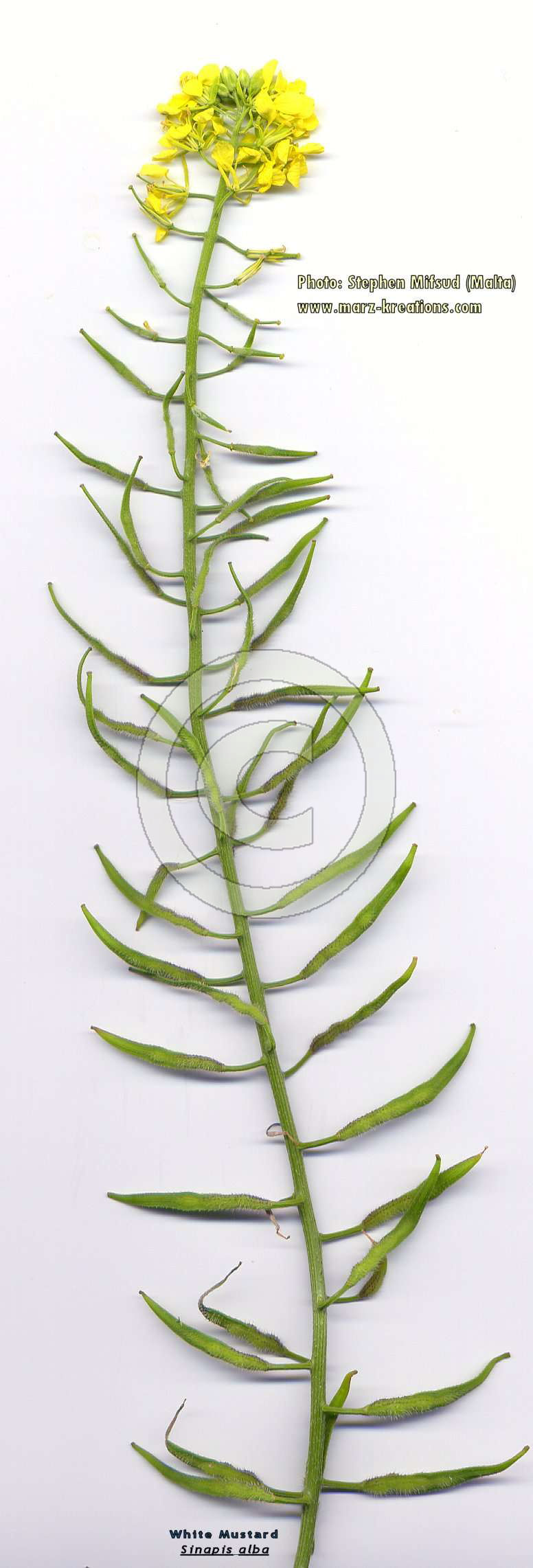
IMAGE: SNPAL-23
Scanned image of 3 young fruit and their coat of white bristles.
IMAGE: SNPAL-24
Annotated scanned image of 2 adult siliqua (fruit pods). They are bulging (with the seeds inside) and have a sabre-like long beak which does not bear any seeds. The fruit pods of this plant usually holds between 4-6 seeds.
Sinapis alba (White Mustard) - CLICK TO ENLARGE PHOTO Sinapis alba (White Mustard) - CLICK TO ENLARGE PHOTO Sinapis alba (White Mustard) - CLICK TO ENLARGE PHOTO Sinapis alba (White Mustard) - CLICK TO ENLARGE PHOTO
IMAGE: SNPAL-25
Scanned image of several fruit increasing in maturity level from left to right. The white bristles are not much well contracted and observed against the white background.
IMAGE: SNPAL-26
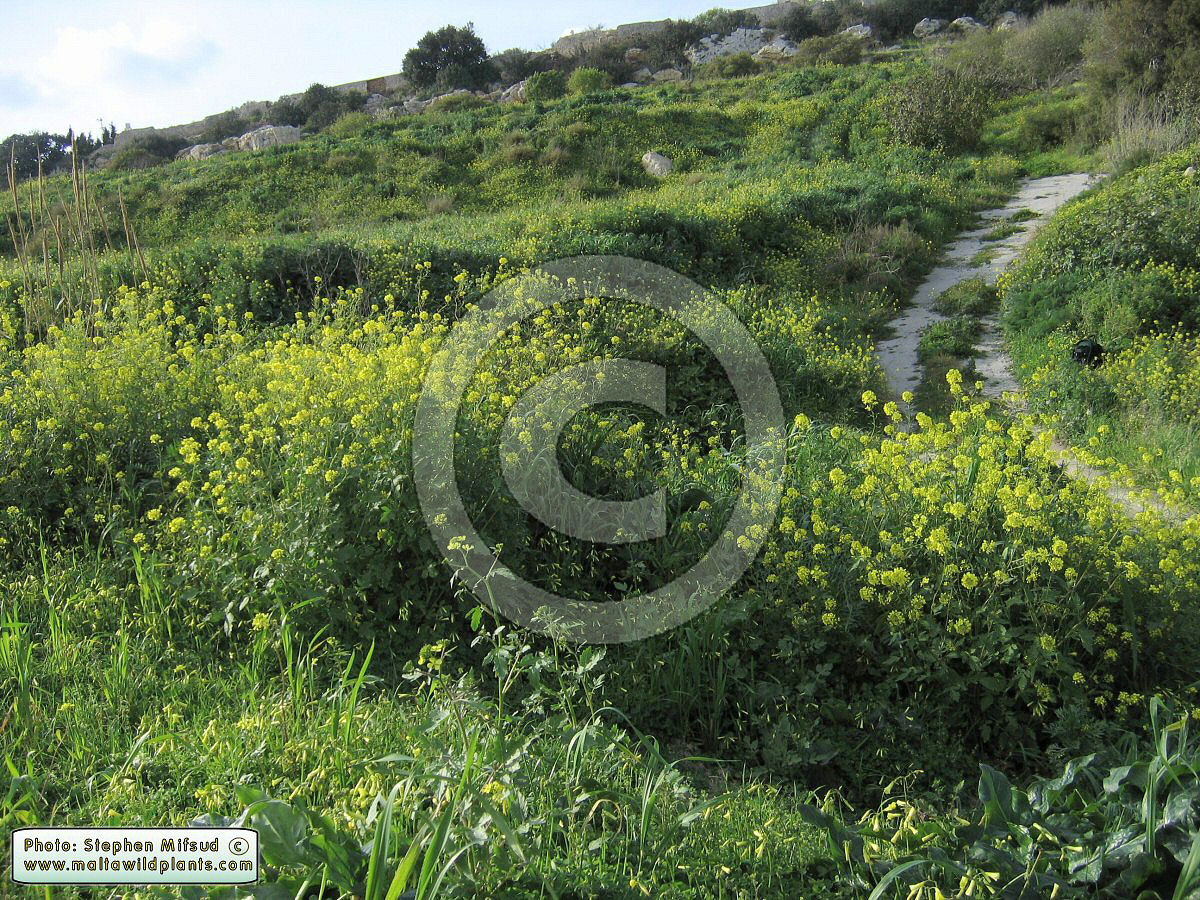
Photo of an uncropped field which seems obvious that was previously cultivated with this plant for harvesting purposes. It is assumed that this crop is harvested for the seeds to make mustard.Photo taken in fields near chadwik lakes (Feb 2005).
IMAGE: SNPAL-27
Photo of numerous plants growing at the border of a field which was previously cultivated with white mustard. Plants have escaped and grown at the border of this and other neighbouring fields and also further away near this region.
IMAGE: SNPAL-28
Photo of several plants in situ. Taken at Mtarfa - Mar 2005.
Sinapis alba (White Mustard) - CLICK TO ENLARGE PHOTO Sinapis alba (White Mustard) - CLICK TO ENLARGE PHOTO Sinapis alba (White Mustard) - CLICK TO ENLARGE PHOTO Sinapis alba (White Mustard) - CLICK TO ENLARGE PHOTO
IMAGE: SNPAL-29
Close up image of stem showing its sparse white bristles.
IMAGE: SNPAL-30
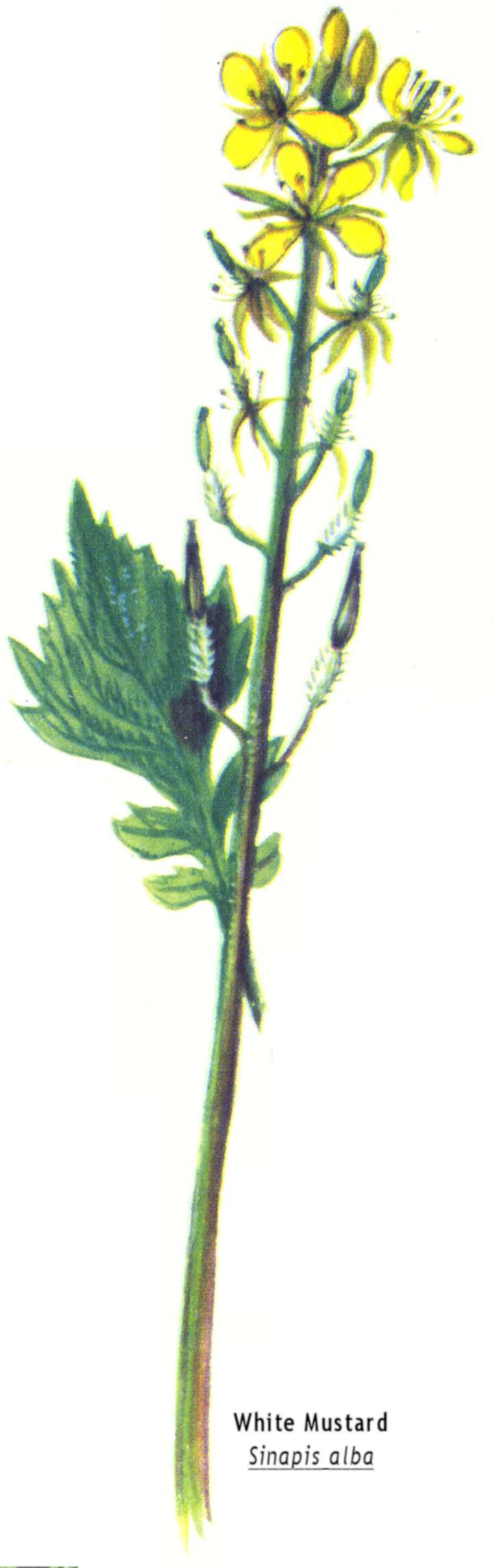
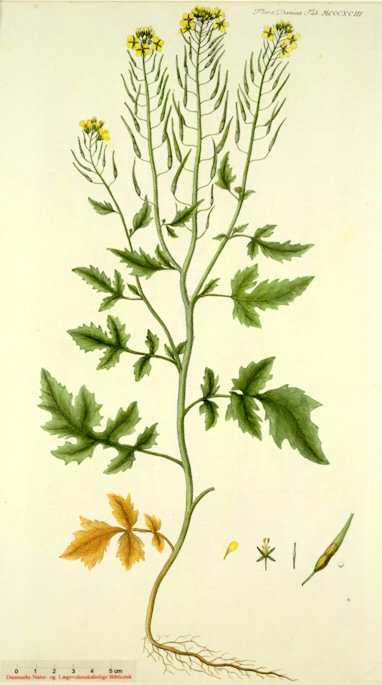
Colour illustration of the plant and its parts taken from Flora Danica Online.
IMAGE: SNPAL-31
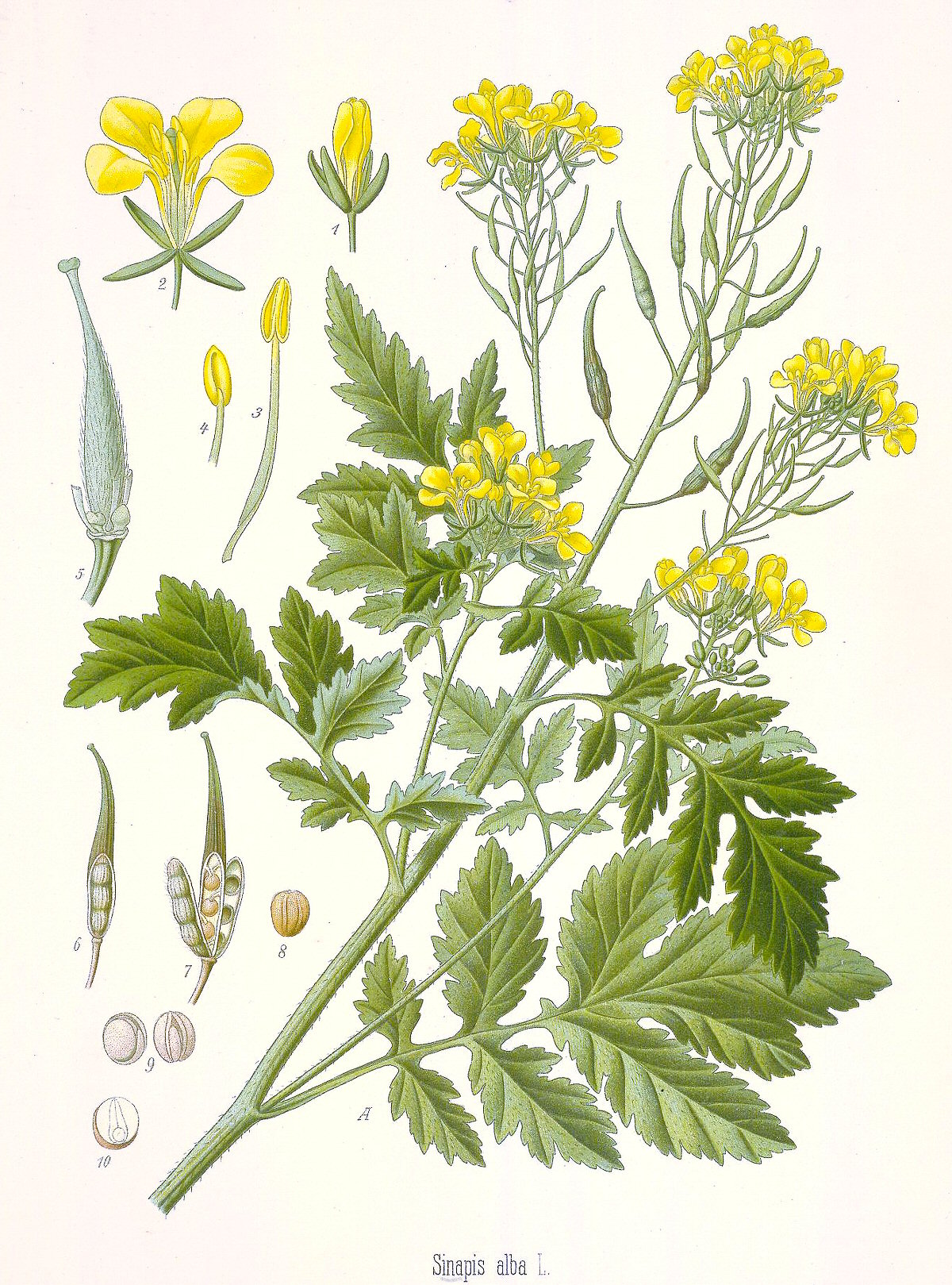
Colour illustration of the plant and its parts taken from © 1995-2005 Missouri Botanical Garden..
IMAGE: SNPAL-32
Scanned image of the globular seeds.
Sinapis alba (White Mustard) - CLICK TO ENLARGE PHOTO Sinapis alba (White Mustard) - CLICK TO ENLARGE PHOTO    
IMAGE: SNPAL-33
Magnified scanned image of brown seeds, approx 4mm across.
IMAGE: SNPAL-34
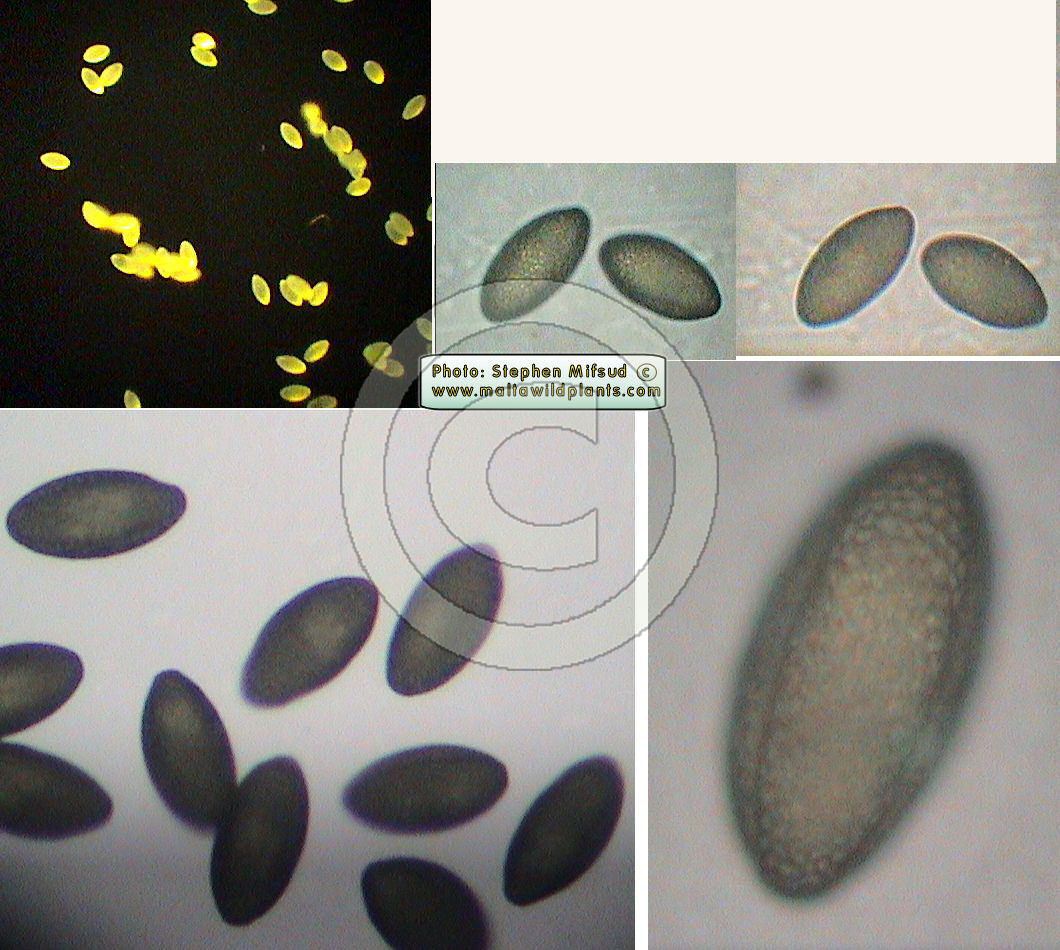
Magnified image under light microscope of pollen. They have a rugby-ball shape, pitted surface and have 3 longitudinal grooves.
-
-

Links & Further info

Further uses and information about WhiteMustard A Manual of Organic Materia Medica and Pharmacognosy
Developing oilseed yellow mustard (Sinapis alba l.) in western Canada Glucosinolate biosynthesis in Sinapis alba
Chemical composition and nutritive value of canola-quality Sinapis alba mustard
Herb information source
Physical and chemical defences of white mustard pods against tarnished plant bugs General Information on Mustard and its cultivation.
Search for on the FORUM of MaltaWildPlants.com


Buy Seeds and Docs

Buy Seeds from Maltawildplants.com Buy samples of seeds of certain wild plants for your studies, trials, research, etc. Not all species' seeds can be exported (depending on Maltese regulations), and availability depends on season of species. So, before any payment, you are kindly asked to fill in the online quotation/order form by which I can contact you back for availability and charges. Buy Seeds from Maltawildplants.com   Online Quotation

Buy Seeds from Maltawildplants.com   Online Payment
Buy Documents from Maltawildplants.com Buy documents related to Maltese Wild Plants such as the list of references, full profile, or other docs you request. Buy Documents from Maltawildplants.com   Online Payment
Buy Images  from Maltawildplants.com Buy any of my own copyright images found in this large collection of Maltese flora. You should first select the image you want to buy and input its corresponding code (found beneath each individual photo) in the online ordering form. Buy Seeds from Maltawildplants.com   Online Payment
Buy Seeds from Maltawildplants.com Kindly donate any sum of money (from 2USD / 2Euro) to help us covering some expenses needed to maintain Maltawildplants.com. Please bear in mind how much hard work such a large and up-to-date website needs to arrive directly to you home, office or library. Your kind donations are both greatly appreciated and recorded for future reference. Donors asking help will have first que preference for assistance and special attention. Buy Seeds from Maltawildplants.com   Online Donation


Submit own info about this plant

Use the form below to submit more information about this plant or a related species. If the data is taken from a book, journal, website, etc, please provide the corresponding reference / website address as indicated in the form. If it is your own observation, then your name will be cited. Your Email address will never be displayed online, it is just for internal communication.


For plant species that are marked as rare, you can also report other locations in Malta where you have seen this species.

Finally you can report any mistakes or errors found on the plant profile for necessary corrections. This will help to improve the website's acuracy.


To have more details about each particular field, just move your mouse on it and wait for the help message to pop up

* = required fields.
Plant Species:  *
Your name:   *
Your Email:   *
Fill any of the following 3 sections below (A, B or/and C) and send the form. - Thank you.
 
A:  Additional Information about this plant species
Own observations:
Info from published material (books, journals, website):

Reference of published material:

 
B:   Where have you seen this plant on the Maltese Islands?
Locations in Malta or Gozo where you have encountered this plant.
Mostly applies for rare plants.


1:        2:   
3:       4:   
5:       6:   

Try to be as concise as possible. Examples: Dingli Cliffs (near chapel), Wied Incita (Zebbug side), Triq il-Kbira (Qormi), Barriera ta\' Abdul (Xlendi), Fields near Salib tal-gholja (Siggiewi). GPS bearings are also welcomed!
 
C:  Corrections for mistakes and errors in this plant profile.
Section of this plant Profile page where you found an error (select one)

What is the error/mistake
What should be its correction


All material and data on this webpage is under the copyright of the author of this site - Stephen Mifsud / www.MaltaWildPlants.com / Malta. (2002-2008)
This research project about the flora of Malta is sponsored by:
Nature Guided Tours in the best countryside areas of Malta The Malta Council for Science and Technology (MCST) is the national advisory body to Government on science and technology policy. The MCST is also the national agency responsible for the management of the local RTDI programme, as well as the national contact organisation for the Seventh Framework Programme (FP7). A Fund established to help in the amelioration and enhancement of the environment in Malta and to take initiatives that enhance awareness on environmental issues amongst the public Advertise in this space Advertise in this space