Euphorbia helioscopia   MaltaWildPlants.com - A website dedicated to the flora of Malta  
        
   Tue 22 May 2012           Google PR= 5
HOME  - Index of Plant FamiliesA to Z INDEX - Species list aided with query filter toolsNEWS - Lateset news from the author & web updatesCOMMUNICATE ( Emails, Comments, Donations, etc)


Mediterranean Heath

Erica multiflora  L.  (Fam: ERICACEAE.)
Erica multiflora  / Mediterranean Heath / Erika
This plant is brought to you by one of the project's sponsors:
MCST - Malta Council for Science & Technology
More sponsors are needed for this project [ click here ]

Contents Links  (Detailed Profile)


Nomenclature

Morphology

Description & Specifications

Plant Information

Photo Gallery

Links and further info

Sales, Support and Donations

Submit further info on this species

Give a small Donation Online

Website FORUM

Copyright Notes


Ericaceae Index

Main Family Index

 
Visitors (Feb-2004):
Profile created on Feb-2004. / Last Update 29 Jun 2011.

Nomenclature

Species name:

Erica multiflora   L.

Author(s):

Carl von Linné;
   Sweden, 1707-1778

Common names:

Mediterranean Heath, Mediterranean Heather

Maltese name:

Erika, Leħjet ix-Xiħ, Savina, Issopu, Sagħtar Aħmar

Plant Family:

Ericaceae   (Heath Family)

Name Derivation:

Erica = Heath or wasteland, the normal habitat of many members of Erica (Latin);
multiflora = Literally means multiple (multi-) flowers (-flora) (Latin)

Synonyms:

None

Remarks:

The only native species of the family in Malta. -


Morphology

PLANT STRUCTURE:

Character

Growth Form

Branching

Surface

Description

Erect :

Upright, vertically straight up well clear off the ground.
Extensively Branched :

Large number of compact branches and sub branches forming a shrub or tree. Common main stem is partially, or sometimes, totally covered by the branches.

Woody :

Stems get lignified to become tough wood.

General
Picture

Wild Plants of the Mediterranean Islands of Malta  - Copyright Stephen Mifsud / Maltawildplants.com / Malta (2002-2010) Wild Plants of the Mediterranean Islands of Malta  - Copyright Stephen Mifsud / Maltawildplants.com / Malta (2002-2010) Wild Plants of the Mediterranean Islands of Malta  - Copyright Stephen Mifsud / Maltawildplants.com / Malta (2002-2010)

LEAVES:

Character

Arrangement

Attachment

Venation

Description

Whorled :

Three or more similar leaves growing at the same level about an axis (stem).

Sessile :

Growing directly from the stem; without a stalk.

None :

No prominent venation visible.

General
Picture

Wild Plants of the Mediterranean Islands of Malta  - Copyright Stephen Mifsud / Maltawildplants.com / Malta (2002-2010) Wild Plants of the Mediterranean Islands of Malta  - Copyright Stephen Mifsud / Maltawildplants.com / Malta (2002-2010) Wild Plants of the Mediterranean Islands of Malta  - Copyright Stephen Mifsud / Maltawildplants.com / Malta (2002-2010)
 

Character

Leaf Shape

Leaf Margin

Remarks

Description

Needle like :

Slender and long.

Entire :

Smooth margin without indentations, lobes or any projections.

General
Picture

Wild Plants of the Mediterranean Islands of Malta  - Copyright Stephen Mifsud / Maltawildplants.com / Malta (2002-2010) Wild Plants of the Mediterranean Islands of Malta  - Copyright Stephen Mifsud / Maltawildplants.com / Malta (2002-2010) Wild Plants of the Mediterranean Islands of Malta  - Copyright Stephen Mifsud / Maltawildplants.com / Malta (2002-2010)

FLOWERS:

Character

Colour

Basic Flower Type

No. of Petals

No. of Sepals

Description

Pink to lilac

Inflated Tubular Shape :

A flower in which the petals are fused into an almost enclosed globe or urn shape, separating at the mouth into individual flared petals or small teeth-like flaps.

(1) Petals are fused into one unit

Single tubular unit.

4

General
Picture

  Wild Plants of the Mediterranean Islands of Malta  - Copyright Stephen Mifsud / Maltawildplants.com / Malta (2002-2010) Wild Plants of the Mediterranean Islands of Malta  - Copyright Stephen Mifsud / Maltawildplants.com / Malta (2002-2010) Wild Plants of the Mediterranean Islands of Malta  - Copyright Stephen Mifsud / Maltawildplants.com / Malta (2002-2010)
 

Character

Inflorescence

Description

Ovary

Stamens

Description

Raceme :

Simple, elongated, indeterminate cluster with stalked flowers.

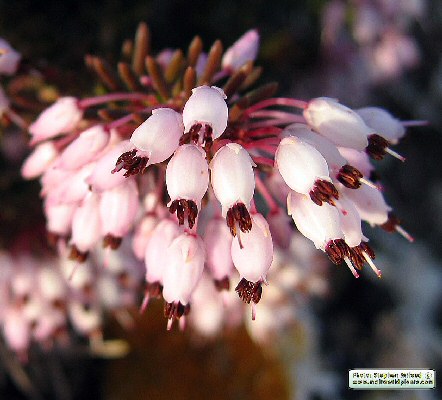
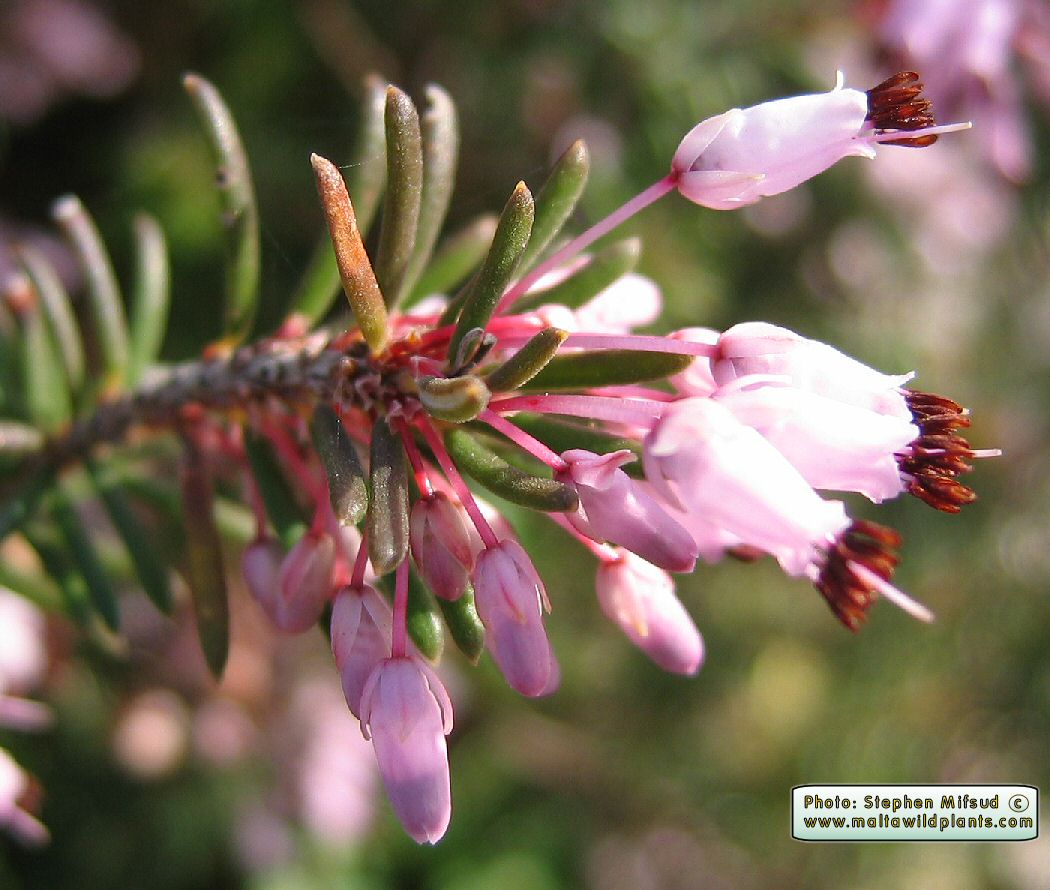
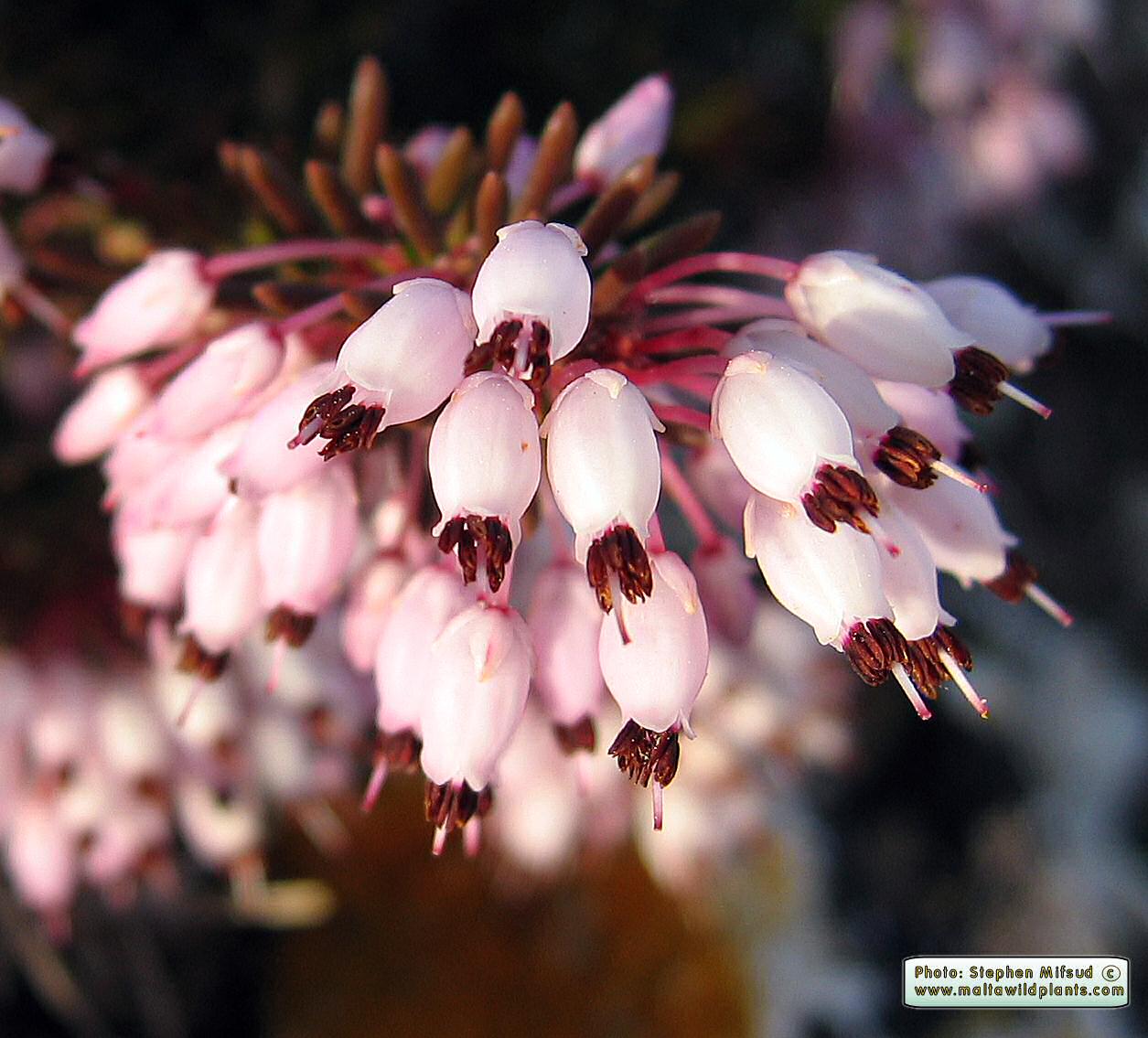
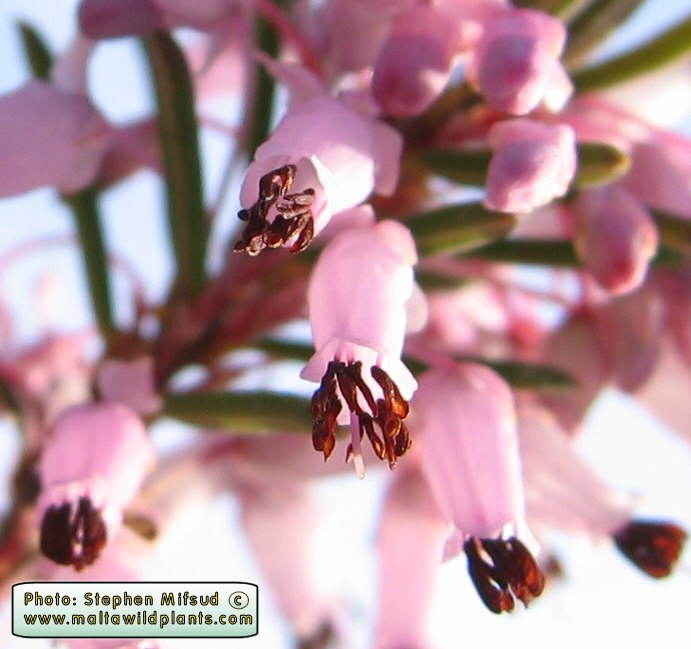
The pink flower is usually found hanging upside down due its long purple pedicels. The corolla have a cylindrical, tube shape with its promonent stamens and stigma protruding out from a star-shaped mouth. The eight, brown/purple anthers are located exactly at the opening of the flower. The single hair-thin style+stigma is about 3 mm longer than the stamens.

Superior :

Ovary situated above the flower parts (the calyx, corolla, and androecium). In other words, these are attached below the ovary.

8, Diplostemonous (alternipetalous) :

Flowers which has twice as many stamens as petals. Stamens are arranged in two separate whorls; the outer whorl with stamens alternatng between the petals, the inner one over the petals (between the sepals).

General
Picture

Wild Plants of the Mediterranean Islands of Malta  - Copyright Stephen Mifsud / Maltawildplants.com / Malta (2002-2010) Wild Plants of the Mediterranean Islands of Malta  - Copyright Stephen Mifsud / Maltawildplants.com / Malta (2002-2010) Wild Plants of the Mediterranean Islands of Malta  - Copyright Stephen Mifsud / Maltawildplants.com / Malta (2002-2010) Wild Plants of the Mediterranean Islands of Malta  - Copyright Stephen Mifsud / Maltawildplants.com / Malta (2002-2010)
 

Character

Scent

Average Flower Size

Pollen Colour

Other Notes

Description

None (or very faint)

6mm x 3mm

Length x Diameter. (not including the flower stalks, anthers and stigma).

Pale Yellow

-


SEEDS:

Character

No. Per Fruit

Shape

Size

Colour

Description

>100

Numerous tiny seeds per capsule.

Linear

1mm x 0.5mm

Brown

General
Picture

Wild Plants of the Mediterranean Islands of Malta  - Copyright Stephen Mifsud / Maltawildplants.com / Malta (2002-2010) Wild Plants of the Mediterranean Islands of Malta  - Copyright Stephen Mifsud / Maltawildplants.com / Malta (2002-2010) Wild Plants of the Mediterranean Islands of Malta  - Copyright Stephen Mifsud / Maltawildplants.com / Malta (2002-2010) Wild Plants of the Mediterranean Islands of Malta  - Copyright Stephen Mifsud / Maltawildplants.com / Malta (2002-2010)

FRUIT AND OTHER BOTANICAL DATA:

Character

Fruit Type

Colour of Fruit

Subterranean Parts

Other Notes

Description

Dehiscent Loculicidal Capsule :

A fruit capsule that splits open longitudinally into the cavity of the locule when the seeds are ripe.

Green

Taproot :

A rooting system where there is the main descending root of a plant having a single dominant large structure from which a network of smaller and long roots emerge.

-

General
Picture

Wild Plants of the Mediterranean Islands of Malta  - Copyright Stephen Mifsud / Maltawildplants.com / Malta (2002-2010) Wild Plants of the Mediterranean Islands of Malta  - Copyright Stephen Mifsud / Maltawildplants.com / Malta (2002-2010) Wild Plants of the Mediterranean Islands of Malta  - Copyright Stephen Mifsud / Maltawildplants.com / Malta (2002-2010) Wild Plants of the Mediterranean Islands of Malta  - Copyright Stephen Mifsud / Maltawildplants.com / Malta (2002-2010)

Specifications & Description

Life Cycle:

Perennial.

Growth Form:

Nano-Phanerophyte (Small trees / Large shrubs)

Habitat:

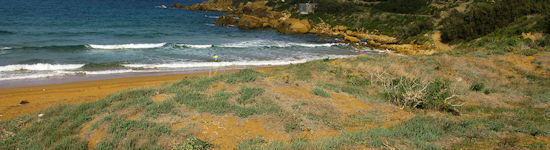
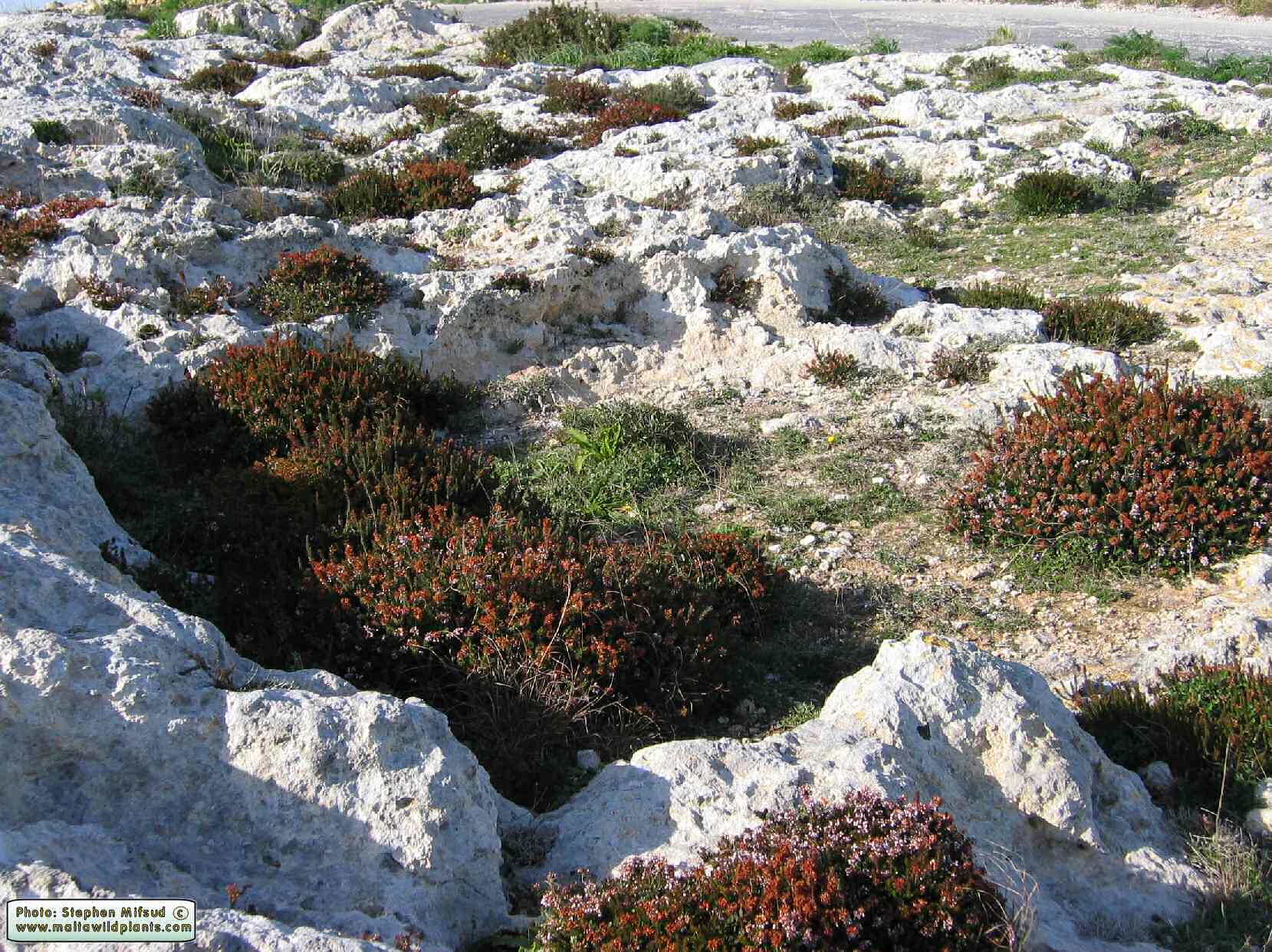
Rocky places, Garigues, Dry Woods, Hills, Cliff tops and sometimes at valley tops.

Frequency:

Common

Localities in Malta:

Common, especially in garigues and cliffs as at Dingli, Mellieha, Bahrija, Delimara, Qrendi and at valley tops of Wied Encita. Also Common in Gozo.

Plant Height:

20-80cm.

Flowering Period:

Dec - Mar

Protection in Malta:

Protected by law (schedule III and VIII of legal notice LN311/2006) and cannot be picked or harmed

Red List 1989:

Not listed in the Flora section of the National Red Data Book (Lanfranco, 1989)

Poison:

Not Poisonous.

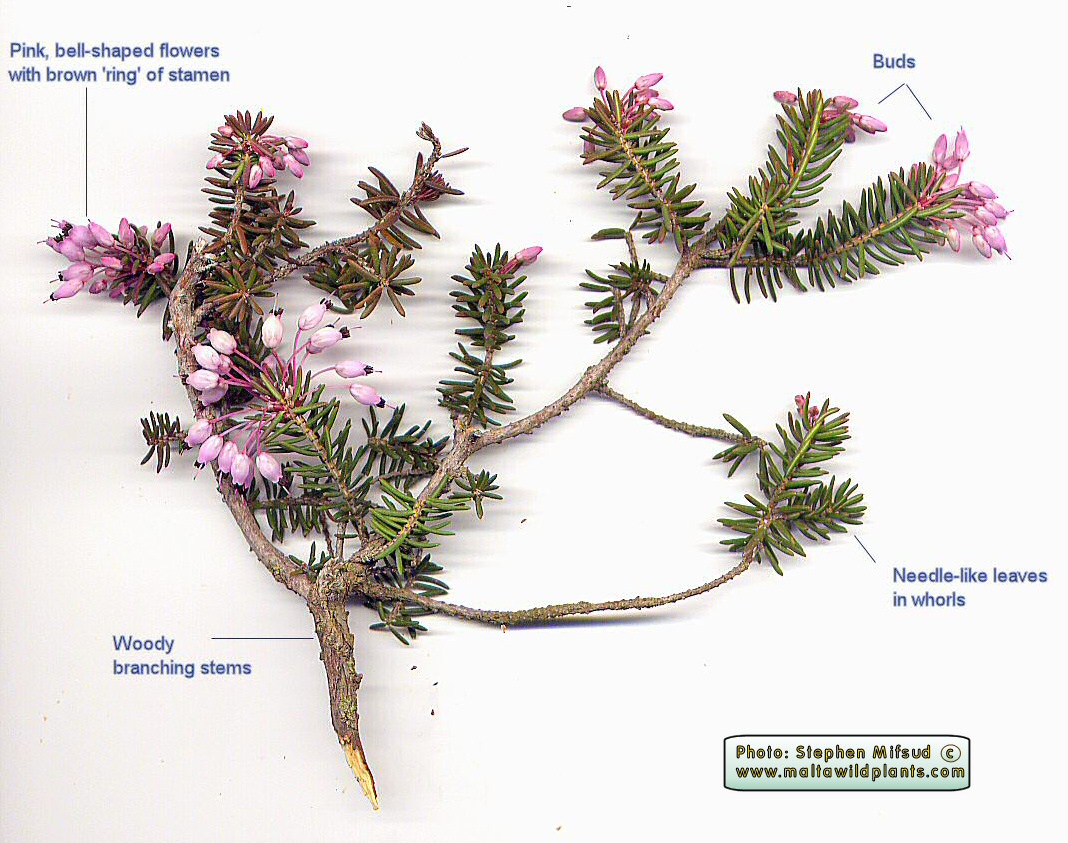
The plant is usually found as a short shrub, of about 30cm lying on rocks and cliffs or other similar dry environments. It can withstand very well cold, wind and hot dry climates. The stems are not so much conspicuous because they are covered by dense leaves and flowers. Stems are woody, have greyish-brown bark and is extensively branched forming a bush

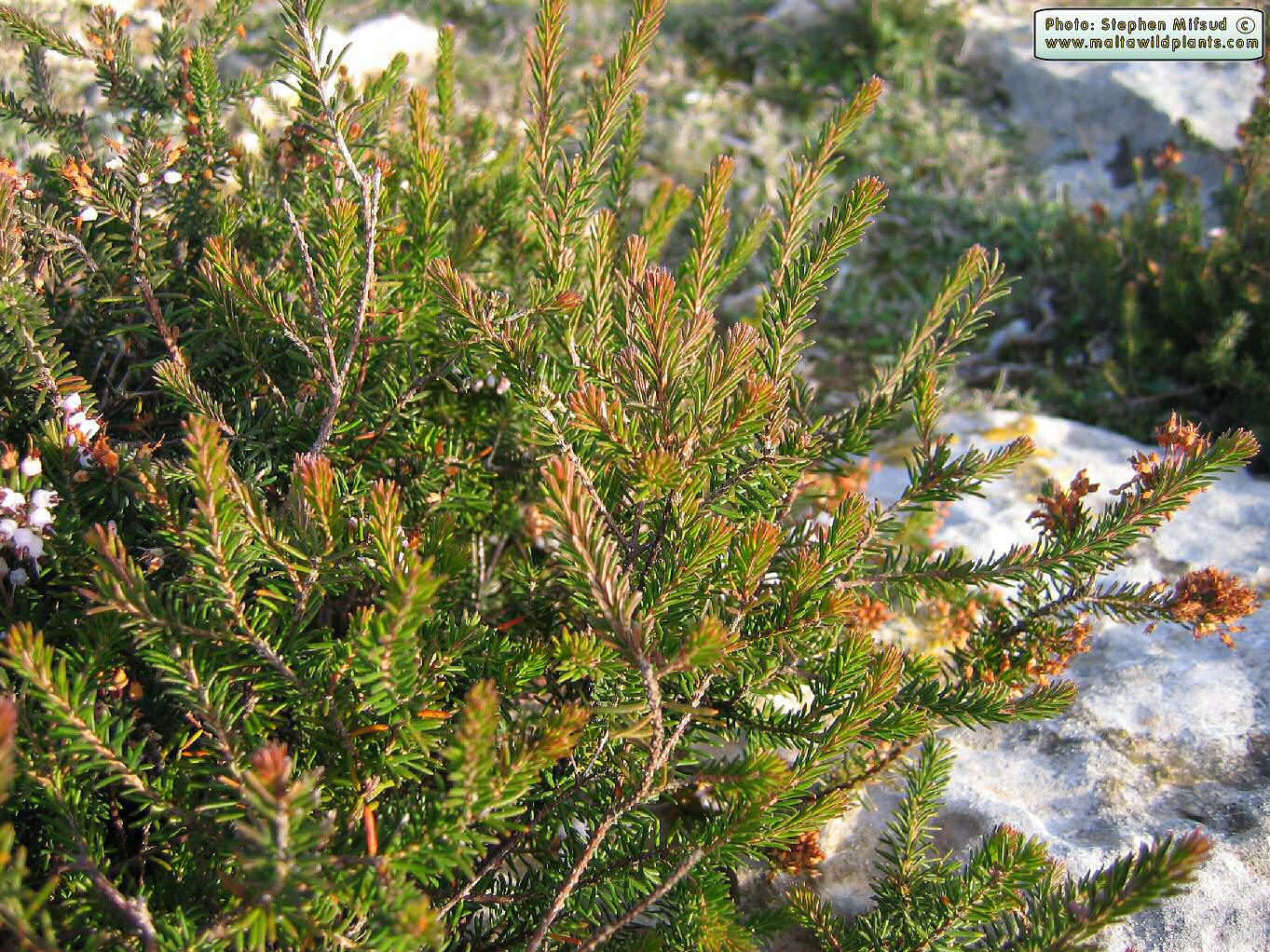
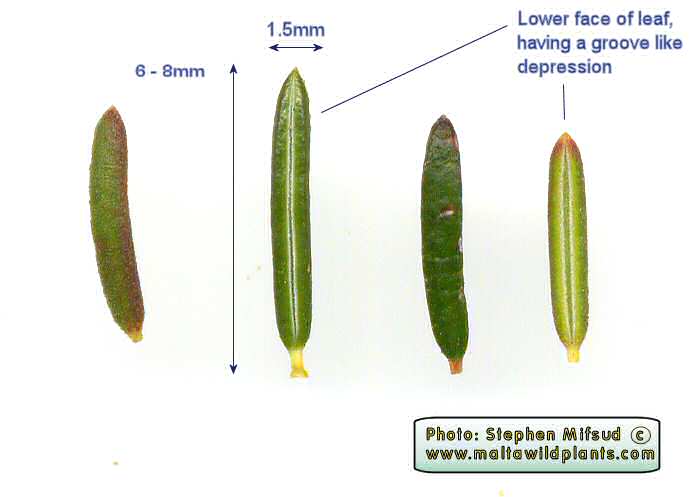
The leaves are arranged in whorls of 3 and sometimes of 5 around a stem axis, which its length can vary in any length normally up to 15cm. The whorls are very close to each other. The individual leaves are needle like, sessile and measure 1.5mm in width and about 6-10mm in length. The side of the leaf facing down have a central, pale, groove running along the axis.

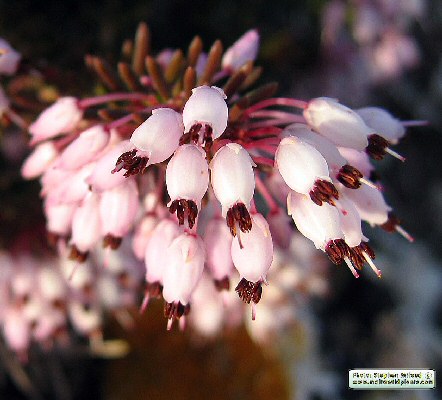
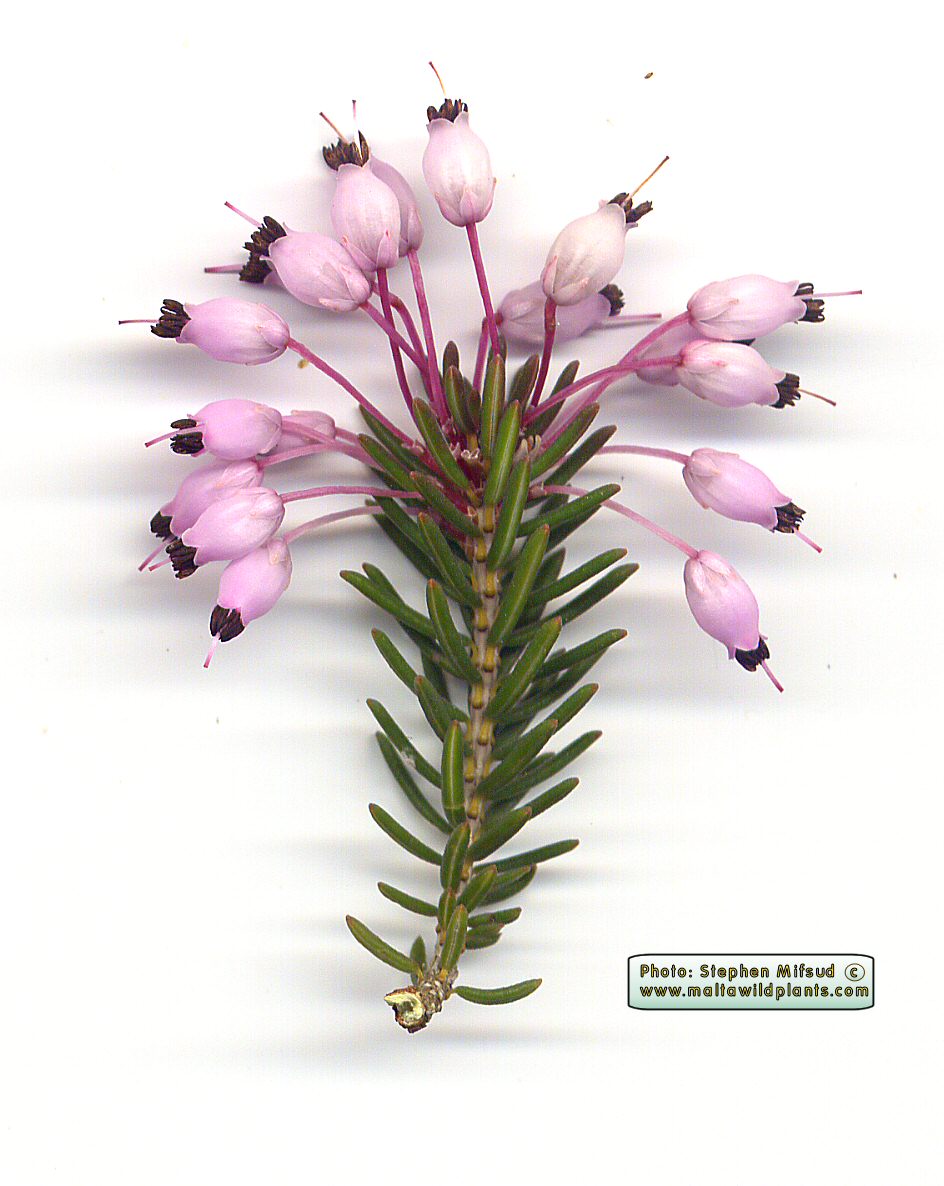
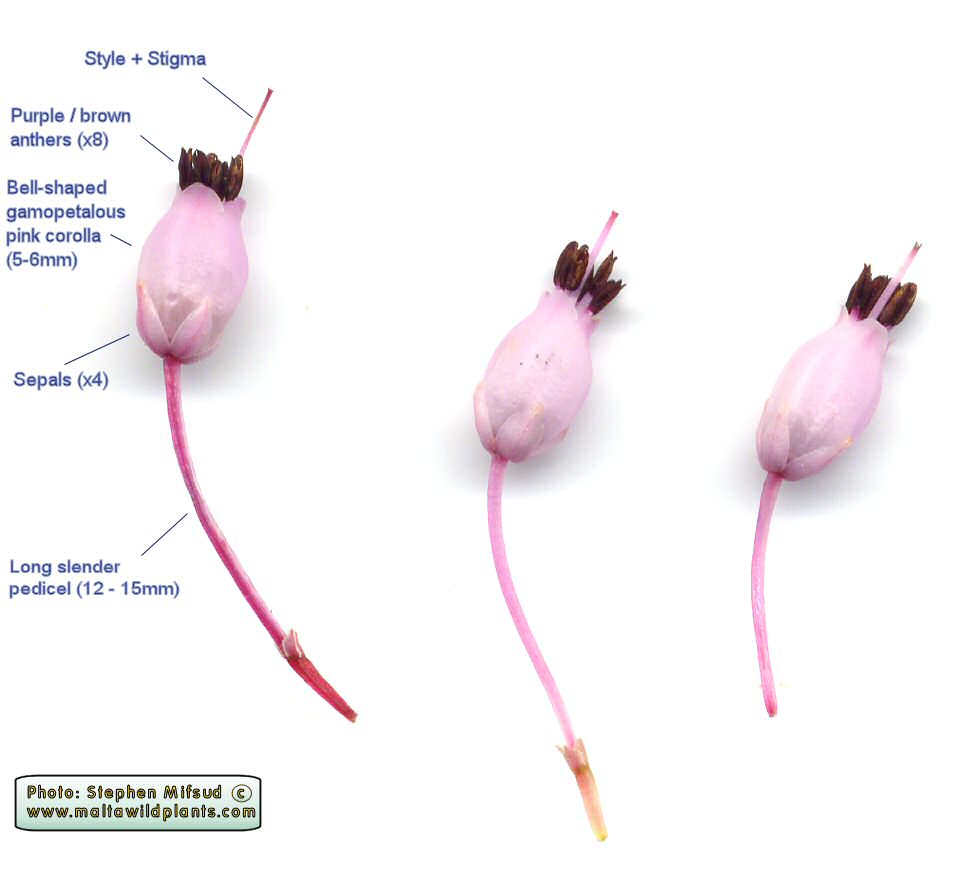
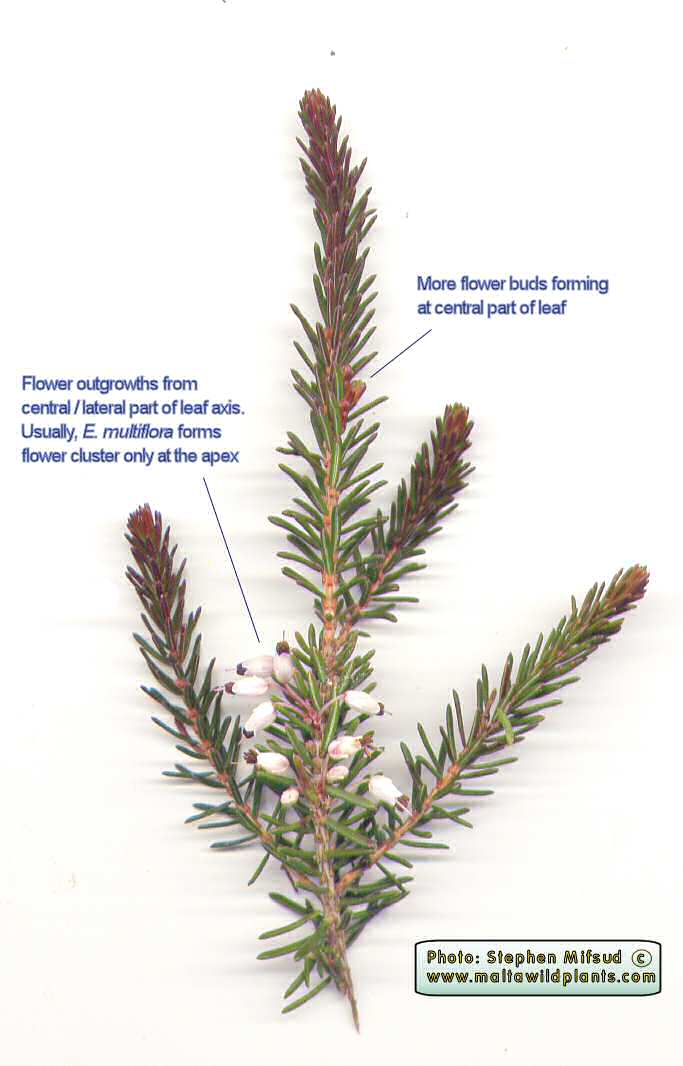
At the apex of the leaf branches there are the infloresences, a cluster of numerous light pink flowers often pendulous due to their long slender purple pedicels (flower stalks) and arranged in racemes . Flowers outgrows as racemes. The colour of the flowers ranges from pink to very pale (off-white) pink. Some plants form flower clusters at the central part of the leaf axis, not only at the apex. Each single flower consists of 4 small light pink sepals, and an inflated tubular sympetalous corolla. Just at the opening of the corolla, the brown / purple anthers protude out giving the false impression that the outer brown 'ring' is part of the corolla structure.

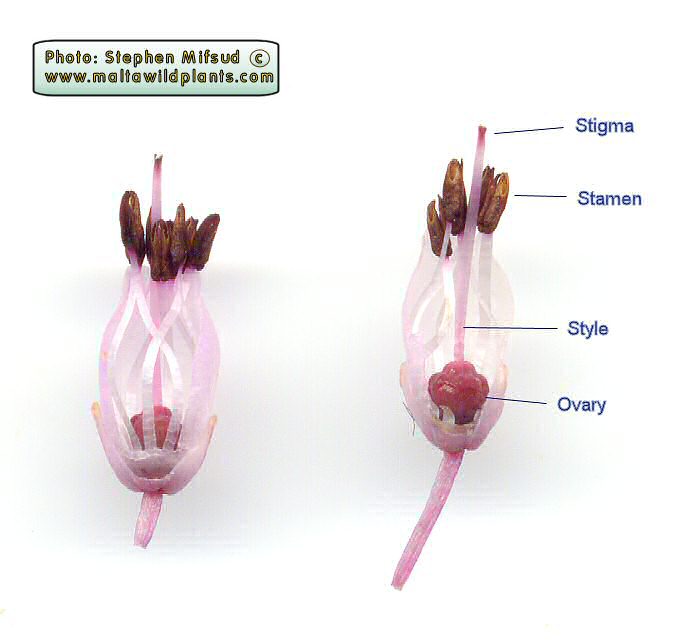
The corolla (excluding anthers) is 5-6mm long and about 3mm wide, while its pedicel is about 2-3 times as much longer. Each flower have 8 stamens made up of purple-brown anthers and pink filaments and also a single hair-thin pink stigma which is longer than the stamens by 2 or 3 mm. The style runs down the corolla into a central, inferior ovary which is speherical in shape and magenta in colour.


Information and Details


Medicinal Uses:

The plant has the following medicinal properties:   [302].
Antiseptic Destroys micro-organisms that carry disease without harming body tissues    [WWW-32]
Astringent Produces contraction in the soft organic tissues, and so discharges of blood, mucus, etc.    [WWW-32 ]
Diuretic Drug that tends to increase the flow of urine.    [WWW-32 ]

Pharmacognosy of Erica multiflora

An undergraduate student, Maureen Delia, of the Department of Pharmacy, University of Malta carried out a Pharmacognosy project on this plant [302]. She describes how she made a decotion of the plant and extracted Glycosidic acid, an alpha-hydroxyacid. Glycosidic acid is used for the treatment of photodamaged skin due its anti-wrinkle and exfoliant properties. Topical glycolic acid accelerates the resolution of erythema in irradiated skin due its anti-inflammatory properties. The Acid is also used in peels (known as glycolic acid peels), much used for the treatment of seborrhoeic keratoses, actinic keratoses and verrucae.

Other uses of Glycosidic acid comes from its polymer compound, used as a surgical suture material and in the production of microspheres for controlled delivery systems for a number of drugs. Also, the acid or its salts can be used for the topical treatment of aphthous ulcers including cancer sores.

Other important extracts apart glycosidic acid were tannins (antiseptic) and ursolic acid (anti-inflammatory) ; properties which may improve the recovery of photodamaged skin.

Honey Making

In certain Italian places like Calabria, Basilicata and Marettimo, the plant is used to produce honey WWW-46]. The organoleptic properties of honey made from E. multiflora are described to have the same peculiar characteristics of honey made from other Ericacea species. These are:
  • Endured and stable after production
  • One of the fastest to crystallize
  • Colour not limpid (hence not clear)
  • Medium to strong scent of flowers, similar to the odour of the artificial aroma of honey
  • Taste is slightly sweet and normal to decisevly acidic (i.e bitter)
  • Aroma of medium intensity similar to an oven-baked cake with honey (eg. pan speciale)
  • Very Persistent


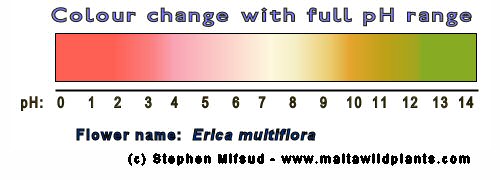
pH of Soil preferred by plant

Many species of the Erica genus prefers acidic soil, but this particular species like alkaline soil instead. This is why we find the plant abundantly on our limestone-alkaline land. According to information found on a website [ [WWW-45] the pH of soil where plenty of E. multiflora were growing was 8.6

Personal Observations


Plant height:
Many references describe the plant to reach normally 1m and even 2 m height. In Malta the average height is 30-60cm, although large shrubs of about 1 - 1.2m height are ocassionaly seen. Probably the plenty of sun, and the restricted soil volume makes the plant grow low and 'small'. It usully grows as low shrubs in rock gaps and pockets filled with little soil inside or between rocks. They prefer to grow by spreading across over the ground rather then rising high. This plant is usually found on bare rock receiving full sunlight all day, so maybe if this plant finds itself in a partially shaded location and plenty of soil (like in woods), it may rise to the described height of up to 2m. [SM]


Infloresences:
Another observation is that botanical references describes the plant to form terminal flower clusters. As seen in aphoto below, there are E. multiforma variants in Malta which can produce flowers laterally along the central/upper part of the stem. [SM]

Photo Gallery   (35 Images)

Erica multiflora  (Mediterranean Heath) - CLICK TO ENLARGE PHOTO Erica multiflora  (Mediterranean Heath) - CLICK TO ENLARGE PHOTO Erica multiflora  (Mediterranean Heath) - CLICK TO ENLARGE PHOTO Erica multiflora  (Mediterranean Heath) - CLICK TO ENLARGE PHOTO
IMAGE: ERIMF-01
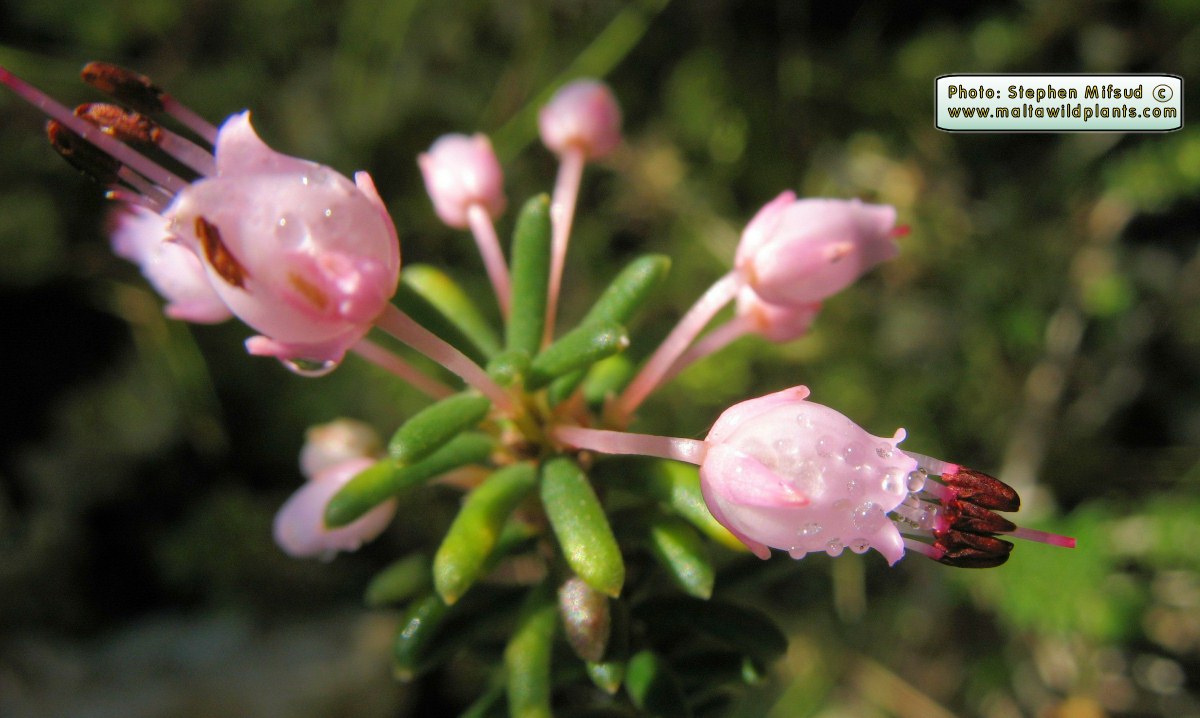
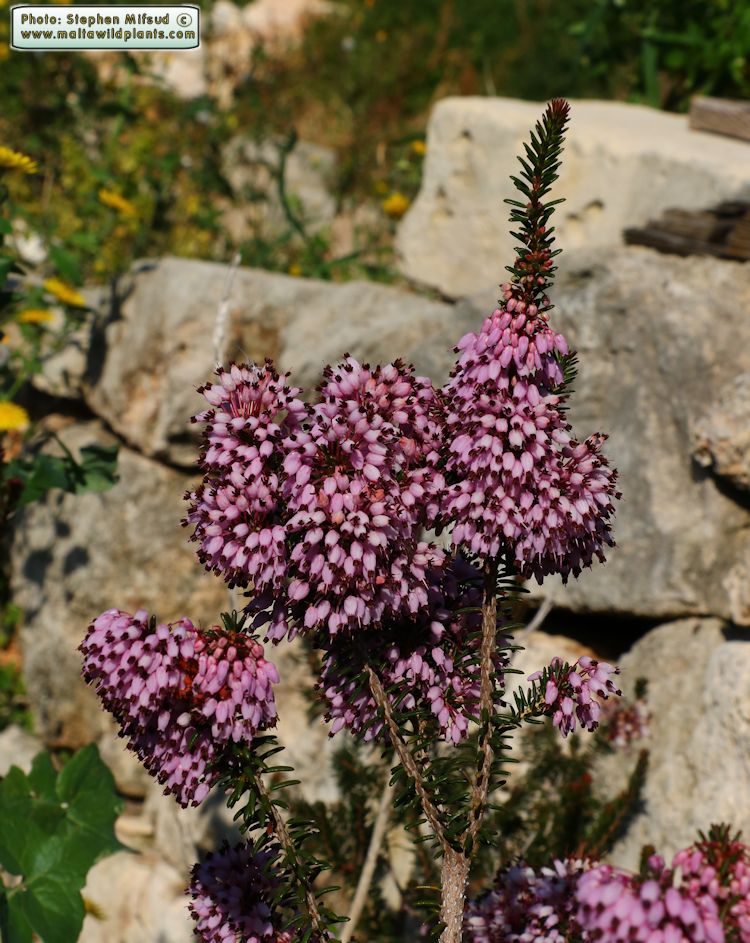
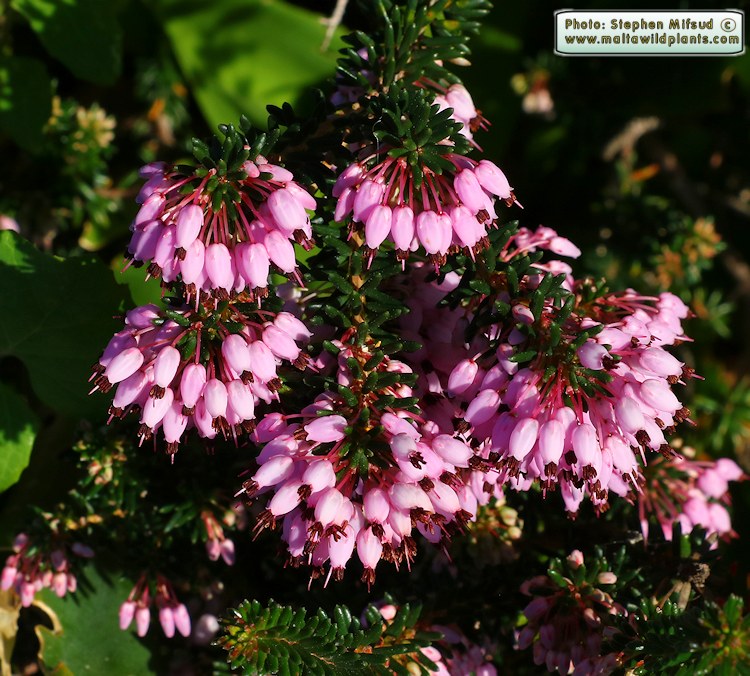
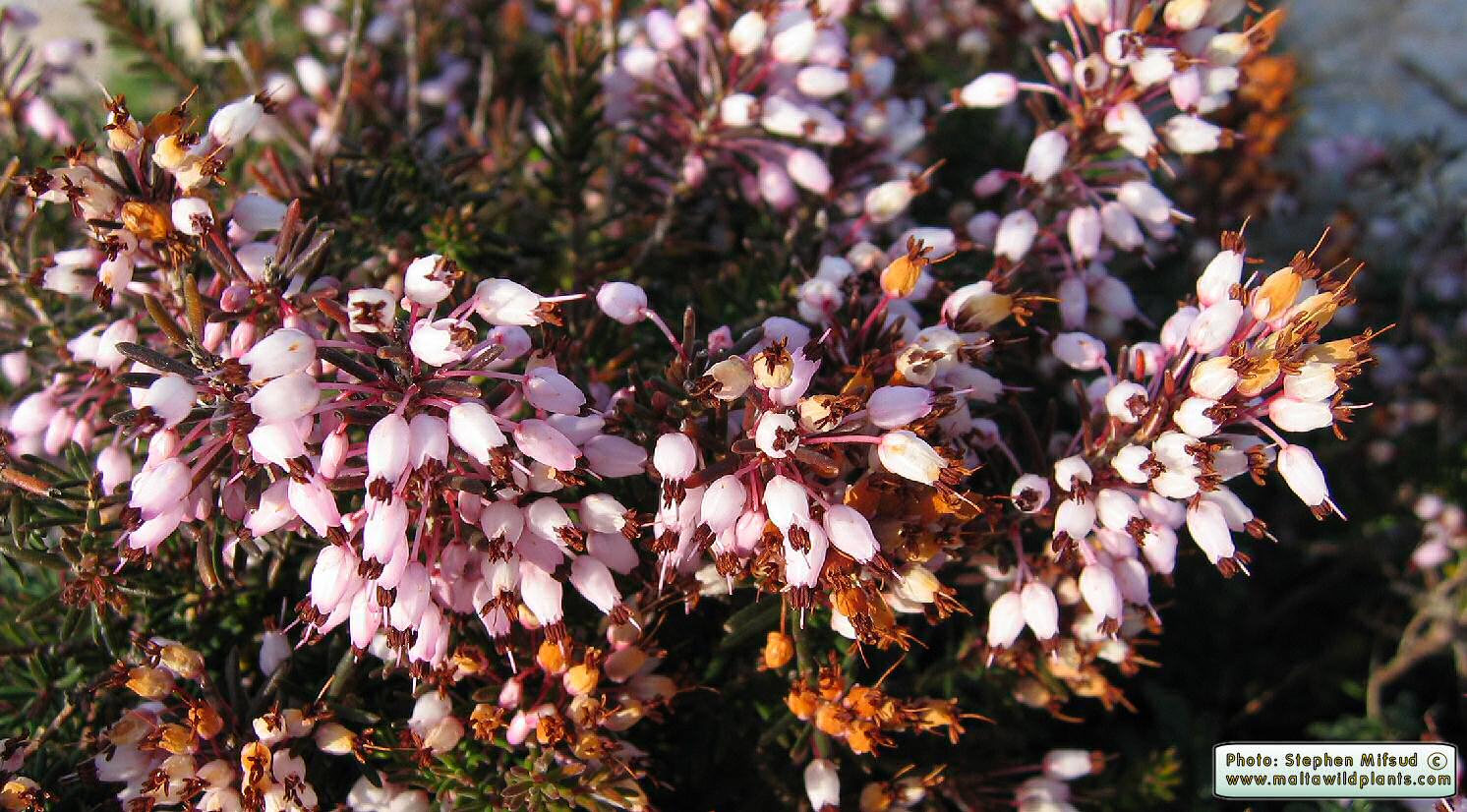
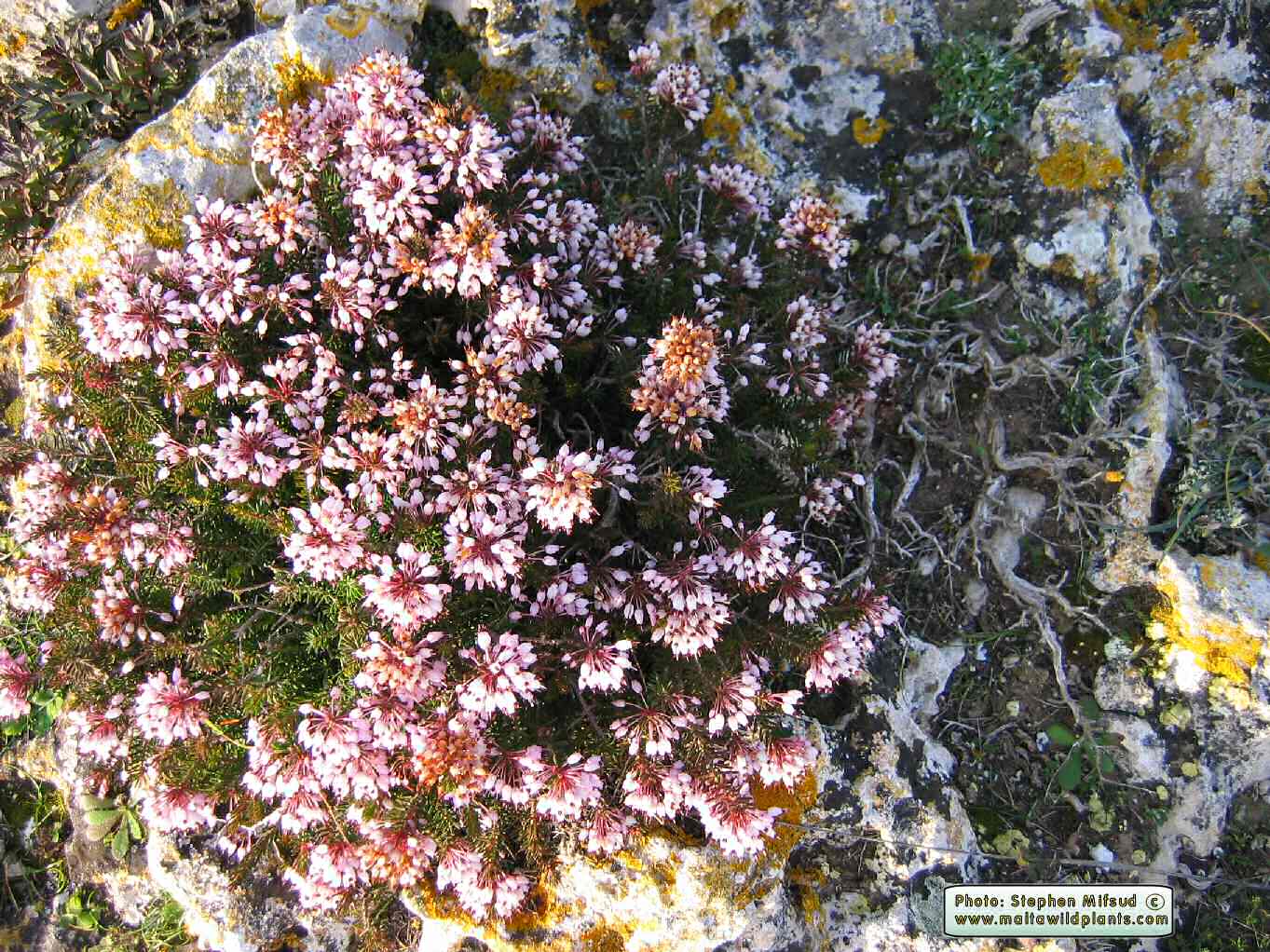
Photo of flowers, consisting of pink, tubular-shaped corollas with protruding brown/maroon anthers.
IMAGE: ERIMF-02
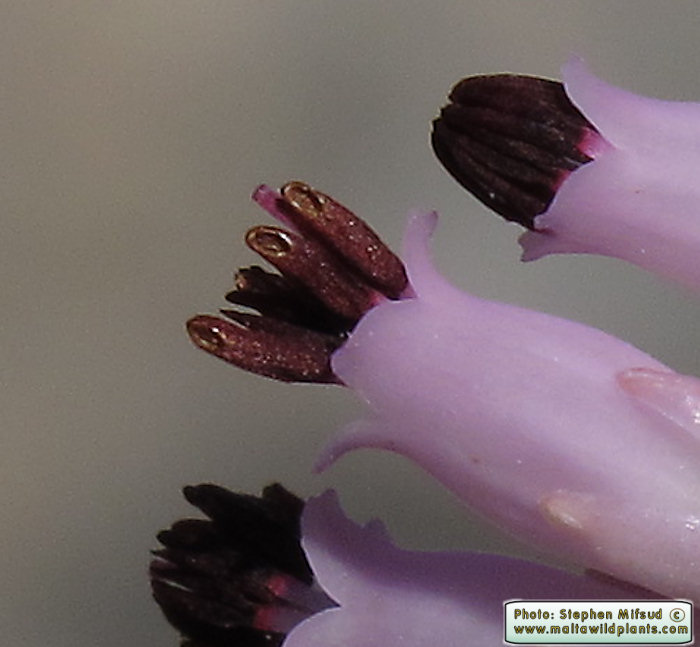
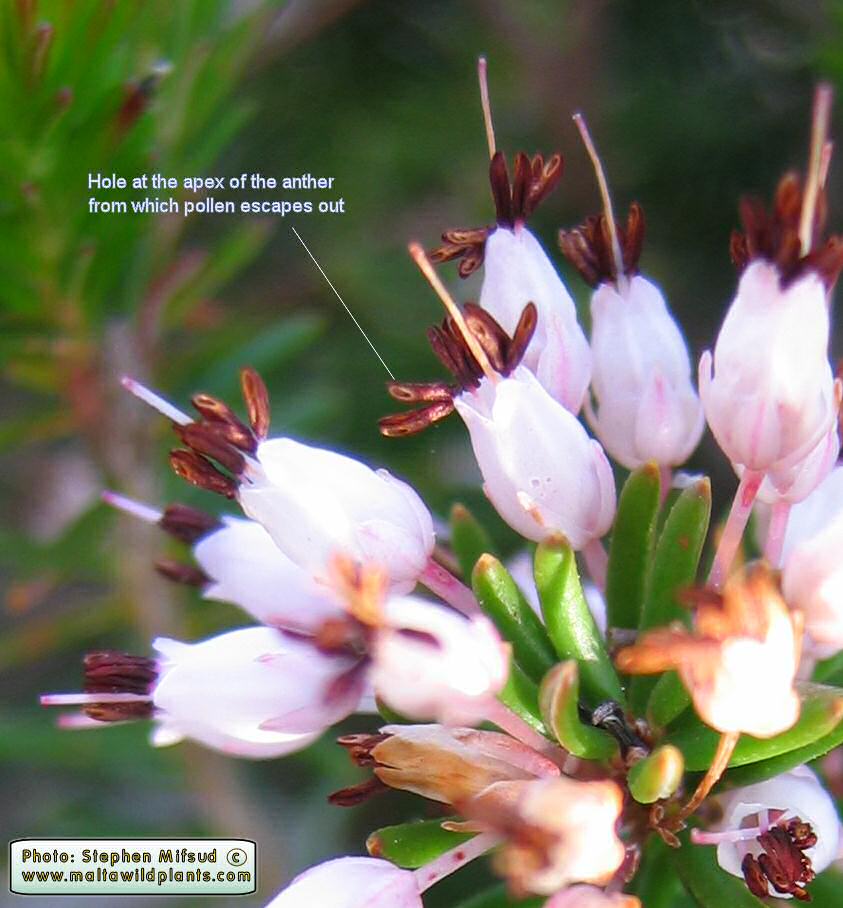
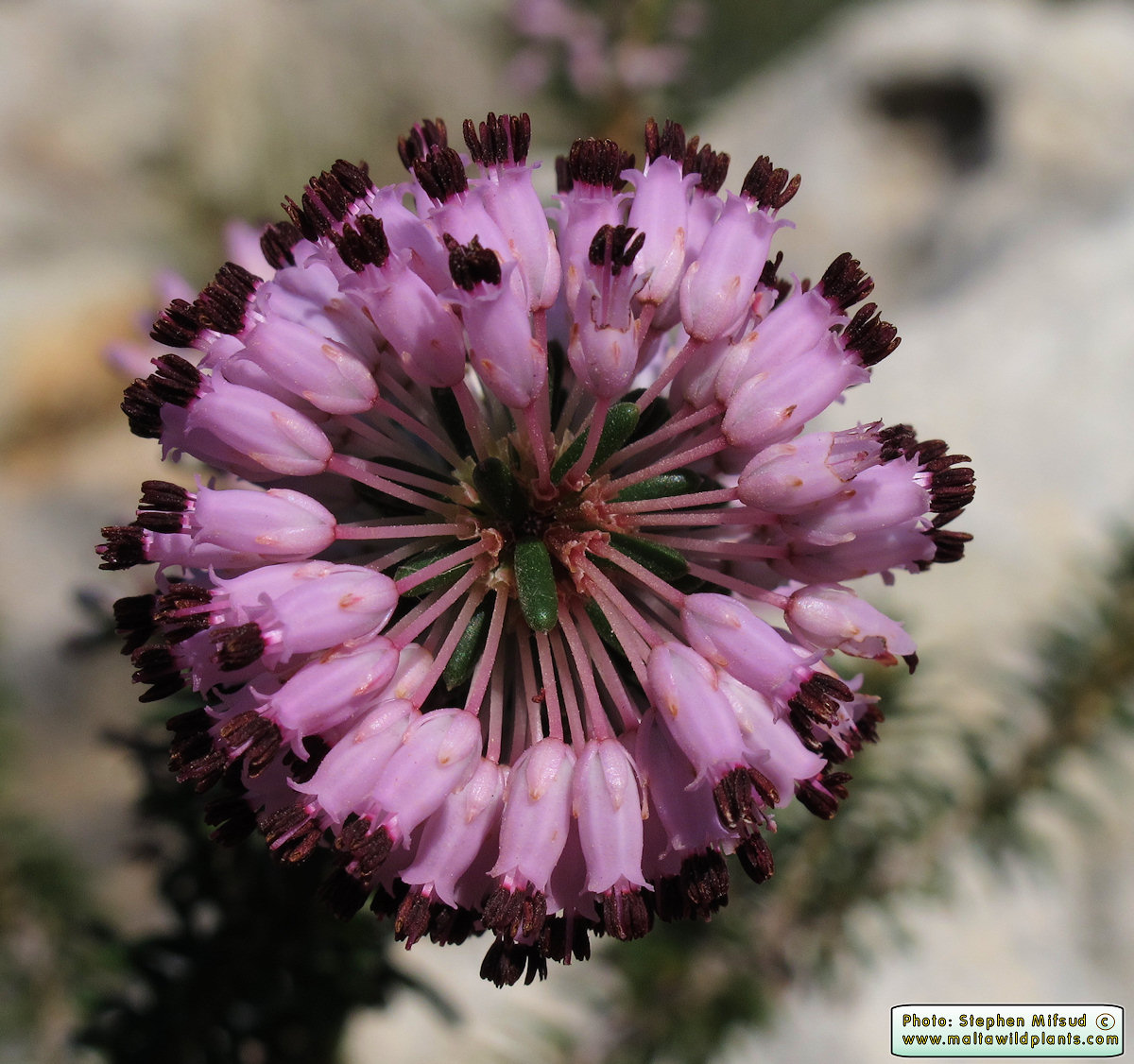
Photo of flowers, showing well the anthers which have an opening at their very ends from which pollen isliberated.
IMAGE: ERIMF-03
Close up photo of flower.
IMAGE: ERIMF-04
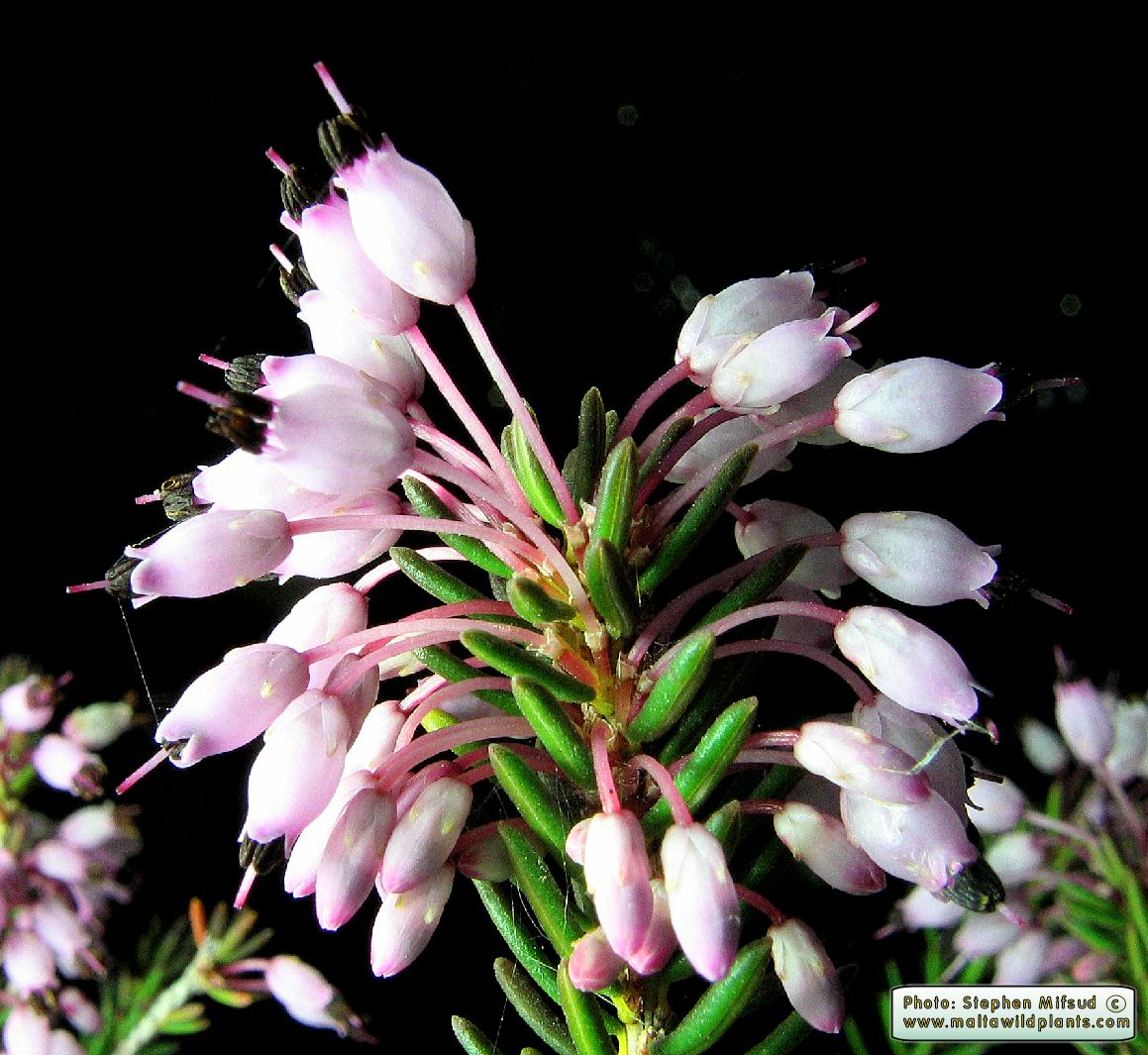
Photo of flowers against a dark backround.
Erica multiflora  (Mediterranean Heath) - CLICK TO ENLARGE PHOTO Erica multiflora  (Mediterranean Heath) - CLICK TO ENLARGE PHOTO Erica multiflora  (Mediterranean Heath) - CLICK TO ENLARGE PHOTO Erica multiflora  (Mediterranean Heath) - CLICK TO ENLARGE PHOTO
IMAGE: ERIMF-05
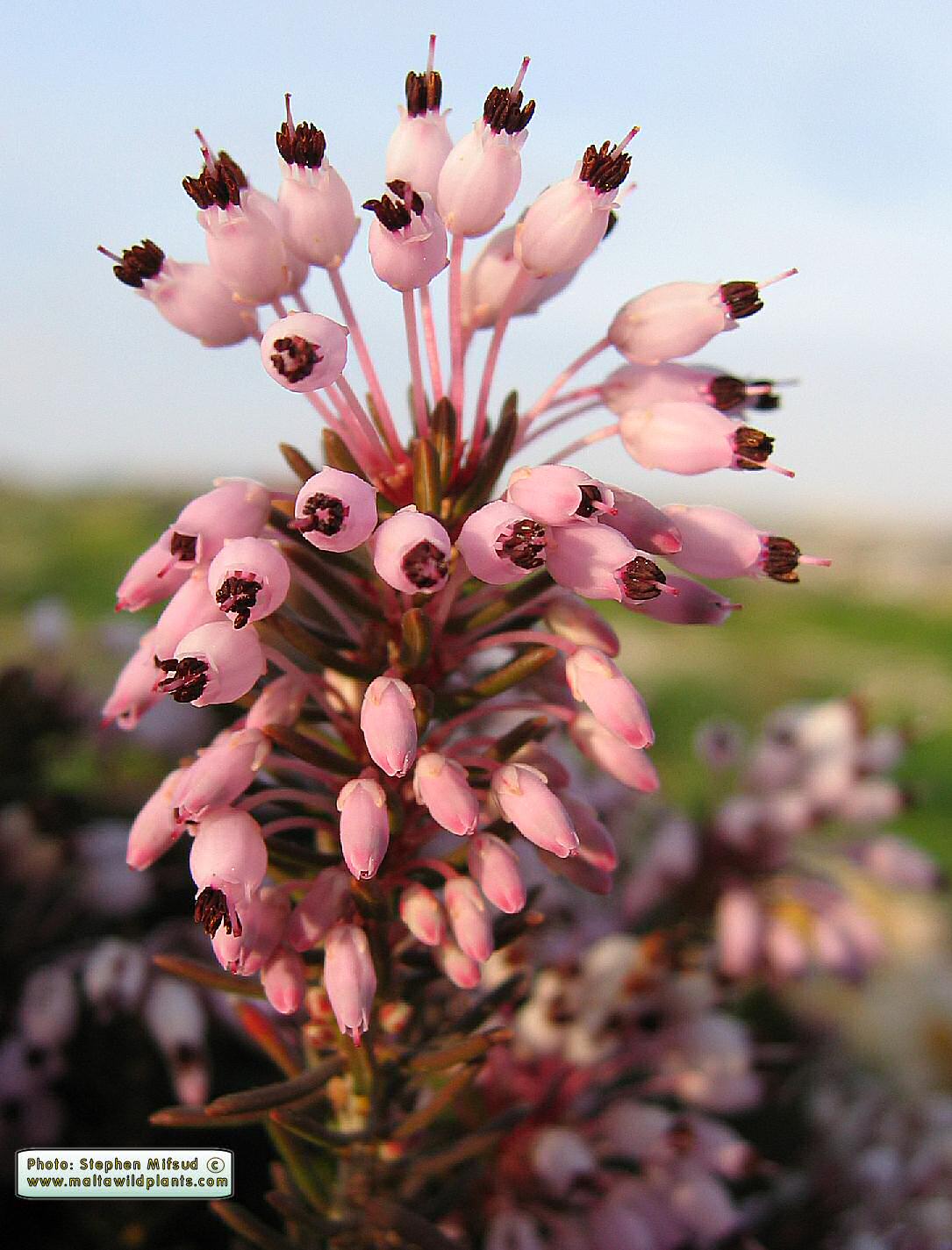
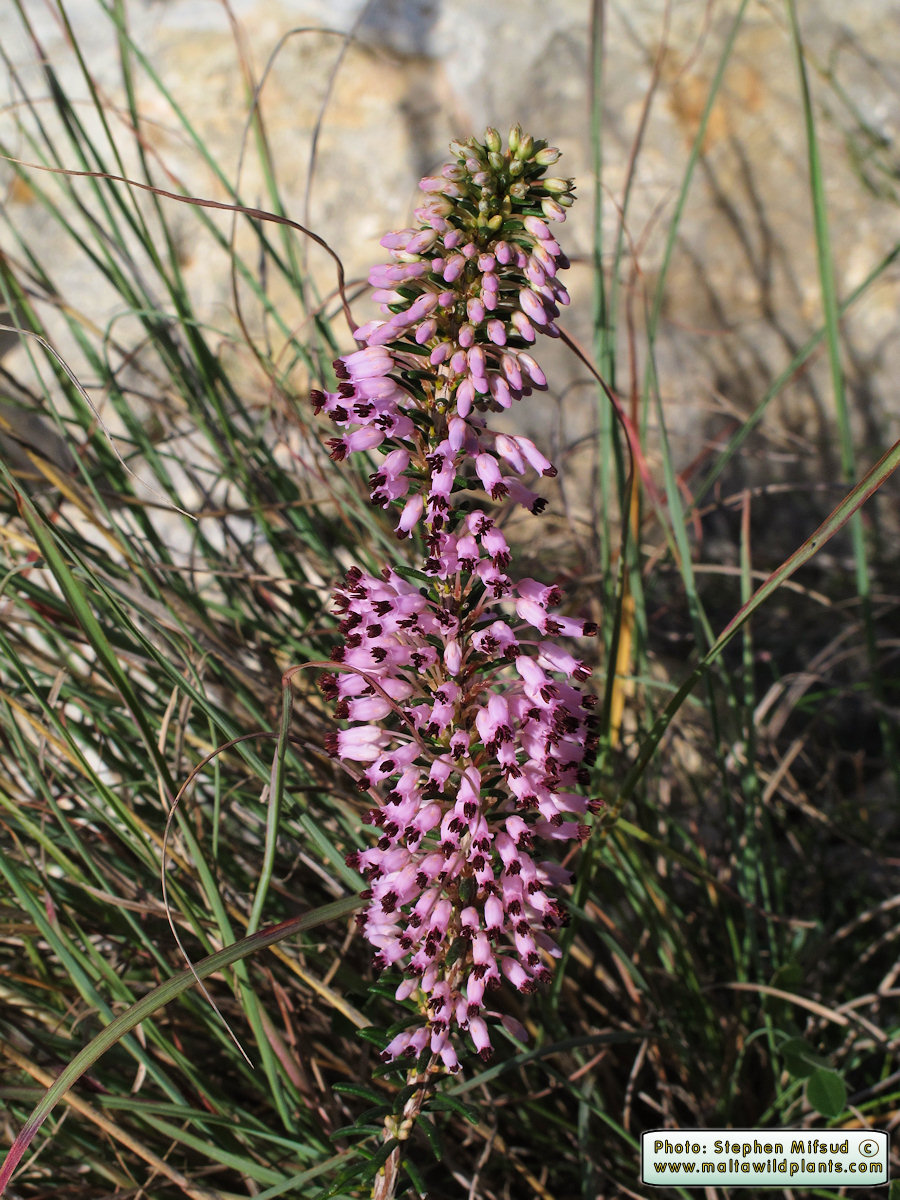
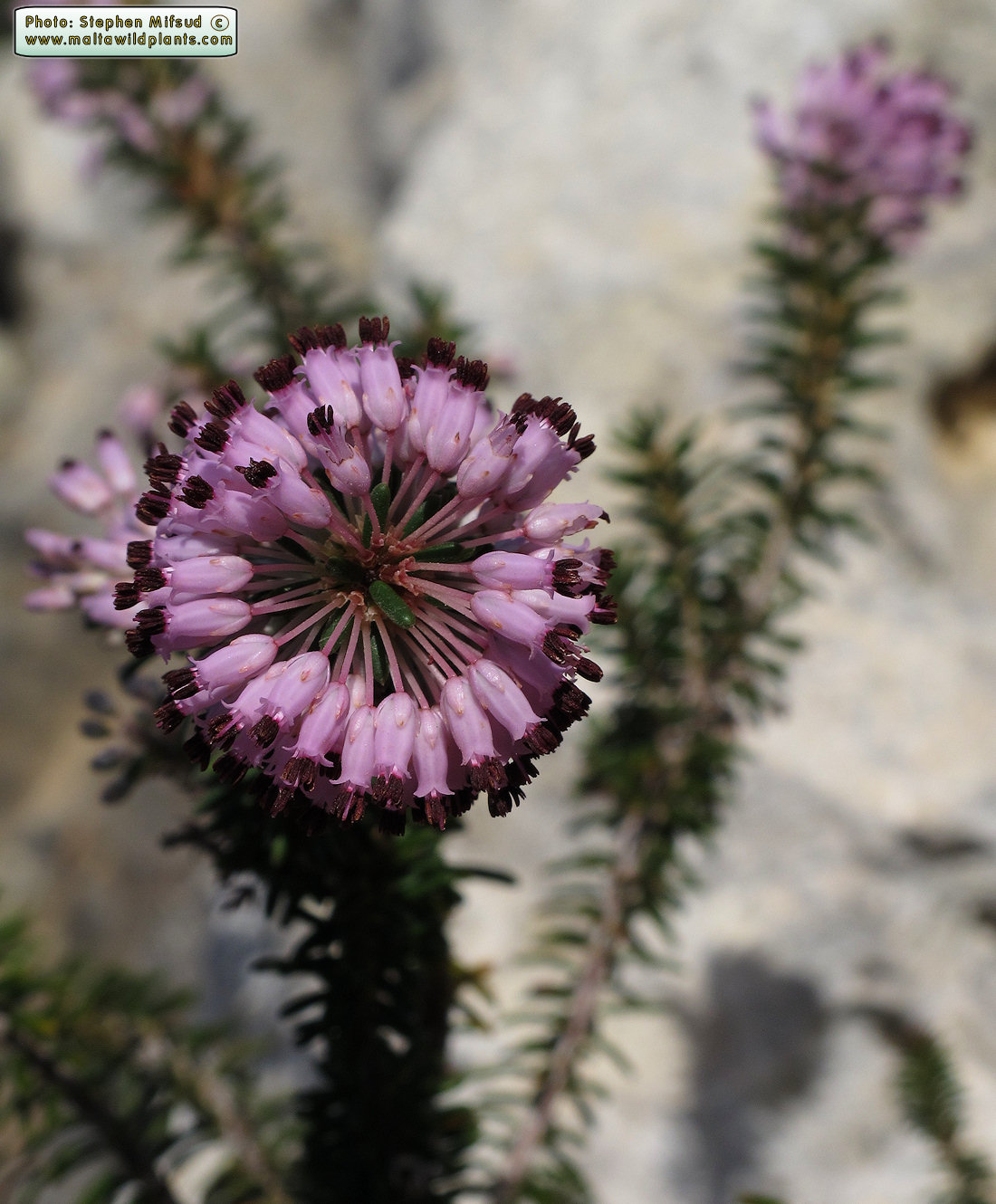
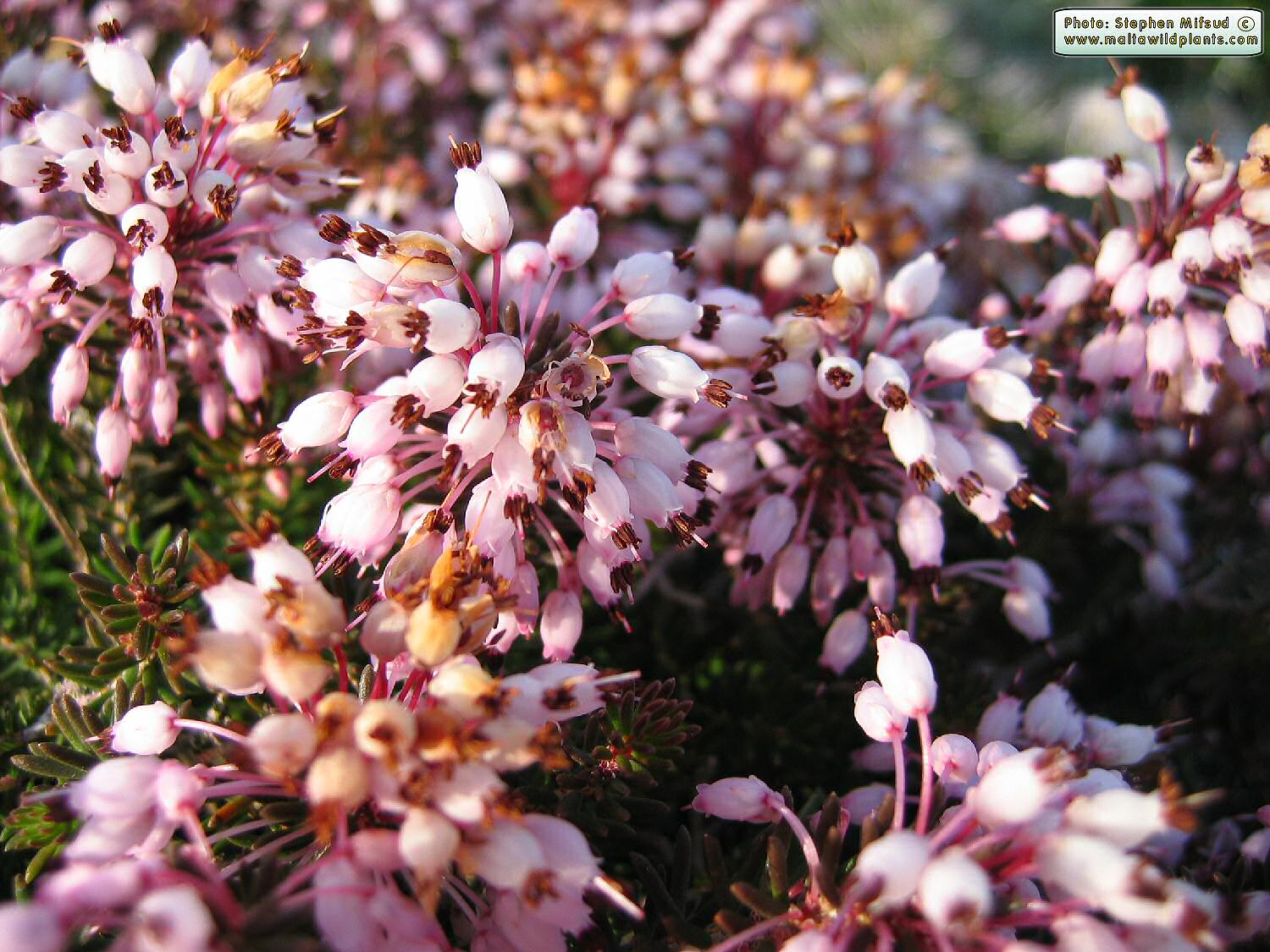
Photo of inflorescence - numerous flowers held by flexible, partly curved pedicels.
IMAGE: ERIMF-06
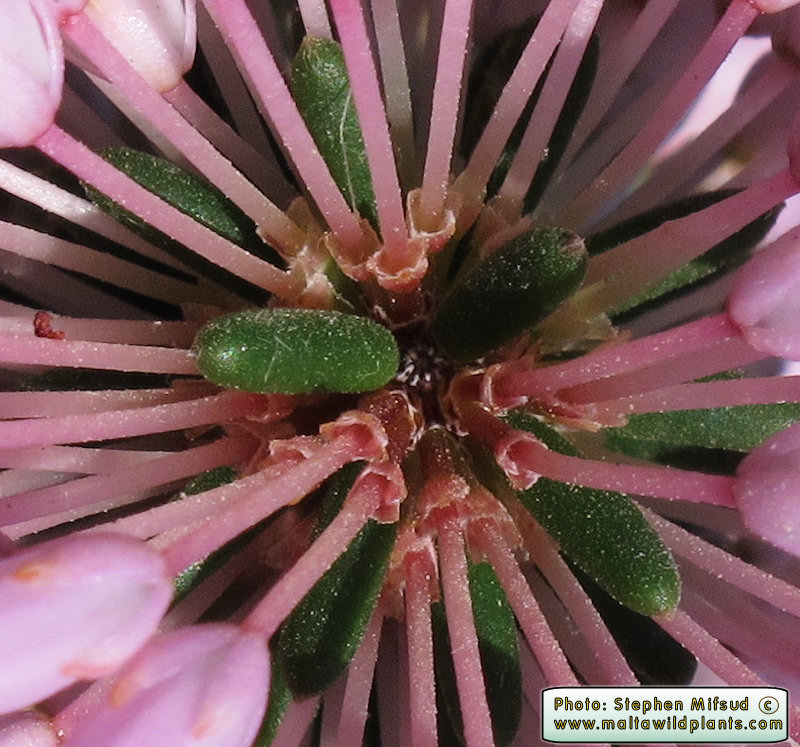
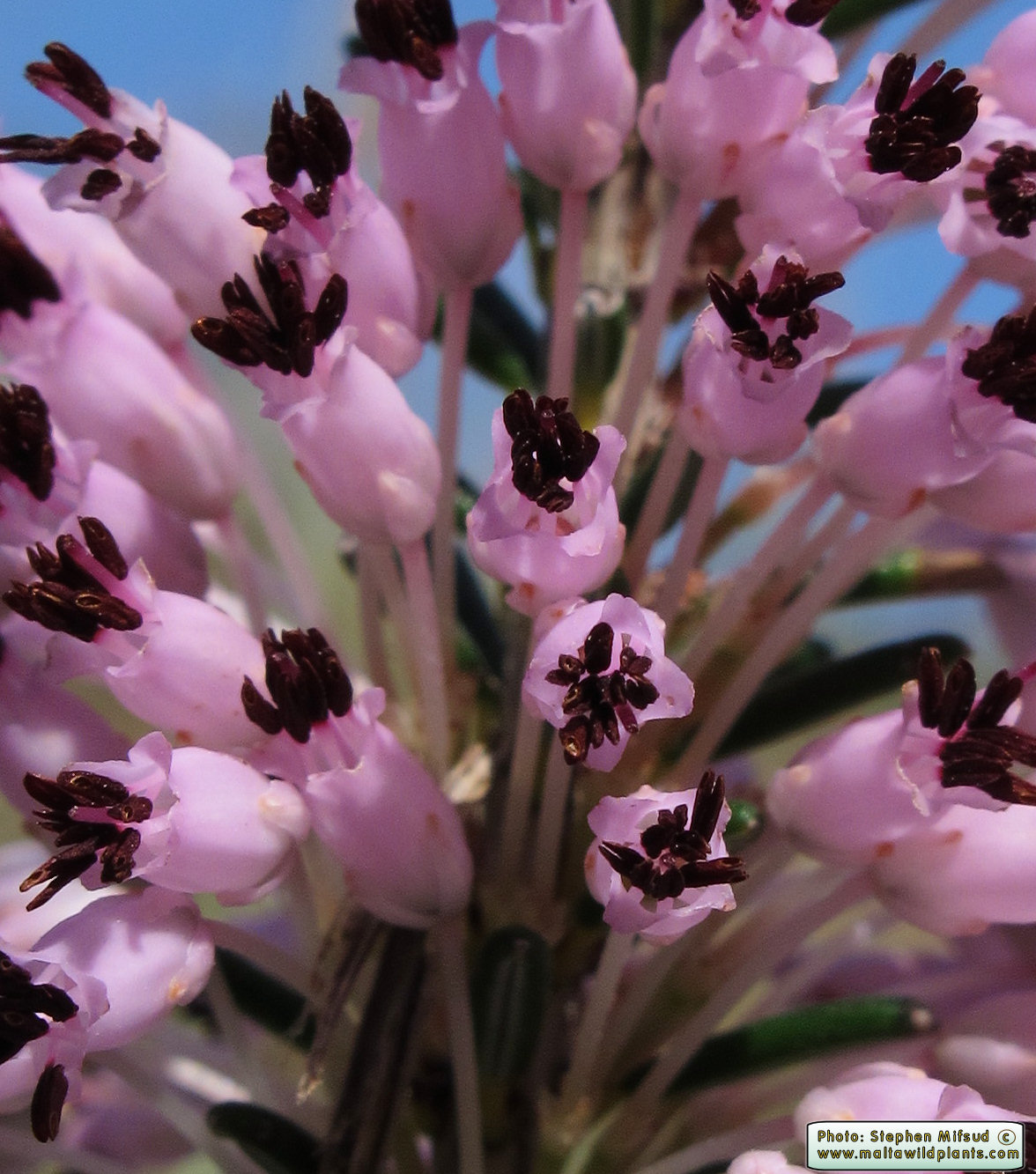
Photo of flowers (front side) showing the numerous anthers (about 8-10) protruding out from the corolla.
IMAGE: ERIMF-07
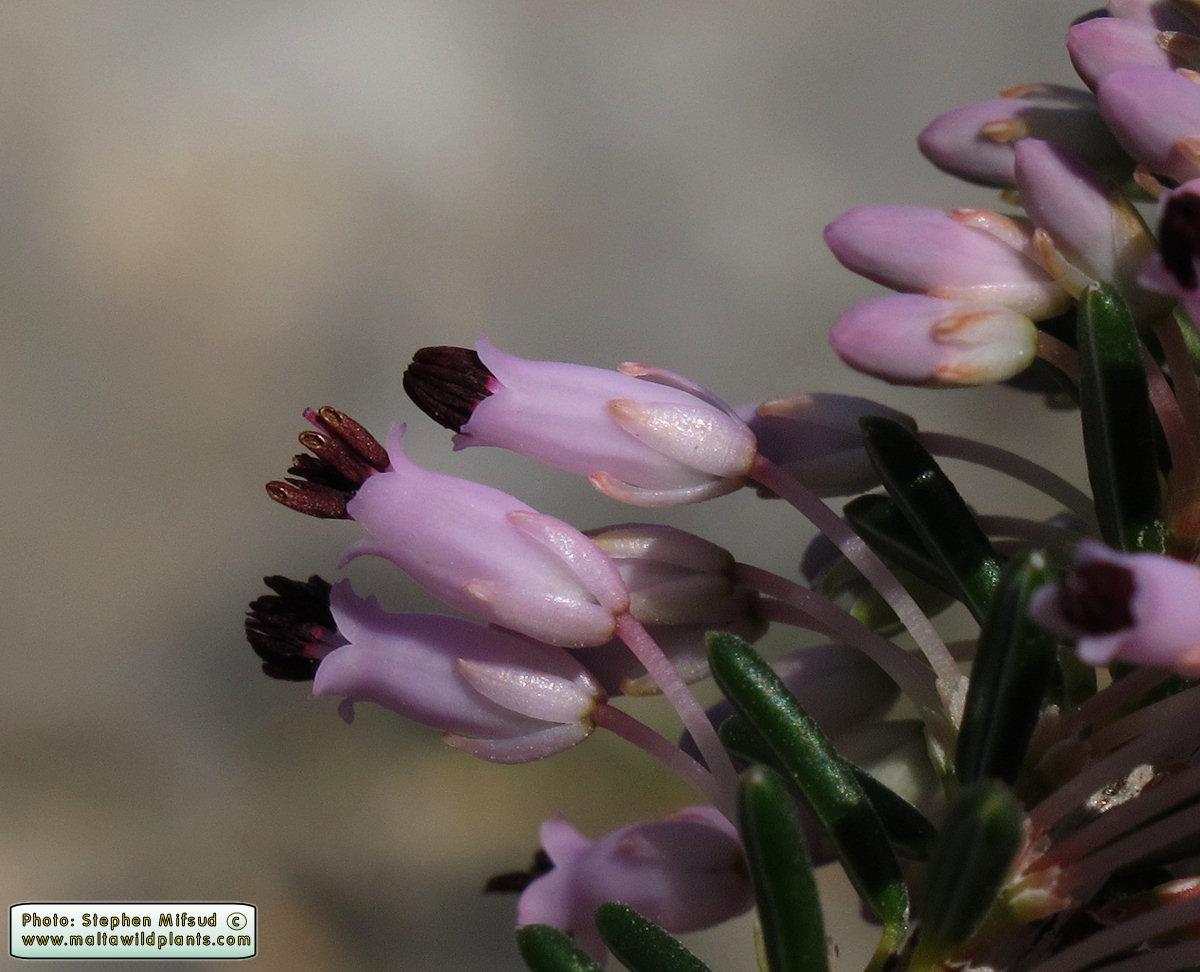
Close up photo of laterel view of flowers showing the 5 slender sepals of same colour of corolla, and hence rather inconspicuous.
IMAGE: ERIMF-08
Photo of another inflorescence, with many flowers radially projecting out from the common flowering branch.
Erica multiflora  (Mediterranean Heath) - CLICK TO ENLARGE PHOTO Erica multiflora  (Mediterranean Heath) - CLICK TO ENLARGE PHOTO Erica multiflora  (Mediterranean Heath) - CLICK TO ENLARGE PHOTO Erica multiflora  (Mediterranean Heath) - CLICK TO ENLARGE PHOTO
IMAGE: ERIMF-09
Close up image of flowers.
IMAGE: ERIMF-10
Photo of flowers with their slender,long, pink pedicels.
IMAGE: ERIMF-11
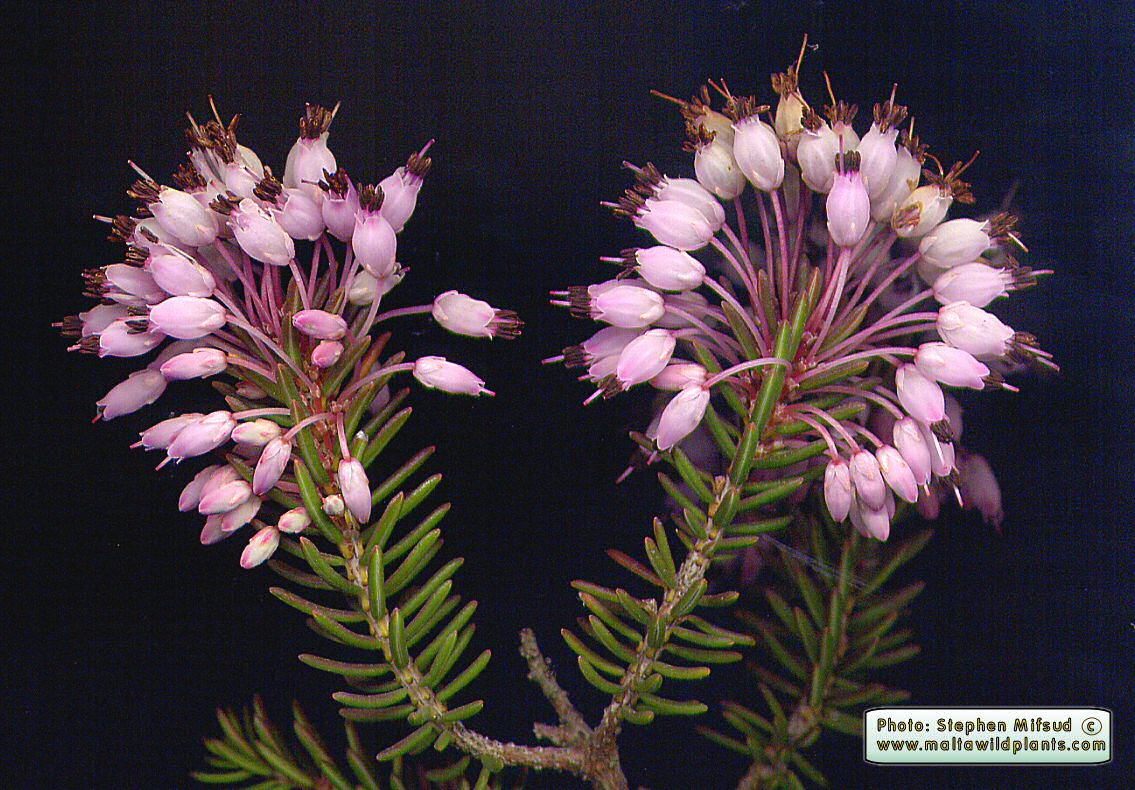
Scanned image of flower clusters against a dark background. Flowers usually grow at the apex of the flowering branches, but sometimes they are also found at the central part (lower from the apex). In rare ocassions, inflorescences are found in bothe mentioned locations.
IMAGE: ERIMF-12
Scanned image of the long flower stalks (pedicels) which makes makes flowers assume a slightly pendulous position.
Erica multiflora  (Mediterranean Heath) - CLICK TO ENLARGE PHOTO Erica multiflora  (Mediterranean Heath) - CLICK TO ENLARGE PHOTO Erica multiflora  (Mediterranean Heath) - CLICK TO ENLARGE PHOTO Erica multiflora  (Mediterranean Heath) - CLICK TO ENLARGE PHOTO
IMAGE: ERIMF-13
Scanned image of a crowded inflorescense. This type of inflorescense is described as a raceme.
IMAGE: ERIMF-14
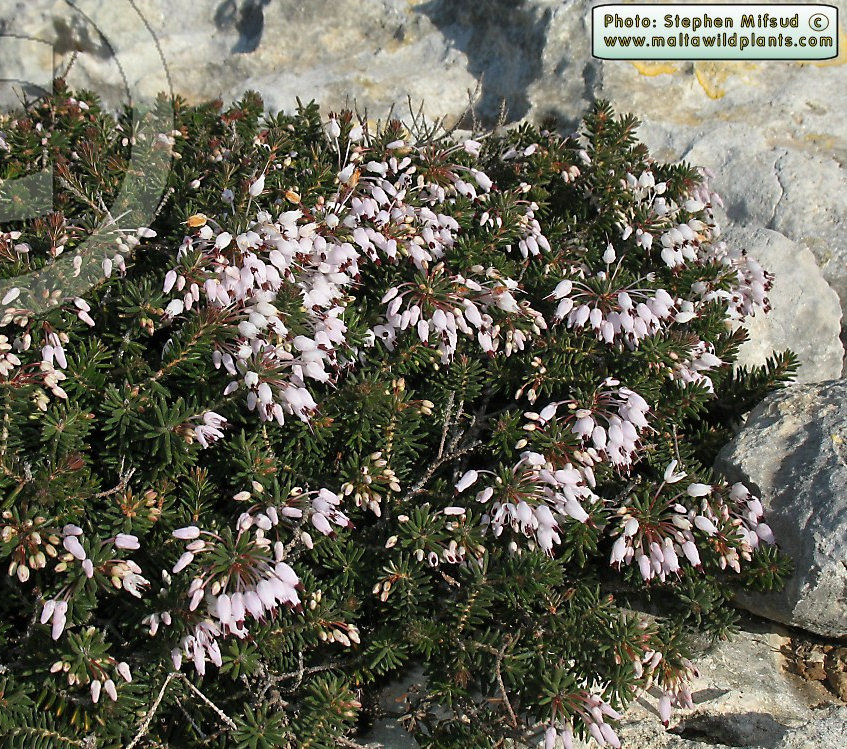
Photo of a plant with very pale flowers, nearly white. The plant show a certain degree of variety in the colour of its flowers ranging from off-white lilac to vivid pink (magenta). Albinos of this species have been observed in Malta, and these pale pink flower forms may be just intermediates between normal and albino specimens.
IMAGE: ERIMF-15
Photo a plant with pink-magenta flowers, contrasting well with previous photo which shows a whiter form of flowers.
IMAGE: ERIMF-16
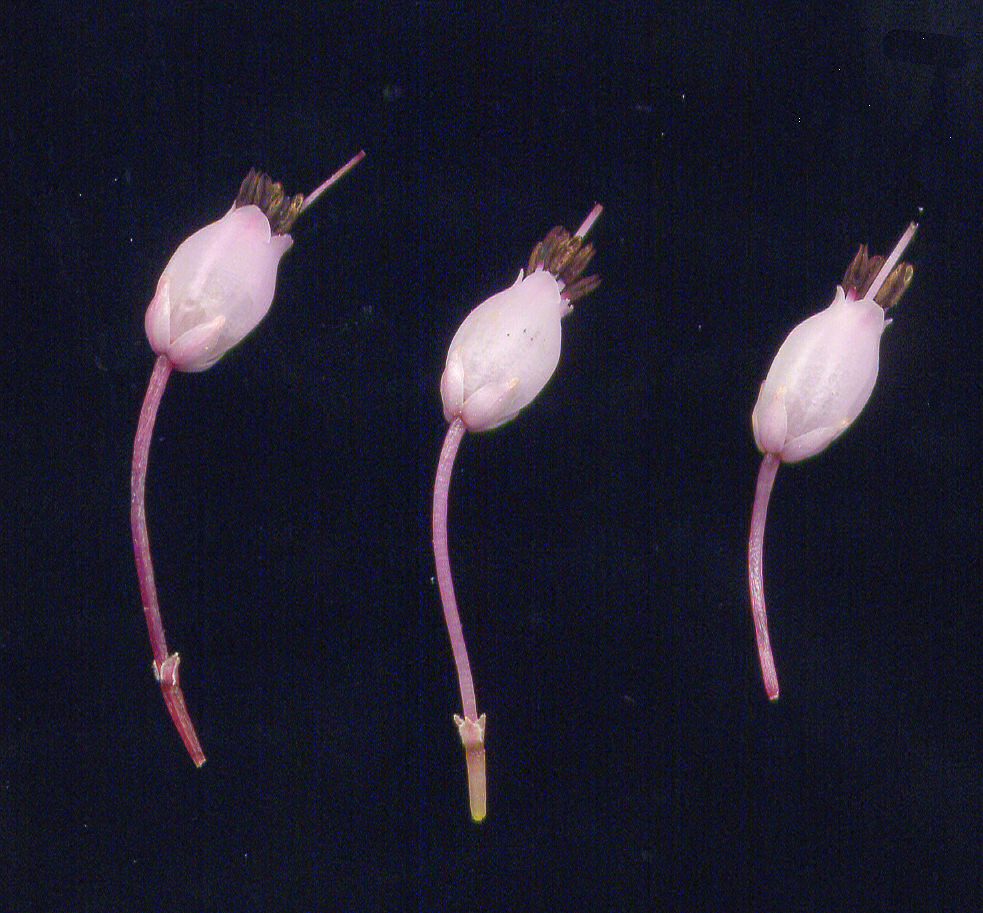
Magnified scanned image of 3 dissected flowers. They have pink pedicels and an inflated tubular corolla.
Erica multiflora  (Mediterranean Heath) - CLICK TO ENLARGE PHOTO Erica multiflora  (Mediterranean Heath) - CLICK TO ENLARGE PHOTO Erica multiflora  (Mediterranean Heath) - CLICK TO ENLARGE PHOTO Erica multiflora  (Mediterranean Heath) - CLICK TO ENLARGE PHOTO
IMAGE: ERIMF-17
Magnified and annotated scanned image of 3 dissected flowers. The flowers at the middle and right side are taken from the same specimen.
IMAGE: ERIMF-18
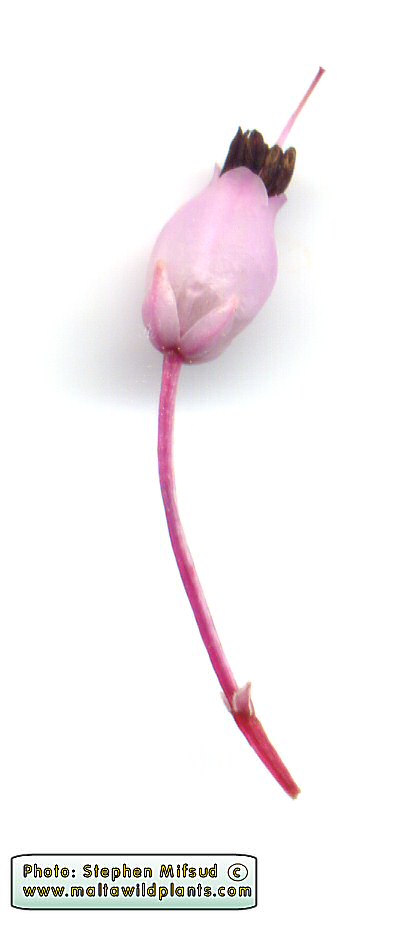
Magnified scanned image of a single flower (lateral view). Note the central pink stripe on the tiny sepals and the 2 flap-like bracts at the base of the pedicel.
IMAGE: ERIMF-19
Scanned image of disected flowers to show arrangement of stamens and pistil. The central inferior ovary is purple. Each flower have 8 stamens, some have been removed in this image during disection.
IMAGE: ERIMF-20
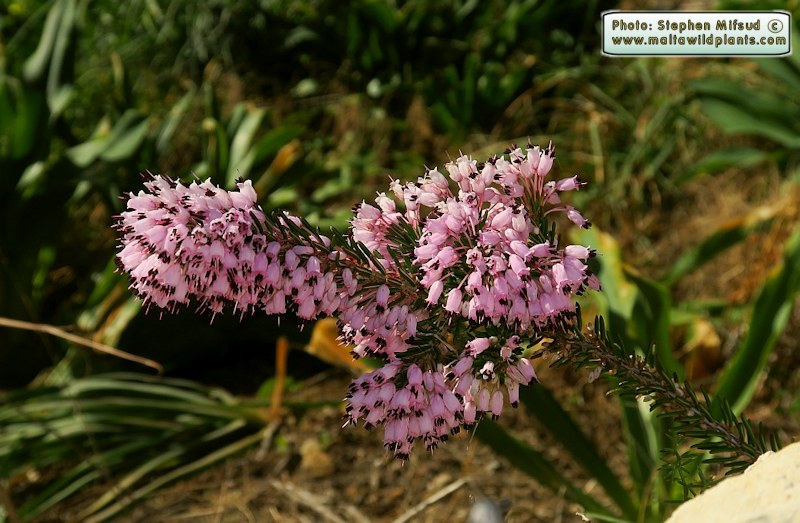
Photo of inflorescences in situ. As it is shown, the plant produces large numbers of flowers.
Erica multiflora  (Mediterranean Heath) - CLICK TO ENLARGE PHOTO Erica multiflora  (Mediterranean Heath) - CLICK TO ENLARGE PHOTO Erica multiflora  (Mediterranean Heath) - CLICK TO ENLARGE PHOTO Erica multiflora  (Mediterranean Heath) - CLICK TO ENLARGE PHOTO
IMAGE: ERIMF-21
Another photo of the flowers of Erica multiflora in situ.
IMAGE: ERIMF-22
Close up photo of the pink flowers with their brown protruding stamens.
IMAGE: ERIMF-23
Close up image of the brown anthers with a pit (hole) at the tip making the anther to look like a hollowed tube.
IMAGE: ERIMF-24
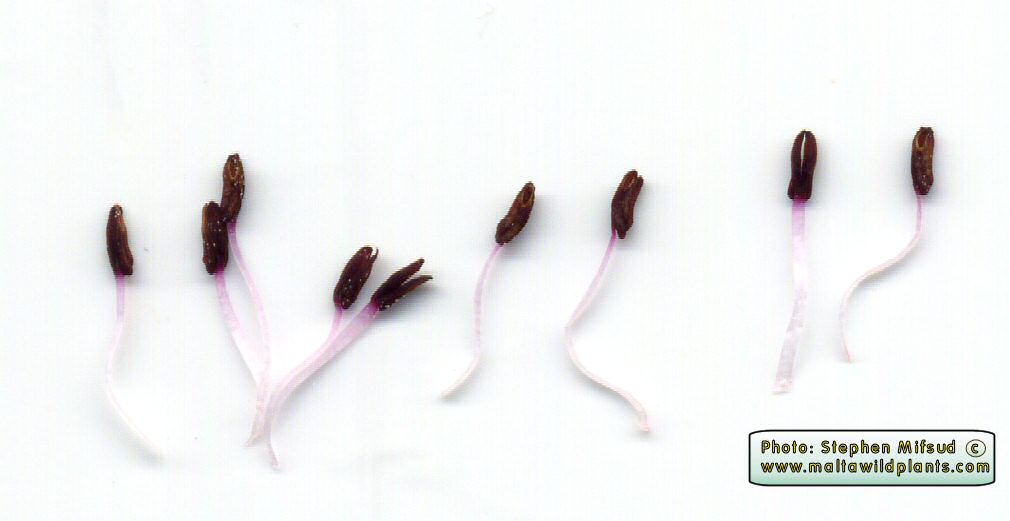
Scanned and magnified image of few disected stamens. Note a characteristic feature of the Ericaceae (Heath family), hence the hole at the end of each anther from which pollen is liberated.
Erica multiflora  (Mediterranean Heath) - CLICK TO ENLARGE PHOTO Erica multiflora  (Mediterranean Heath) - CLICK TO ENLARGE PHOTO Erica multiflora  (Mediterranean Heath) - CLICK TO ENLARGE PHOTO Erica multiflora  (Mediterranean Heath) - CLICK TO ENLARGE PHOTO
IMAGE: ERIMF-25
A variant of the E. multiforma growing on Malta which is able to form flower clusters at the central part of the leaf, hence not only terminal inflorescense.
IMAGE: ERIMF-26
Photo of the tiny bracts present between the flowering branch and the pedicels.
IMAGE: ERIMF-27
Photo of shoots and leaves in situ. They are so dense that the woody stems are not visible.
IMAGE: ERIMF-28
Scanned image of individual linear shaped leaves. The sizes are anotated in the image, but the length can vary by few more mm. Note the interesting white groove at the center of the lower side of the leaf.
Erica multiflora  (Mediterranean Heath) - CLICK TO ENLARGE PHOTO Erica multiflora  (Mediterranean Heath) - CLICK TO ENLARGE PHOTO Erica multiflora  (Mediterranean Heath) - CLICK TO ENLARGE PHOTO Erica multiflora  (Mediterranean Heath) - CLICK TO ENLARGE PHOTO
IMAGE: ERIMF-29
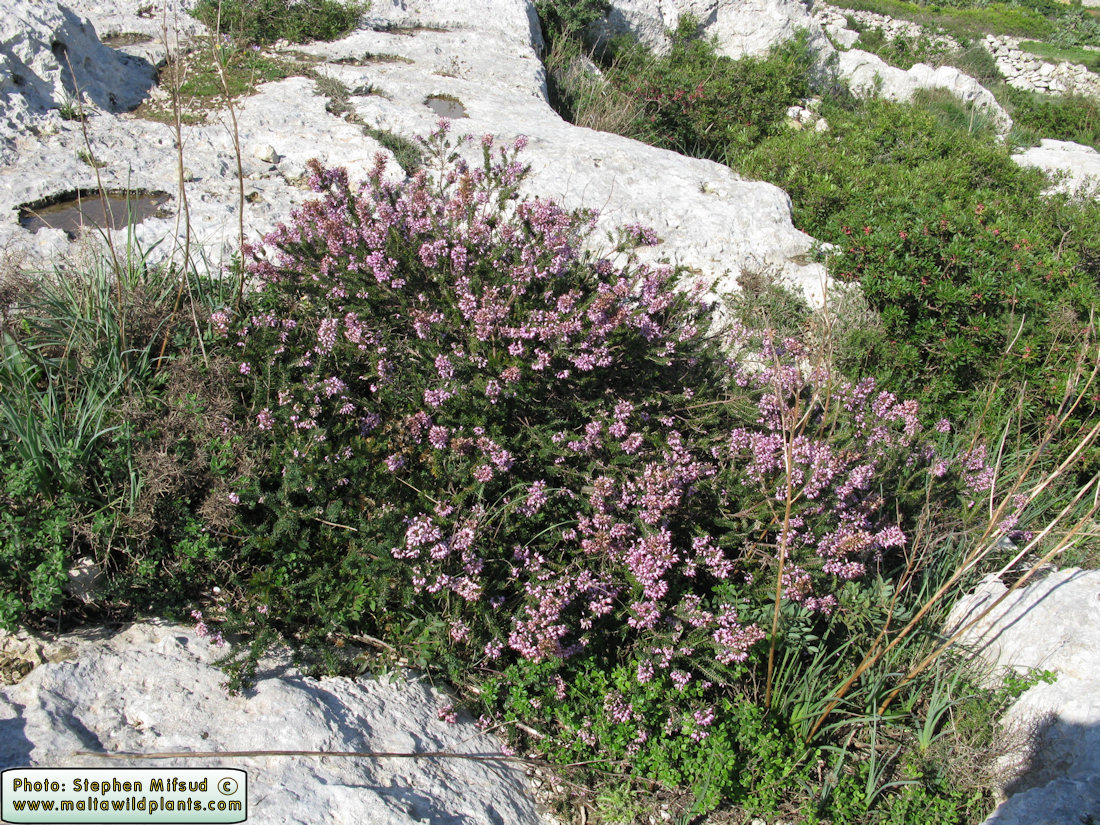
Photo of the common habitat of the plant, hence gaps, cracks and spaces in bare rock of garigue or heathland in an exposed location. The plant tollerate cold temperatures and wind and one of the uniques species of Erica which tolerates slightly alkaline ground, compared to the rest which grow in acidic soil.
IMAGE: ERIMF-30
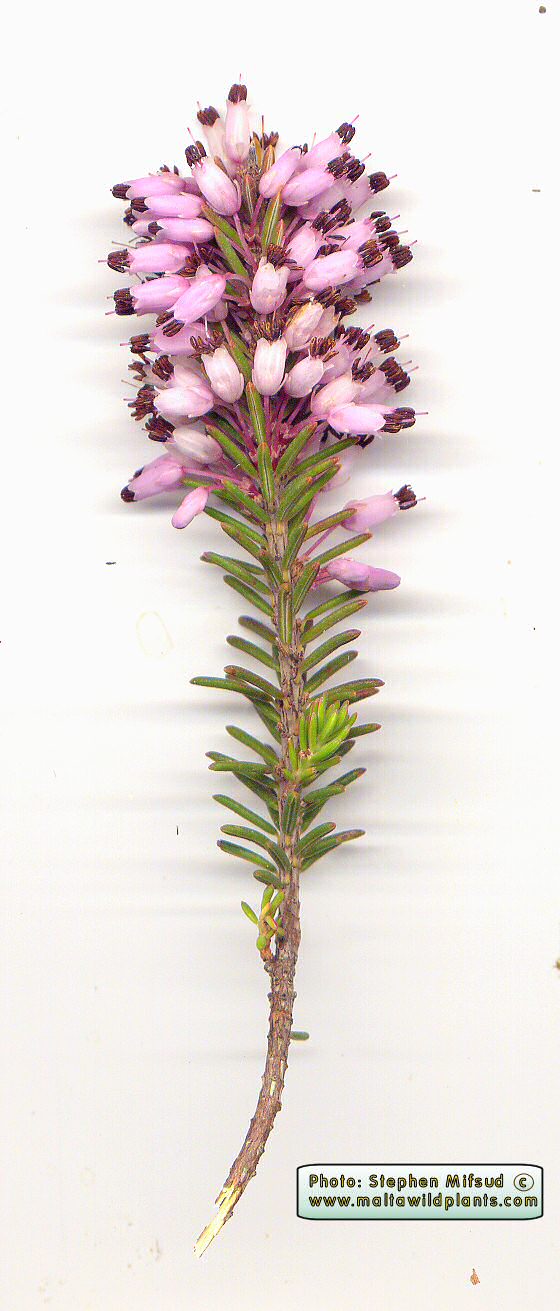
Scanned image of a twig of the plant showing the highly branched and woody stem, whorls of needle like leaves and terminal flower clusters.
IMAGE: ERIMF-31
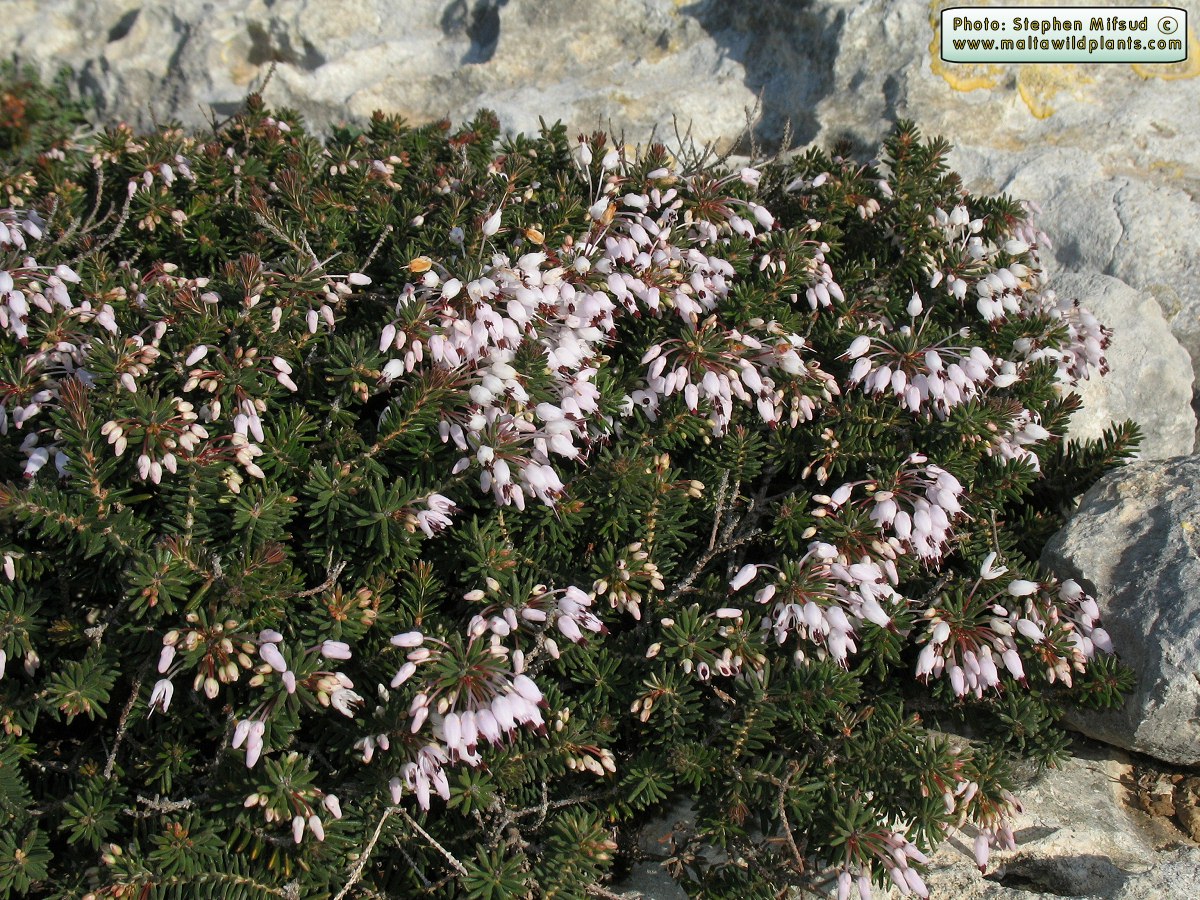
Photo of plant in situ. It is very branched and so described as a small bush.
IMAGE: ERIMF-32
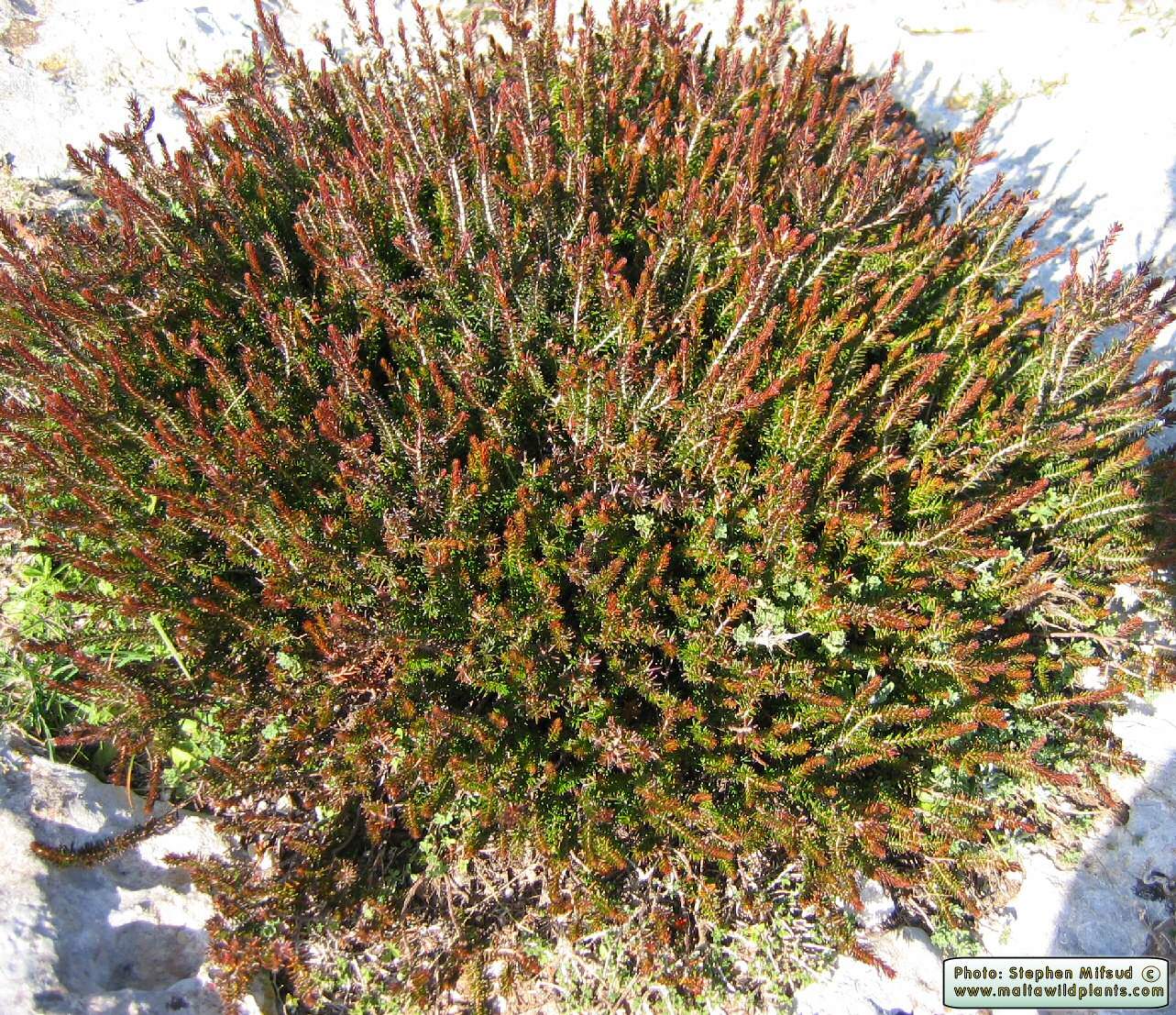
Photo of plant in situ. Note the reddish brown colour of the shoots.
Erica multiflora  (Mediterranean Heath) - CLICK TO ENLARGE PHOTO Erica multiflora  (Mediterranean Heath) - CLICK TO ENLARGE PHOTO Erica multiflora  (Mediterranean Heath) - CLICK TO ENLARGE PHOTO  
IMAGE: ERIMF-33
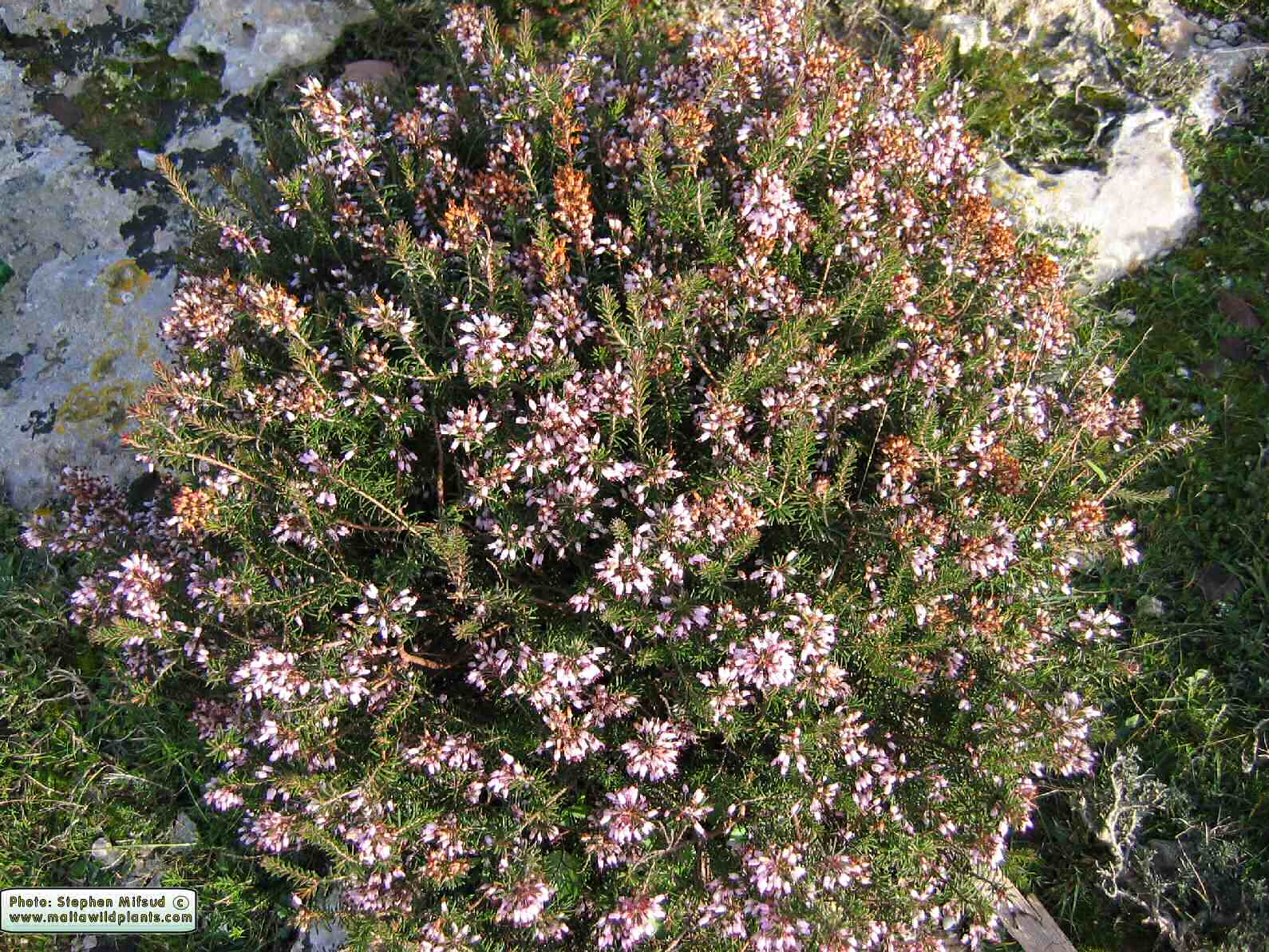
Photo of plant in situ. This plant is in full bloom and it has many flowers that make the plant look more pink than green.
IMAGE: ERIMF-34
Another plant in its natural habitat in the Maltese islands. It grows in rocky habitats namely garigues and pre-desert scrub.
IMAGE: ERIMF-35
Black and white illustration of the plant taken from Handbuch der Laubholzkunde by Dr. Leopold Dippel.
IMAGE: ERIMF-36

Links & Further info

More info about the Heather family Effects of an experimental increase of temperature and drought on the ecophysiology of shrub species at four sites in Europe (including E. multiflora)
Ecophysiological responses of two Mediterranean shrubs, Erica multiflora and Globularia alypum, to experimentally drier and warmer conditions Link 4
Search for Erica multiflora on the FORUM of MaltaWildPlants.com


Buy Seeds and Docs

Buy Seeds from Maltawildplants.com Buy samples of seeds of certain wild plants for your studies, trials, research, etc. Not all species' seeds can be exported (depending on Maltese regulations), and availability depends on season of species. So, before any payment, you are kindly asked to fill in the online quotation/order form by which I can contact you back for availability and charges. Buy Seeds from Maltawildplants.com   Online Quotation

Buy Seeds from Maltawildplants.com   Online Payment
Buy Documents from Maltawildplants.com Buy documents related to Maltese Wild Plants such as the list of references, full profile, or other docs you request. Buy Documents from Maltawildplants.com   Online Payment
Buy Images  from Maltawildplants.com Buy any of my own copyright images found in this large collection of Maltese flora. You should first select the image you want to buy and input its corresponding code (found beneath each individual photo) in the online ordering form. Buy Seeds from Maltawildplants.com   Online Payment
Buy Seeds from Maltawildplants.com Kindly donate any sum of money (from 2USD / 2Euro) to help us covering some expenses needed to maintain Maltawildplants.com. Please bear in mind how much hard work such a large and up-to-date website needs to arrive directly to you home, office or library. Your kind donations are both greatly appreciated and recorded for future reference. Donors asking help will have first que preference for assistance and special attention. Buy Seeds from Maltawildplants.com   Online Donation


Submit further info on this species

Use the form below to submit more information about this plant or a related species. If the data is taken from a book, journal, website, etc, please provide the corresponding reference / website address as indicated in the form. If it is your own observation, then your name will be cited. Your Email address will never be displayed online, it is just for internal communication.


For plant species that are marked as rare, you can also report other locations in Malta where you have seen this species.

Finally you can report any mistakes or errors found on the plant profile for necessary corrections. This will help to improve the website's accuracy.


To have more details about each particular field, just move your mouse on it and wait for the help message to pop up

* = required fields.
Plant Species:  *
Your name:   *
Your Email:   *
 
Fill any of the 3 sections below (A, B, C) and send the form - Thank you.
 
A:  Additional Information about this plant species
Own observations:
Info from published material (books, journals, website):

Reference of published material:

 
B:   Where have you seen this plant on the Maltese Islands?
Locations in Malta or Gozo where you have encountered this plant.
Mostly applies for rare plants.


1:        2:   
3:       4:   
5:       6:   

Try to be as concise as possible. Examples: Dingli Cliffs (near chapel), Wied Incita (Zebbug side), Triq il-Kbira (Qormi), Barriera ta\' Abdul (Xlendi), Fields near Salib tal-gholja (Siggiewi). GPS bearings are also welcomed!
 
C:  Corrections for mistakes and errors in this plant profile.
Section of this page where you found an error (select one)

What is the error/mistake
What should be its correction


All material and data on this webpage is under the copyright of the author of this site - Stephen Mifsud / www.MaltaWildPlants.com / Malta. (2002-2010)
This research project about the flora of Malta is sponsored by:
Nature Guided Tours in the best countryside areas of Malta The Malta Council for Science and Technology (MCST) is the national advisory body to Government on science and technology policy. The MCST is also the national agency responsible for the management of the local RTDI programme, as well as the national contact organisation for the Seventh Framework Programme (FP7). Advertise in this space Advertise in this space Other sponsors / supporting companies