Wild Plants of Malta & Gozo - Plant: Anagyris foetida (Stinking Bean Trefoil)

Stinking Bean Trefoil

Anagyris foetida / Stinking Bean Trefoil / Fula tal-Klieb
This plant is brought to you by one of the project's sponsors:
HSBC Cares for the Environment Fund
More sponsors are needed for this project [ click here ]

Contents Links


Nomenclature

Botanical Data

Description

General Information

Photo Gallery

Further Info & Links

Buy Seeds and Docs

Submit own info
about this plant

Give a small Donation Online

FORUM

Copyright Info


Main Index

 
Visitor hits (Mar-2007)

Nomenclature

Species name:

Anagyris foetida   L.

Author(s):

Carl von Linné;
   Sweden, 1707-1778

General names:

Stinking Bean Trefoil, Purging Trefoil, Stinking Wood

Maltese name:

Fula tal-Klieb

Plant Family:

Fabaceae/ Leguminosae   (Pea Family)

Name Derivation:

Anagyris = Ana- means without or lacking of; while -gyros means around or circular. (Latin);
foetida = Stinking, foetid, referring to its unpleasant smell of spoiled beans (Latin);

Synonyms:

Anagyris neapolitana

Remarks:

-


Botanical Data

PLANT STRUCTURE:

Characteristic

Growth Form

Branching

Surface

Description

Erect :

Upright, vertically straight up well clear off the ground.

Extensively Branched :

Large number of compact branches and sub branches forming a shrub or tree. Common main stem is partially, or sometimes, totally covered by the branches.

Woody :

Stems get lignified to become tough wood.

General
Picture

Wild Plants of the Mediterranean Islands of Malta  - Copyright Stephen Mifsud / Maltawildplants.com / Malta (2002-2007) Wild Plants of the Mediterranean Islands of Malta  - Copyright Stephen Mifsud / Maltawildplants.com / Malta (2002-2007) Wild Plants of the Mediterranean Islands of Malta  - Copyright Stephen Mifsud / Maltawildplants.com / Malta (2002-2007)

LEAVES:

Characteristic

Arrangement

Attachment

Venation

Description

Alternate :

Growing at different positions along the stem axis.

Stalked / Petiolate :

Hanging out by a slender leaf-stalk.

Pinnate venation :

Lateral veins which diverge from the midrib towards the leaf marhins.

General
Picture

Wild Plants of the Mediterranean Islands of Malta  - Copyright Stephen Mifsud / Maltawildplants.com / Malta (2002-2007) Wild Plants of the Mediterranean Islands of Malta  - Copyright Stephen Mifsud / Maltawildplants.com / Malta (2002-2007) Wild Plants of the Mediterranean Islands of Malta  - Copyright Stephen Mifsud / Maltawildplants.com / Malta (2002-2007)
 

Characteristic

Leaf Shape

Leaf Margin

Remarks

Description

Trifoliate Lanceolate:

Compound leaf made up of 3 similar leaflets. Each leaflet is has the shape of a lance.

Entire :

Smooth margin without indentations, lobes or any projections.

Leaf Texture

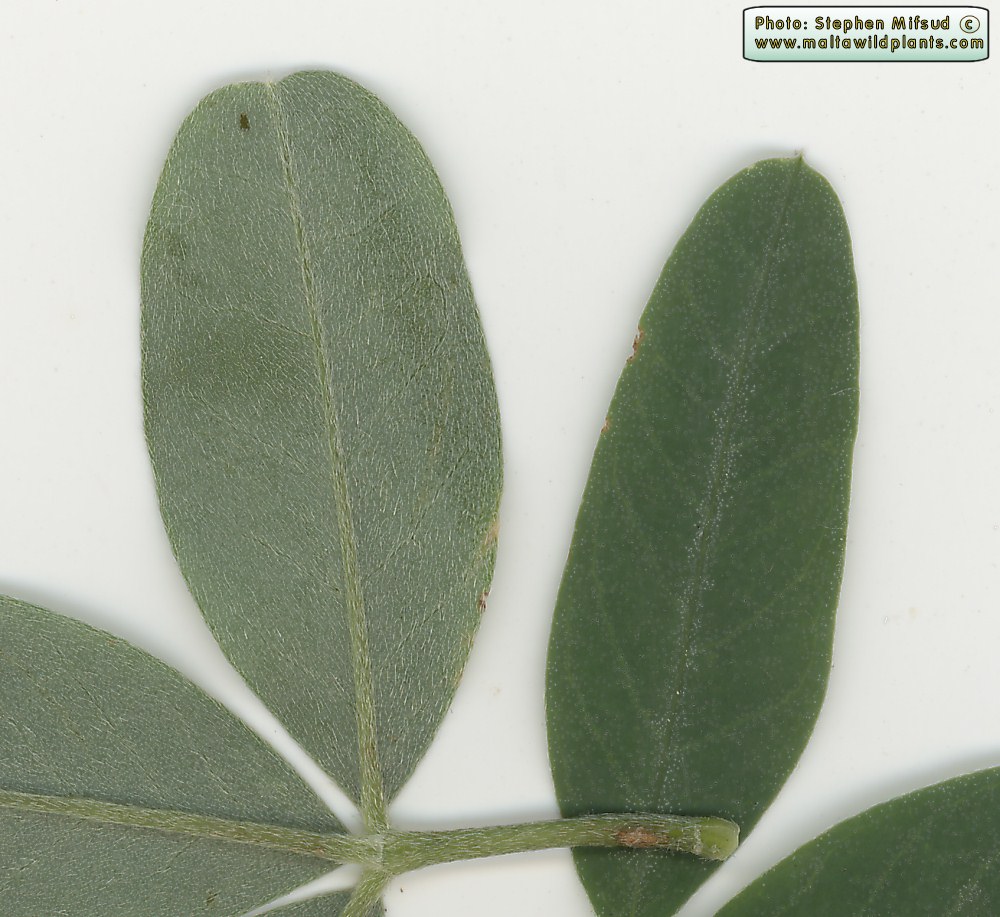
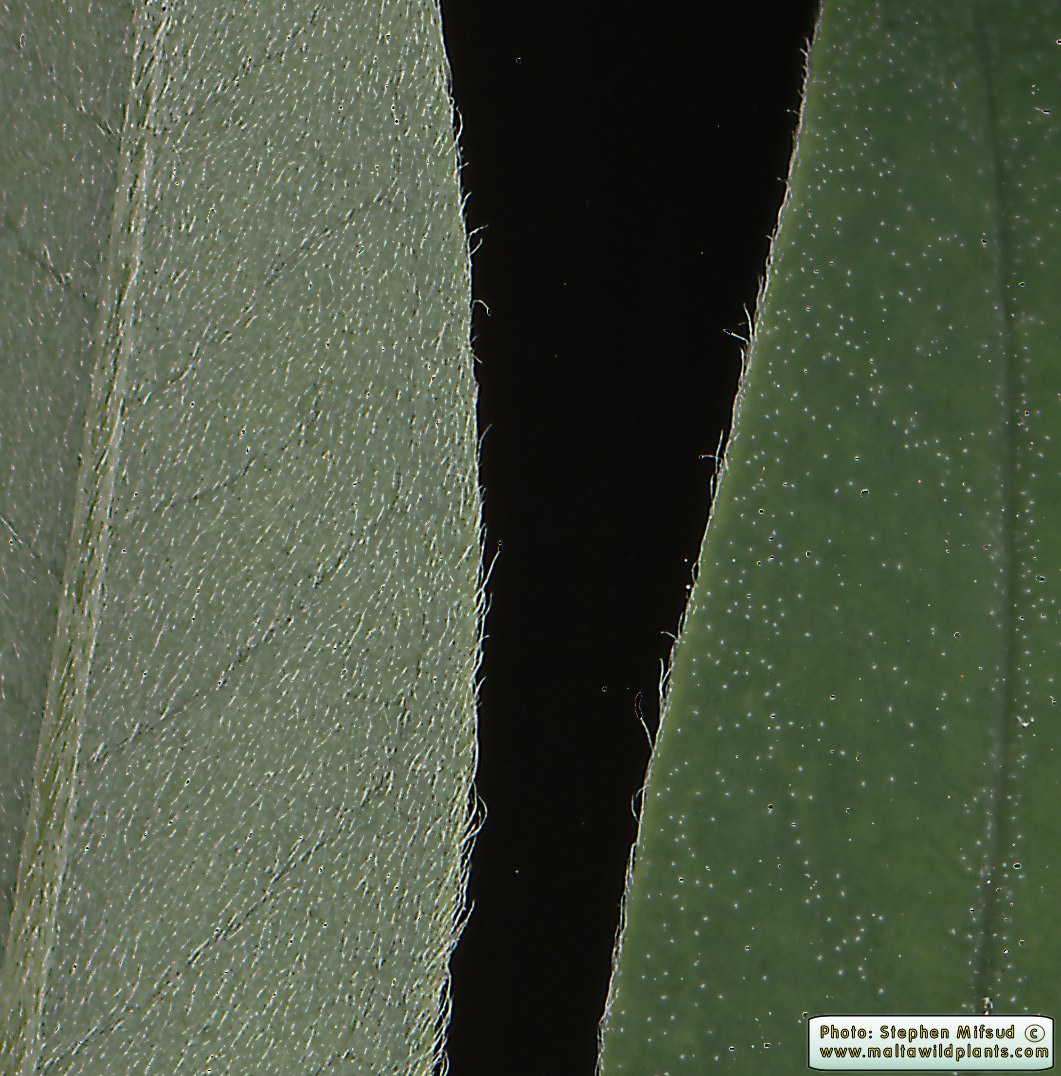
Sericeous; the lower side of the leaves bear fine, usually straight, apressed, hairs giving the appearance of a silky texture. Also found on upper side but much more sparse.

General
Picture

Wild Plants of the Mediterranean Islands of Malta  - Copyright Stephen Mifsud / Maltawildplants.com / Malta (2002-2007) Wild Plants of the Mediterranean Islands of Malta  - Copyright Stephen Mifsud / Maltawildplants.com / Malta (2002-2007) Wild Plants of the Mediterranean Islands of Malta  - Copyright Stephen Mifsud / Maltawildplants.com / Malta (2002-2007)

FLOWERS:

Characteristic

Colour

Basic Flower Type

No. of Petals

No. of Sepals

Description

Yellow-Green

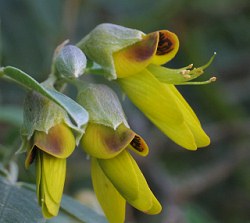
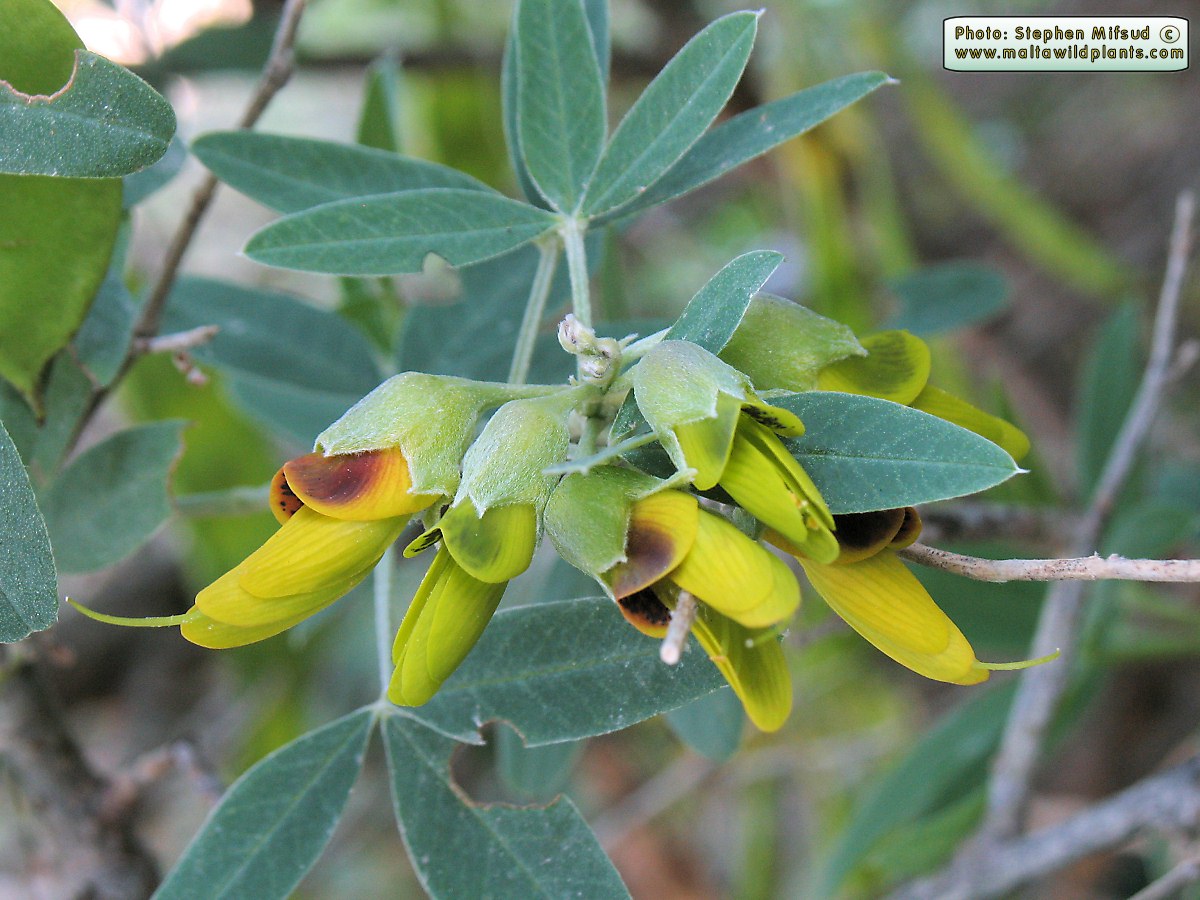
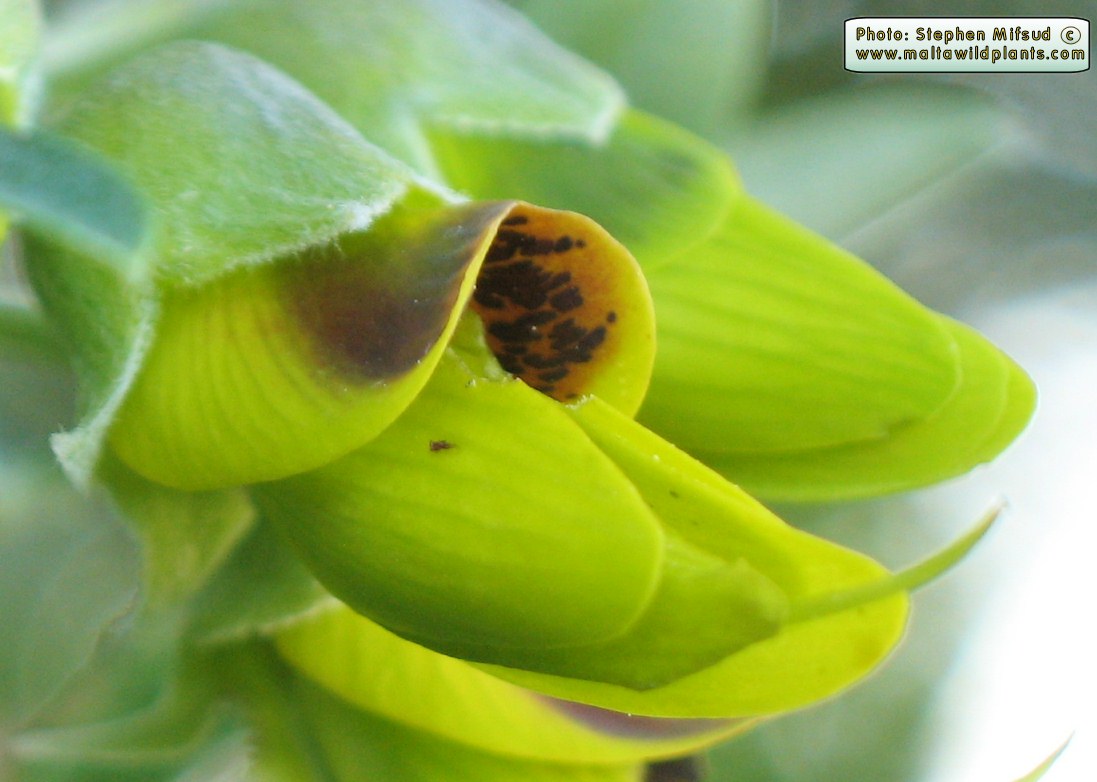
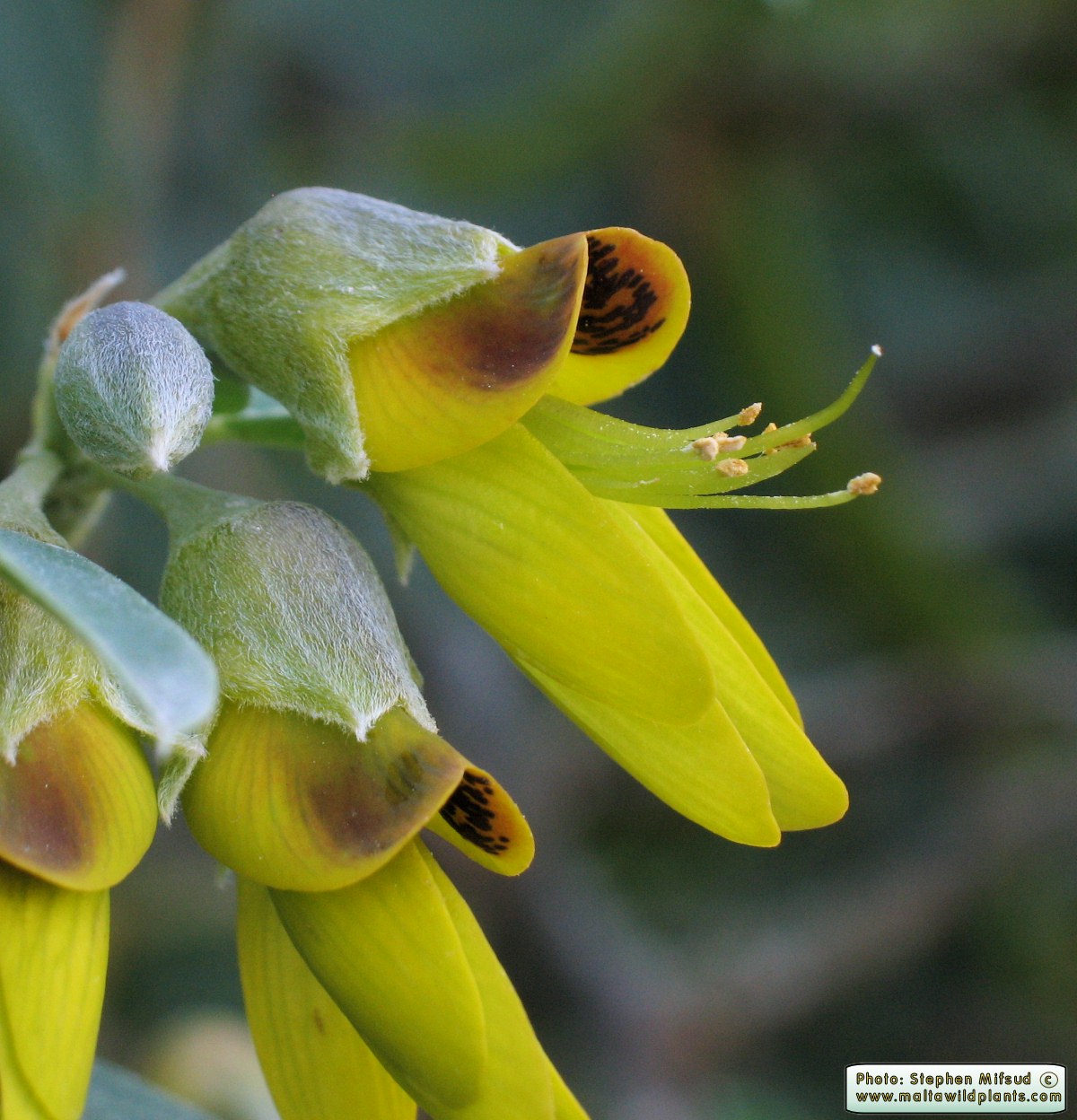
The upper petal (=standard) has a brownish-black blob.

Papilionaceous :

A zygomorphic corolla consisting of a standard, 2 wings, and keel, as in the peculiar corolla of many Leguminosae (pea family).

5

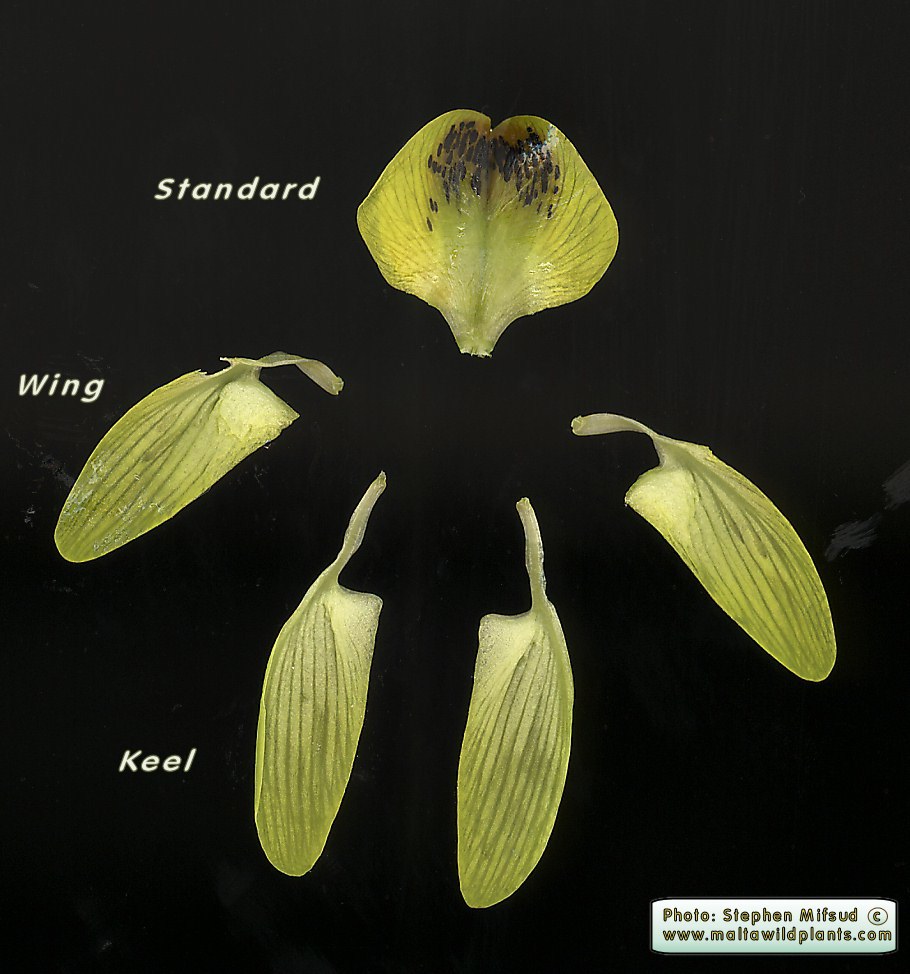
1 upper standard, 2 lateral wings, and 2 bottom keels.

5 Fused

Sepals fused to form a calyx with an undivided structure.

General
Picture

  Wild Plants of the Mediterranean Islands of Malta  - Copyright Stephen Mifsud / Maltawildplants.com / Malta (2002-2007) Wild Plants of the Mediterranean Islands of Malta  - Copyright Stephen Mifsud / Maltawildplants.com / Malta (2002-2007) Wild Plants of the Mediterranean Islands of Malta  - Copyright Stephen Mifsud / Maltawildplants.com / Malta (2002-2007)
 

Characteristic

Inflorescence

Description

Ovary

Stamens

Description

Raceme :

Simple, elongated, indeterminate cluster with stalked flowers.

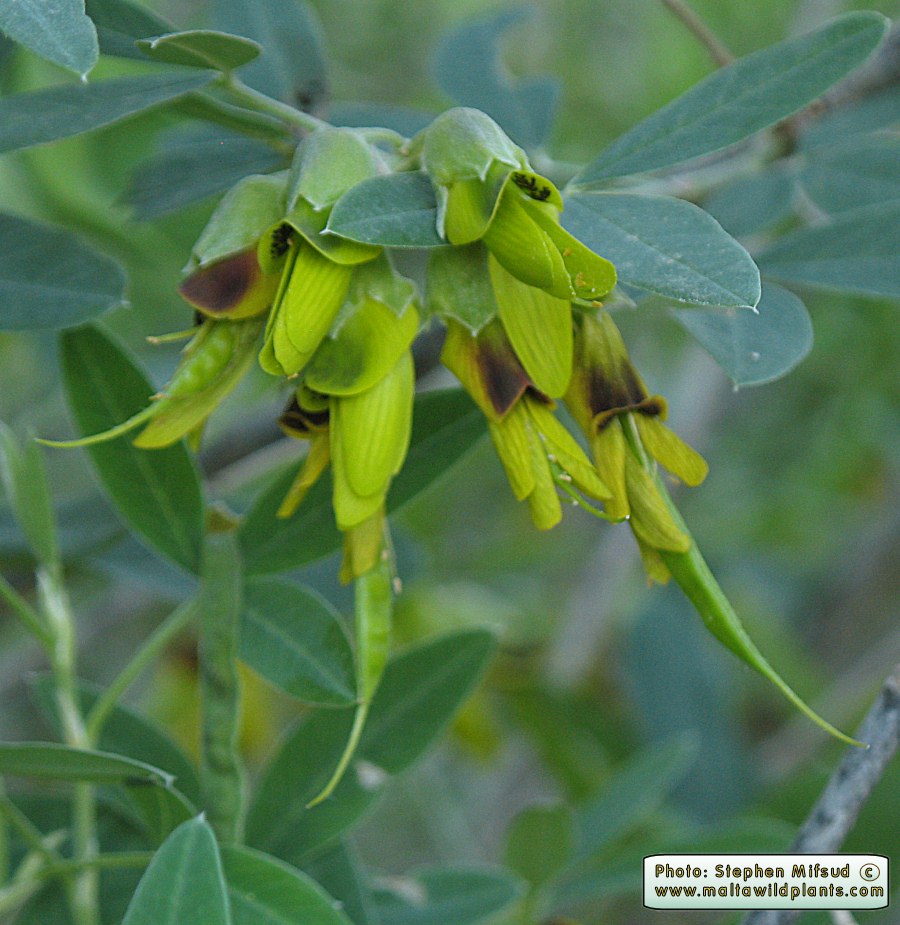
The 5 yellowish petals are apressed on each other and overlap to form a rather cylindrical or tubular shape. The standard is circular and slightly erect showing its reddish brown or black blobs. The keel and wings are oval, undecorated and similar to each other.

Superior :

Ovary situated above the flower parts (the calyx, corolla, and androecium). In other words, these are attached below the ovary.

10, Fasciculate :

Stamens arranged in cluster or bundles.

General
Picture

Wild Plants of the Mediterranean Islands of Malta  - Copyright Stephen Mifsud / Maltawildplants.com / Malta (2002-2007) Wild Plants of the Mediterranean Islands of Malta  - Copyright Stephen Mifsud / Maltawildplants.com / Malta (2002-2007) Wild Plants of the Mediterranean Islands of Malta  - Copyright Stephen Mifsud / Maltawildplants.com / Malta (2002-2007) Wild Plants of the Mediterranean Islands of Malta  - Copyright Stephen Mifsud / Maltawildplants.com / Malta (2002-2007)
 

Characteristic

Scent

Average Flower Size

Pollen Colour

Other Notes

Description

YES

The flowers and most of the plant gives off a foetid smell of spoiled beans.

22mm x 6mm x 5mm

Length x width x height.

Yolk-yellow

-


SEEDS:

Characteristic

No. Per Fruit

Shape

Size

Colour

Description

4-12

Reniform

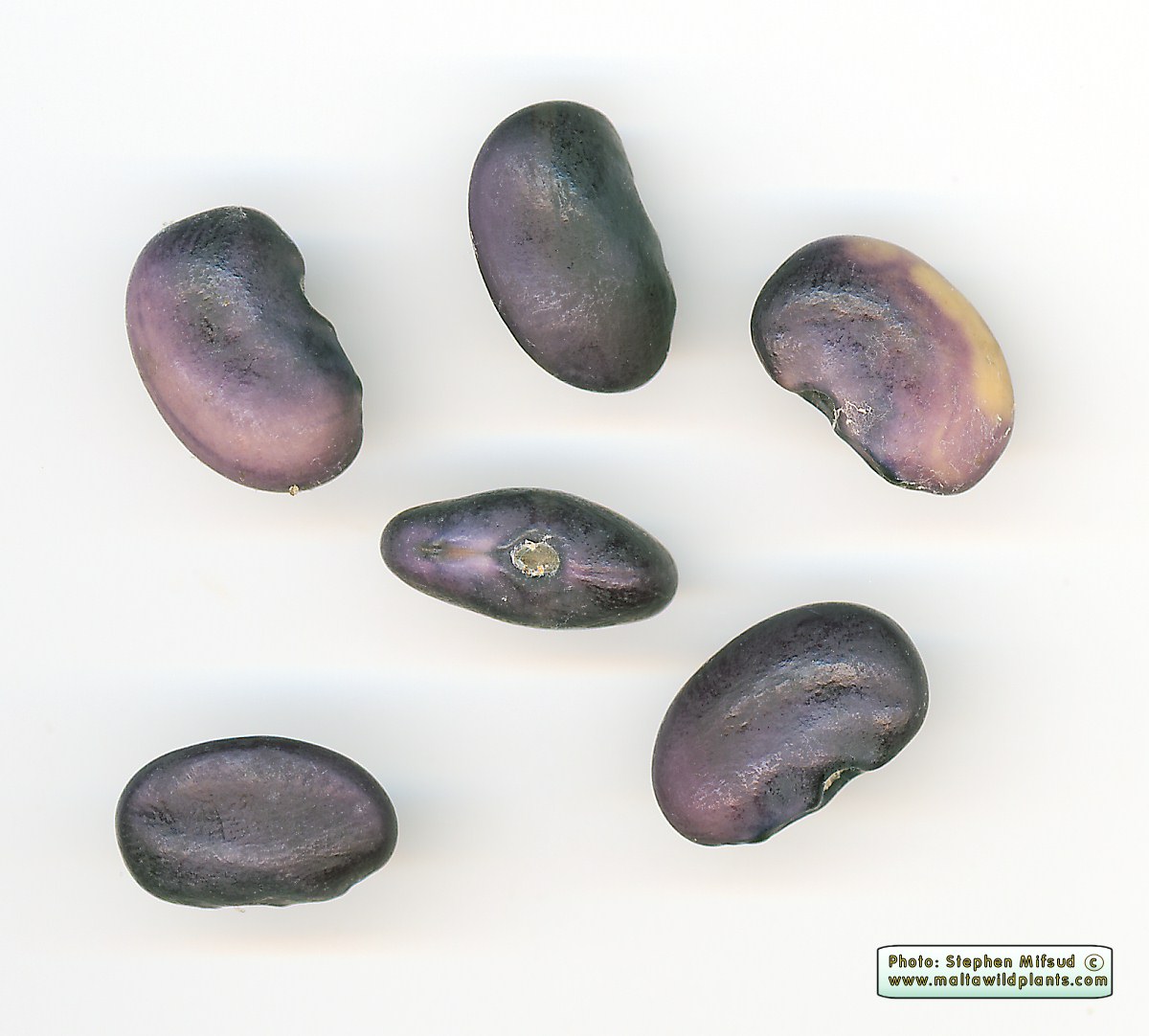
Broad, kidney-shaped structure. They are very hard and posoinous.

13mm x 9mm x 5mm

(Length x Breadth x Height).

Purple-Black

Occasionally found uncoloured (pale yellow).

General
Picture

Wild Plants of the Mediterranean Islands of Malta  - Copyright Stephen Mifsud / Maltawildplants.com / Malta (2002-2007) Wild Plants of the Mediterranean Islands of Malta  - Copyright Stephen Mifsud / Maltawildplants.com / Malta (2002-2007) Wild Plants of the Mediterranean Islands of Malta  - Copyright Stephen Mifsud / Maltawildplants.com / Malta (2002-2007) Wild Plants of the Mediterranean Islands of Malta  - Copyright Stephen Mifsud / Maltawildplants.com / Malta (2002-2007)

FRUIT AND OTHER BOTANICAL DATA:

Characteristic

Fruit Type

Colour of Fruit

Subterranean Parts

Other Notes

Description

Legume :

The dry, single-celled fruit of the Leguminosae, formed of a simple pistil, and usually but not always dehiscent by both sutures and often grouped in a long pod, as found in a pea-pod.

Dark Brown / Black

Bright green when immature.

Taproot :

A rooting system where there is the main descending root of a plant having a single dominant large structure from which a network of smaller and long roots emerge.

Seed texture

Seeds are very hard with a smooth surface as if made of glass.

General
Picture

Wild Plants of the Mediterranean Islands of Malta  - Copyright Stephen Mifsud / Maltawildplants.com / Malta (2002-2007) Wild Plants of the Mediterranean Islands of Malta  - Copyright Stephen Mifsud / Maltawildplants.com / Malta (2002-2007) Wild Plants of the Mediterranean Islands of Malta  - Copyright Stephen Mifsud / Maltawildplants.com / Malta (2002-2007) Wild Plants of the Mediterranean Islands of Malta  - Copyright Stephen Mifsud / Maltawildplants.com / Malta (2002-2007)

Plant Description

Life Cycle:

Perennial

Habitat:

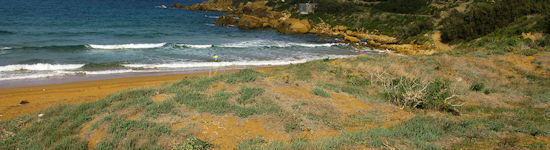
Rock slopes at valley sides, maquis.

Frequency:

Rare

Sources in Malta:

Very Rare, found at few localities like San Pawl tat-Targa, Wied Anglu and also reported to be present at Mellieha (Ghadira).

Plant Height:

1m to 3m.

Flowering Time:

Jan - Mar

Poison:

Yes - Whole plant (especially the seeds) contains very toxic substances.

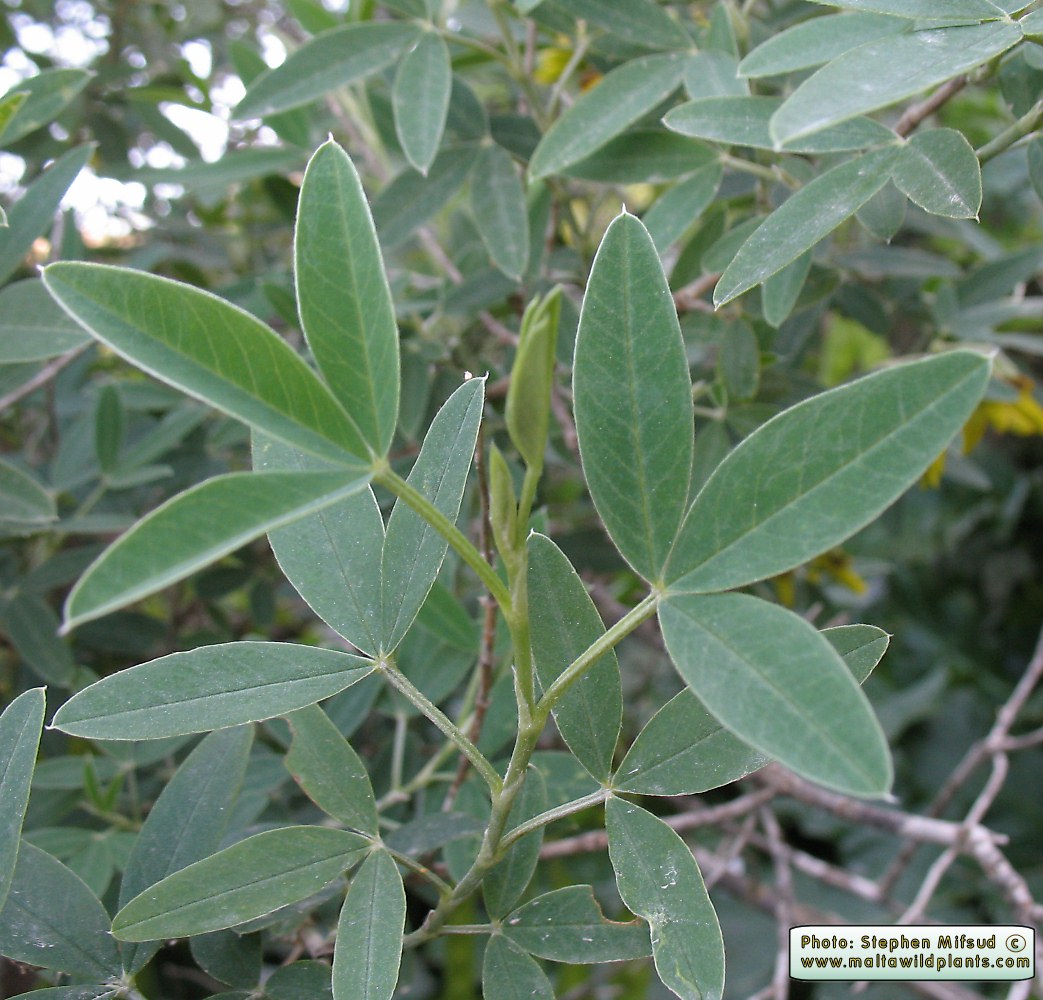
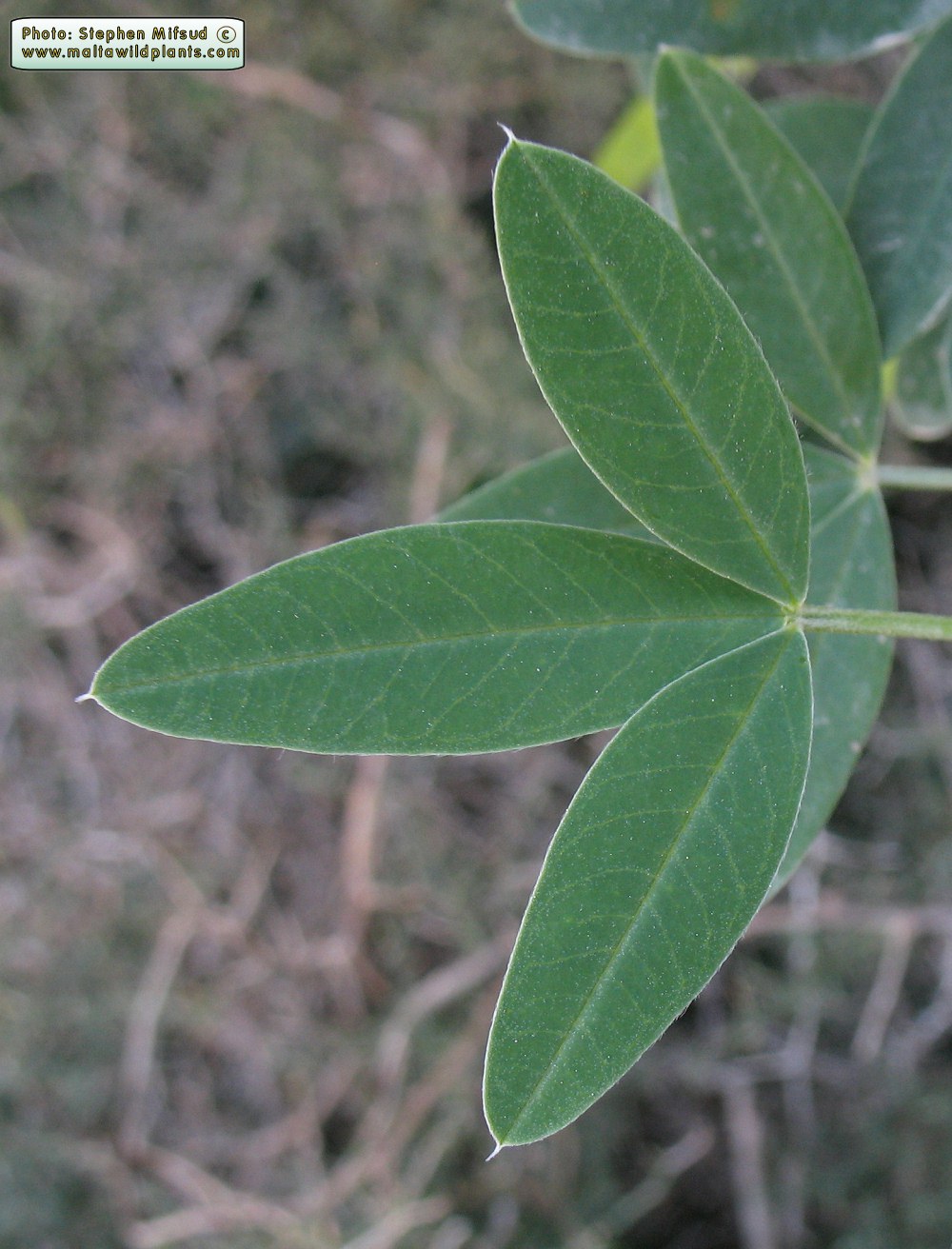
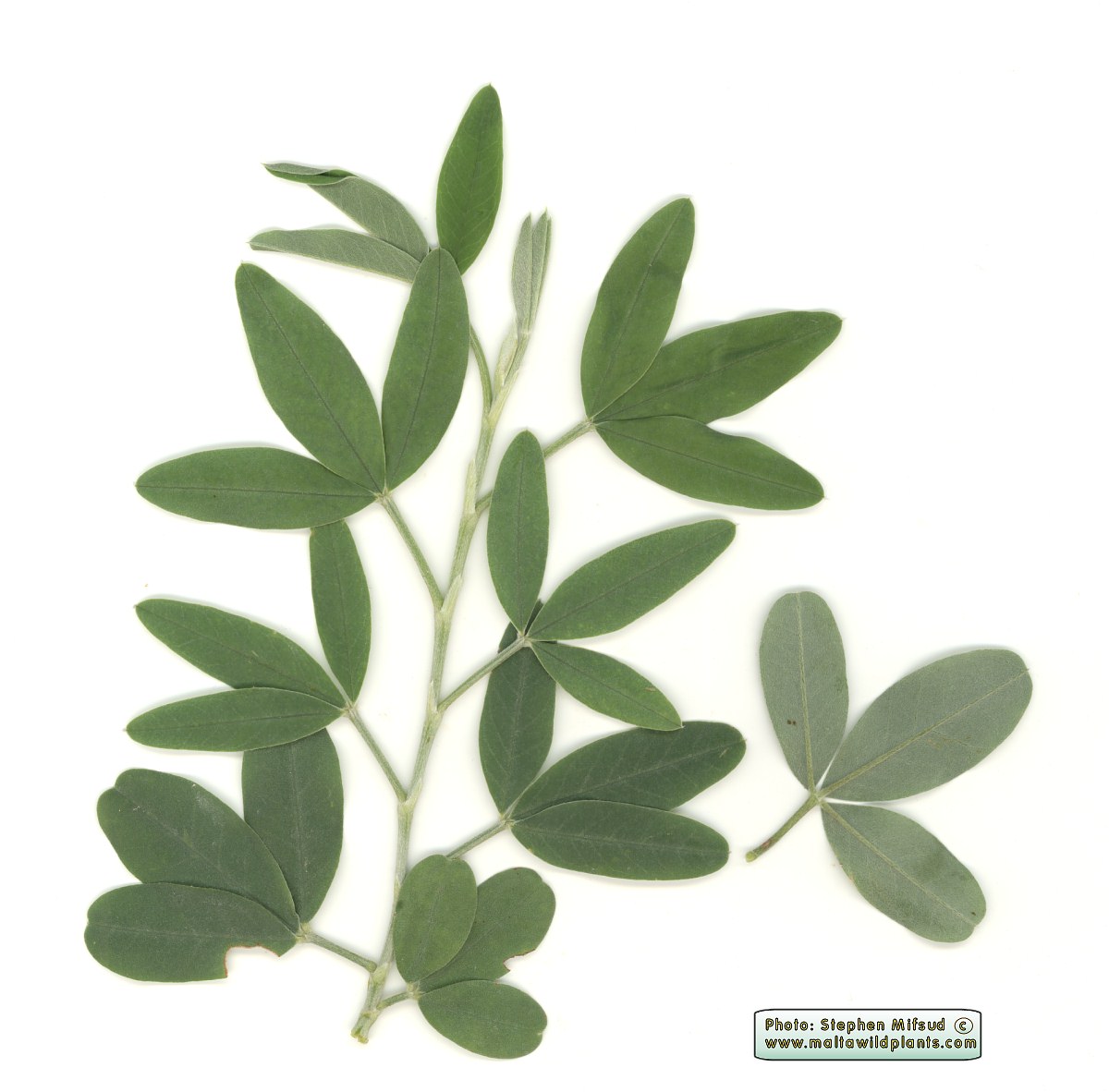
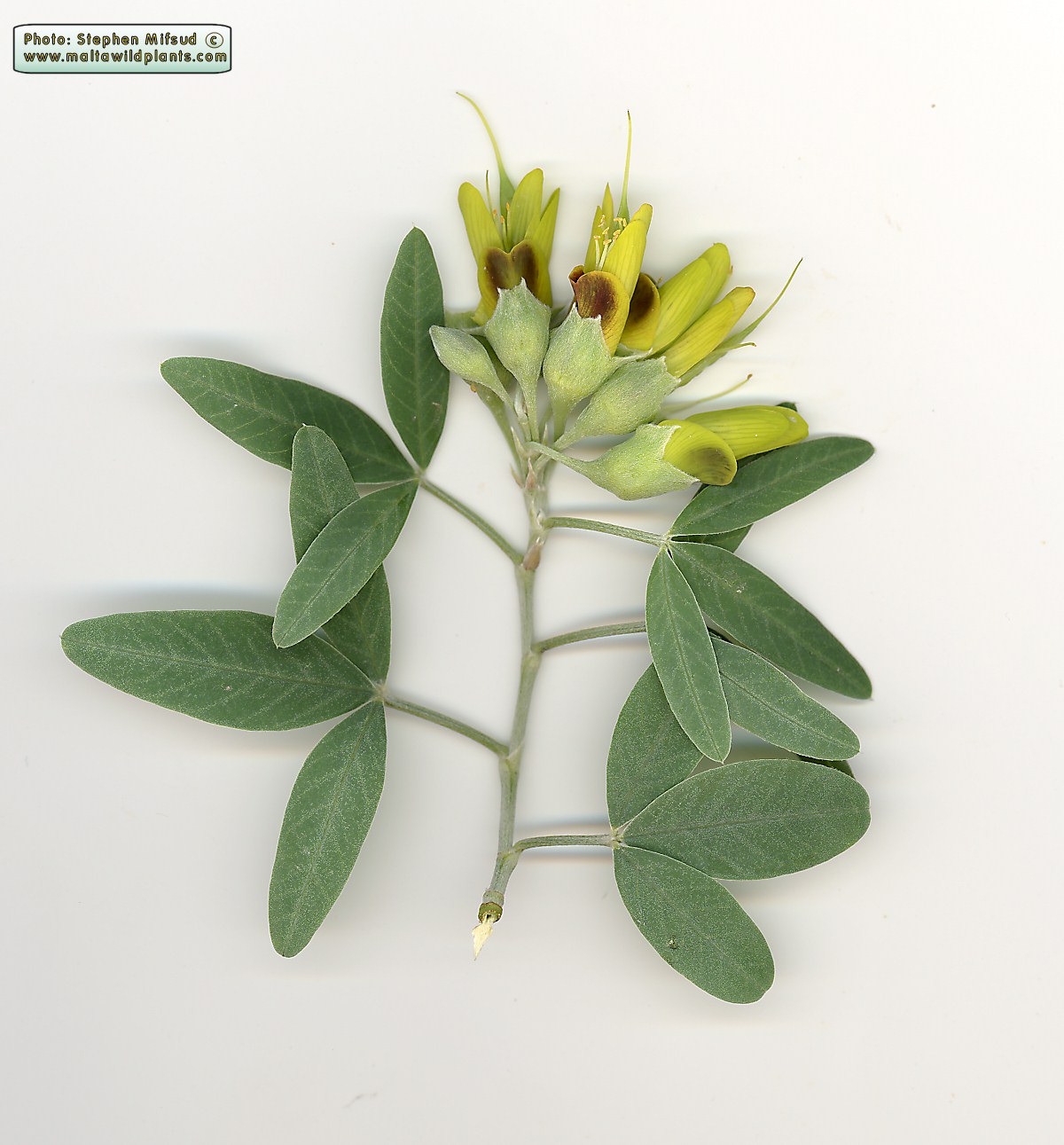
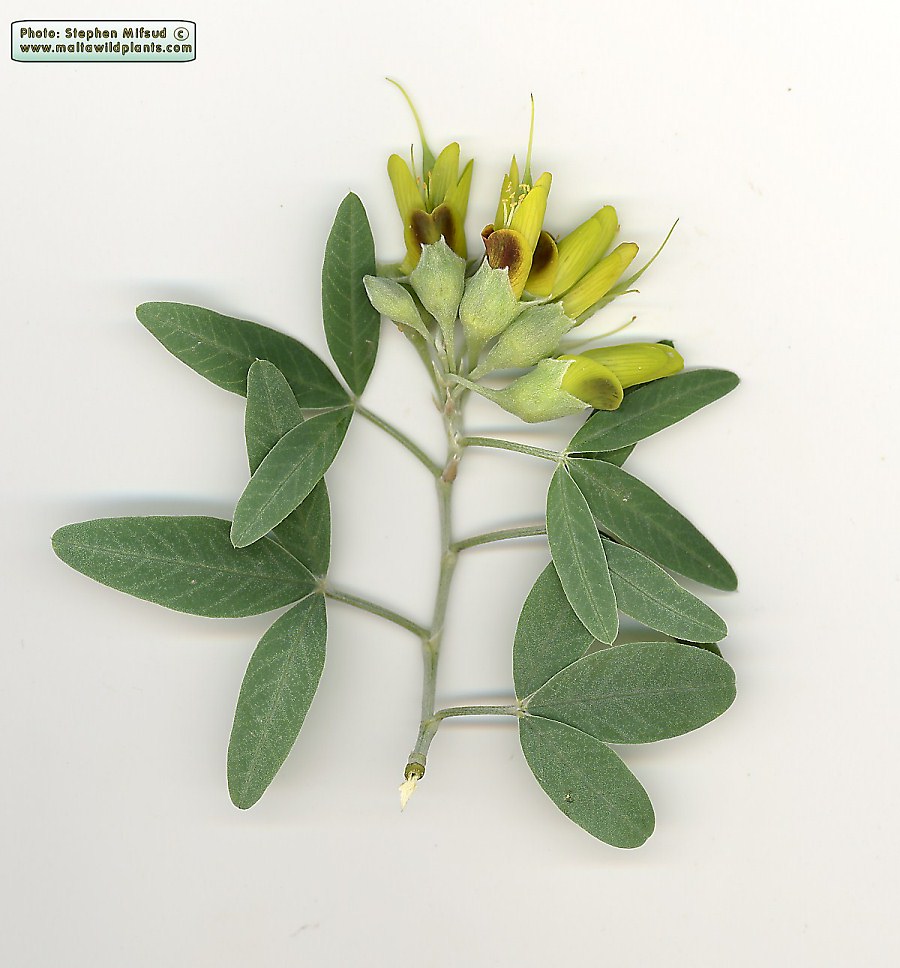
The leaves are stalked and grows in an alternating fashion along the stems. They are formed in sets of 3 leaflets (trifoliate) each having a simple pinnate venation. The leaflets are nearly identical, with the central one being slightly larger. They large leaflets are often about 35mm long and 12mm wide. Leaflets have an entire outline and a lanceolate shape, sometimes fusiform (elliptical shape). In Summer the leaves are dropped and grow again the following Autumn after the first rains, hence making the plant to be described as deciduous. The short, inconspicuous and apressed stipule is found opposite the leaf.

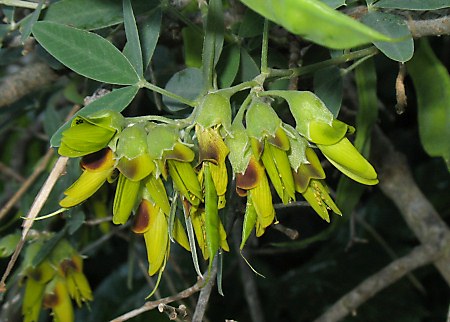
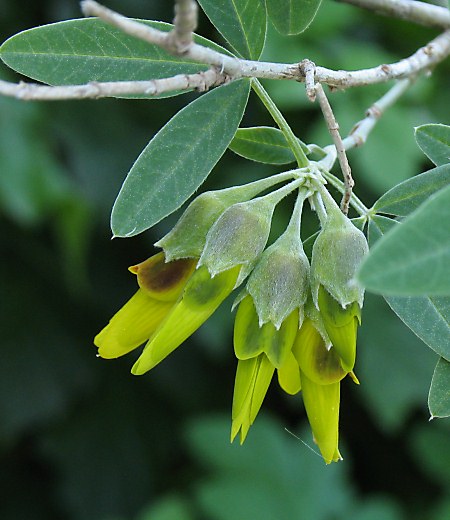
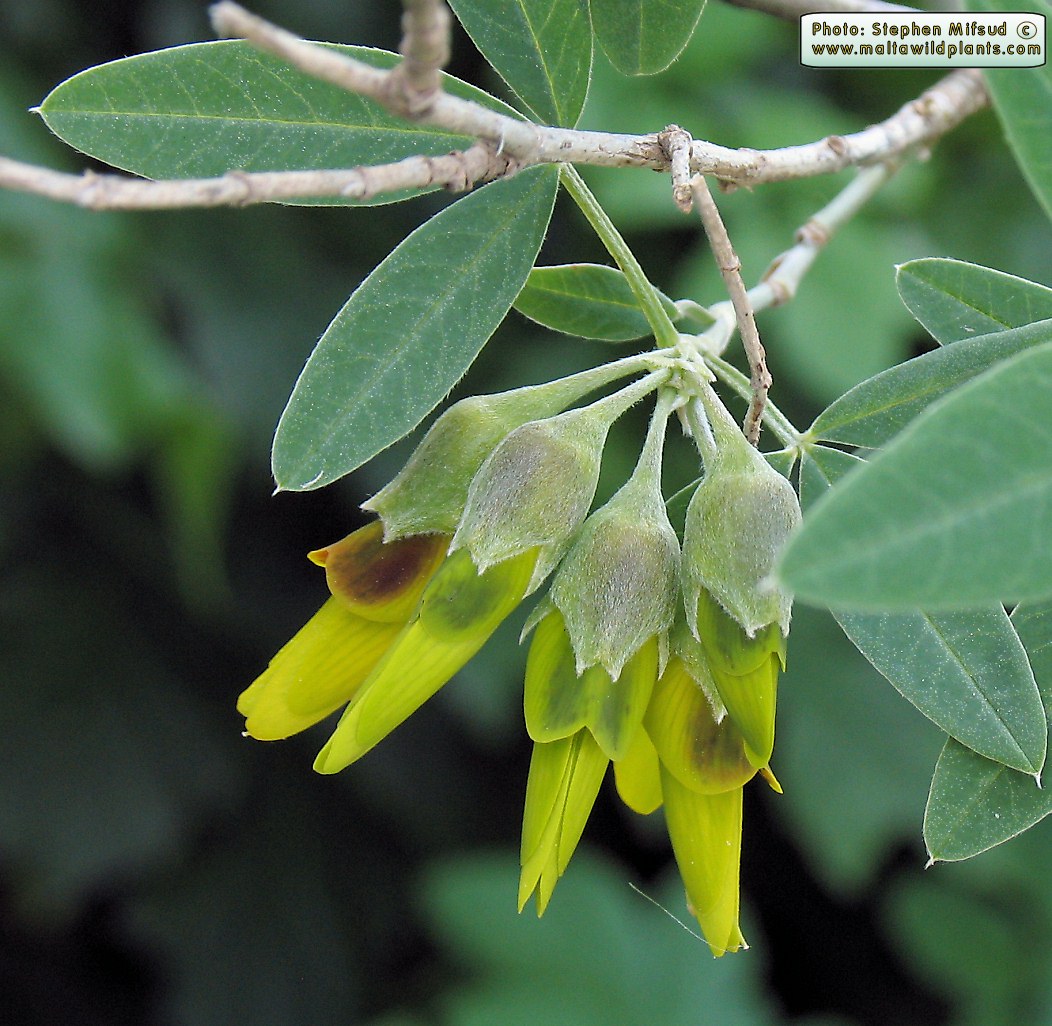
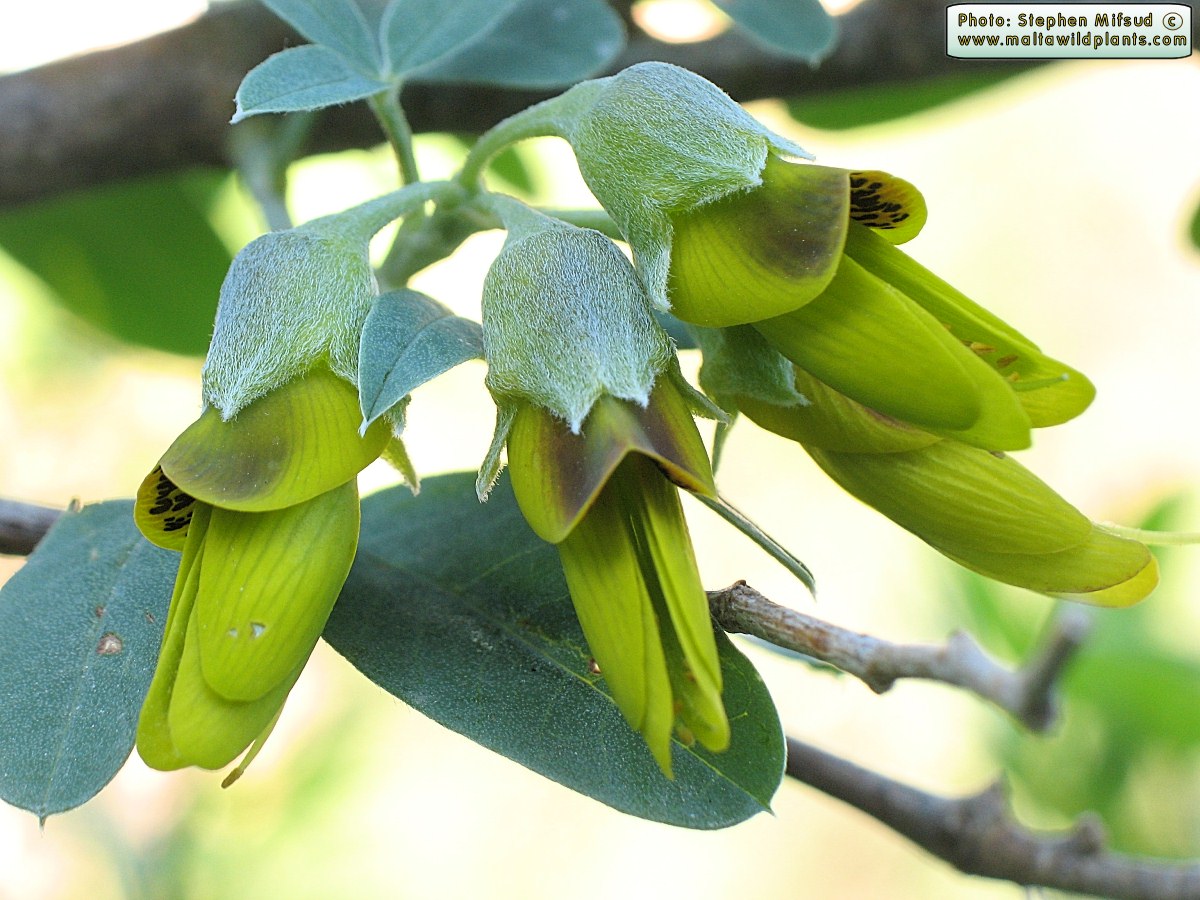
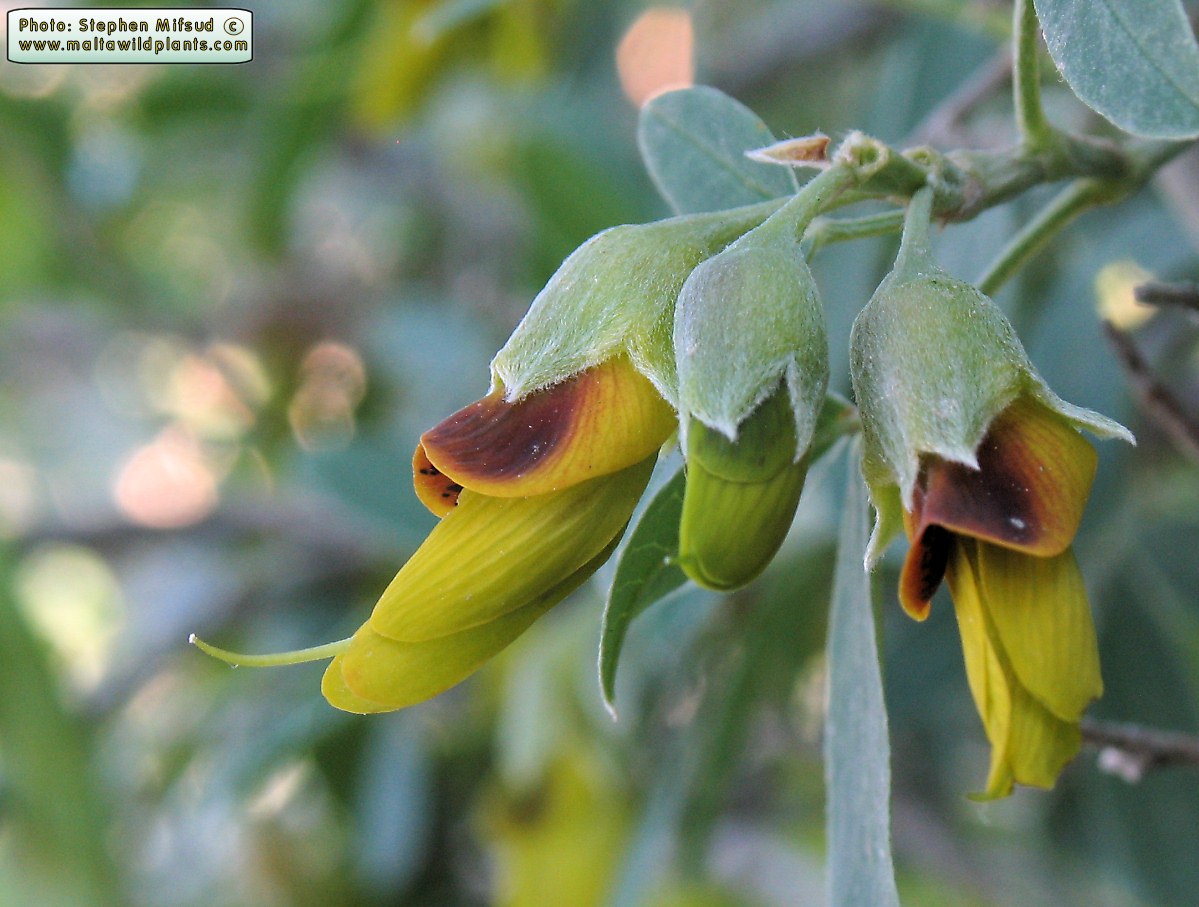
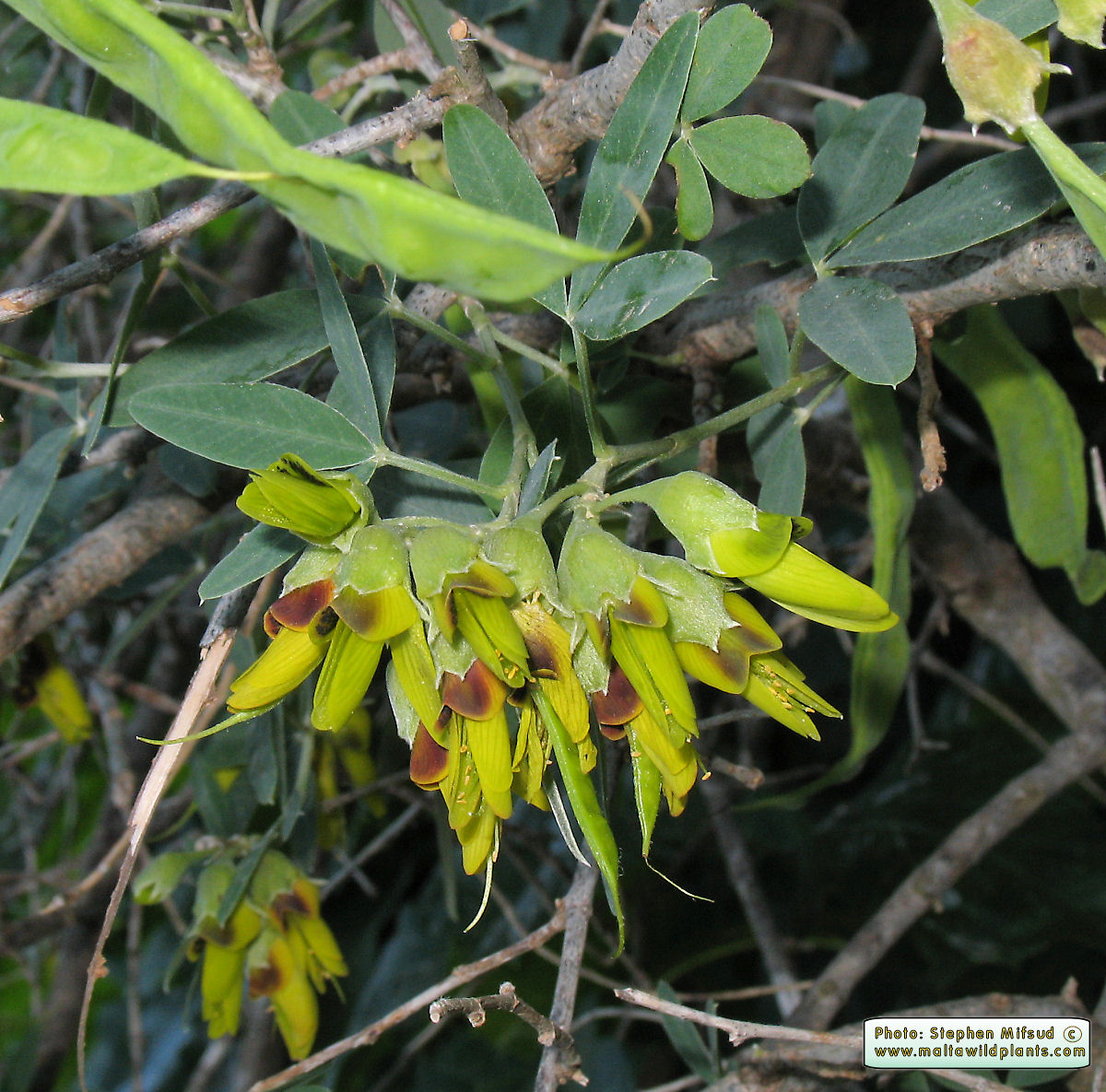
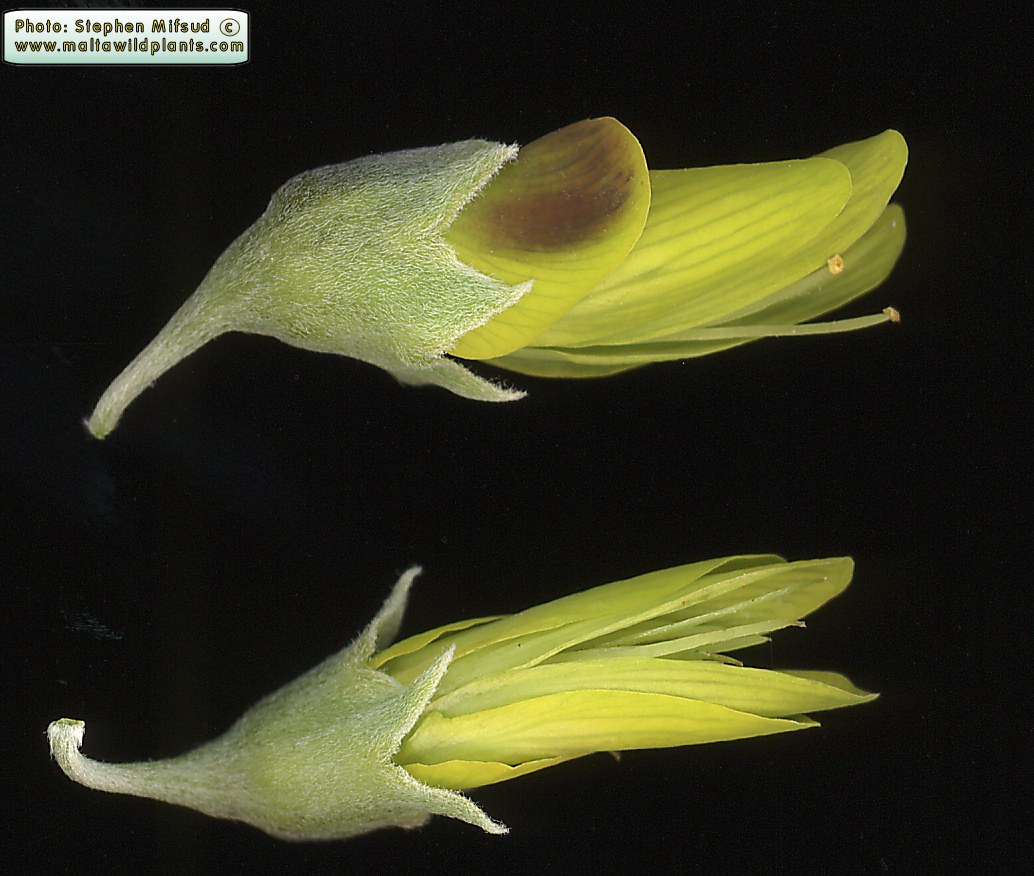
The flowers are arranged in racemes, with 5-12 flowers per raceme. Each flower have a 8-12mm long pedicel followed by a gamosepalous (fused-sepals) calyx and yellow-green corolla. The bell-shaped calyx have 5 teeth (or triangular lobes) where the upper 2 being smaller and more near to each other.

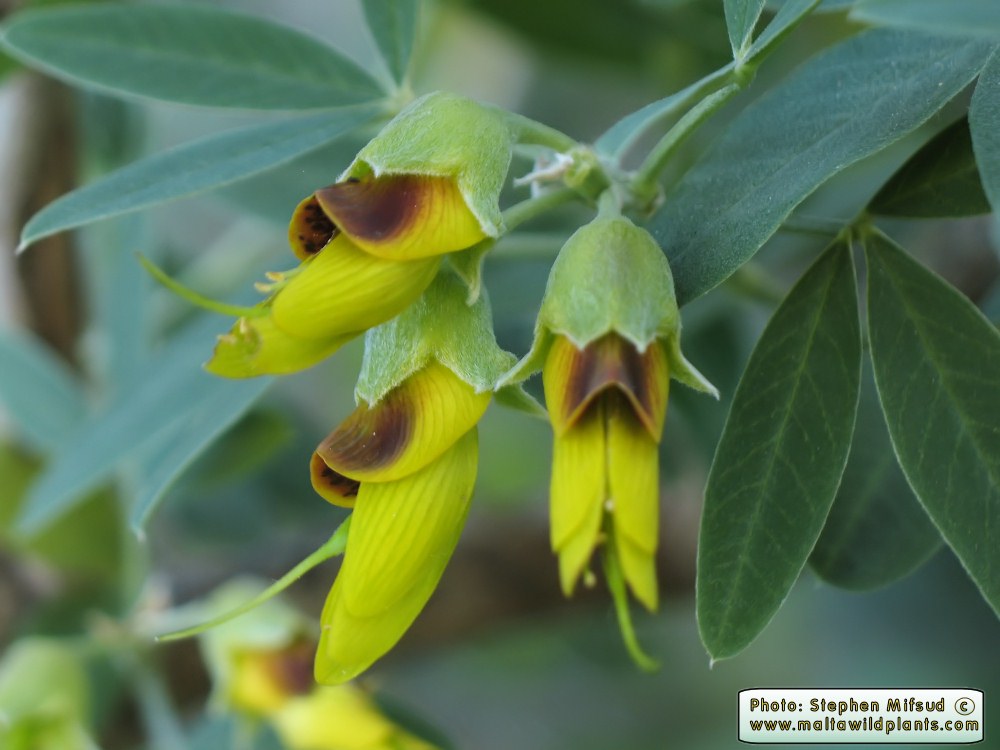
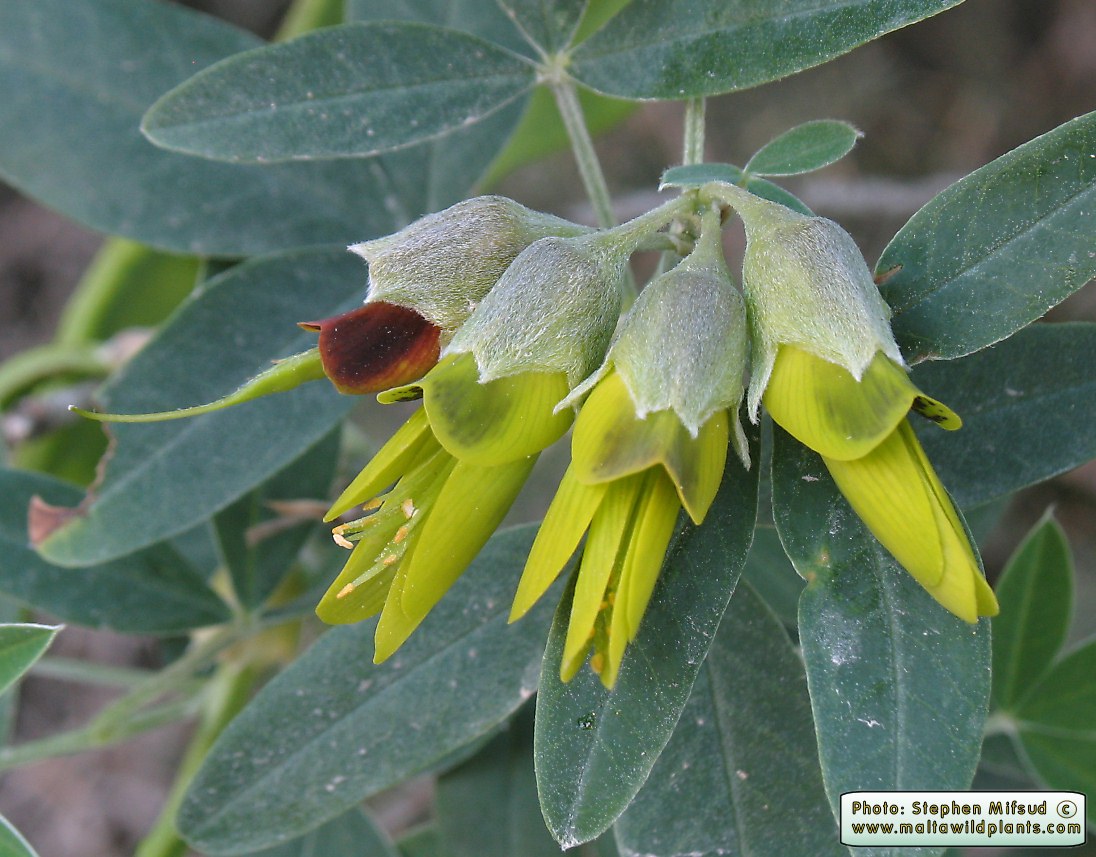
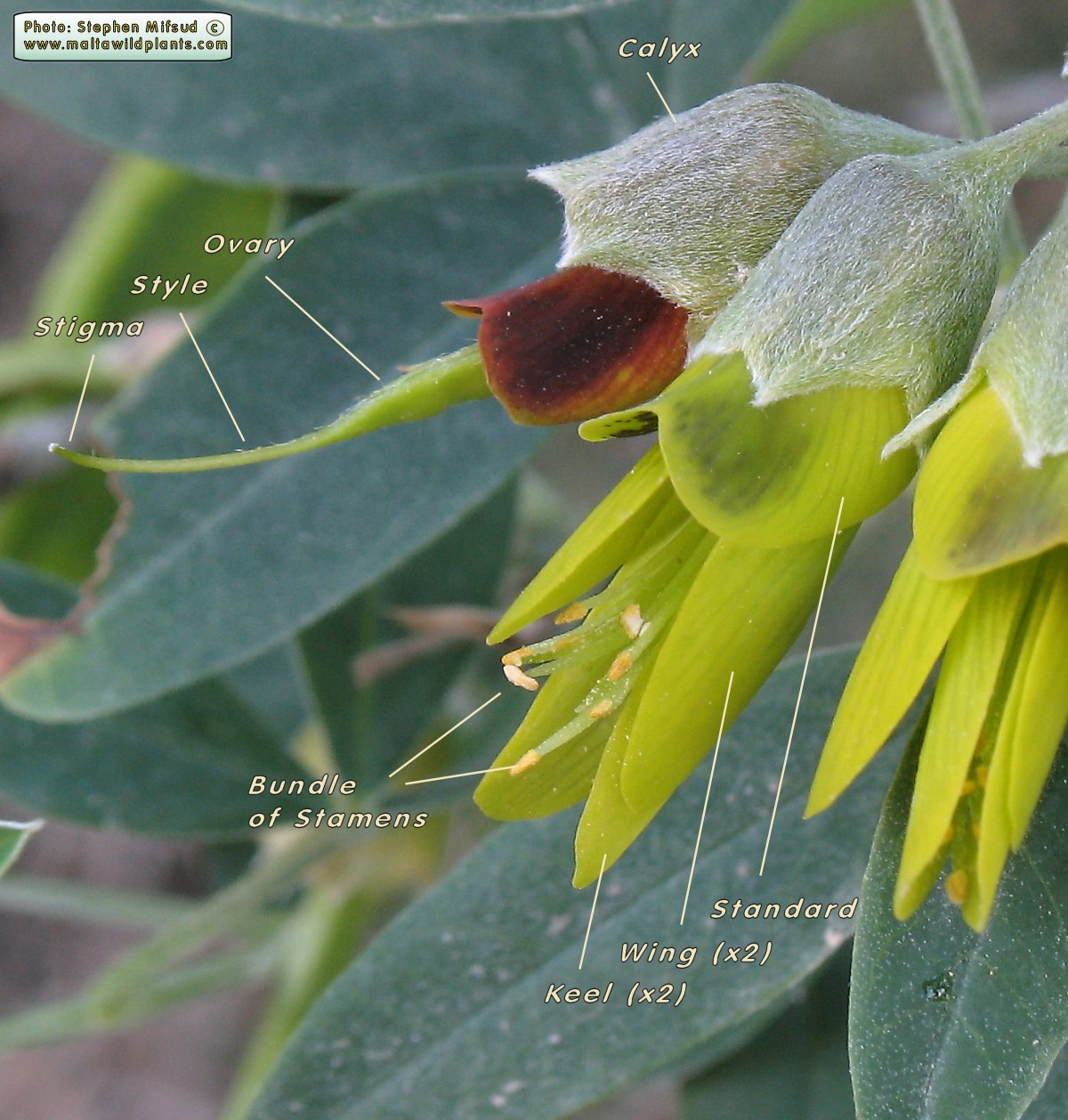
As in most Fabaceae species, the corolla is basically composed of 5 petals, the upper standard, 2 lateral wings, and 2 central and lower ones known as the keel. These are compact and apressed to form a closed tube. The standard has a circular shape with a diameter of about 12-13mm and is the only petal which is decorated with dark brown or black blob, or strictly speaking a collection of smaller blobs close to each other. The wings and keel are of same oblong shape, about 16mm long, undecorated with longitudinal veins.

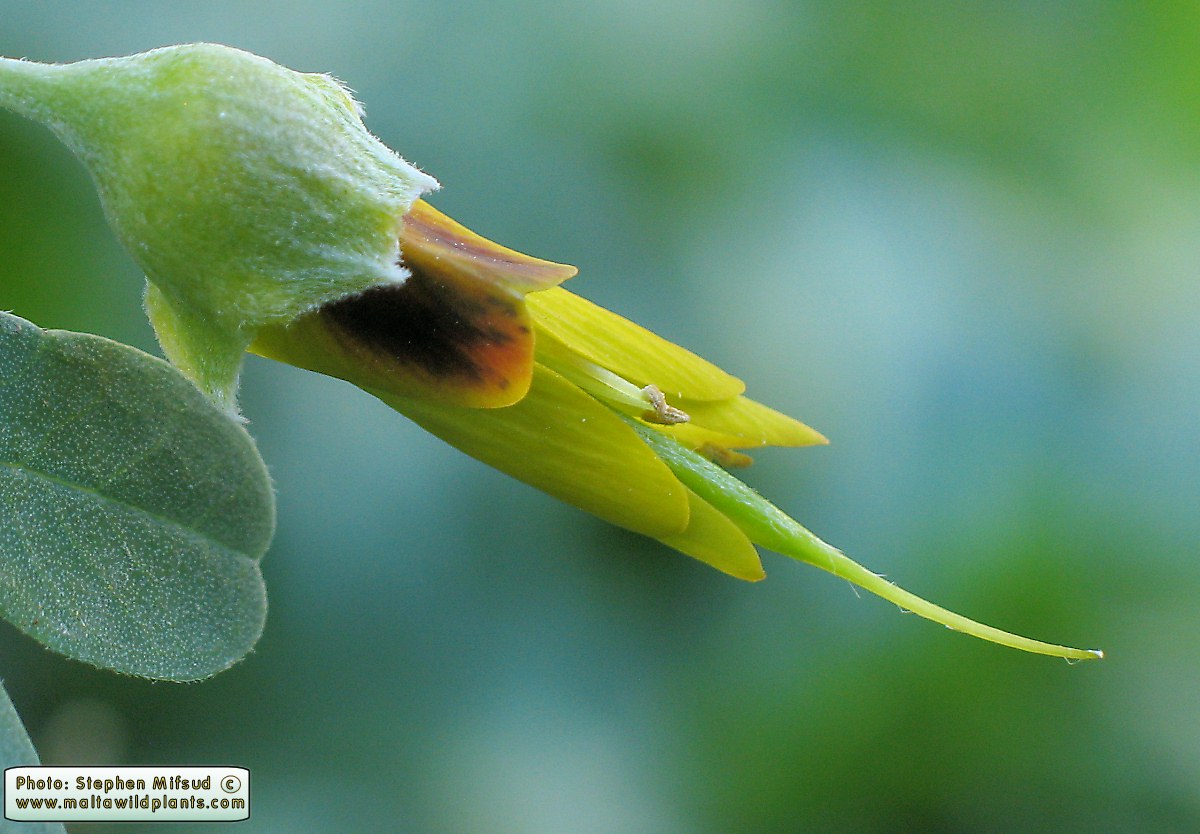
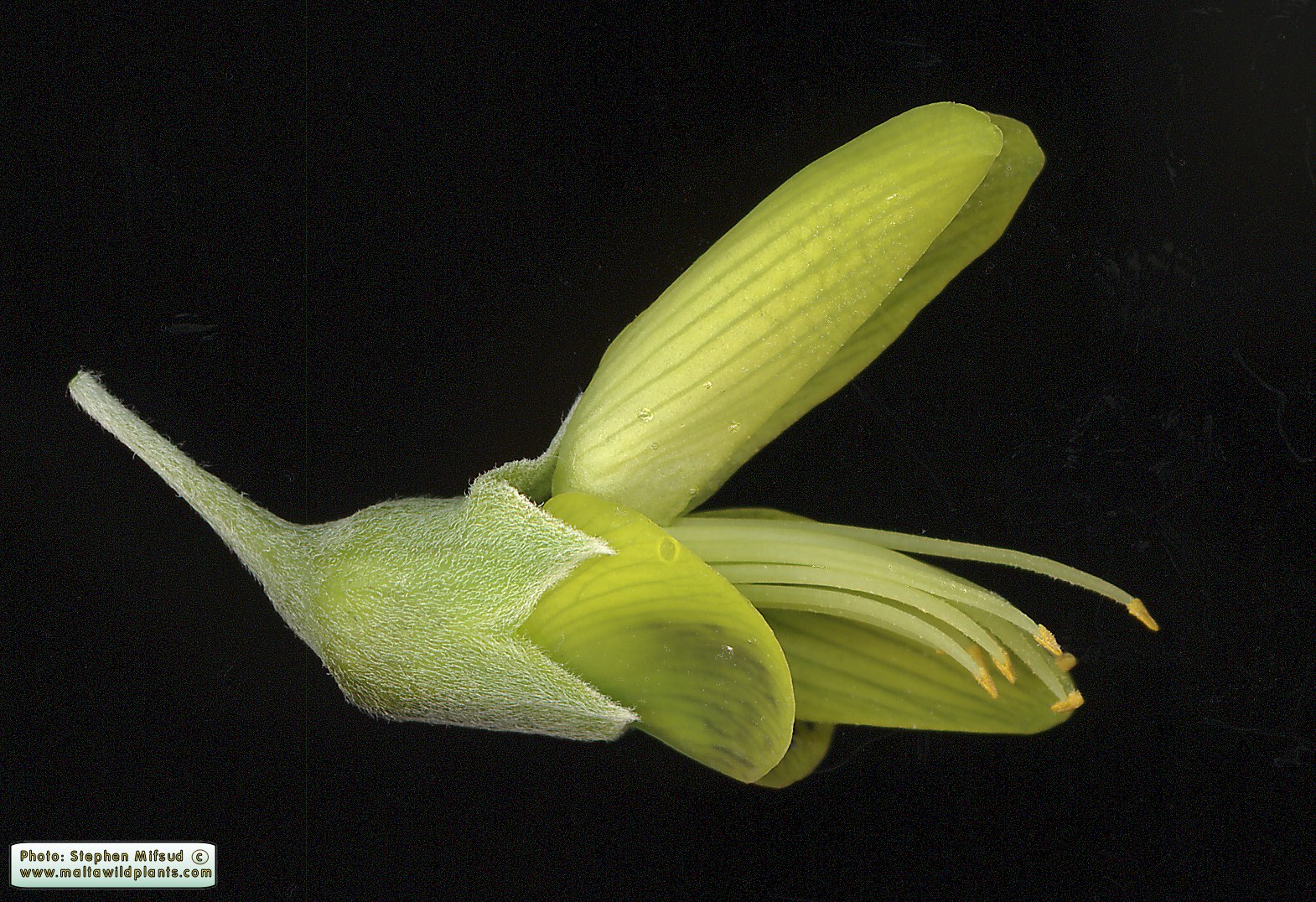
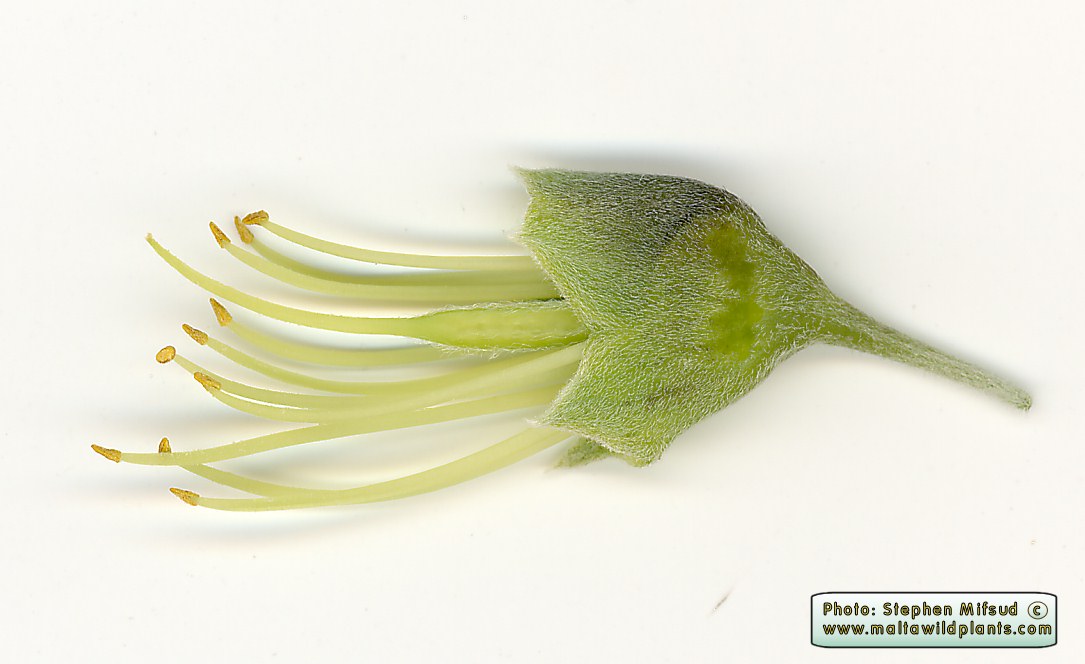
Anagyris foetida Most of the reproductive organs are hidden inside the corolla tube. There are 10 free stamens (with yellow anthers) of unequal length arranged as a bundle around the central pistil. The latter consists of an elongated superior ovary, and a long style with its tip (stigma) usually found protruding out from the corolla.

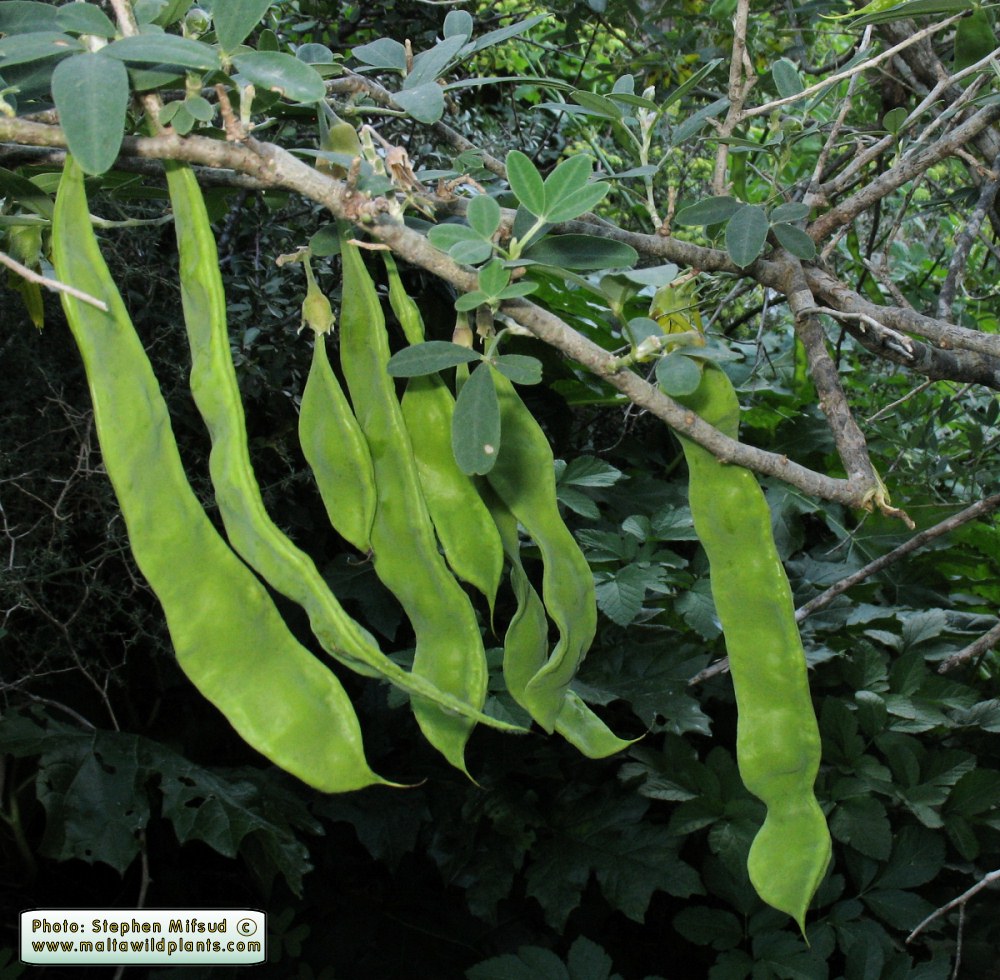
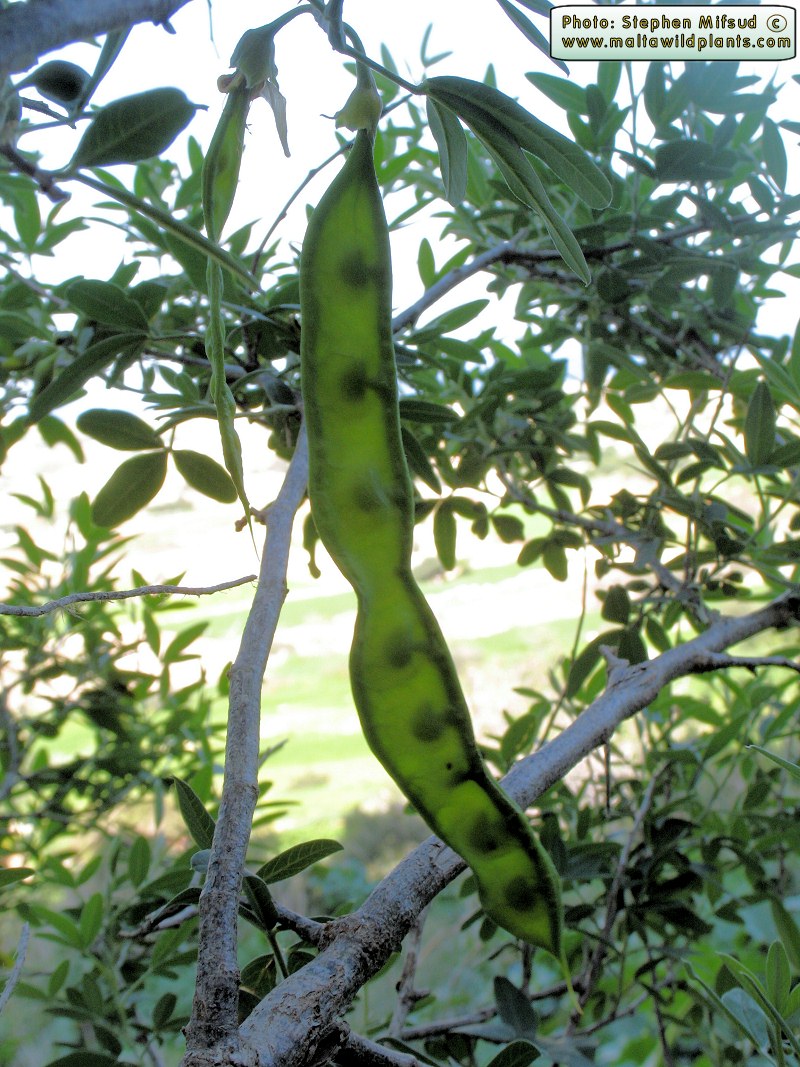
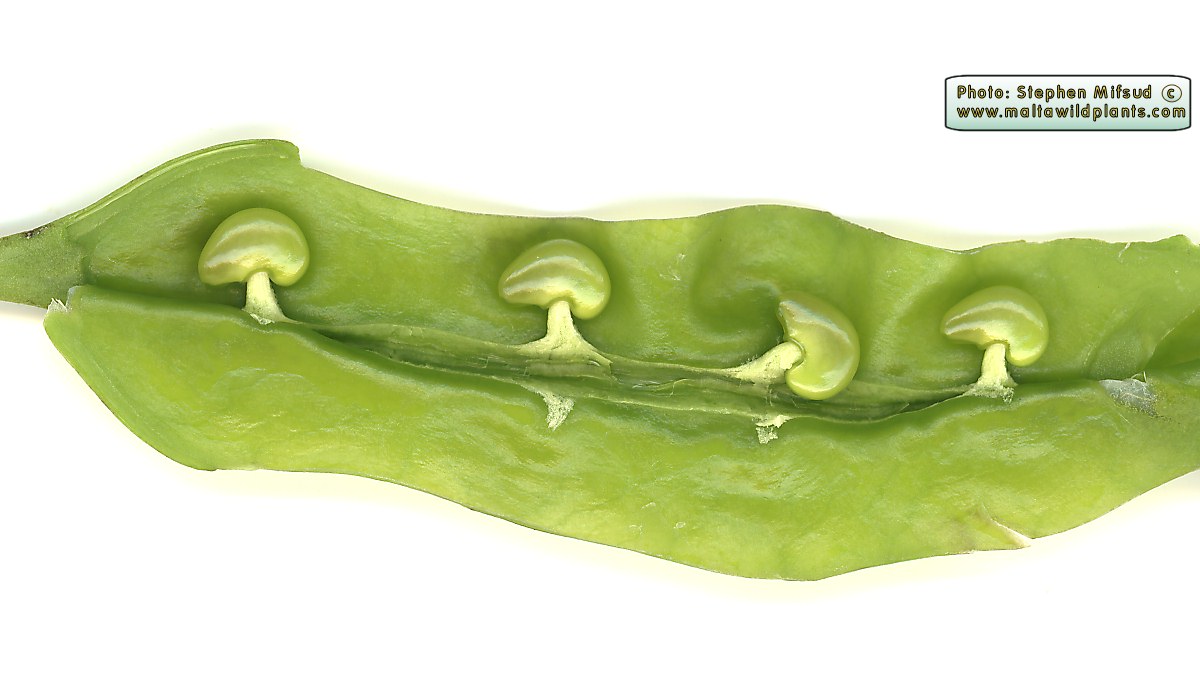
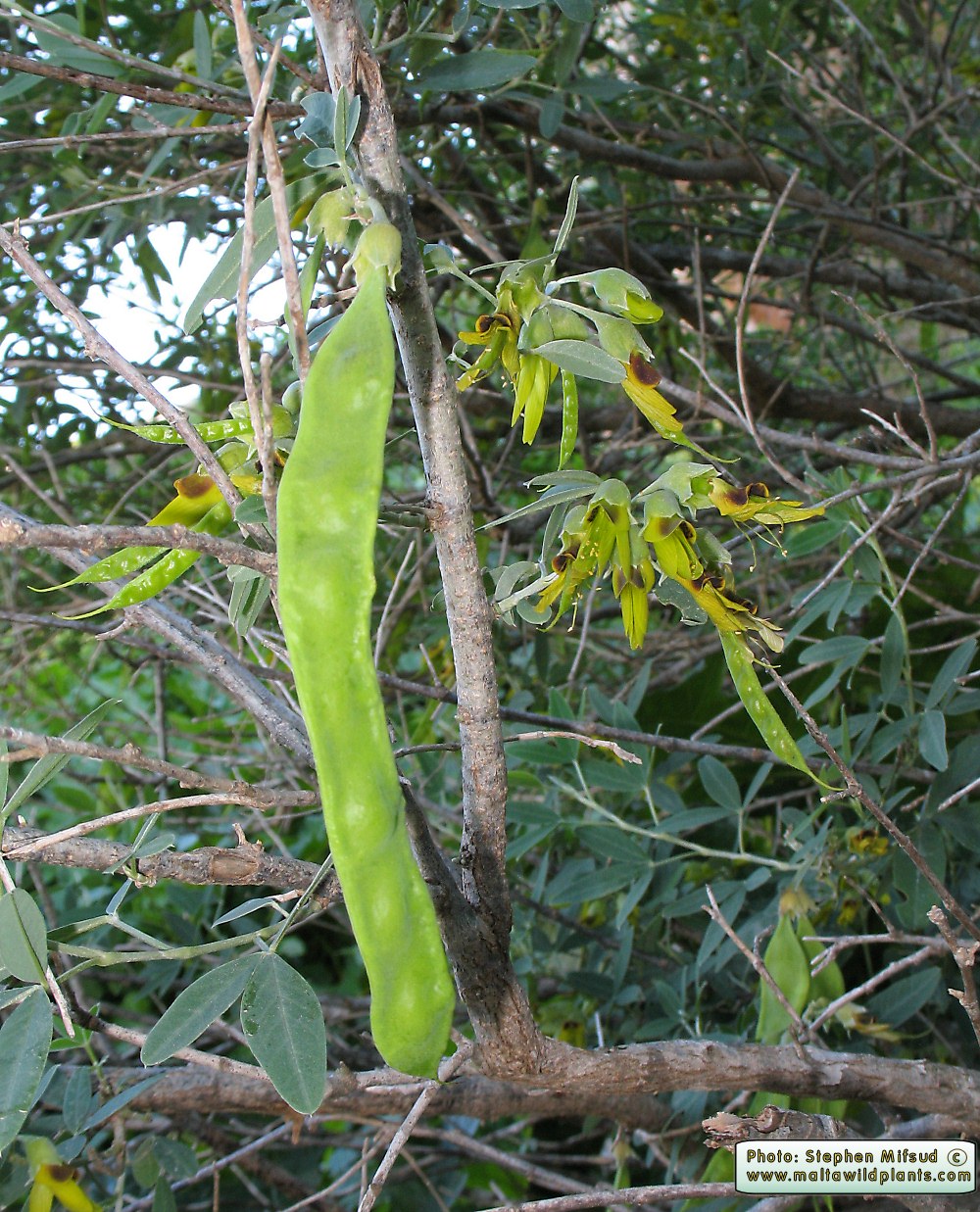
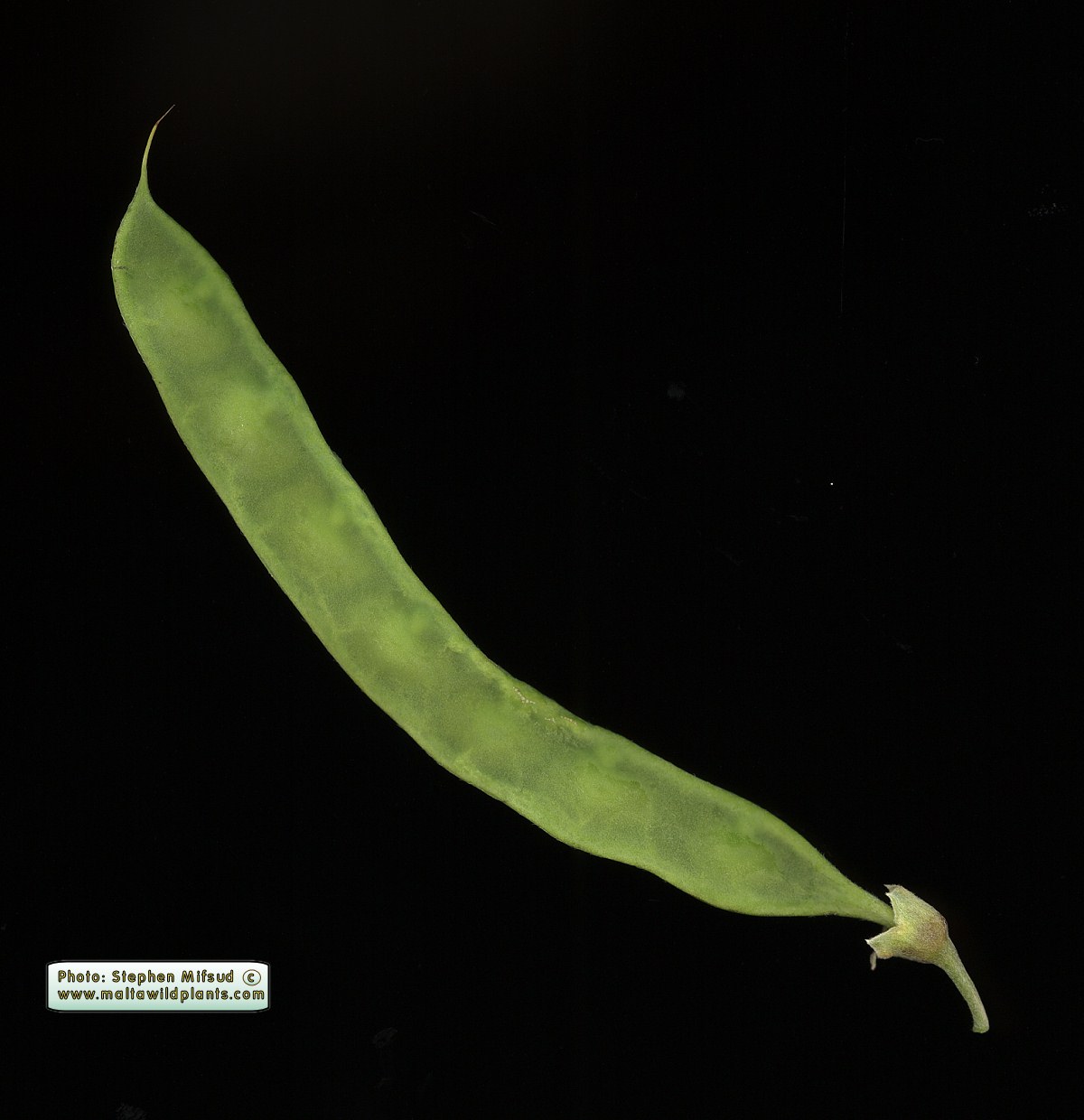
The ovary develops into a flattened legume which varies in length and number of seeds - 3-12 per pod. The longest legumes are about 15-18cm long and 15-20mm wide. They are more or less oblong structures (with rounded ends), curved backwards and somehow crooked. The seeds can be seen bulging out in the narrow pods (just 3mm wide). The legume has a thread-like tip, previously the style of the flower.

The legumes matures in Summer where they become brown and dehisce to release the seeds inside. The seeds are broad, kidney-shaped structures about 14mm long, 9mm wide and 5mm broad. Normally, they have a dark-purple to black colour, very hard and smooth surface.


Additional Information


Nativity and distribution

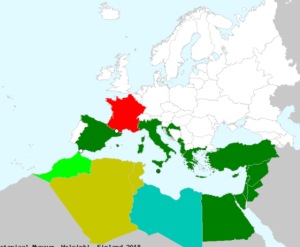
The distributional range of this plant is shown in the list below:  [WWW-26, WWW-158]

Northern Africa:   Algeria , Libya , Morocco, Tunisia
Western Asia:   Egypt - Sinai, Iran, Iraq, Israel, Jordan, Lebanon, Syria , Turkey
Europe:   Albania, Bulgaria, Corsica, Croatia, Cyprus, France, Greece, Italy, Jugoslavia, Portugal, Sardegnia, Sicily, Spain.

Its origin is believed to be North Africa, Mediterranean and South Europe  [383]

Pollination of Anagyris foetida by birds

The pollination of Anagyris foetida L. (Fabaceae), a Mediterranean species that is a relict of the Tertiary, was studied in two populations of SW Spain over a three-year period. Numerous censuses of birds and insects were carried out, the floral nectar was quantified, and specific tests were performed to determine the pollinators' pollen load, the pollen's effective transfer to the pistil, and spontaneous self-pollination. The most important pollinators were three species of passeriforms Phylloscopus collybita Vieillot, Sylvia atricapilla L. and S. melanocephala Gmelin - a result coherent with findings in populations of S and E Spain. The negligible existence of insect visitors and pollinators of A. foetida flowers could be explained by the early flowering of this species during the autumn-winter, coinciding with the coolest and wettest months of the year (cold, high winds, almost daily mists that persist until nightfall, and above all, abundant rainfall). The pollen loads carried by the birds were high, as were also the loads transferred to the pistil. The fruit-set of bagged flowers was very low, evidence of the plant's need for the birds as pollinators. This is the first proof of the existence of a native European bird-pollinated plant, since besides ifs peculaliarities (flowers odourless, pseudotubular, with no landing platform, pendulous, diurnal populations were mainly pollinated by three passeriform species.  [388]

The alkaloid anagyrine from Anagyris foetida

Hardy and Gallois have separated from Anagyris foetida an alkaloid, anagyrine. Parthiel and Spasski found that the crude alkaloid could be separated into cytisine, C11H14N2O and anagyrine, C15H22N2O; the latter is not obtainable in crystalline form; it forms a brittle, resinous-like mass easily reducible to a yellowish powder, but rapidly absorbs moisture and becomes sticky. It volatilizes at 245° C. (473° F.). (Arch. d. Pharm., 244, No. 1, 1906, 20.) It forms, however, a crystalline hydrobromide.  [387] Anagyrine hydrobromide, which has the formula C14H18N2O2HBr, occurs in colorless or faintly yellow crystals and soluble in water. Anagyrine, according to Loewi (A. I. P., vol. vii, p. 66), is physiologically related to lobeline, acting primarily upon the nerve endings as a paralyzant and later upon nerve centers, but having no direct influence upon the muscles. It lessens the cardiac frequency and decreases the force of the systole in the frog, but is said in the mammal to have very little influence upon the blood pressure, death occurring through respiratory paralysis.  [387]

Medicinal Uses

The plant has the following medicinal properties according to reference:    [WWW-66] *,  [359] ^ .
Cathartic ^ Cleansing the bowels; promoting evacuations by stool; purgative.     [WWW-32]
Constipation ^ -    [WWW-57]
Emetic *^ An agent that causes vomiting, so as the stomach is emptied from its contents.    [WWW-57]
Laxative *^ Having the effect of loosening or opening the intestines, hence stimulating evacuation of feces and so relieving from constipation.    [WWW-32]
Lithiasis ^ An agent used against the formation of stones (calculi) in an internal organ    [WWW-32]
Nephretic ^ An agent usd to treat inflammation of the kidney    [WWW-32]
Pectoral * A medicine for diseases of the chest organs, especially the lungs    [WWW-57]
Purgative *^ A purging medicine; stimulates evacuation of the bowels.    [WWW-32]
Tumor * Used to treat or reduce growth of tumors
Vermifuge * A medicine or substance that expels worms from animal bodies; an anthelmintic.    [WWW-57]

Cytotoxic constituents from Anagyris foetida leaves.

Anagyris foetida extracts were investigated in preliminary cytotoxic tests against two tumour cell lines. Chromatographic separations on active extracts led to the isolation of two alkaloids, anagyrine (1) and baptifoline (2), as well of isorhamnetin (3) and syringin 4-O-beta-D-glucopyranoside (4). In vitro cytotoxicity of compounds 1-3 was also evaluated.  [390]

Rhombifoline and 5,6-dehydroLupinine from Anagyrus foetida

Rhombifoline and 5,6-dehydroLupinine were isolated for the first time from the leaves and stems of A. foetida L. indigenous to Saudi Arabia. In addition, five other alkaloids, previously identified in A. foetidia L., namely N-methylcytisine, sparteine, anagyrine, Lupinine and cytisine, were isolated. The isolated alkaloids were characterized by UV, 1H-NMR, 13C-NMR and Mass spectral data. 13C-NMR data of rhombifoline and 5,6-dehydroLupinine are reported for the first time.  [391]

Toxicity Notes

The following toxicity notes about A. foetida were extracted frm reference  [WWW-173] :

Toxic parts: all but particularly seeds

Active ingredients: two alkaloids, the cytisine and the anagyrine

Circumstances of intoxication: ingestion by the man at the time of confusion with bean pods and consumption by the cattle

Toxicity: described in the child like in the horses and the bovines and sheep (more rarely because the odor of the shrub is dissuasive)

Target body: Nervous system (ganglionic poison)

Symptoms: they appear 4 to 5 a.m. after the seed ingestion: mydriase, excitation, driving incoordination and giddinesses, associated sudation, salivation, colics and convulsions. In the severe cases, the coma then death by asphyxiation occur in the 4 hours after the appearance of the symptoms. The ingestion of sheets involves vomiting and a violent purging.

Livestock productions: elimination of the cytisine in the milk which becomes toxic and present yellow clots.

Main Toxic alkaloids of A. foetida

From the chapters above, the most important toxic alkaloids present in the Stinking bean trefoil are Sparteine, Lupinine, Anagyrine, and Cytisine of which the last two are the most dangerous.

Sparteine: This is a class 1a antiarrhythmic agent  [WWW-60] , an alkaloid isolated from lupin beans, Lupinus luteus and Lupinus niger. It has been used as an oxytocic and an anti-arrhythmia agent. It has also been of interest because of genetic variation in its metabolism. [WWW-174]

Lupinine: The seed of modern cultivars of Lupinus angustifolius normally contain less than 0.03% alkaloids. The acute oral LD50 to rats of a pro rata mixture of the alkaloids of L. angustifolius seed was found to be 2279 mg/kg. For Lupinine the LD50 by oral administration was 1464 mg/kg and by intraperitoneal injection 177 mg/kg. For 13-hydroxyLupinine the LD50 by intraperitoneal injection was 199 mg/kg. Since these two alkaloids comprise about 85% of the total and are known to be rapidly cleared from the body it is suggested that the alkaloids in this species do not pose a health problem for man.  [393] Lupinine, a quinolizidine alkaloid, induces nicotinic effects in animals. Leaves, seeds and fruits all contain lupinine, which is retained in dried plants. Pods may concentrate the toxin, becoming a source of poisoning during the winter season when livestock are moved through infested areas or contaminated hay is fed.  [WWW-135] . Lupinine is reported to cause the following symptoms: Birth defects, spasms, vomiting, nausea, dizziness, headache, abdominal pain, & in severe cases death.  [WWW-176]

Anagyrine: C15H20N2O A toxic alkaloid found in several species of Lupinus in the western United States; acute poisoning produces nervousness, depression, loss of muscular control, convulsions, and coma.  [WWW-125] This alkaloid causes the "crooked calf syndrome" (i.e., carpal flexure, torticollis and scoliosis in calves exposed in utero during days 40-70 of gestation).  [WWW-135]

Cytisine: Cytisine is a toxic pyridine-like alkaloid. Pharmacologically it exhibits similar effects to nicotine due to structural similarity of the two molecules. In large doses it can interfere with respiration and become fatal.  [WWW-60] Cytisine is a nicotine agonist, and as a pharmaceutical preparation it is available for the treatment of nicotinism. Cytisine derivative varenicline was approved in 2006 as a smoking cessation drug. A 2006 literature review concludes that while trials performed with cytisine itself are mostly of poor quality, there is some evidence that cytisine may be prescribed to aid in smoking cessation. [WWW-125] Cytisine is reported to cause the following symptoms: Nausea, vomiting, abdominal pain, diarrhea, drowsiness, headache, dizziness, fever, irregular heartbeat, dilated pupils. Severe cases can have convulsions, coma & death. The toxicity varies widely.  [WWW-176]

Plants containing cytisine, including the Common Broom and Mescalbean have also been used recreationally. Positive effects are reported to include a mild intoxication and heightened awareness of color. However this practice is not recommended since negative side-effects can include nausea, vomiting, convulsions, heart pain, headache and in larger doses even death via respiratory failure. Plants that contain the alkaloid in various concentrations include several from the Faboideae subfamily, including laburnum, anagyris, thermopsis, cytisus, genista and sophora.  [WWW-125]

Cases of toxicity from anagyrine in lupin plants

Silky lupine (Lupinus sericeus) is a native herb of western Canada. This lupine has caused poisoning and death in cattle, goats, horses, and sheep. Sheep eat the plants more readily than do other animals and are therefore more commonly poisoned. Cattle also suffer from crooked calf disease, a teratogenic syndrome caused by maternal ingestion of certain lupines between day 40 and day 70 of gestation. The calves can suffer from arthrogryposis, scoliosis, and other deformities. Humans are also at risk from lupine toxins. In one case in California, a child was born with limb deformities. The family raised milk goats that had also given birth to kids with deformed limbs, and a dog gave birth to deformed pups. All had ingested the goat''s milk during pregnancy. Anagyrine in a local lupine species was believed to cause the problem. Tests showed that lactating goats that ingest lupine seeds pass anagyrine in the milk. Edible lupine seeds are being marketed in health food stores. In Edmonton (Smith 1987), a woman suffered mild dizziness and incoordination after ingesting the seeds. She did not follow specific instructions to soak and boil the seeds in several changes of water, which is necessary to remove the toxins.  [WWW-175]

Binding of quinolizidine alkaloids to nicotinic and muscarinic acetylcholine receptors.

Fourteen quinolizidine alkaloids, isolated from Lupinus albus, L. mutabilis, and Anagyris foetida, were analyzed for their affinity for nicotinic and/or muscarinic acetylcholine receptors. Of the compounds tested, the alpha-pyridones, N-methylcytisine and cytisine, showed the highest affinities at the nicotinic receptor, while several quinolizidine alkaloid types were especially active at the muscarinic receptor.  [389]

Personal Observations


The blotch on the standard
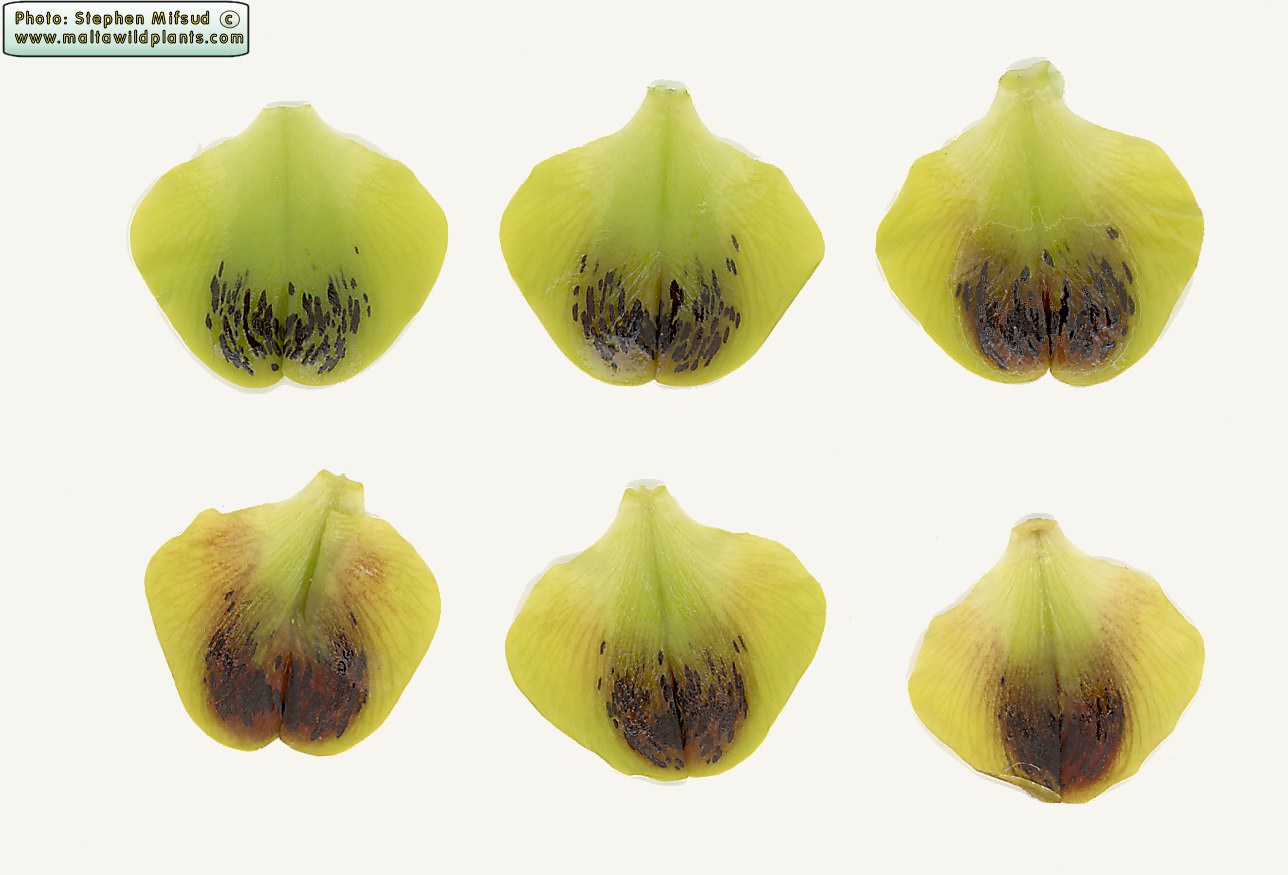
Anagyris foetida On examining several flowers of the same specimen, I found two different types of dark blotches on the standard petal. One type of blotch consisted of a cluster of very small, isolated and well defined specs which where as black as coal. The other type of consisted of a singular iodine-brown blotch. All other blotches fell as gradual intermediates between the two extreme types described. On further study it was noted that the blossoming flower had the former type of blackish blotch and as if the colour diffuses gradually with flower age across the petal to form the other brownish type of blotch. On a similar note, blossomed flowers had a yellow-green corolla while mature ones turn to a more golden hue of yellow.
Odour of the plant
Personally, I do not find the odour of this plant very stinking. It has a strong smell of boiled or cooked beans, but not an unpleasant one.

Photo Gallery

Anagyris foetida (Stinking Bean Trefoil) - CLICK TO ENLARGE PHOTO Anagyris foetida (Stinking Bean Trefoil) - CLICK TO ENLARGE PHOTO Anagyris foetida (Stinking Bean Trefoil) - CLICK TO ENLARGE PHOTO Anagyris foetida (Stinking Bean Trefoil) - CLICK TO ENLARGE PHOTO
Photo of showing inflorescence and also some trefoil leaves and part of the immature pods.
Photo of inflorescence, a raceme of 5-12 yellow-green flowers that blossom gradually one after the other. As shown here, some flowers have already developed an ovary while others have just blossomed.
Photo of flowers having a gamosepalous calyx and a corolla of 5 overlapping petals. The upper petal is called the standard and is slightly erect. There are 2 pairs of nearly identical petals, apressed on each other of which the lateral are called the wings, and the lower ones as the keel.
Photo of flowers showing their lateral and upper parts.
Anagyris foetida (Stinking Bean Trefoil) - CLICK TO ENLARGE PHOTO Anagyris foetida (Stinking Bean Trefoil) - CLICK TO ENLARGE PHOTO Anagyris foetida (Stinking Bean Trefoil) - CLICK TO ENLARGE PHOTO Anagyris foetida (Stinking Bean Trefoil) - CLICK TO ENLARGE PHOTO
Photo of few flowers showing the detail of the calyx - a bell-shaped structure with 5 pointed lobes (teeth), of which the upper 2 are closer to each other. The calyx is covered with very short, white hair.
Photo of 2 flowers (and a bud). The standard has a circular shape and have a reddish-brown, or sometimes black blotch.
Another photo of the yellow-green flowers stained with a contrasting iodine-brown blotch on their upper petal.
Close up photo of a flower showing the detail of both the petals and the exposed reproductive organs. There is a bundle of 10 free stamens around a central pistil slightly longer from the stamens - all curved up.
Anagyris foetida (Stinking Bean Trefoil) - CLICK TO ENLARGE PHOTO Anagyris foetida (Stinking Bean Trefoil) - CLICK TO ENLARGE PHOTO Anagyris foetida (Stinking Bean Trefoil) - CLICK TO ENLARGE PHOTO Anagyris foetida (Stinking Bean Trefoil) - CLICK TO ENLARGE PHOTO
Photo of 4 flowers with their petals slightly separated in the older flowers.
Close up photo of one of the flowers in the previous photo with annotated explanations of the main flowering parts.
Close up photo of the flower with an attempt to catch the detail of the dark coloration of the standard.
Close up photo of a flower (top view). Note the protruding pistil, which starts to elongate already from the flowering phase.
Anagyris foetida (Stinking Bean Trefoil) - CLICK TO ENLARGE PHOTO Anagyris foetida (Stinking Bean Trefoil) - CLICK TO ENLARGE PHOTO Anagyris foetida (Stinking Bean Trefoil) - CLICK TO ENLARGE PHOTO Anagyris foetida (Stinking Bean Trefoil) - CLICK TO ENLARGE PHOTO
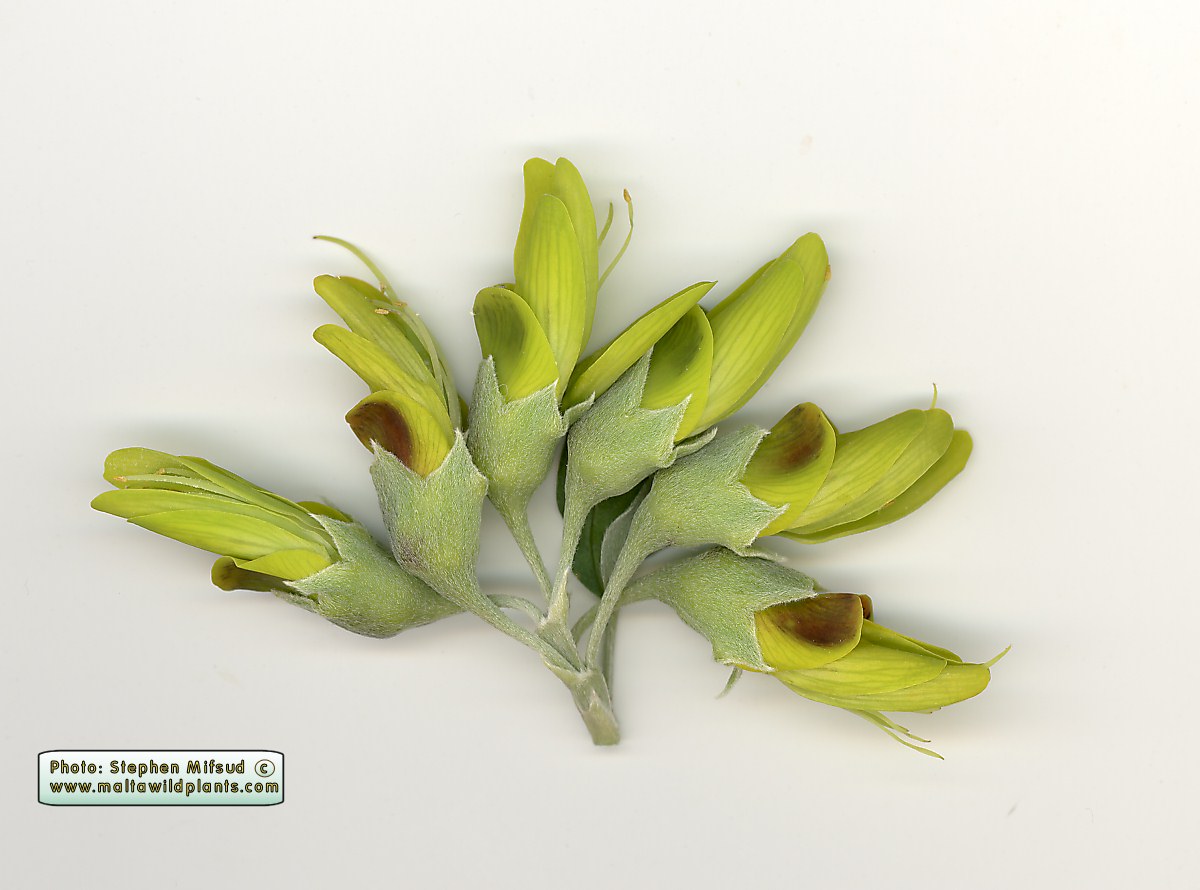
Scanned image of the pedicelled flowers which are arranged as a raceme.
Scanned, side view image of a flower. One of the wings was removed and the lower pair of petals (keel) was pushed down so as to show better the reproductive parts.
Scanned image of 2 flowers - lateral view and bottom view.
Scanned image of the petals dissected out from the flower. Note the longitudinal veins of the wings and keel.
Anagyris foetida (Stinking Bean Trefoil) - CLICK TO ENLARGE PHOTO Anagyris foetida (Stinking Bean Trefoil) - CLICK TO ENLARGE PHOTO Anagyris foetida (Stinking Bean Trefoil) - CLICK TO ENLARGE PHOTO Anagyris foetida (Stinking Bean Trefoil) - CLICK TO ENLARGE PHOTO
Scanned image of 6 standards from the same specimen. Some have a brownish, diffused blotch, while others have a set of well-defined black blobs. According to my observations, a young flower initially have a set of dark blobs as in the example at the top left corner and the colour gradually diffuses out forming a singular iodine-brown blotch as in the bottom right petal. It is also observed that younger flowers have a greener yellow petals.
Scanned image of the bundle of stamens, which are free and have unequal lengths. Also visible is the pistil with a slightly hairy ovary.
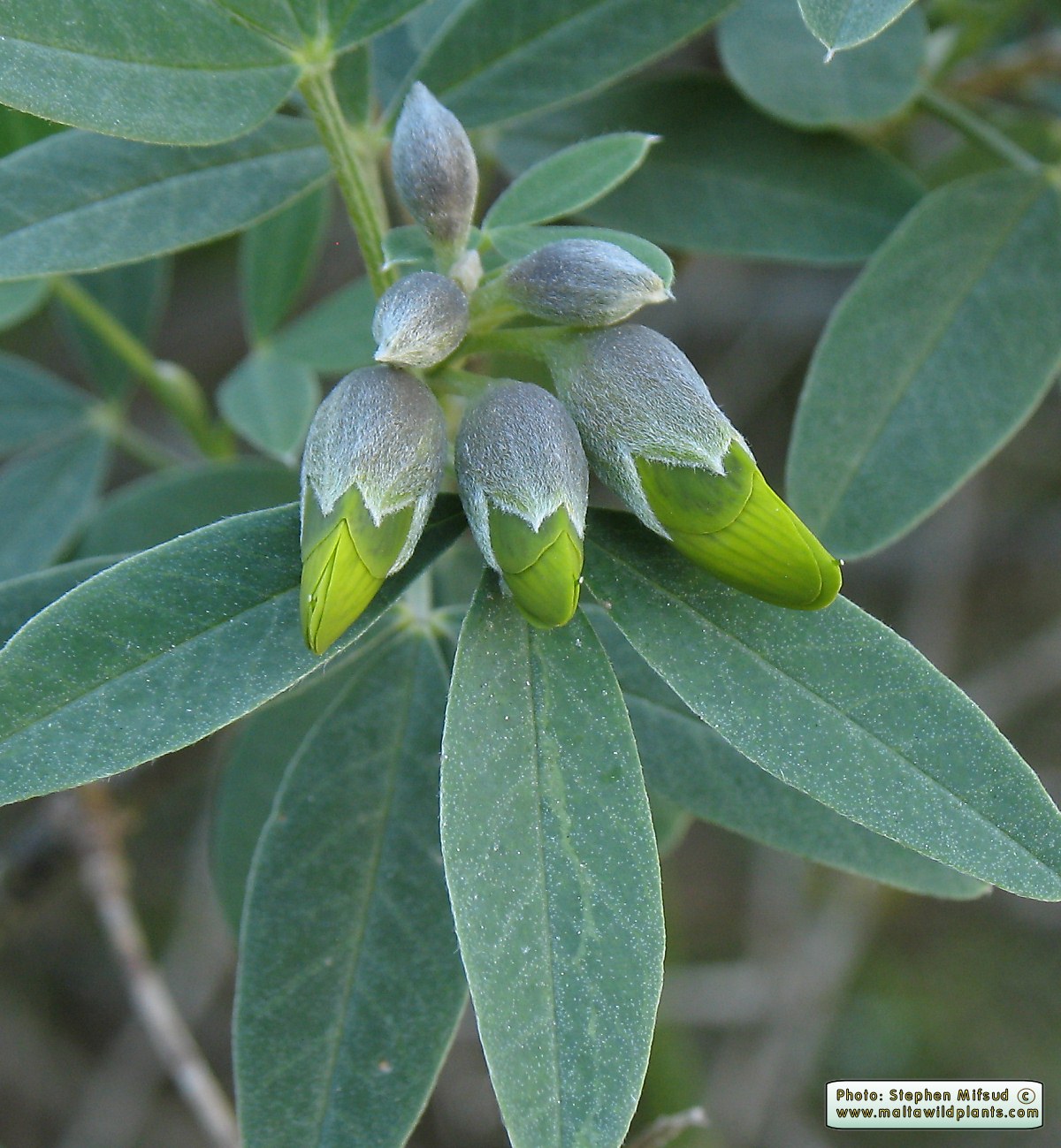
Photo of the buds.
Photo of the leaves, which consists of 3 identical leaflets each having an elliptic(fusiform) or lanceolate shape.
Anagyris foetida (Stinking Bean Trefoil) - CLICK TO ENLARGE PHOTO Anagyris foetida (Stinking Bean Trefoil) - CLICK TO ENLARGE PHOTO Anagyris foetida (Stinking Bean Trefoil) - CLICK TO ENLARGE PHOTO Anagyris foetida (Stinking Bean Trefoil) - CLICK TO ENLARGE PHOTO
Photo of the trifoliate leaf. The central leaflet is slightly bigger from the lateral ones. Leaflets have an entire outline and show simple pinnate venation.
Scanned image of a twig with alternating trefoil leaves. The underside of the leaf is grayish-green.
Scanned image of 2 leaves where the one at the left shows the lower face. The latter have much more short hairs, giving it the grayish-green appearance.
Enlarged scanned image of leaf outline (lower side at the left) showing the sericeous (silky) short hairs.
Anagyris foetida (Stinking Bean Trefoil) - CLICK TO ENLARGE PHOTO Anagyris foetida (Stinking Bean Trefoil) - CLICK TO ENLARGE PHOTO Anagyris foetida (Stinking Bean Trefoil) - CLICK TO ENLARGE PHOTO Anagyris foetida (Stinking Bean Trefoil) - CLICK TO ENLARGE PHOTO
Scanned image of a twig with leaves and inflorescence. Each leaf has a tiny stipule at the opposite side of the stem.
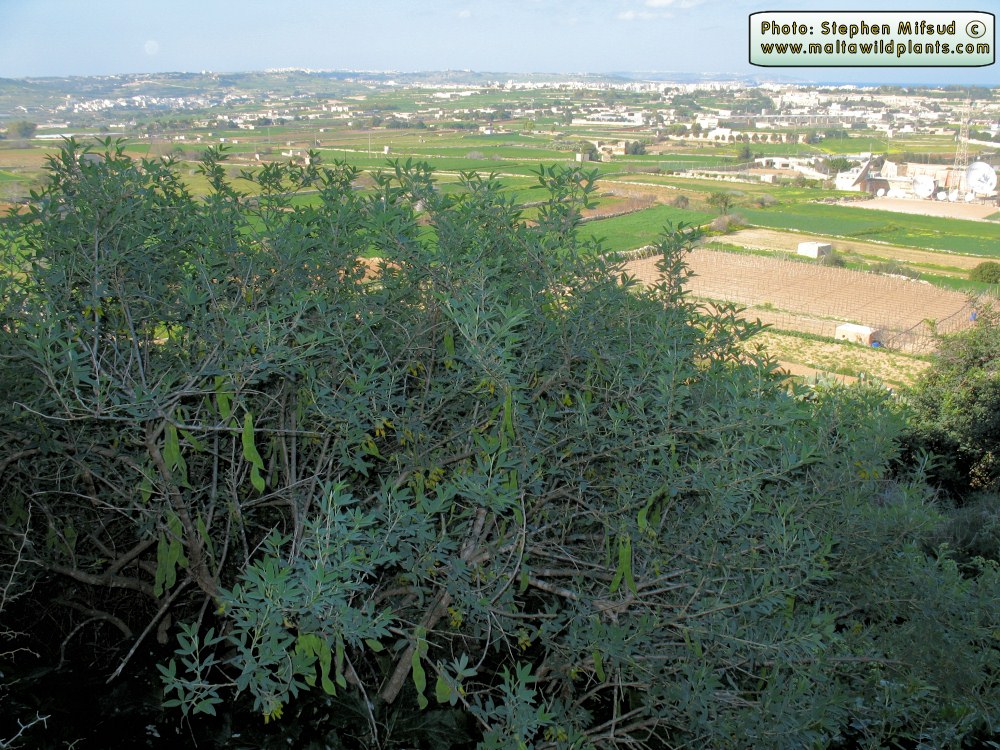
Photo of plant, which grows into a large bush, 1, 2 or even 3m across. Some reports describes it up to 3-4m high.
Photo of fruit and flowers in situ. Fruit is a legume which can have between 3 -12 seeds.
Photo of a group of fruit hanging down like those of Ceratonia siliqua. They are oblong structures which are narrow and somehow crooked.
Anagyris foetida (Stinking Bean Trefoil) - CLICK TO ENLARGE PHOTO Anagyris foetida (Stinking Bean Trefoil) - CLICK TO ENLARGE PHOTO Anagyris foetida (Stinking Bean Trefoil) - CLICK TO ENLARGE PHOTO Anagyris foetida (Stinking Bean Trefoil) - CLICK TO ENLARGE PHOTO
Photo of fruit against light showing the seeds (ovules) inside which are well separated from each other. Seeds are seen bulging out from the narrow legume.
Scanned image of fruit, dissected open to show ovules inside.
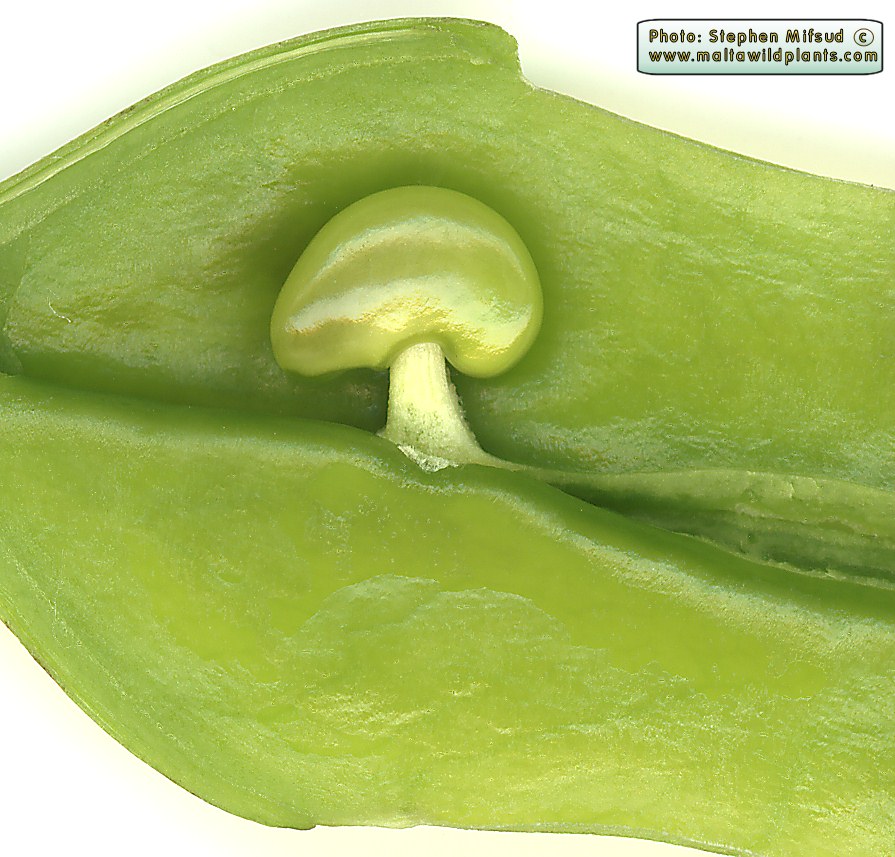
Scanned and magnified image of one ovule.
Scanned image of the legume; 10-18cm long, 2cm wide, slightly curved back.
Anagyris foetida (Stinking Bean Trefoil) - CLICK TO ENLARGE PHOTO Anagyris foetida (Stinking Bean Trefoil) - CLICK TO ENLARGE PHOTO    
Scanned image of the seeds. They are broad, kidney-shaped bodies, which usually have a purple-black colour. They are very hard with a smooth surface.
Illustration from Natürliche Pflanzenfamilien. Vol. III, 3. by Paul Hermann Wilhelm Taubert (1862-1897) ; Engelmann (ed.):.
-
-

Further Information and Links

Synthesis of di-Sparteine Toxicity of Lupenine
List of scholar (academic) documents mentioning Anagyris foetida. Pittosporum vein yellowing nucleorhabdovirus
Toxic plants as possible human teratogens. Link 6
Search for Anagyris foetida on the FORUM of MaltaWildPlants.com


Buy from and support MaltaWildPlants.com

Buy Seeds from Maltawildplants.com Buy samples of seeds of certain wild plants for your studies, trials, research, etc. Not all species' seeds can be exported (depending on Maltese regulations), and availability depends on season of species. So, before any payment, you are kindly asked to fill in the online quotation/order form by which I can contact you back for availability and charges. Buy Seeds from Maltawildplants.com   Online Quotation

Buy Seeds from Maltawildplants.com   Online Payment
Buy Documents from Maltawildplants.com Buy documents related to Maltese Wild Plants such as the list of references, full profile, or other docs you request. Buy Documents from Maltawildplants.com   Online Payment
Buy Images  from Maltawildplants.com Buy any of my own copyright images found in this large collection of Maltese flora. You should first select the image you want to buy and input its corresponding code (found beneath each individual photo) in the online ordering form. Buy Seeds from Maltawildplants.com   Online Payment
Buy Seeds from Maltawildplants.com Kindly donate any sum of money (from 2USD / 2Euro) to help us covering some expenses needed to maintain Maltawildplants.com. Please bear in mind how much hard work such a large and up-to-date website needs to arrive directly to you home, office or library. Your kind donations are both greatly appreciated and recorded for future reference. Donors asking help will have first que preference for assistance and special attention. Buy Seeds from Maltawildplants.com   Online Donation


Submit More Information

Use the form below to submit more information about this plant or a related species. If the data is taken from a book, journal, website, etc, please provide the corresponding reference / website address as indicated in the form. If it is your own observation, then your name will be cited. Your Email address will never be displayed online, it is just for internal communication.


For plant species that are marked as rare, you can also report other locations in Malta where you have seen this species.

Finally you can report any mistakes or errors found on the plant profile for necessary corrections. This will help to improve the website's acuracy.


To have more details about each particular field, just move your mouse on it and wait for the help message to pop up

* = required fields.
Plant Species:  *
Your name:   *
Your Email:   *
Fill any of the following 3 sections below (A, B or/and C) and send the form. - Thank you.
 
A:  Additional Information about this plant species
Own observations:
Info from published material (books, jounals, website):

Reference of published material:

 
B:   Where have you seen this plant on the Maltese Islands?
Locations in Malta or Gozo where you have encountered this plant.
Mostly applies for rare plants.


1:        2:   
3:       4:   
5:       6:   

Try to be as concise as possible. Examples: Dingli Cliffs (near chapel), Wied Incita (Zebbug side), Triq il-Kbira (Qormi), Barriera ta\' Abdul (Xlendi), Fields near Salib tal-gholja (Siggiewi). GPS bearings are also welcomed!
 
C:  Corrections for mistakes and errors in this plant profile.
Section of this plant Profile page where you found an error (select one)

What is the error/mistake
What should be its correction


All material and data on this webpage is under the copyright of the author of this site - Stephen Mifsud / www.MaltaWildPlants.com / Malta. (2002-2008)
This research project about the flora of Malta is sponsored by:
Middlesea Insurance p.l.c. A Fund established to help in the amelioration and enhancement of the environment in Malta and to take initiatives that enhance awareness on environmental issues amongst the public Empty space for sponsor Empty space for sponsor Benefit companies get by sponsoring this project