| |
|
 | |
| Online Flora of the Maltese Islands by Stephen Mifsud |
|
| |
|
|
 |  |  |  |
| External Links: |
|
Crocus longiflorus (Yellow-throated Crocus) |

Crocus longiflorus (IRIDACEAE.)
Images for this profile are taken from the Maltese Islands after year 2000.
Website launch: Oct-2002
Taxonomic update: Aug-2026
Code update: Jul-2026 |
|
| Nomenclature |
Species name : | Crocus longiflorus Raf. | Authority : | Constantine Samuel Rafinesque-Schmaltz, Turkey/France/Sicily, (1783 - 1840) | Synonyms :
(basionym or principal syn.) |
|
Plant Family : | Iridaceae Juss.
(Iris Family) | English name(s) : | Yellow-throated Crocus | Maltese name(s) : | Żagħfran selvaġġ skars | Status for Malta : | Subendemic. Found in Malta and neighbouring territories such as in Sicily,
Lampedusa, Pantelleria, and other islands. | Name Derivation : |
Crocus: old name for the plant saffron. (Both Latin and Greek origin)); 2. Saffron (Latin);. ( origin); 3. Saffron (Latin);.
longiflorus: literally meaning long-flowered; for the long throat (neck) of the flower. (); 2. Long flowered, referring to the long neck of the flower (Latin). ( origin); 3. Long flowered, referring to the long neck of the flower (Latin).
| Remarks : | |
|
| Morphology and structure |
PLANT STRUCTURE: |
Character | Growth Form | Branching | Surface |
Description | | | |
General
Picture |  |  |  |
|
LEAVES: |
Character | Arrangement | Attachment | Venation |
Description | | | |
General
Picture |  | 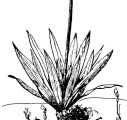 | 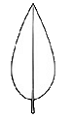 |
| |
Character | Leaf Shape | Leaf Margin | Remarks |
Description | | | |
General
Picture | 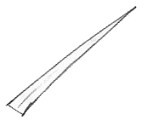 | 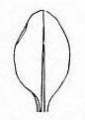 |  |
|
FLOWERS: |
Character | Colour | Basic Flower Type | No. of Petals | No. of Sepals |
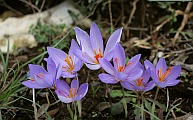
Description | Lilac to violet | | 6 To be botanically precise, the flower has 3 sepals (outer whorl) and 3 petals (inner whorl) which are identical, and so they are collectively referred to as 6 tepals or perianth segments. | 0 |
General
Picture | | 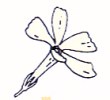 | | |
| |
Character | Inflorescence | Description | Ovary | Stamens |
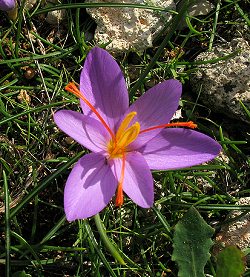
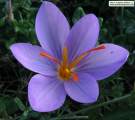
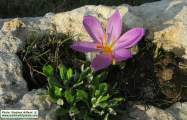
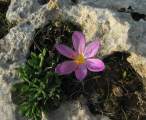
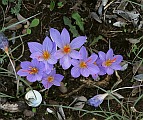
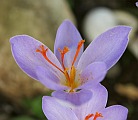
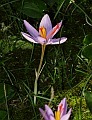
Description | | The flower consists of 6 distinct petals of lilac / violet colour which have dark purple veins more prominent at the outer side. The petals constrict and form a tube like structure (the neck) at the basal part. The tubular neck runs further down to the underground corm where the ovaries are located. There is a yellow ring at the constriction region (known as the throat). | | |
General
Picture |  | | 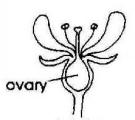 | 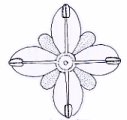 |
| |
Character | Scent | Average Flower Size | Pollen Colour | Other Notes |
Description | YES Sweet and quite strong honey-like scent. | 30mm across (when flower is fully open). | Bright Yellow | - |
|
SEEDS: |
Character | No. Per Fruit | Shape | Size | Colour |
Description | 16-24 | Spherical or Slightly ovoid | 2-3mm | Orange to reddish-brown (when fully ripe they have a reddish brown colour). |
General
Picture | | | | |
|
FRUIT AND OTHER BOTANICAL DATA: |
Character | Fruit Type | Colour of Fruit | Subterranean Parts | Other Notes |
Description | | Green Turns light brown when ripe. | | - |
General
Picture | 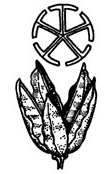 | |  | |
|
|
| Plant description and characters | |
Life Cycle: | Perennial. |
Growth Form: | Geophyte (perennials bearing underground bulbs, tubers, rhizomes, stolons, etc.) |
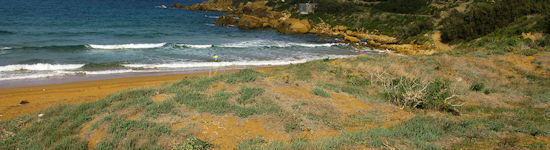
Habitat: | Grassy land in rocky places and garigue. |
Frequency: | Rare |
Localities in Malta: | Very Rare but locally frequent in one area at the South-South West of Malta (ie. Dingli Cliffs, Ghar il-Kbir, Girgenti). |
Plant Height: | 15cm. |
| Nov-Dec |
Protection in Malta: | Not legally protected till the last update of this website (22/Aug/2025) |
Red List 1989: | Threatened status for the Maltese Islands and has been listed in the Red Data Book (1st ed.) |
Poison: | |
This low (10cm approx) perennial grows from underground brown and fibrous corms. Around the start of Autumn, the vegetative corm start developing the reproductive flower. The flower grows directly from the corm with no real stalks or stems. The stalk-like structure is actually the long neck of the flower. The leaves also grow directly from the corm and strangely they develop fully just at or after blossoming of the flowers.
The leaves are simple and variably long (about 5-10cm), thin (2 to 3mm), have an entire outline and a characteristic central white stripe running longitudinally along the leaf axis. The shape of these leaves is sometimes described as ensiform, hence having the shape of sword-blade.
If the leaf is simple, the flower is not! It is highly coloured, sweet scented, and attractive. It is made up of 6 petals of a pale violet / lilac colour, but no sepals. At the outer side there is a pattern of pinnate dark-violet/purple veins which are less prominent at the inside part of the petal. The petals are mostly un-fused, but they constrict and then join at the 'base' of the flower to form a thin tube which goes further down under the soil to the corn. At along half way its length. the flower tube is protected by a whitish to pale green sheath which also supports the flower neck.
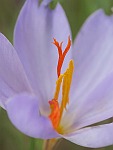
At the zone where the petals constrict to form a tube, hence at a region referred to as the throat, there is a yellow coloration, more prominent from inside of the flower, but still noticable from the exterior. At the throat region, 3 stamens are joined to the 3 petals (= the inner whorl of 6 corolla tepals). The stamens are erect, and have a rod-shaped anther which is bright yellow in colour. The female part is more contrasting, having a bright orange-red colour, prominent, and the style divides to three branches of stigma which have short lobed ends. The style goes down the flower neck until it reaches the ovary located under the soil.
The ovaries develop into the seed capsule (the fruit) which open up in March, when the seeds are ripe. The young fruit can be difficult to locate since it is found at or just above ground level. The fruit capsule is an ovate structure, about 1cm long and dull green. When ripe it splits longitudinally into 3 parts bearing the orange or reddish-brown seeds. The seeds are subspherical in shape and measure about 2mm.
|
|
| Information, uses and other details |
Sub-endemic species
This plant is found in few places around the central Mediterranean region and so it is nearly an endemic species to Malta, or what is referred to as sub-endemic. Apart from Malta it is only found in Egadi islands (West of Sicily), some parts of Sicily and South Italy mostly in Calabria, Murge, Basilic. a Serraneta, Pollino, Sila, Rosarno, Mongiana, Serra S, R nel Salern. (Monte di Stella, Monte Sacro), Bruno and also in Dalmazia. Reports that it was seen in Tunisia, were false. [WWW-42]
Propagation
Once the leaves have died down, the corms can be lifted and separated for replanting. Seeds may also be sown in pots of sandy soil in the fall and placed in a cold frame. The seedlings grow very slowly, however, and will not bloom for several years. [WWW-43]
Uses for Saffron
The spice saffron comes mainly from the stigma of a closely related Crocus, thus the C. sativus. This species is cultivated purposely to extract saffron. However a paper reports that C. longiflorus also have very similar characteristics of producing saffron like the C. sativus. The paper by Casoria et al, 1996 called a preliminary note on an interesting species of crocus (Crocus longiflorus, Iridaceae) similar to Saffron (C. sativus) discusses a wild crocus in the Salerno region of Italy that local people use like saffron. Chemical tests show that C. longiflorus contains some of the same coloring and flavoring agents as true saffron. Interestingly, C. longiflorus reproduces sexually, unlike C. sativus. Further studies might show that the two species are related. [299]
Personal Observations
Species in danger of disappearing from the Maltese islands
It has been reported by many botanists, namely E. Lanfranco [300] that this plant is continually decreasing in number from our islands, mainly due to land management and bad disposing of rubble in the environment. It is very difficult to resist the temptation of not picking up this wonderful, colourful and scented flower, but bear in mind that this species is in danger of disappearing from our country and must NOT BE PICKED UP at all costs. Apart from the fact that the plant is attractive and scented, another factor which acts against the plant is that of growing low and one is more encouraged to cut it up to look closer without bowing down. Additionally each individual plant may develop only 2 - 3 flowers in its life cycle and so it is more important to leave the flowers to perform their reproductive process. Unfortunately, seed production and dispersion in the wild is not much effective for this plant either.
So, avoid picking this wild, sub-endemic and rather endangered, flowering wild plant. [SM]
|
|
| Links & Further literature
(0 papers) |

Google Web |

Google Images |

Google Scholar |

Research Gate |

Wikipedia |

JSTOR |
GBIF |
Med Checklist |
Cat. of Life |

EoL |
IPNI |

World Flora Online |
Plants of the World Online |

Vienna Virt. Herb. |
RBGE Herbarium |
KEW Herbarium |
MNHN |

Garden Database |

IUCN |

TROPICOS |
Kindly Email if there are papers and publications about local
studies or information about this species to be included in the list above.
|
|

Sales and Donations

|
 |
Sales of seeds of wild plant from Malta: Seeds of selected wild plant species may be available for academic studies, research purposes, or personal use. Please note that not all species can be supplied or exported. Availability is subject to seasonal seed production, stock levels, and applicable regulations, including Maltese legislation and CITES requirements where relevant. Protected and endemic species cannot be sold (at least without the relevant environmental permits).
How it works: First, submit a quotation request by completing the Online Quotation Form (link provided on the right side of this table). Once your request has been reviewed, you will receive confirmation regarding seed availability, export eligibility (where applicable), pricing, and any transport charges. Payments are accepted by Revolut, bank transfer (IBAN), or PayPal only; credit and debit card payments are not accepted.
Please note that local orders are currently not being accepted. Seek Maltese nurseries and NGOs for local orders.
|
Online Quotation (Seeds)
|
 |
Buy Images: Purchase photographs from this extensive online collection of Maltese flora by Stephen Mifsud. Images are available at reasonable prices, with rates varying according to image size and resolution. Your purchase helps support the maintenance and development of this website. When placing an order, please note the image code displayed beneath each photograph on the corresponding species page, as this is required when completing the online order form. Images are normally supplied under a license agreement, with copyright retained by the author; however, the sale of copyright for exceptional images may be considered on request.
|
Online Purchase (Images)
|
 |
Support this ad-free website Kindly consider to support this website by giving a small donation which will help to cover some expenses needed to pay the webserver and domains, maintain the website without any adverts, upgrading the code, including more wild plants and photos, and adding further data amongst other developments. You can use the links on the right for direct donations to this website by PayPal or Revolut. Even a 5 or 10 Eur donation is appreciated. Remember this website was ad*free since its launch back in 2002 and has served as an environmental educational tool for over 20 years.
|
💙 Donate by PayPal
💳 Donate by Revolut
|
|
| Contribute Information or Report Errors |
Use this form to submit additional information about this species or to report any inaccuracies on this webpage.
If the information you provide is sourced from a book, journal, website, or any other publication, rather then your own information or experience, then please include the relevant reference or web address whenever possible. Your email address will be used solely for internal communication and will not be shared. We greatly appreciate reports of: taxonomic updates; species misidentifications; incorrect or outdated information, broken links, technical website issues, or any additional information specific to the plant in this webpage.
Your contributions help to improve the accuracy and quality of this website. Thank you! Fill any of the three sections (A/B/C) below: .
|
|
|
|
| | |