Wild Plants of Malta & Gozo - Plant: Papaver somniferum subsp. setigerum (Opium Poppy)

Opium Poppy

Papaver somniferum subsp. setigerum / Opium Poppy / Xaħxieħ Vjola
This plant is brought to you by one of the project's sponsors:
HSBC Cares for the Environment Fund
More sponsors are needed for this project [ click here ]

Contents Links


Nomenclature

Botanical Data

Description

General Information

Photo Gallery

Further Info & Links

Medicinal Properties

Buy Seeds and Docs

Submit own info
about this plant

Give a small Donation Online

FORUM

Copyright Info


Main Index

 
Visitor hits (Mar-2003)

Nomenclature

Species name:

Papaver somniferum subsp. setigerum   L.

Author(s):

Carl von Linné;
   Sweden, 1707-1778

General names:

Opium Poppy

Maltese name:

Xaħxieħ Vjola

Plant Family:

Papaveraceae   (Poppy Family)

Name Derivation:

Papaver = Latin name for poppy, also "pappa" is the Latin for food or milk, referring to the milky sap of the plant (Latin)

somniferum subsp. setigerum = sleep producing / inducing (Latin)

Synonyms:

Papaver album, Papaver nigrum

Remarks:

It is believed that our population mostly consists of Papaver somniferum subsp. setigerum (sometimes found as P. setigerum), which is generally a smaller plant with smaller fruit capsules, and short britsles. The other subspecies is Papaver somniferum subsp. somniferum (the cultivated Opium Poppy) and has a large fruit capsule and more glabrous.


Botanical Data

PLANT STRUCTURE:

Characteristic

Growth Form

Branching

Surface

Description

Erect :

Upright, vertically straight up well clear off the ground.

Moderately Branched :

Considerable number of secondary branches along the main stem.

Hirsute :

Covered with rough, coarse hairs. Few sparse bristles can be found near the flowering part.

General
Picture

Wild Plants of the Mediterranean Islands of Malta  - Copyright Stephen Mifsud / Maltawildplants.com / Malta (2002-2007) Wild Plants of the Mediterranean Islands of Malta  - Copyright Stephen Mifsud / Maltawildplants.com / Malta (2002-2007) Wild Plants of the Mediterranean Islands of Malta  - Copyright Stephen Mifsud / Maltawildplants.com / Malta (2002-2007)

LEAVES:

Characteristic

Arrangement

Attachment

Venation

Description

Alternate :

Growing at different positions along the stem axis.

Sessile :

Growing directly from the stem; without a stalk.

Pinnate venation :

Lateral veins which diverge from the midrib towards the leaf marhins.

General
Picture

Wild Plants of the Mediterranean Islands of Malta  - Copyright Stephen Mifsud / Maltawildplants.com / Malta (2002-2007) Wild Plants of the Mediterranean Islands of Malta  - Copyright Stephen Mifsud / Maltawildplants.com / Malta (2002-2007) Wild Plants of the Mediterranean Islands of Malta  - Copyright Stephen Mifsud / Maltawildplants.com / Malta (2002-2007)
 

Characteristic

Leaf Shape

Leaf Margin

Remarks

Description

Lanceolate :

Lance shaped, widest in the basal third, tapering gradually towards the tip.

Dentate Serrate :

With large teeth-like projections, each being self dented more or less perpendicularly to margin.

Sap

The plant exudes a sour, milky sap if leaves r stems are broken.

General
Picture

Wild Plants of the Mediterranean Islands of Malta  - Copyright Stephen Mifsud / Maltawildplants.com / Malta (2002-2007) Wild Plants of the Mediterranean Islands of Malta  - Copyright Stephen Mifsud / Maltawildplants.com / Malta (2002-2007) Wild Plants of the Mediterranean Islands of Malta  - Copyright Stephen Mifsud / Maltawildplants.com / Malta (2002-2007)

FLOWERS:

Characteristic

Colour

Basic Flower Type

No. of Petals

No. of Sepals

Description

Mauve / Lilac

Bowl or Cup Shape :

A flower which is roughly hemispherical, with straight sides and a very slight flare at the tips.

4

2

General
Picture

  Wild Plants of the Mediterranean Islands of Malta  - Copyright Stephen Mifsud / Maltawildplants.com / Malta (2002-2007) Wild Plants of the Mediterranean Islands of Malta  - Copyright Stephen Mifsud / Maltawildplants.com / Malta (2002-2007) Wild Plants of the Mediterranean Islands of Malta  - Copyright Stephen Mifsud / Maltawildplants.com / Malta (2002-2007)
 

Characteristic

Inflorescence

Description

Ovary

Stamens

Description

Single and Terminal :

Single, solitary flower at the apex of the stem or flower branch.

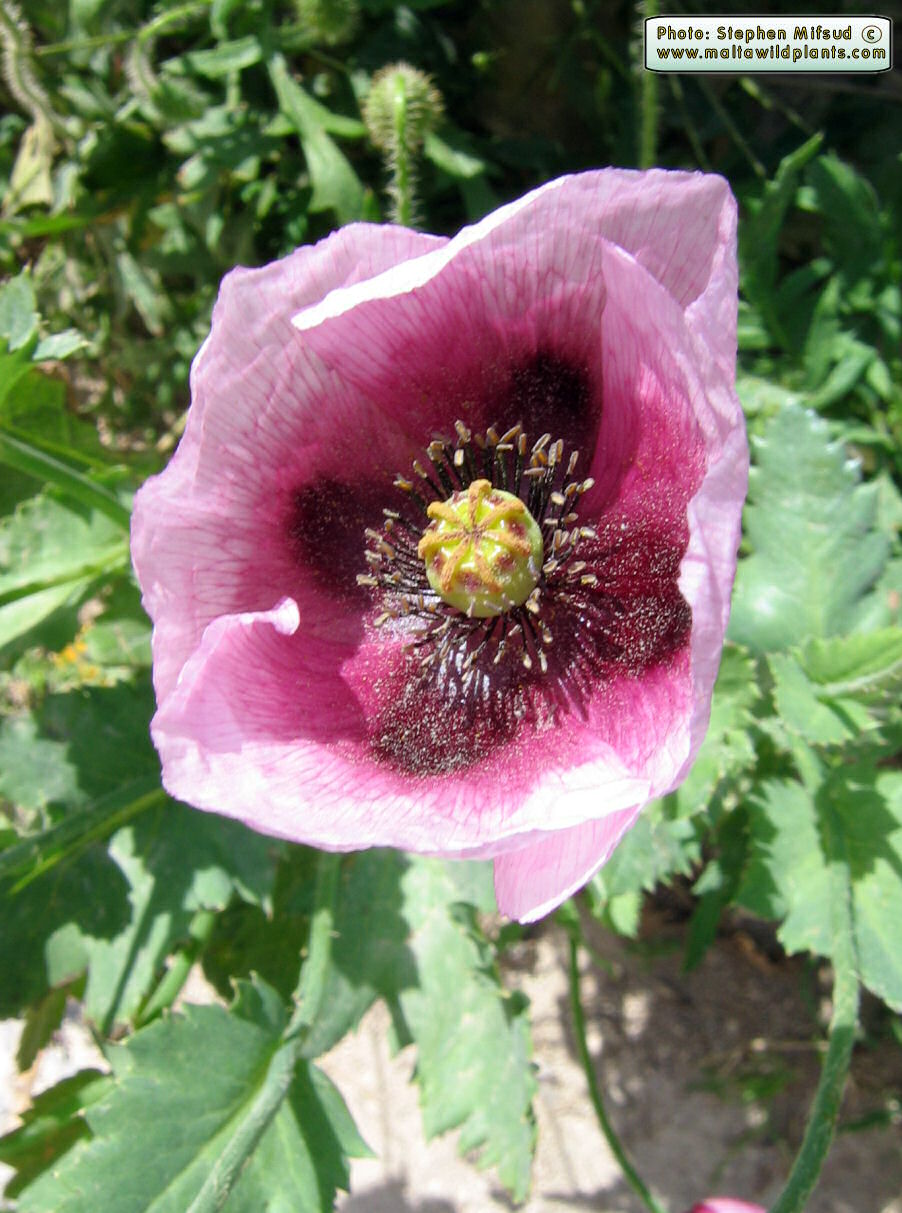
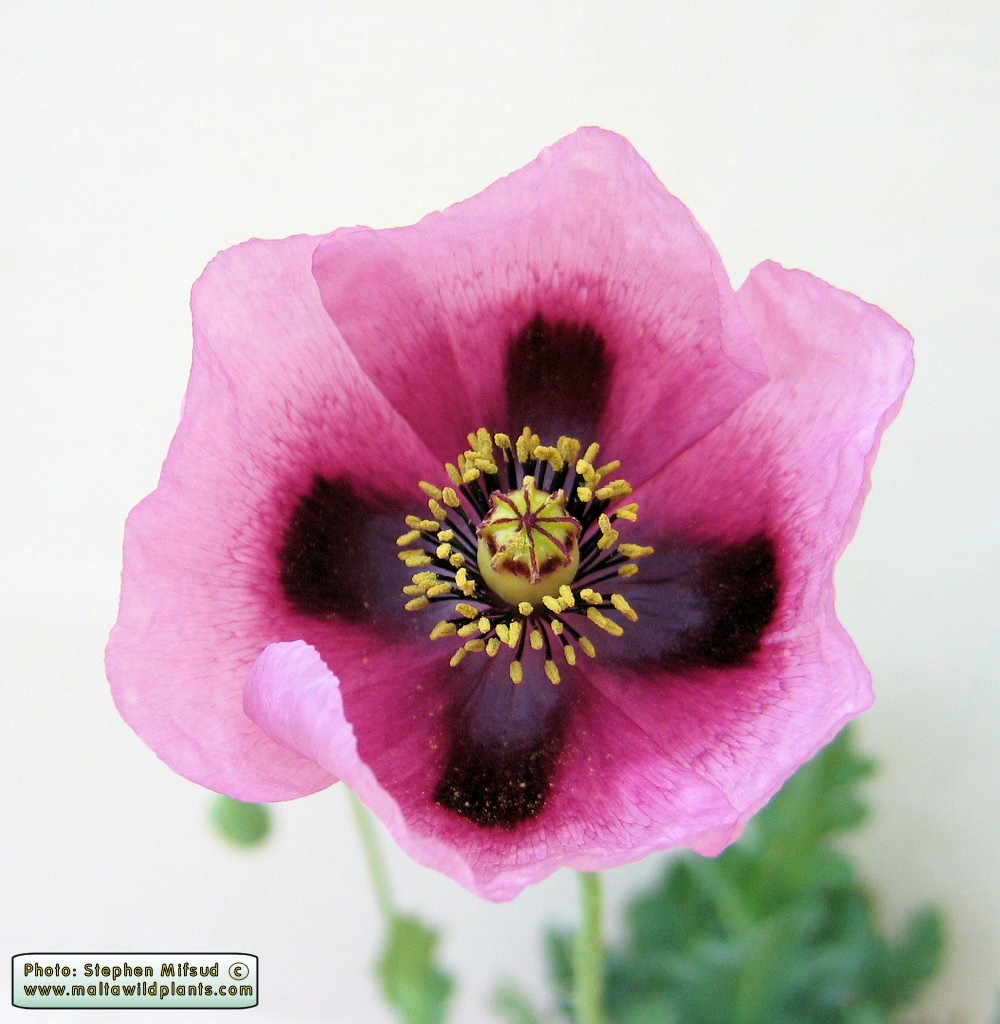
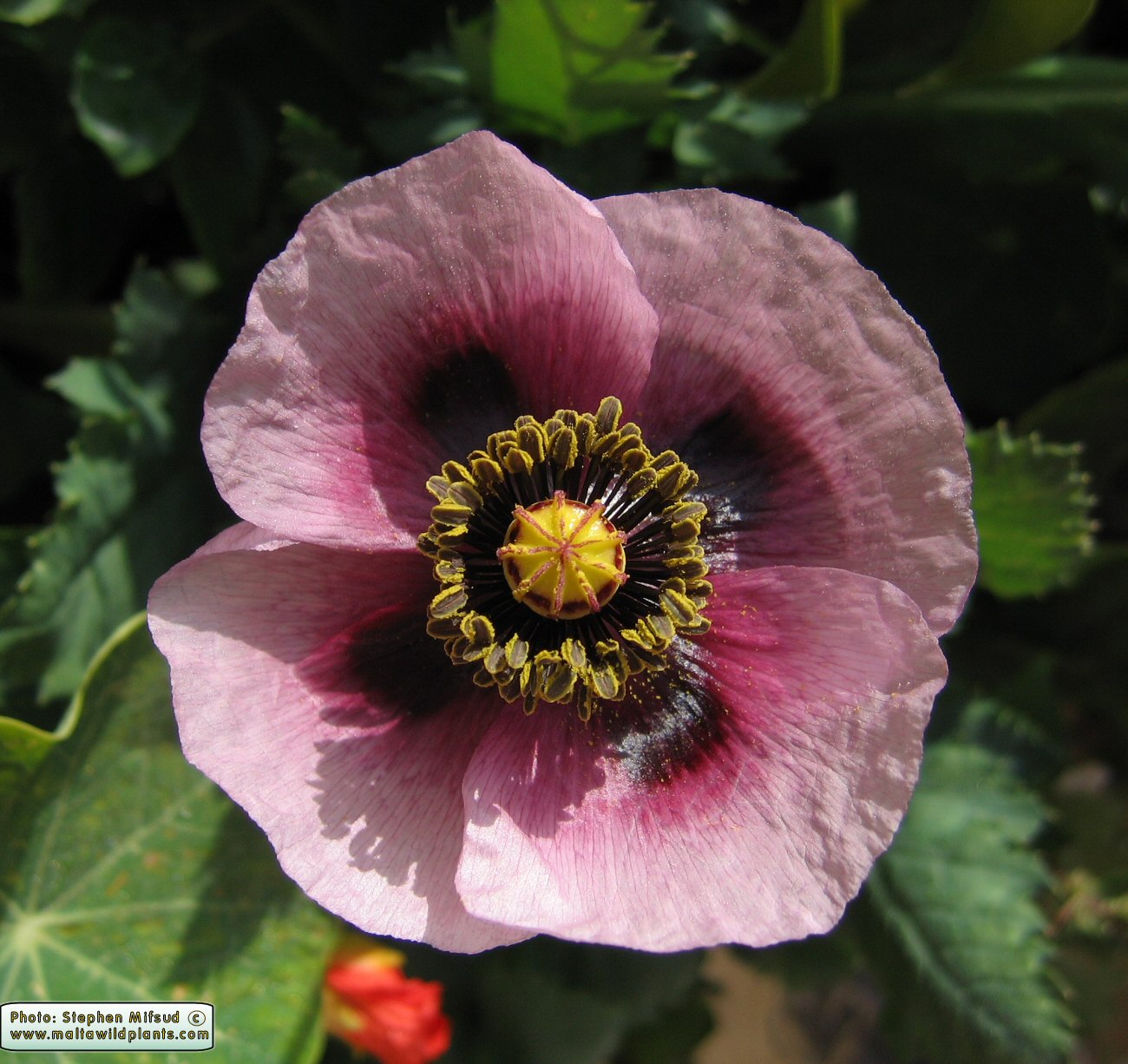
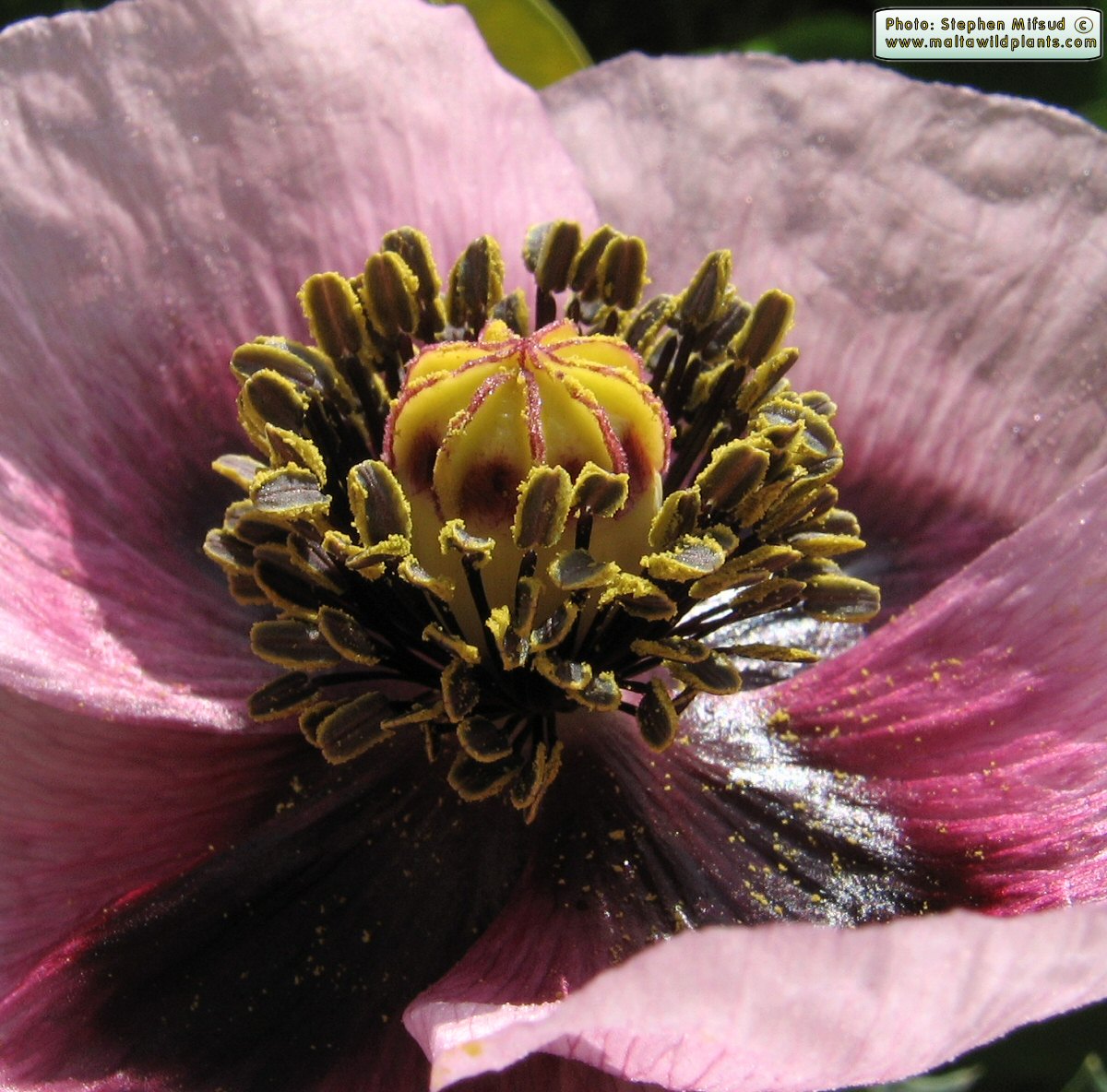
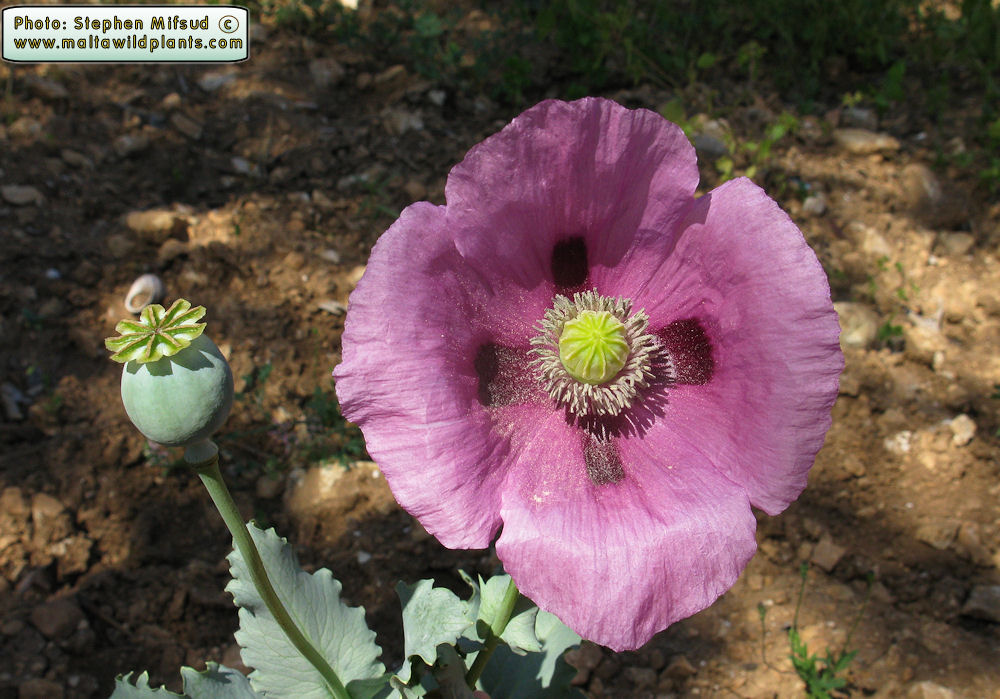
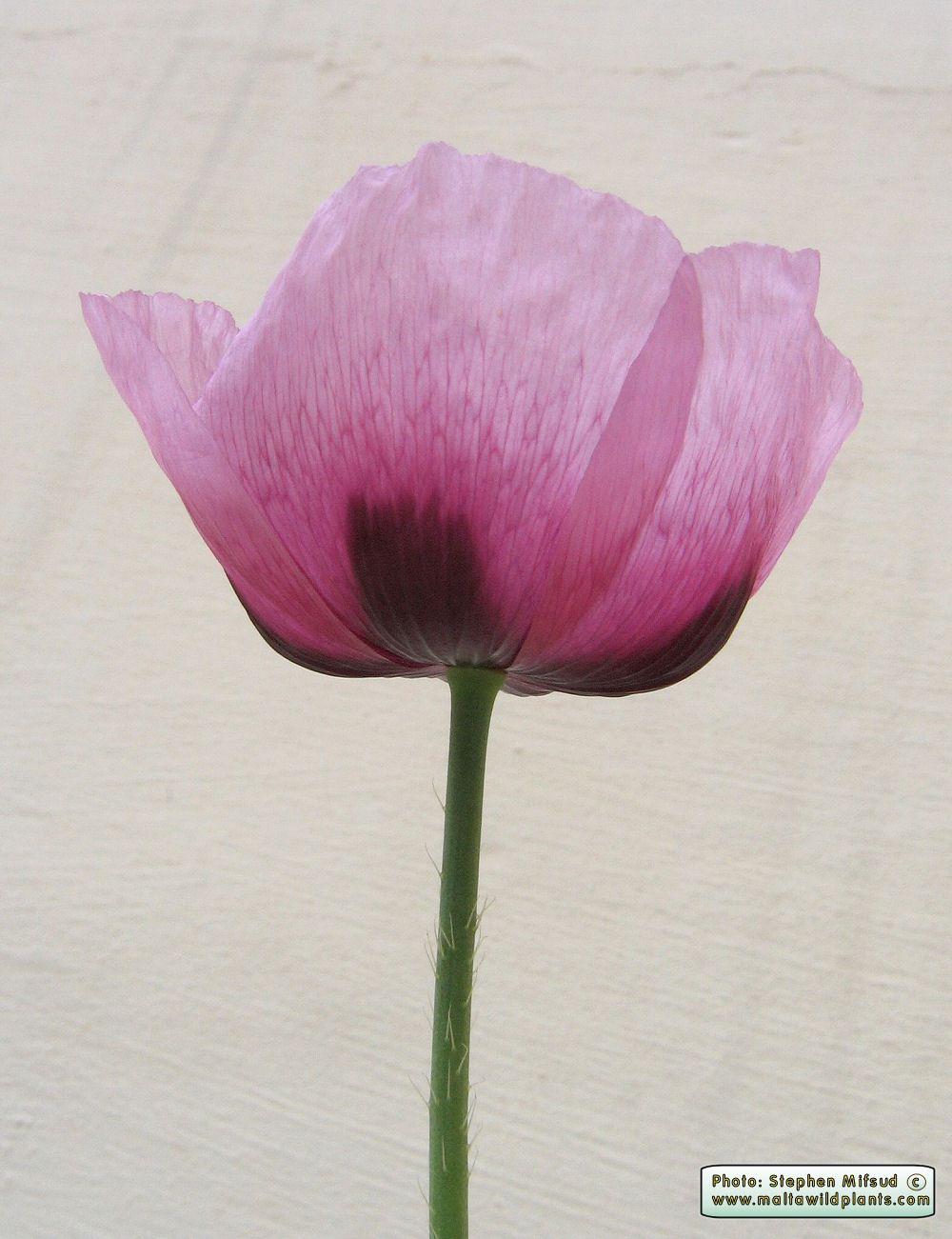
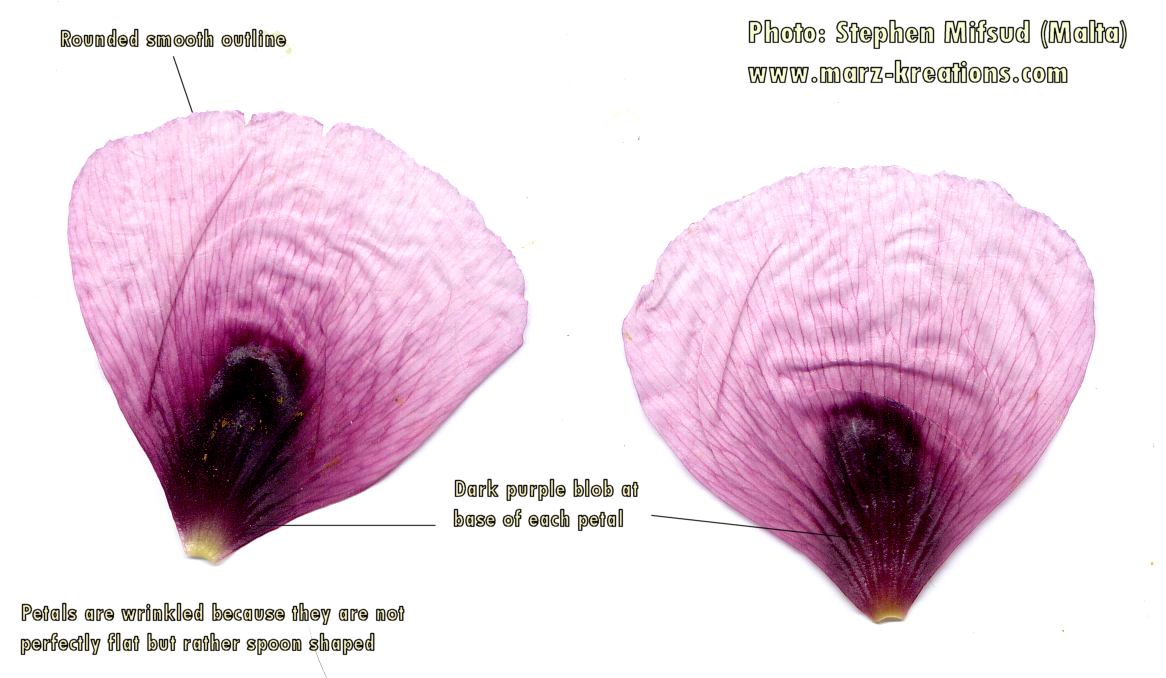
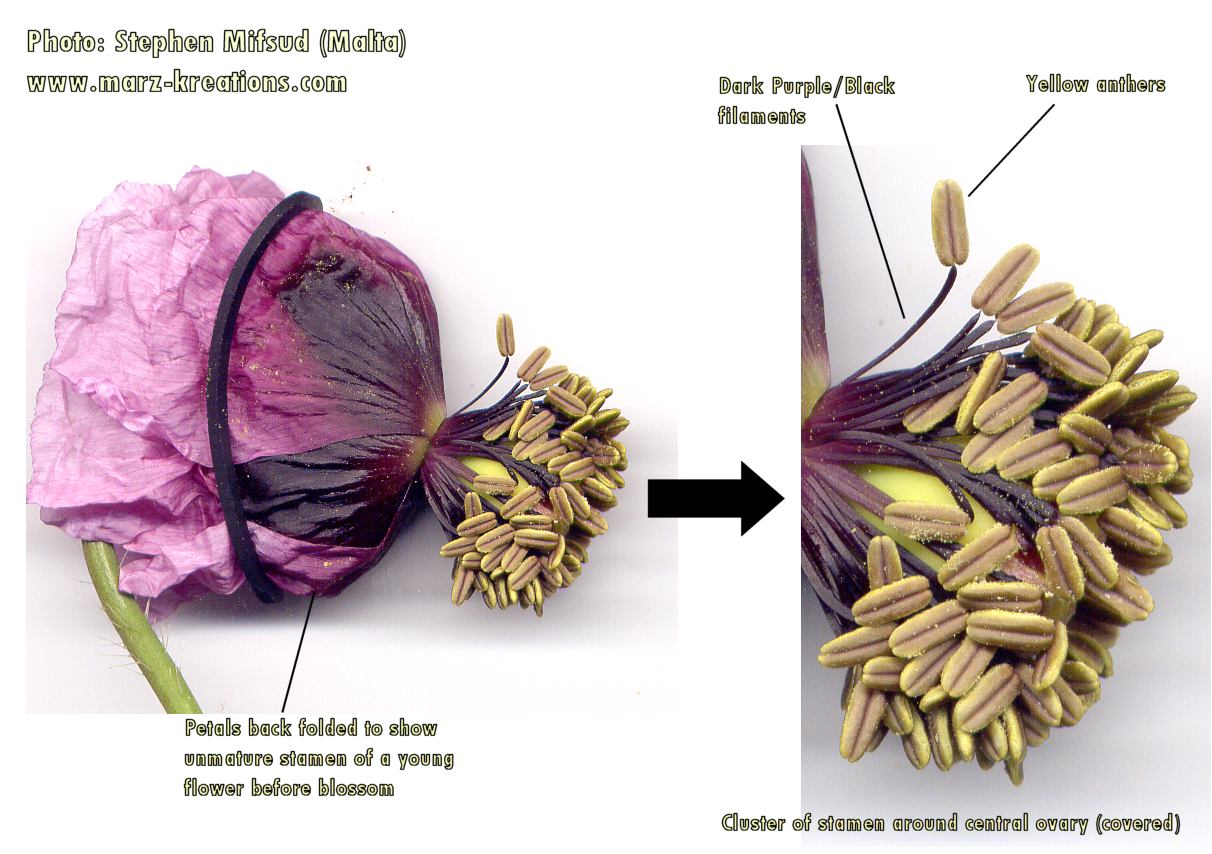
Solitary cup shaped flowers consisting of 4 large, flimsy, mauve petals (each having a dark purple blob at base) and a large, central pot-shaped ovary surrounded by a cluster of about numerous black stamens.

Superior :

Ovary situated above the flower parts (the calyx, corolla, and androecium). In other words, these are attached below the ovary.

50-100+, Annular Cluster :

A cluster of stamens in the form of a ring, often encircling the gynoecium.

General
Picture

Wild Plants of the Mediterranean Islands of Malta  - Copyright Stephen Mifsud / Maltawildplants.com / Malta (2002-2007) Wild Plants of the Mediterranean Islands of Malta  - Copyright Stephen Mifsud / Maltawildplants.com / Malta (2002-2007) Wild Plants of the Mediterranean Islands of Malta  - Copyright Stephen Mifsud / Maltawildplants.com / Malta (2002-2007) Wild Plants of the Mediterranean Islands of Malta  - Copyright Stephen Mifsud / Maltawildplants.com / Malta (2002-2007)
 

Characteristic

Scent

Average Flower Size

Pollen Colour

Other Notes

Description

None or a faint one

Slight unpleasant scent, sometimes missed in the open air.

30-50mm

Pale Yellow


SEEDS:

Characteristic

No. Per Fruit

Shape

Size

Colour

Description

>200

Numerous tiny seeds which ther quantity varies according to the fruit size.

Reniform

Small, kidney-shaped seeds; rather swollen.

1mm

Dark Brown

General
Picture

Wild Plants of the Mediterranean Islands of Malta  - Copyright Stephen Mifsud / Maltawildplants.com / Malta (2002-2007) Wild Plants of the Mediterranean Islands of Malta  - Copyright Stephen Mifsud / Maltawildplants.com / Malta (2002-2007) Wild Plants of the Mediterranean Islands of Malta  - Copyright Stephen Mifsud / Maltawildplants.com / Malta (2002-2007) Wild Plants of the Mediterranean Islands of Malta  - Copyright Stephen Mifsud / Maltawildplants.com / Malta (2002-2007)

FRUIT AND OTHER BOTANICAL DATA:

Characteristic

Fruit Type

Colour of Fruit

Subterranean Parts

Other Notes

Description

Indehiscent Operculate Poricidal Capsule :

A fruit having the shape of a pot with a lid (operculum). It stores large number of seeds that escapes from small pores or slits in the lid (at the upper part of the fruit).

Light Green

(turns pale brown when completely dry).

Taproot :

A rooting system where there is the main descending root of a plant having a single dominant large structure from which a network of smaller and long roots emerge.

-

General
Picture

Wild Plants of the Mediterranean Islands of Malta  - Copyright Stephen Mifsud / Maltawildplants.com / Malta (2002-2007) Wild Plants of the Mediterranean Islands of Malta  - Copyright Stephen Mifsud / Maltawildplants.com / Malta (2002-2007) Wild Plants of the Mediterranean Islands of Malta  - Copyright Stephen Mifsud / Maltawildplants.com / Malta (2002-2007) Wild Plants of the Mediterranean Islands of Malta  - Copyright Stephen Mifsud / Maltawildplants.com / Malta (2002-2007)

Plant Description

Life Cycle:

Annual

Habitat:

Fields (esp. barley and wheat fields) disturbed grounds, waysides, and soily wasteground.

Frequency:

Common

Sources in Malta:

Scattered numbers throughout Malta and Gozo in fields, countrylanes and waste soil. Examples include Mistra, Qormi, Rabat and Ghajn Tuffieha. Not as common as the Field Poppy.

Plant Height:

30-100cm.

Flowering Time:

Mar - May

Poison:

Possibly, if taken in excess.

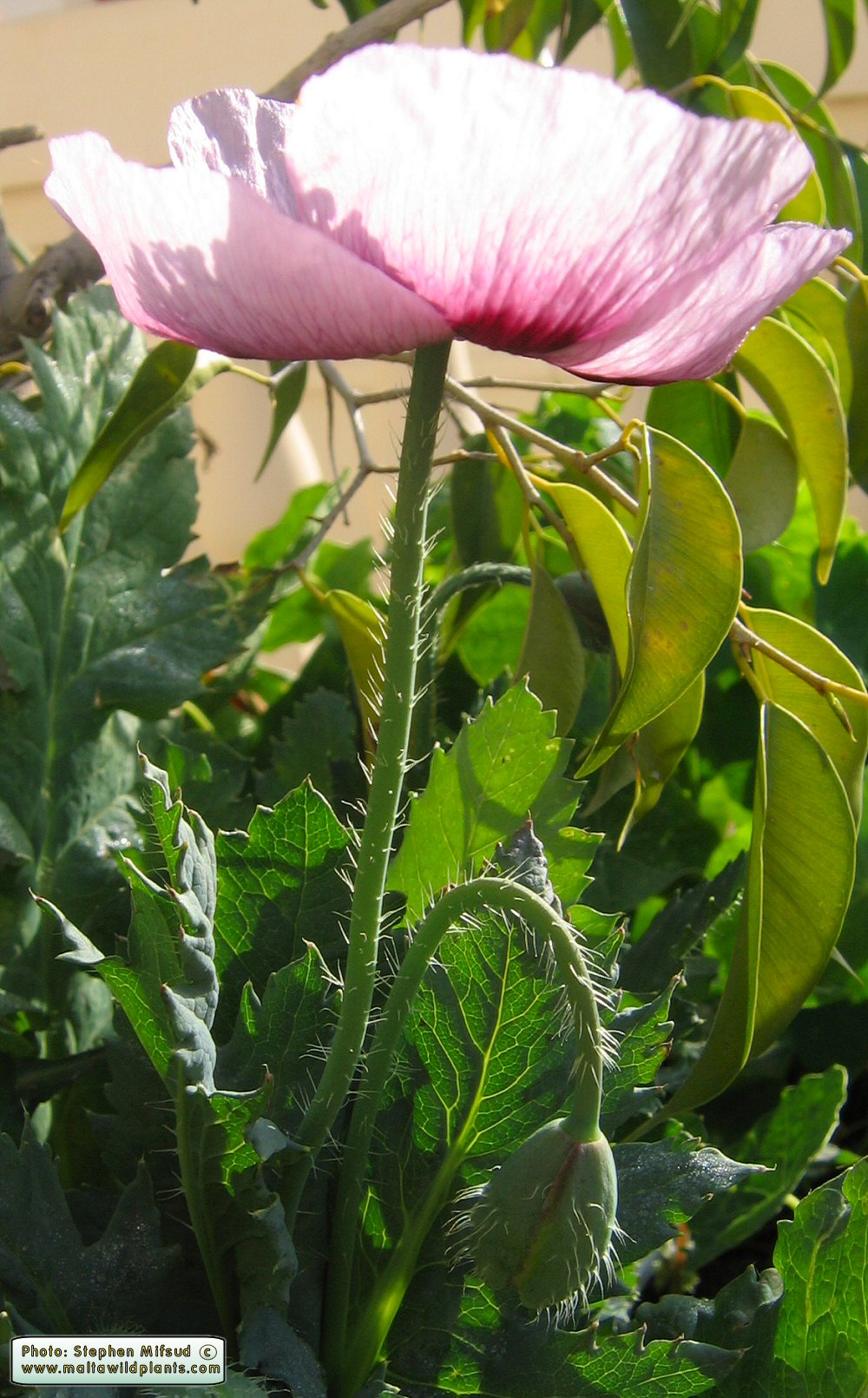
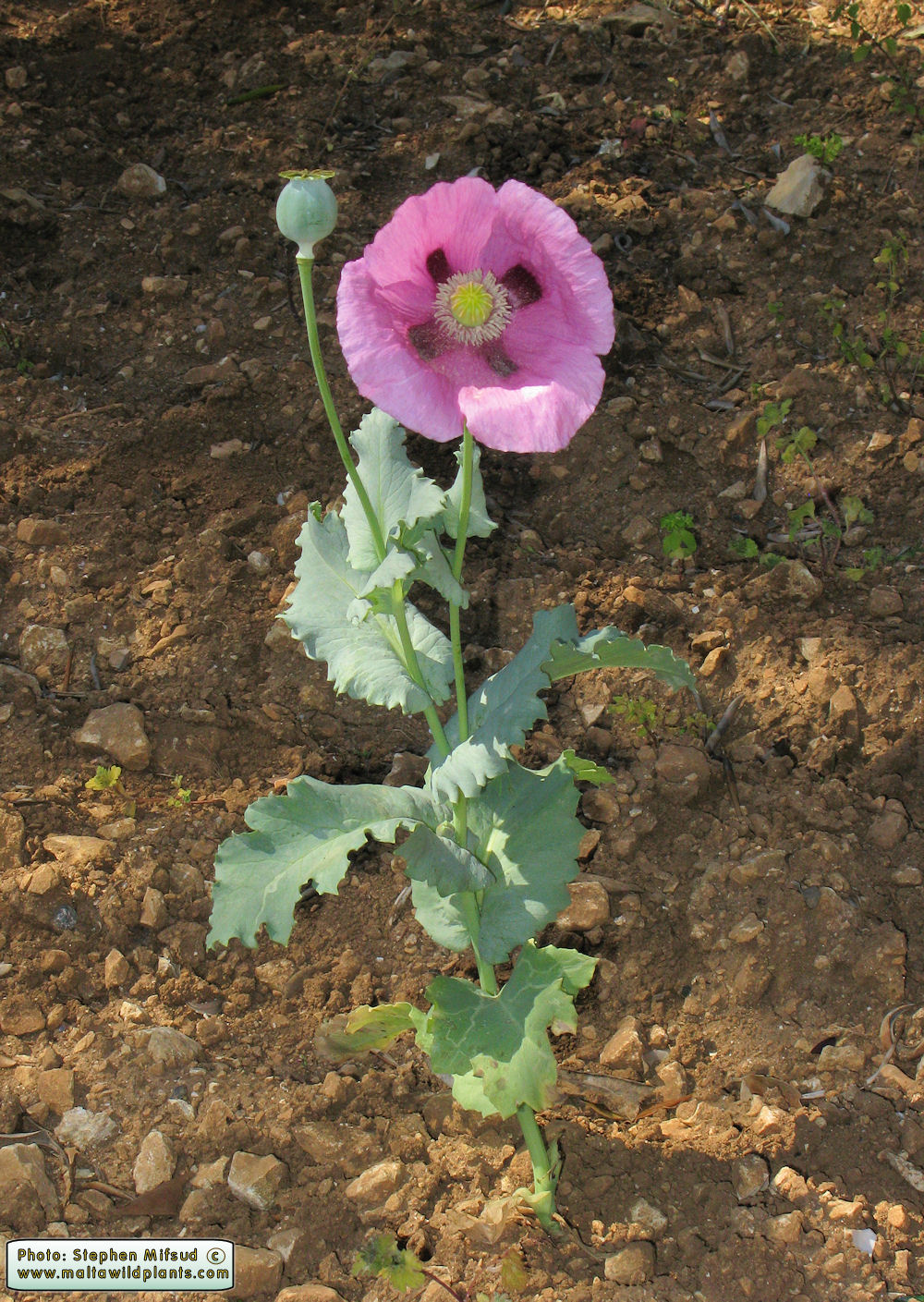
This poppy has few different characteristics from other poppy species. Like poppies it is an erect plant, with single terminal flower, but the stem is hairless and smooth, except at the upper part (near the flower) where there are sparse white bristles.

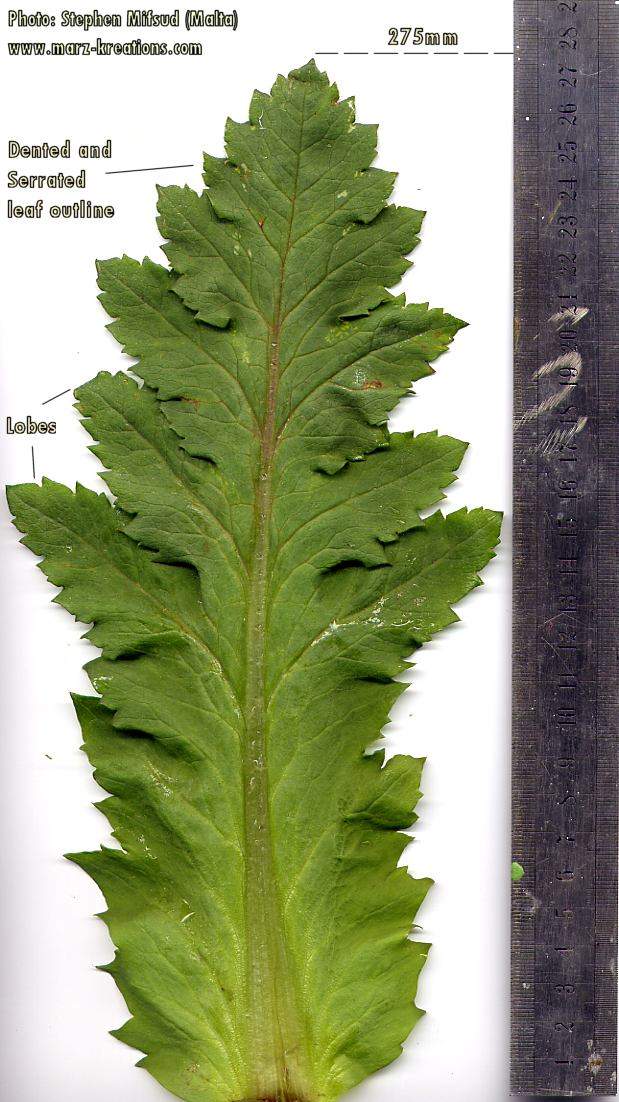
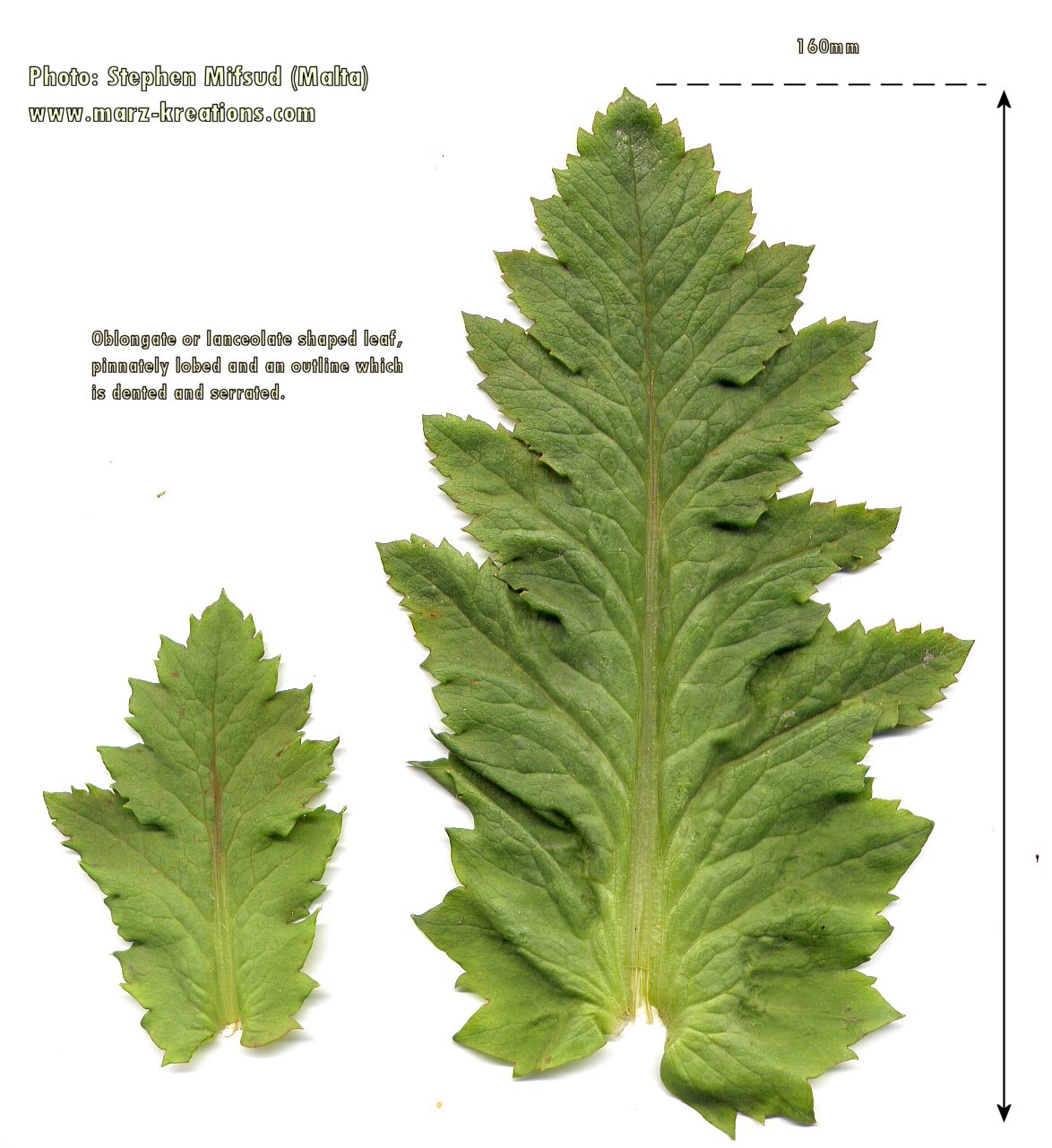
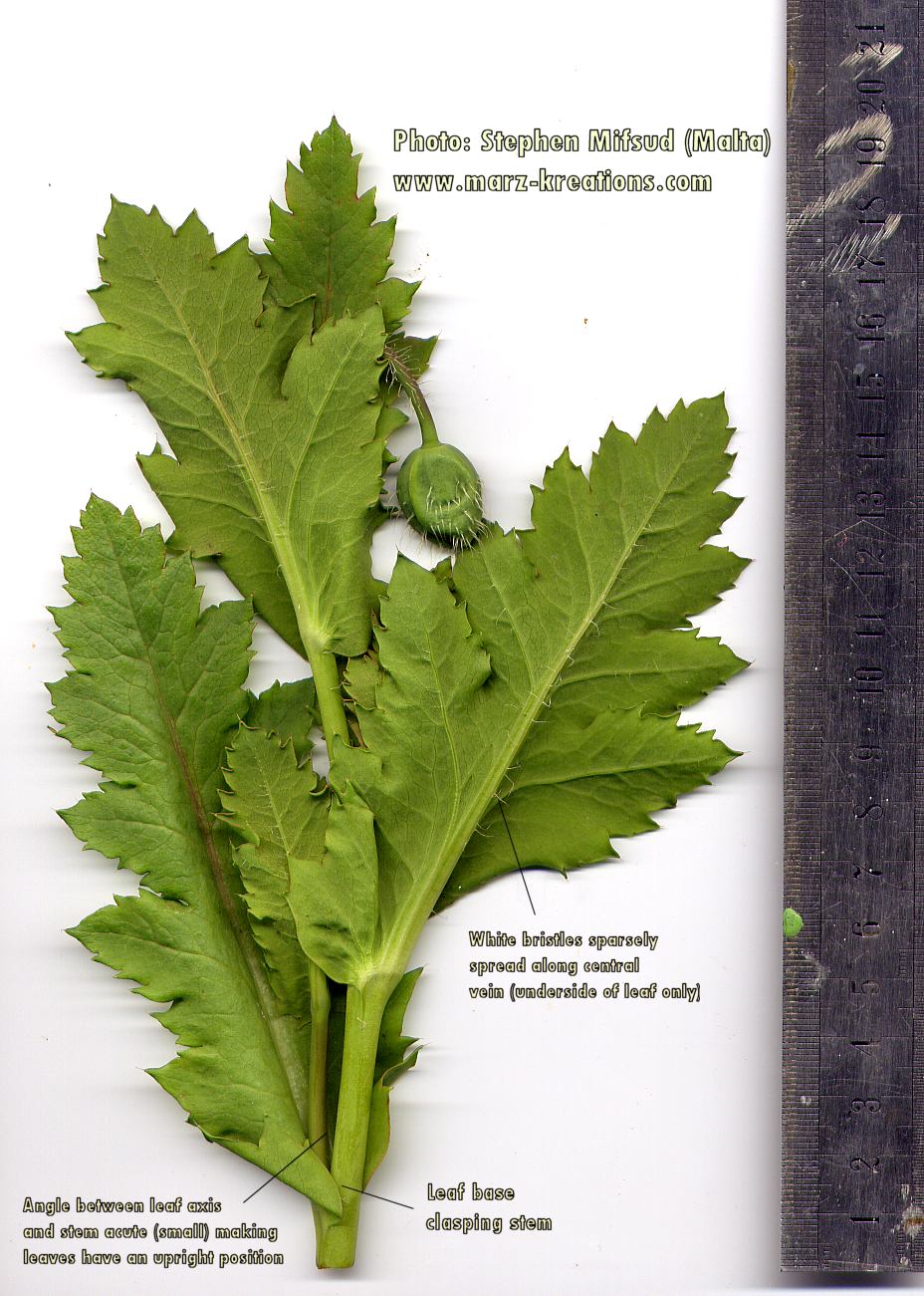
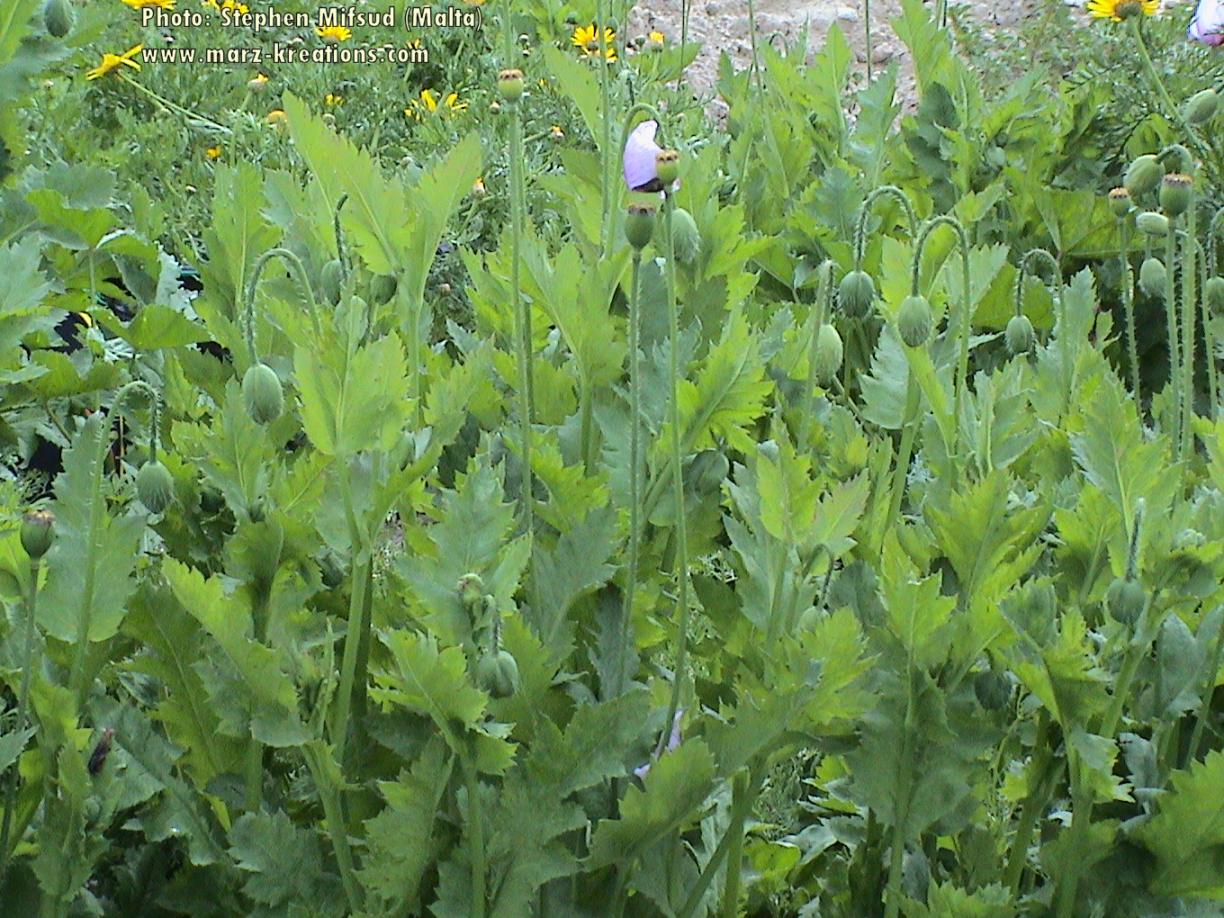
The sessile leaves are not much deeply lobed as the other wild poppy species in Malta. Additionally, they are bluish green in colour and more fleshy then its relative species. Their shape is roughly oblong to linear or lanceolate with shallow teeth-like lobes. The margin is dentate and serrate (like a saw). Sometimes. there are few white bristles on the midrib of the leaf. The alternate leaves are not spread out but grows at an acute angle (approx. 30 degrees) to the stem, and looking at the plant sideways, one would see the lower side of the leaf.

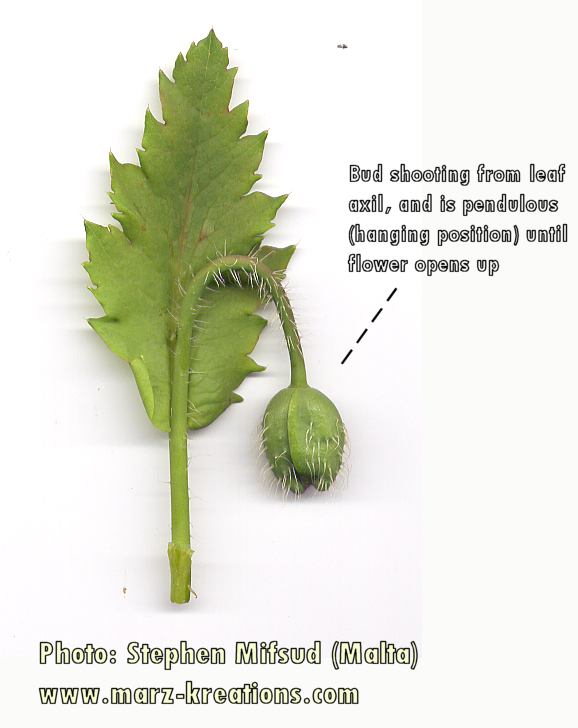
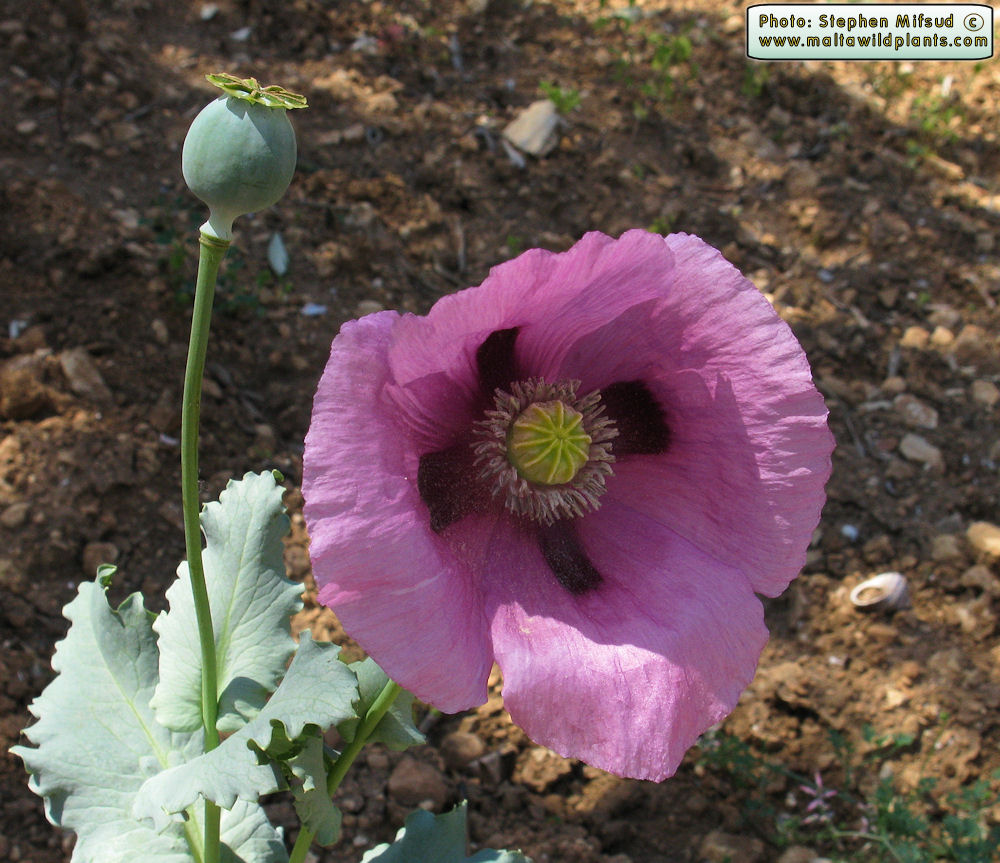
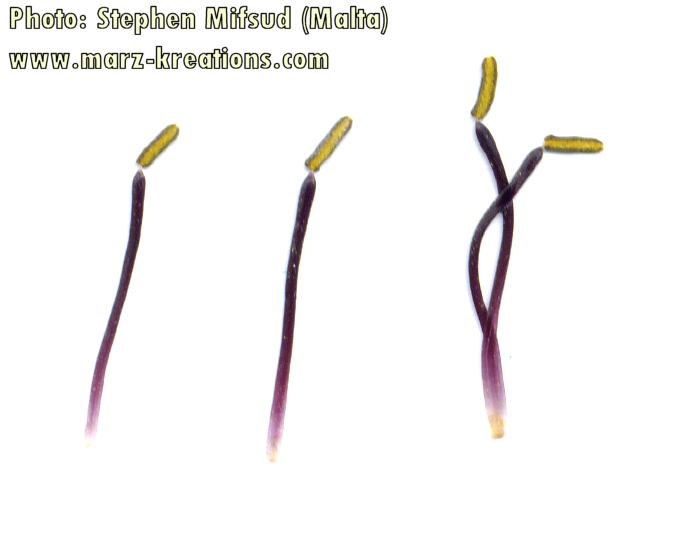
The flower's shape and anatomy is similar to other wild poppies, except its colour, which is purple/mauve or lilac. Each of the 4 circularly-shaped petals have a dark purple blob at their base. The petals are very flimsy, and fall off with a slight shake. The stamens, which usually have a black filament and pale yellow anthers, are present in clusters around the central ovary, which is green and glabrous (sometimes shiny). Like other poppies, the flower bud is a peduncle (hanging upside-down) and made up of 2 ovoid bristly sepals. When the flower blooms, the sepals falls off and the flower takes an erect position.

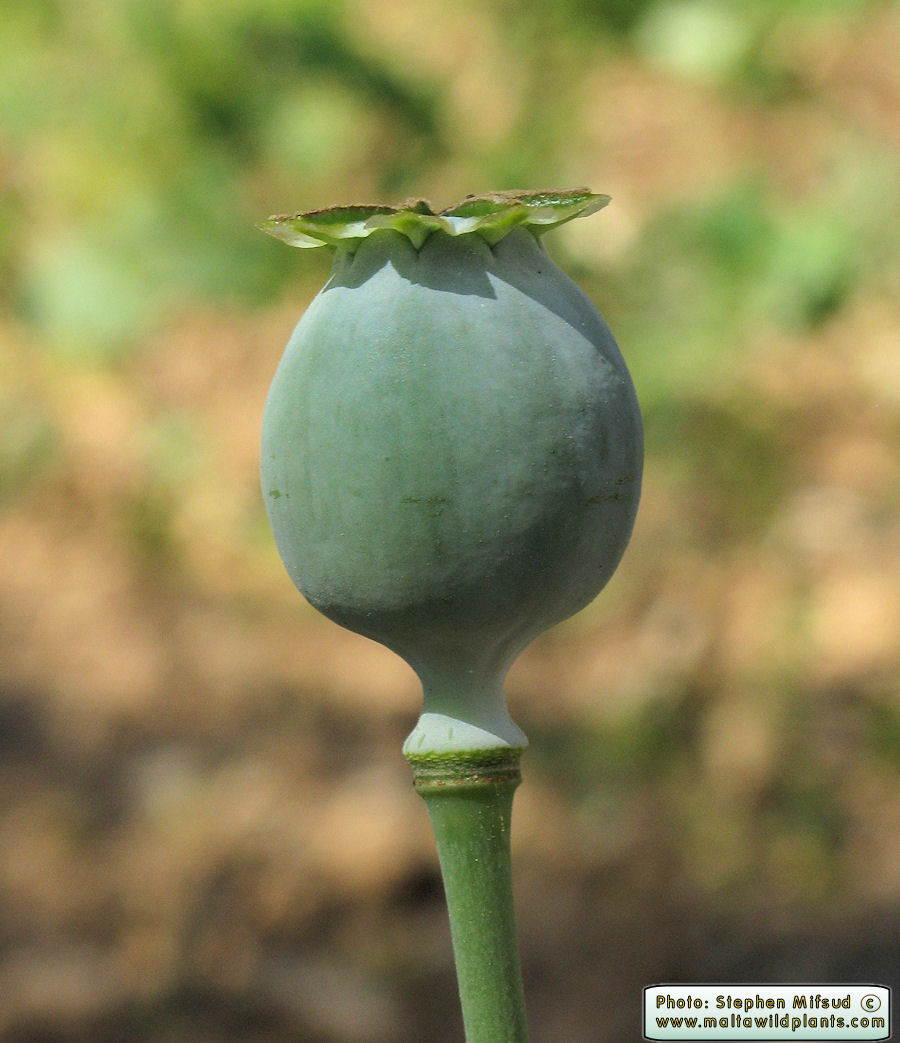
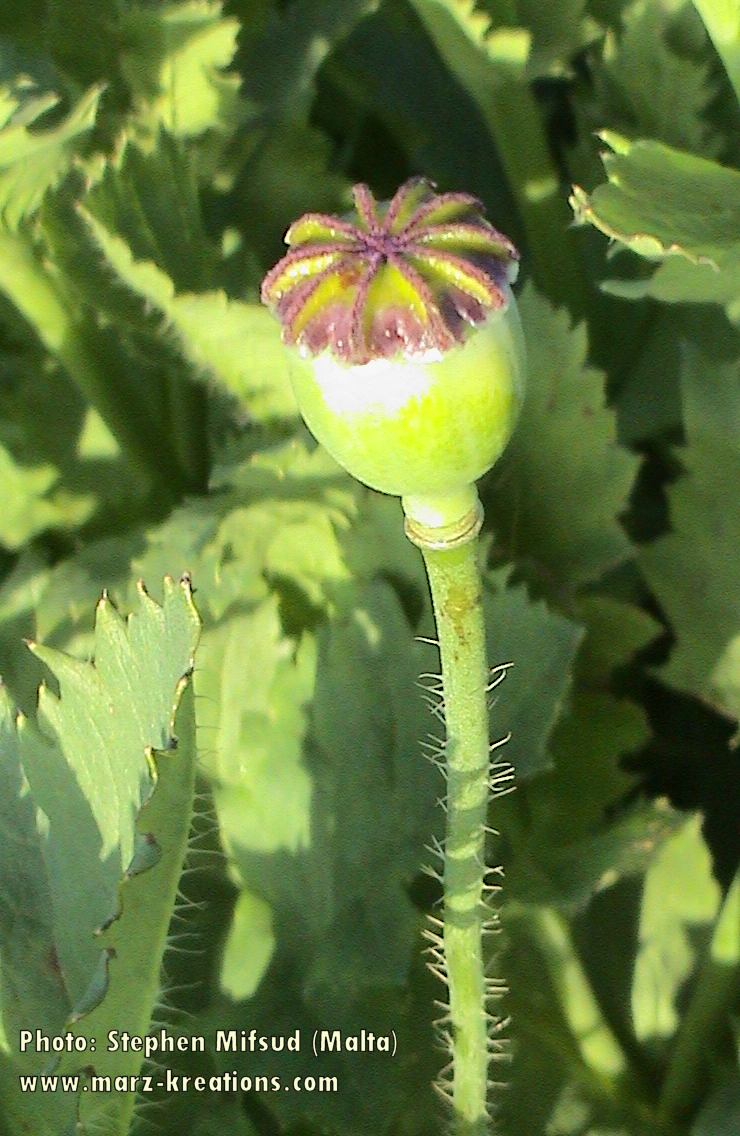
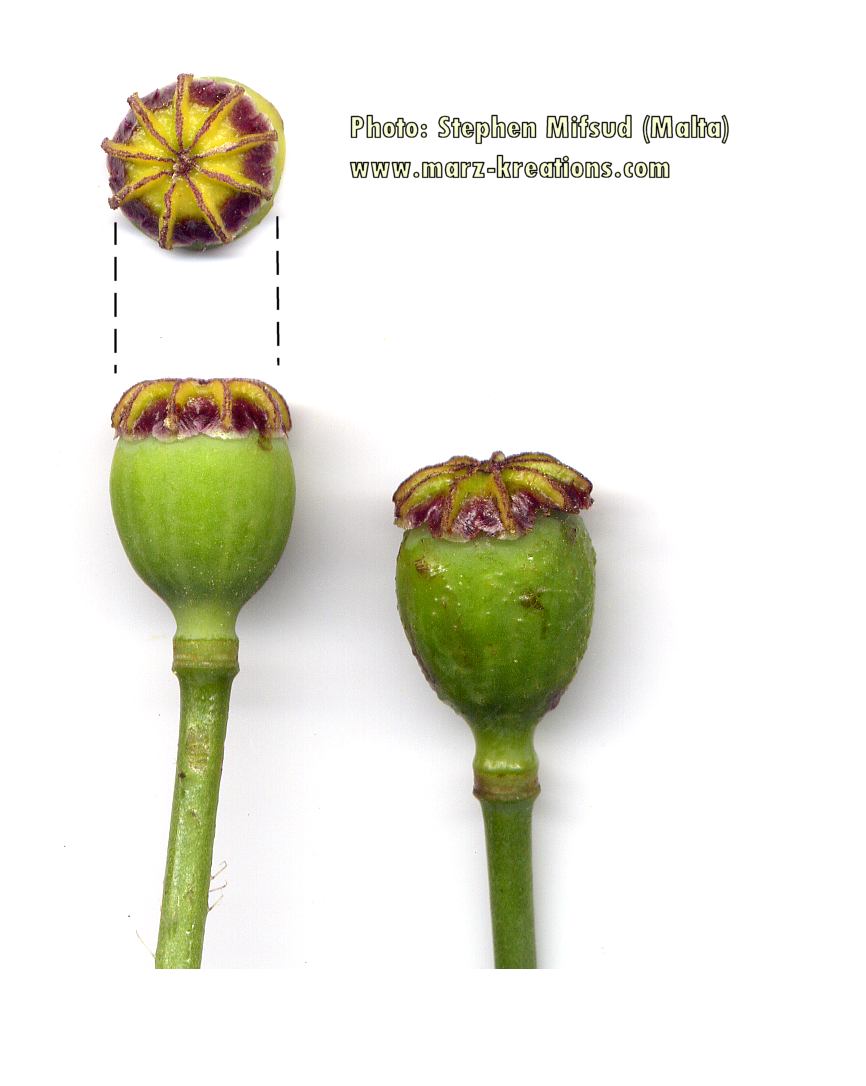
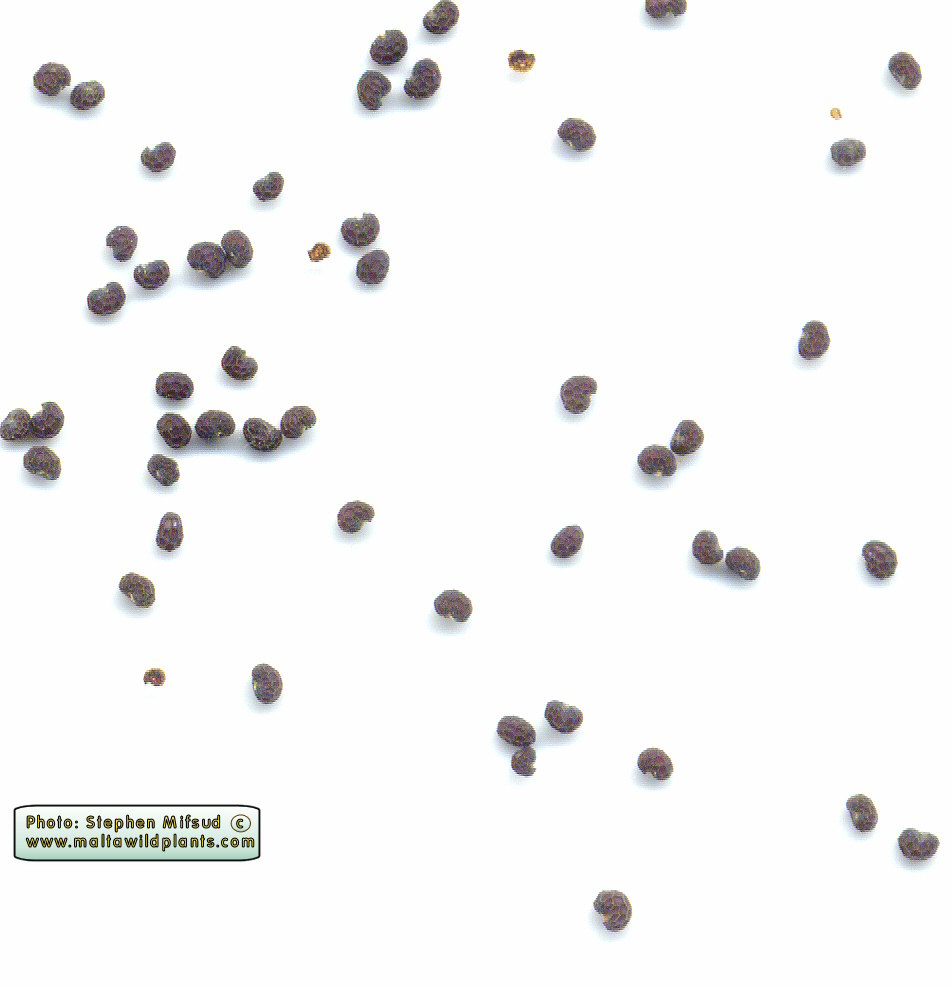
The fruit is a an poricidal dehiscent operculate capsule, which is glabrous, green with a rather yellowish lid, and quite spherical in shape. When it ripens and dries, its tiny, kidney-shaped, dark brown seeds escape from tiny slots in the upper part (lid) of the capsule.


Additional Information


There is so much information and documentary about this plant species and in order to facilitate the navigation and reading of this content, below you find a quick index of the main subtitles. Click on the sub-title links below:


  1. History
  2. Edible Uses
  3. Medicinal Uses
  4. Folk Medicine
  5. Other Uses
  6. Cultivation details
  7. Chemistry of the Seeds
  8. Pests and parasites attacking the plant


History:

The native land of the plant is believed to be Asia but pictures of poppy have been found on the islands of Crete, dating back to the ancient Greek culture. It is also on the list of medicinal plants in an Egyptian papyrus from 1500 BC.

Papaver Somniferum has been used since Greek times to relieve suffering and euphoria. Records indicate that the opium poppy has been used since the time of Mesopotamia (5000 to 4000 BC). The records refer to the poppy and its use as opiates as medical tablets. "Homer's writings indicate Greek usage of the substance at least by 900 BC: Hippocrates made extensive use of medicinal herbs including opium"   [WWW-19]

It is believed that the Romans probably learned of opium in the Mediterranean. Opium spread to places all over the world. In China opium was reported as a problem during the seventeenth century. Between World War I and H the cultivation of opium grew in Central America in the mountains. Now the major producers and exporters of opium are Turkey and India.   [WWW-19] An excellent abstract regards the history of the Papaver somniferum is this one below taken from the website "Poisonous plants and animals"   [WWW-20]: The poppy is the oldest intoxicating plant in the human history. The plant is an annual, about 1.5 m high. It has white, pink or violet blossoms, and a specific unpleasant smell. Its every part, except for the seeds, contains a white milky resinous liquid, which is, in fact, the raw opium. It is gathered from the plant early in the mourning, kneaded into small flat loaves and then dried.

Turkish warriors always went to battle intoxicated and nothing could stop them. The plant was also popular in India, Taiwan and later in China, where more than 120 million people needed opium in 1878. The desire for tranquility and sweet dreams over and over again led to numerous poisonings. At first, sleepiness appeared, followed by weakness, contracted eye pupils, lower body temperature, and faint breathing. If the dose is high, all this will result in coma.

This lasted until 1805 when a German pharmacist extracted an alkaloid and named it after the Greek god of sleep Morphaeus. It was the first alkaloid which possesses narcotic properties. Morphine is one of the strongest painkillers ever known-a soporific tranquilizer. One who has taken morphine forgets all about hunger, fatigue, grief, and fear. The poison has turned to a medicine but a medicine can also turn to poison. Morphine saves patients from pain but not from the disease, so they need more and more morphine. The symptoms of poisoning are nausea, vomiting and depression. Then come dizziness, dry mouth, breathing disruptions and decreased blood pressure, usually with an unfortunate end. Anyway, millions of people in the whole world still find relief from the pain in this poisonous cure, morphine.

Later, scientists found more than 20 other alkaloids in the opium. The most important ones are codeine and papaverinum. Codeine is a common ingredient of medicines against cough, whereas papaverinum is a popular painkiller of stomachache; it also controls blood vessel spasms.

Morphine played another big, yet evil, part in human history-it is the "father" of heroine (the name is a derivative of hero), the implacable addictive poison of our century created by the German pharmacist H. Dreser working for Bayer. A notoriously bad invention that has lead to many addictions and many deaths!   [WWW-20]

Goto Information quick index (top of additional Info section)

Edible Uses:

Seed: - raw or cooked   [2, 14, 15]. Much used as a flavouring in cakes, bread, fruit salads etc  [183], it imparts a very nice nutty flavour  [KF]. The crushed and sweetened seeds are used as a filling in crepes, strudels, pastries etc  [183]. The seeds are perfectly safe to eat, containing very little if any of the narcotic principles   [10, 65, 238]. The seeds are rather small, but there are large numbers of them contained in capsules 3cm or more in diameter and so they are easy to harvest and utilize   [KF].

Edible young leaves - raw or cooked  [183]. They must be used before the flower buds have formed. One report says that the leaves do not contain any narcotic principles  [179]. Some caution is advised, see notes at top of the page.

Seed Oil: A high quality edible drying oil is obtained from the seed. It has an almond flavour  [238] and makes a good substitute for olive oil  [21, 46, 57, 89, 183].

Goto Information quick index (top of additional Info section)

Medicinal Uses:

The plants extracts, especially opium have the following medicinal properties:

Anodyne used to relieve pain.    [WWW-32]
Antispasmodic used to relieve or prevent spasms (especially of the smooth muscles)    [WWW-32]
Antitussive used to suppress or relieve coughing.    [WWW-32]
Astringent a medication (in the form of an oil or salve etc.) that soothes inflamed or injured skin.    [WWW-32]
Diaphoretic A medicine or agent which promotes perspiration.    [WWW-32]
Emmenagogue used to promote the menstrual discharge.    [WWW-32]
Expectorant used to induce the ejection of mucus, phlegm, and other fluids from the lungs and air passages by coughing or spitting.    [WWW-32]
Homeopathic A term used in medicine when small doses of a drug cure symptoms like those that larger doses would cause    [271]
Hypnotic * used to promote sleep where the effect is intermediate between that of a sedative (tranquilizer) and narcotic.    [271]
Narcotic * causes dulling of consciousness, and hence induces sleep rapidly    [271]
Sedative * used for making drowsy or sooth a patient, but not strong enough to induce sleep    [271]
* The difference between Sedative, Hypnotic and Narcotic can simply lie in the dose of the administered drug.


As the name of the plant suggest, the main use of Opium poppy is the extraction of an important compound called opium. Opium is largely used for manufacture of morphine, codeine, narcotine, laudenine, papaverine, and many other alkaloids. It is also the source of the toxic and extremely habit-forming narcotic heroin or diamorphine, prohibited in some countries.   [WWW-16].

Another source   [WWW-18] states that opium contains a mixture of sixteen or more different alkaloids, with Meconic acid, coloring matters, and various inert substances. The principal constituents are the following alkaloids: Morphine, C17H19NO3 + H2O. codeine, C18H21NO3 + H2O (both official); narcotine, narceine, paramorphine, papaverine, meconidine, pseudomorphine, codamine, laudanine, and oxynarcotine; these are in combination with Meconic and, thebolactic acids. Mineral constituents average about 6 per cent.

The opium poppy contains a wide range of alkaloids and has been a very valuable medicine, especially useful in bringing relief from pain. Its use (especially of the extracted alkaloids opium and morphine which it contains) can become addictive, however, and so it should be treated with extreme caution and only be used under the supervision of a qualified practitioner  [244].

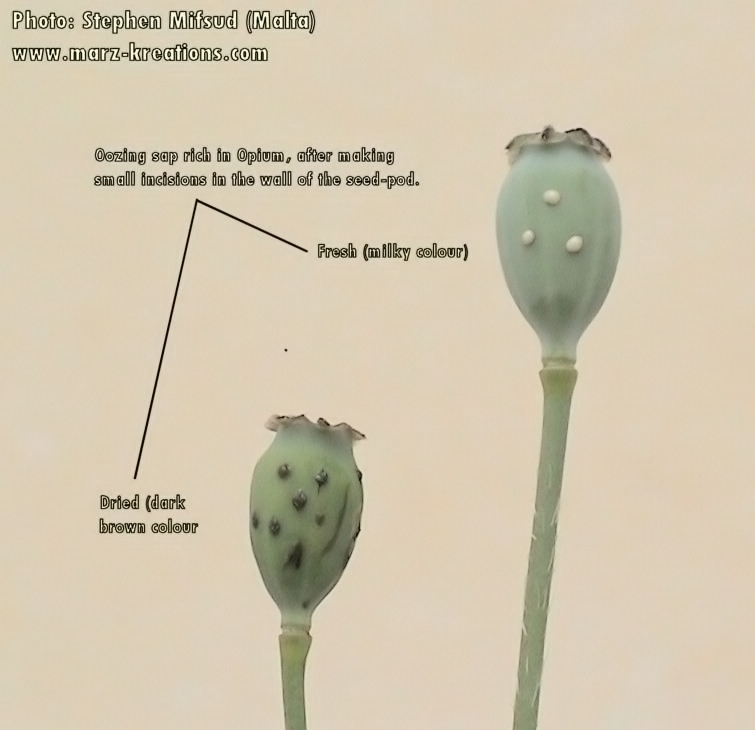
The dried juice (latex) from the unripe green seed vessels is a rich source of the active alkaloids, including morphine  [232, 240]. It is extracted by making shallow incisions in the capsules as soon as the petals have fallen  [4]. Care must be taken that the incisions do not penetrate to the interior of the seed capsules  [4]. The latex exudes from the capsules and dries in contact with the air - it is then scraped off  [4]. This latex is anodyne, antitussive, astringent, diaphoretic, emmenagogue, hypnotic, narcotic and sedative  [4, 7, 13, 176, 192, 218]. As well as its pain-relieving properties, the latex has also been used as an antispasmodic and expectorant in treating certain kinds of coughs, whilst its astringent properties make it useful in the treatment of dysentery etc  [4].

A homeopathic remedy is made from the dried latex  [232]. This is used in the treatment of a variety of complaints, including constipation, fevers and insomnia  [232].
Opium is unexcelled as a hypnotic and sedative, and is frequently administered to relieve pain and calm excitement. For its astringent properties, it is employed in diarrhoea and dysentery, and on account of its expectorant, diaphoretic, sedative and antispasmodic properties, in certain forms of cough, etc.   [WWW-03]

Small doses of opium and morphine are nerve stimulants. The Cutch horsemen share their opium with their jaded steeds, and increased capability of endurance is observed alike in man and beast.   [WWW-03]

Opium and morphine do not produce in animals the general calmative and hypnotic effects which characterize their use in man, but applied locally, they effectually allay pain and spasm. Owing to the greater excitant action in veterinary patients, the administration of opium does not blunt the perception of pain as effectually as it does in human patients.   [WWW-03]

The British Pharmacopeia Tincture of Opium, popularly known as Laudanum, is made with 3 OZ. of Opium and equal parts of distilled water and alcohol, and for immediate effects is usually preferable to solid Opium. Equal parts of Laudanum and Soap Liniment make an excellent anodyne, much used externally.   [WWW-03]

Go to Information quick index (top of additional Info section)


Folk Medicine:

Hartwell (1967-1971) mentions opium as a remedy for such cancerous conditions as cancer of the skin, stomach, tongue, uterus, carcinoma of the breast, polyps of the ear, nose, and vagina; scleroses of the liver, spleen, and uterus; and tumours of the abdomen, bladder, eyes, fauces, liver, spleen, and uvula. The plant, boiled in oil, is said to aid indurations and tumours of the liver. The tincture of the plant is said to help cancerous ulcers. The capsule decoction and an injection of the seed decoction are said to help uterine cancer.   [280]

Egyptians claim to become more cheerful, talkative, and industrious following the eating of opium. When falling asleep, they have visions of "orchards and pleasure gardens embellished with many trees, herbs, and various flowers."
Lebanese use their opium wisely; to quiet excitable people, to relieve toothache, headache, incurable pain, and for boils, coughs, dysentery, and itches.
Algerians tamp opium into tooth cavities. Iranians use the seed for epistaxis; a paste made from Linum, Malva, and Papaver is applied to boils.
In Ayurvedic medicine, the seeds are considered aphrodisiac, constipating, and tonic; the fruit antitussive, binding, cooling, deliriant, excitant, and intoxicant, yet an aphrodisiac if freely indulged; the plant is considered aphrodisiac, astringent, fattening, stimulant, tonic, and good for the complexion;
In Unani medicine, the fruit is suggested as well for anaemia, chest pains, dysentery, fever, but is correctly deemed hypnotic, narcotic, and perhaps harmful to the brain   [282,] .

The plant provides a narcotic that induces sleep; a sleep so heavy that the person becomes insensible. When the Roman soldiers at Golgotha took pity on their prisoner on the cross, they added this poppy juice to the potion of sour wine.
Jewish authorities maintain that the plant and its stupefacience were well known among the Hebrews more than 2,000 years ago.
The Jerushalmi warns against opium eating. Although the seeds contain no narcotic alkaloids, urinalysis following their ingestion may suggest the morphine or heroin addict's urinalysis   [281] .

Go to Information quick index (top of additional Info section)


Other Uses:

The main use of the Papaver Somniferum is extraction of Opium, but it has also other different uses, especially the opium-free seeds.

Seeds are used extensively in baking and sprinkling on rolls and bread. Seeds are a good source of energy. They are also the source of a drying-oil, used for manufacture of paints, varnishes, and soaps, and in foods and salad dressing.   [46, 57, WWW-16]. The seed yields 44 - 50% of an edible drying oil   [61]. Very good for lighting, it burns for longer than most oils  [115].

Other uses include:

  • Oil cake is a good fodder for cattle.
  • Stems used for straw.
  • Lecithin has been extracted from poppy seed meal.
  • Seedlings are eaten as a potherb in Iran.
  • Seeds used for preparation of emulsions (white-seeded varieties preferred); the bluish-black varieties are generally used for baking.
  • As the peony flowered poppy, the opium poppy is widely grown as an ornamental.   [WWW-16]


Go to Information quick index (top of additional Info section)


Cultivation details:

Prefers a rich well-drained sandy loam in a sunny position  [4, 200]. Requires a moist soil  [14] but does not do well on wet clays  [115]. Prefers a sandy loam or a chalky soil  [115]. Plants often self-sow in British gardens.

The opium poppy is a very ornamental plant that is often cultivated in the flower garden  [1]. There are many named varieties, some of which have been developed for their edible uses  [183]. The plant is widely grown, often illegally, in warm temperate and tropical climates for the substances contained in its sap. These are often used medicinally as pain killers, especially in the treatment of terminally ill patients suffering extreme pain, they are also used for their narcotic effects by some people. These substances are highly addictive and lead to a shortening of the life span if used with any frequency. In cool temperate zones the plant does not produce sufficient of the narcotic principles to make their extraction feasible  [4] and cultivation of the plant is perfectly legal in Britain  [KF]. Plants have ripened their seeds as far north as latitude 69°n in Norway  [141].

Members of this genus are rarely if ever troubled by browsing deer or rabbits  [233].

More cultivation notes come from the reference: James A. Duke. 1983. Handbook of Energy Crops. (unpublished.) via brugerforeningen.dk website   [WWW-16]:
Propagated from seed. Seeds germinate best at 15°C and are less sensitive to temperature than most poppy species. Seed sown in shallow furrows, at rate of 4-6 kg/ha. In some areas poppy seed, mixed with sand, is often broadcast over tilled fields in early autumn at rate of about 0.5 kg/ha, as in Asia Minor. Then fields are weeded in the spring when the poppy has grown to about 15 cm tall, and plants are thinned then to stand about 60 cm apart. They flower in April and May and the capsules are ripe in June to July. Optimum yields are obtained when plants are spaced 10 cm between plants and rows 32 cm apart, thus allowing space for mechanical cultivation. Yields of seeds are slightly higher when plants are spaced 30 cm apart than when 40 cm apart. Thinning and spacing do not affect the oil content of the seeds. Fertile soil is essential for good growth and land should be fertilised accordingly.   [WWW-16]

Go to Information quick index (top of additional Info section)


Chemistry of the Seeds:

Seed is reported to contain:
  • Moisture, 4.3-5.2%;
  • Protein, 22.3-24.4%;
  • Oil via ether extract 46.5-49.1%;
  • Nitrogen-free extract, 11.7-14.3%;
  • Crude fibre, 4.8-5.8%;
  • Ash, 5.6-6.0%;
  • Calcium, 1.03-1.45%;
  • Phosphorous, 0.79-0.89%;
  • Iron, 8.5-11.1 mg/100 g;
  • Thiamine, 740-1,181 mg/100 g;
  • Riboflavin, 765-1,203 mg/100 g;
  • Nicotinic acid, 800-1,280 mg/100 g;


  • Minor minerals in the seeds including iodine, 6 mg/kg; - manganese, 29 mg/kg; - copper, 22.9 mg/kg; - magnesium, 15.6 g/kg; - sodium, 0.3 g/kg; - potassium, 5.25 g/kg; - zinc, 130 mg/kg


  • The organic compounds : lecithin, 2.80%; - oxalic acid, 1.62%; - pentosans, 3.0-3.6%; - traces of narcotine and an amorphous alkaloid; - carotene is absent.


  • The enzymes : diastase, - emulsin, - lipase, - nuclease.   [269]
Poppy seed oil cakes were estimated to have 88 feed units per 100 kg, 27.5% digestible crude protein and 25.6% digestible true protein.   [269]. As already stated previously, there are no dangerous alkaloids, like morphine and codeine in the seeds   [SM]

All this info was gathered from the website :- www.brugerforeningen.dk   [WWW-16] - where the author has stated that he got the info from the source:   [James A. Duke. 1983. Handbook of Energy Crops = ref. 269]

HREF Information quick index (top of additional Info section)

Pests and parasites attacking the plant:

Some of the fungi attacking opium poppy include the following species: Alternaria brassicae var. somniferi, Cladosporium herbarum, Erysiphe polygoni, Fusarium scirpi var. caudatum, Heterosporium echinulatum, Macrosporium papaveris, M. bresdolae, Mucor mucedo, Ophiobolus sativus, Oidium erysiphoides, Peronospora arborescens, P. papaveracea, Rhizoctonia solani, Sclerotinia sclerotiorum, Trichothecium roseum.

Plants are also attacked by the bacteria Bacillus (Erwinia) papaveri, causing bacterial blight, and Xanthomonas papavericola.

The following nematodes have been isolated from the opium poppy: Ditylenchus dipsaci, Longidorus maximus, Meloidogyne sp., Pratylenchus crenatus, P. penetrans, and P. pratensis.

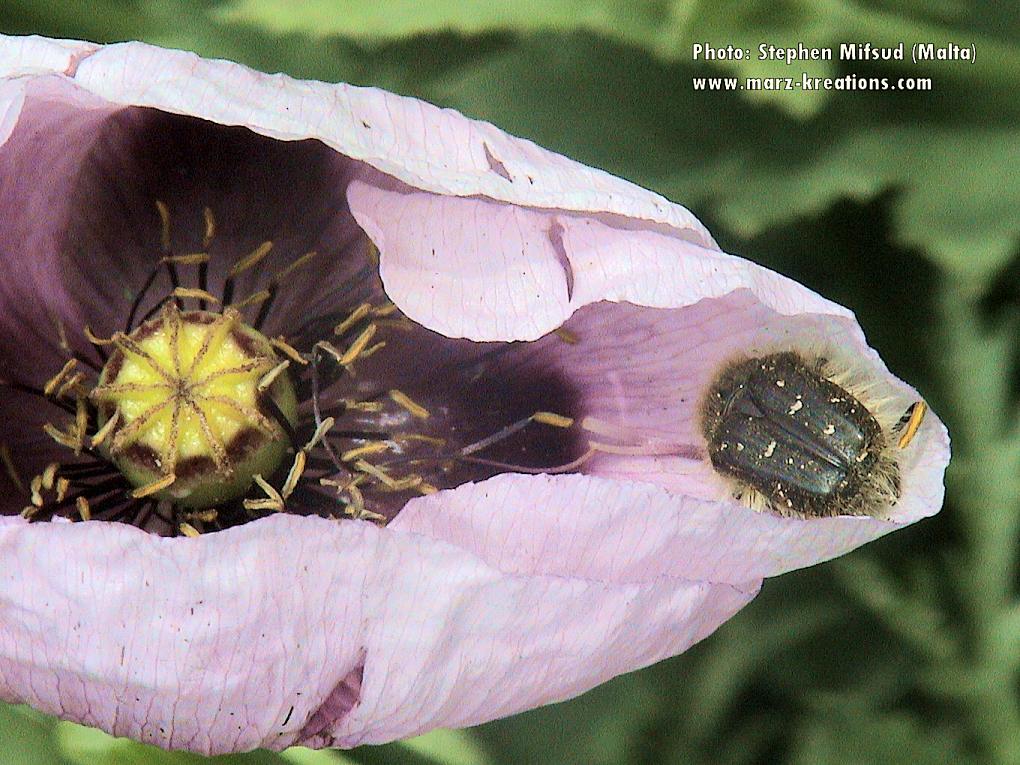
Insect pests include: Aphis papaveris, Ceutorhynchus abbreviatus, C. albovittatus, C. maculaalba, Cynips minor, Dasynevra papaveris, C. callida, Lestodiplosis callida, Mamestra brassicae, Phytomiza albiceps, Sciophila wahlbomiana, and Stenocarus fuliginosus.   [WWW-16] Habituating beetle Finally, it has been frequently observed in Malta that a certain type of beetle resides in the cup-shaped flowers for protection and possibly to feed on. While moving around the ovary it destroys the fragile stamens around the ovary hence hindering the pollination process   [SM]

Photo Gallery

Papaver somniferum subsp. setigerum (Opium Poppy) - CLICK TO ENLARGE PHOTO Papaver somniferum subsp. setigerum (Opium Poppy) - CLICK TO ENLARGE PHOTO Papaver somniferum subsp. setigerum (Opium Poppy) - CLICK TO ENLARGE PHOTO Papaver somniferum subsp. setigerum (Opium Poppy) - CLICK TO ENLARGE PHOTO
Photo of the mauve, cup-shaped flower and its central pot-shaped ovary surrounded by clusters of black stamens.
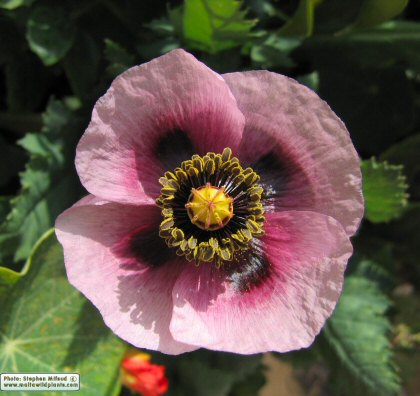
Top view photo of the flower. It consists of 4 large purple petals each with a dark blob at their base. At the centre of the flower there is the pot-shaped ovary with 9 ridges being the stigma and a cluster of stamens around the ovary.
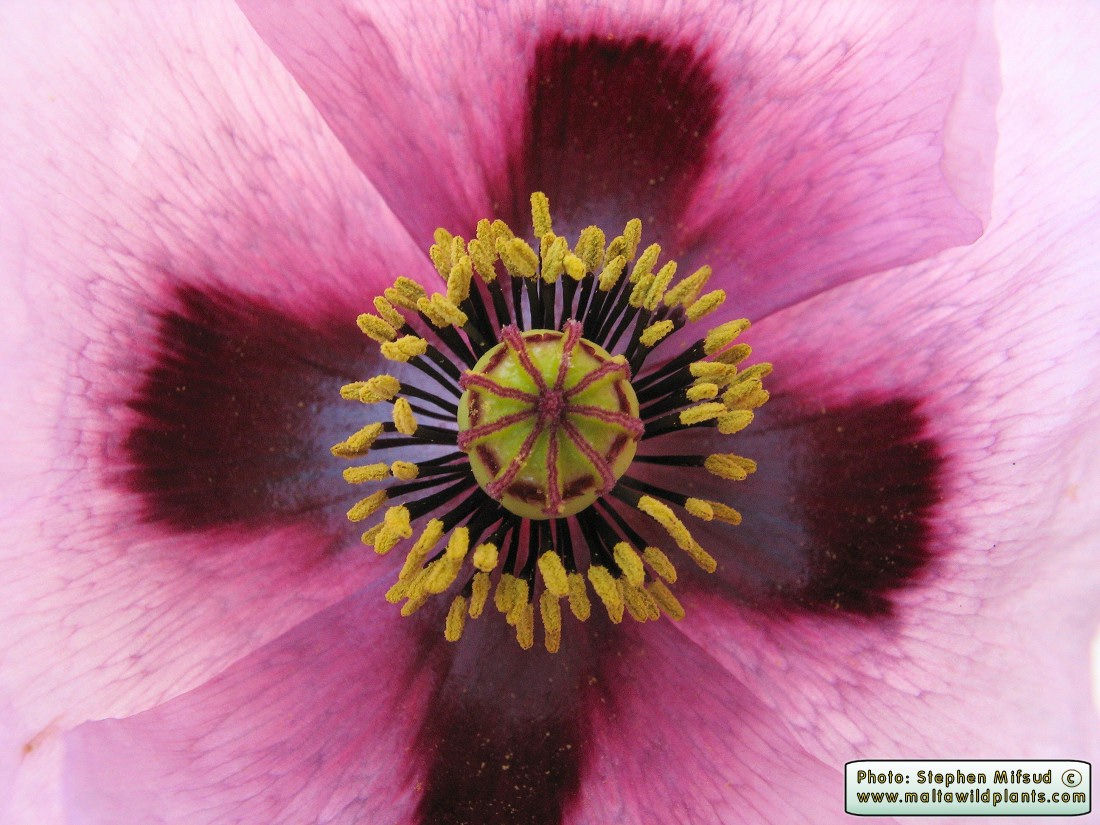
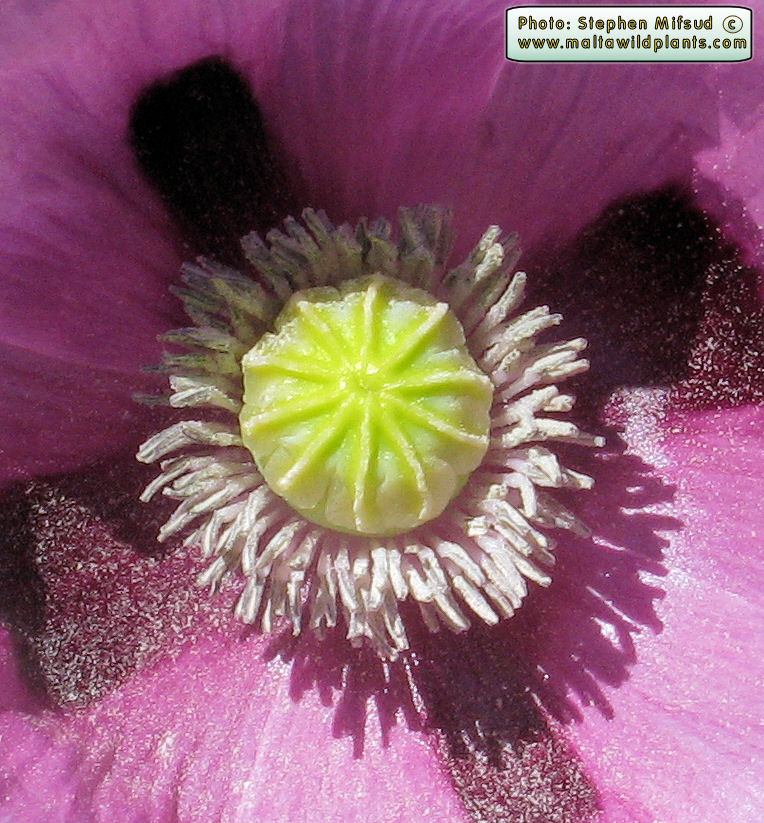
Photo of the flower which have a conspicuous central ovary surrounded a brush of stamens. The ovary is glabrous, yellow-green with a yellow lid that contains 9 elevated linear ridges.
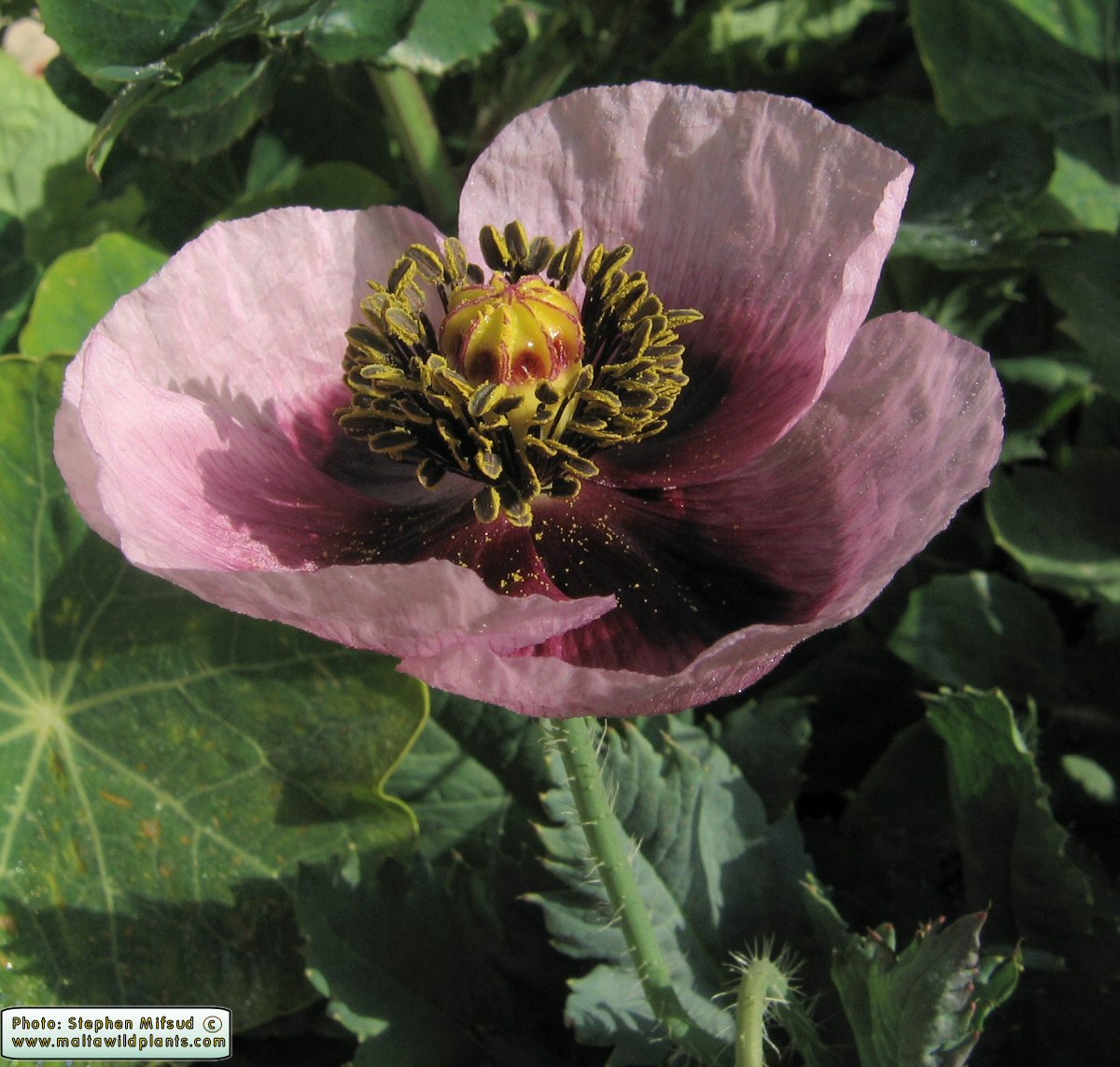
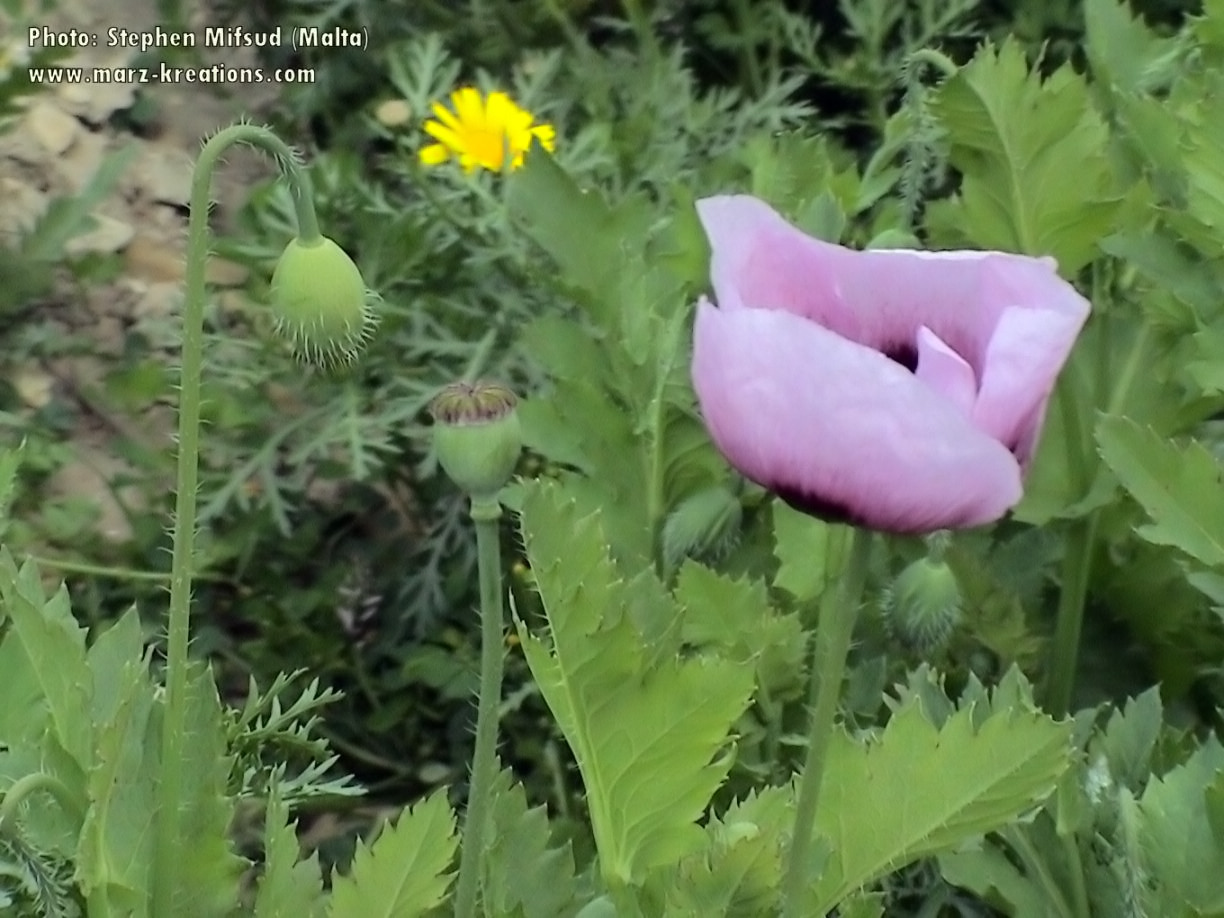
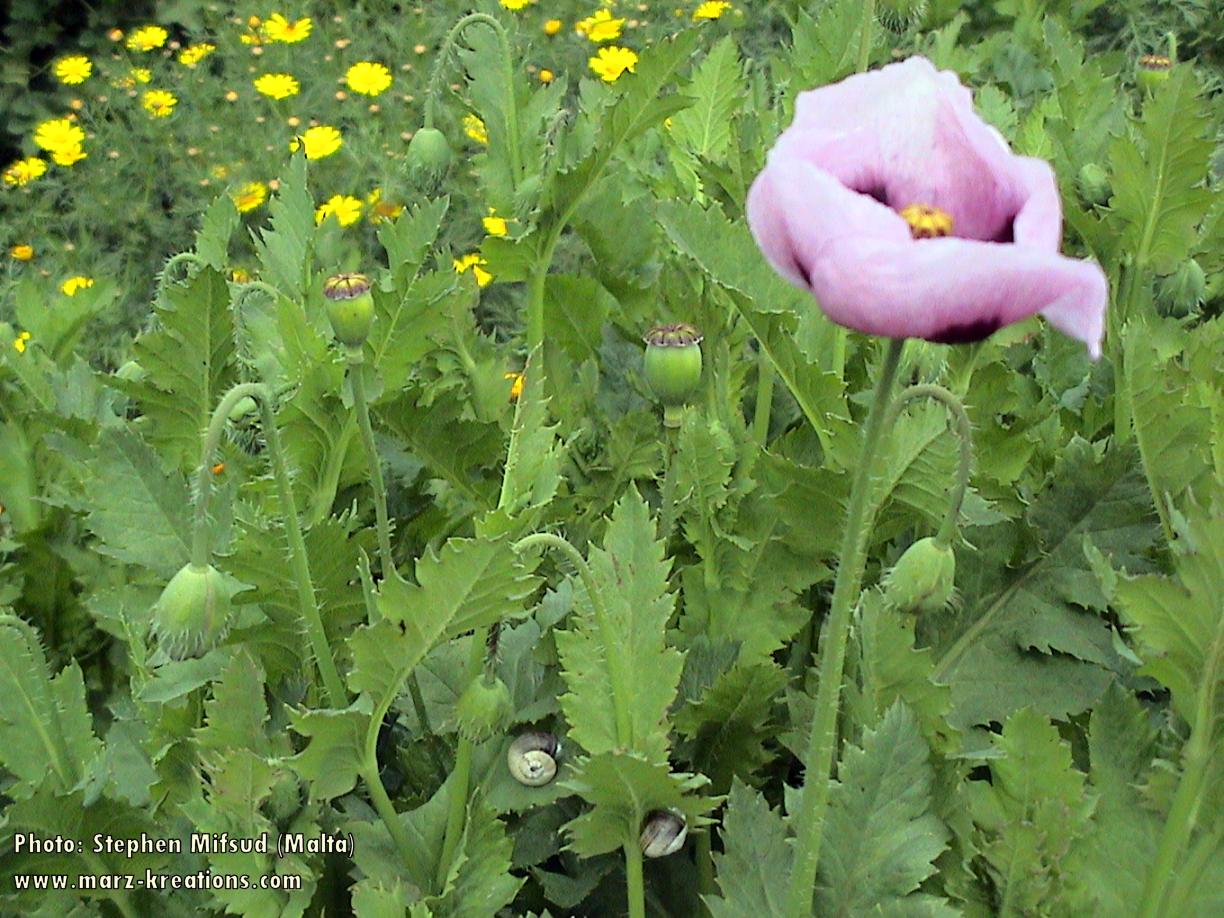
Photo of the cup-shaped flower (side view), flowering stalk having several white bristles and a developing bud which assumes an upside-down position.
Papaver somniferum subsp. setigerum (Opium Poppy) - CLICK TO ENLARGE PHOTO Papaver somniferum subsp. setigerum (Opium Poppy) - CLICK TO ENLARGE PHOTO Papaver somniferum subsp. setigerum (Opium Poppy) - CLICK TO ENLARGE PHOTO Papaver somniferum subsp. setigerum (Opium Poppy) - CLICK TO ENLARGE PHOTO
Photo of flower (side view) made of 4, large, erect petals which overlap and form cup-shaped flower.
Top view photo of flower. The large, dark-purple, blotch at the base of each petal, makes the flower appear to have a painted cross. This beautiful flower usually lasts for 1-2 days only.
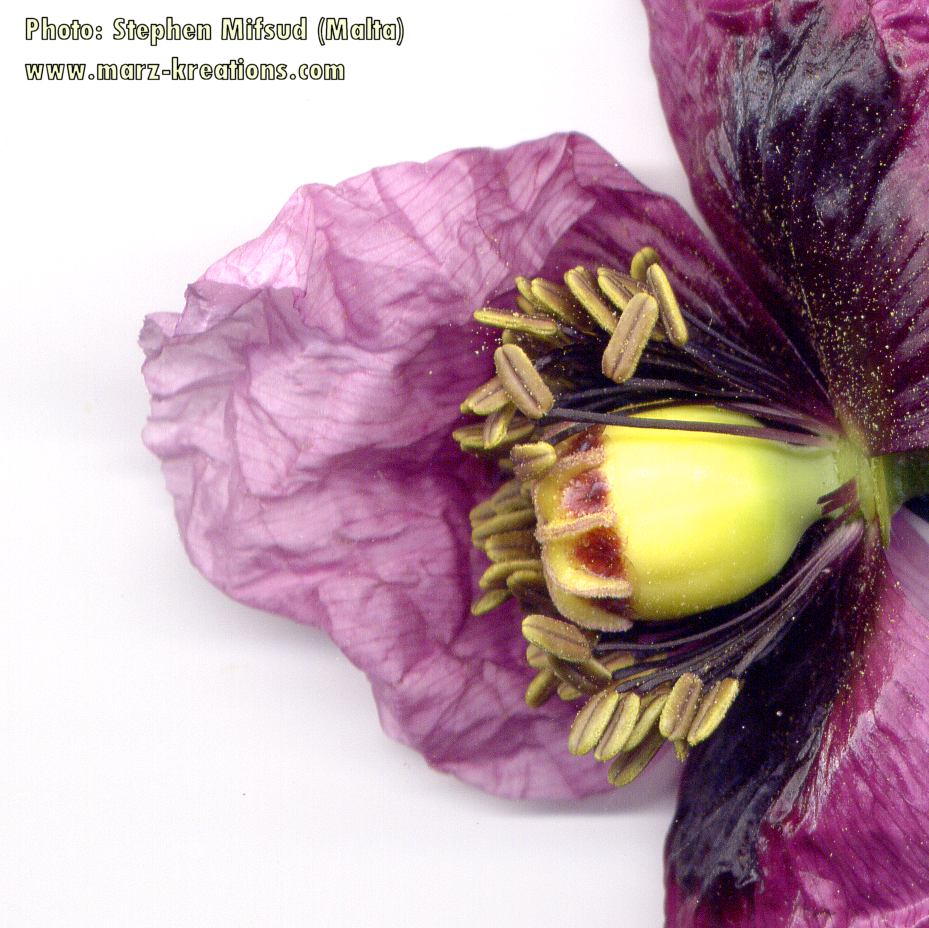
Close up photo of the central part of the flower showing its reproductive parts - a large ovary surrounded by a ring of stamens.
Close up photo of the ovary and stamens. The ridged stigma at the top of the ovary are purple but often covered with yellow pollen.
Papaver somniferum subsp. setigerum (Opium Poppy) - CLICK TO ENLARGE PHOTO Papaver somniferum subsp. setigerum (Opium Poppy) - CLICK TO ENLARGE PHOTO Papaver somniferum subsp. setigerum (Opium Poppy) - CLICK TO ENLARGE PHOTO Papaver somniferum subsp. setigerum (Opium Poppy) - CLICK TO ENLARGE PHOTO
Photo with of flower and an one of its inhabitants - a large hairy beetle. While roaming inside the flower the beetle destroys the fragile stamens found around the central ovary, and so hinders the pollination process.
Scanned image of 2 petals showing clearly the large dark purple spot at the base of the petals.
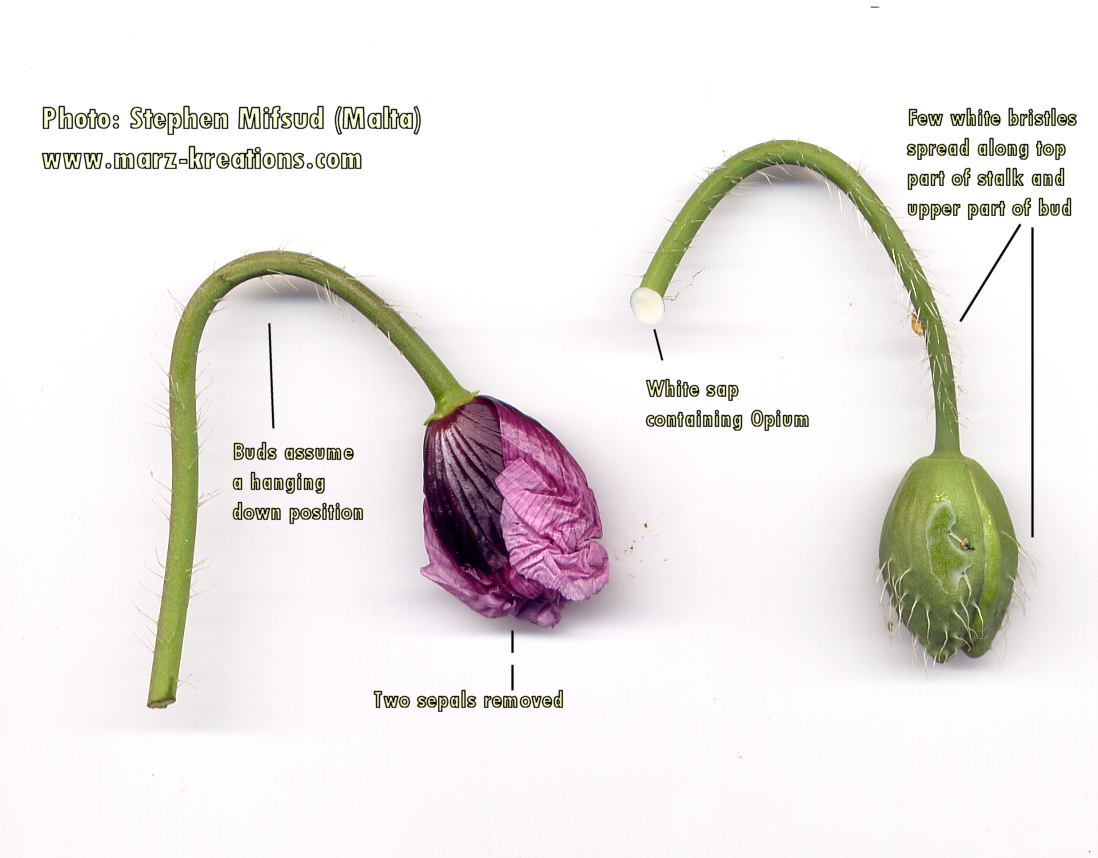
Scanned image of 2 buds. They assume an upside down position and becomes erect just before blossoming into the flower.
Scanned image showing in detail the numerous cluster of stamens. They consist of black anthers and pale yellow anthers.
Papaver somniferum subsp. setigerum (Opium Poppy) - CLICK TO ENLARGE PHOTO Papaver somniferum subsp. setigerum (Opium Poppy) - CLICK TO ENLARGE PHOTO Papaver somniferum subsp. setigerum (Opium Poppy) - CLICK TO ENLARGE PHOTO Papaver somniferum subsp. setigerum (Opium Poppy) - CLICK TO ENLARGE PHOTO
Magnified scanned image of stamens.
Scanned image of ovary and some stamens. The ovary is pot-shaped, glabrous, and green in colour, with a yellowish lid and a purple-brown ring just under the lid.
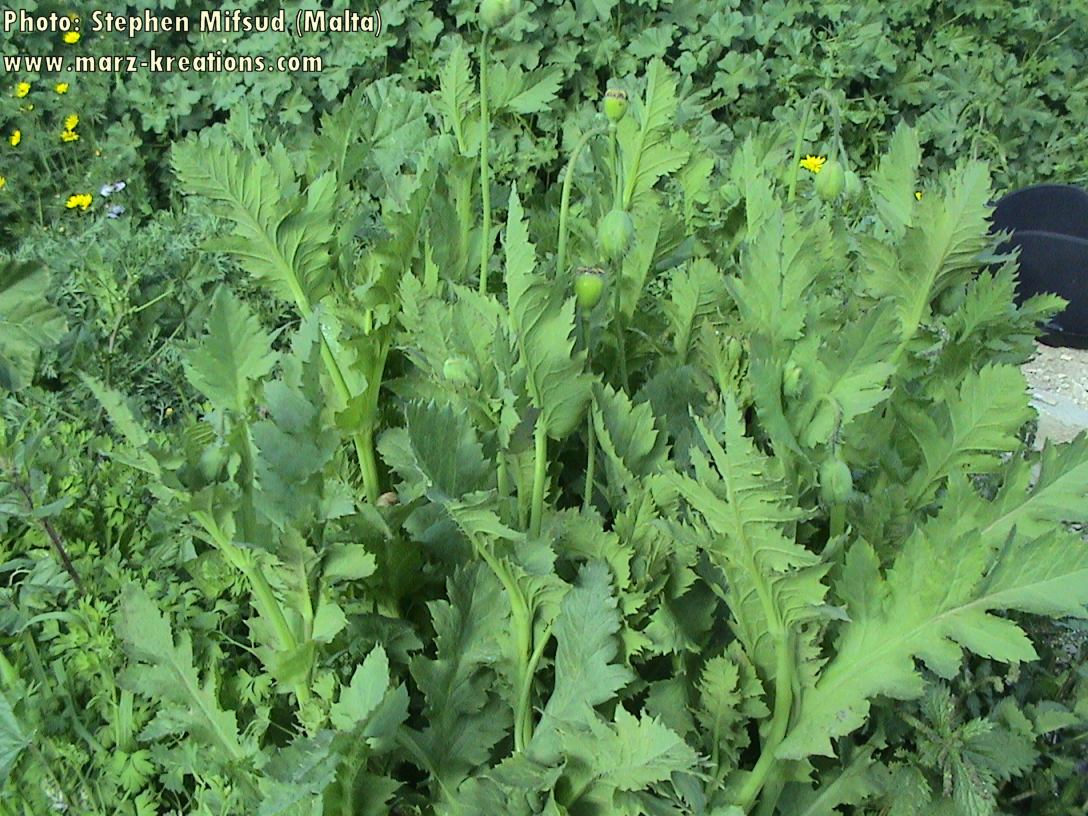
Photo of several plants and their oblong leaves with serrate-dentate margin.
Photo of plant including flower and upper leaves.
Papaver somniferum subsp. setigerum (Opium Poppy) - CLICK TO ENLARGE PHOTO Papaver somniferum subsp. setigerum (Opium Poppy) - CLICK TO ENLARGE PHOTO Papaver somniferum subsp. setigerum (Opium Poppy) - CLICK TO ENLARGE PHOTO Papaver somniferum subsp. setigerum (Opium Poppy) - CLICK TO ENLARGE PHOTO
Photo of several plants. Leaves are grow at an acute angle with the stem (about 30-45 degrees).
Photo of plant including leaves, buds and the solitary purple flower.
Scanned image of a young and adult leaves. Similar in structure except their size.
Scanned image of an adult leaf showing clearly the teeth-like lobes it possesses and the serrate (saw-like) leaf margin.
Papaver somniferum subsp. setigerum (Opium Poppy) - CLICK TO ENLARGE PHOTO Papaver somniferum subsp. setigerum (Opium Poppy) - CLICK TO ENLARGE PHOTO Papaver somniferum subsp. setigerum (Opium Poppy) - CLICK TO ENLARGE PHOTO Papaver somniferum subsp. setigerum (Opium Poppy) - CLICK TO ENLARGE PHOTO
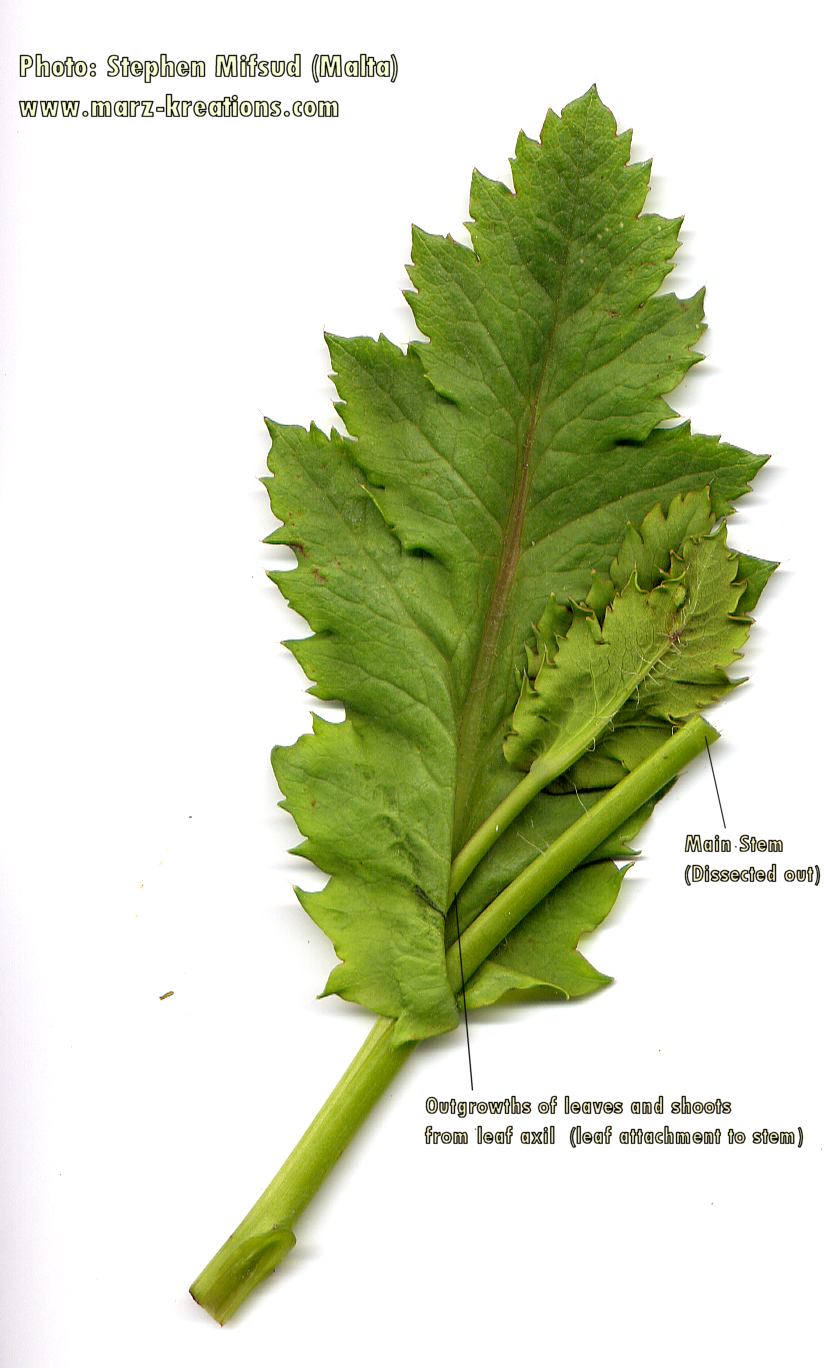
Scanned image of a leaf blade and a shoot growing from its axil.
Scanned image of several leaves.
Scanned image of a young leaf with new flowering stems growing from their axil.
Photo of fruit pod in situ.
Papaver somniferum subsp. setigerum (Opium Poppy) - CLICK TO ENLARGE PHOTO Papaver somniferum subsp. setigerum (Opium Poppy) - CLICK TO ENLARGE PHOTO Papaver somniferum subsp. setigerum (Opium Poppy) - CLICK TO ENLARGE PHOTO Papaver somniferum subsp. setigerum (Opium Poppy) - CLICK TO ENLARGE PHOTO
Scanned image of fruit-pod showing in details its anatomy (side view an top view).
Photo of fruit pods after making small incisions to make sap ooze out. The sap is rich in opium.
Scanned and magnified image of the tiny, kidney-shaped, brown seeds. Seed coat have a 'wrinkled' texture.
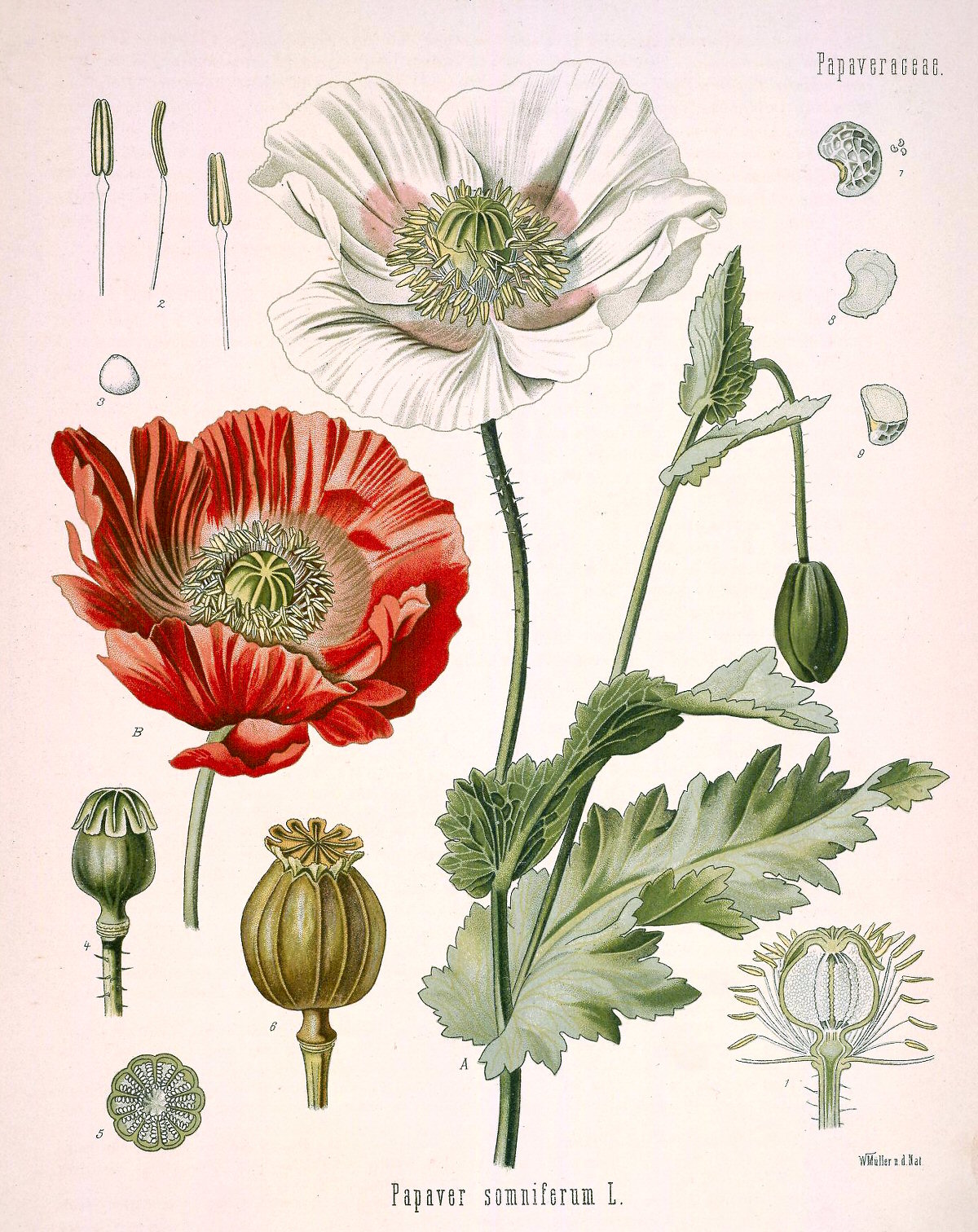
Colour illustration of the plant and its main parts taken from © 1995-2005 Missouri Botanical Garden.. Illustrated is the white or red form which is not found in Malta.
Papaver somniferum subsp. setigerum (Opium Poppy) - CLICK TO ENLARGE PHOTO Papaver somniferum subsp. setigerum (Opium Poppy) - CLICK TO ENLARGE PHOTO    
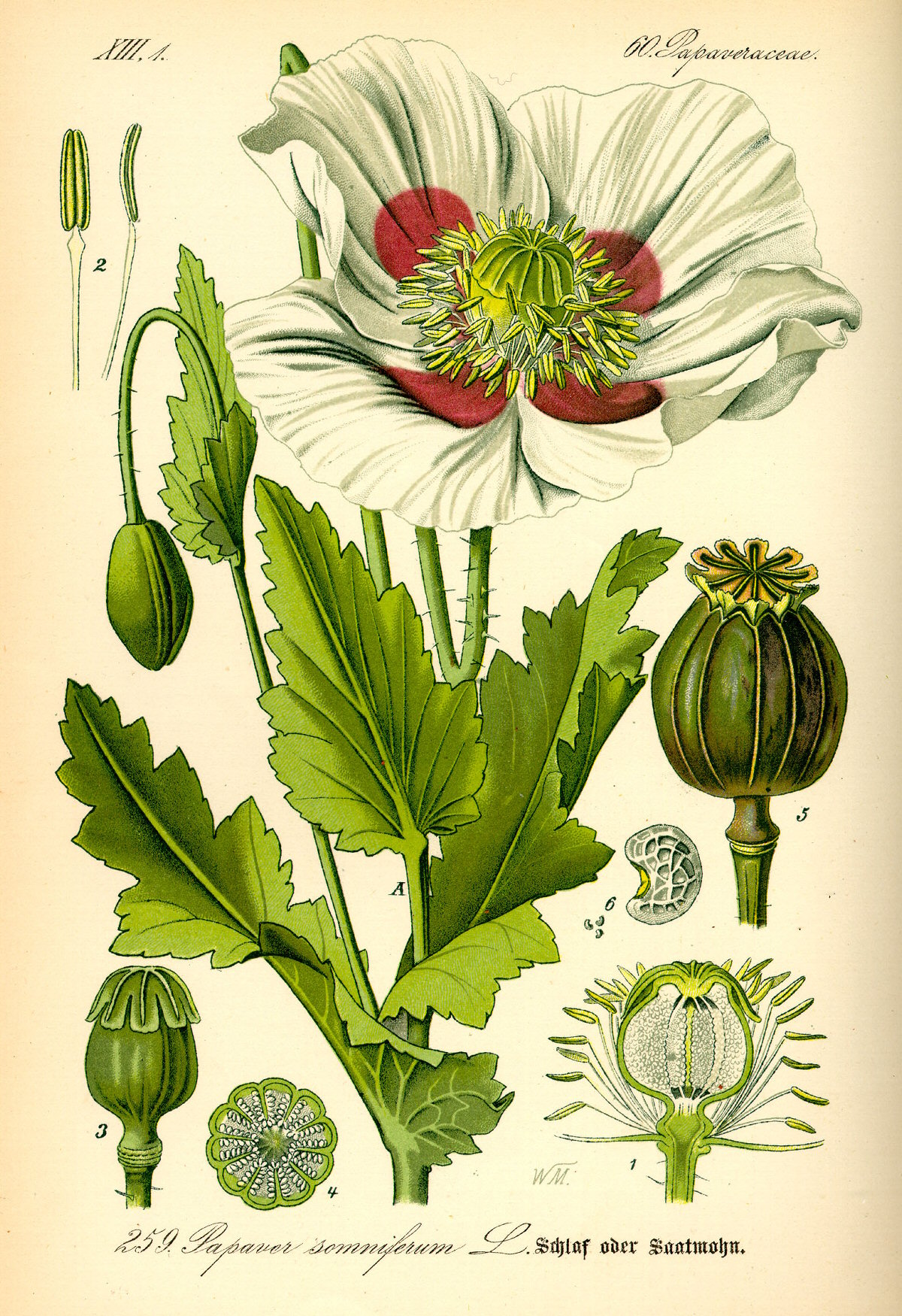
Colour illustration of the plant and its main parts taken from Thomé - Flora von Deutschland, Österreich und der Schweiz. In Malta the violet form is found.
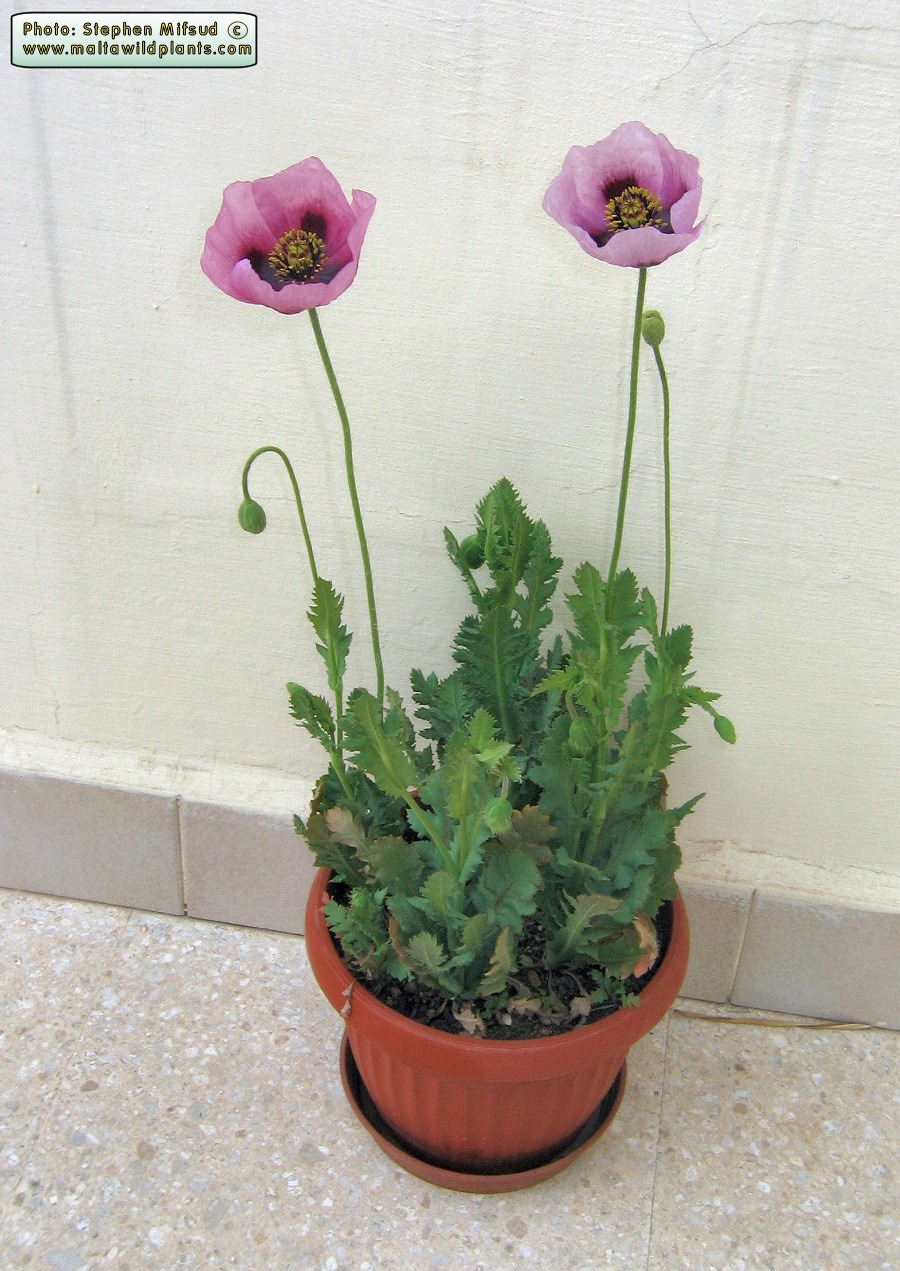
As this photo shows, the Opium Poppy makes an elegant pot fowering plant.
-
-

Further Information and Links

Site dedicated to the Papaver somniferum (papaver.somniferum.word.sytes.org) More info about the poppy such as Uses, history, mythology etc.
Medical and cultivation info about the Opium poppy Opium - from The British Pharmaceutical Codex.
Papaver somniferum profile from www.opioids.com Papaver somniferum profile from Ethno Botanical Leaflets WebSite
Papaver somniferum -- Opium Poppy Discussion Forum Several documentation and discussion about various topics concerning Opium Poppy, Morphine, cultivation methods, etc.
Opium and its preparations Studies of the Morphine content from Papaver somniferum (PDF file, 111kb)
The pernicious opium poppy - History and Uses; from Economical Botany How to grow P. somniferum from seeds (propagation details)
Search for Papaver somniferum subsp. setigerum on the FORUM of MaltaWildPlants.com
Detailed Medicinal Properties for Papaver somniferum subsp. setigerum


Buy from and support MaltaWildPlants.com

Buy Seeds from Maltawildplants.com Buy samples of seeds of certain wild plants for your studies, trials, research, etc. Not all species' seeds can be exported (depending on Maltese regulations), and availability depends on season of species. So, before any payment, you are kindly asked to fill in the online quotation/order form by which I can contact you back for availability and charges. Buy Seeds from Maltawildplants.com   Online Quotation

Buy Seeds from Maltawildplants.com   Online Payment
Buy Documents from Maltawildplants.com Buy documents related to Maltese Wild Plants such as the list of references, full profile, or other docs you request. Buy Documents from Maltawildplants.com   Online Payment
Buy Images  from Maltawildplants.com Buy any of my own copyright images found in this large collection of Maltese flora. You should first select the image you want to buy and input its corresponding code (found beneath each individual photo) in the online ordering form. Buy Seeds from Maltawildplants.com   Online Payment
Buy Seeds from Maltawildplants.com Kindly donate any sum of money (from 2USD / 2Euro) to help us covering some expenses needed to maintain Maltawildplants.com. Please bear in mind how much hard work such a large and up-to-date website needs to arrive directly to you home, office or library. Your kind donations are both greatly appreciated and recorded for future reference. Donors asking help will have first que preference for assistance and special attention. Buy Seeds from Maltawildplants.com   Online Donation


Submit More Information

Use the form below to submit more information about this plant or a related species. If the data is taken from a book, journal, website, etc, please provide the corresponding reference / website address as indicated in the form. If it is your own observation, then your name will be cited. Your Email address will never be displayed online, it is just for internal communication.


For plant species that are marked as rare, you can also report other locations in Malta where you have seen this species.

Finally you can report any mistakes or errors found on the plant profile for necessary corrections. This will help to improve the website's acuracy.


To have more details about each particular field, just move your mouse on it and wait for the help message to pop up

* = required fields.
Plant Species:  *
Your name:   *
Your Email:   *
Fill any of the following 3 sections below (A, B or/and C) and send the form. - Thank you.
 
A:  Additional Information about this plant species
Own observations:
Info from published material (books, jounals, website):

Reference of published material:

 
B:   Where have you seen this plant on the Maltese Islands?
Locations in Malta or Gozo where you have encountered this plant.
Mostly applies for rare plants.


1:        2:   
3:       4:   
5:       6:   

Try to be as concise as possible. Examples: Dingli Cliffs (near chapel), Wied Incita (Zebbug side), Triq il-Kbira (Qormi), Barriera ta\' Abdul (Xlendi), Fields near Salib tal-gholja (Siggiewi). GPS bearings are also welcomed!
 
C:  Corrections for mistakes and errors in this plant profile.
Section of this plant Profile page where you found an error (select one)

What is the error/mistake
What should be its correction


All material and data on this webpage is under the copyright of the author of this site - Stephen Mifsud / www.MaltaWildPlants.com / Malta. (2002-2008)
This research project about the flora of Malta is sponsored by:
Middlesea Insurance p.l.c. A Fund established to help in the amelioration and enhancement of the environment in Malta and to take initiatives that enhance awareness on environmental issues amongst the public Empty space for sponsor Empty space for sponsor Benefit companies get by sponsoring this project