Wild Plants of Malta & Gozo - Plant: Clematis cirrhosa (Evergreen Traveller's Joy)

Evergreen Traveller's Joy

Clematis cirrhosa / Evergreen Traveller's Joy / Kiesħa jew Bajda
This plant is brought to you by one of the project's sponsors:
Middlesea Insurance p.l.c.
More sponsors are needed for this project [ click here ]

Contents Links


Nomenclature

Botanical Data

Description

General Information

Photo Gallery

Further Info & Links

Buy Seeds and Docs

Submit own info
about this plant

Give a small Donation Online

FORUM

Copyright Info


Main Index

 
Visitor hits (Nov-2005)

Nomenclature

Species name:

Clematis cirrhosa   L.

Author(s):

Carl von Linné;
   Sweden, 1707-1778

General names:

Evergreen Traveller's Joy, Evergreen Virgin's Bower

Maltese name:

Kiesħa jew Bajda

Plant Family:

Ranunculaceae   (Buttercup Family)

Name Derivation:

Clematis = From the Greek word "Klema" which means vine-like and used as ancient name for some climbing plant (Greek);
cirrhosa = Bearing tendrils (Latin)

Synonyms:

Clematis balearica, Clematis calycina, Clematis polymorpha

Remarks:

Quite and uncommon plant and becoming scarcer. -


Botanical Data

PLANT STRUCTURE:

Characteristic

Growth Form

Branching

Surface

Description

Prostrate + Climber :

Laying and trailing along the ground, but climbs along vertical supports by the aid of tendrils.

Highly Branched :

Numerous branches and sub-branches are present but the common main stem is usually tall and well visible.

Hirsute :

Covered with rough, coarse hairs.

General
Picture

Wild Plants of the Mediterranean Islands of Malta  - Copyright Stephen Mifsud / Maltawildplants.com / Malta (2002-2007) Wild Plants of the Mediterranean Islands of Malta  - Copyright Stephen Mifsud / Maltawildplants.com / Malta (2002-2007) Wild Plants of the Mediterranean Islands of Malta  - Copyright Stephen Mifsud / Maltawildplants.com / Malta (2002-2007)

LEAVES:

Characteristic

Arrangement

Attachment

Venation

Description

Opposite :

Leaves that are situated in pairs at each node along the stem.

Stalked / Petiolate :

Hanging out by a slender leaf-stalk.

Pinnate venation :

Lateral veins which diverge from the midrib towards the leaf marhins.

General
Picture

Wild Plants of the Mediterranean Islands of Malta  - Copyright Stephen Mifsud / Maltawildplants.com / Malta (2002-2007) Wild Plants of the Mediterranean Islands of Malta  - Copyright Stephen Mifsud / Maltawildplants.com / Malta (2002-2007) Wild Plants of the Mediterranean Islands of Malta  - Copyright Stephen Mifsud / Maltawildplants.com / Malta (2002-2007)
 

Characteristic

Leaf Shape

Leaf Margin

Remarks

Description

Lanceolate and Trifoliate:

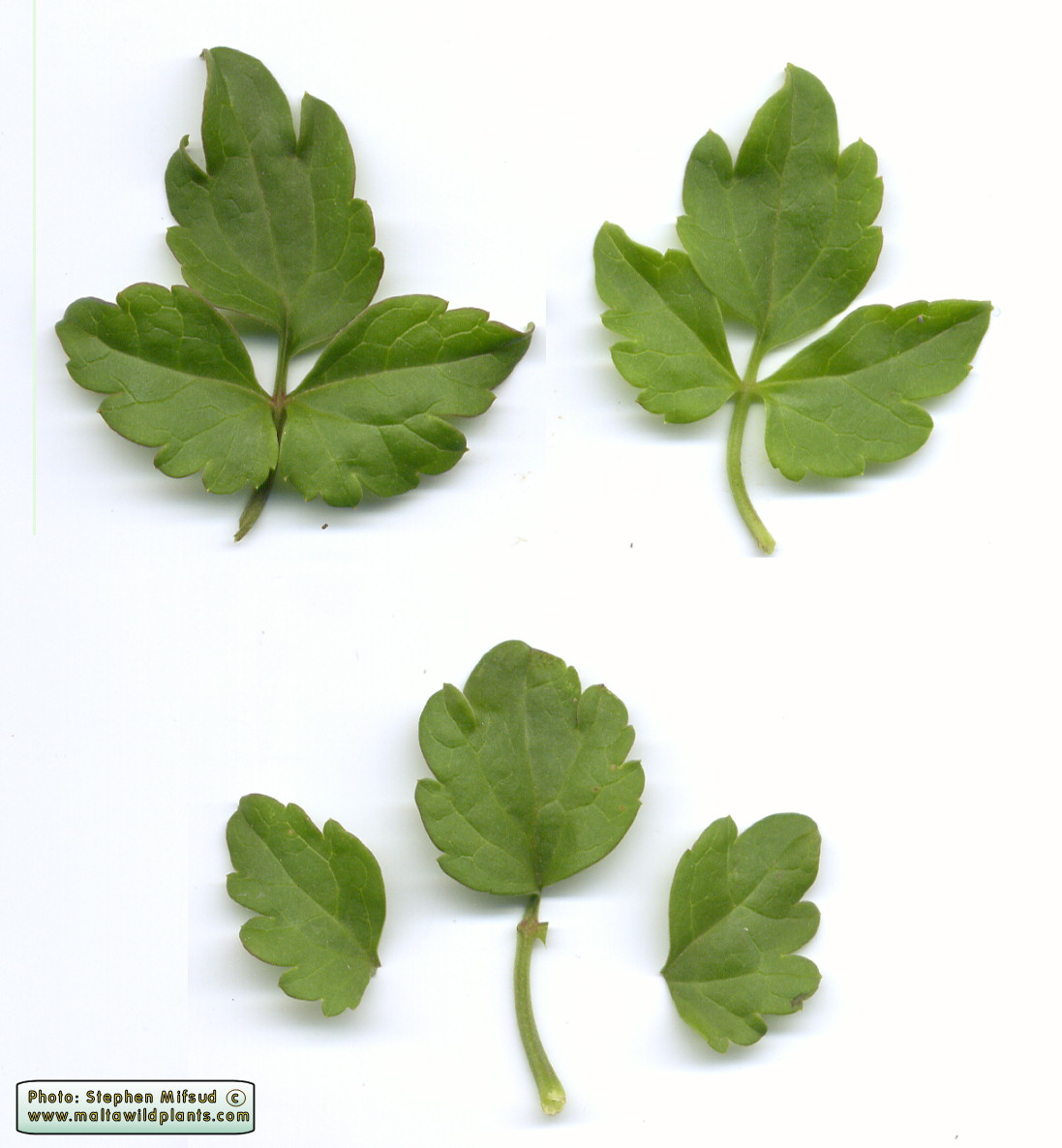
Lance shaped, widest in the basal third, tapering gradually towards the tip. Leaves are found in sets of three.

Serrate :

Sharp pointed teeth, oblique (inclined) to the margin, pointing apically like a saw.

Leaf Variation

Some leaves are lobed, having 2 or usually 3 lobes per leaflet.

General
Picture

Wild Plants of the Mediterranean Islands of Malta  - Copyright Stephen Mifsud / Maltawildplants.com / Malta (2002-2007) Wild Plants of the Mediterranean Islands of Malta  - Copyright Stephen Mifsud / Maltawildplants.com / Malta (2002-2007) Wild Plants of the Mediterranean Islands of Malta  - Copyright Stephen Mifsud / Maltawildplants.com / Malta (2002-2007)

FLOWERS:

Characteristic

Colour

Basic Flower Type

No. of Petals

No. of Sepals

Description

White

Campanulate :

Petals fused together to form a flower having the shape of a bell.

4

Apparently free, but fused at the base.

1 (Fused sepals)

A single-unit calyx made up of fused sepals.

General
Picture

  Wild Plants of the Mediterranean Islands of Malta  - Copyright Stephen Mifsud / Maltawildplants.com / Malta (2002-2007) Wild Plants of the Mediterranean Islands of Malta  - Copyright Stephen Mifsud / Maltawildplants.com / Malta (2002-2007) Wild Plants of the Mediterranean Islands of Malta  - Copyright Stephen Mifsud / Maltawildplants.com / Malta (2002-2007)
 

Characteristic

Inflorescence

Description

Ovary

Stamens

Description

Dichasial Cyme :

A type of cyme that has opposite branching (at lateral axes) of determinate flowers or clusters. The central or upper flower is the one to blossom first.

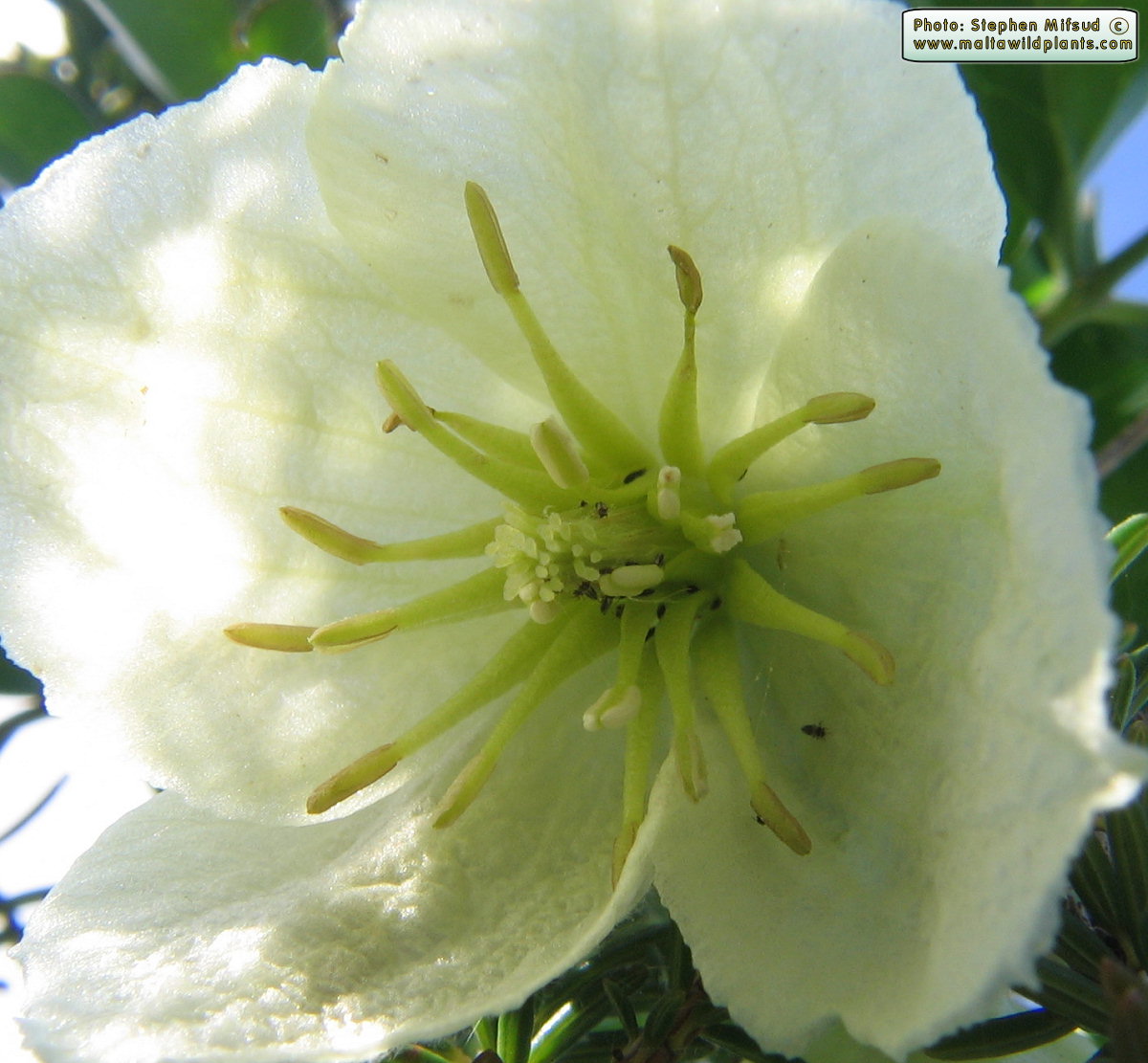
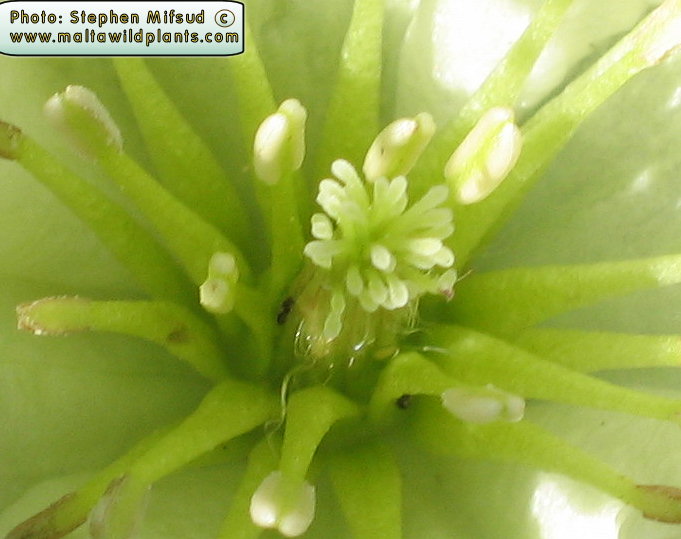
A hanging down flower made up of 4 perianths fused at their base forming a shape of a bell. Inside there is a cluster of stamens encircling a group of styles that collectively have a conical shape.

Superior :

Ovary situated above the flower parts (the calyx, corolla, and androecium). In other words, these are attached below the ovary.

20-30, Annular Cluster :

A cluster of stamens in the form of a ring, often encircling the gynoecium.

General
Picture

Wild Plants of the Mediterranean Islands of Malta  - Copyright Stephen Mifsud / Maltawildplants.com / Malta (2002-2007) Wild Plants of the Mediterranean Islands of Malta  - Copyright Stephen Mifsud / Maltawildplants.com / Malta (2002-2007) Wild Plants of the Mediterranean Islands of Malta  - Copyright Stephen Mifsud / Maltawildplants.com / Malta (2002-2007) Wild Plants of the Mediterranean Islands of Malta  - Copyright Stephen Mifsud / Maltawildplants.com / Malta (2002-2007)
 

Characteristic

Scent

Average Flower Size

Pollen Colour

Other Notes

Description

YES

Very sweet and delicate fragrance.

35-40mm across

This measurement refers to when the flower is in its original cup shape. When folded open, flower diameter is about 60-70mm.

White or Cream

-


SEEDS:

Characteristic

No. Per Fruit

Shape

Size

Colour

Description

25-45

Plumose seed :

Seed with one or more feather-like appendages at one end used to aid in wind dispersion.

3mm

(30-38mm long if including beak+pappus).

Brown

(Pappus is cotton white).

General
Picture

Wild Plants of the Mediterranean Islands of Malta  - Copyright Stephen Mifsud / Maltawildplants.com / Malta (2002-2007) Wild Plants of the Mediterranean Islands of Malta  - Copyright Stephen Mifsud / Maltawildplants.com / Malta (2002-2007) Wild Plants of the Mediterranean Islands of Malta  - Copyright Stephen Mifsud / Maltawildplants.com / Malta (2002-2007) Wild Plants of the Mediterranean Islands of Malta  - Copyright Stephen Mifsud / Maltawildplants.com / Malta (2002-2007)

FRUIT AND OTHER BOTANICAL DATA:

Characteristic

Fruit Type

Colour of Fruit

Subterranean Parts

Other Notes

Description

Numerous achenes with pappus :

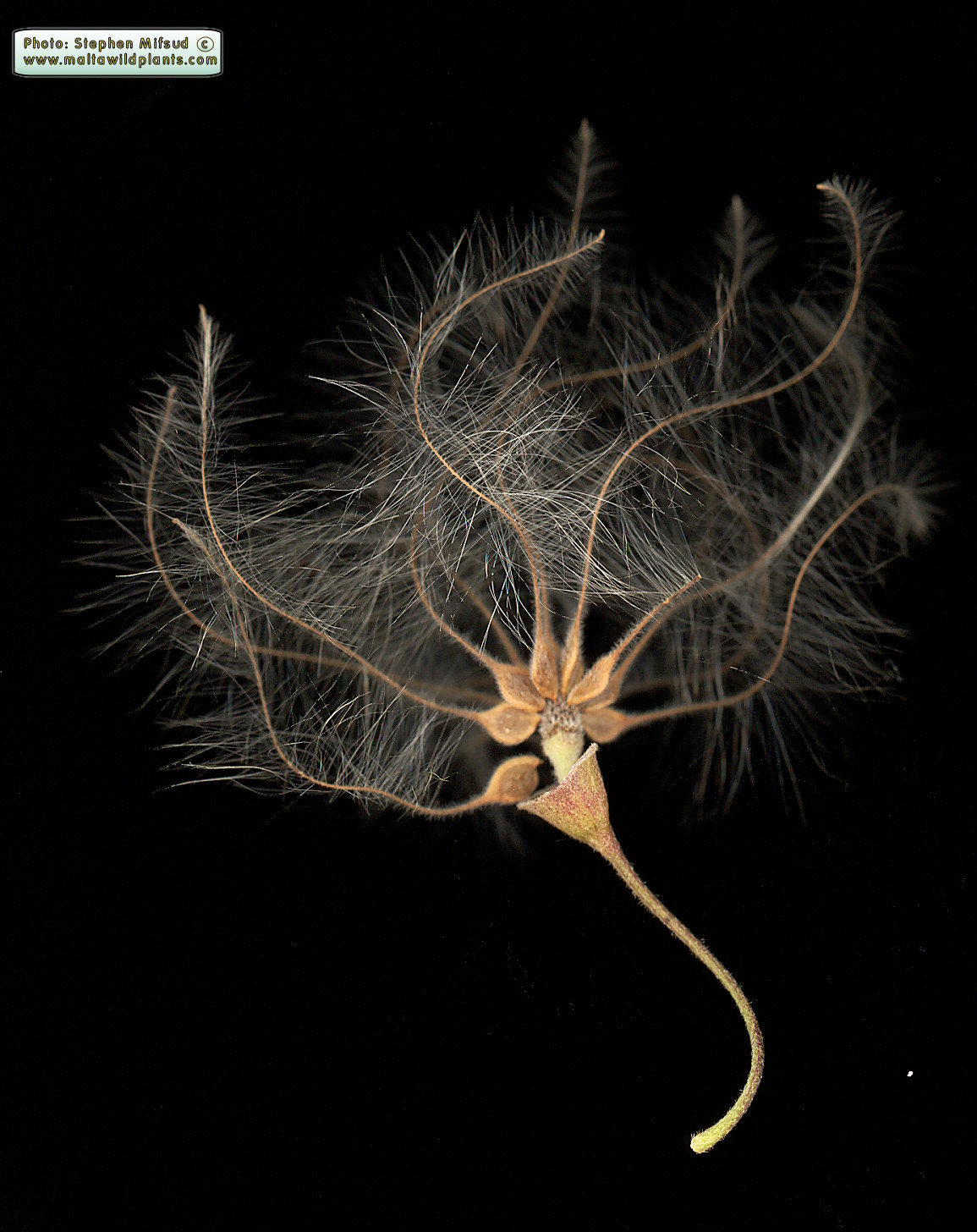
A collection of achenes with a bristly pappus forming a soft spherical structure. The radiating achenes are attached to a common receptacle and when mature they detach and get dispersed by wind.

White

Taproot :

A rooting system where there is the main descending root of a plant having a single dominant large structure from which a network of smaller and long roots emerge.

-

General
Picture

Wild Plants of the Mediterranean Islands of Malta  - Copyright Stephen Mifsud / Maltawildplants.com / Malta (2002-2007) Wild Plants of the Mediterranean Islands of Malta  - Copyright Stephen Mifsud / Maltawildplants.com / Malta (2002-2007) Wild Plants of the Mediterranean Islands of Malta  - Copyright Stephen Mifsud / Maltawildplants.com / Malta (2002-2007) Wild Plants of the Mediterranean Islands of Malta  - Copyright Stephen Mifsud / Maltawildplants.com / Malta (2002-2007)

Plant Description

Life Cycle:

Perennial

Habitat:

Valleys, sheltered rocky locations such as cliffs and walls.

Frequency:

Infrequent

Sources in Malta:

Wied Encita and Bahrija are two examples where this plant can be found.

Plant Height:

Climbs up to 4m.

Flowering Time:

Oct - Jan

Poison:

Mild to Moderately poisonous.

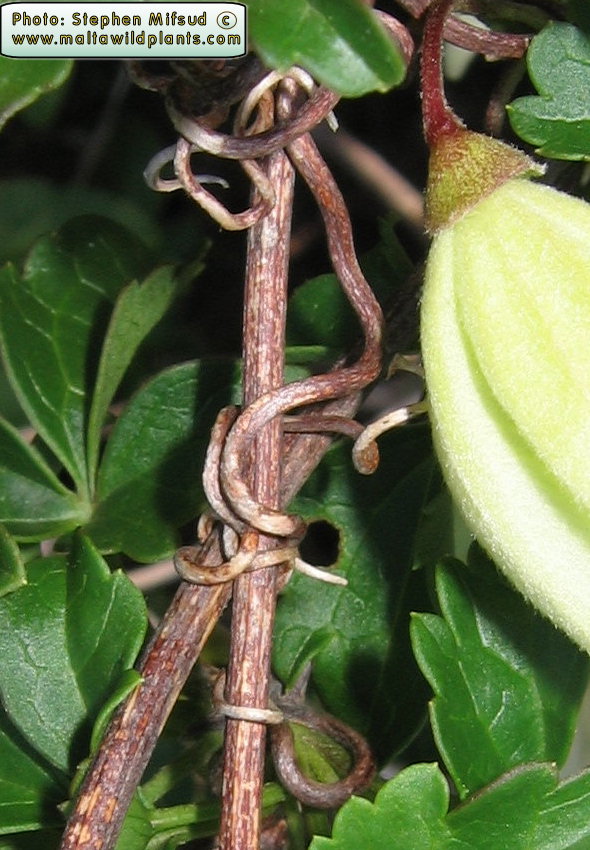
This perennial plant is often found twining around other erect plants, shrubs or walls which it uses as a means of support and extension of its numerous branches. The branches are adapted to this function by having strong, woody tendrils that intertwine around anything they find - sometimes even around its own branches. Additionally, the stems are thin and do not produce crowded or large leaves that would hinder the plant while twining around another one. However, it is not said that the Evergreen Traveller's Joy is a leafless plant, but on the contrary, it has numerous small leaves all year round.

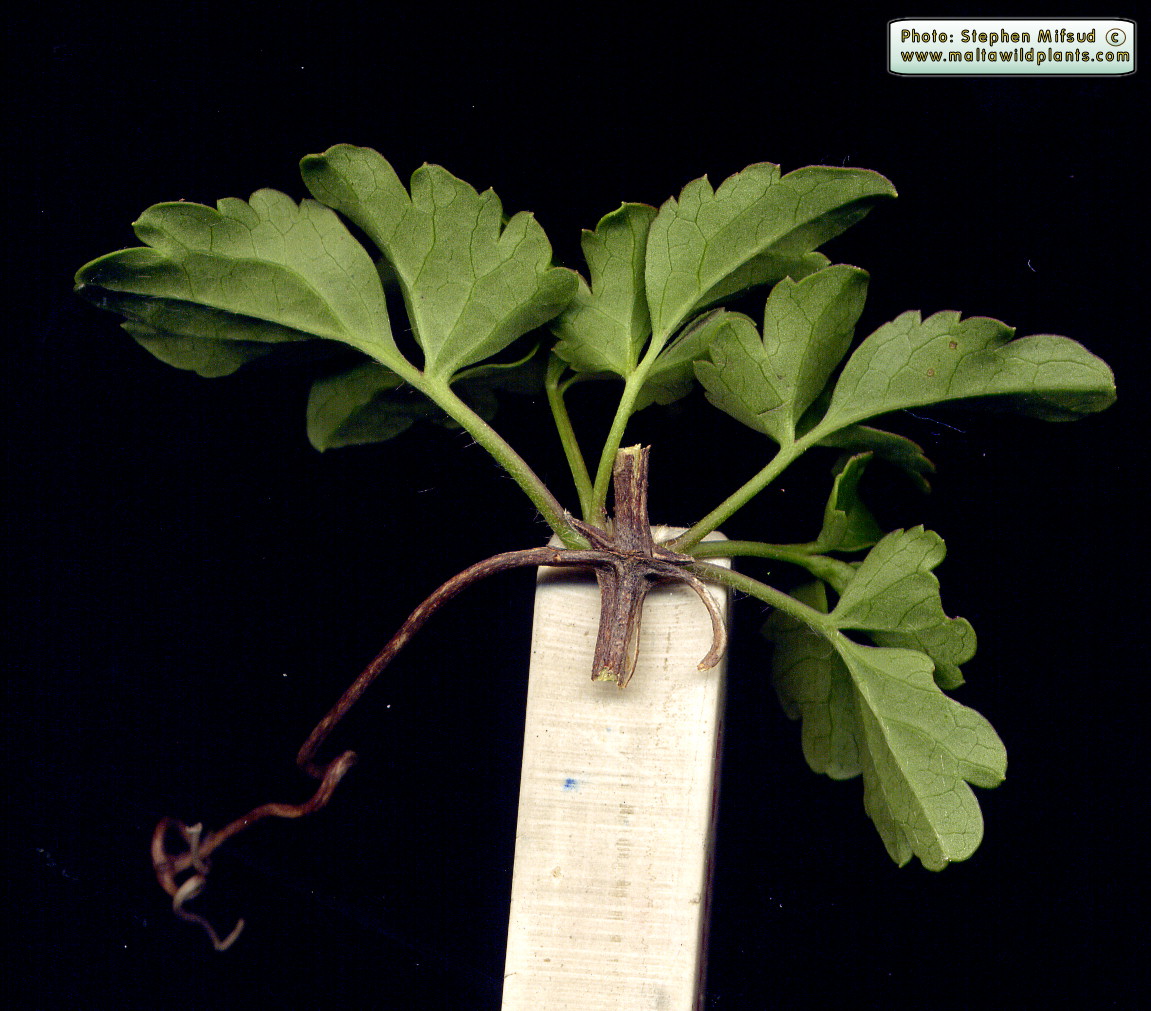
Plant has branched and extending stems that are glabrous and woody. Leaves, tendrils and flowers emerge in pairs only from nodes located at regular intervals of few centimetres along the branches.

From each node grow opposite leaves and stalked flowers at each side of the stem. There are 2 or 3 opposite pairs of short leaves measuring between 30-50mm. Each leaf has a slender petiole (10-15mm long) which holds 3 similar leaflets, the largest being the terminal one. These measure between 22-35mm long. Leaflets are lance-shaped, glabrous, have a serrated margin and occasionally lobed (2 or 3 lobes).

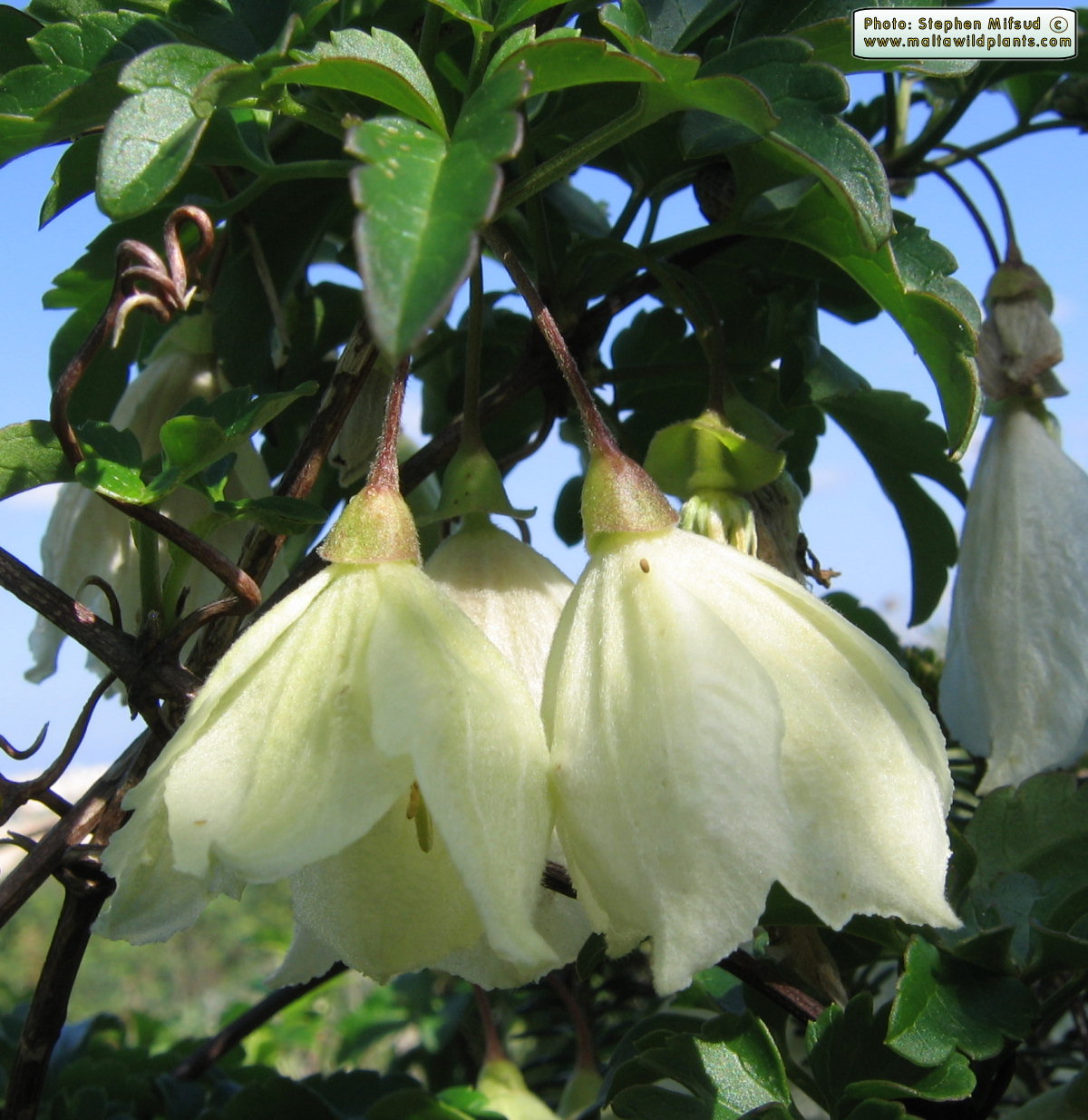
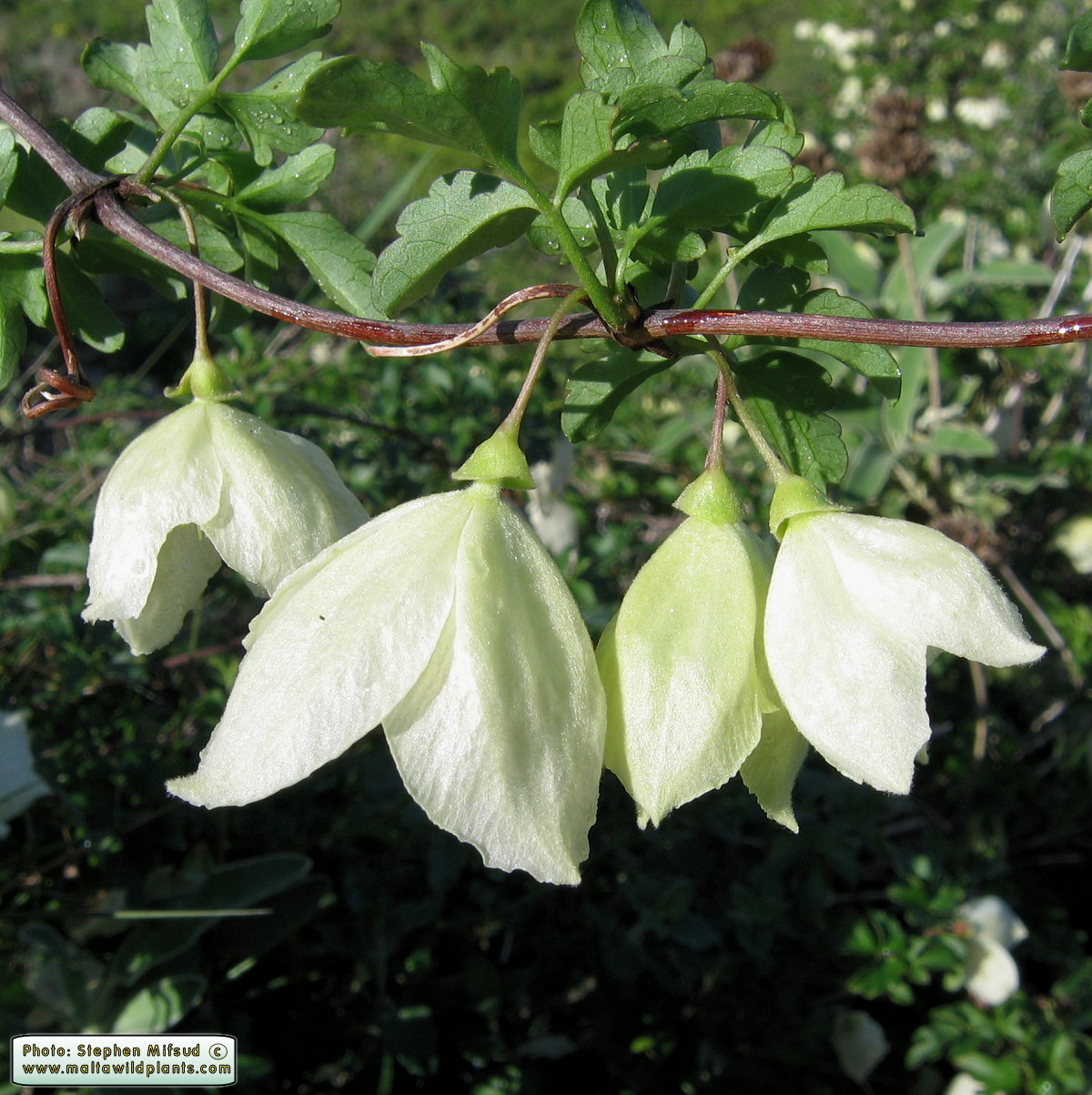
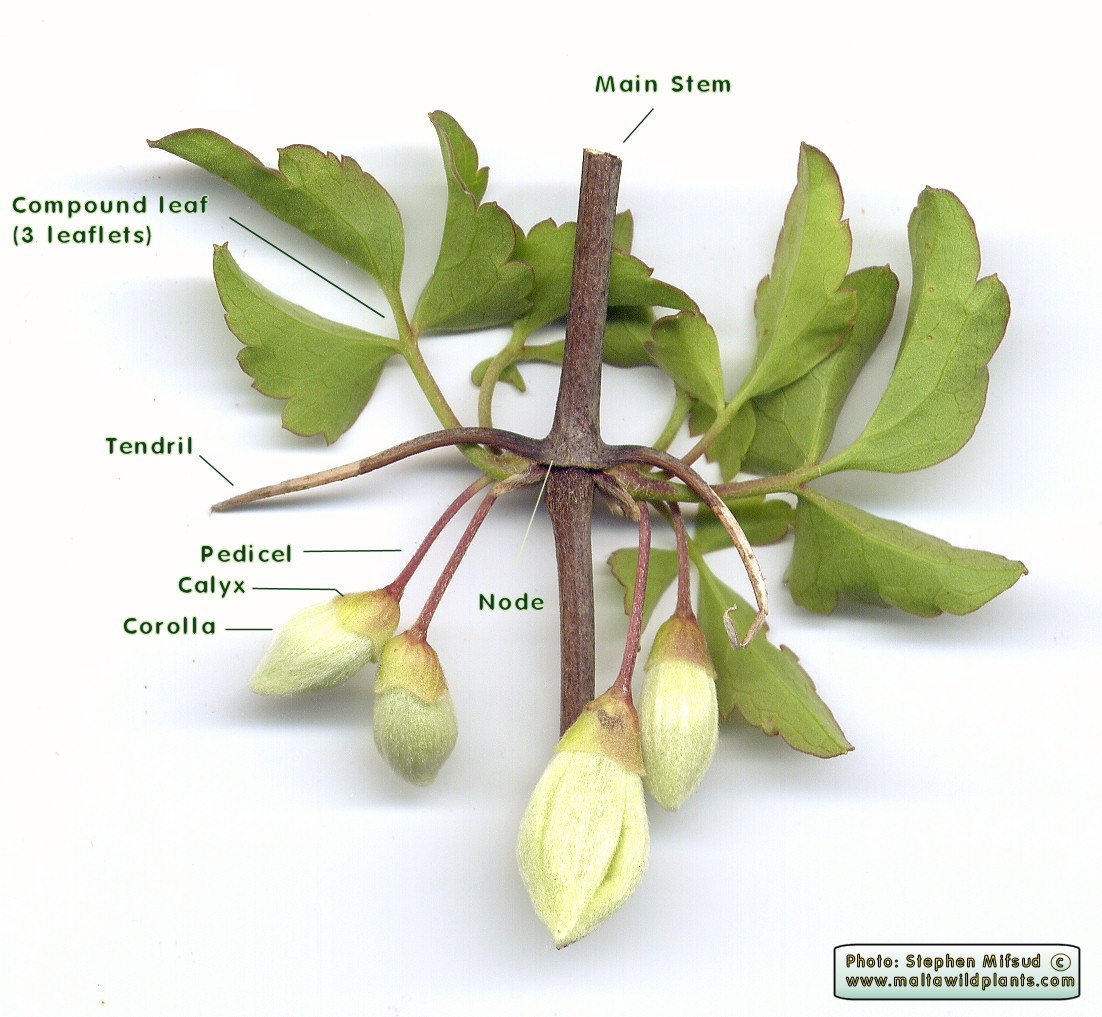
The flowers have also slender pedicels about 15-20mm long, and since they are flimsy, the flower hangs down to an upside down position (pendulous). There are usually 2 pairs of flowers per node and since they are opposite to each other and arise from the same locus, the resulting inflorescence can be described as dichasial cyme, but slightly different from the general type of dichasial cyme since there is no apical/central flower in between the forking flower branches.

The general description of the flower may be different from the real 'to-the-book' botanical description, because for instance the perianth structures that look as obvious 'petals' are referred to be modified stamens by some, and as sepals by others! In simple terms, the flower has a gamosepalous calyx and 4 petaloid structures that overlap and assume the shape of a bell (campanulate). Inside, there is a cluster of 20-30 spread-out stamens and a cluster of ovaries/styles/stigma sitting on a common central receptacle and grouped close to each other as a single conical structure.
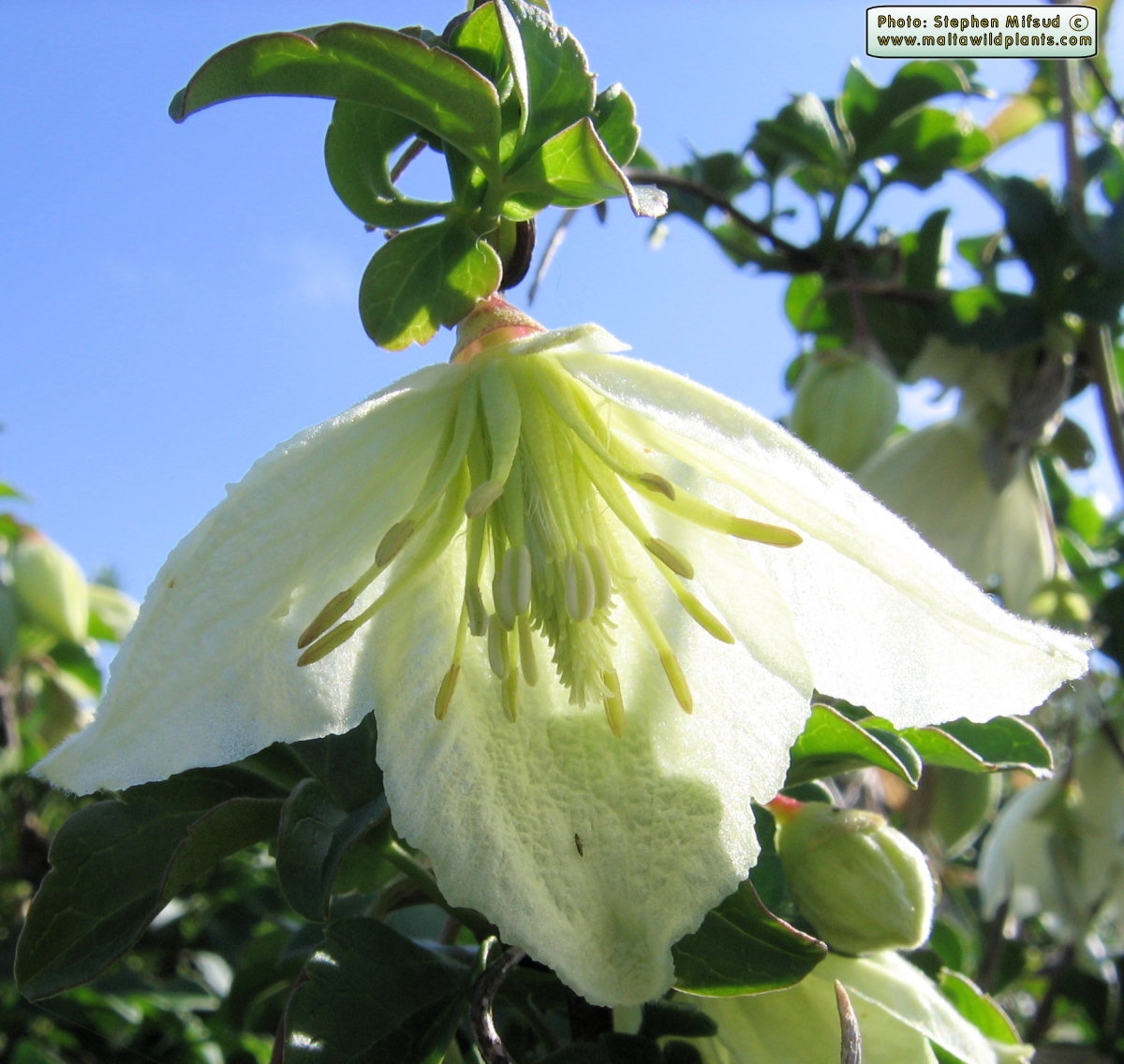
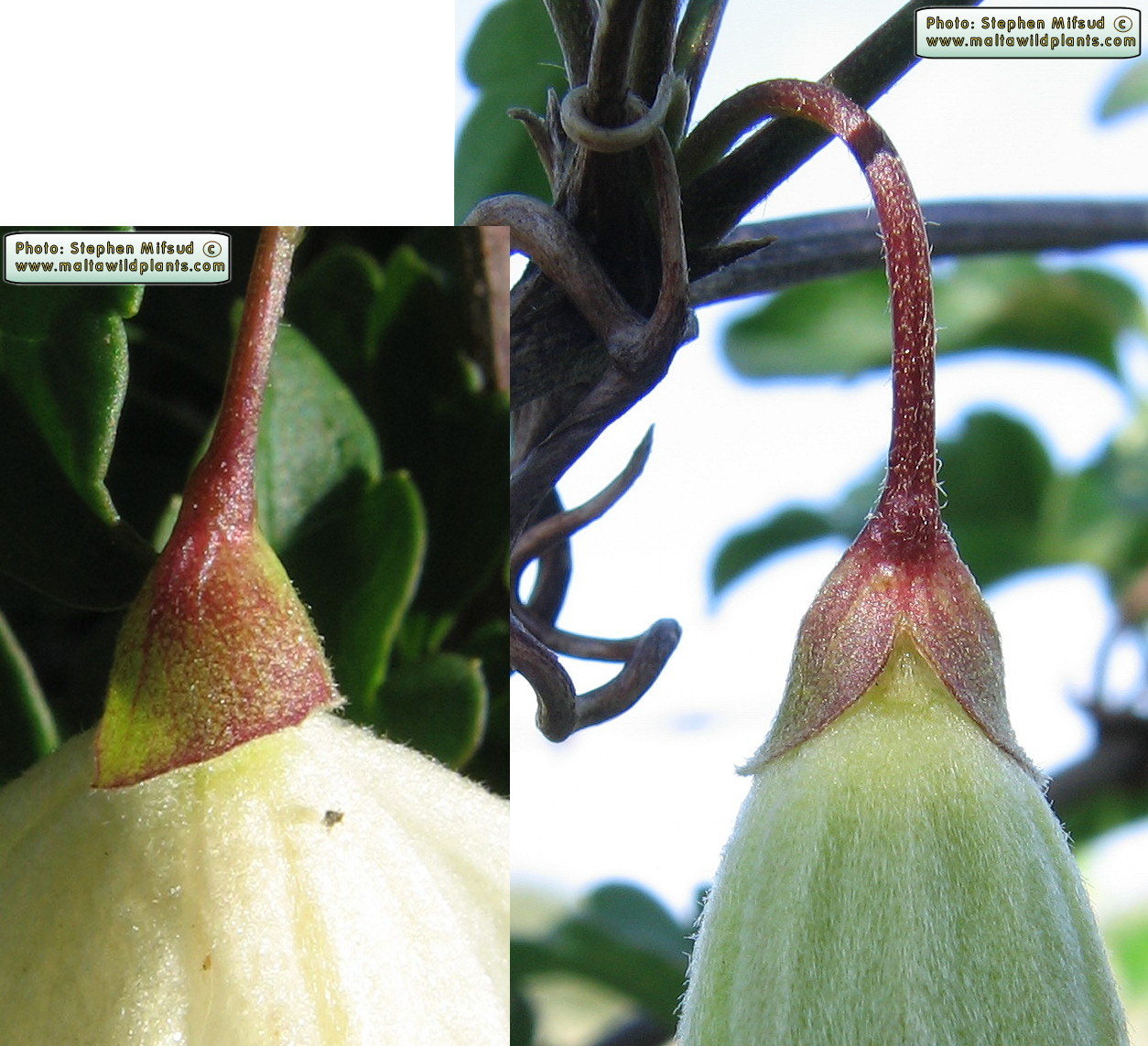
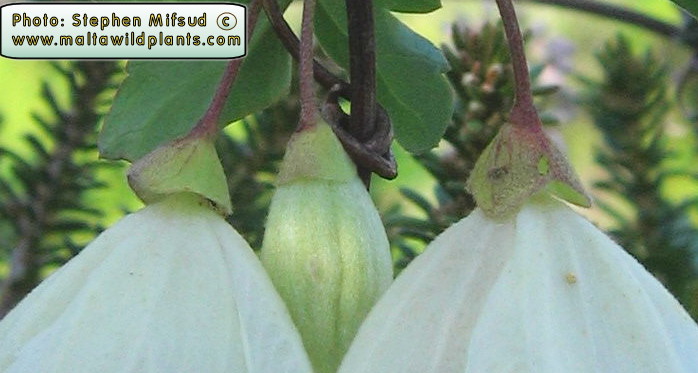
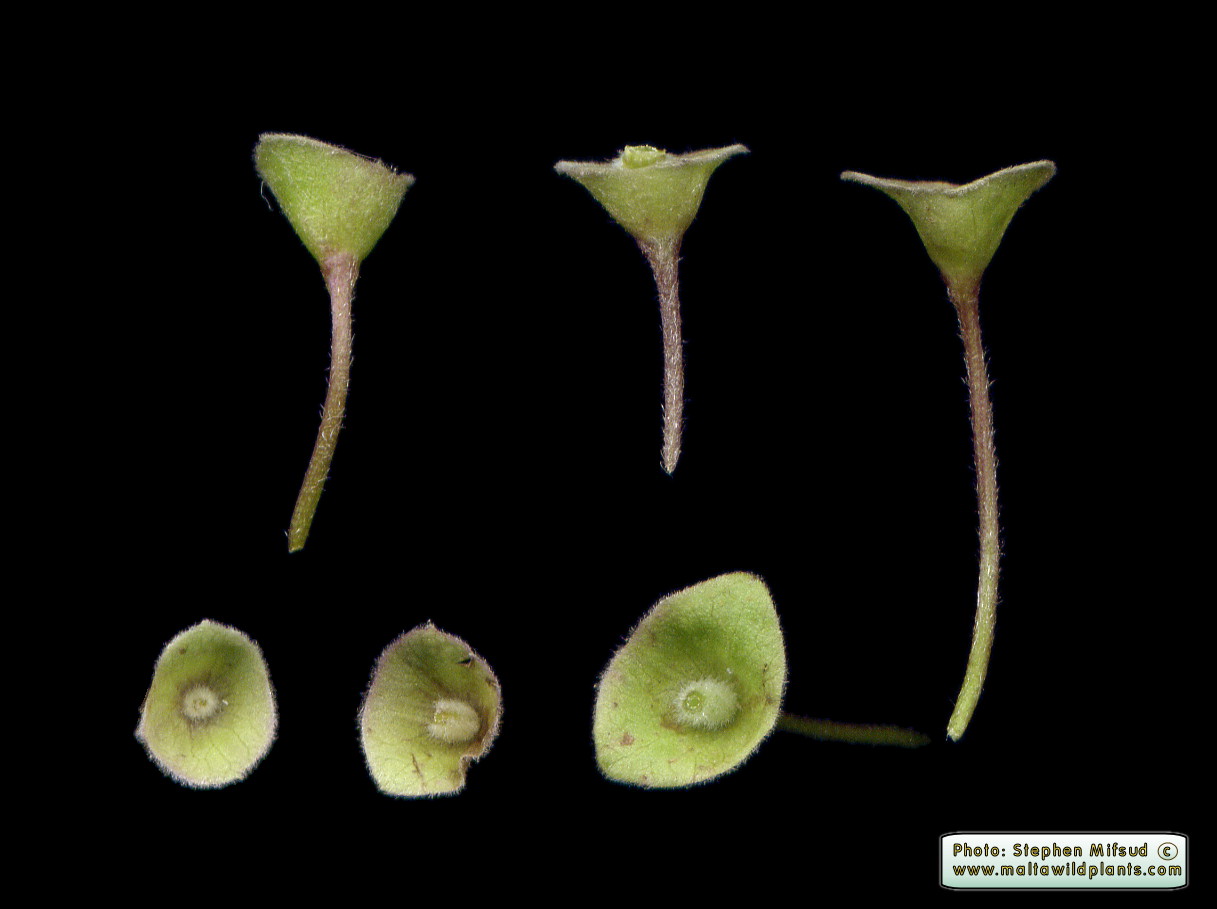
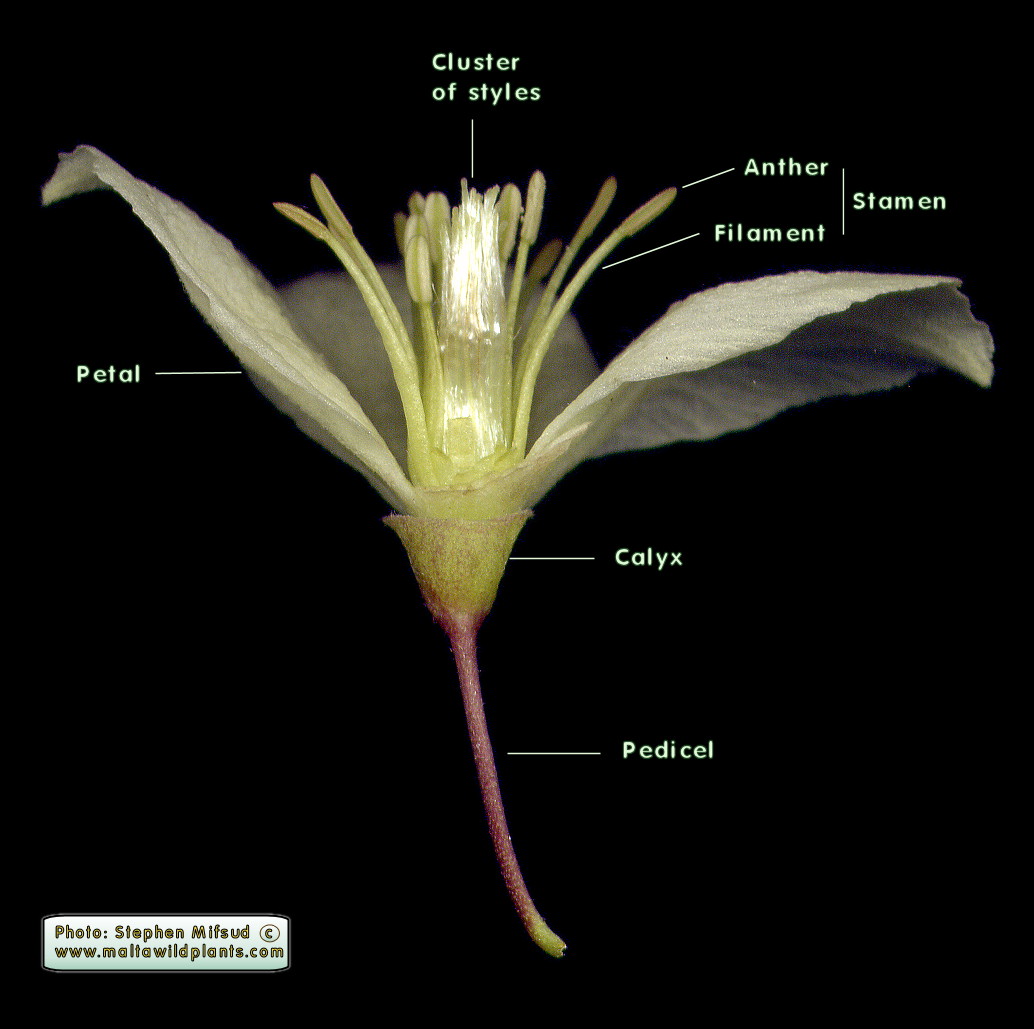
The calyx is small (8mm across), singular, cup-shaped unit with a rim that is not perfectly circular, but somehow undulate. It can be spotted or flushed in red and occasionally found split into 2 halves. The 'petals' are off-white cream or pale green and are about 30mm long and 24mm wide. Each stamen has a firm rather thick filament (14mm long) and a white or pale green anther (3mm long). The centre is occupied by numerous ovaries that have long styles and a swollen or hooked stigmas. Sweet scented flowers are off-white cream, sometimes with many red spots. They measure about 36mm across and 30mm long including the calyx but not the pedicel (which is 16-20mm long).

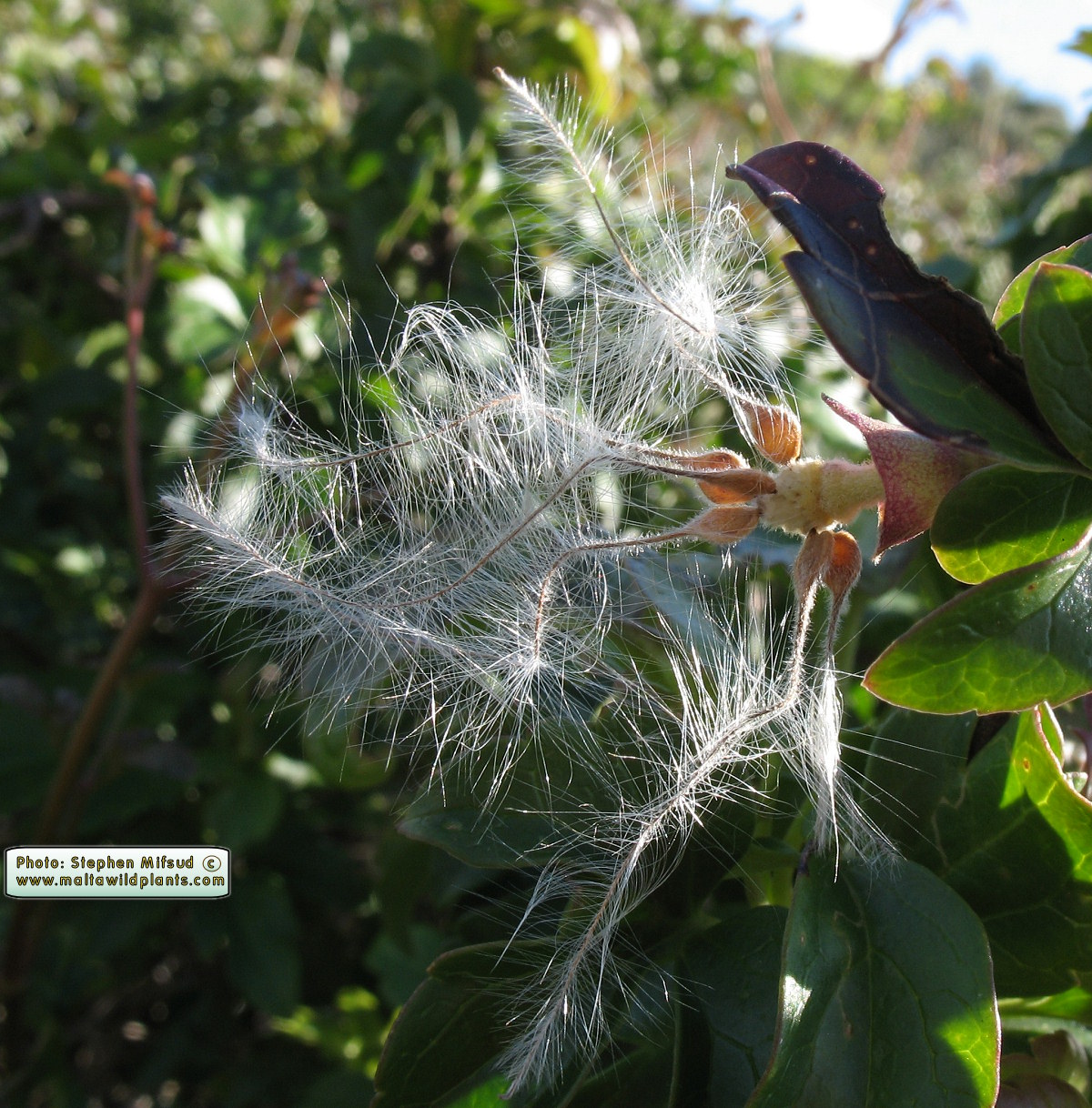
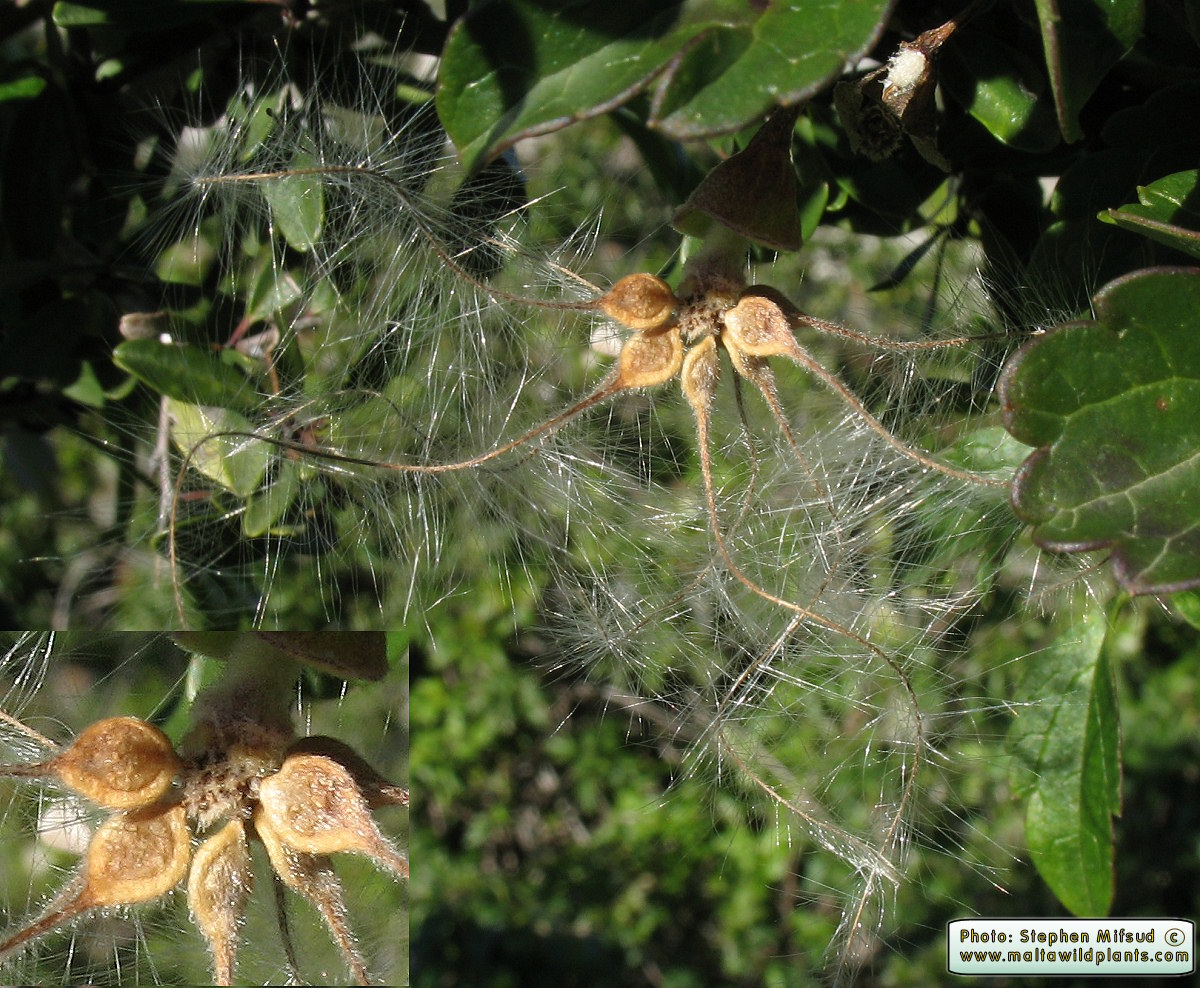
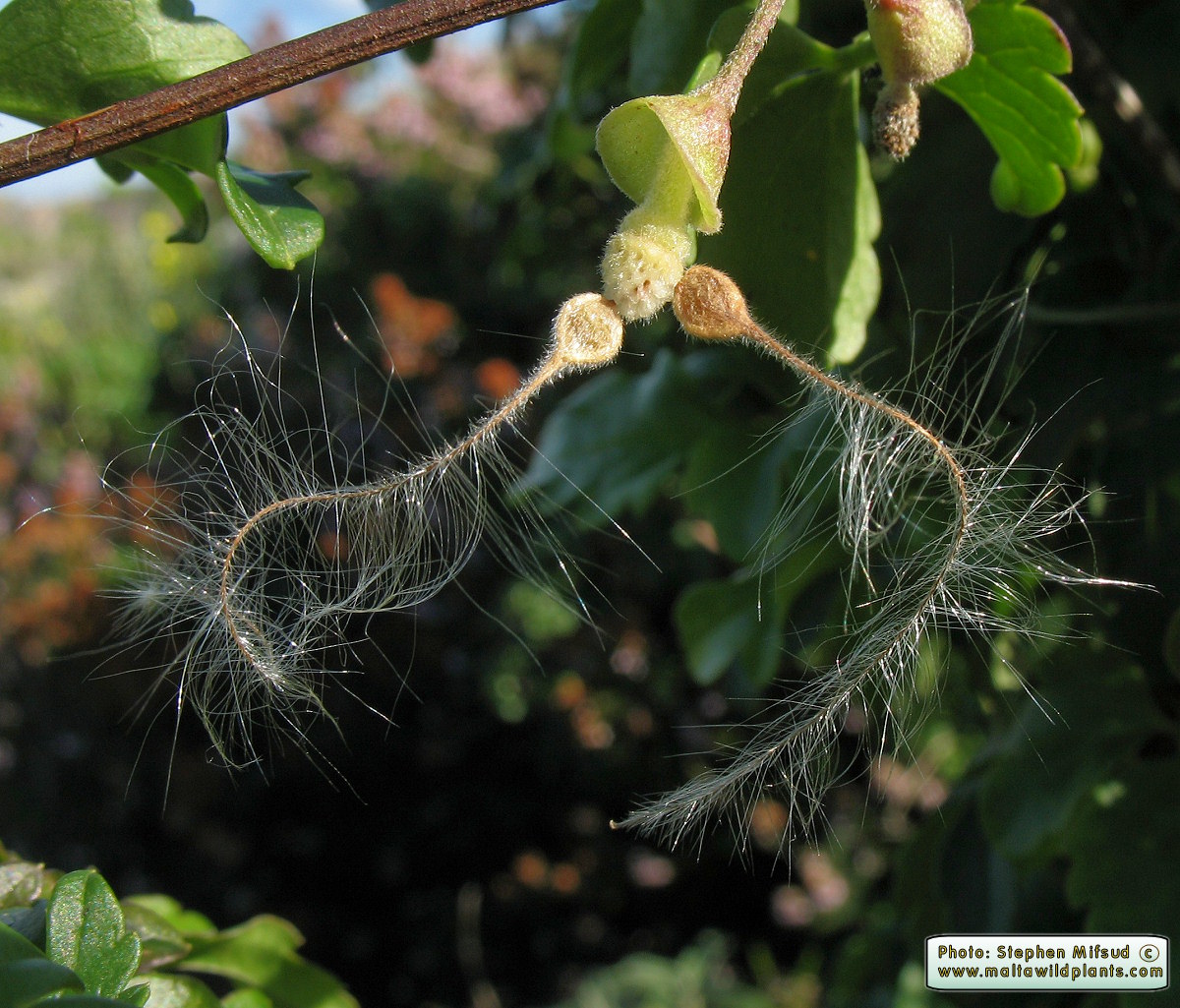
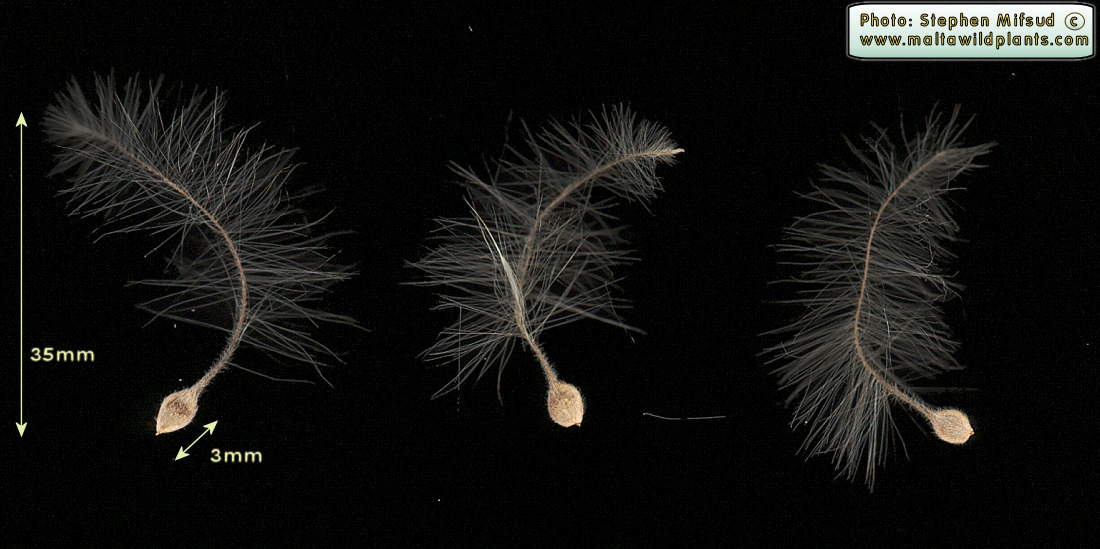
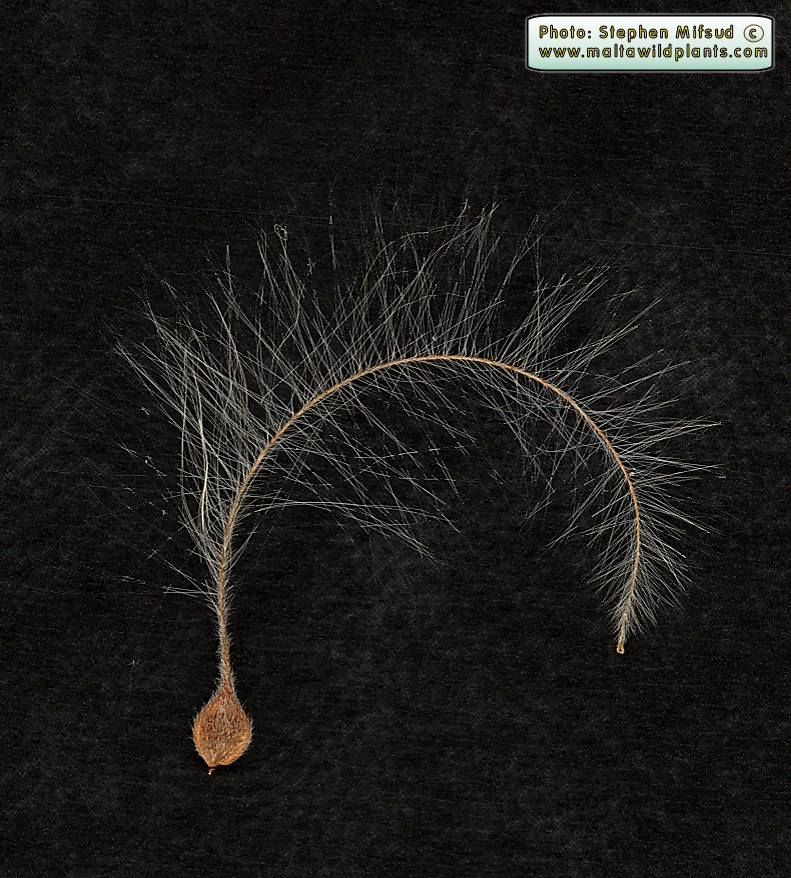
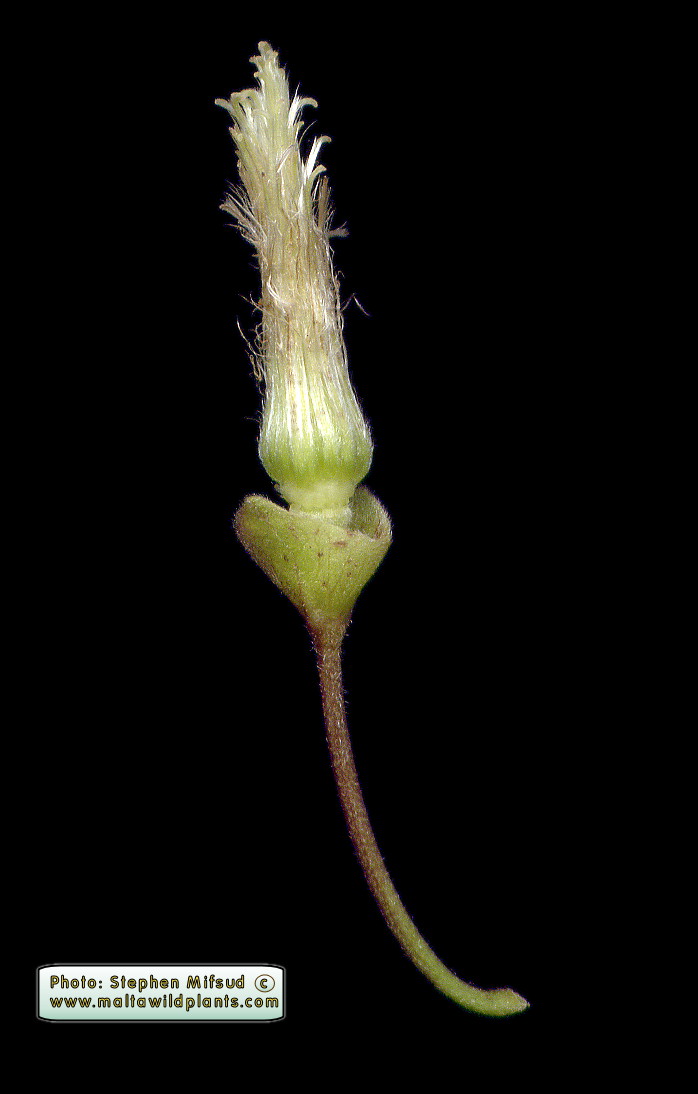
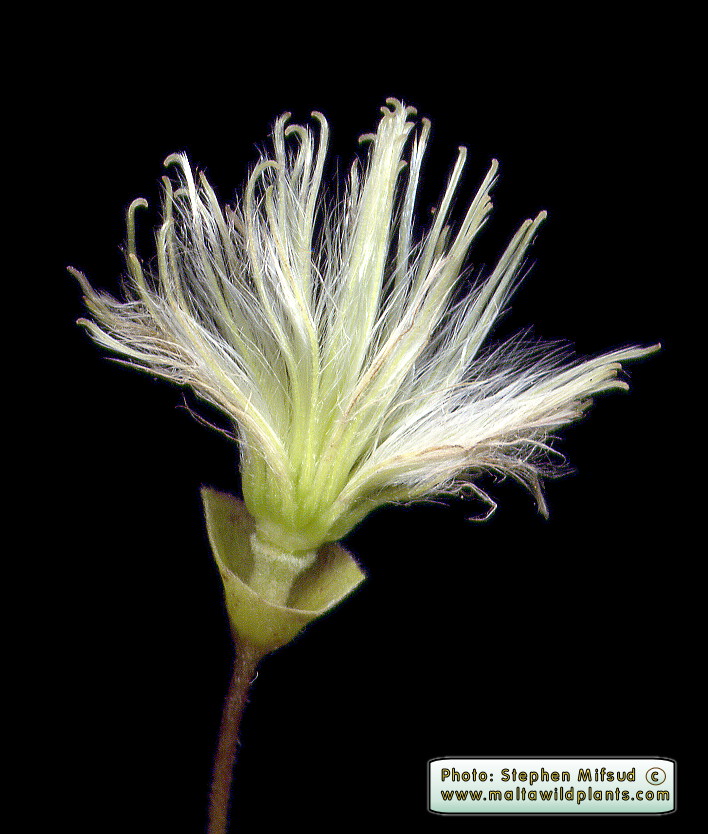
After fertilisation, each ovary becomes a single-seeded circular achene attached to a common dome-shaped receptacle. The achene retains the long style from which numerous radiating bristles spread out when it matures and makes the whole structure looks like a feather - referred to as plumose. For this reason, the fruit (collection of seeds) look like a tuft of shining white feathers or silk. Seed is brown with a flattened circular structure 2-3mm in diameter. Needless to say, it is dispersed by wind. The seed and feather-like appendage measures about 35mm in length when straightened out.


Additional Information


Nativity and distribution

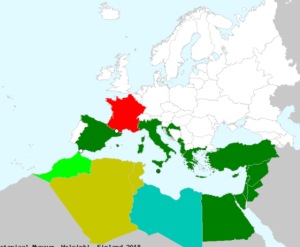
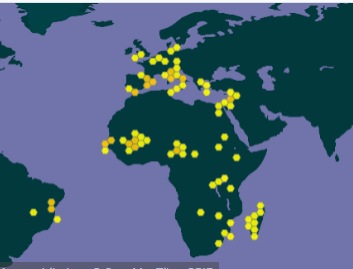
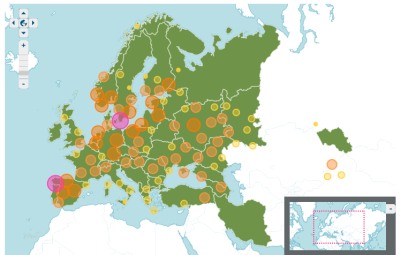
The distributional range of this plant is shown in the list below: [WWW-26]

Northern Africa:   Algeria [n.] ; Libya [n.] ; Morocco; Tunisia
Western Asia:   Israel; Lebanon; Syria [w.] ; Turkey
Europe:   Cyprus; Greece [incl. Crete] ; Italy [incl. Sardinia, Sicily] ; France - Corsica; Portugal [s.] ; Spain [s. & Baleares]

It is a native of South Europe and North Africa [WWW-122]

Potting

Grow Clematis in moist, fertile, well-drained soil in a sunny position. The hole should be at least 18 inches wide and as deep as the depth of the topsoil will allow. A mixture of equal parts good topsoil and well-rotted manure or leaf mold should be used to fill in the hole. A handful or two of bonemeal would also be beneficial. The location for your plant should be chosen carefully. The hole shouldn't be near the feeder roots of any shrub or tree up which the Clematis is to grow, nor should it be too close to the trunk. A cane can be placed at a slant between the Clematis and its support so the vines can be trained toward it. [WWW-43]
When growing against a wall, note that the base is usually sheltered from rain and Clematis will not thrive in dry conditions; to prevent death, don't dig the hole too close to the structure. Water your Clematis while they are still in their containers and again after they are planted. Large-flowered Clematis should be planted deep enough so that the crown is 1 to 3 inches below the surface. Clematis planted in the spring need to be watched carefully until fall and watered well whenever dry. The roots of the Clematis need to be kept cool, therefore mulch with decayed manure or compost and plant a shallow-rooted, low growing, ground cover underneath. Clematis are pruned according to the group to which they belong. The Florida, Patens, and Lanuginosa groups produce flowers on the previous year's growth. Pruning consists of trimming the old flowering growths right after flowering. Older, crowded plants can be pruned hard in late winter, but the first crop of flowers will be lost. [WWW-43]

The second group contains Jackmanii, Viticella, and Texensis. These Clematis flower on the current year's growth, often in late summer and fall. Pruning for this group consists of cutting back to within 12 inches of the ground in late winter or early spring. Old, unpruned plants will become spindly at the base. [WWW-43]

Propagation

Seeds may be sown in the fall, plants may be divided in the spring, or they may be increased by layering, grafting, or cuttings. Sow the seeds in shallow pans filled with sandy soil and place in a cool greenhouse. Layering can be done at almost any season, however, September is the best time. Bend shoots and peg them down with pegs or large stones. Cuttings may be inserted in a frame kept closed for a few weeks. Clematis seem to produce roots better from the piece of stem between the nodes or joints rather than from the joints themselves. [WWW-43]

Toxicity

It is stated by [WWW-123] that all Clematis species are rather toxic due to their constituent Anemonin. All parts of the plant have this toxin. Symptoms of anemonin intoxication are burning sensation of mouth and mouth ulcers; skin redness and burning sensation. It causes severe pain in the mouth if eaten! Skin irritation is minor, or lasting only for few minutes. Mode of entry is through skin, ingestion or inhalation.

Source [WWW-79] put the Clematis plants to be toxic at category 2 and 4. Category 2 are those plants which after ingestion, they may cause minor illnesses such as vomiting or diarrhea. Category 4 are plants that their juice, sap, or thorns of these plants may cause a skin rash or irritation. Wash the affected area of skin with soap and water as soon as possible after contact. The rashes may be very serious and painful [WWW-79]

Another source [WWW-87] says that the toxicity of Clematis spp. are all between mild to moderate due to the presence of Protoanemonin (Precursor of Anemonin) from ranunculin glycoside. Symptoms mostly inflammation and blistering of skin and gastrointestinal irritation. Usually only present in fresh plants, not dried.

Medicinal Uses

Not much information about medicinal properties of this plant has been found. One source [WWW-123] mentions that it was used in ointments in the treatment of pain. It contains Acetyloleanolic acid.

A report from [WWW-18] states that the plant was useful to treat migraine:
"My husband gets cluster migraines, and he is immensely helped by Clematis tincture (40 drops). It doesn't work to prevent getting a migraine in the first place, like Feverfew is supposed to, but it will stop a migraine in its tracks. It's important to take the Clematis as soon as you realize you might be getting a migraine. It makes the migraine go away in about 20 minutes, without ever getting really bad; without it his migraine would last several hours."

Additionally, the same source mentions a report by Prof. Landerer, of Greece (1877), that a case of epilepsy was cured after futile attempts with other medicine, by a species of Clematis, either C. cirrhosa (more) or C. sylvestris. They are also rubefacient and vesicant. [WWW-18]

Habitat, hardiness and vigourisity

Clematis cirrhosa is a native of South Europe and North Africa, and scarcely hardy enough for the climate of London, but thrives in a cool conservatory and on open walls that are well sheltered. Miller, the renowned manager of the Chelsea Botanic Garden, said: "Those which have been growing in the open air at Chelsea more than fifty years have resisted the greatest cold without covering." But Mr. Moore, the present curator there, says, "It gets cut to the ground in severe winters, even in Devonshire." In the woody parts of the Atlas Mountains and about Algiers it is a vigorous climber and a strangler of trees; but here its vigour is subdued, and it makes no impression of a capability to give a character to forest scenery. Its flowers are white or cream-coloured, and somewhat campanulate in structure. [WWW-123]

A Brief History on Clematis

There are over 400 wild varieties of native clematis, in fact most countries in the temperate regions of the northern hemisphere and to some extent in the southern hemisphere have species of clematis. For example, C. alpina is found in eastern Europe and C. cirrhosa in Mediterranean countries, C. vitalba in Britain, C. montana in India, C. lanuginosa in China, C. patens in Japan, C. aristata in Australia, C. afoliata in New Zealand and C. virginiana in America. [WWW-120]

Early plant collectors brought examples back to europe, which were soon to enrich its flora. One of the first to be introduced to England was C. viticella, which was brought from Spain in 1569. This was followed in 1596 by three other European species, C. cirrhosa, C. integrifolia and C. flammula. They were all used in hybridising programmes to produce new varieties. It was not until the 19th century that the stock for the large flowered clematis, which is so admired today was introduced from China, C. lanuginosa for example and C. patens from Japan. The Victorians took to clematis in a big way and the pioneering nursery of Jackmans once held a list of 343. Unfortunately the then little understood disease wilt, decimated the commercial stocks and it was not until after the second world war that nurseries were once more able to pursue serious large scale propagation. However the legacy of the Victorians does live on, many of the popular large flowered clematis available today come from the last century. [WWW-120]

Myths about Clematis

There are but two. One states that a clematis likes its feet in the shade and its head in the sun. It is not the shade that the roots require, it is the water that lies in the shade. If clematis are given adequate watering and adequate mulching they will flower in full sun.

A second myth states that clematis enjoys an alkaline soil which comes from the observation that they flourish in chalk soil. It is not the alkalinity, however, that encourages the clematis, rather it is that chalk holds deposits of water and this is what the plant is after. Given water it will flourish in any soil as long as there are no extremes of acidity or alkalinity. [WWW-120]

Differences between C. cirrhosa and C. cirrhosa var. balearica

The table below lists the differences between the 2 species according to reference [WWW-71] :

Feature C. cirrhosa C. cirrhosa var. balearica
Common name in US The tendril clematis The fern-leaved clematis
Habitat and height Vigorous on a warm wall. Height to 4 m (15 ft). Vigorous on sheltered wall. Height to 6 m (20 ft).
Petals Creamy-white sepals with no freckles Yellow-white sepals with reddish-maroon freckles
Leaves Evergreen, Tri-lobed ovate leaves. Evergreen, Fern-like leaves
Nativity South Europe / Mediterrenean From the Balearic islands.

Personal Observations


Rusts observed on Clematis cirrhosa in Malta
Few leaves of C. cirrhosa had yellow markings or patches which looked to be some sort of disease likely caused by a fungus. A sample was taken at the plant mycology Lab, Ghammieri and indeed it was a fungal pathogen of the genus Aecidium. It was difficult to arrive to the species level due to the complexity of the life cycle of Aecidium species, but the most likely species is Aecidium clematidis DC. Confirmation could not take place due lack of sample material amongst other things.

Photo Gallery

Clematis cirrhosa (Evergreen Traveller`s Joy) - CLICK TO ENLARGE PHOTO Clematis cirrhosa (Evergreen Traveller`s Joy) - CLICK TO ENLARGE PHOTO Clematis cirrhosa (Evergreen Traveller`s Joy) - CLICK TO ENLARGE PHOTO Clematis cirrhosa (Evergreen Traveller`s Joy) - CLICK TO ENLARGE PHOTO
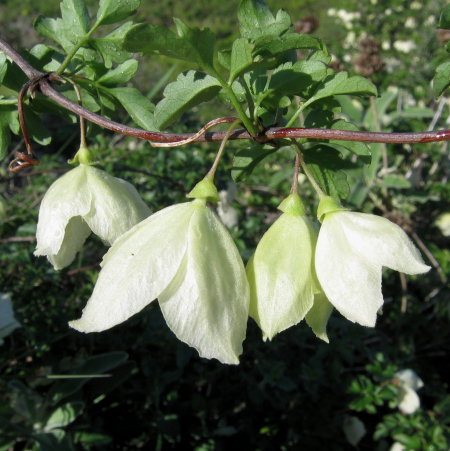
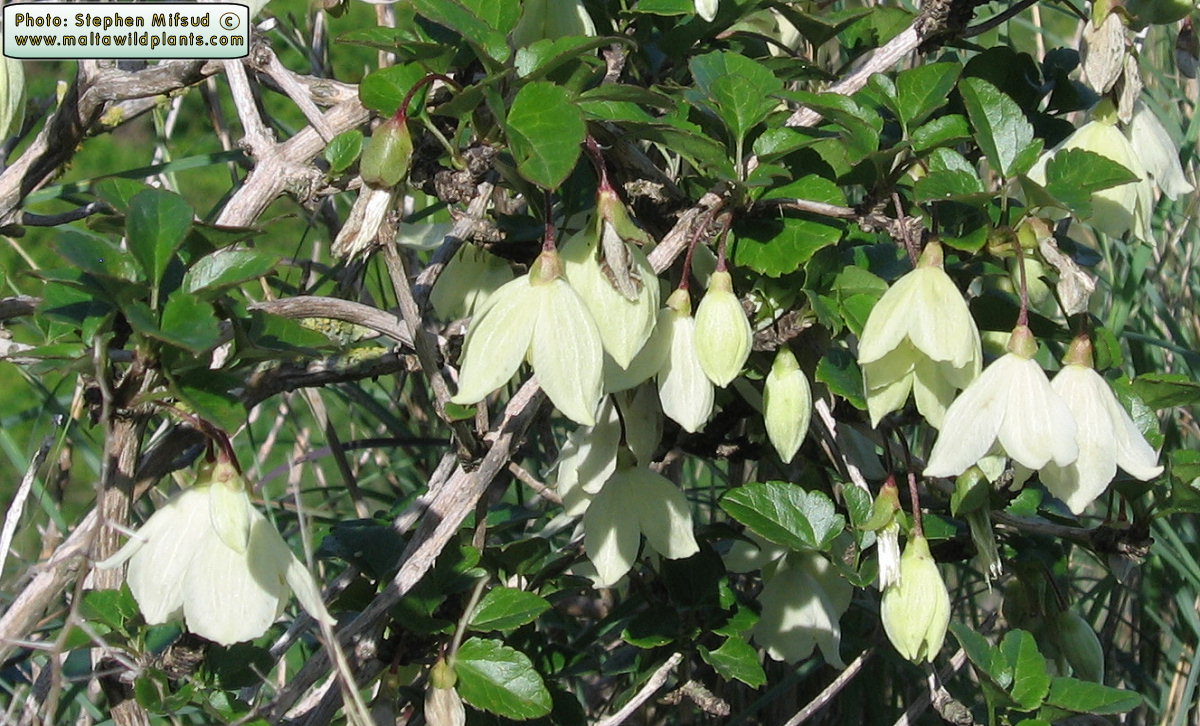
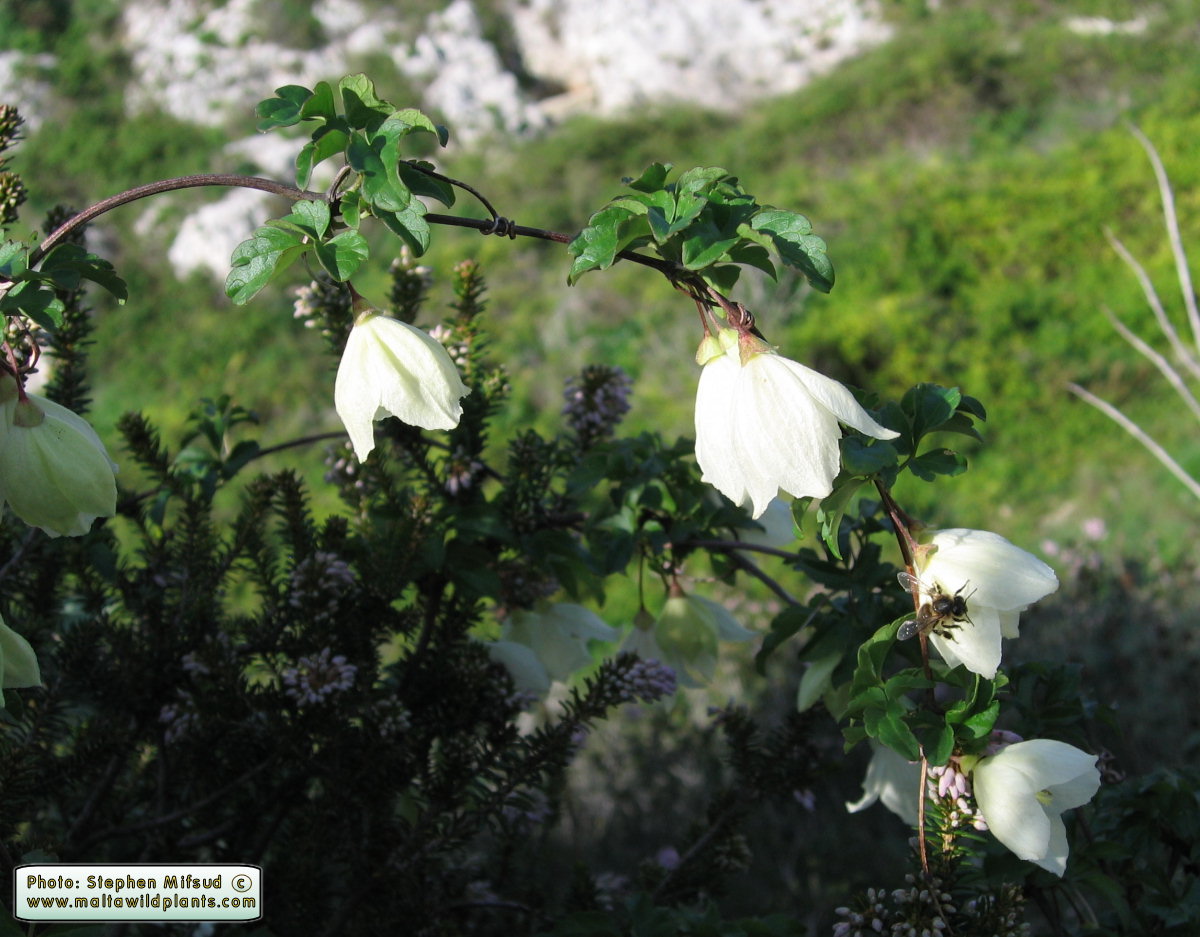
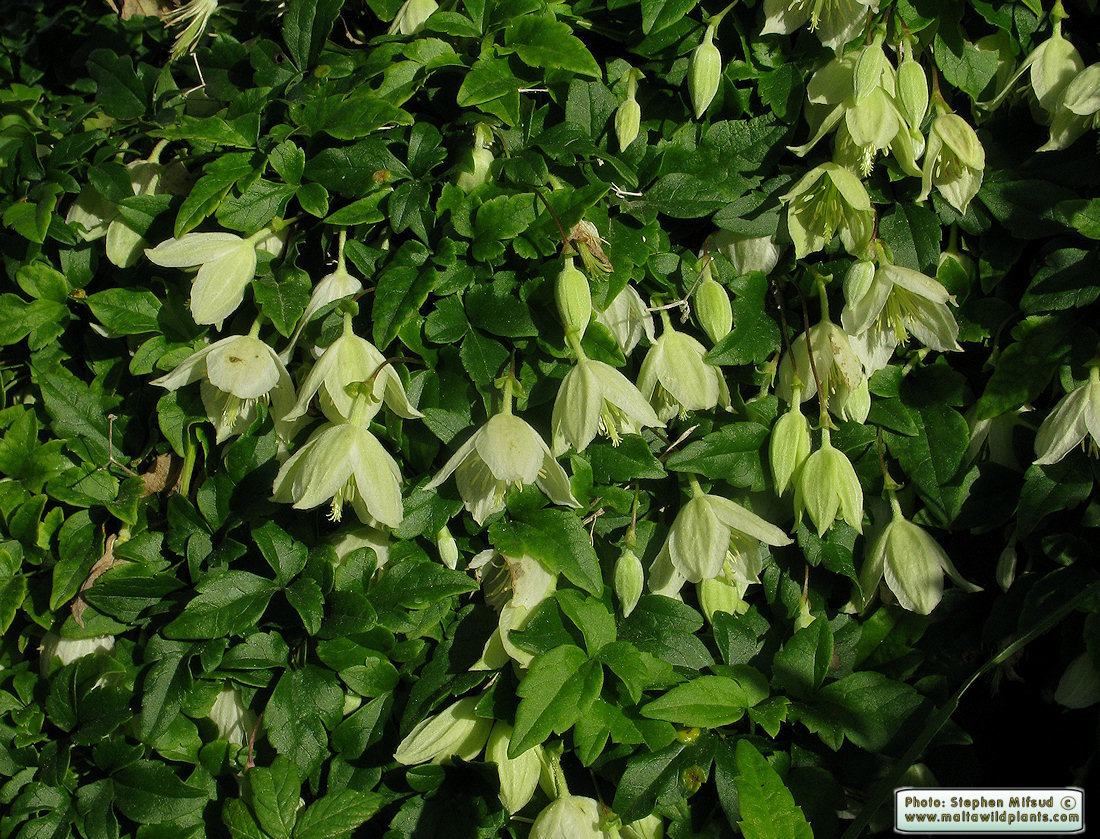
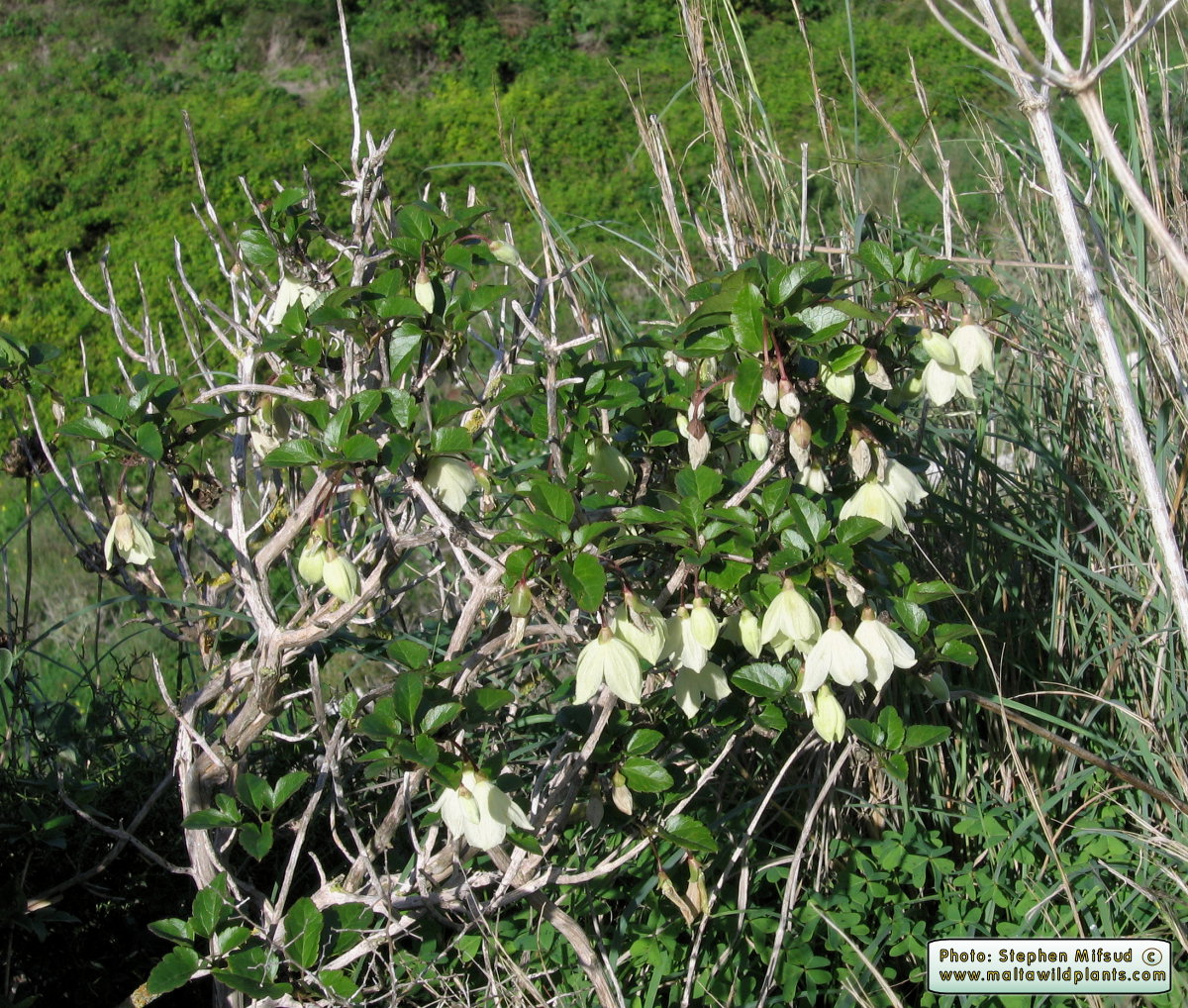
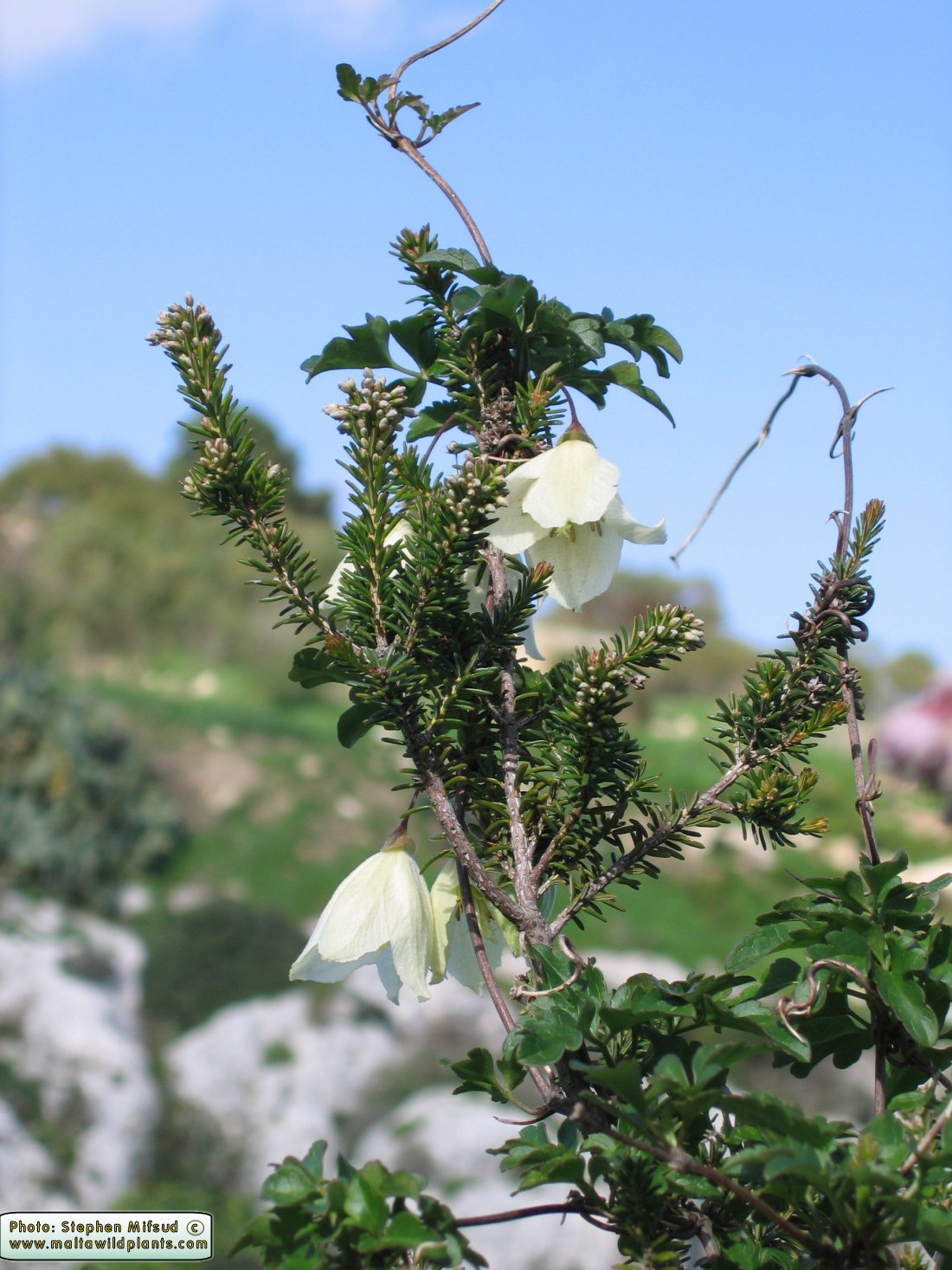
Photo of a group of flowers of the Evergreen Traveller's Joy. They are cream / pale green in colour and hang upside down like bells.
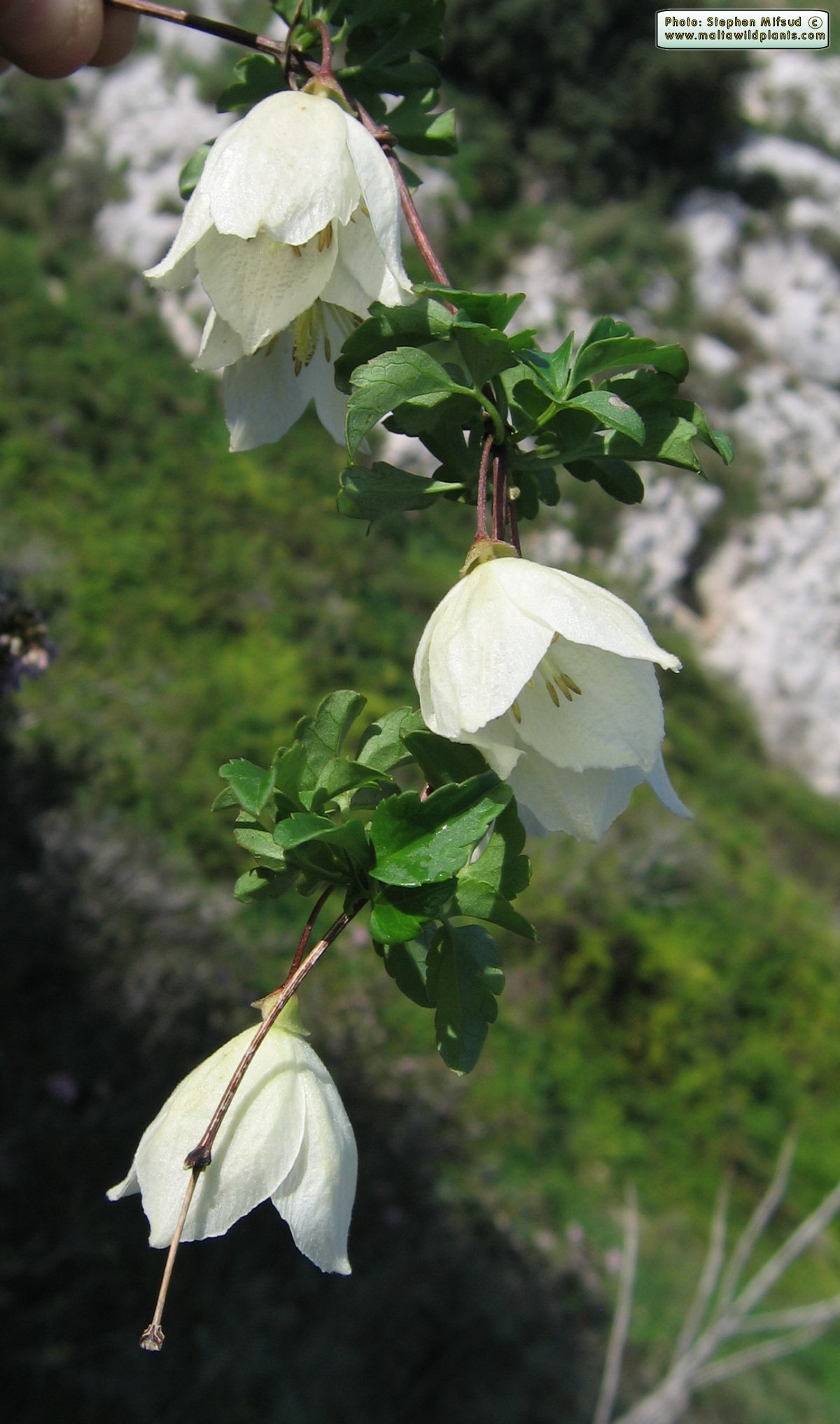
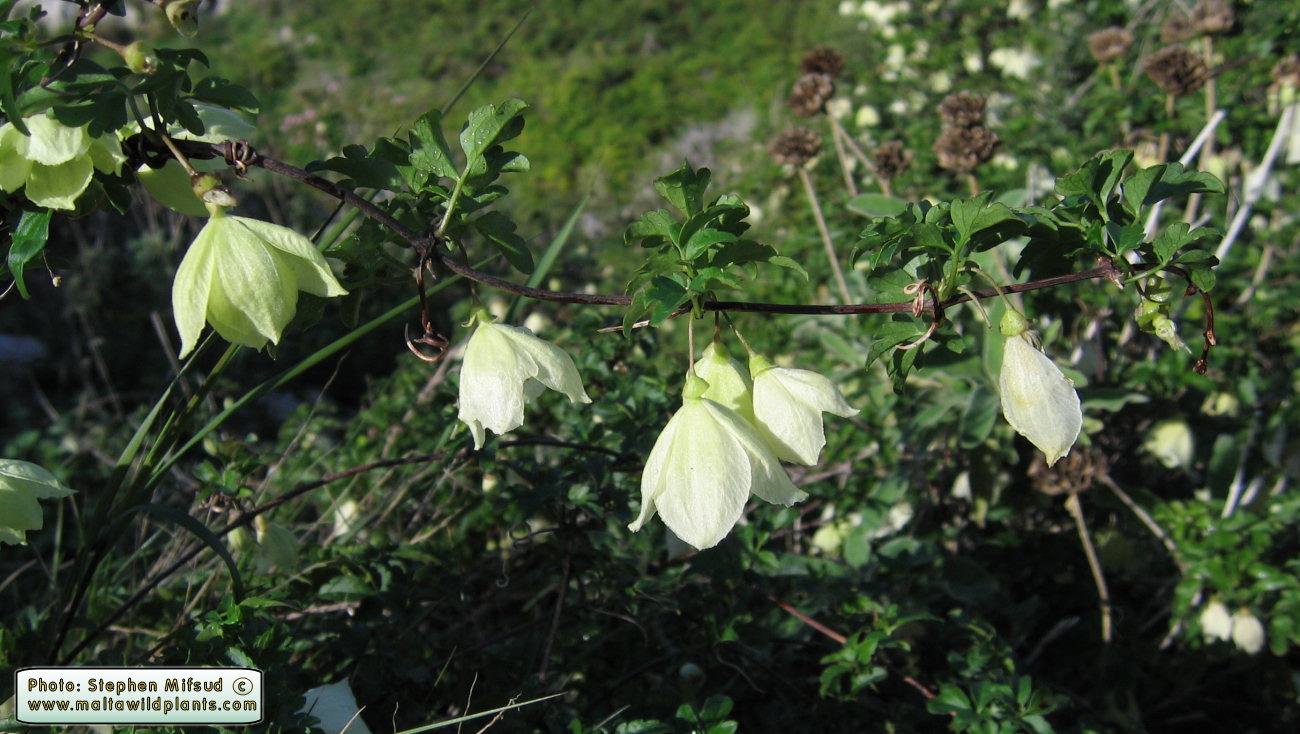
Photo of the bell-shaped flowers along one of the many branches that the plant produces.
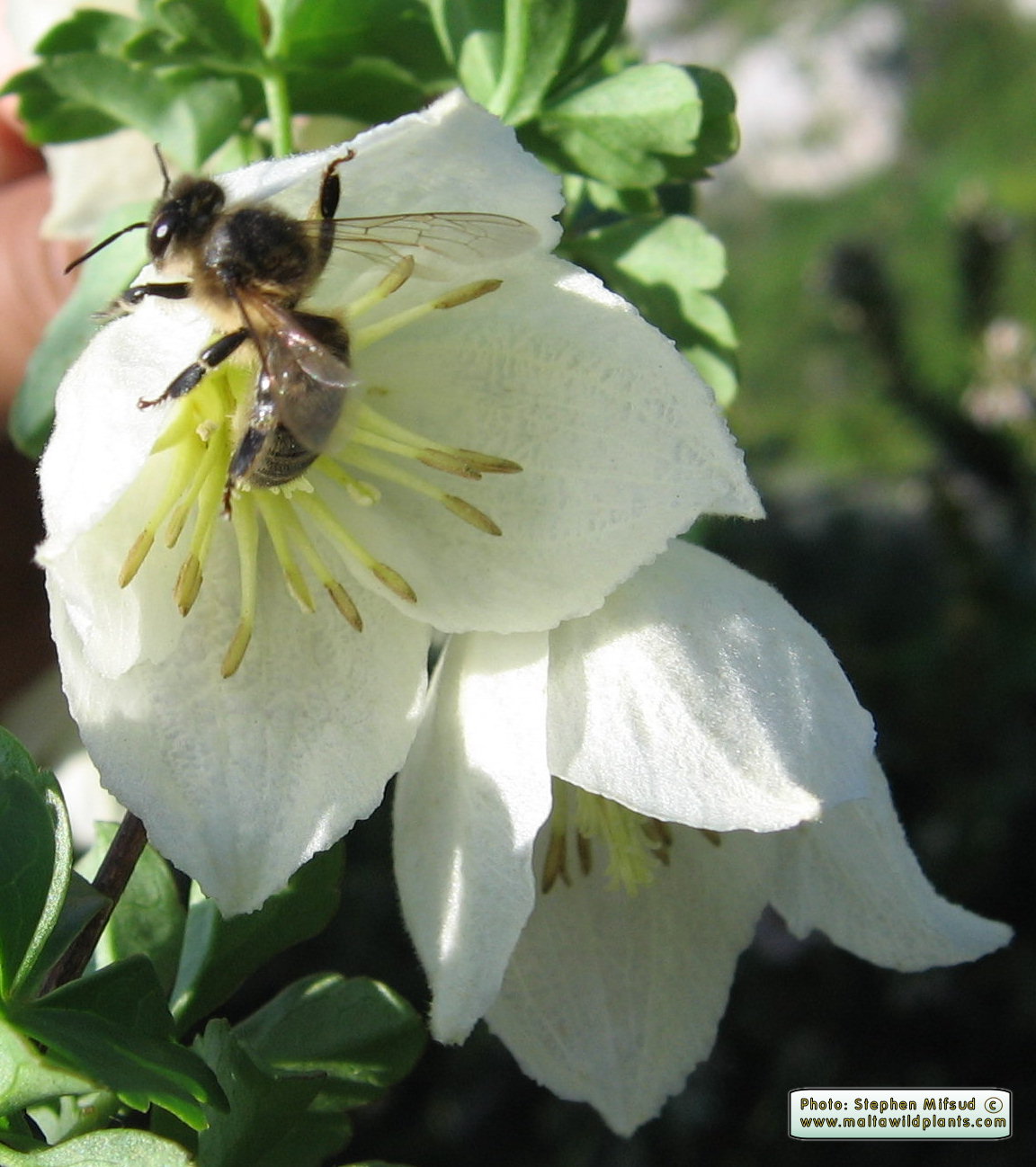
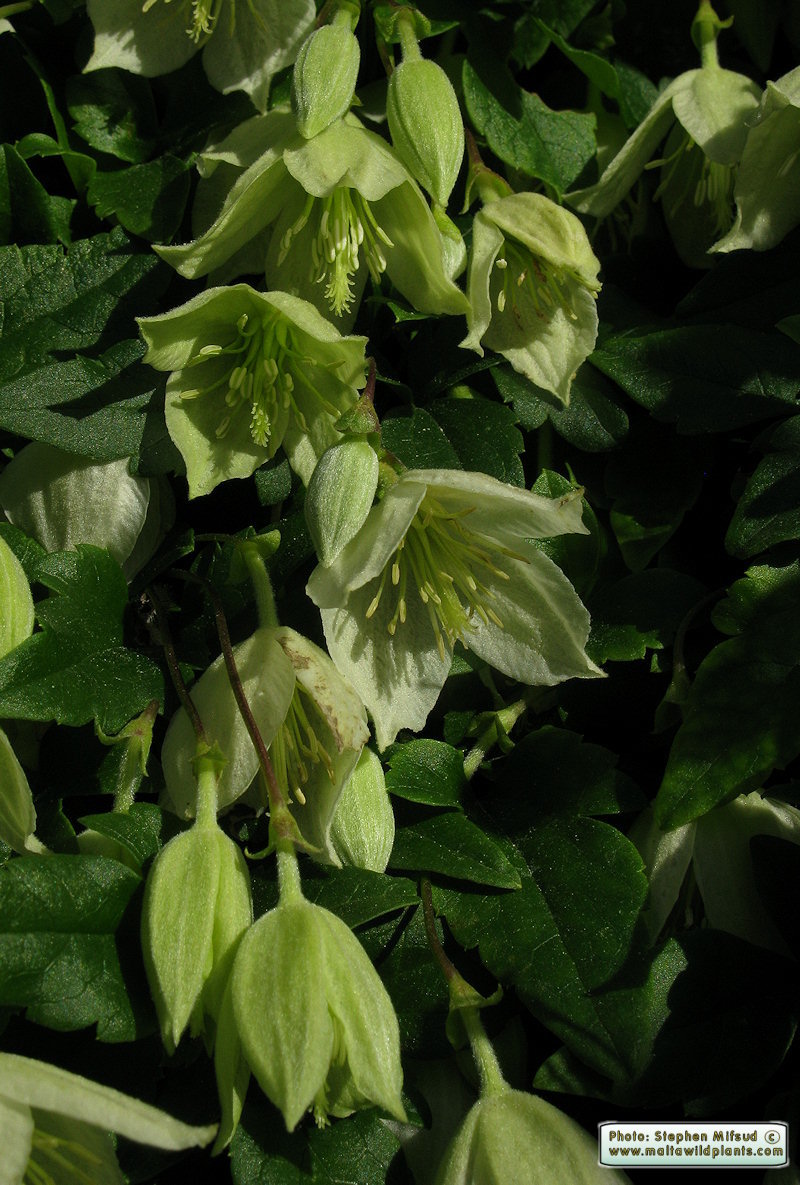
Photo of flowers at regular intervals along the branch. Flowers are sweet scented and attract bees.
Another photo of a group of flowers along a common branch.
Clematis cirrhosa (Evergreen Traveller`s Joy) - CLICK TO ENLARGE PHOTO Clematis cirrhosa (Evergreen Traveller`s Joy) - CLICK TO ENLARGE PHOTO Clematis cirrhosa (Evergreen Traveller`s Joy) - CLICK TO ENLARGE PHOTO Clematis cirrhosa (Evergreen Traveller`s Joy) - CLICK TO ENLARGE PHOTO
Photo of 2 flowers arising from the same node on the stem.
Photo of flowers basically composed of a flimsy, 15-18mm long pedicel, a hat-shaped calyx and 4 petaloid segments ('petals') that overlap each other and give the flower its distinct bell-shape structure.
Photo of a bee visiting one of the many hundreds of flowers that a mature plant produces.
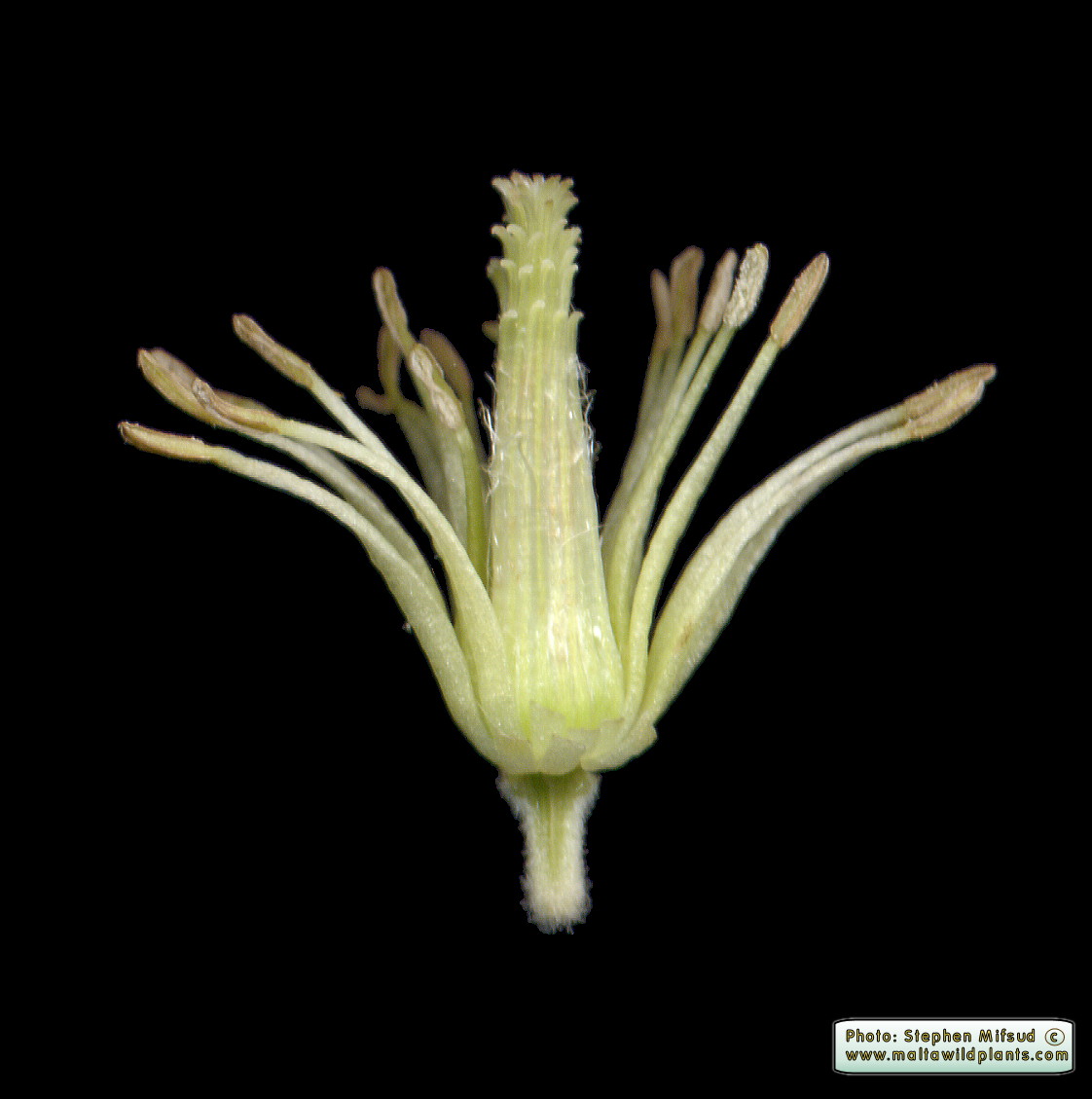
Photo of flower (lateral view) with one of the petals removed so as to show its reproductive organs - an annular cluster of stamens around a central gynoecium.
Clematis cirrhosa (Evergreen Traveller`s Joy) - CLICK TO ENLARGE PHOTO Clematis cirrhosa (Evergreen Traveller`s Joy) - CLICK TO ENLARGE PHOTO Clematis cirrhosa (Evergreen Traveller`s Joy) - CLICK TO ENLARGE PHOTO Clematis cirrhosa (Evergreen Traveller`s Joy) - CLICK TO ENLARGE PHOTO
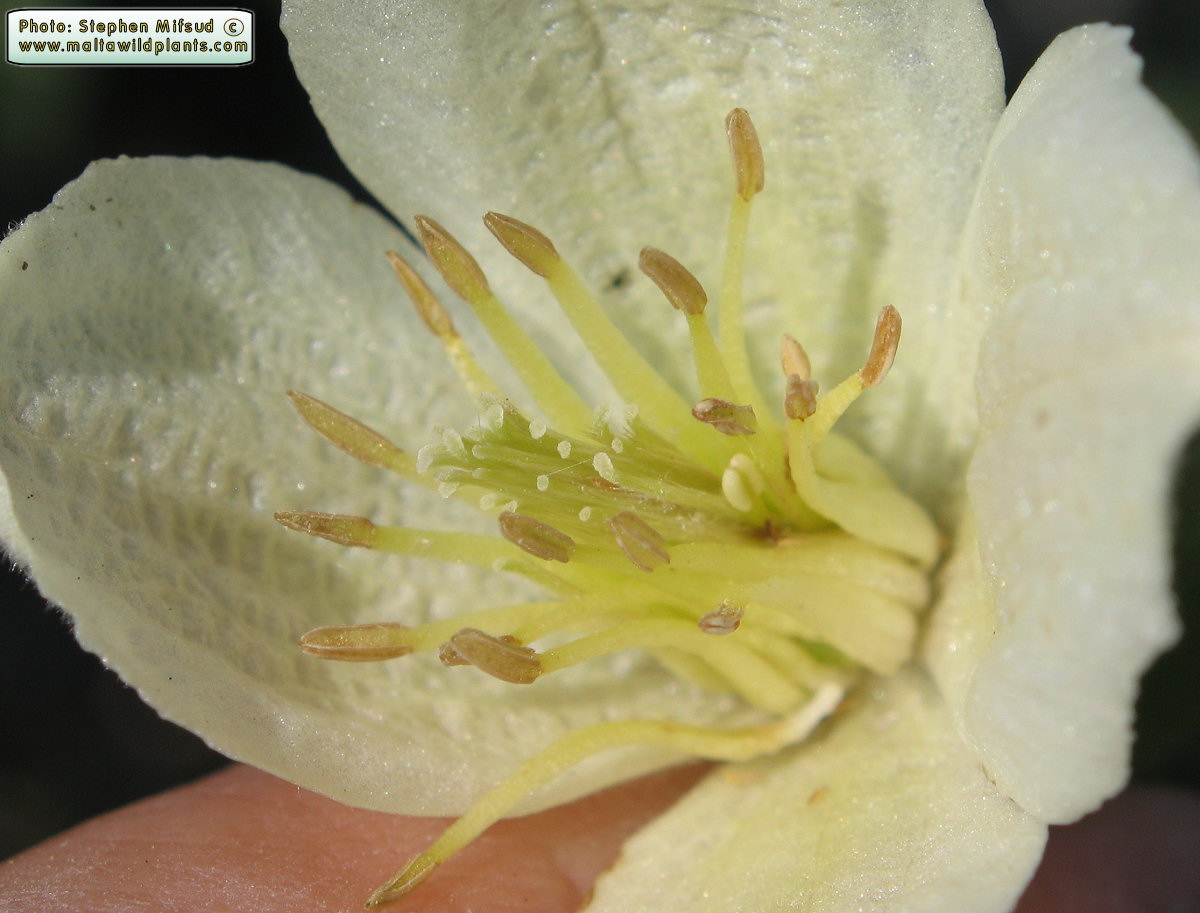
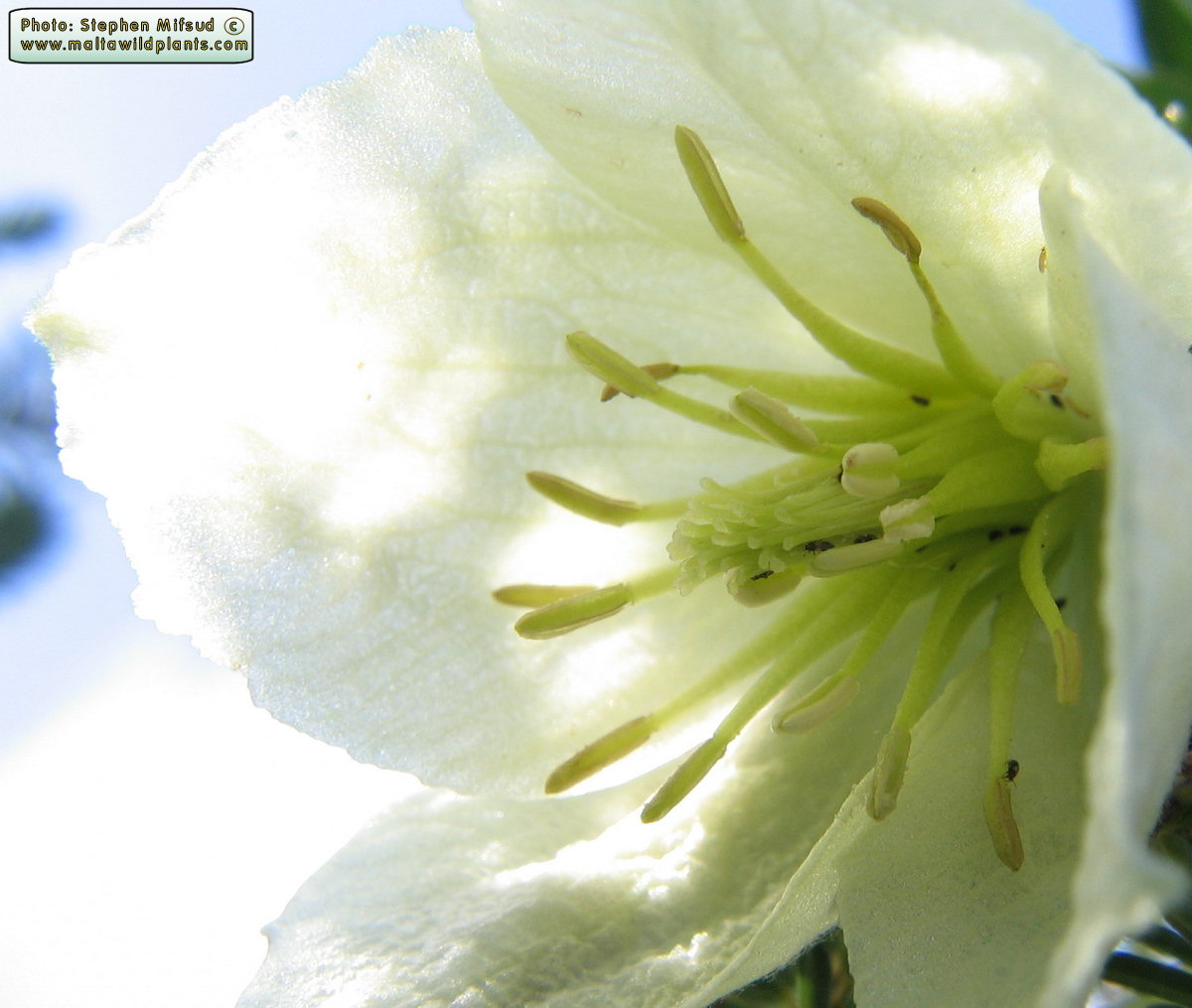
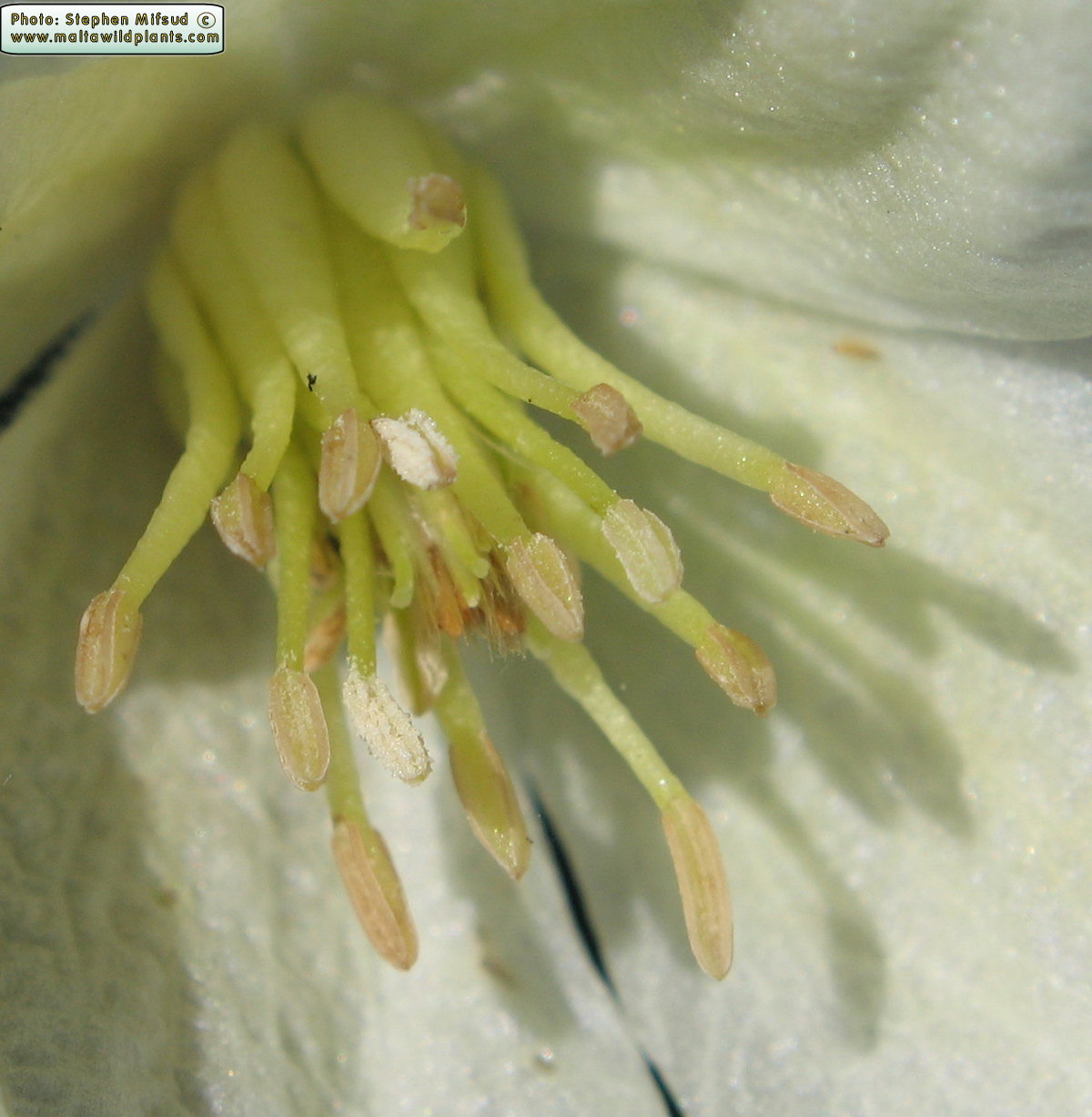
Close up photo of stamens which consists of an erect, rather thick, firm filament and an anther that produces white pollen.
Close up photo of stamens around the female part. The latter consists of a group of ovaries on a common receptacle with long green styles and a swollen and hooked pale stigma.
Another photo inside the flower showing the arrangement of the reproductive organs. The number of stamens varies from flower to flower but they count between 20-30 per flower.
Close up photo of the female reproductive organs that are grouped centrally and have pale stigma.
Clematis cirrhosa (Evergreen Traveller`s Joy) - CLICK TO ENLARGE PHOTO Clematis cirrhosa (Evergreen Traveller`s Joy) - CLICK TO ENLARGE PHOTO Clematis cirrhosa (Evergreen Traveller`s Joy) - CLICK TO ENLARGE PHOTO Clematis cirrhosa (Evergreen Traveller`s Joy) - CLICK TO ENLARGE PHOTO
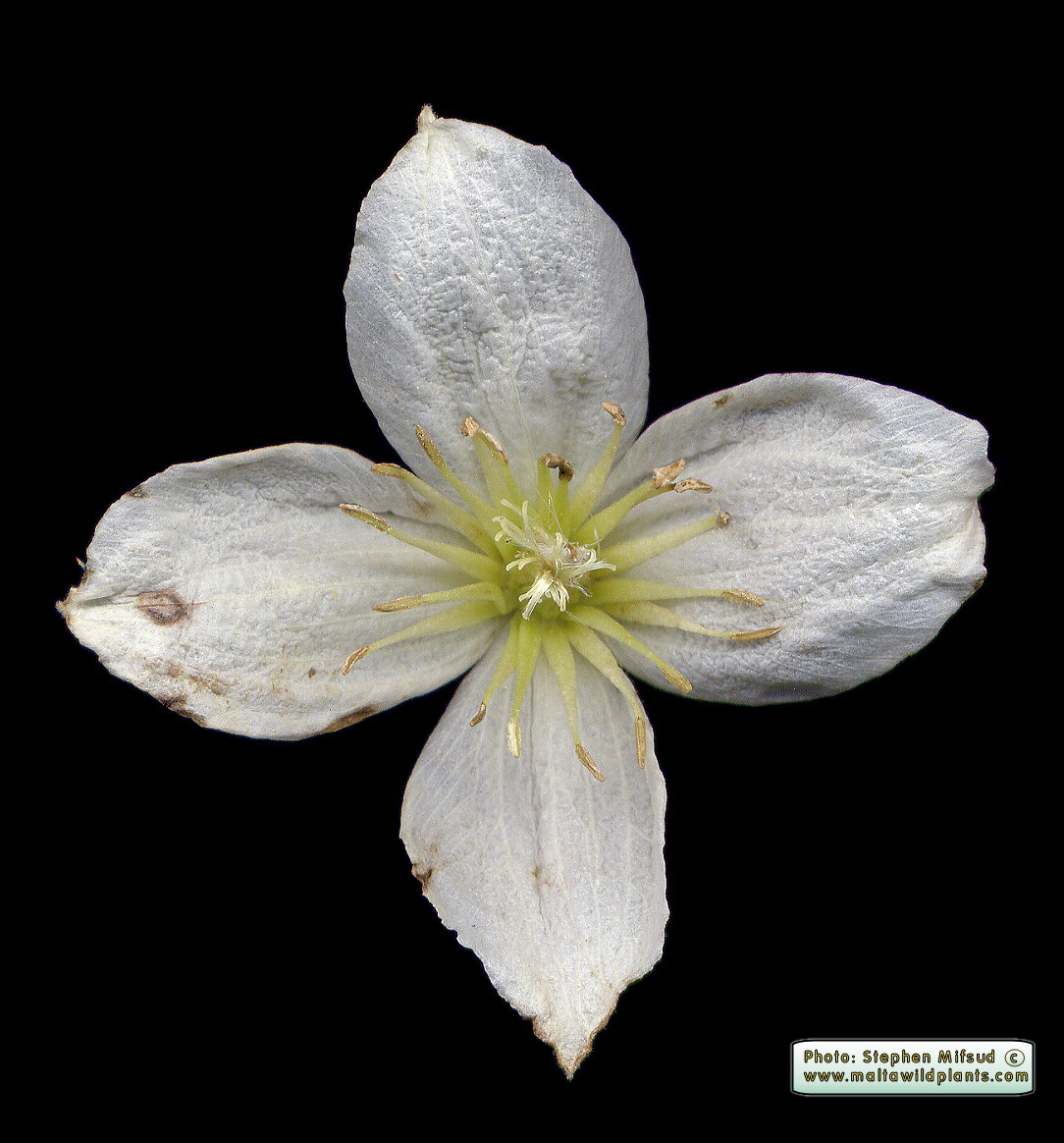
Scanned image of flower.
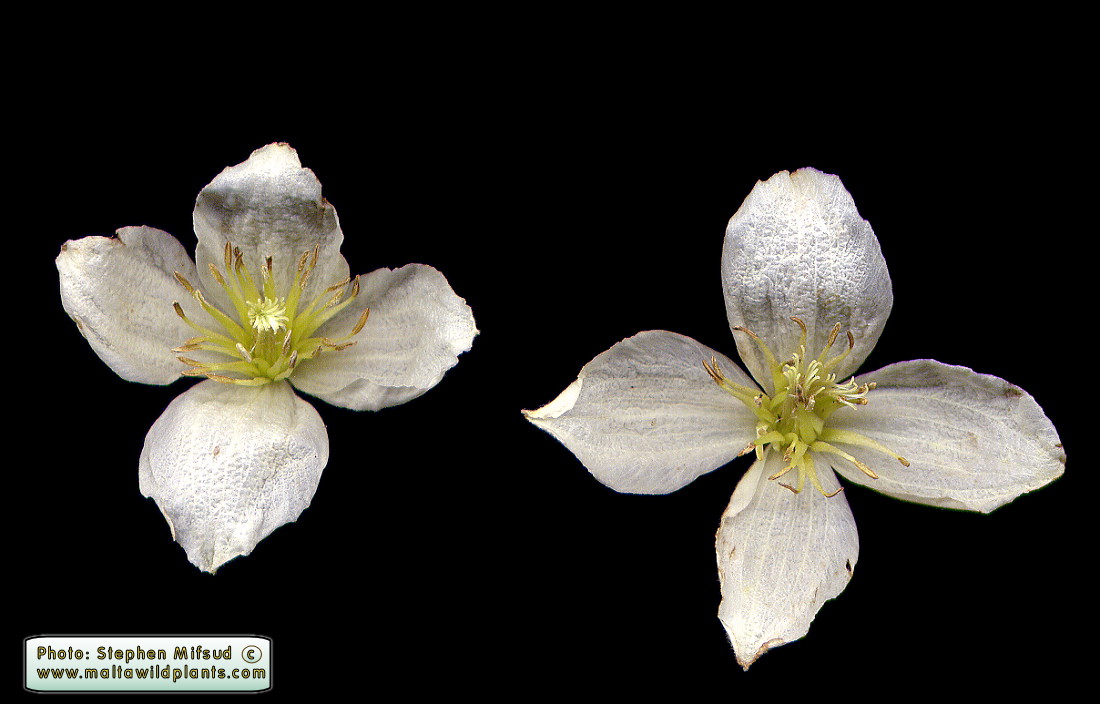
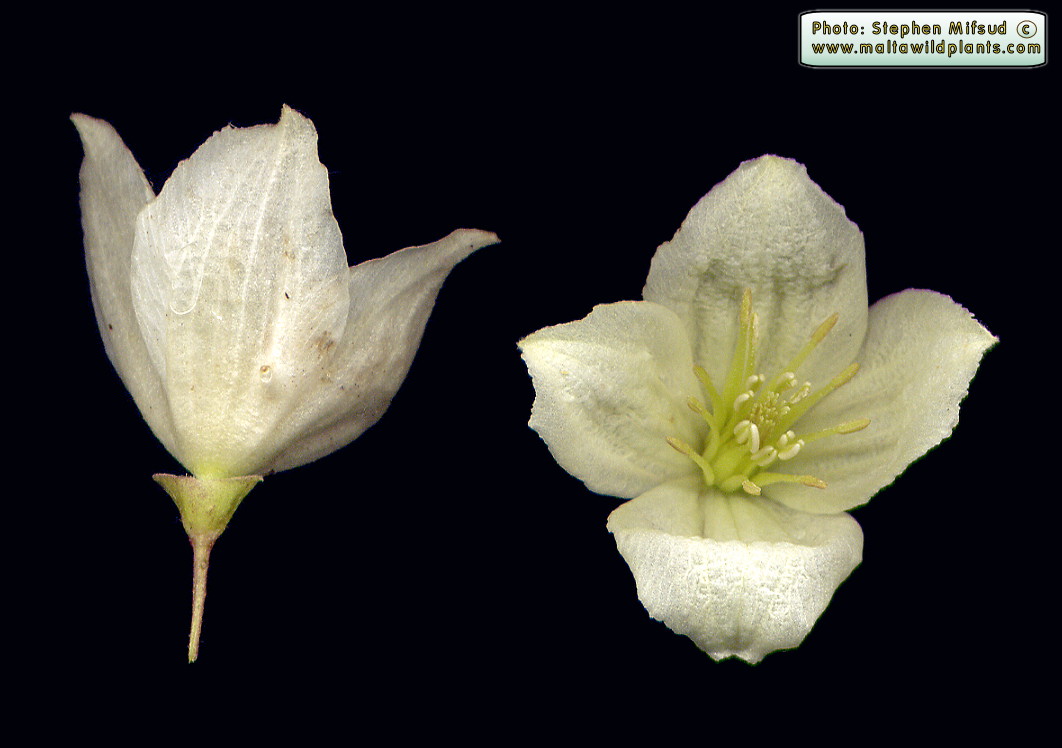
Scanned image of 2 typical flowers having white/cream petals and pale green anthers and styles.
Another scanned image of 2 flowers, one of which shows the lateral view of the flower.
Scanned and annotated image of a flower with one petal and some stamens removed.
Clematis cirrhosa (Evergreen Traveller`s Joy) - CLICK TO ENLARGE PHOTO Clematis cirrhosa (Evergreen Traveller`s Joy) - CLICK TO ENLARGE PHOTO Clematis cirrhosa (Evergreen Traveller`s Joy) - CLICK TO ENLARGE PHOTO Clematis cirrhosa (Evergreen Traveller`s Joy) - CLICK TO ENLARGE PHOTO
Scanned image of the reproductive organs of the flower, which basically consists of a group of anthers arranged around a central column of closely packed ovaries with long styles and stigma that end like a small swollen hook.
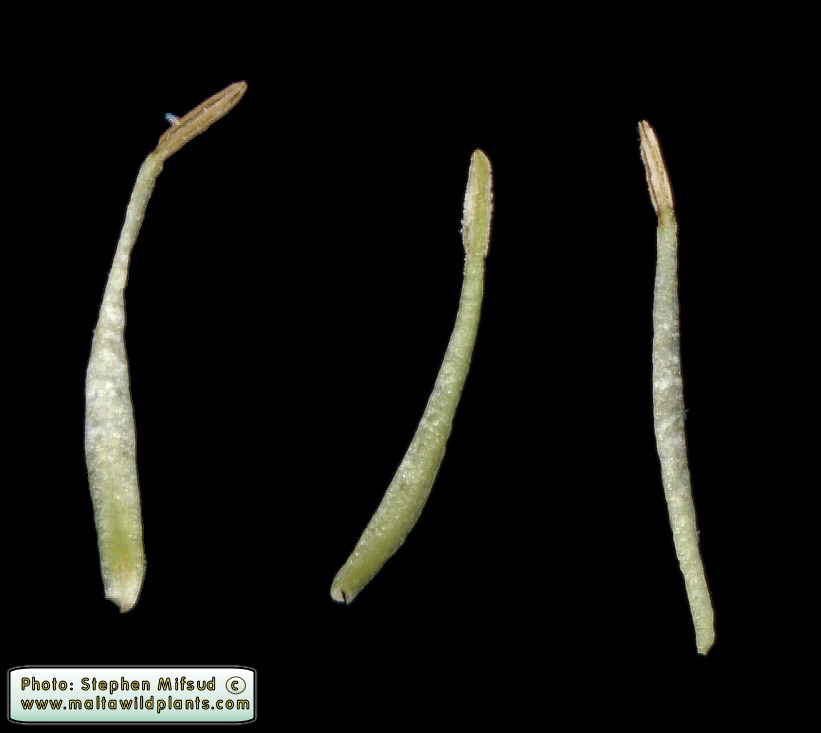
Scanned image of some stamens which are made up of a 15mm long, firm filament and a 3 mm long anther that is pale brown but often covered with pale green/white pollen. stamens are extrorse, that is bending outward from centre of flower.
Scanned image of group of styles each coming from a single ovary.
Scanned image of styles that are opened up to reveal the feathery pappus that they have. When developed, the ovary becomes a small single-seeded achene, with the style still attached and having a developed feather-like pappus that serves for seed dispersion by wind.
Clematis cirrhosa (Evergreen Traveller`s Joy) - CLICK TO ENLARGE PHOTO Clematis cirrhosa (Evergreen Traveller`s Joy) - CLICK TO ENLARGE PHOTO Clematis cirrhosa (Evergreen Traveller`s Joy) - CLICK TO ENLARGE PHOTO Clematis cirrhosa (Evergreen Traveller`s Joy) - CLICK TO ENLARGE PHOTO
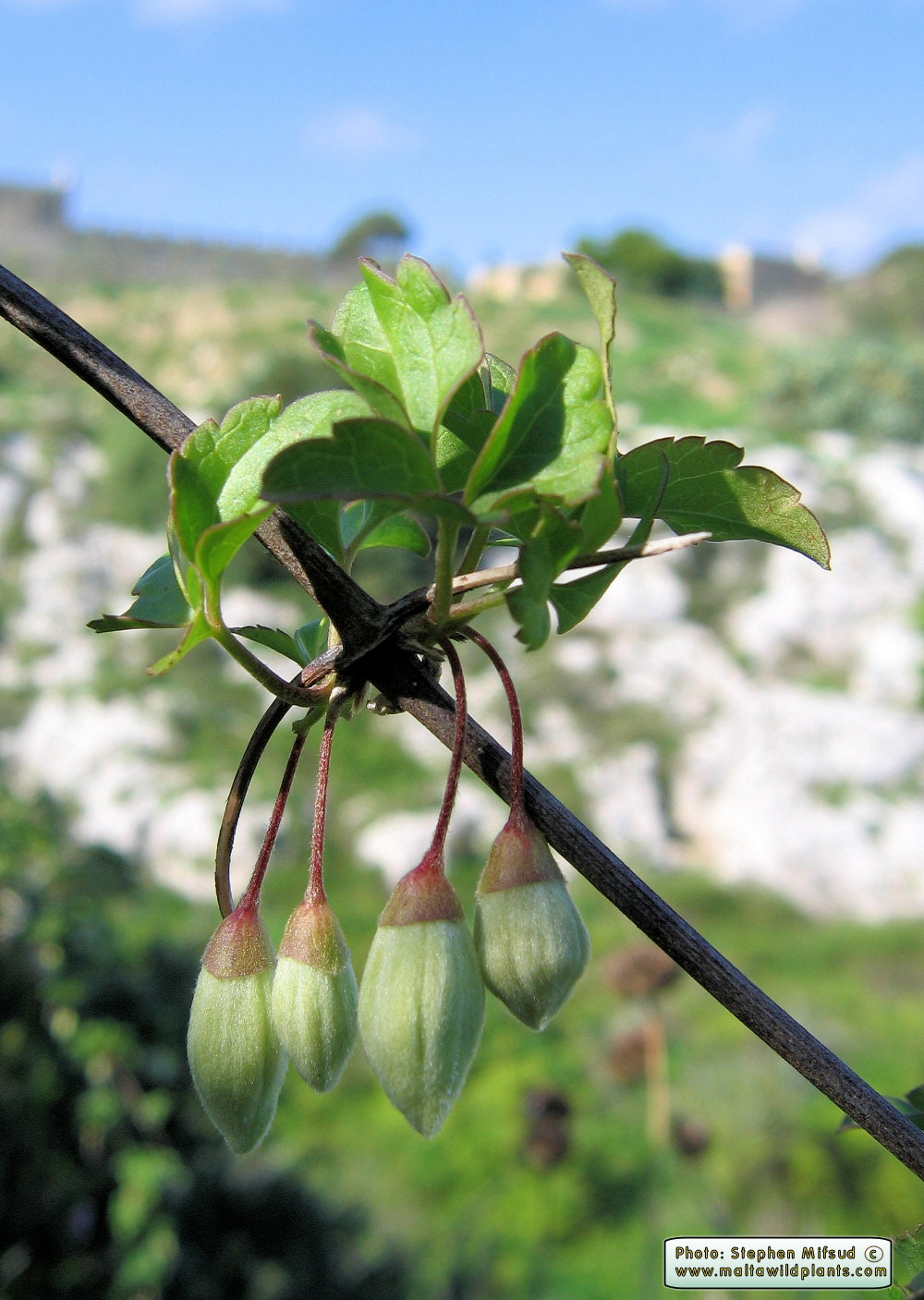
Photo of a group of 4 buds. Note the singular-unit, hat-shaped calyx that often is spotted or tinged in red.
Close up photo of 2 calyces. Usually, it is a singular (gamosepalous) structure but sometimes it is seen to consist of 2 similar halves.
Photo of more calyces. The rim is not flat but shallow undulate, or in other words not equidistant from the centre. The flower is slightly detached from the calyx.
Scanned image of several calyces (corolla removed) to show their slightly different shapes. Somehow they resemble the shape of a soldier hat.
Clematis cirrhosa (Evergreen Traveller`s Joy) - CLICK TO ENLARGE PHOTO Clematis cirrhosa (Evergreen Traveller`s Joy) - CLICK TO ENLARGE PHOTO Clematis cirrhosa (Evergreen Traveller`s Joy) - CLICK TO ENLARGE PHOTO Clematis cirrhosa (Evergreen Traveller`s Joy) - CLICK TO ENLARGE PHOTO
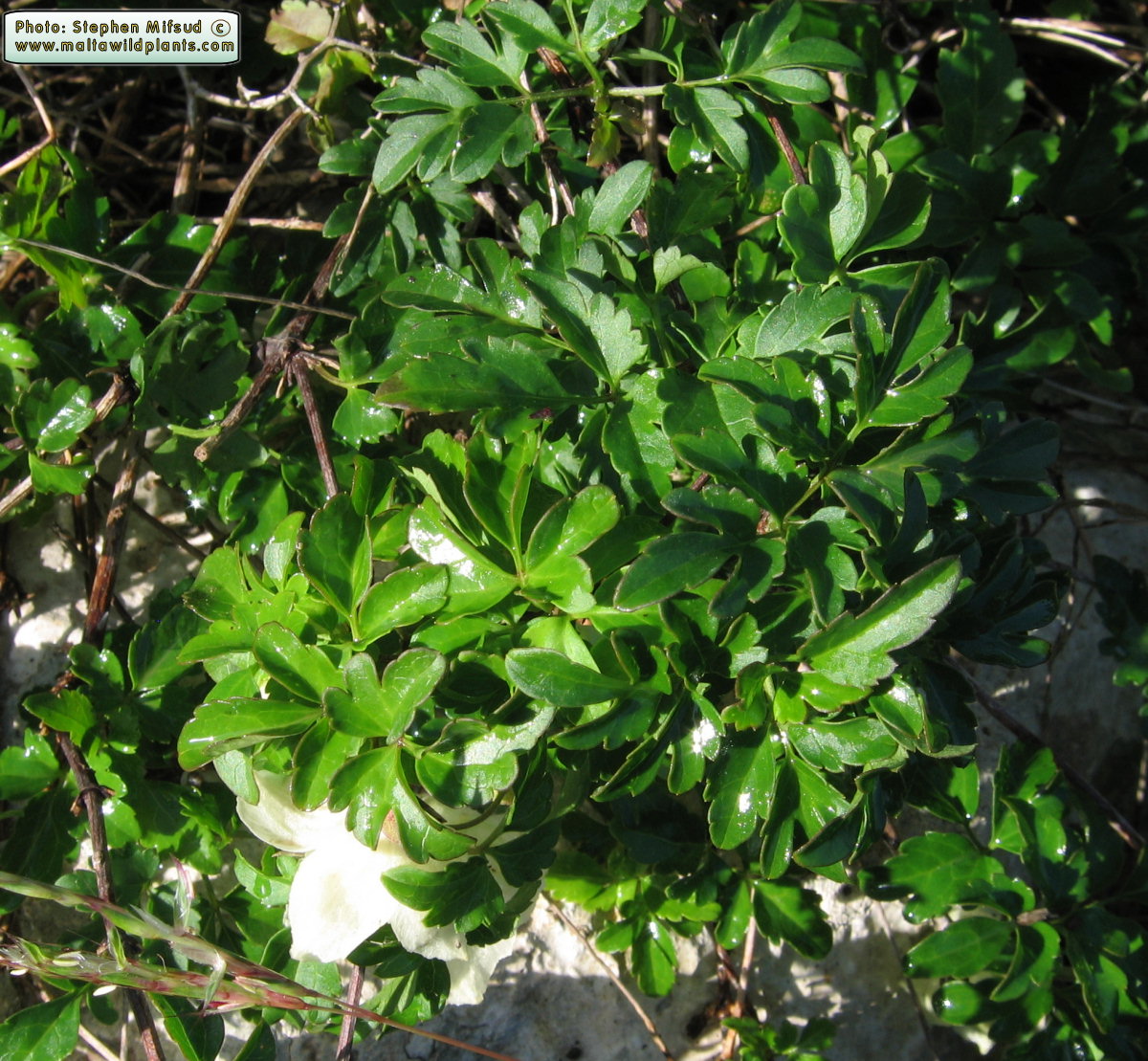
Photo of stalked leaves in situ. Plant is evergreen, that is, it produces leaves all year round.
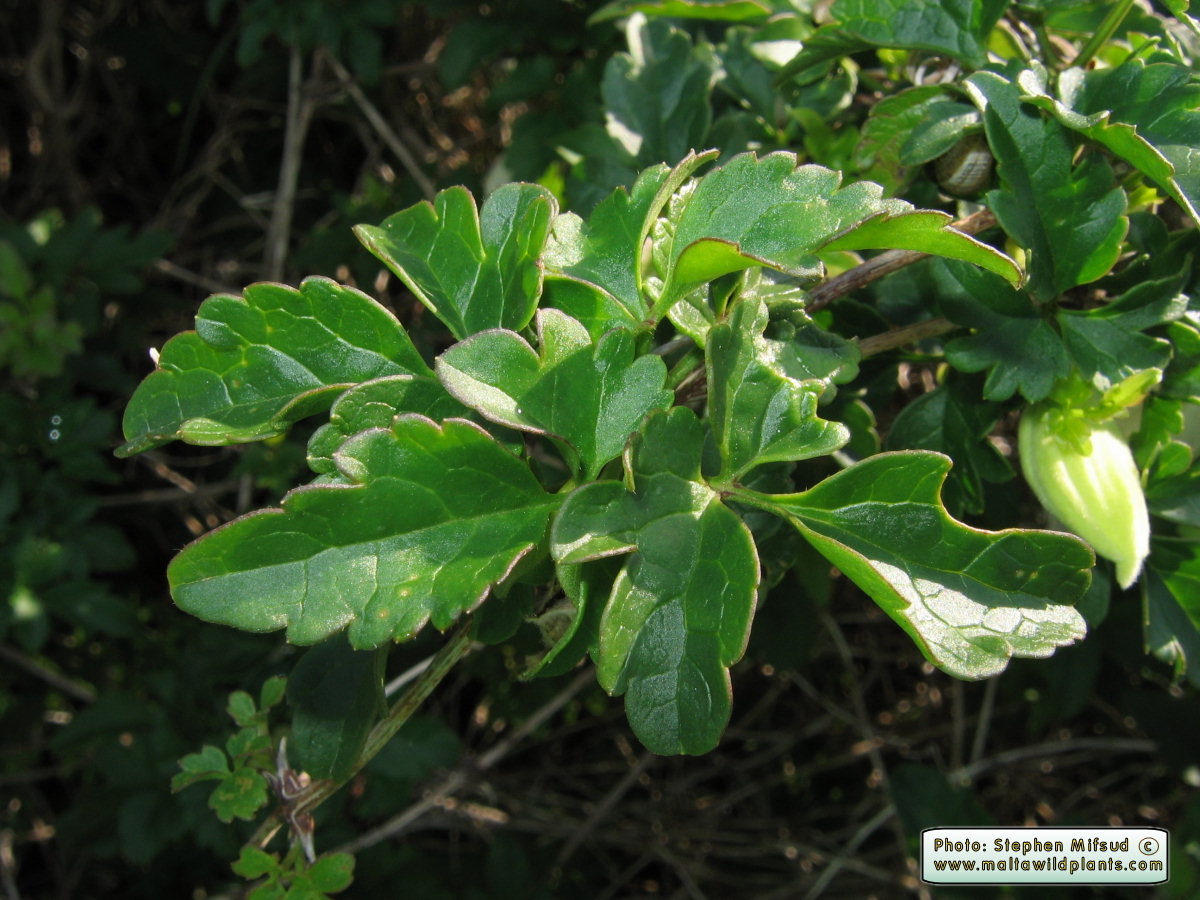
Photo of leaves. Lance shaped, pinnate venation and a serrated outline. Interestingly, the leaf lining is often found to be reddish.
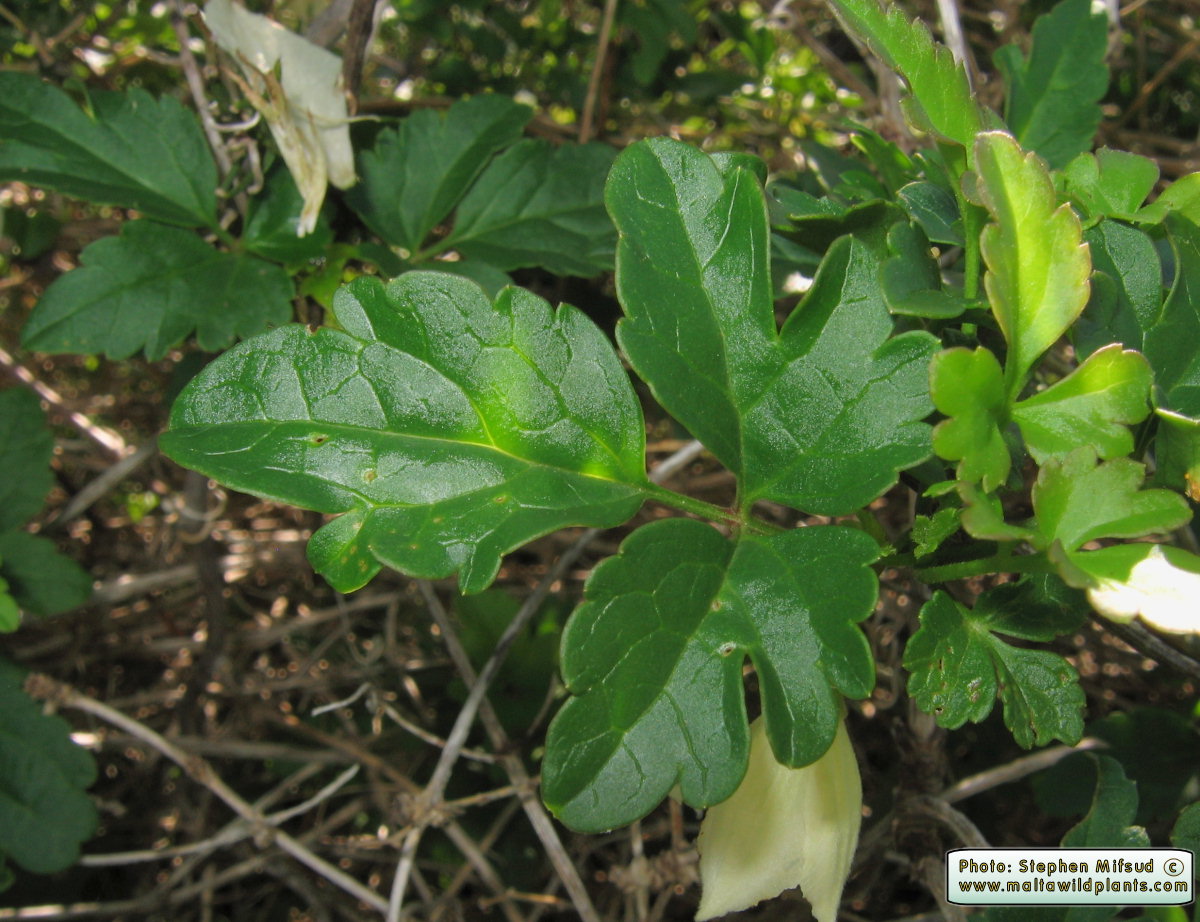
Close up image of a typical leaf. Leaves can be described as trifoliate since they actually consist of three similar leaflets originating from a common locus.
Scanned image of leaves. Leaves can further have 2 or 3 small lobes as seen in the upper left leaf.
Clematis cirrhosa (Evergreen Traveller`s Joy) - CLICK TO ENLARGE PHOTO Clematis cirrhosa (Evergreen Traveller`s Joy) - CLICK TO ENLARGE PHOTO Clematis cirrhosa (Evergreen Traveller`s Joy) - CLICK TO ENLARGE PHOTO Clematis cirrhosa (Evergreen Traveller`s Joy) - CLICK TO ENLARGE PHOTO
Scanned image of leaves outgrowing from a stem node. Leaves are found in opposite pairs, and there are usually 2 or 3 pairs per node.
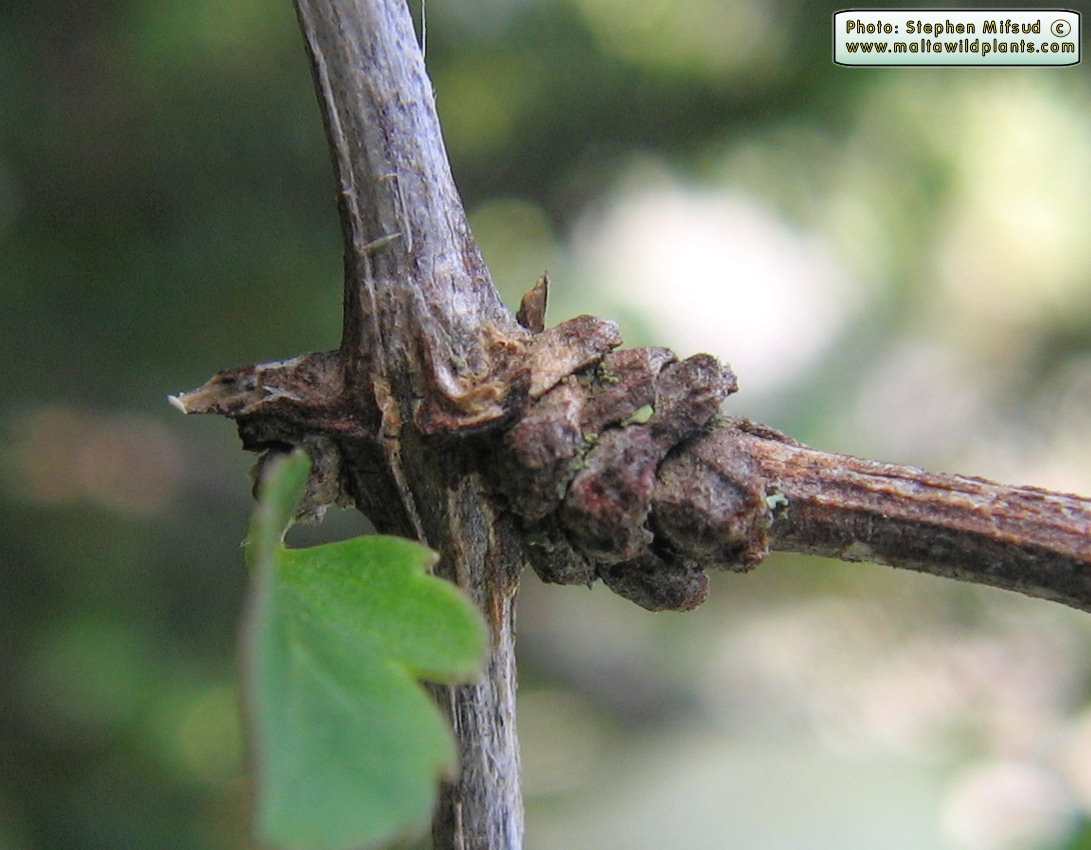
Close up photo of node present at regular intervals along the stems. Node are the site of leaf and flower outgrowth for this plant.
Photo of the woody, strong intertwining tendrils used to attach the plant with any suitable support it finds, namely shrubs, trees or walls. Often found around branches of the same plant itself.
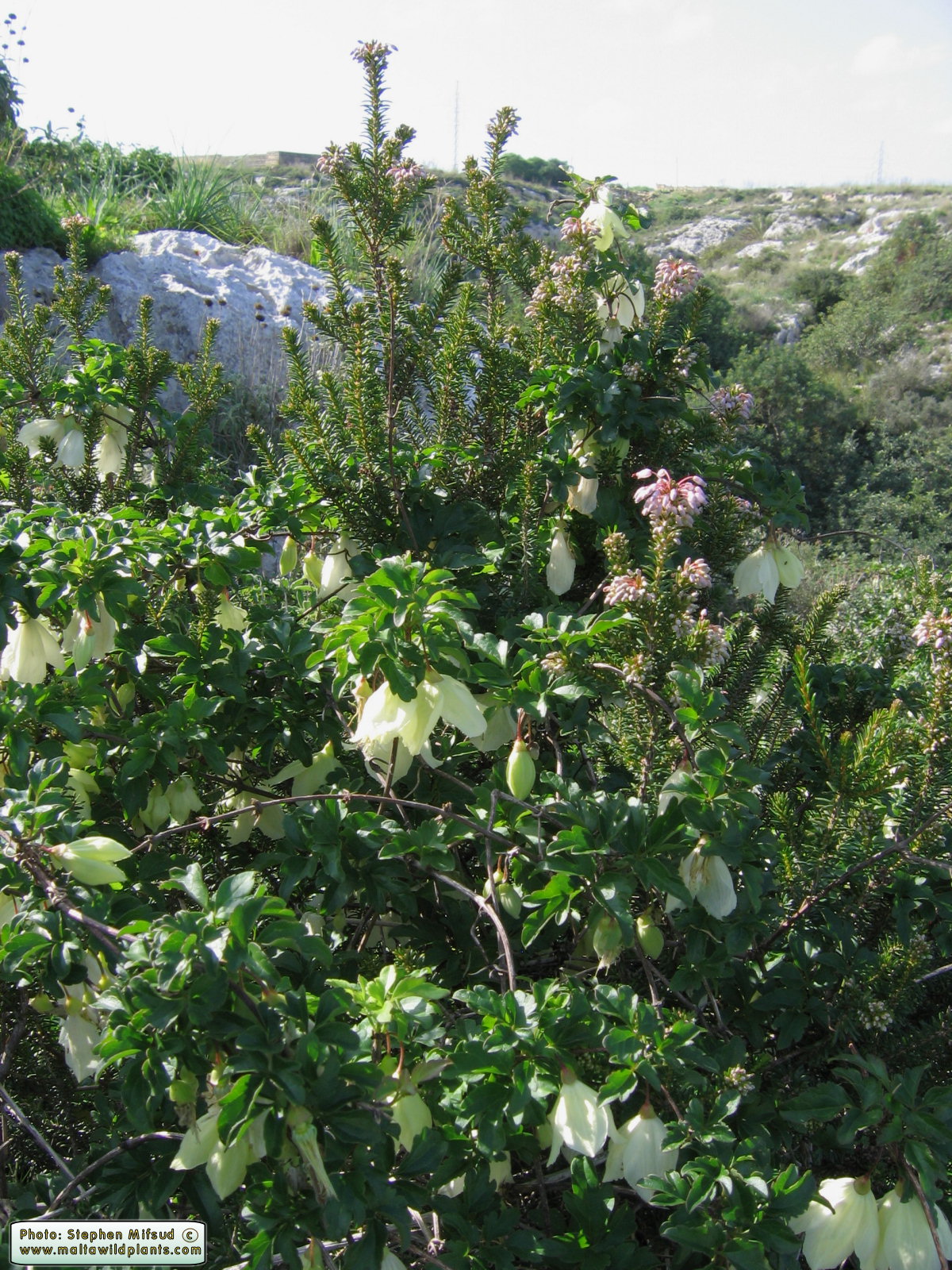
Photo showing plant twining and climbing on an Erica multiflora shrub.
Clematis cirrhosa (Evergreen Traveller`s Joy) - CLICK TO ENLARGE PHOTO Clematis cirrhosa (Evergreen Traveller`s Joy) - CLICK TO ENLARGE PHOTO Clematis cirrhosa (Evergreen Traveller`s Joy) - CLICK TO ENLARGE PHOTO Clematis cirrhosa (Evergreen Traveller`s Joy) - CLICK TO ENLARGE PHOTO
Photo of plant around Erica multiflora.
Another photo of the plant climbing along a woody shrub.
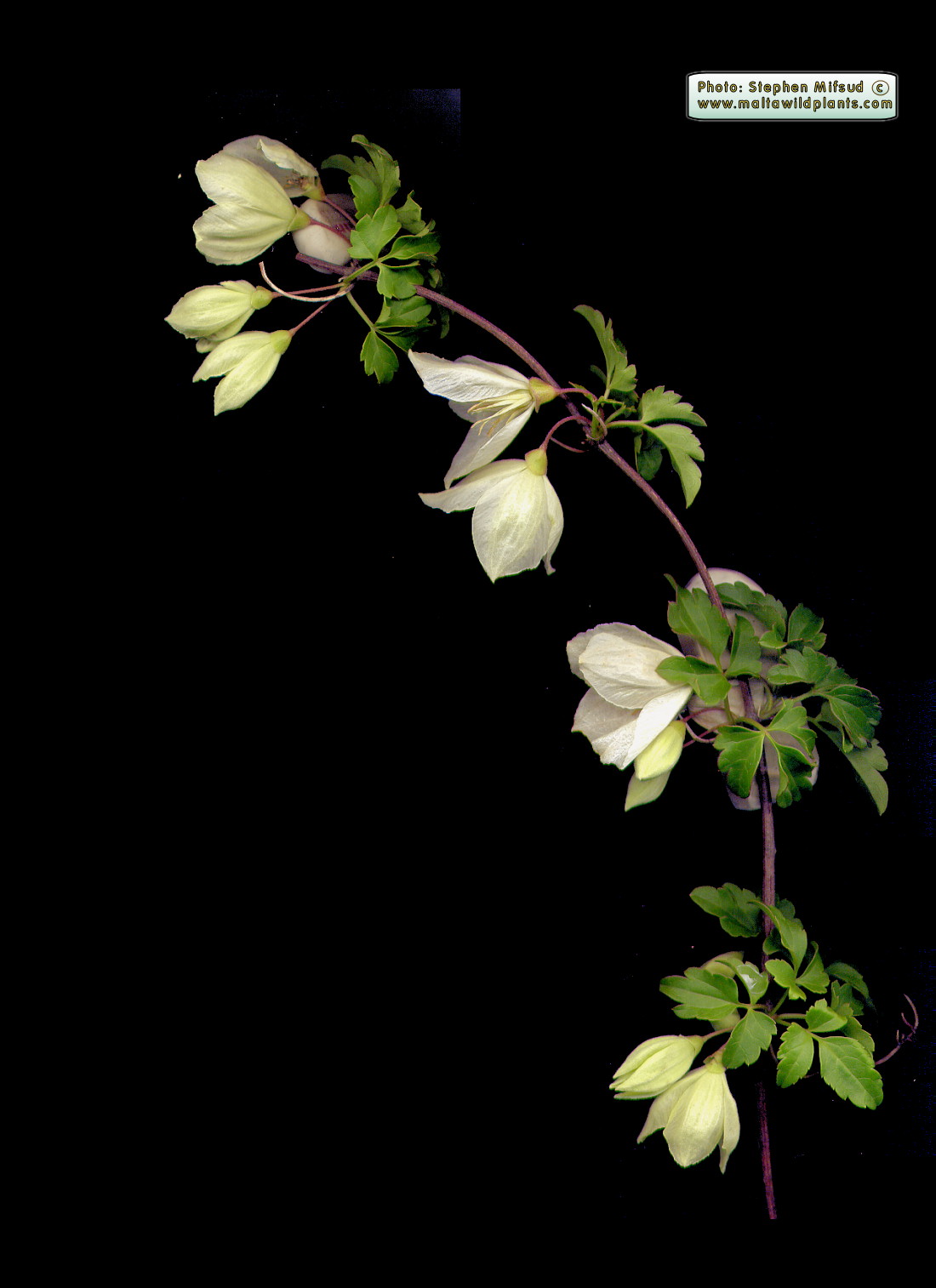
Scanned image of a plant branch. Outgrowth of leaves and flowers from stem nodes at regular intervals along the stem.
Scanned and annotated image of flower and leaf outgrowths from stem node. Inflorescence of this plant can be described as a dichasial cyme - forking of pairs of flowers at each side of the stem from the same locus (node).
Clematis cirrhosa (Evergreen Traveller`s Joy) - CLICK TO ENLARGE PHOTO Clematis cirrhosa (Evergreen Traveller`s Joy) - CLICK TO ENLARGE PHOTO Clematis cirrhosa (Evergreen Traveller`s Joy) - CLICK TO ENLARGE PHOTO Clematis cirrhosa (Evergreen Traveller`s Joy) - CLICK TO ENLARGE PHOTO
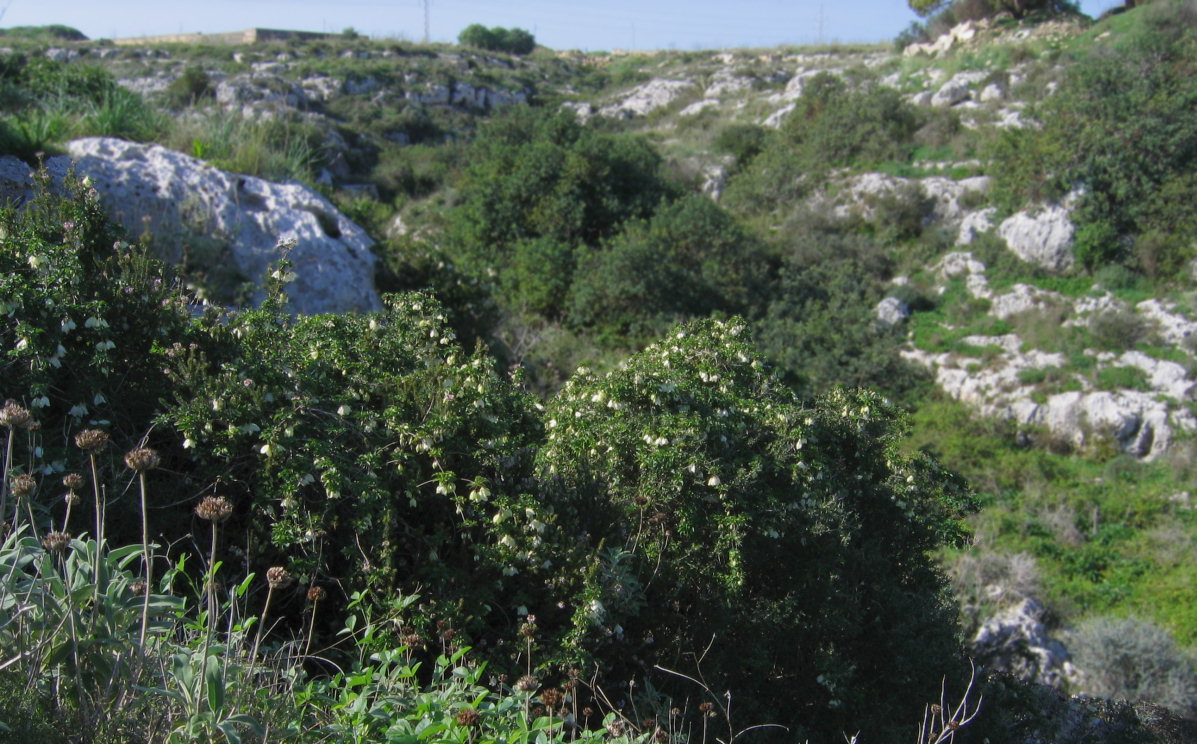
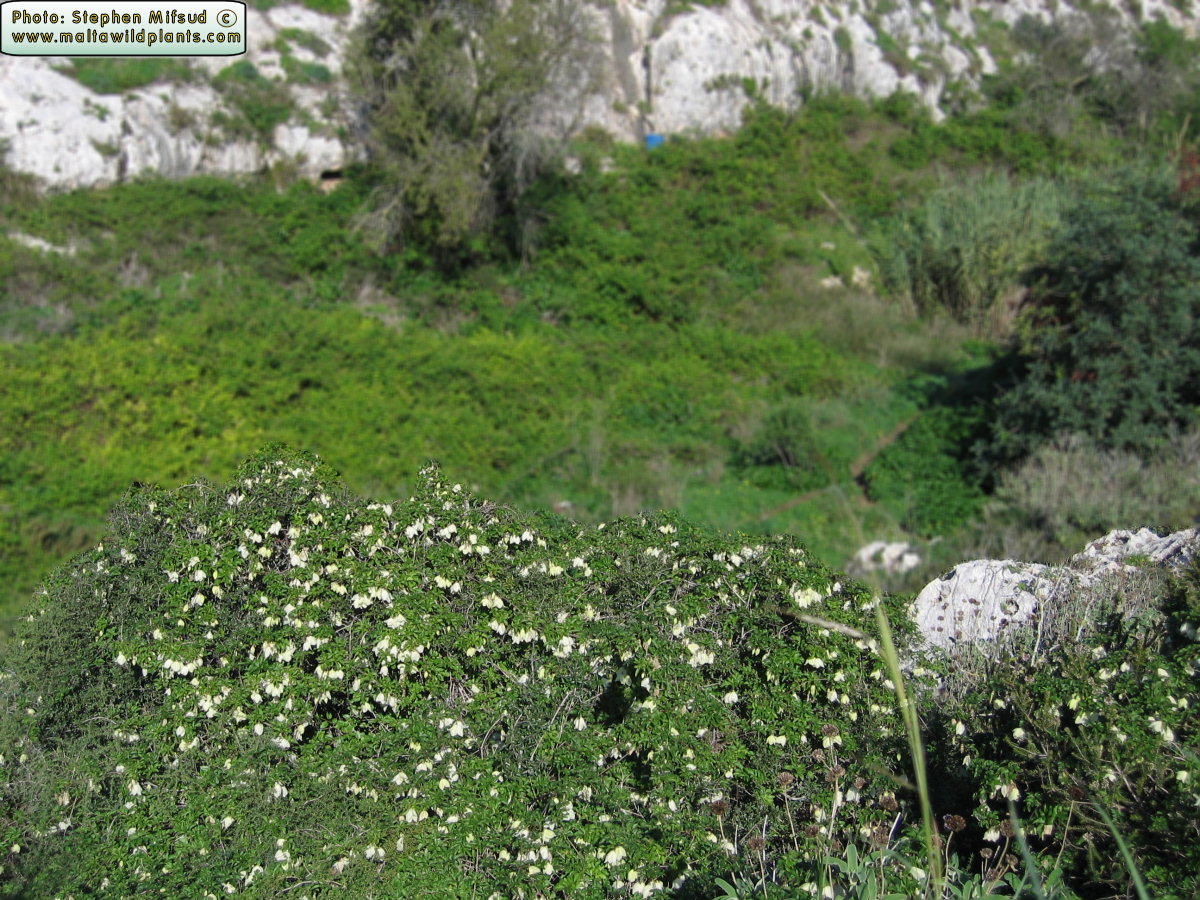
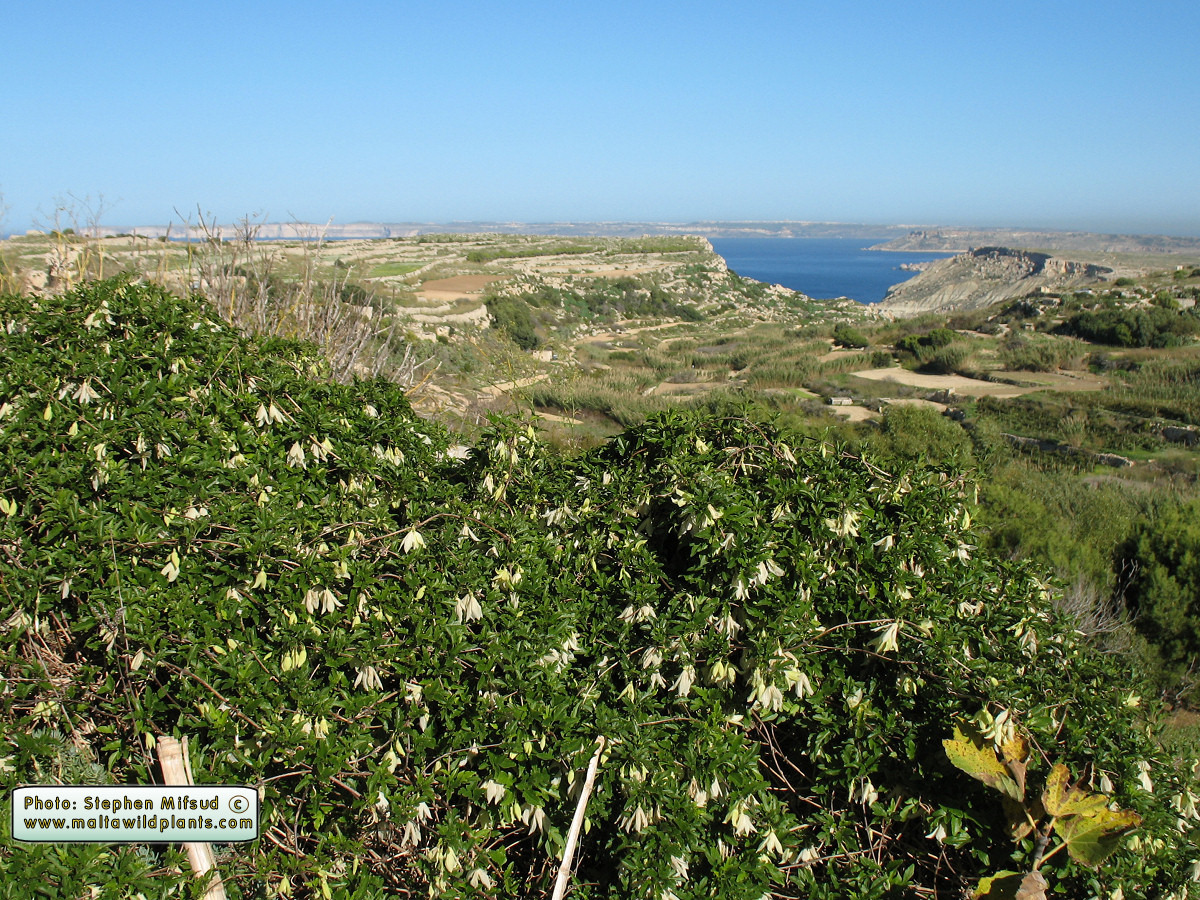
Photo of the plant in its habitat, commonly found in valley sides.
Photo of plant climbing along one bank of Incita Valley, in Attard (Nov 2005).
Photo of fruit in situ. A number of plumose seeds that glisten against sunlight.
Photo of fruit with a close up of the seeds attached to the receptacle.
Clematis cirrhosa (Evergreen Traveller`s Joy) - CLICK TO ENLARGE PHOTO Clematis cirrhosa (Evergreen Traveller`s Joy) - CLICK TO ENLARGE PHOTO Clematis cirrhosa (Evergreen Traveller`s Joy) - CLICK TO ENLARGE PHOTO Clematis cirrhosa (Evergreen Traveller`s Joy) - CLICK TO ENLARGE PHOTO
Photo of 2 remaining seeds. They have a feather-like structure which aids the seed to detach from the receptacle and carried away by wind.
Scanned image of fruit with some seeds removed. About 20-25 seeds or achenes are attached to a common dome-shaped receptacle.
Scanned image of 3 seeds against a dark background. It consists of a flattened circular seed and a feather like appendage. The whole structure measures about 35mm long when straightened out.
Scanned and enlarged image of the seed. The longitudinal axis of the feather appendage is the style, which has a slightly swollen tip previously being its stigma. Note that the seed wall is covered by fine hair.
Clematis cirrhosa (Evergreen Traveller`s Joy) - CLICK TO ENLARGE PHOTO Clematis cirrhosa (Evergreen Traveller`s Joy) - CLICK TO ENLARGE PHOTO Clematis cirrhosa (Evergreen Traveller`s Joy) - CLICK TO ENLARGE PHOTO Clematis cirrhosa (Evergreen Traveller`s Joy) - CLICK TO ENLARGE PHOTO
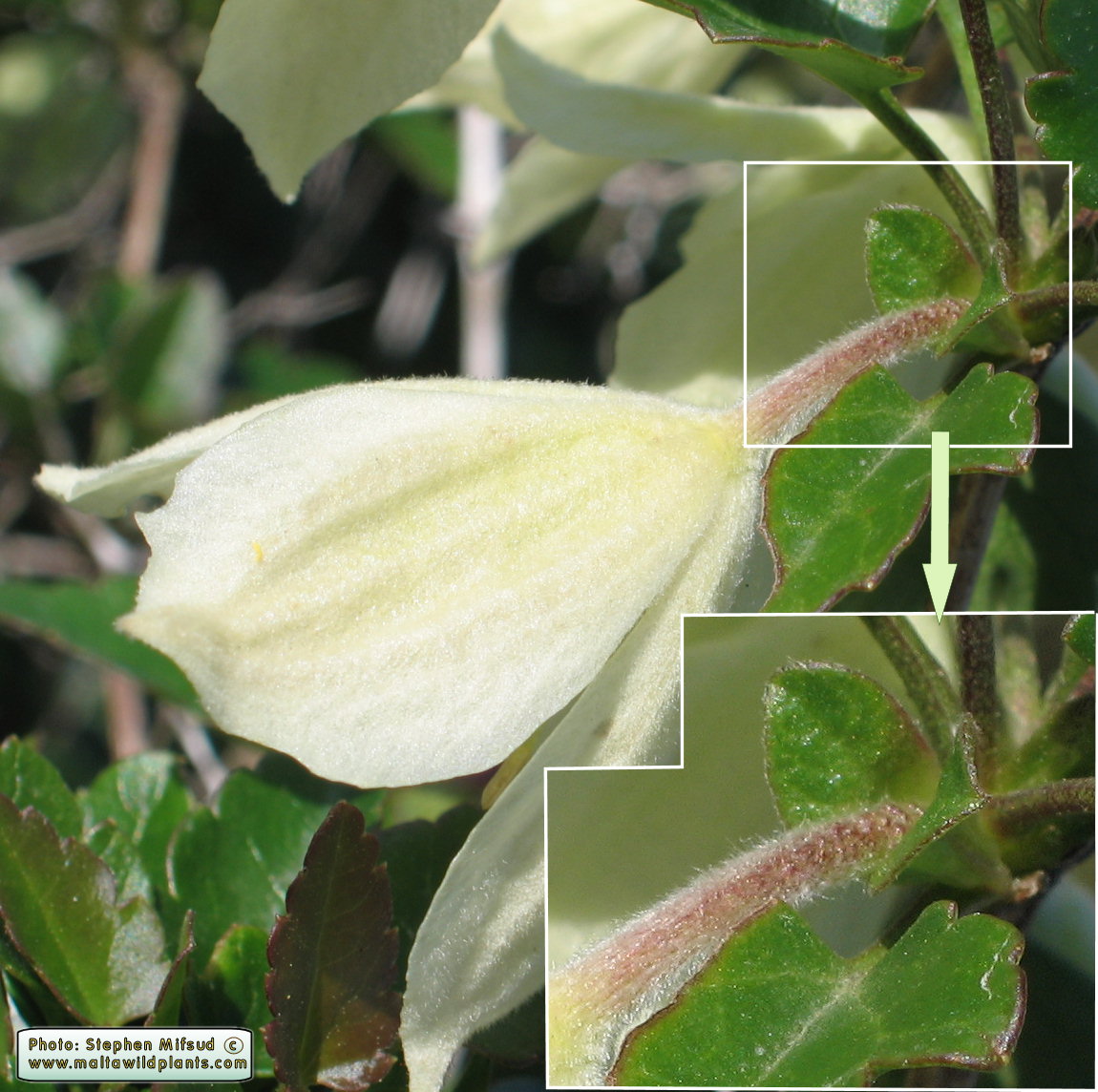
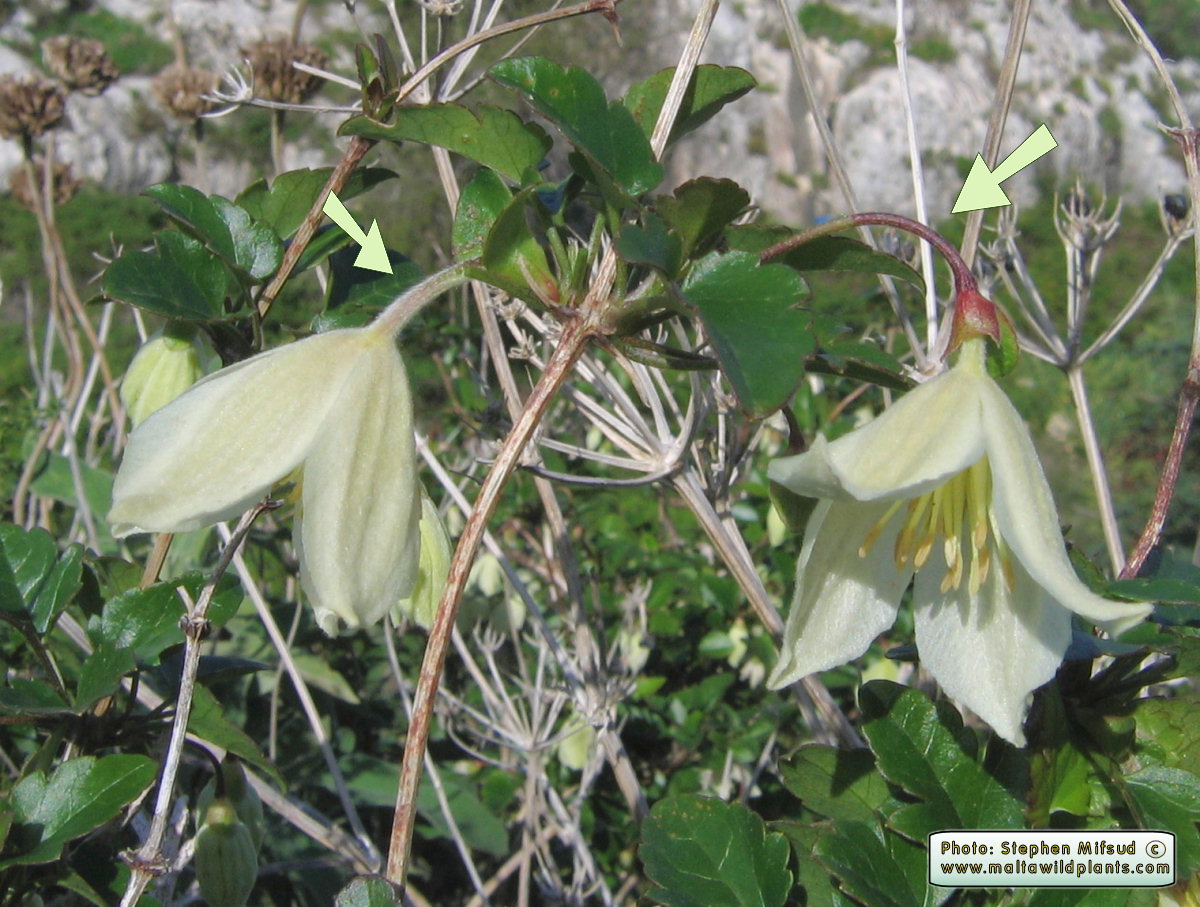
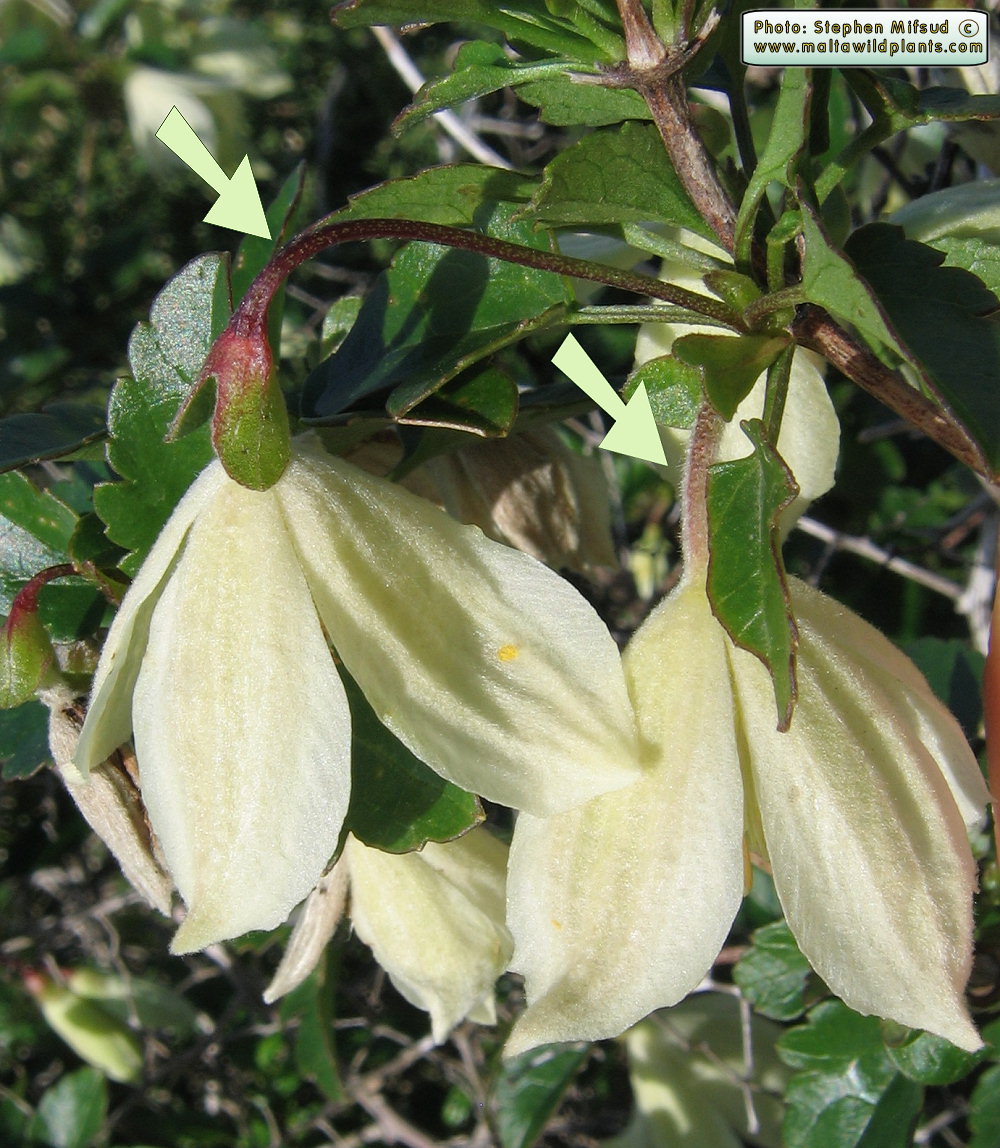
Photo showing some variation in the flower of this plant. More precisely this flower is seen to have a long corolla tube projecting out through a calyx which is distinctly split into 2 leaf-like sepals.
A good photo showing the difference (at arrows) of 2 flowers. The one on the right has a long pedicel and short corolla tube from a single-body calyx. The one on the left has a long tube coming out from a bifid (2 split) calyx.
Another photo showing the variation that flowers can have in the calyx + corolla tube morphology.
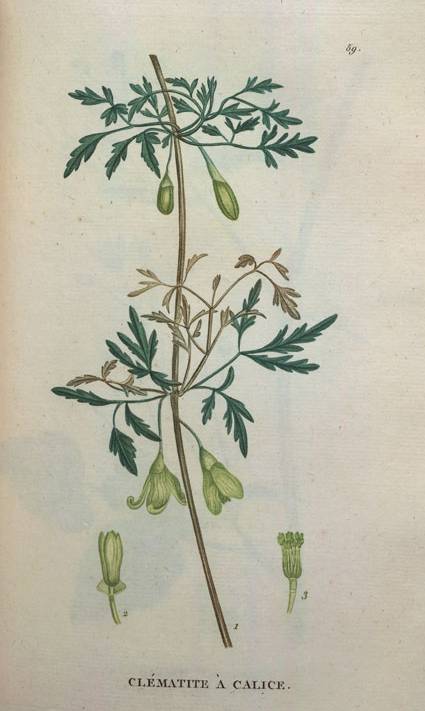
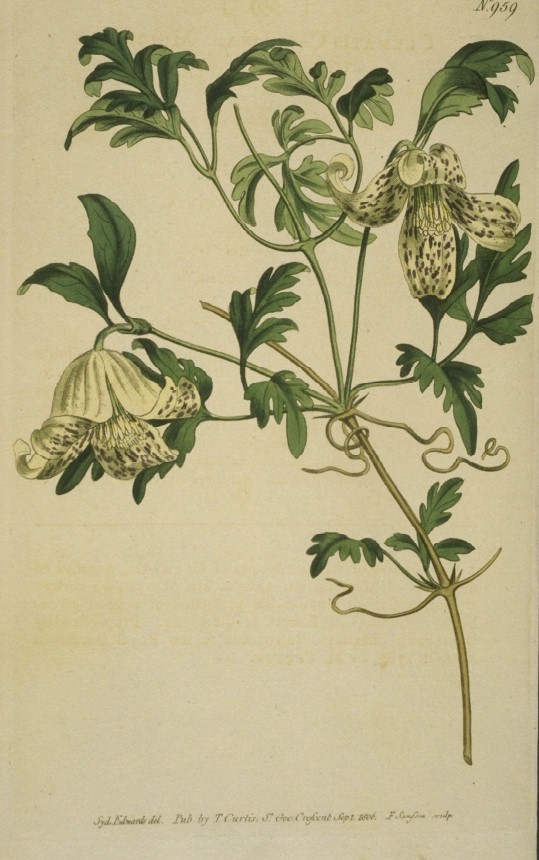
Illustration of the plant from © 1995-2005 Missouri Botanical Garden..
Clematis cirrhosa (Evergreen Traveller`s Joy) - CLICK TO ENLARGE PHOTO      
The largest specimen / population of Clematis cirrhosa in Malta located at Bahrija.
-
-
-

Further Information and Links

Antifungal activity of plant extracts against dermatophytes (Ali-Shtayeh MS, Abu Ghdeib SI.) Collecting and Growing Clematis Seeds
Propagation details of Clematis for the garden. (from Garnden Action) Several varieties of clematis sold as flowering ornamentals
Howells' Gardeners' Classification of Clematis Clematis cirrhosa hybrids sold as ornamental flowers
Clematis better than Roses Use of Plant Growth Regulators to Enhance Branching of Clematis spp. (by Sadie Erica Puglisi)


Buy from and support MaltaWildPlants.com

Buy Seeds from Maltawildplants.com Buy samples of seeds of certain wild plants for your studies, trials, research, etc. Not all species' seeds can be exported (depending on Maltese regulations), and availability depends on season of species. So, before any payment, you are kindly asked to fill in the online quotation/order form by which I can contact you back for availability and charges. Buy Seeds from Maltawildplants.com   Online Quotation

Buy Seeds from Maltawildplants.com   Online Payment
Buy Documents from Maltawildplants.com Buy documents related to Maltese Wild Plants such as the list of references, full profile, or other docs you request. Buy Documents from Maltawildplants.com   Online Payment
Buy Images  from Maltawildplants.com Buy any of my own copyright images found in this large collection of Maltese flora. You should first select the image you want to buy and input its corresponding code (found beneath each individual photo) in the online ordering form. Buy Seeds from Maltawildplants.com   Online Payment
Buy Seeds from Maltawildplants.com Kindly donate any sum of money (from 2USD / 2Euro) to help us covering some expenses needed to maintain Maltawildplants.com. Please bear in mind how much hard work such a large and up-to-date website needs to arrive directly to you home, office or library. Your kind donations are both greatly appreciated and recorded for future reference. Donors asking help will have first que preference for assistance and special attention. Buy Seeds from Maltawildplants.com   Online Donation


Submit More Information

Use the form below to submit more information about this plant or a related species. If the data is taken from a book, journal, website, etc, please provide the corresponding reference / website address as indicated in the form. If it is your own observation, then your name will be cited. Your Email address will never be displayed online, it is just for internal communication.


For plant species that are marked as rare, you can also report other locations in Malta where you have seen this species.

Finally you can report any mistakes or errors found on the plant profile for necessary corrections. This will help to improve the website's acuracy.


To have more details about each particular field, just move your mouse on it and wait for the help message to pop up

* = required fields.
Plant Species:  *
Your name:   *
Your Email:   *
Fill any of the following 3 sections below (A, B or/and C) and send the form. - Thank you.
 
A:  Additional Information about this plant species
Own observations:
Info from published material (books, jounals, website):

Reference of published material:

 
B:   Where have you seen this plant on the Maltese Islands?
Locations in Malta or Gozo where you have encountered this plant.
Mostly applies for rare plants.


1:        2:   
3:       4:   
5:       6:   

Try to be as concise as possible. Examples: Dingli Cliffs (near chapel), Wied Incita (Zebbug side), Triq il-Kbira (Qormi), Barriera ta\' Abdul (Xlendi), Fields near Salib tal-gholja (Siggiewi). GPS bearings are also welcomed!
 
C:  Corrections for mistakes and errors in this plant profile.
Section of this plant Profile page where you found an error (select one)

What is the error/mistake
What should be its correction


All material and data on this webpage is under the copyright of the author of this site - Stephen Mifsud / www.MaltaWildPlants.com / Malta. (2002-2008)
This research project about the flora of Malta is sponsored by:
Middlesea Insurance p.l.c. A Fund established to help in the amelioration and enhancement of the environment in Malta and to take initiatives that enhance awareness on environmental issues amongst the public Empty space for sponsor Empty space for sponsor Benefit companies get by sponsoring this project