|
Autumn Buttercup |
| This plant is brought to you by one of the project's sponsors: |
 |
| More sponsors are needed for this project [ click here ] | |
|
|
| Nomenclature |
Species name: |
Ranunculus bullatus L. |
Author(s): |
Carl von Linné; Sweden, 1707-1778
|
General names: |
Autumn Buttercup, Golden Button, Bullate Buttercup |
Maltese name: |
Ċfolloq |
Plant Family: |
|
Name Derivation: |
Ranunculus = from rana, "little frog" because many species tend to grow in moist / marshy places where frogs are usually found. (Latin);
bullatus = Having an inflated, blistered or puckered structure or texture with reference to the leaves. (Latin). |
Synonyms: |
None |
Remarks: |
-
|
|
| Botanical Data |
PLANT STRUCTURE: |
Characteristic | Growth Form | Branching | Surface |
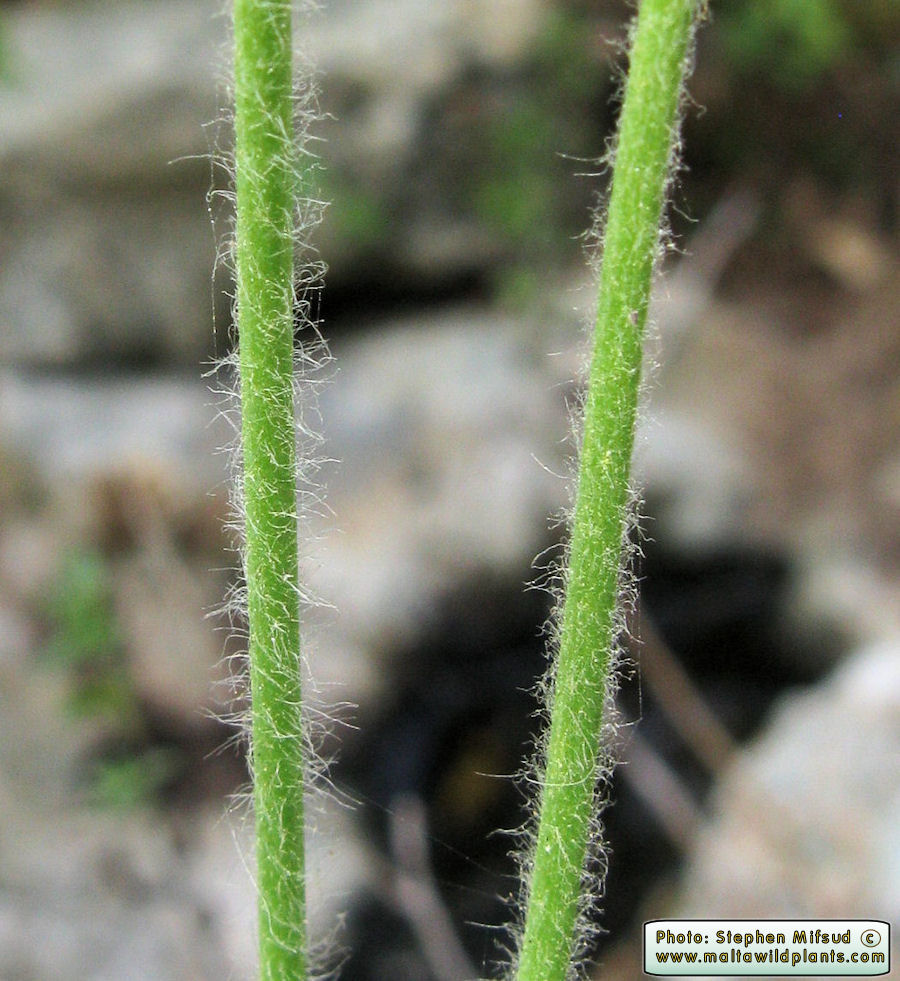
Description | Erect : Upright, vertically straight up well clear off the ground. | Basal Branching : Branches are mostly present at the basal part of the stem. | Bullate : Having blister-like swellings. |
General Picture | | | |
|
LEAVES: |
Characteristic | Arrangement | Attachment | Venation |
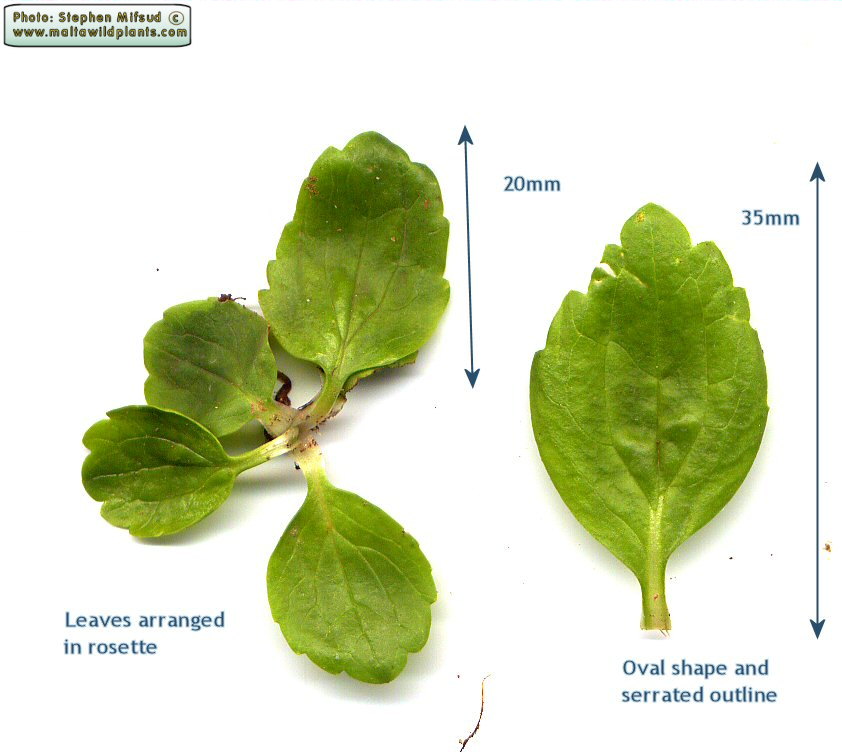
Description | Basal Rosette : A cluster of leaves in a circular arrangement at the base of the plant. | Stalked / Petiolate : Hanging out by a slender leaf-stalk. | Pinnate / branched : Veins that run at opposite sides of the common mid-vein and sub-branch towards the outer parts of the leaf. |
General Picture | | | |
| |
Characteristic | Leaf Shape | Leaf Margin | Remarks |
Description | Ovate : Oval shape, similar to an egg shape thus having a fairly broad centre and rounded ends. | Serrate : Sharp pointed teeth, oblique (inclined) to the margin, pointing apically like a saw. | |
General Picture | | | |
|
FLOWERS: |
Characteristic | Colour | Basic Flower Type | No. of Petals | No. of Sepals |
Description | Shining Yellow | Bowl or Cup Shape : A flower which is roughly hemispherical, with straight sides and a very slight flare at the tips. | 5-10 (5 petals is the most common). | 5 |
General Picture | | | | |
| |
Characteristic | Inflorescence | Description | Ovary | Stamens |
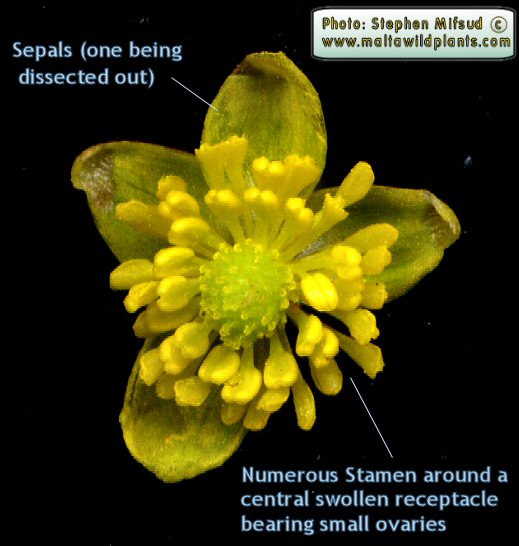
Description | Single and Terminal : Single, solitary flower at the apex of the stem or flower branch. | The actinomorphic flower consists of 5 to 10 shiny yellow petals and 5 green-yellow bucket shaped sepals. At the centre there is the receptacle bearing above numerous, green ovaries with small projecting style+stigma. The stigma tips are sometimes yellow with entrapped pollen. A cluster of stamens lies around the receptacle+ovaries structure. | Superior : Ovary situated above the flower parts (the calyx, corolla, and androecium). In other words, these are attached below the ovary. | 50-100, Annular Cluster : A cluster of stamens in the form of a ring, often encircling the gynoecium. |
General Picture | | | | |
| |
Characteristic | Scent | Average Flower Size | Pollen Colour | Other Notes |
Description | YES Little sweet scent which maybe missed in the open air. | 20-25mm | Yellow | - |
|
SEEDS: |
Characteristic | No. Per Fruit | Shape | Size | Colour |
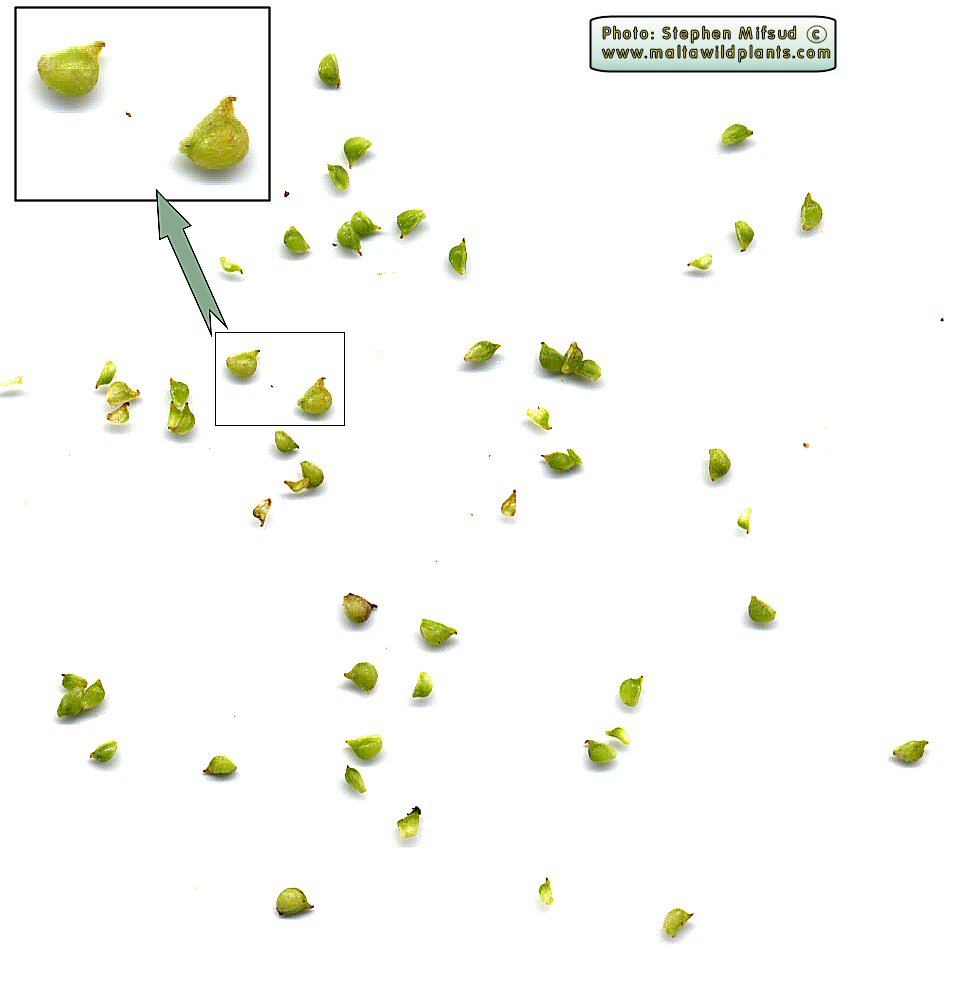
Description | 40-100 | Ovoid Oval (tooth shaped) achene with an eccentric rod-like projecting structure. | 1-2 mm | Green to light brown Achenes often fall off unripe. |
General Picture | | | | |
|
FRUIT AND OTHER BOTANICAL DATA: |
Characteristic | Fruit Type | Colour of Fruit | Subterranean Parts | Other Notes |
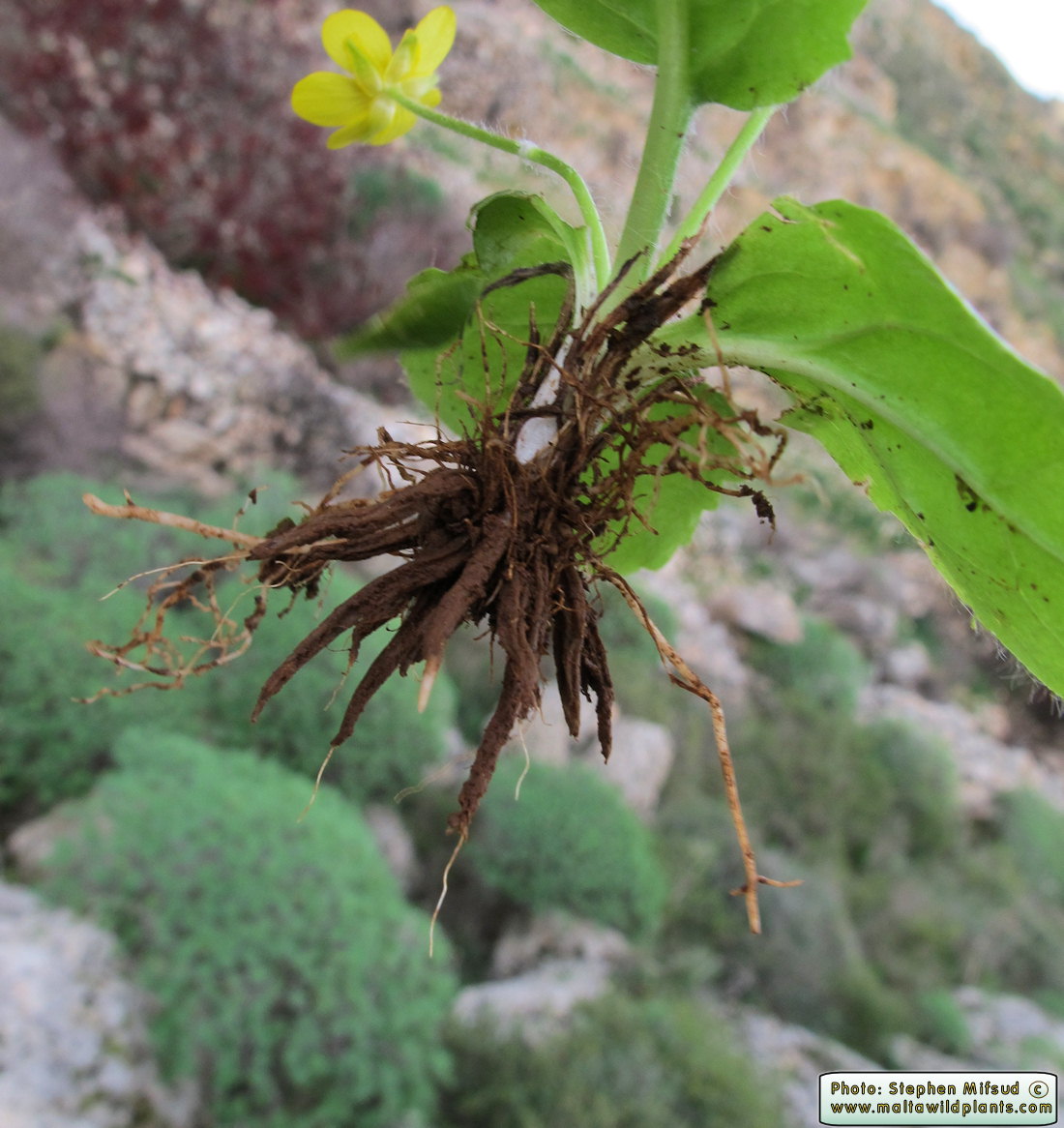
Description | Achene cluster : A cluster of achenes attached to a common receptacle which have no pappus for wind dispersal. Usually found radiating out from a columnar receptacle. | Green to light brown | Root Tuber A type of root with the special advantage of being able to form rounded knobs (small tubers) to store food. | - |
General Picture | | | | |
|
|
| Plant Description |
Life Cycle: | Perennial |
Habitat: | Garigue, valley sides, rocky places with moist soil. Common in moist soil: found in pits and pockets on bare rock. |
Frequency: | Common |
Sources in Malta: | Quite common to very common upon many cliffs and garigues such as at Dingli cliffs, Girgenti, Wied Encita, and Mellieha (Qammieh). |
Plant Height: | 6-15cm. |
| Oct - Dec |
Poison: | Yes since it contains Anemonin toxin. |
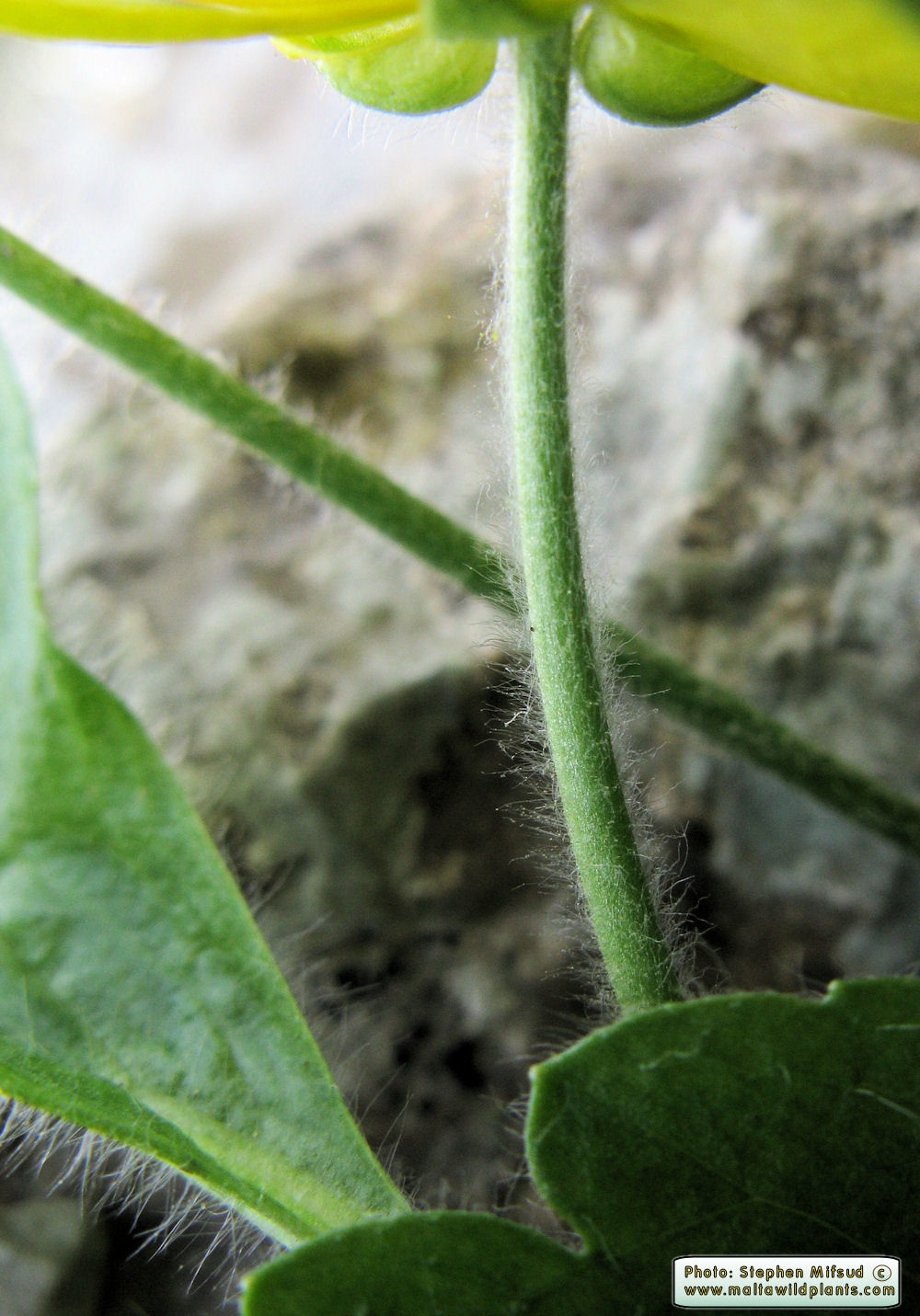
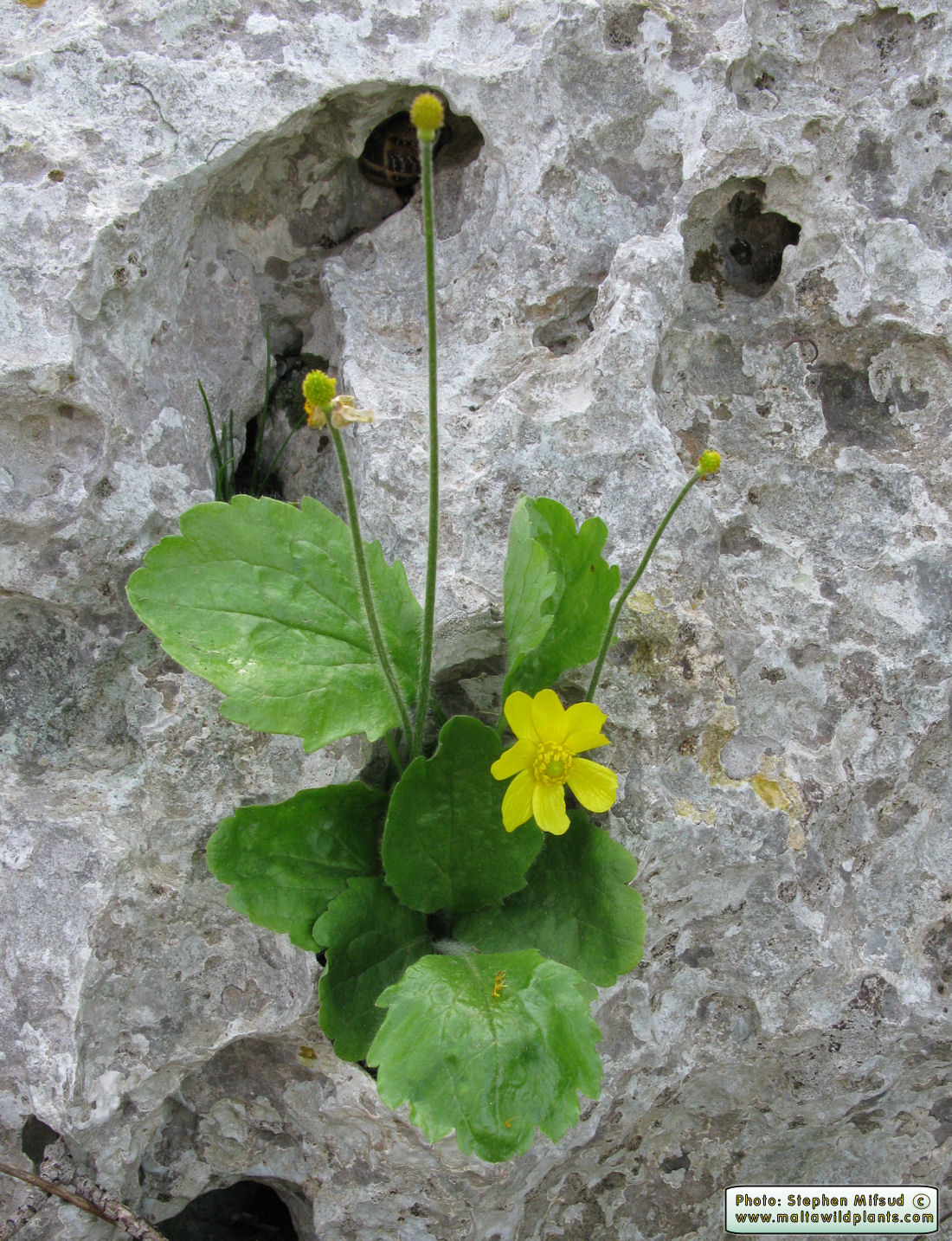
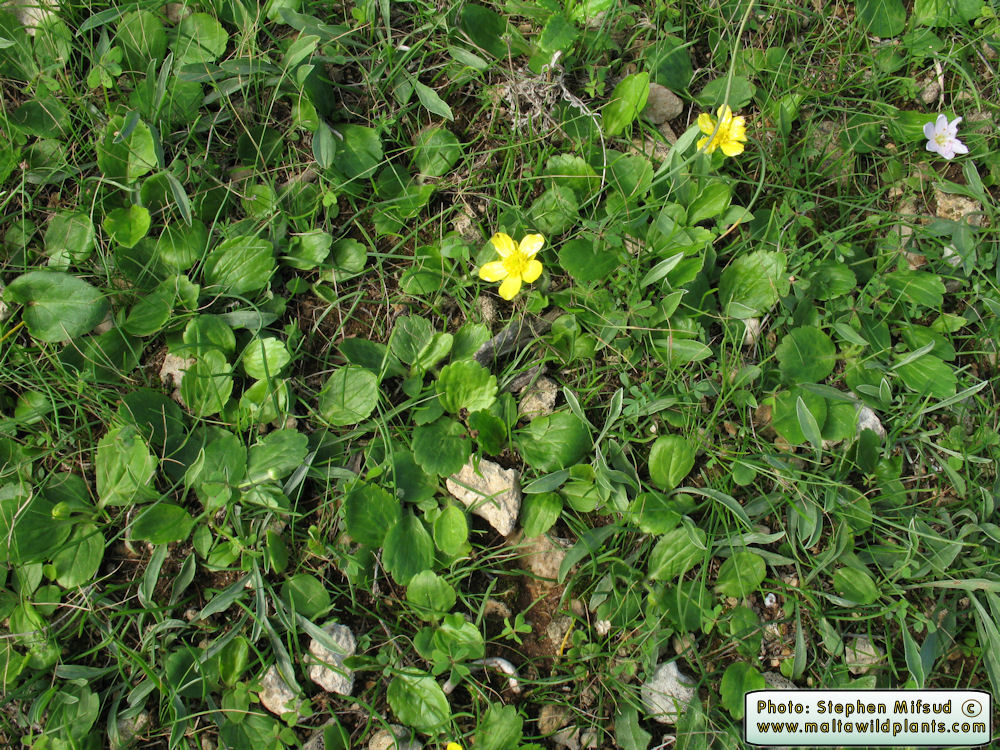
This perennial plant is just about 6 to 15cm high and occupy a small area. The plant consists of few basal leaves and unbranched, erect flower stems which bear solitary flowers. The flowering stems are covered with fine hair and do not have leaves.
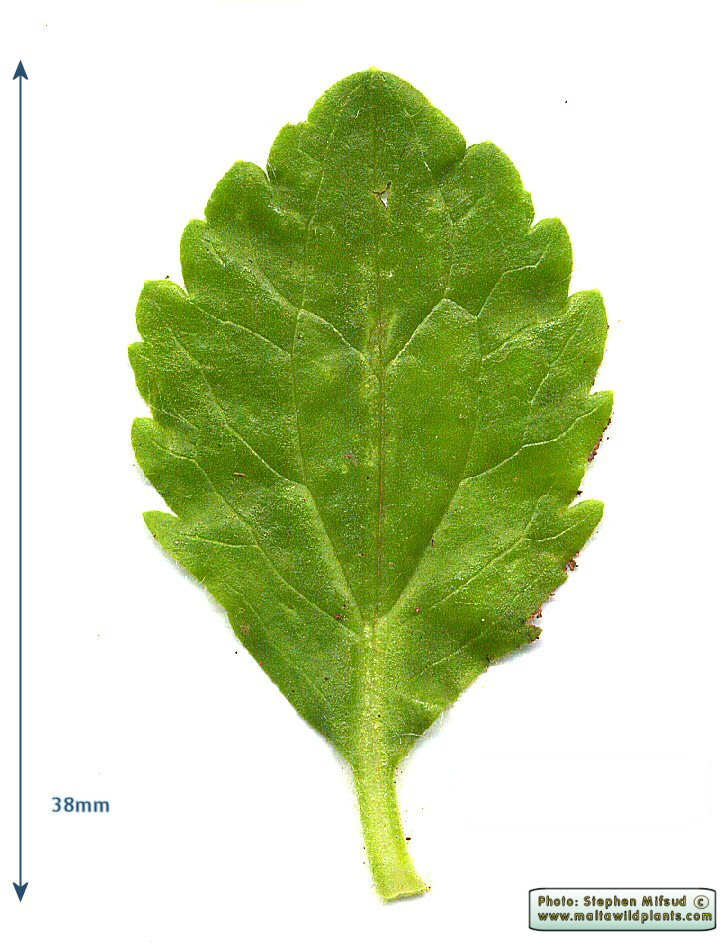
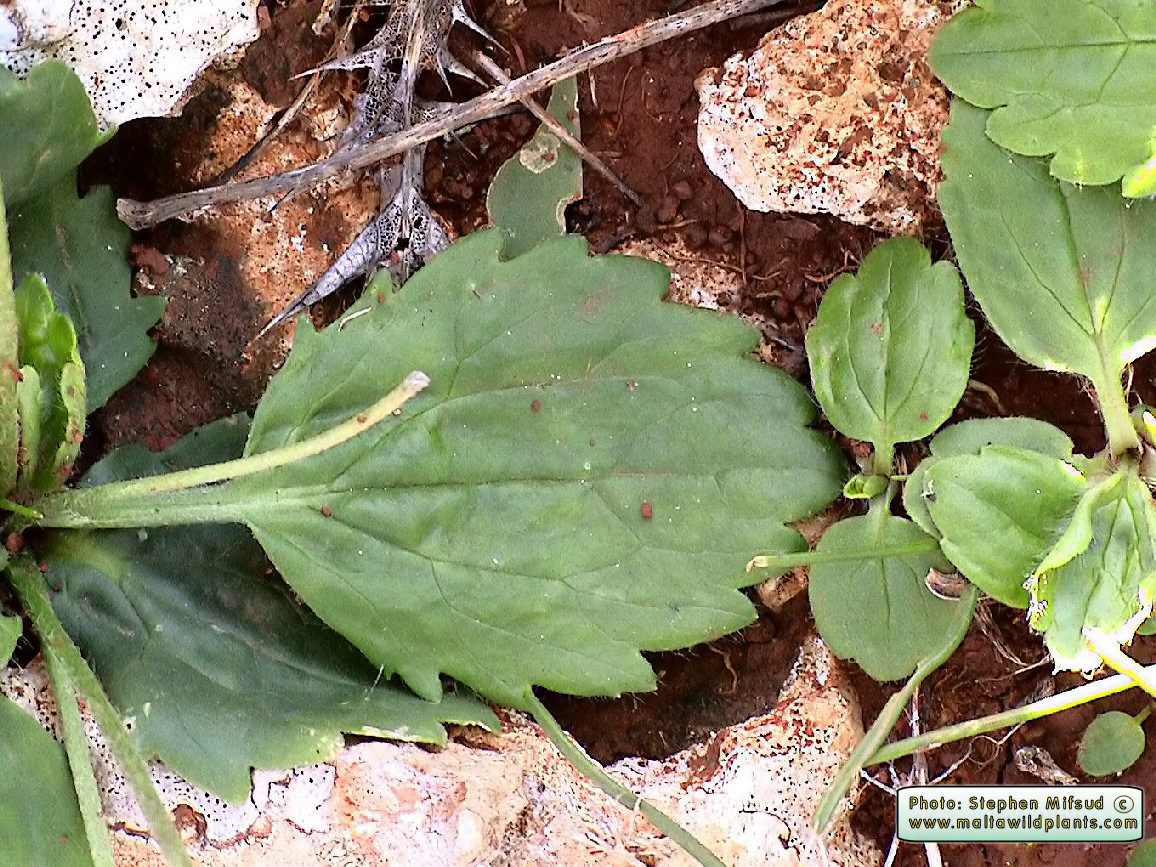
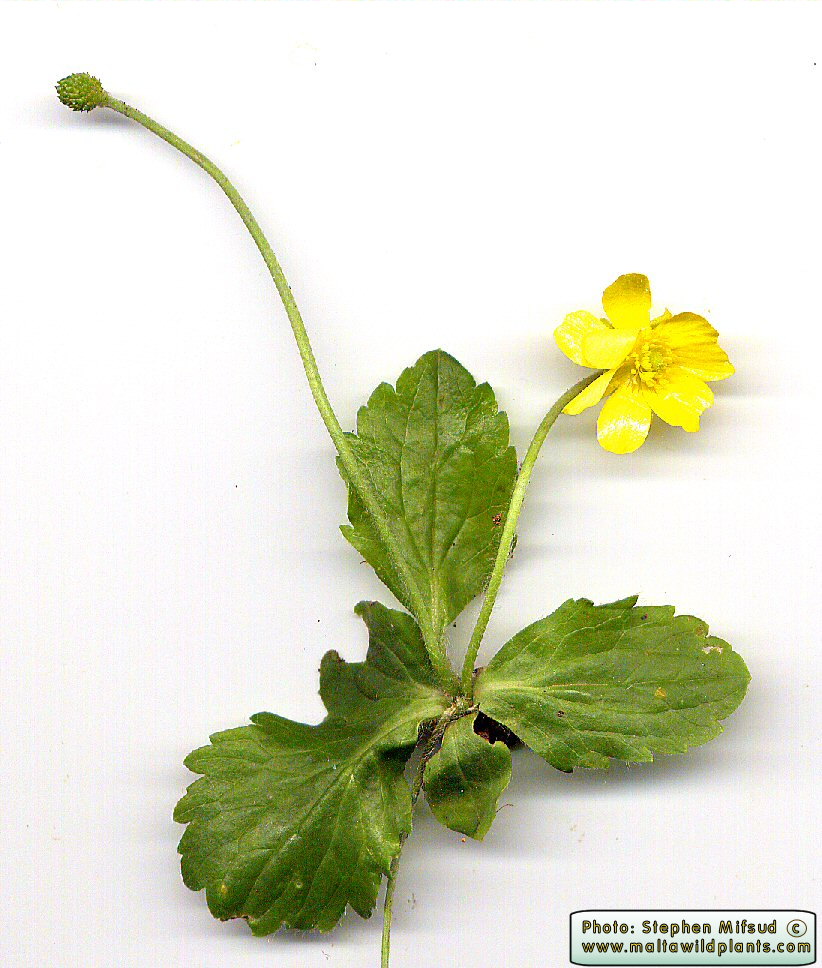
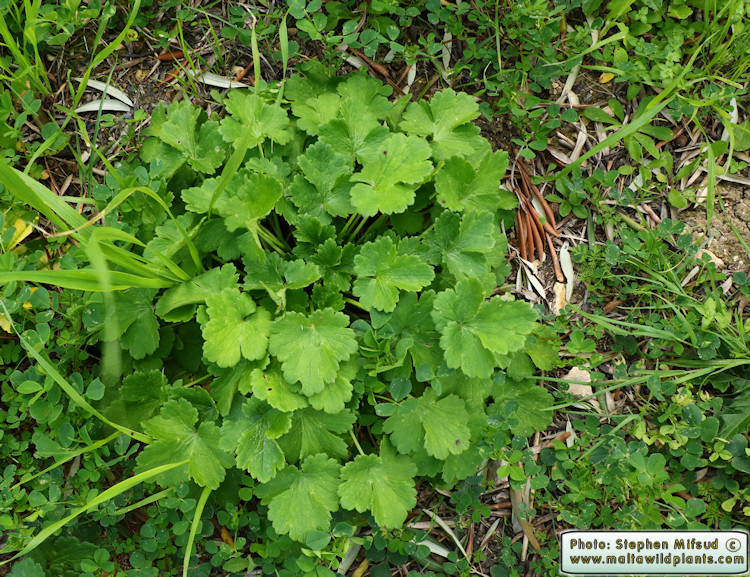
The leaves are arranged as a basal rosette, and they are often found lying on the ground. There are not much leaves per plant, and although this varies, it rarely exceeds 10 leaves. The leaves are stalked, have a serrated outline, covered with stiff hair and their shape is ovoid and broad or bullate, hence the origin of species name (bullatus). The leaf is fleshy, and its veins look like deep wrinkles into the leaf body.
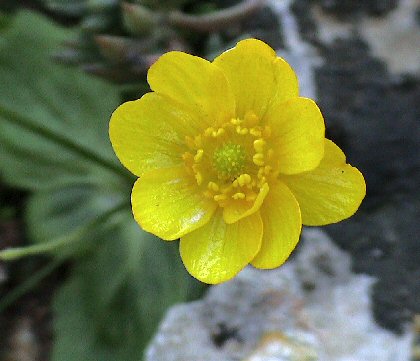
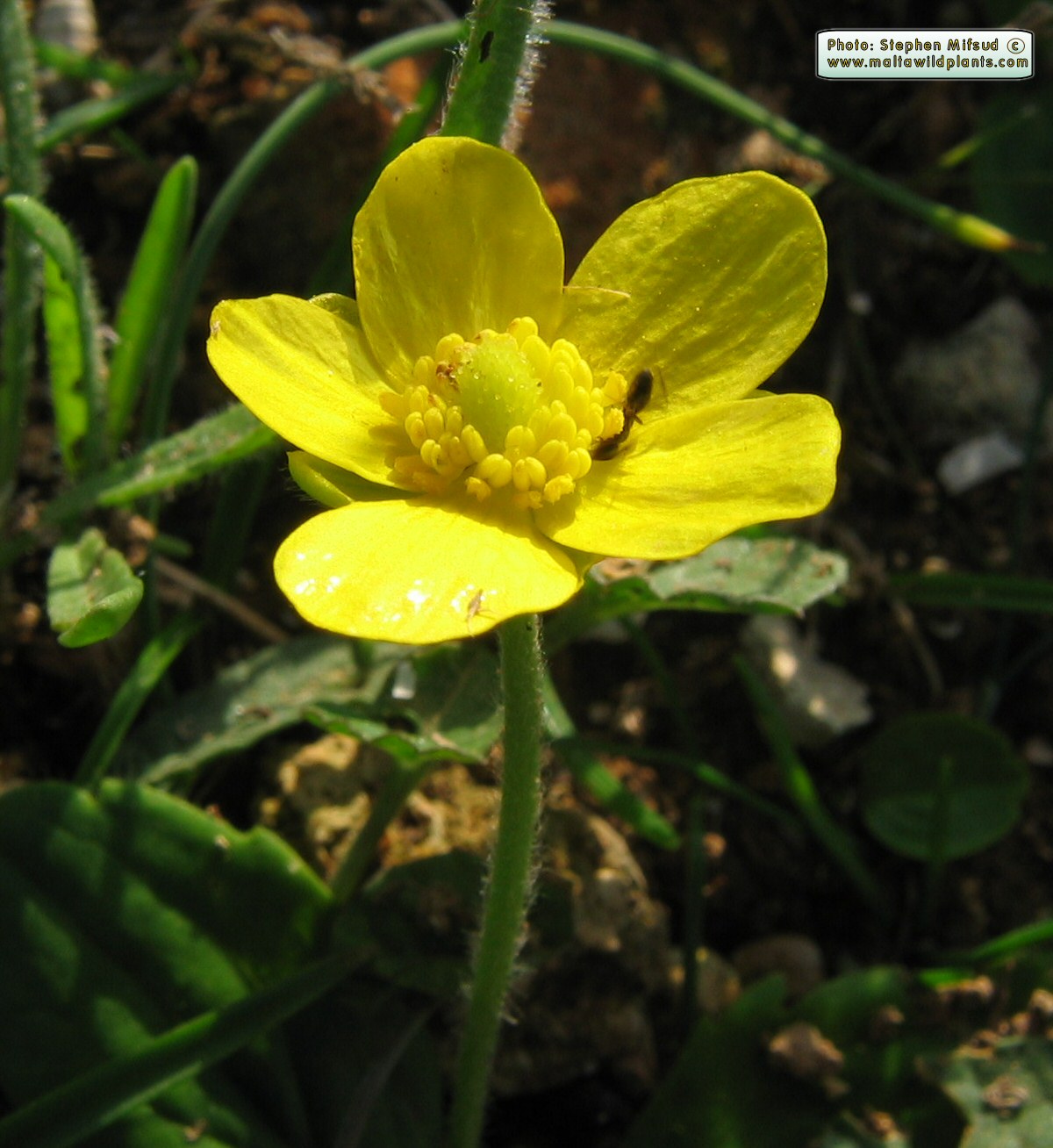
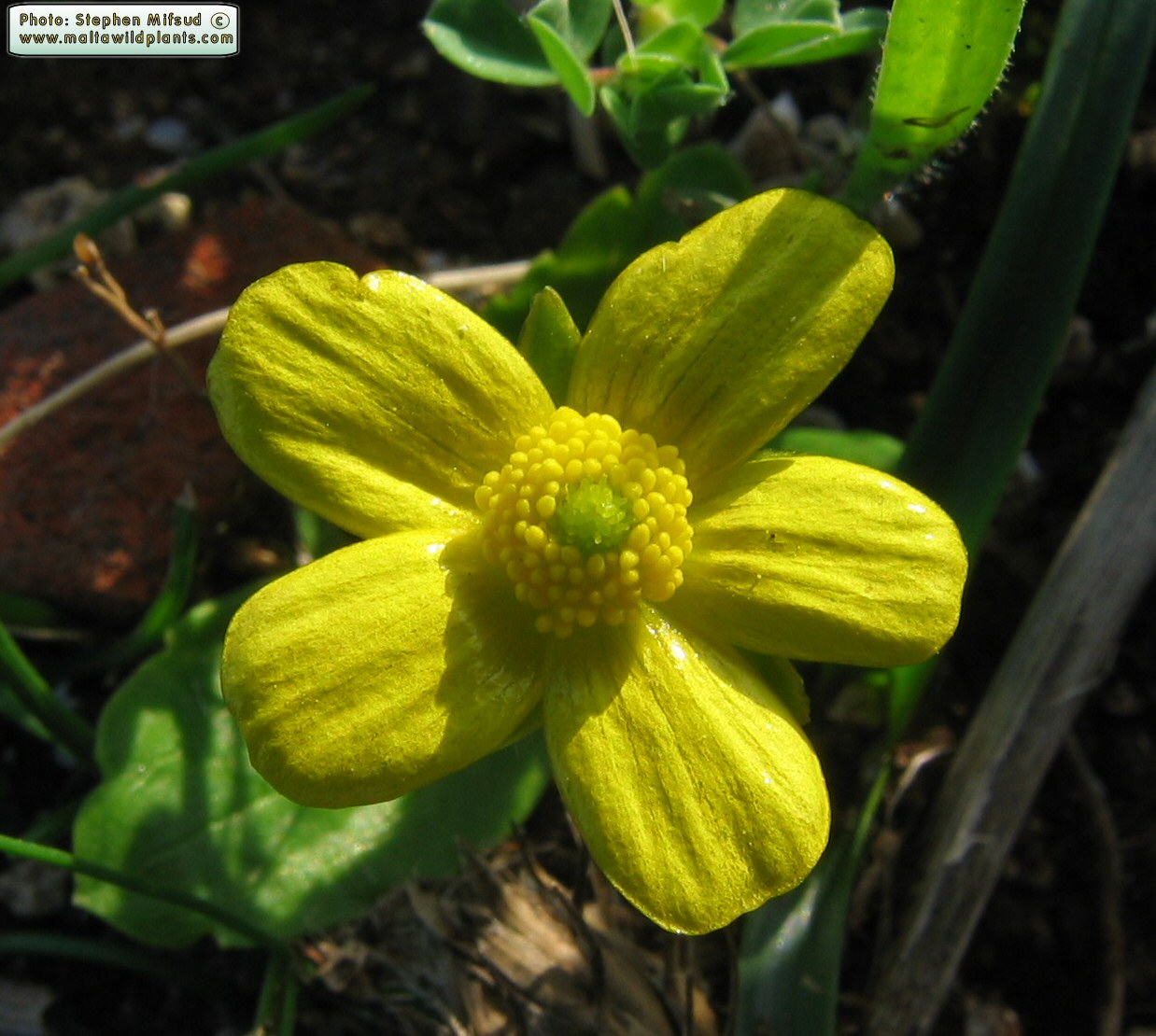
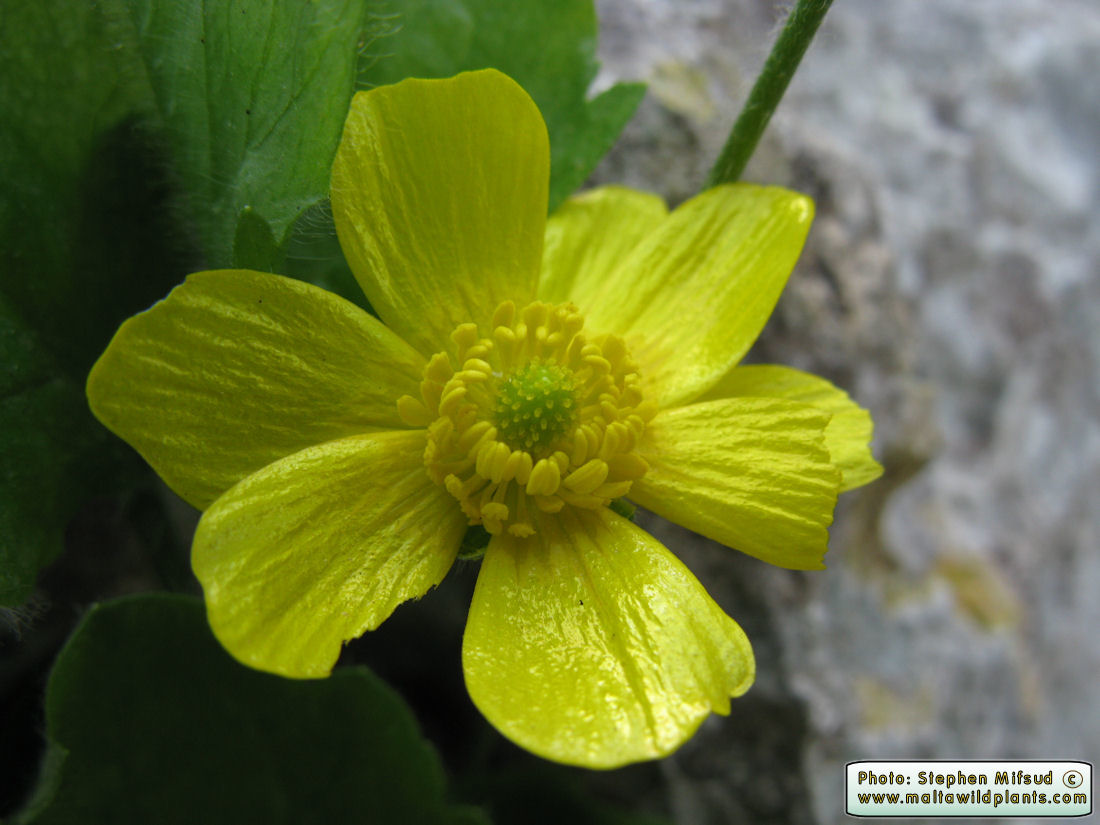
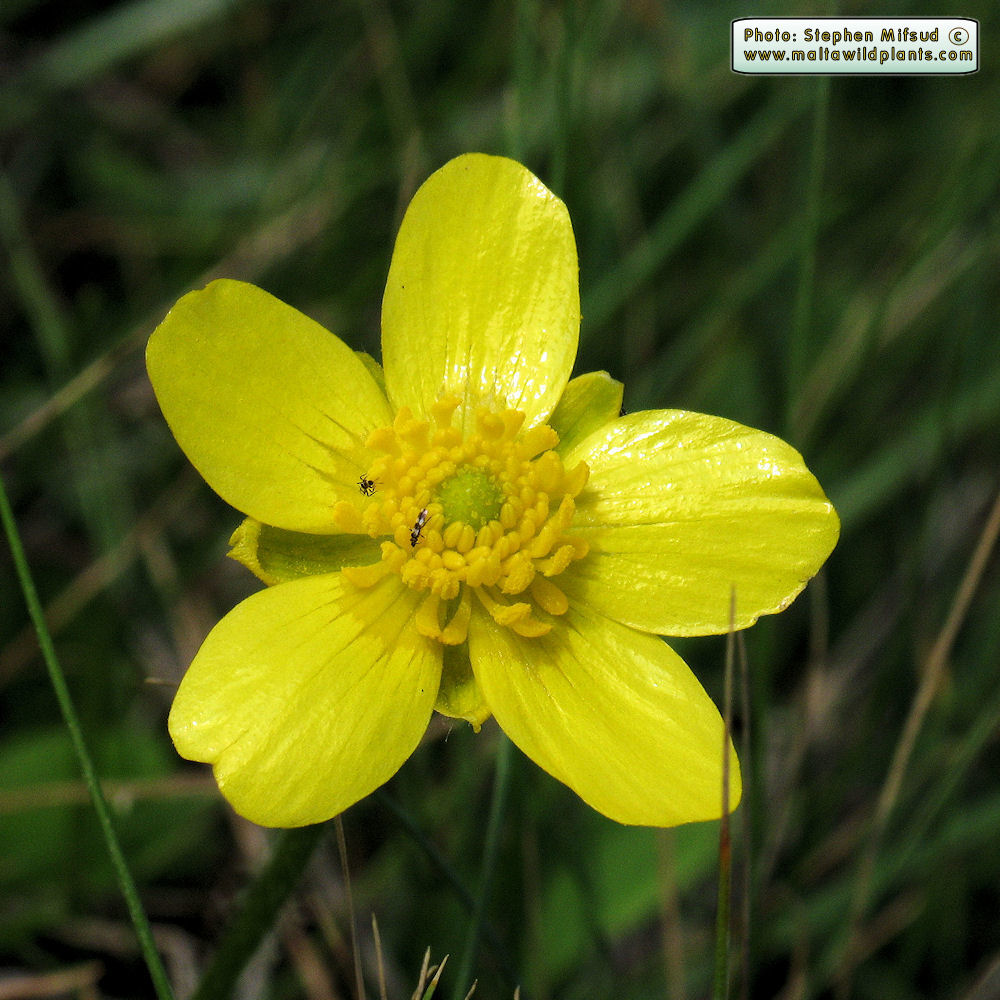
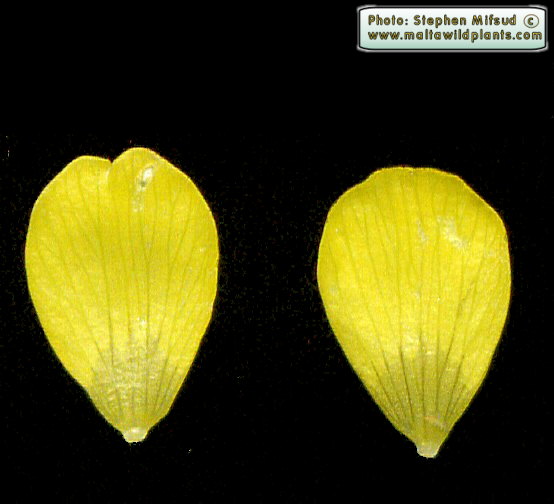
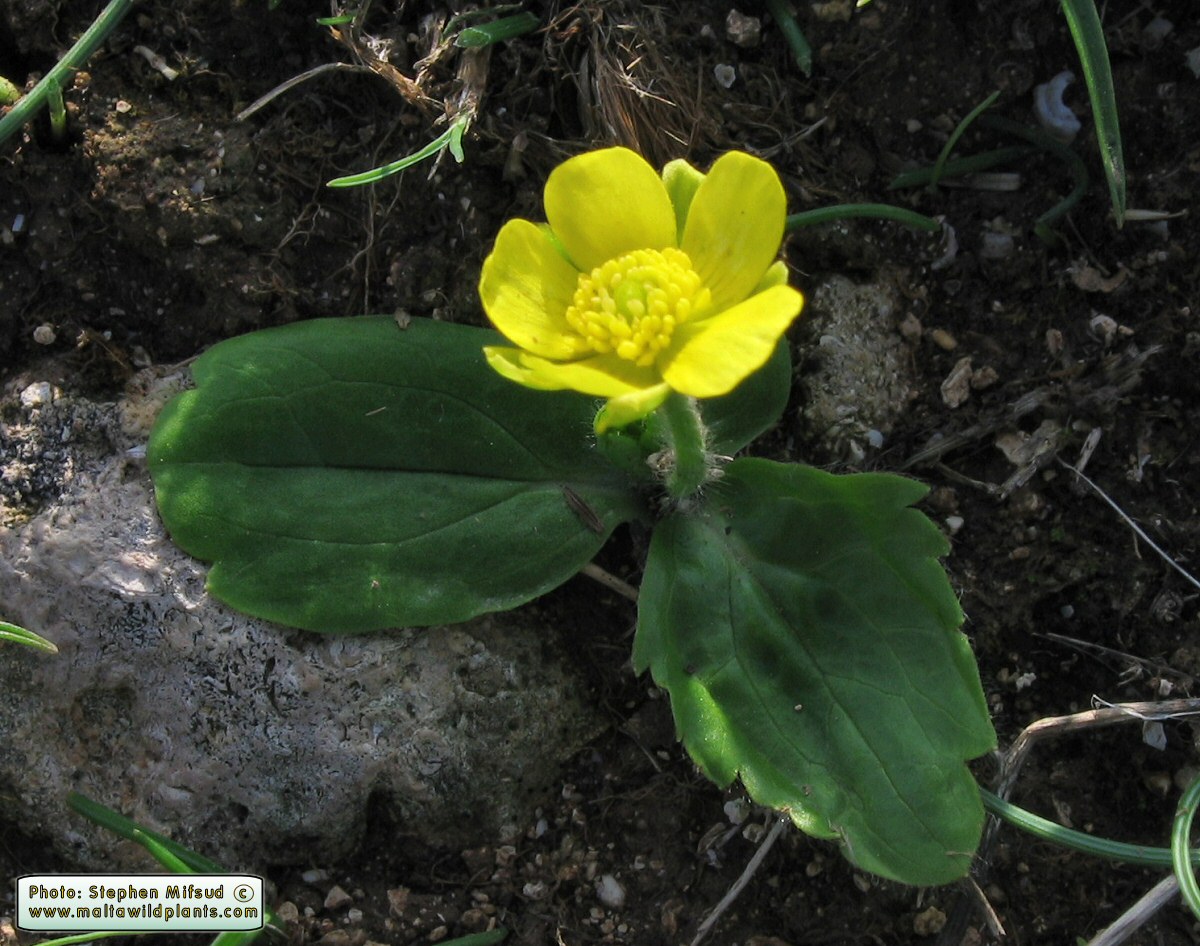
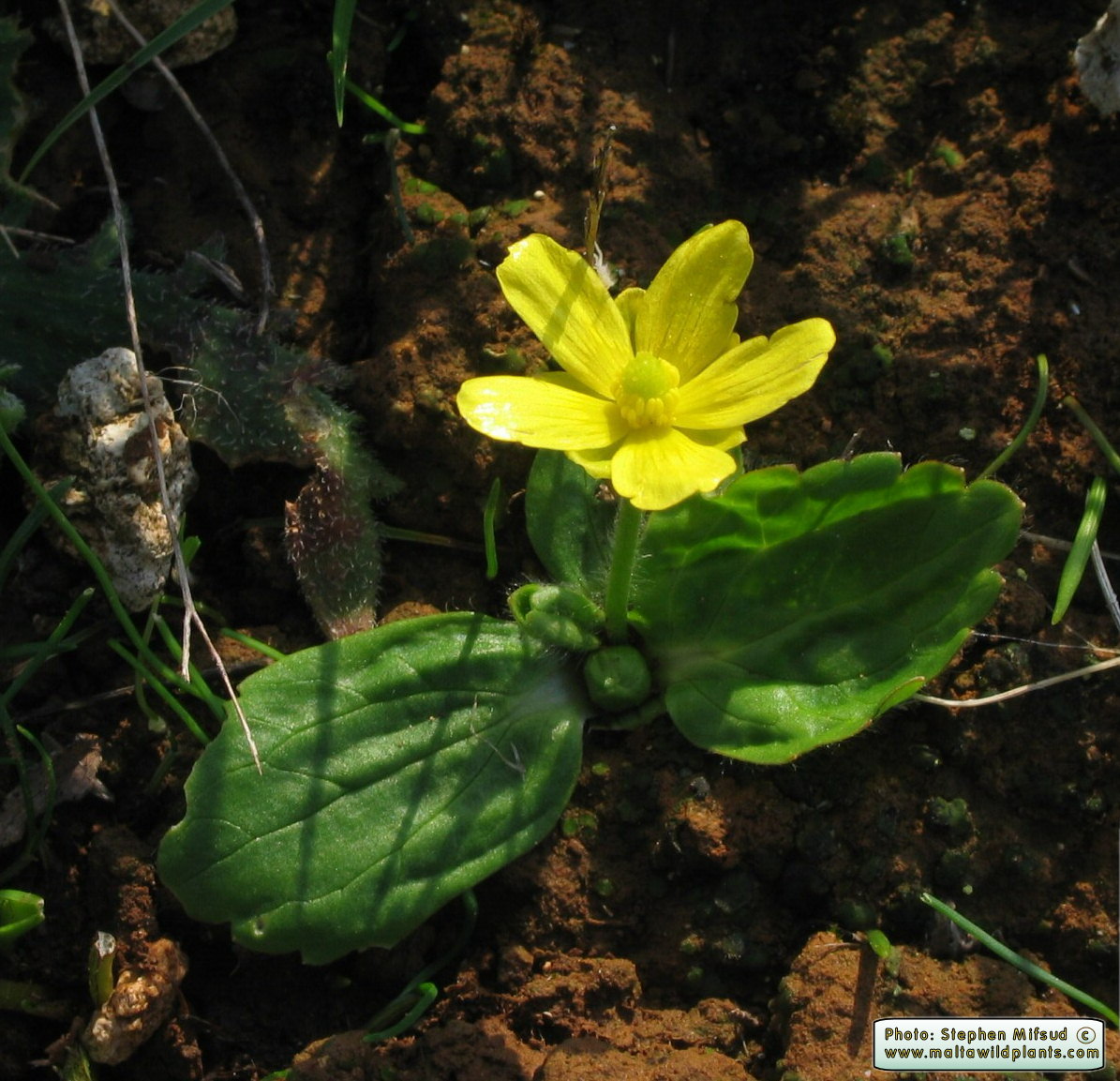
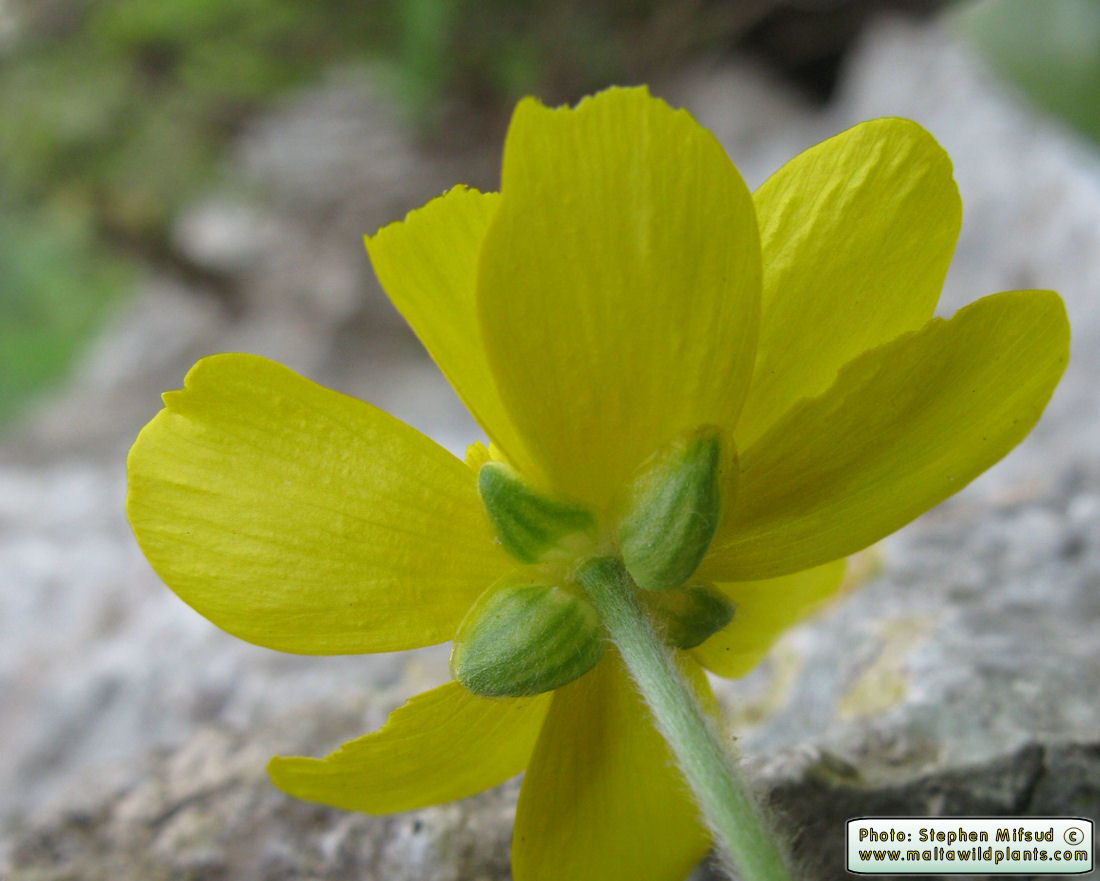
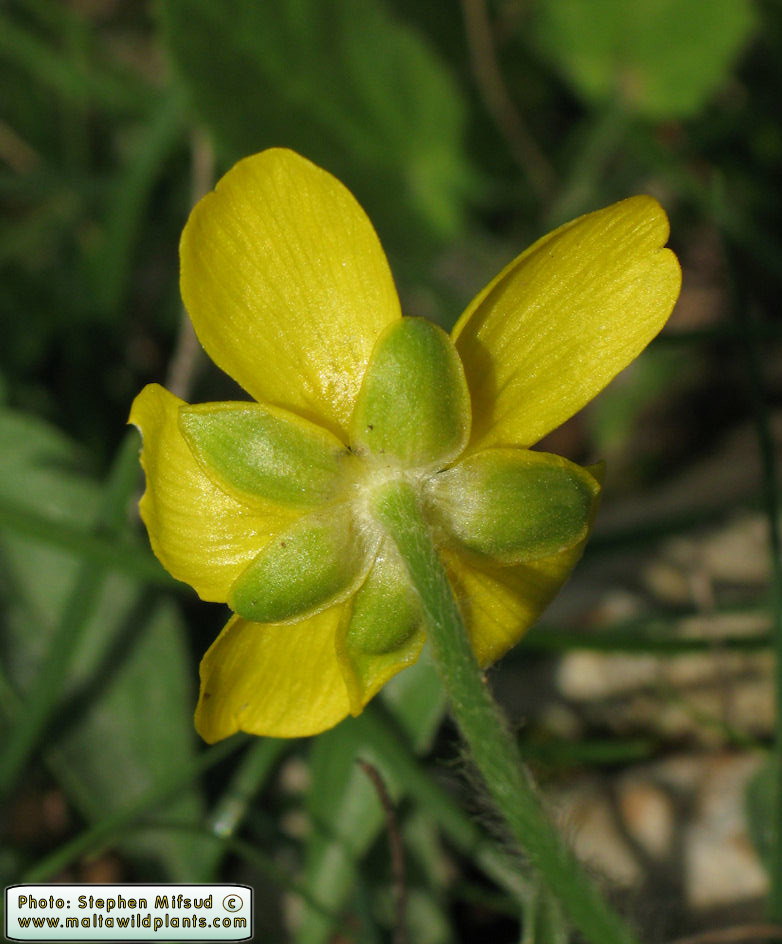
The flowers are eye-catching and quite large in comparison to the plant's size, having a diameter of about 22mm. They have a bright yellow colour, as most Ranunculus species. The perianth consists of 5 green/yellow, bucket shaped sepals around an elongated receptacle, and normally 5 petals but the number could be any up to 10. The petals are yellow, and somehow looks shiny or glaze in light. At their base they have a patch of darker yellow colour and slightly darker, longitudinal veins. The receptacle bears the female part, which consists of a group of small, simple pistils ( apocarpous); and the male part, a cluster of yellow stamens growing from the receptacle base around the carpel. The flower have nectar pockets at the base of the petals which attract many pollinating insects (namely bees), which can promote cross pollination.
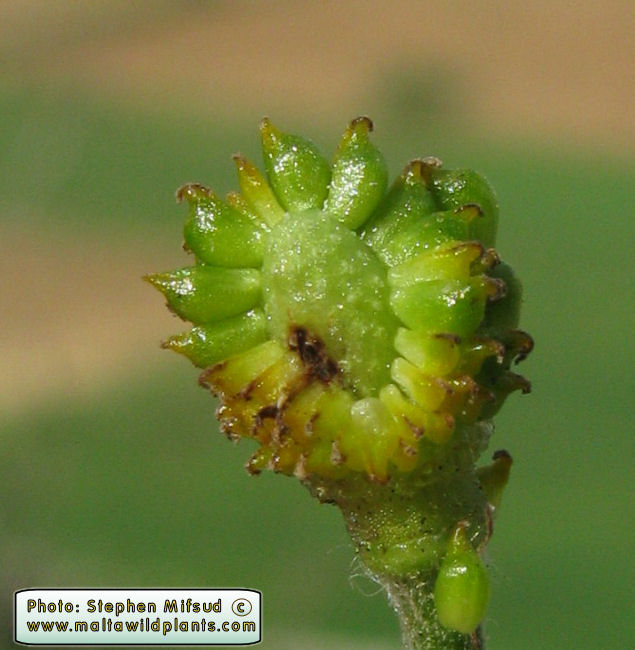
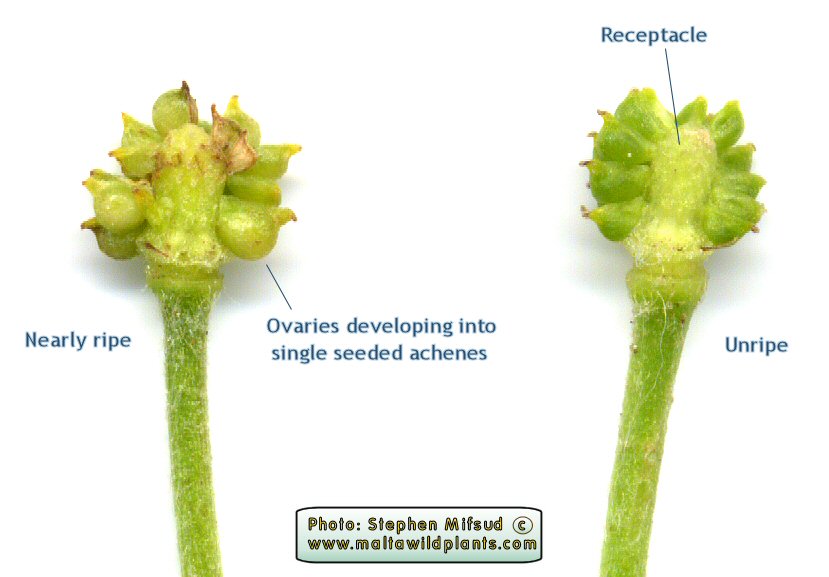
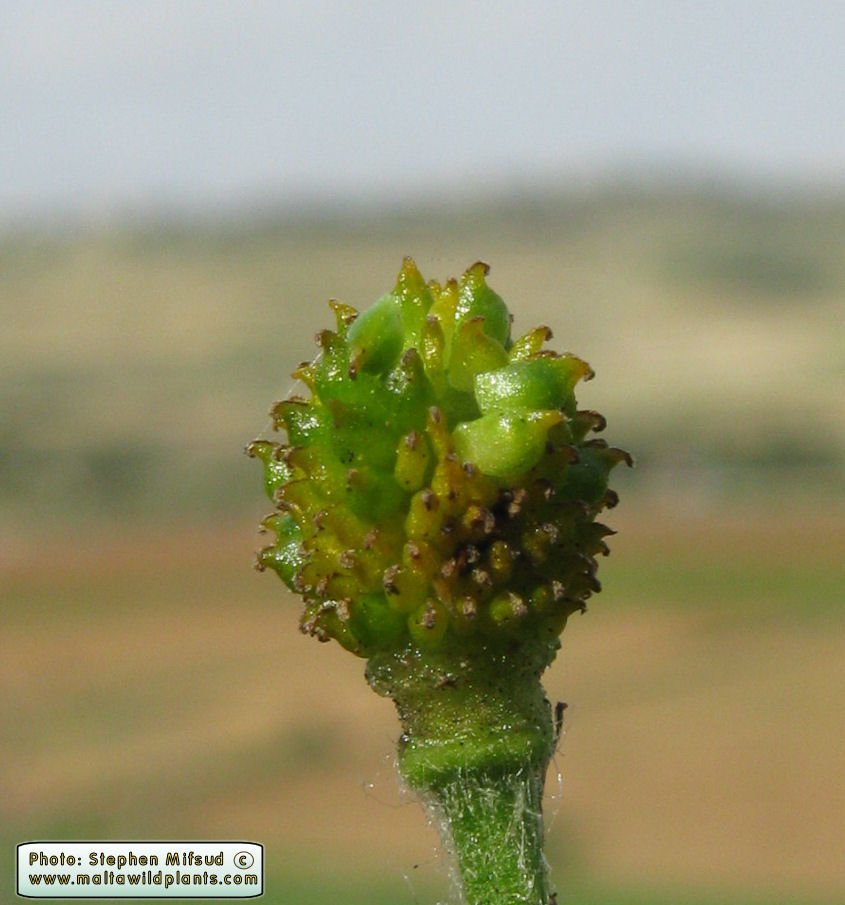
After fertilisation, the ovary develops into the seed itself, referred to as an achene, which is glabrous, lacks pappus, and have an eccentric beak by which it is attached to the receptacle. The outer part of this beak was previously the style and stigma of the flower. The seeds are ripe when they get a light-brown / green colour and they simply fall off in the ground without any means of mechanical seed-disperssion. The plant lives all year round due its underground tuberous roots which give rise to the plant at Autumn when the climate gets colder and rainy.
|
|
| Additional Information |
Origin and Distribution
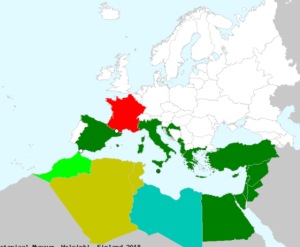
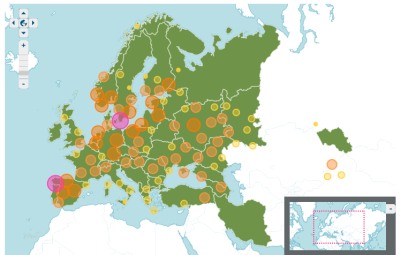
Found throughout most of the Mediterranean region, including North Africa, and also in Portugal and north-west Spain. [WWW-35], [WWW-37]
According to reference [WWW-26] this plant is native to the following regions and countries :
Northern Africa: Algeria [n.], Morocco, Tunisia
Western Asia: Turkey [Islands]
Southeastern Europe: Greece - Crete, Italy [incl. Sardinia, Sicily]
Southwestern Europe: France - Corsica, Portugal, Spain [incl. Baleares]
Genus name derivation
The genus name is derived from the Latin word "Rana" = frog and "Cola" = inhabiting or living place: and so together it means frog's inhabitation. This is so since many of the species of the Ranunculus genus are typical of humid / damp places, hence same as the frog's inhabitation. [WWW-38]
Toxic properties
All parts of the plant is toxic due to the presence of the main toxic compounds - Anemonin and ProtoAnemonin. Also it contains the non-toxic saponine. [WWW-39]
Like many other species of the Ranunculus genus, this species have irritating properties when used internally, due to its alkaloid contents derived from the anemonin. These can produce renal and gastrointestinal alterations, which in the most serious cases, causes death. [WWW-38]. The toxic sap of most Ranunculus species affects the gastrointestinal tract and nervous system; it also causes dermatitis. [WWW-41]
The toxic properties are of more concern to life stock then to humans. Like other buttercups, this species often affects: cattle, goats, and horses. [WWW-24]
Anemonin
Anemonin is an acrid, poisonous, crystallisable substance, obtained from some species of anemone and Ranunculus. [WWW-40]
Anemonin is crystalline, tasteless and odourless when pure and melts at 152øC. Anemonin is a powerful irritant, like cantharides, in overdoses causing violent gastroenteritis. It is volatile in water vapour and is then irritating to the eyes and mouth. The Oil acts as a vesicant when applied to the skin. Anemonic acid appears to be inert. Anemonin sometimes causes local inflammation and gangrene when subcutaneously injected, vomiting and purging when given internally. It is, however, uncertain whether these symptoms are due to Anemonin itself or to some impurity in it. The chief action of pure Anemonin is a depressant one on the circulation, respiration and spinal cord, to a certain extent resembling that of Aconite. The symptoms are slow and feeble pulse, slow respiration, coldness, paralysis and death without convulsions. In poisoning by extract of Pulsatilla (rich in anemonin), convulsions are always present. Their absence in poisoning by pure Anemonin appears to be due to its paralysing action on motor centres in the brain. [WWW-03]
History and old curiosities
The Flemish botanist Carlos Clusio discovered This nice species for the science or of L'Ecluse in the XVIth century, and he tells us " in Lisbon, in the olive groves, as well as in many places of the Andalusia, where I botanized flowery after November began, and I took it to Belgium. There it blooms also in October and November, and preserves the sheets during the whole winter, until May, and earlier it begins to re-bloom little ". Likewise he mentions to us that " if an old woman uses the flower, it becomes suitable for her to receive the semen ", since to its late flowering, it was believed that the species was useful to make the aged women fertile. [WWW-38] (translated and edited by [SM] from Spanish)
Medicinal uses
Vesicant in large doses, anti-inflammatory in small doses, antirheumatismal, drains articulary capsules. [WWW-37]. In general, Buttercups have an irritating effect on skin and especially mucus membranes. Because of this it has been used as a rubefacient. Eating the plant can cause intense pain and burning. Most plants in this family should be avoided. [WWW-31]
Personal Observations
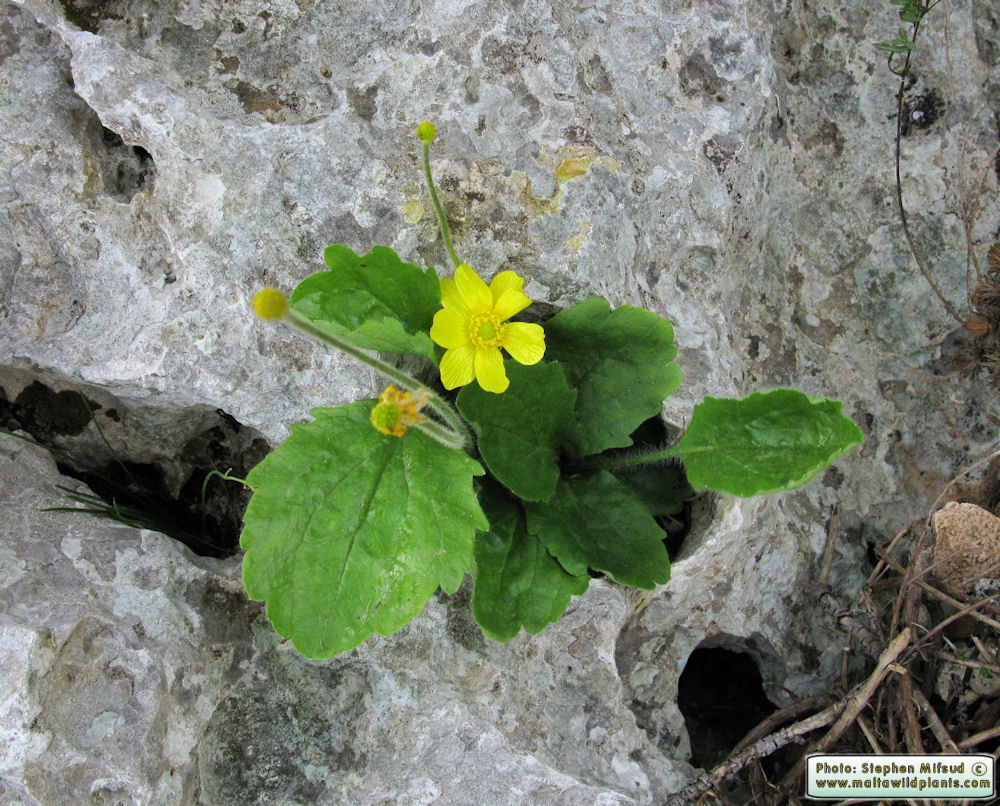
This plant flowers in Autumn, and is found lying on bare rock, or precisely in the damp and moist soil entrapped in grooves, pits or spaces in or between rocks. When it rains, the water drains very slowly from the un-porous rock, and hence the layer of soil present is always moist. This condition favours the growth and flowering of the plant in Malta [SM]
The plant is seen growing often with another, completely different plant, but of similar short height, hence the Bellis annua. In November and December, the rocky face of Dingli Cliffs are nicely coloured in yellow and white by these two common flowers [SM]
|
|
| Photo Gallery |
 |
 |
 |
 |
Typical photo of buttercup flower. Flattened or cup shaped yellow flower with cluster of anthers around the central swollen receptacle which contains numerous tiny green ovaries. |
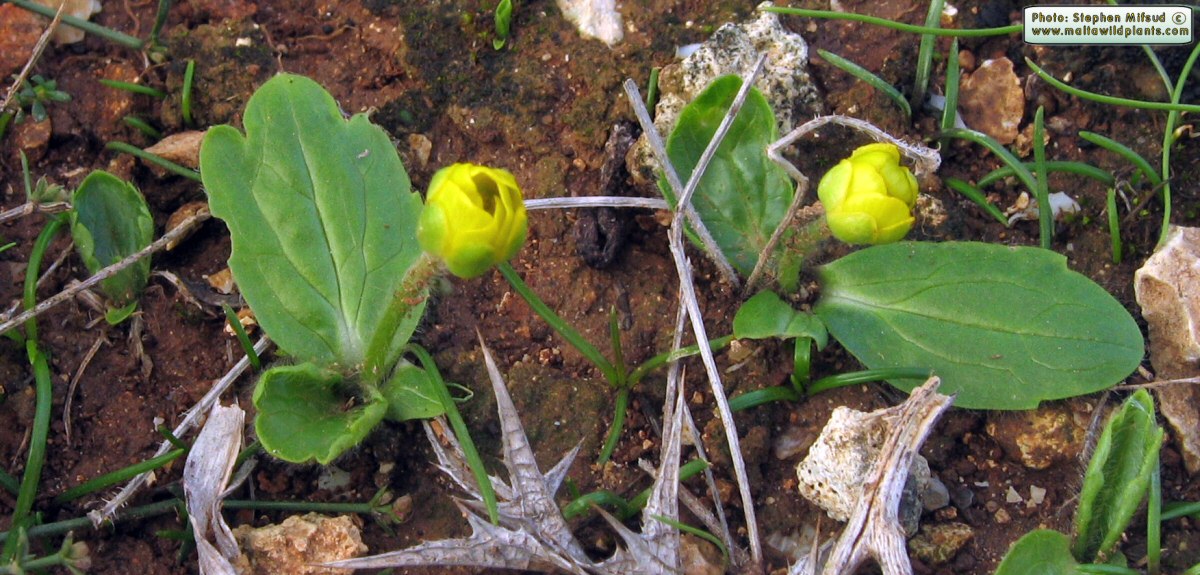
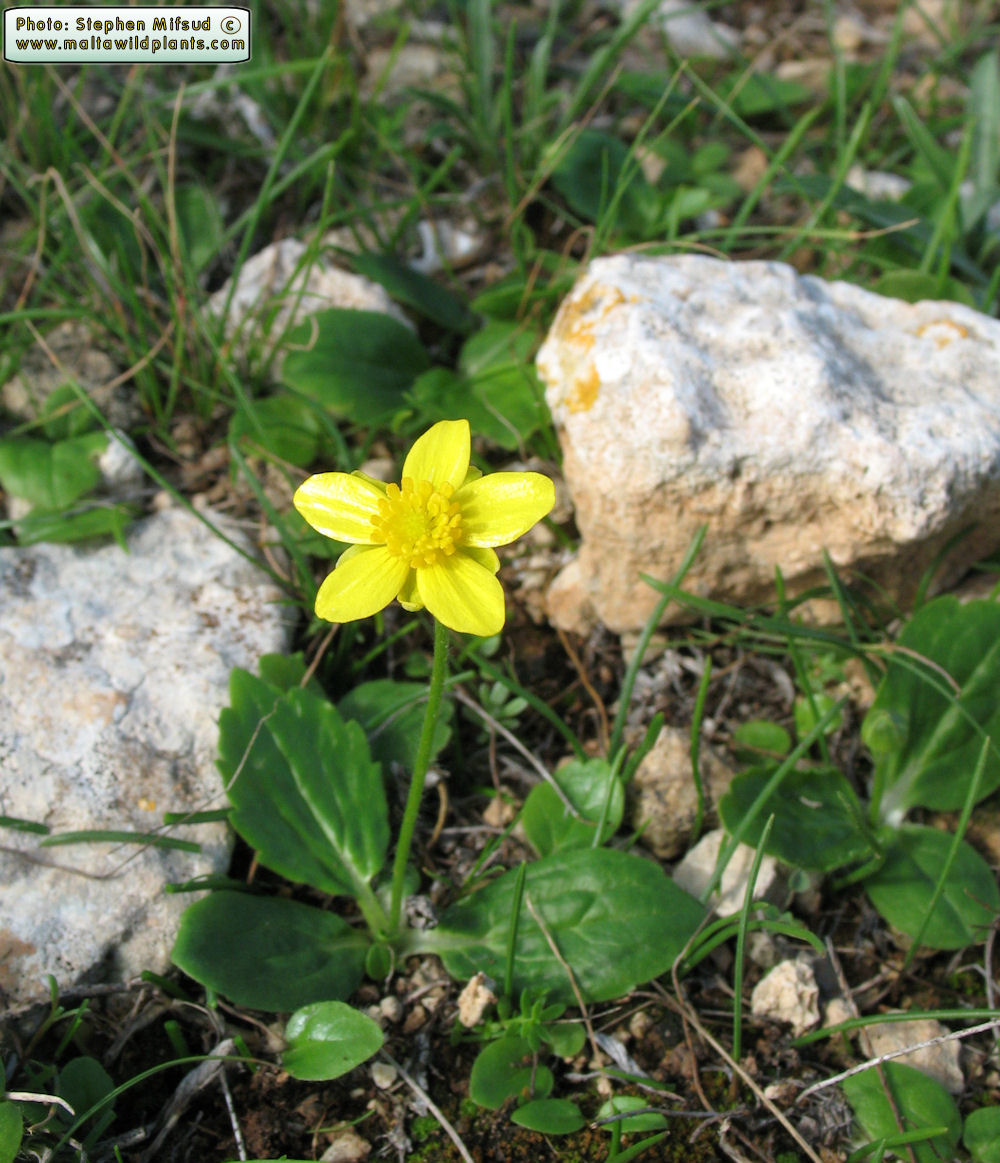
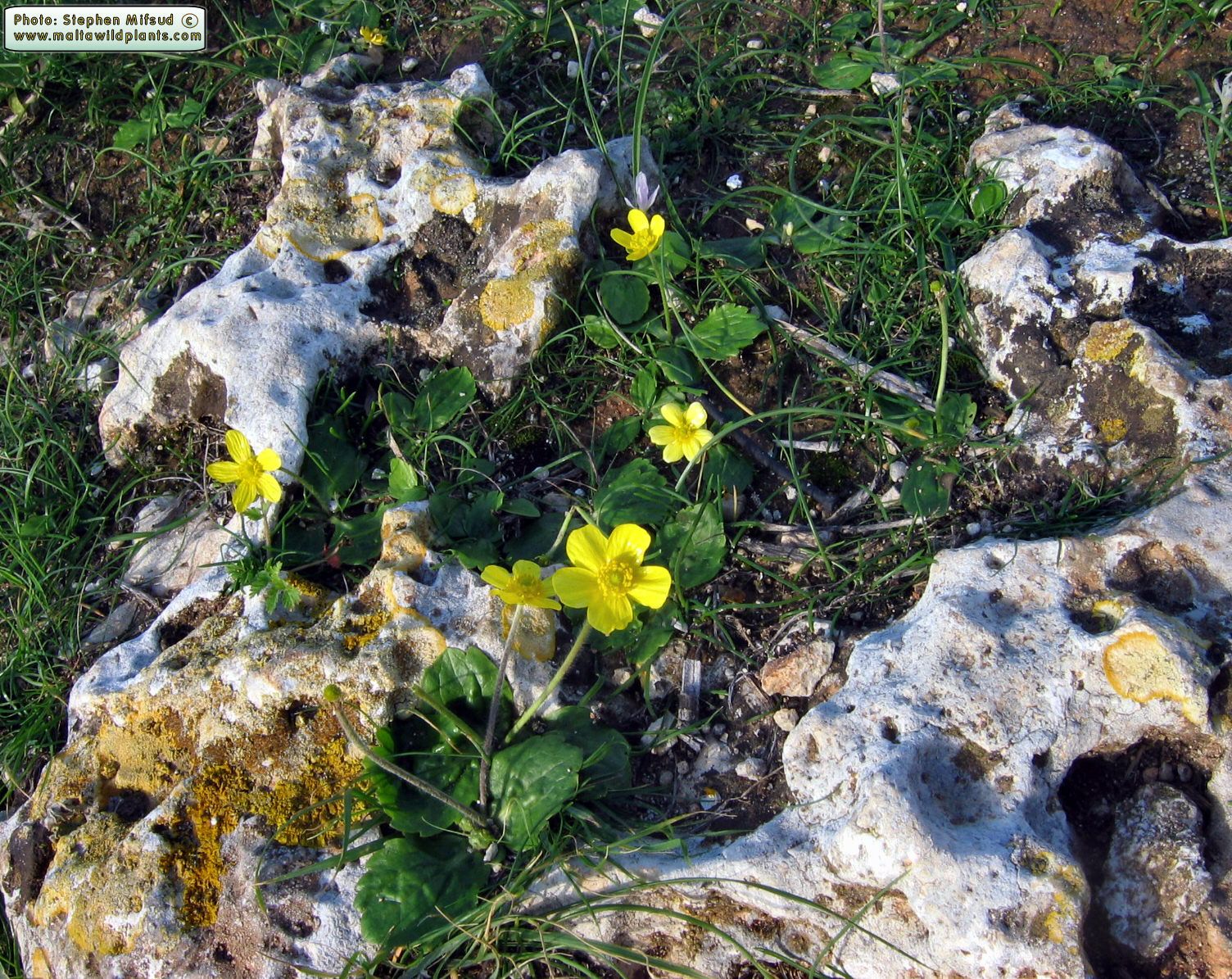
Photo of flowers and leaves in situ. One flower has 5 petals and the other 10. |
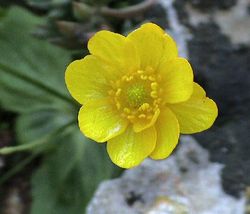
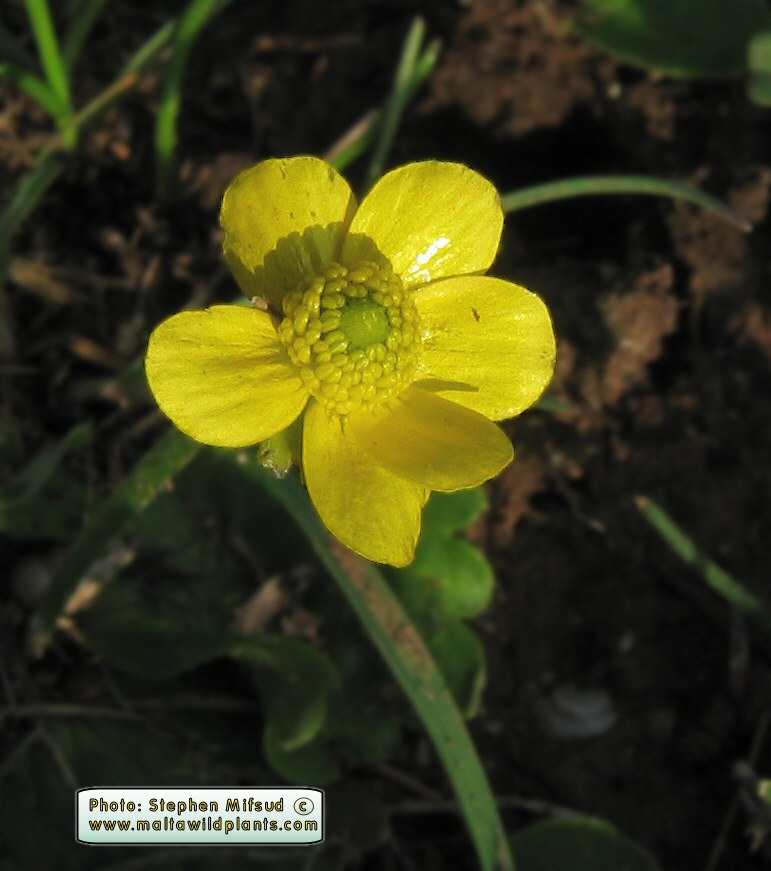
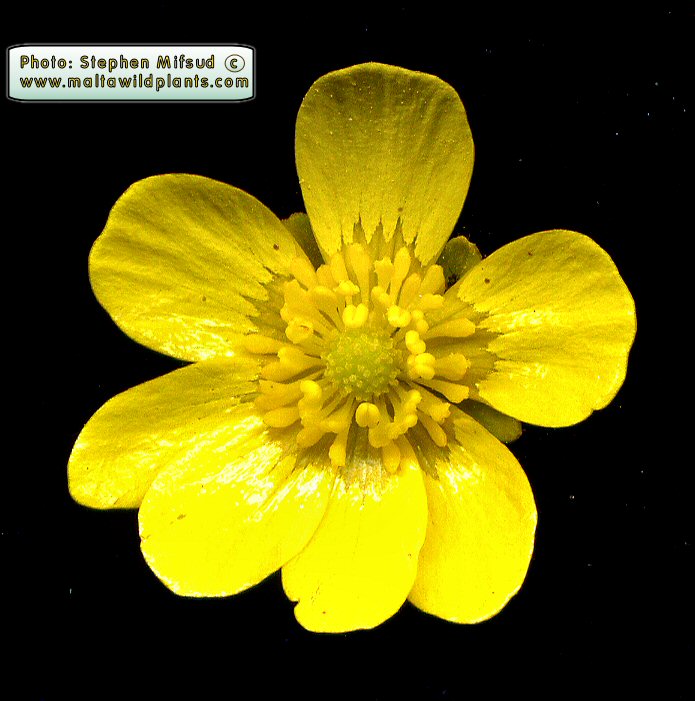
Close up photo of the yellow flower. This flower have 9 petals, and as it can be seen the number of petals is not fixed, even between flowers of the same plant. However the minimum is always 5 petals, and rarely more than 10. |
Photo of yellow flower taken in November. |
 |
 |
 |
 |
Close up photo of the actinomorphic yellow flower. It has shining broad petals, sometimes in the form of a cup, a clister of stamens around a conical capitula. Stamens of this flower ar still still unmature. |
Close up photo of flower having the characteristical shining petals in direct light. |
Close up photo of flower in sunlight. |
Photo of buds of two young plants. |
 |
 |
 |
 |
Scanned image of flower against a dark background. It contains numerous petals around a central receptacle with many simple pistils (apocarpous). |
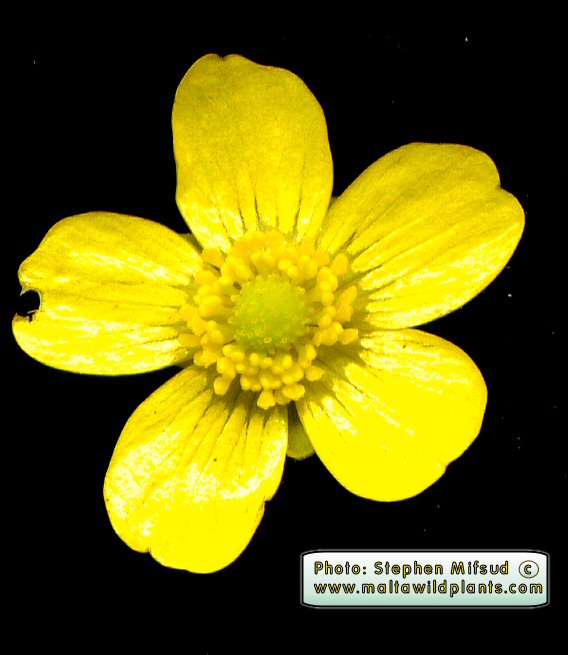
Scanned image of young flower. |
Scanned image of petals - smooth outline, oval, and sometimes there is a single small indentation at the tip. Base of petal is darker yellow and veined. |
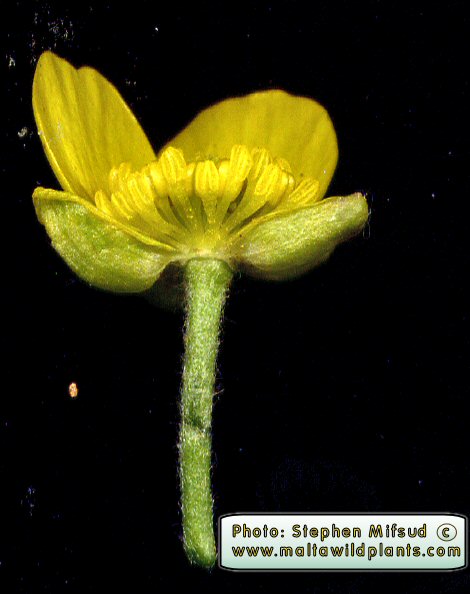
Scanned image of flower (lateral view) with some petals dissected out to show cluster of yellow stamens. |
 |
 |
 |
 |
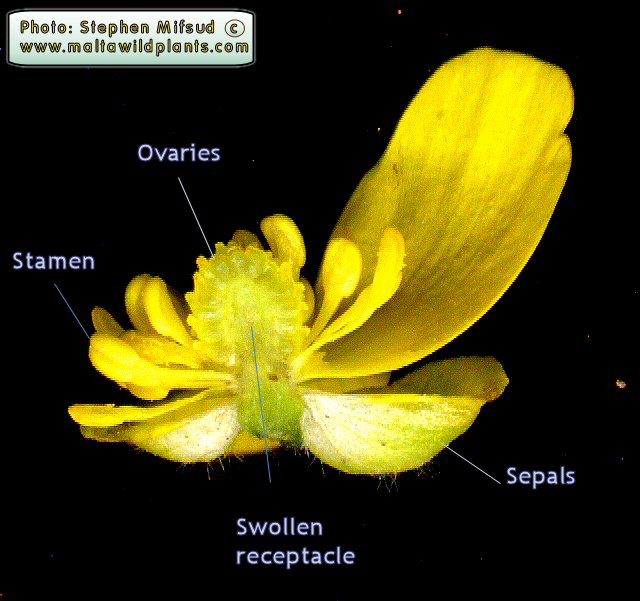
Annotated scanned image of a transverse section of flower with most petals and some sepals dissected out. The single ovaries lie on an elongated receptacle and from its base comes out the numerous stamens. The sepals are greenish yellow and oval-bucket (inverted-cap) shaped. |
Scanned image of a flower (top view) with all petals dissected to show the arrangement of stamens and globular pistils. |
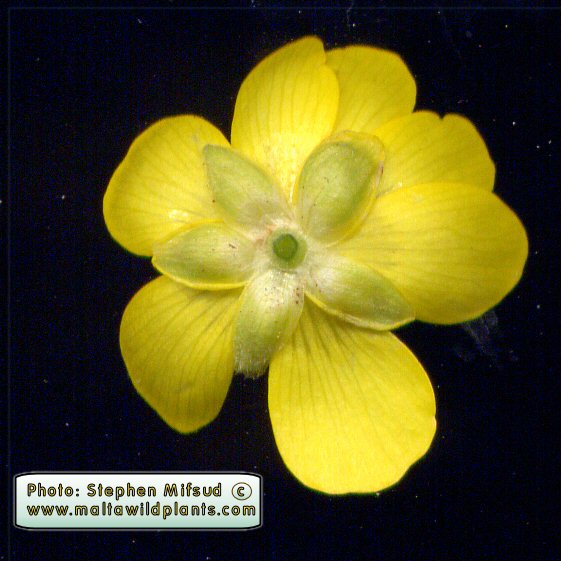
Scanned image of flower (underside view) to show arrangement of the 5 oval, bucket shaped sepals, green/yellow in colour. The number of petals may vary between 5 and 10, but the number of sepals is constantly 5 in every flower. |
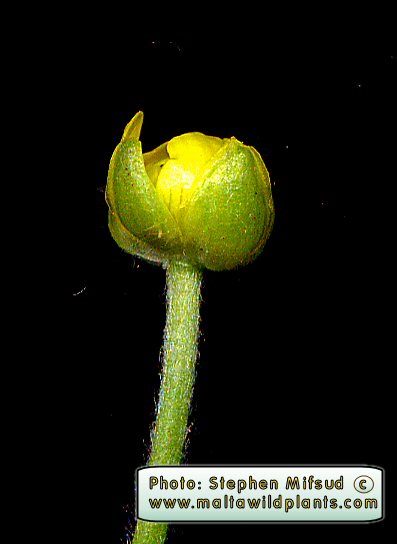
Globular, yellow topped calyx (bud) made up of 5 sepals. |
 |
 |
 |
 |
Photo of leaves in situ. The large one at the left is a fully sized mature leaf, while at the right are 2 small leaves of a young plant. Both have a serrated outline and oval shape. |
Scanned image of leaves. Average length of a mature leaf is 35-40mm. |
Enlarged image of a typical leaf, with prominent pinnate venation, serrated outline and ovoid shape. |
Scanned image of entire plant. |
 |
 |
 |
 |
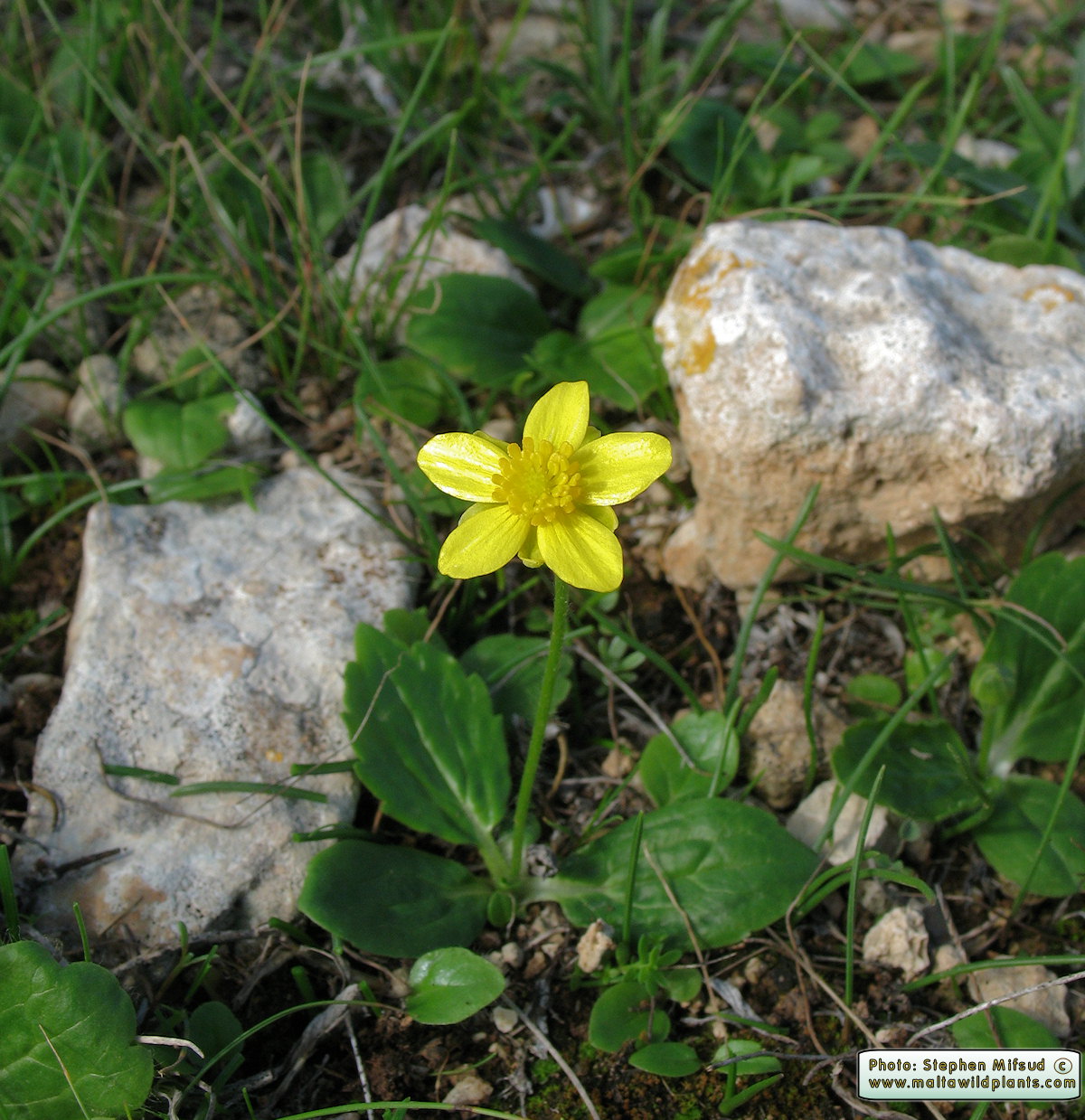
Photo of whole plant in situ. Its leaves are arranged as a basal rosette and have erect unbranched stems with terminal solitary flowers. |
Photo of a flower and seed-head which resembles a match-stick. |
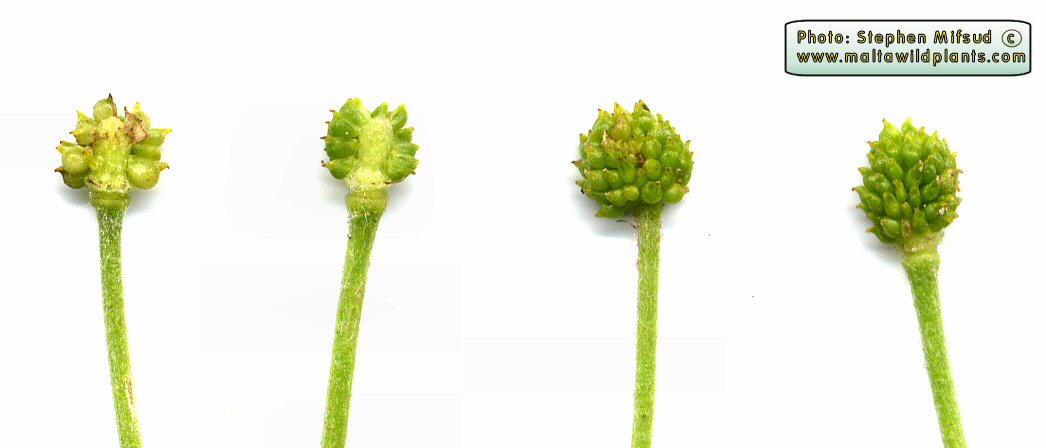
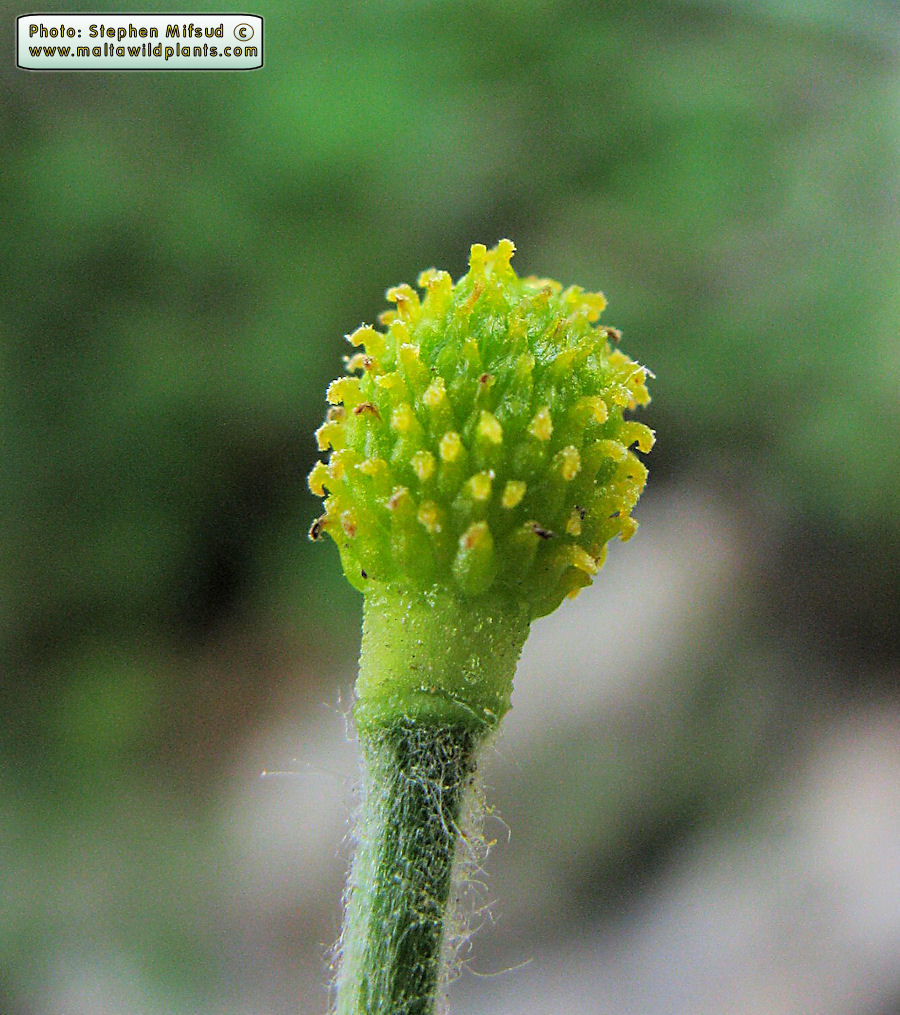
Scanned image of 4 seed-heads. The ones on the right being the more mature. |
An Magnified scanned image of seed-head. The fertilised ovaries, which lie on the elongated receptacle, develop in a one-seed achene without pappus. When ripe the seeds just fall off. |
 |
 |
 |
 |
Image of seeds, including enlarged images of 2 typical seeds. They fall from the receptacle when they are green/light brown in colour. They are roundish with an eccentric rod-like structure by which the seeds were attached with the receptacle. One end of this rod-shaped structure was once the stigma+style. |
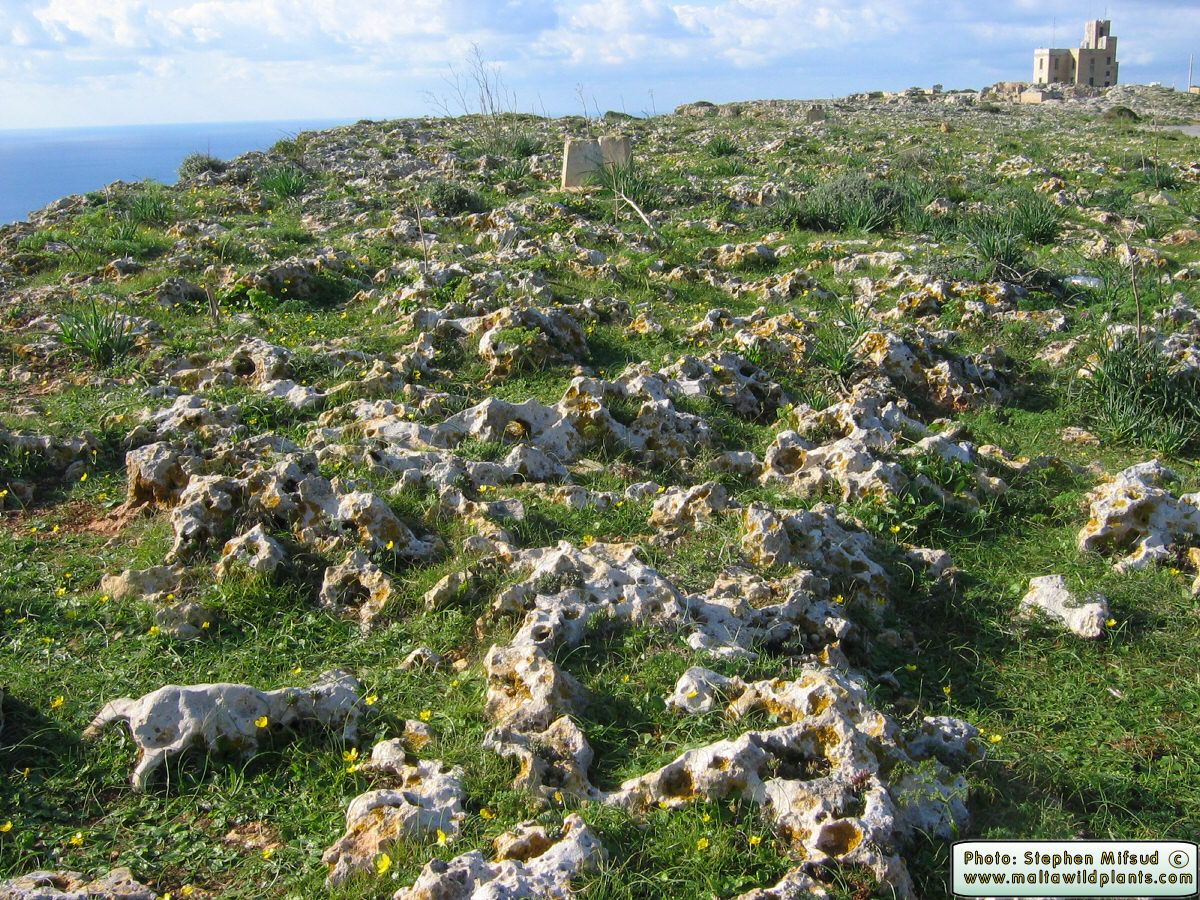
Bonus photo - A good location of this plant - Dingli cliffs, Dec/03, Malta. |
Photo of small plant in situ. It consists of small low leaves lying on the ground and one to few flowering stalks with a terminal solitary yellow flower. |
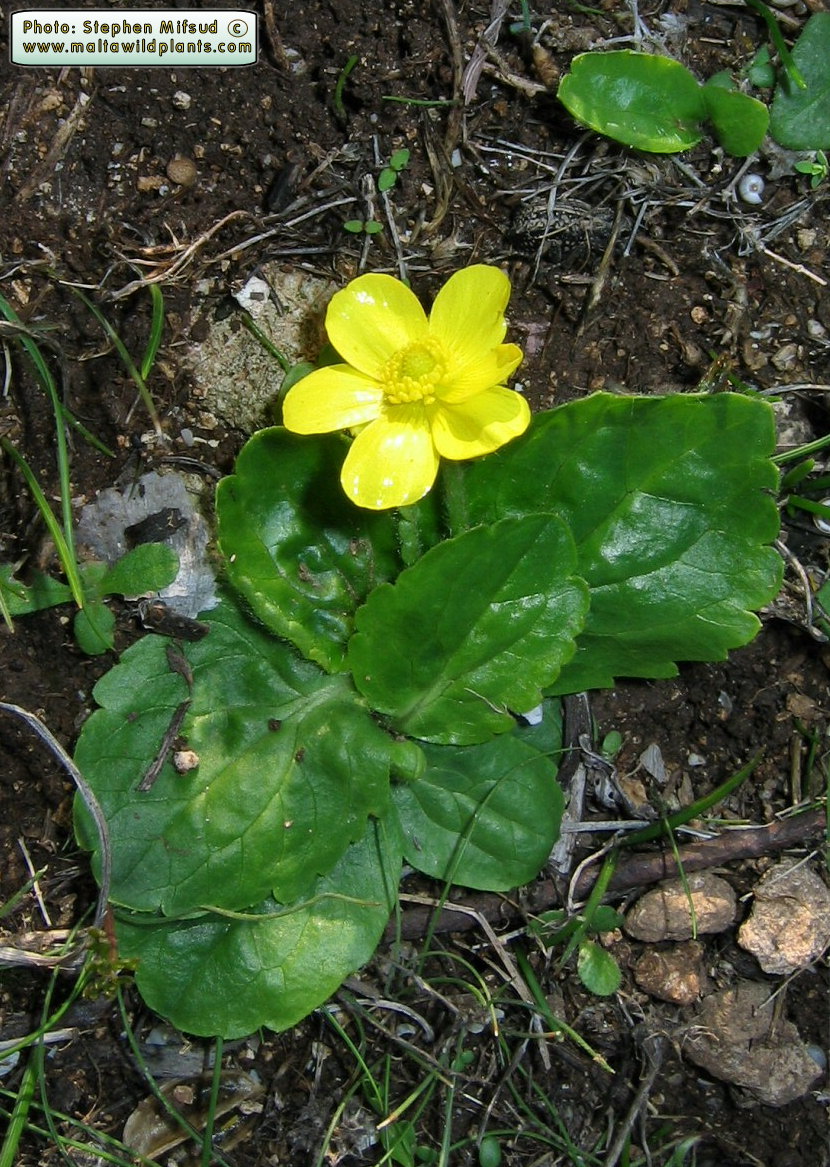
Photo of plant. |
 |
 |
 |
 |
Photo of plant. |
Photo of plant. |
Photo of plant in one of it common habitats, that is in shallow, damp soil found in gaps, pits and spaces between rocks. |
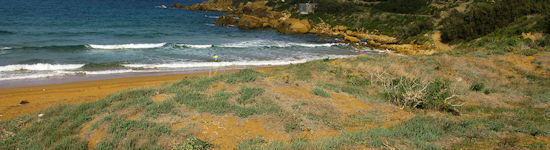
Photo of habitat of plant, on steppe and garigue. |
 |
| | |
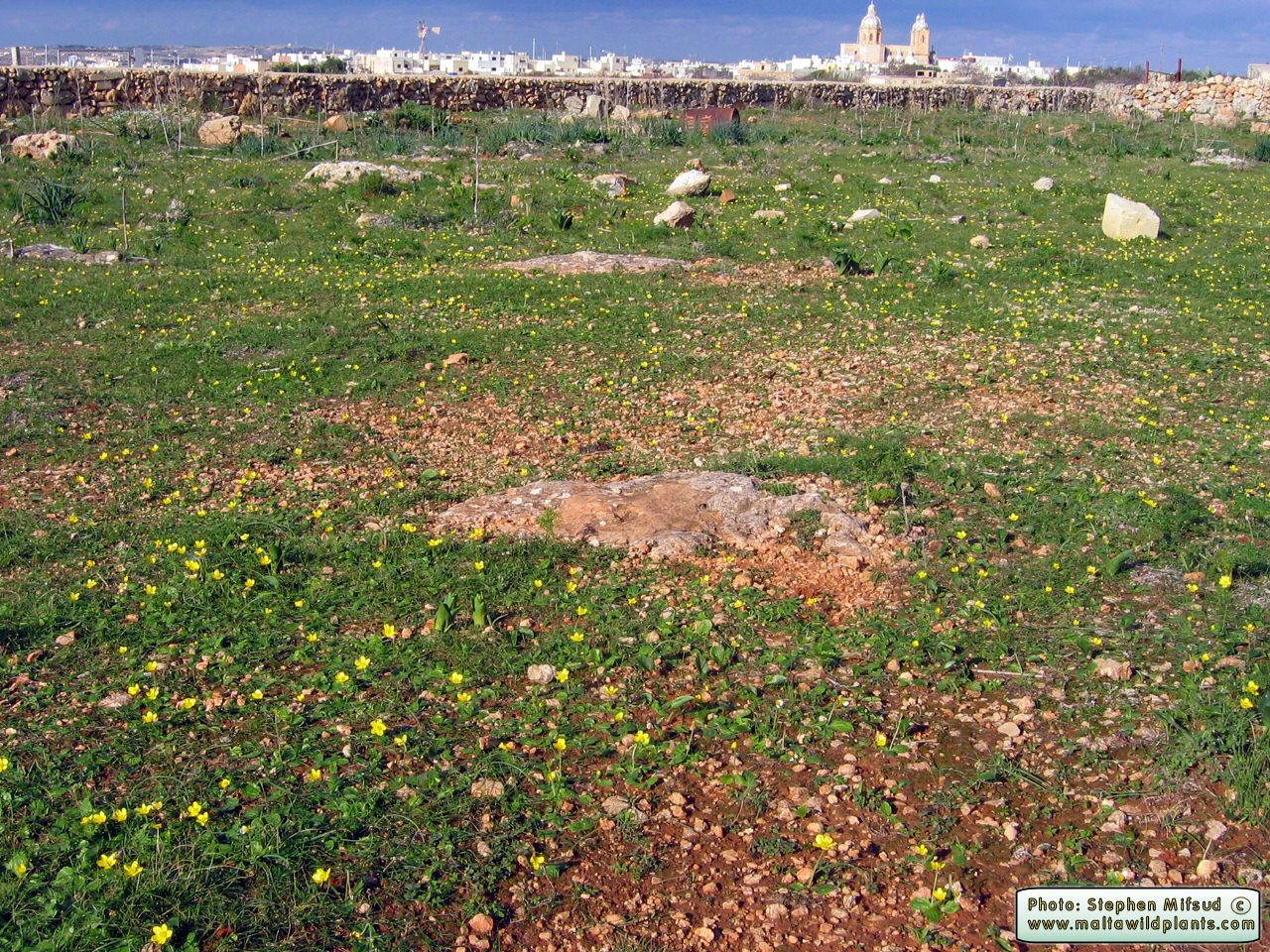
Photo of another related habitat of the plant, that is areas of shallow, damp soil on garigue. |
- |
- |
- |
|
|
|
| Submit More Information |
Use the form below to submit more information about this plant or a related species. If the data is taken from a book, journal, website, etc, please provide the corresponding reference / website address as indicated in the form. If it is your own observation, then your name will be cited.
Your Email address will never be displayed online, it is just for internal communication.
For plant species that are marked as rare, you can also report other locations in Malta where you have seen this species.
Finally you can report any mistakes or errors found on the plant profile for necessary corrections. This will help to improve the website's acuracy.
To have more details about each particular field, just move your mouse on it and wait for the help message to pop up
* = required fields.
|
|
|