| Information and Details |
Nativity and distribution
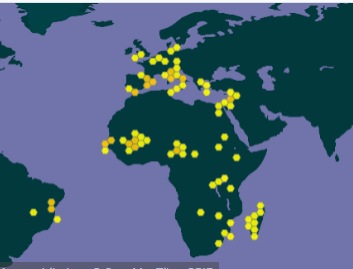
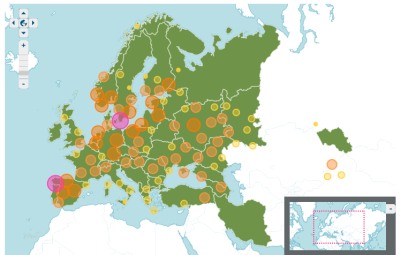
Tropaeolum majus is native to the South American Andes from Bolivia to Columbia. [WWW-186] The portal of Global Biodiversity Information Facility ( [WWW-189] ) gives that the species occurs in the countries listed below. The number of records for the corresponding country is given in brackets and somehow but not essentially, may reflect the frequency in that country. The list should not be interpreted as a complete distributional range for the species.
South America: Argentina (2), Bolivia (5), Brazil (7), Chile (2), Colombia (2), Costa Rica (9), Dominican Republic (2), Ecuador (14), Guatemala (1), Honduras (2), Mexico (21), Nicaragua (2), Panama (1), Peru (5), Puerto Rico (2), Venezuela (1)
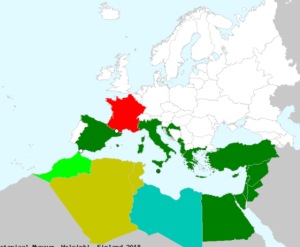
Europe: Austria (3), Finland (9), France 5), Germany 9), Hungary (1), Ireland (32), Italy (2), Netherlands (3),Norway (24),Poland (4),Portugal (5), Russian Federation (4), Slovakia (1), Spain (101), Sweden (105), Ukraine (1), United Kingdom (394)
Other stations: Australia (24), Canada (2), Japan (2), Korea (1), New Zealand (41), United States (126)
Common names in other countries
Cresson d'Inde, Grande capucine (French) ; Kapuzinerkresse (German) ; Chagas (Portuguese ) ;
Capuchina, Mastuerzo (Spanish) [WWW-26] ; Pohe haole (Hawaii) [WWW-187]
Varieties and other species
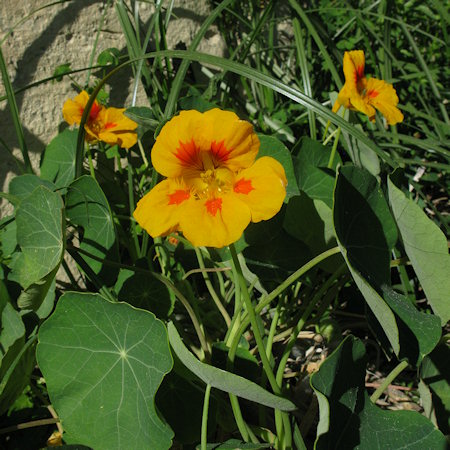
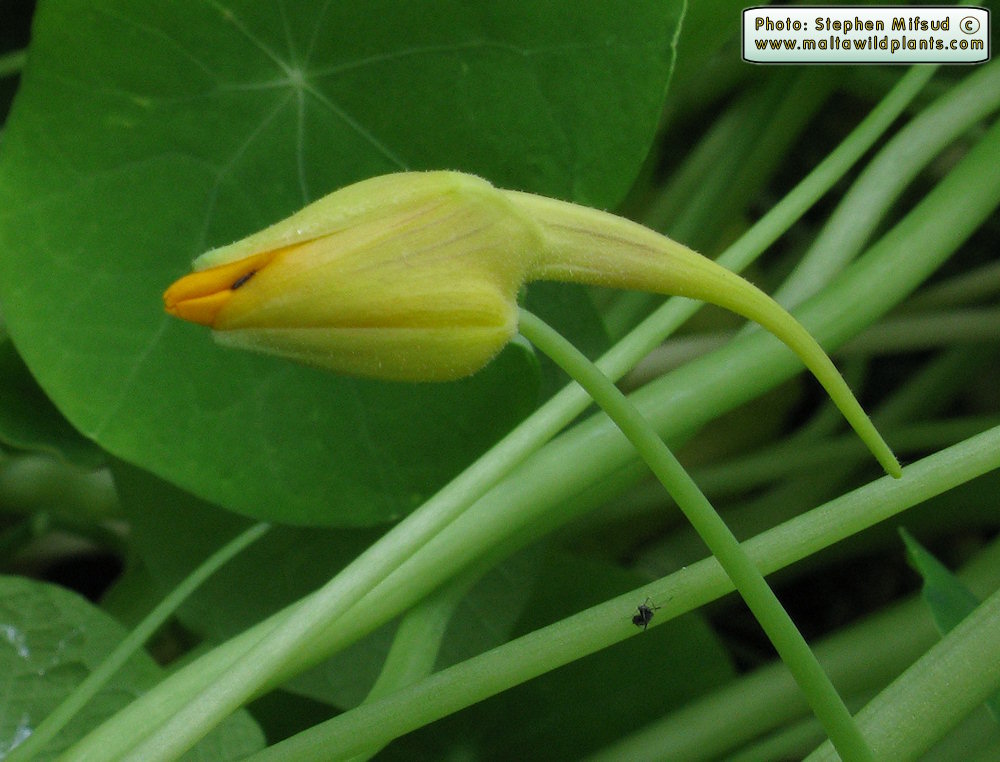
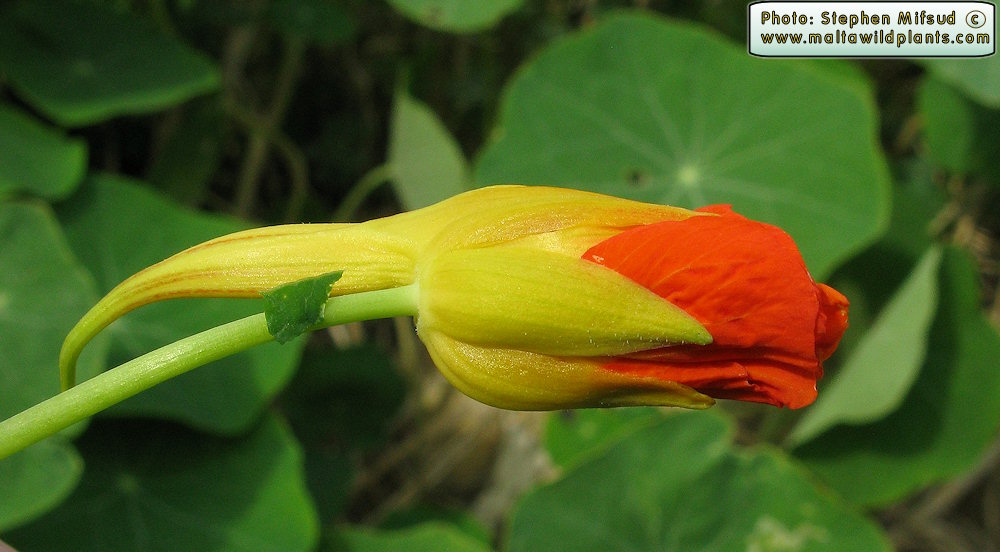
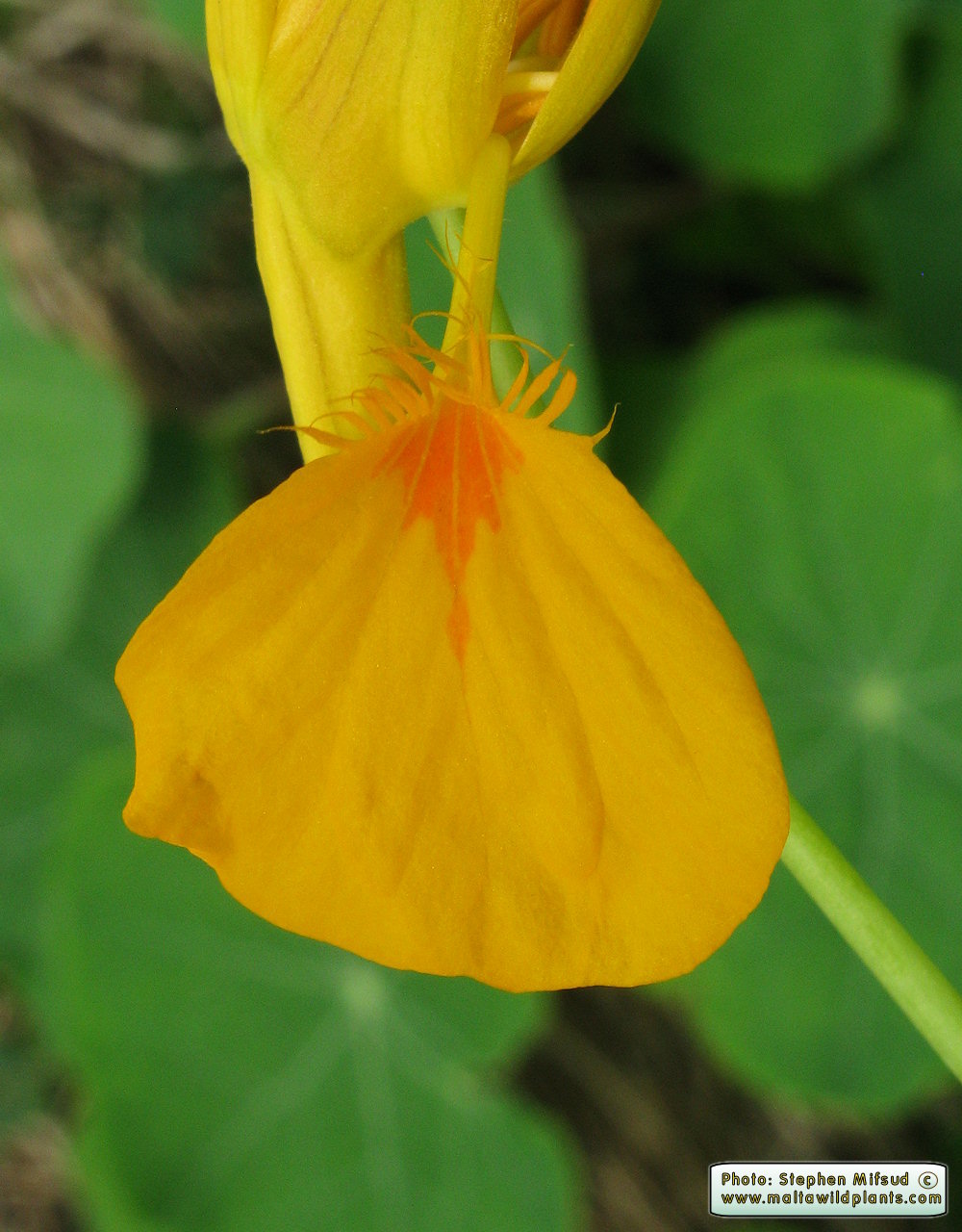
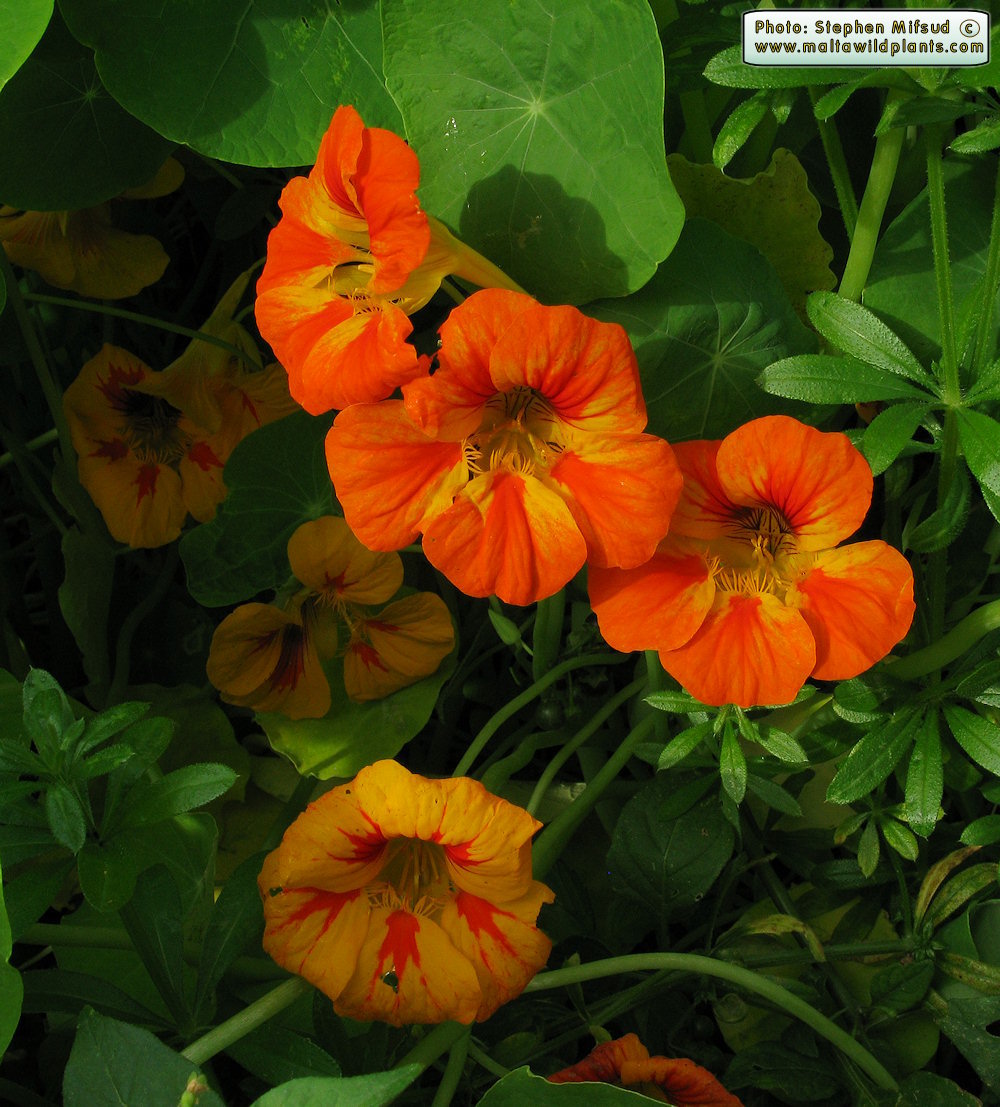
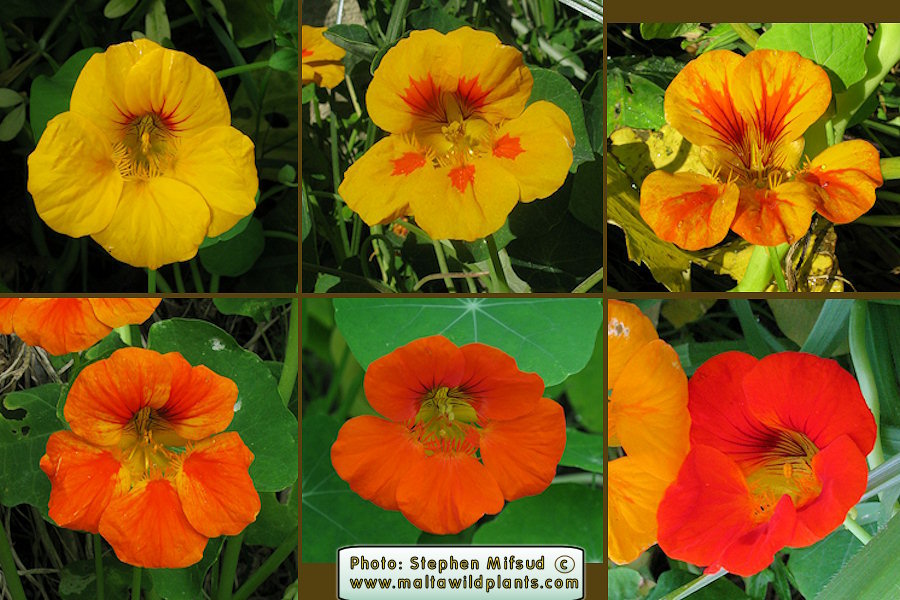
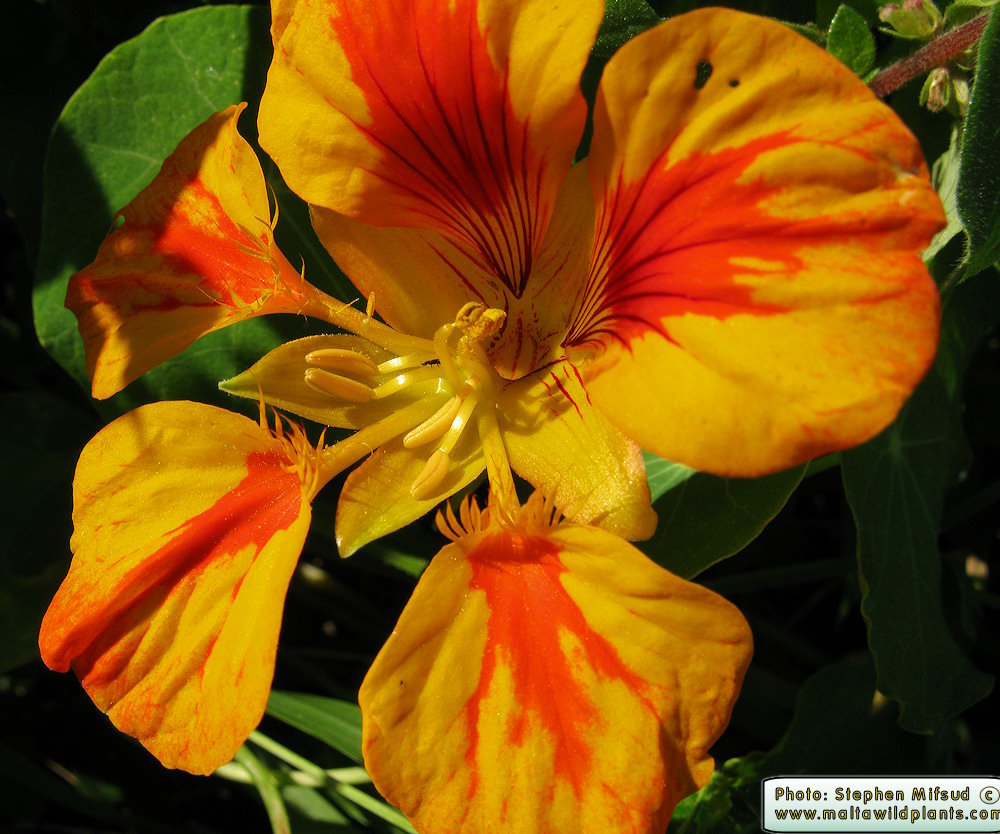
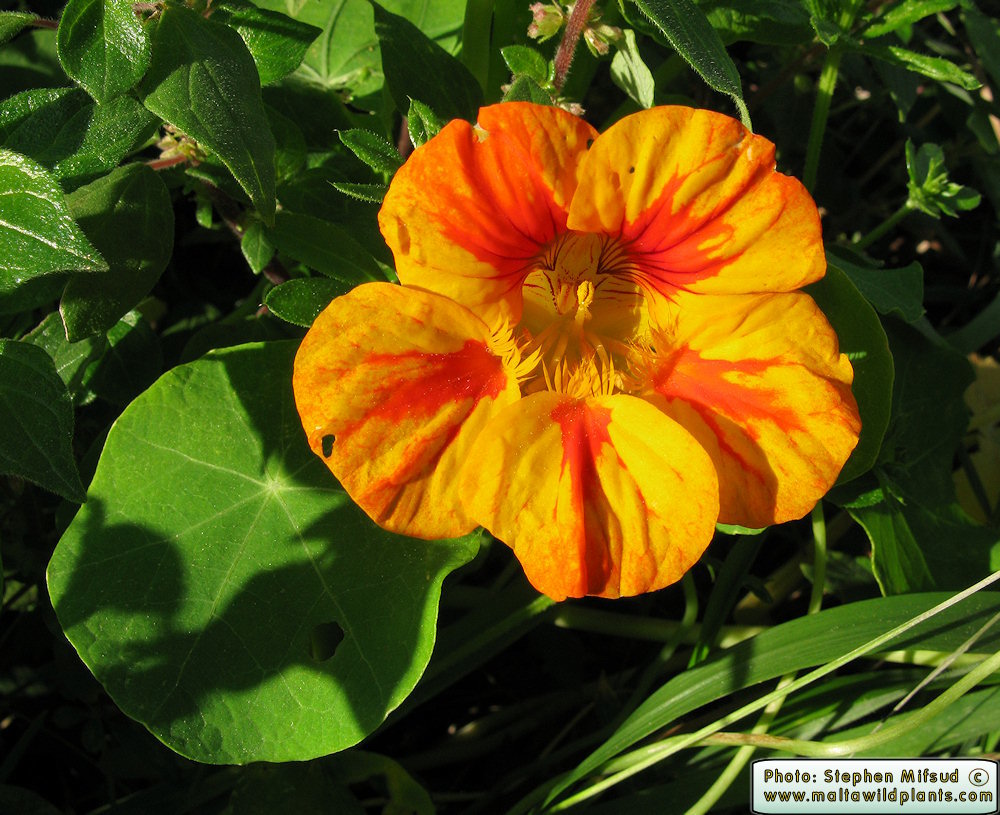
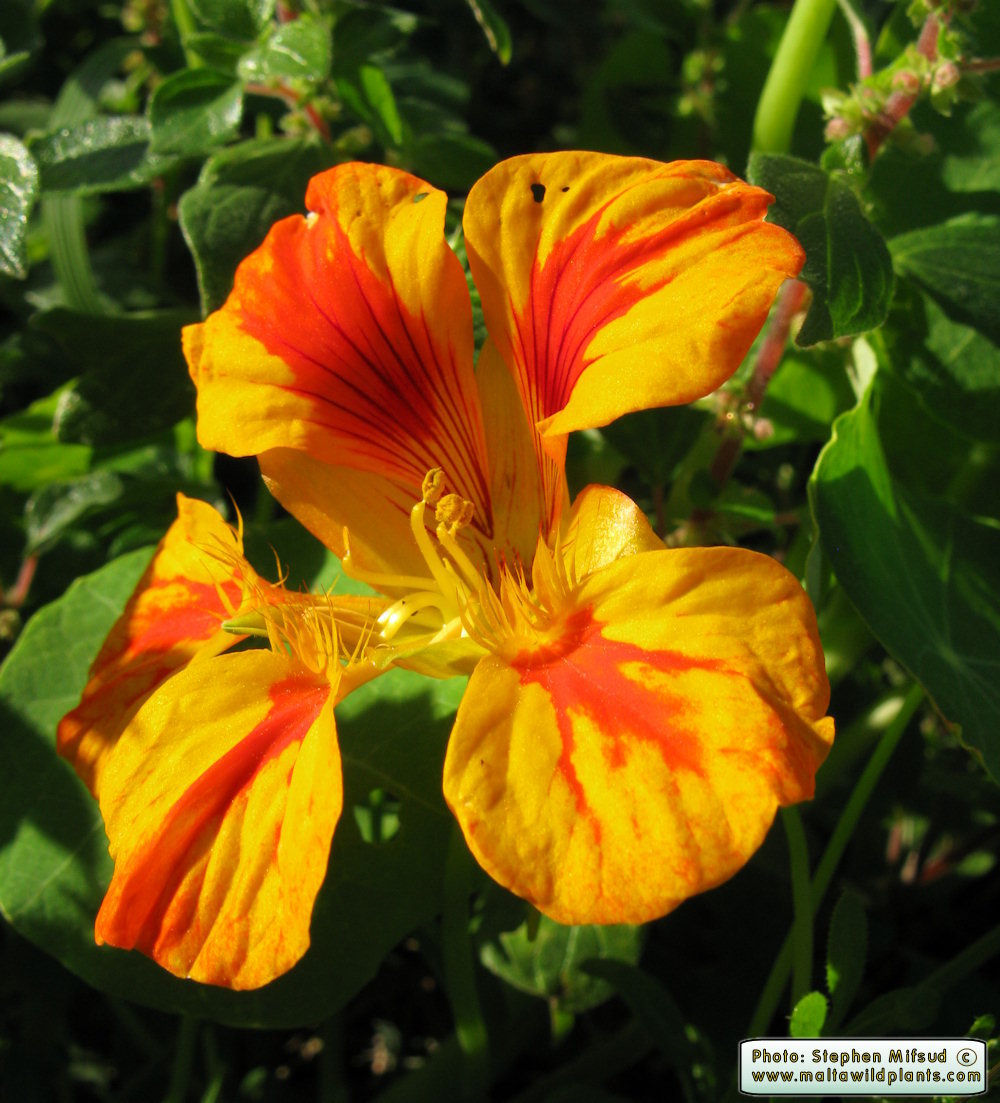
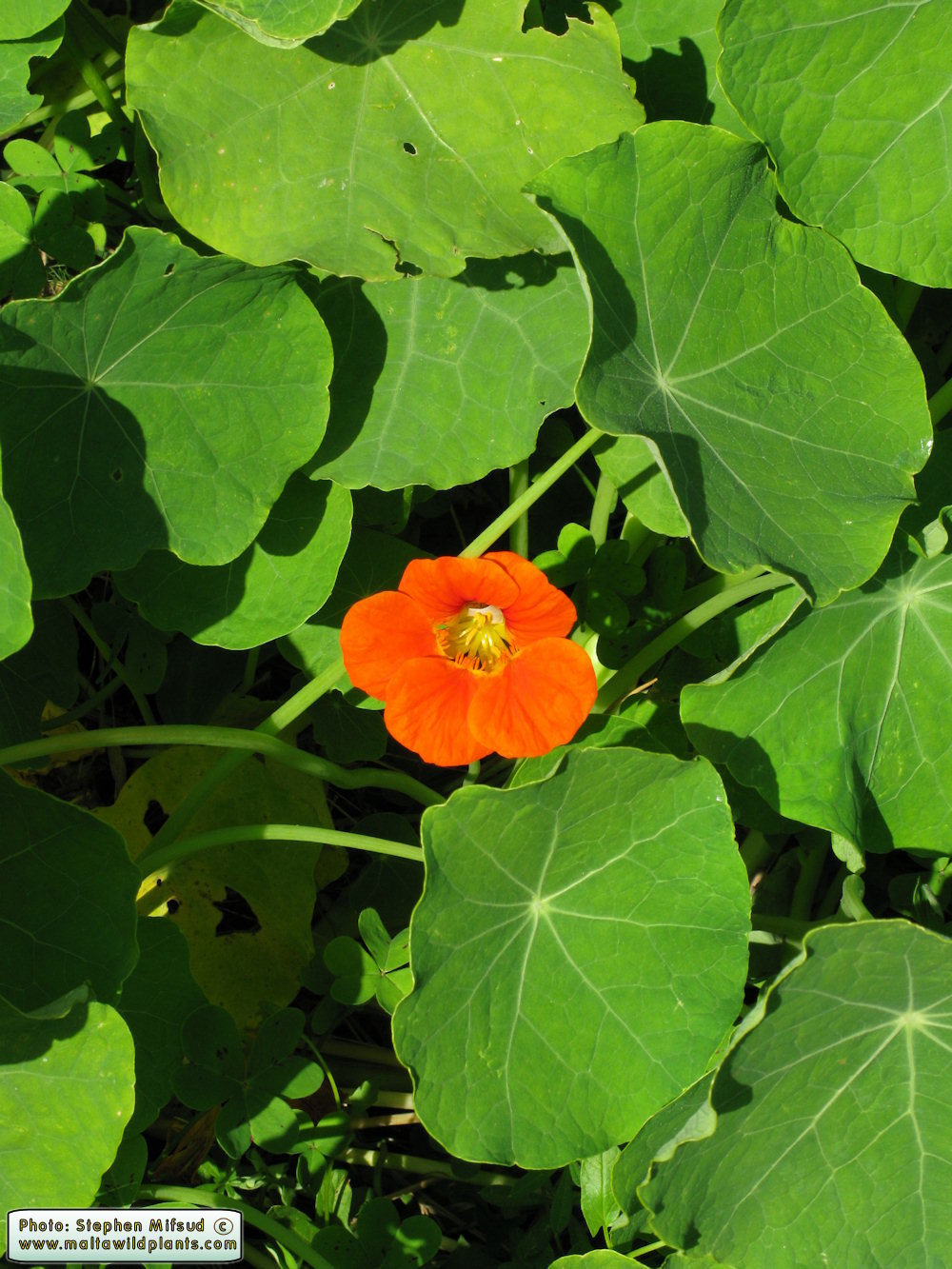
T. majus is popular for planting in gardens, window and porch boxes and pots. There are single and double flowered varieties, climbing and dwarf forms and those with variegated foliage. The old Gleam Hybrids have long, trailing runners that can be draped over a trellis. Modern dwarf bush Nasturtiums, such as the 'Jewel', are classified as T. minus. They are prettier and better for flowers because the blossoms grow out beyond the leaves Other species used in horticulture include T. peregrinum; T. azureum; T. brachyceras; T. Deckerianum; T. peltophorum (Lobbianum); T. pentaphyllum; T. polyphyllum; T. speciosum (Flameflower); T. tricolor; T. tuberosum (Anyu).
T. peregrinum, the Canary-Bird Flower or Canary Creeper is an annual, climbing kind with yellow flowers.
T. speciosum, the Flameflower, is a perennial climber. Its delicate shoots are covered with apple green foliage. It produces scarlet flowers, which are followed by dull red seedpods revealing turquoise-blue seeds as large as peas.
T. tuberosum, Anyu, is a half-hardy perennial. It is grown in the mountains of South America for its edible tubers. This vine climbs high, anywhere from 6 to 8 feet on banks and trees. The flowers have long stems and are yellow with red spurs. [WWW-43]
There are many cultivated varieties of nasturtium suitable for the home garden. Two which are striking are Climbing Alaska (white marbled variegation on leaves) and Climbing Jewel of Africa. [WWW-185] Other varieties are CRIMSON JEWEL, GOLDEN JEWEL, MAHOGANY JEWEL, ORANGE JEWEL, PRIMROSE JEWEL, SCARLET JEWEL, WHIRLYBIRD CHERRY ROSE, WHIRLYBIRD GOLD and WHIRLYBIRD SCARLET [WWW-26]
T. majus flowers have a very pleasing mild scent and the Gleam Hybrid cultivars are more strongly scented [245]
The 'Gourmet Brand Salad Mixture' has been selected to provide a large number of big open-faced nasturtium flowers. Ideal for salads and garnishes, it provides one of the widest colour selections available. [183]
Propagation and Cultivation Notes
Sowing: Plants will develop fruit about 4 months after seeding. [404] Seeds may be started inside at a 65-degree F temperature. They should be sown in individual pots, 6 to 8 weeks before it is safe to plant outside. Seeds may be sown outside where they are to grow when the soil is warm. Seeds of Indian Cress should be soaked for 12 hours, dried, and sown outdoors in warm, well-drained soil after danger from frost has passed. Care must be taken when transplanting, their roots are very delicate. [WWW-43]
Potting: The tender kinds may be grown outside in mild climates, though they won't thrive where summers are very hot. They may also be grown in pots filled with loam, leaf mould and sand. When they've finished flowering, water should gradually be withheld. They should be stored safely from frost until they start new growth the following spring. The annuals are grown in well drained, moist soil and they should have sun half the day or more. T. speciosum, the Flameflower, should be planted in peaty soil or leaf mold, mixed with broken sandstone. The bed should be on the north side of a hedge, the foot of a cool wall, or some low evergreen shrub. The roots should be laid horizontally on the bed and covered with 4 or 5 inches of the special soil. Anyu, T. tuberosum, grows best in sun or light shade in mountain highlands or cool gardens. The tubers may survive the winter under deep snow, but store a few in a cold root cellar just in case those in the garden don't make it. Throughout the growing season, the edible flowers may be picked. The tubers should be mulched and dug up as late in the fall as possible. T. majus, Nasturtium or Indian Cress, are perennials in mild climates; otherwise, they are frost-tender annuals. They need full sun and fairly cool weather, but they produce a lovely, short lived show of colour in hot summer areas if grown in partial shade. To harvest, snip off leaves and flowering stems near ground level to maintain a neat appearance. New growth will quickly replace the removed foliage, flowers and buds. [WWW-43]
Garden nasturtium does best in light, sandy soils. Too much nitrogen fertilizer will produce an abundance of foliage and few flowers.
Light: Does well in full sun or light shade. Nasturtiums appreciate a little midday shade in summer.
Moisture: Nasturtiums are fairly tolerant of drought, but do best with regular watering.
Hardiness: Plant this annual in spring in zones 4-8 and in winter in zones 9-11. Nasturtiums cannot tolerate a hard freeze, but usually will sprout back after a light frost or freeze. Nasturtiums do best with warm days and cool nights. They stop flowering in the heat of summer.
Propagation: Plant nasturtium seeds after the last frost in the garden where they will be grown, as they do not transplant well.
[WWW-186]
Garden Nasturtium tolerates most soils [202] , though it prefers a rich light well-drained soil in full sun or partial shade [14, 15, 37] More and lusher leaves are produced when the plant is growing in a rich soil, though less flowers are produced [238] When grown in a soil of low fertility the leaves are smaller and less lush, though more flowers are produced [200, KF] The plant will also succeed in very poor soils [202] It dislikes drought [37] This species is not frost hardy in Britain but it is often grown in the flower garden as an annual when it will frequently self-sow [37] In cold springs, however, the seed will often not germinate until mid or even late summer, which is too late to produce a reasonable crop [KF] A very ornamental and free-flowering species, it is often in bloom from early summer until cut down by the autumn frosts [KF] A climbing plant, it supports itself by twisting its leaf stalks around other plants etc [219]
There are many named varieties, some of which are low-growing forms that do not climb [183, 202, KF] A good companion plant in the garden, growing well with radishes, cabbages and fruit trees, improving their growth and flavour [14, 20] A good companion for many plants, keeping many harmful insects at bay and also improving the growth and flavour of neighbouring crops [201] Aphids on nasturtiums indicate a lime deficiency in the soil [20] Slugs and snails love eating this plant, so it can be grown to attract them away from other plants [201] The caterpillars of the cabbage white butterfly can be a nuisance and often cause considerable damage to the leaves. [219]
In New Zealand, the plant grows in waysides and waste places, especially moist and shady situations, also river banks and other waterways in built-up areas, and around many gardens and parks. [166]
Active Principles:
This is a list of chemical constituents found in Tropaeolum majus according [WWW-66] . The list includes the part of plant that the chemical is principally found, and for some chemicals also the concentration in part per million.
- 11-EICOSENOIC-ACID - Seed: 11,000 - 20,000 ppm
- ASCORBIC-ACID - Flower: 1,300 ppm; Leaf 2,000 - 4,650 ppm Pt 1,000 - 1,600 ppm
- ASH - Shoot: 14,000 - 102,200 ppm
- BENZYL-CYANIDE - Shoot:
- BENZYL-ISOTHIOCYANATE - Seed: 9,700 ppm; Shoot 300 ppm;
- BETA-CAROTENE - Shoot: 90 - 665 ppm
- CALCIUM - Shoot: 2,110 - 15,400 ppm
- CARBOHYDRATES - Shoot: 92,000 - 671,500 ppm
- CHLOROGENIC-ACID - Pericarp:
- CYANIDIN-SOPHOROCOSIDE - Plant:
- EO - Shoot: 300 ppm;
- ERUCIC-ACID - Seed: 72,000 ppm;
- FAT - Seed: 72,000 - 102,000 ppm Shoot 12,000 - 87,600 ppm
- FIBER - Shoot: 5,000 - 36,500 ppm
- GLUCOTROPAEOLIN - Plant:
- HELENIEN - Flower:
- IRON - Shoot: 13 - 95 ppm
- ISOQUERCITRIN - Leaf:
- ISOQUERCITROSIDE - Leaf:
- KAEMPFEROL-GLUCOSIDE - Flower:
- KILOCALORIES - Shoot: 480 - 3,500 /kg
- LUTEIN - Flower:
- NIACIN - Shoot: 10 - 75 ppm
- OXALIC-ACID - Shoot:
- PELARGONIDIN-3-BIOSIDE - Flower:
- PELARGONIDIN-3-SOPHOROSIDE - Flower:
- PEROXIDASE - Leaf:
- PHENYLACETOTHIOHYDROXIMATE - Leaf:
- PHOSPHORUS - Shoot: 850 - 6,200 ppm
- PHYTOFLUENE - Flower:
- PROTEIN - Seed: 262,000 ppm; Shoot 18,000 - 131,500 ppm
- QUERCETIN-3-TRIGLUCOSIDE - Leaf:
- RIBOFLAVIN - Shoot: 3.5 - 25.5 ppm
- THIAMIN - Shoot: 0.9 - 6.5 ppm
- URIDINE-DIPHOSPHATE-GLUCOSE:THIOHYDROXIMATE-GLUCOSYL-TRANSFERASE - Leaf:
- WATER - Shoot: 863,000 ppm;
- ZEAXANTHIN - Flower:
According [WWW-52] , the main active principles are:
Glucotrapeoline
Oxalic acid
Espilantol
Medicinal Uses
The plant has the following medicinal properties according to reference: [WWW-66] .
| Antibiotic |
a chemical substance derivable from a mold or bacterium that kills microorganisms and cures infections.
[WWW-32 ] |
| Anti-Scorbutic | Counteracting scurvy hence a remedy for scurvy. [WWW-32] |
| Bactericide |
Any drug that destroys bacteria or inhibits their growth [WWW-32] |
| Anti-cancer |
Used in the treatment of cancer; "anticancer drug"; "an antineoplastic effect". [WWW-32] |
| Against Cystisis |
Inflammation of the urinary bladder and ureters [WWW-32] |
| Depurative |
An agent which is able of Purifying the blood or the humors (body fluids) [WWW-32] |
| Diuretic |
Tending to increase the secretion and discharge of urine. [WWW-32] |
| Emmenagogue |
Used to promote the menstrual discharge. [WWW-32] |
| Expectorant |
Used to induce the ejection of mucus, phlegm, and other fluids from the lungs and air passages by coughing or spitting. [WWW-32] |
| Eye Tonic |
Promotes well being of the eye |
| Febrifuge |
A medicine that lowers body temperature to prevent or alleviate fever [WWW-32] |
| Fungicide |
An agent that destroys or prevents the growth of fungi [WWW-32] |
| Against Inflammation |
A morbid condition of any part of the body, consisting in congestion of the blood vessels, with obstruction of the blood current, and growth of morbid tissue. It is manifested outwardly by redness and swelling, attended with heat and pain.
[WWW-32] |
| Itch |
An irritating cutaneous sensation that produces a desire to scratch [WWW-32] |
| Kidney Tonic |
Promotes the well being of the kidney |
| Laxative |
Having the effect of loosening or opening the intestines, hence stimulating evacuation of feces and so relieving from constipation. [WWW-32] |
| Lung Tonic |
Promotes the well being of the lung |
| Against Ringworm infections |
Infections of the skin or nails caused by fungi and appearing as itching circular patches [WWW-32] |
| Scurvy |
Helps to prevent or treat scurvy. - Scurvy is a condition caused by deficiency of ascorbic acid (vitamin C). [WWW-32] |
| Sore relief |
A place in an animal body where the skin and flesh are ruptured or bruised, so as to be tender or painful; a painful or diseased place, such as an ulcer or a boil [WWW-32] |
| Stimulant |
Produces a temporary increase of vital activity in the organism, or in any of its parts; [WWW-32] |
| Urogenital tonic |
Promotes the well-being of the urinary and reproductive systems of the body. [WWW-32] |
Nasturtium has long been used in Andean herbal medicine as a disinfectant and wound-healing herb, and as an expectorant to relieve chest conditions. [254] All parts of the plant appear to be antibiotic and an infusion of the leaves can be used to increase resistance to bacterial infections and to clear nasal and bronchial catarrh. [254] The remedy seems to both reduce catarrh formation and stimulate the clearing and coughing up of phlegm. [254] The leaves are antibacterial, antifungal, antiseptic, aperient, depurative, diuretic, emmenagogue, expectorant, laxative and stimulant. [7, 21, 238] A glycoside found in the plant reacts with water to produce an antibiotic. [238] The plant has antibiotic properties towards aerobic spore forming bacteria. [61] Extracts from the plant have anticancer activity. [218] The plant is taken internally in the treatment of genito-urinary diseases, respiratory infections, scurvy and poor skin and hair conditions. [238] Externally it makes an effective antiseptic wash and is used in the treatment of baldness, minor injuries and skin eruptions. [238] Any part of the plant can be used, it is harvested during the growing season and used fresh. [238]
The active medicinal parts includes the whole whole plant and less used are the roots, the young plants or the tender buds. The seeds have higher toxicity than the rest of the plant. [WWW-52]
It has been used in home-made medicine as a stimulant of the hair growth, to prevent its fall and to favour its conservation. It was used either directly on the hair, or as a 2% infusion or also used in shampoo diluting the extract fluid to 5%.. Another method used is to mash the plant into a paste which is applied externally on the hair. It also has demulcent properties and hence considered as a good remedy to cure wounds or to reduce inflammations. Because of its bactericidal properties, it has disinfectant values, especially in all those infections taken place by fungi. [WWW-52]
In internal use, it is known for its rich source of vitamin C, and hence the flowers and leaves have been eaten fresh to combat the disease of scurvy caused by the deficiency of Vitamin C. Floral buds, hardened in vinegar, have been used as a substitute of the capers. [WWW-52]
The extract produced from crushing the entire plant has been applied to promote blood circulation, mainly in the legs and in the fingers. The same juice has also been used to increase micturition and to favour menstruation. [WWW-52]
The infusions of the dry plant are considered appropriate to treat breathing problems related with bacterial implications, in cases like bronchitis, sore throat, flu, etc. Its components seem to carry out both a bacterial and expectorant function , by eliminating the bacteria or helping to expel the chest accumulated mucosities. [WWW-52]
While one of the most common garden flowers, nasturtium leaves and pods are used as condiments rather rarely, and appear not to be commercially grown for this purpose. [404]
The tea is said to help bring relief from chest congestion while the seeds have been pounded into a poultice and used for styes. Flowers used in the herbal bath and are astringent (Causes shrinkage and drying of surface membranes when applied topically).
[WWW-185]
Toxicity
The plant has mild toxicity of which symptoms are manifested if the plant is consumed in large quantities. It affects mainly to the digestive tract and the kidneys, producing considerable irritations in people that have manifested sensitiveness to their components and whenever the established doses are surpassed. One has to keep in mind not to administer in people that have gastrointestinal ulcer or affections of the kidney. [WWW-52]
High intake of the plant may result in the following symptoms: Stomachache, nausea sickness, vomit and diarrhoea. In external use, the contact with the skin can produce dermatitis in some sensitive persons. [WWW-52]
Two female patients in whom the plant repeatedly produced dermatitis. In the first case both hands were affected. In the second case, the right hand in which she carried the plants was affected and the left hand which had been gloved was unaffected. [WWW-27]
Synthesis of Benzylglucosinolate in Tropaeolum majus
Benzylglucosinolate accumulates in mature plants of Tropaeolum majus L.
The biosynthetic capacity for synthesis of benzylglucosinolate
and the total content of benzylglucosinolate have been
investigated during plant development and in different tissues. the
content increased from 5 mg of benzylglucosinolate in the fresh
seed to between 200 and 400 mg in the adult plant, depending on
size. the biosynthetic capacity was measured using L-[U-14C]phenylalanine
as precursor. lncorporation levels of approximately 30%
were obtained with green leaves, whereas the incorporation levels
obtained with other tissues were in the range of O to 5%. Leaves
were the primary site of benzylglucosinolate synthesis. The high
amounts of benzylglucosinolate accumulated in other tissues (e.g.
developing seeds) reflected transport of benzylglucosinolate from
the leaves. The initial steps in the biosynthesis of glucosinolates
and cyanogenic glycosides are thought to be similar and to be
localized on microsomal membranes. However, a microsomal system
prepared from T. majus was biosynthetically inactive. lnclusion
of T. majus plant material during preparation of sorghum microsomes
also inhibited their activity. Benzylisothiocyanate, generated
by degradation of benzylglucosinolate during the homogenization
procedure, strongly inhibited the sorghum enzyme system, and its
presence may thus explain why the isolated T. majus microsomal
system is inactive.
[Click here for full text]
Ornamental uses
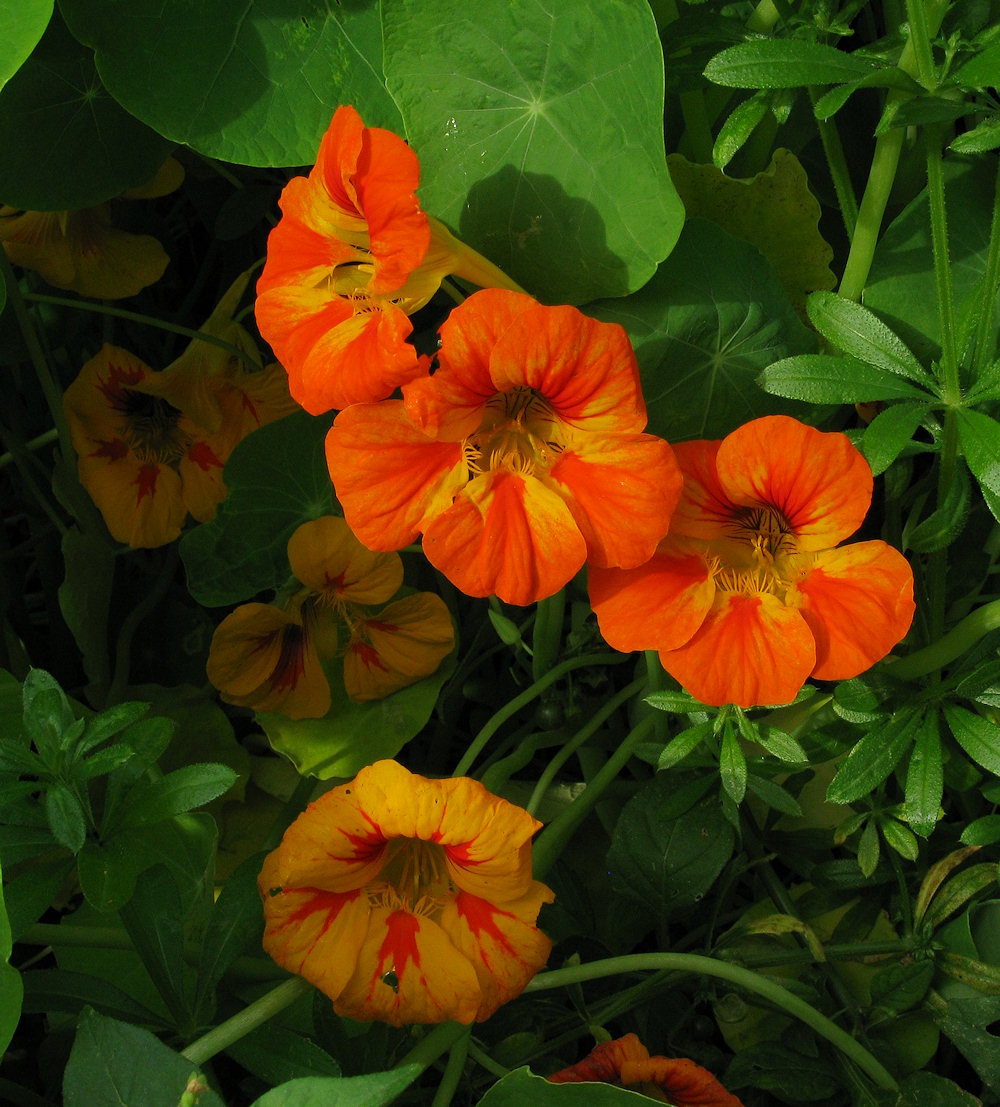
It is used as gardening plant because of its beautiful flowers. It has some repellent properties against aphids and other pests. Its infusion made from all the plant can be used as an insectiside spray on other plants. [WWW-52]
The tea is used as a spray against aphids, whitefly and squash bug. Repels striped pumpkin beetles and wooly aphids. If aphids appear on a plant it indicates a lack of lime - sprinkle plants with lime. [WWW-185]
The dwarf, bushy nasturtiums add rainbows of cheerful color in annual beds and borders. Use the trailing forms on low fences or trellises, on a gravelly or sandy slope, or in a hanging container. Many gardeners include nasturtiums in the salad garden. Nasturtiums are attacked by aphids, and organic gardeners like to plant lots of them all around the vegetable patch to serve as aphid "lures.".(floridata)
Nasturtiums are perfect for introducing kids (and beginners of any age) to gardening. The seeds are very large making them easy for smaller children to manipulate. The plants germinate quickly, grow rapidly and have large showy flowers. The fact that they are edible (as opposed to toxic!) makes nasturtium the number one plant for budding gardeners [WWW-186]
Culinary Uses
Edible Parts: Flowers; Leaves; Seed; Seedpod. [KF]
Edible Uses: Condiment. [KF]
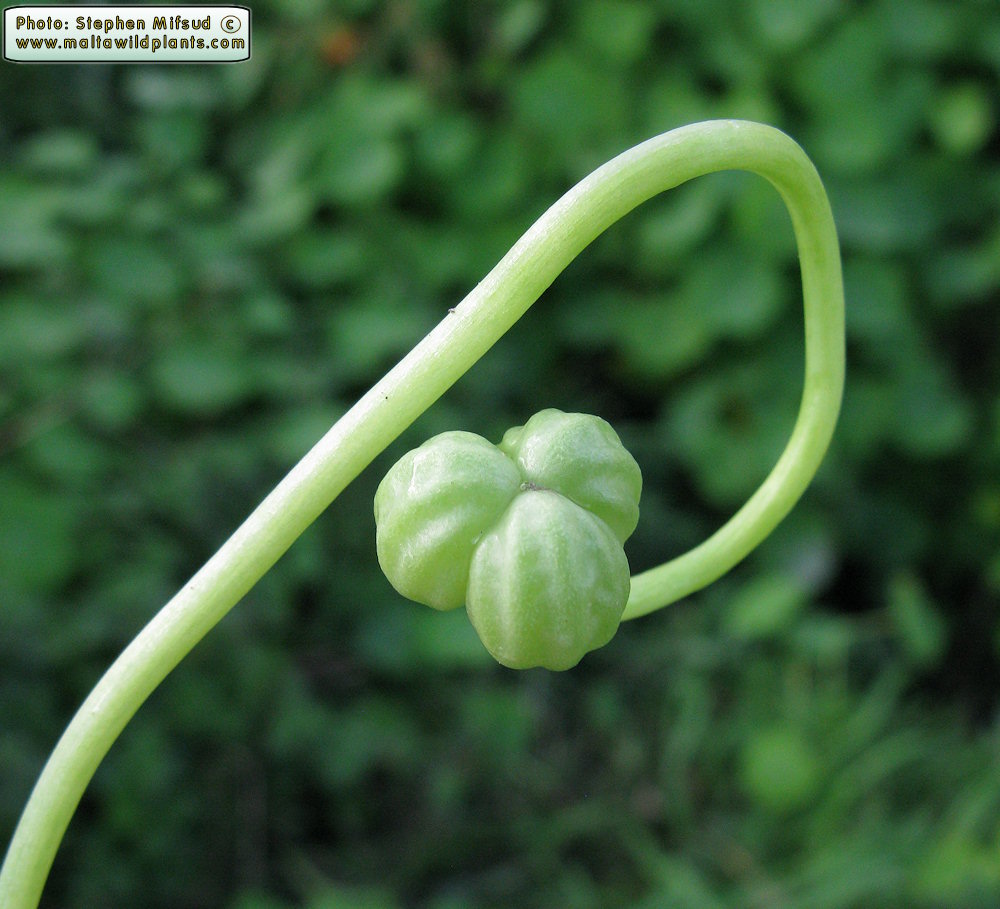
Leaves - raw [2, 7, 14, 15, 27, 37] . A hot watercress flavour [183] . Very nice on its own or as a flavouring in mixed salads [KF] . Rich in vitamin C [201] . The leaves are available from early summer until the first frosts of the autumn [K] . Flowers - raw [2, 7, 14, 27, 37, 183] . A very ornamental and tasty addition to the salad bowl, the flowers have a hot watercress flavour and are available all through the summer [7, KF] . The flowers contain about 130mg vitamin C per 100g [218] . Young seed pods - raw [2, 14, 15, 27, 37] . These are even hotter than the flowers or leaves [KF] . They can also be harvested whilst immature and pickled for use as a caper substitute [183, 238] . Seed - raw or cooked [105] . Very hot [KF] . The mature seed can be ground into a powder and used as a pepper substitute [183] . The seed contains 26% protein and 10% oil [218] .
From [WWW-185] :
- Peppery flavored leaves and flowers are added to salads and used as garnishes.
- The pickled flower buds cured in vinegar are substituted for capers.
- Leaves and flowers used for tea.
Nasturtium flowers, leaves and immature seed pods have a tangy taste like water cress, and the colorful flowers really brighten up a green salad. Add some nasturtium flowers to an herb vinegar. The immature pods can be pickled. The mature seeds can be roasted for eating out of hand or used like black pepper. [WWW-186]
Recipes using Nasturtium
Several recipes using Nasturtium exist and used till current day. Below are some recipes given by Wen Zientek-Sico - a freelance writer and recipe developer specializing in family friendly recipes. Source: Annie's Recipes
Nasturtium Vinegar
This vinegar is always one of my most popular gifts. Everyone loves
how attractive the vinegar is with a wide range of different coloured
nasturtium blossoms included. The finished vinegar has a nice peppery
bite and makes an excellent ingredient to use in salad dressings,
sauces, and other dishes.
1 cup nasturtium leaves, flowers, and buds
1 pint champagne, white wine, or apple cider vinegar
Place the ingredients in a clean clear glass jar or bottle. Tightly seal.
Let sit for at least 3 weeks before using. The nasturtium can remain in for
decoration, but you should make sure the vinegar always covers the flowers or
they will mold. Makes 1 pint vinegar.
Preparation Time: 5 minutes
Sitting Time: 3 weeks
Total Time: 3 weeks
Strawberry-Nasturtium Salad
This unique salad is filled with delightful flavour and colour. The sweetness
of the strawberries is perfectly balanced by the pepperiness of the nasturtiums
and spark of the vinegar for a salad that everyone will love. This salad should
not be made too far in advance to prevent wilting of the nasturtium blossoms.
1 pint sliced strawberries
1/3 cup nasturtium blossoms
2 tablespoons champagne vinegar
2-3 tablespoons sugar
Toss together all of the ingredients. Taste the mixture, and adjust the
amount of sugar depending on how sweet the strawberries are.
Makes 4 servings.
Preparation Time: 5 minutes
Total Time: 5 minutes
Stuffed Nasturtiums
I love serving trays of these easy appetizers at parties. We grow a bunch
of different types of nasturtiums and use them a lot, and they are exquisite
served together. The wide range of colours makes for a great presentation,
and the mixture of flavours is actually quite tasty as well.
3 ounces softened cream cheese
1 tablespoon heavy cream
2 tablespoons minced fresh chives
Salt to taste
30 large nasturtium blossoms
Mix together the cream cheese, heavy cream, chives, and salt until smooth.
Spoon about a teaspoonful of the mixture into the center of each flower.
Fold the petals up around the stuffing. Chill for up to an hour before serving.
Makes 30 appetizers.
Preparation Time: 15 minutes
Total Time: 15 minutes
Salmon-Cucumber Stuffed Nasturtium Leaves
Nasturtium leaves are very similar to watercress leaves, and have the same
affinity for cucumber and salmon that watercress does. These little rolls
are very easy to make and offer a beautiful presentation. Homemade salmon
cream cheese can be made by mixing equal amounts of lox and softened
cream cheese.
2 ounces softened salmon cream cheese.
1/4 cup finely minced cucumber
Salt to taste
20 large nasturtium leaves
20 long stemmed nasturtium blossoms
Mix together the salmon cream cheese, cucumber, and salt until smooth.
Spoon about a teaspoonful of the mixture into the center of each leaf.
Roll the leaves up into a tight roll. Wrap the blossom stems around the
leaf and tie tightly. Chill for up to an hour before serving.
Nasturtium-Lemon Butter
This butter has a light lemon flavour lightly accented with peppery
nasturtiums. It is one of my favourite herb butters for fish, chicken,
broccoli, and asparagus. It is also excellent on white bread for just a
hint of peppery citrus.
1/2 cup unsalted butter at room temperature
2 teaspoons grated lemon peel
1 tablespoon lemon juice
3 tablespoons finely chopped nasturtium blossoms
Mix all of the ingredients well until smooth and well blended.
Refrigerate or freeze until ready to serve. Makes 3/4 cup flavoured butter.
Preparation Time: 5 minutes
Total Time: 5 minutes
Other Recipes
- Salmon Nasturtium Pizza Recipe
- Red Nasturtium Oil
- Gazpacho Verde
- Tabbouleh Salad With Nasturtium Flowers
- Stuffed Nasturtium Flowers
- Nasturtium Butter
- Nasturtium Pesto
- Stuffed Nasturtium Blossoms
- Nasturtium Mayonnaise
- Nasturtium Vinaigrette
- Strawberry Nasturtium salad
- Ensalata Mixta
- Salmon-Cucumber Stuffed Nasturtium Leaves
- Feta and Garlic Dip With Nasturtiums
- Nasturtium Lemon Butter
- Other Nasturtium recipes
Invasive reputations
The status of this plant in the following countries was found :
- New Zealand - Weed of concern on conservation lands. [WWW-188]
- Spain - dangerous. [WWW-188]
- Portgal - Not aboriginal species with known ecological risk. [WWW-188]
- Galapagos Islands - potentially invasive species. [WWW-188]
- Pacific Islands - Primarily a threat at high elevations. [WWW-187]
Other Notes and Uses
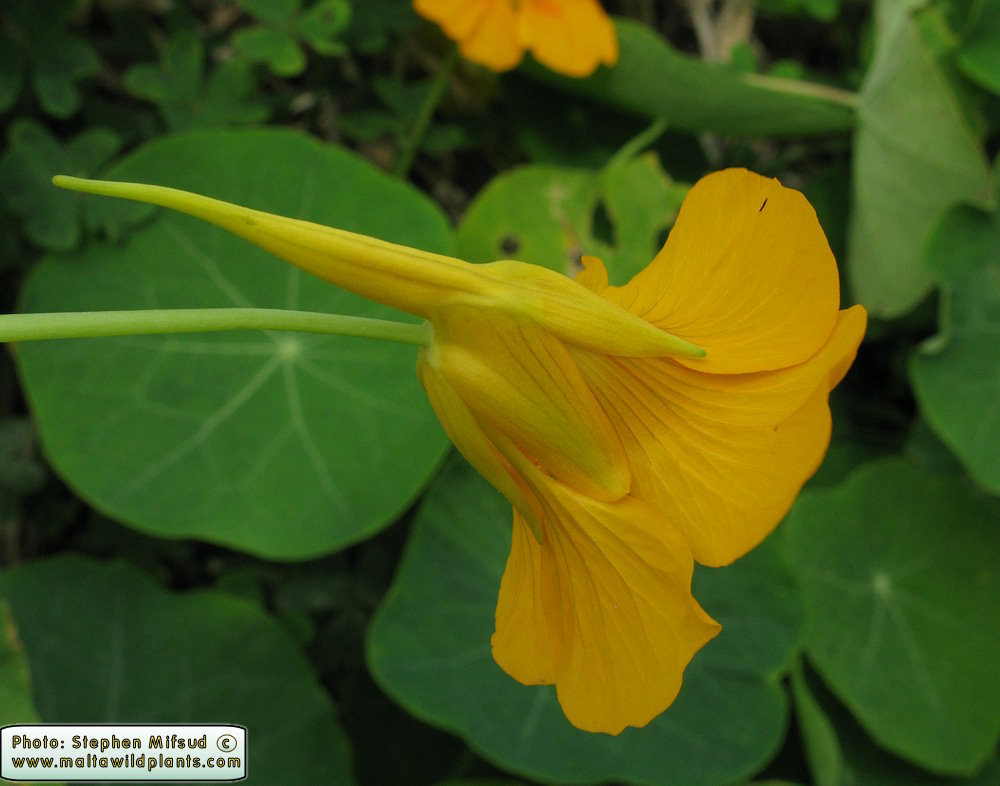
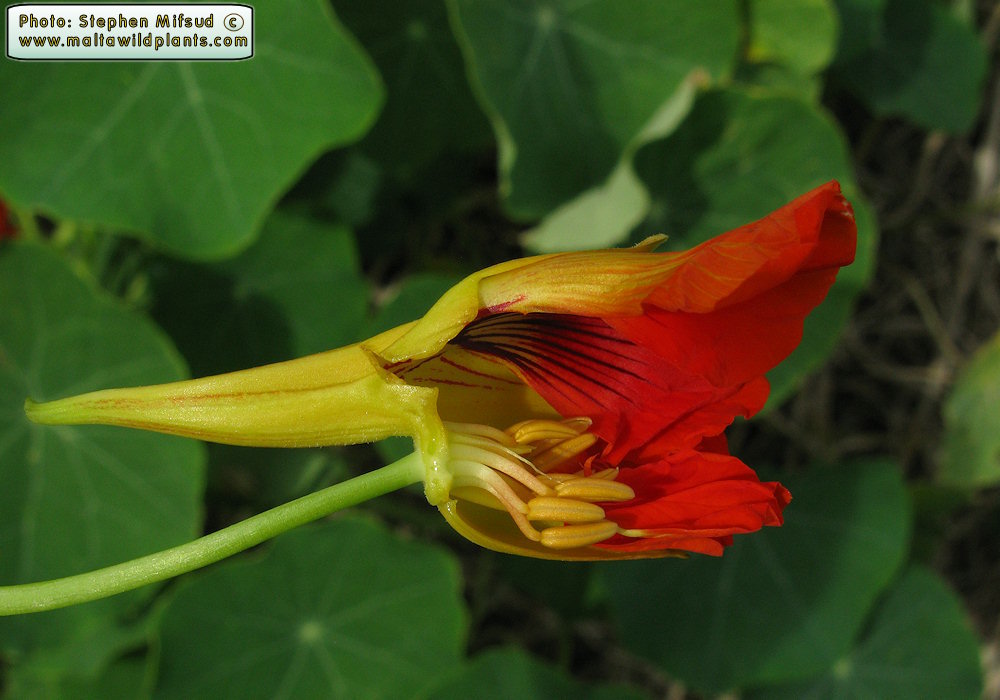
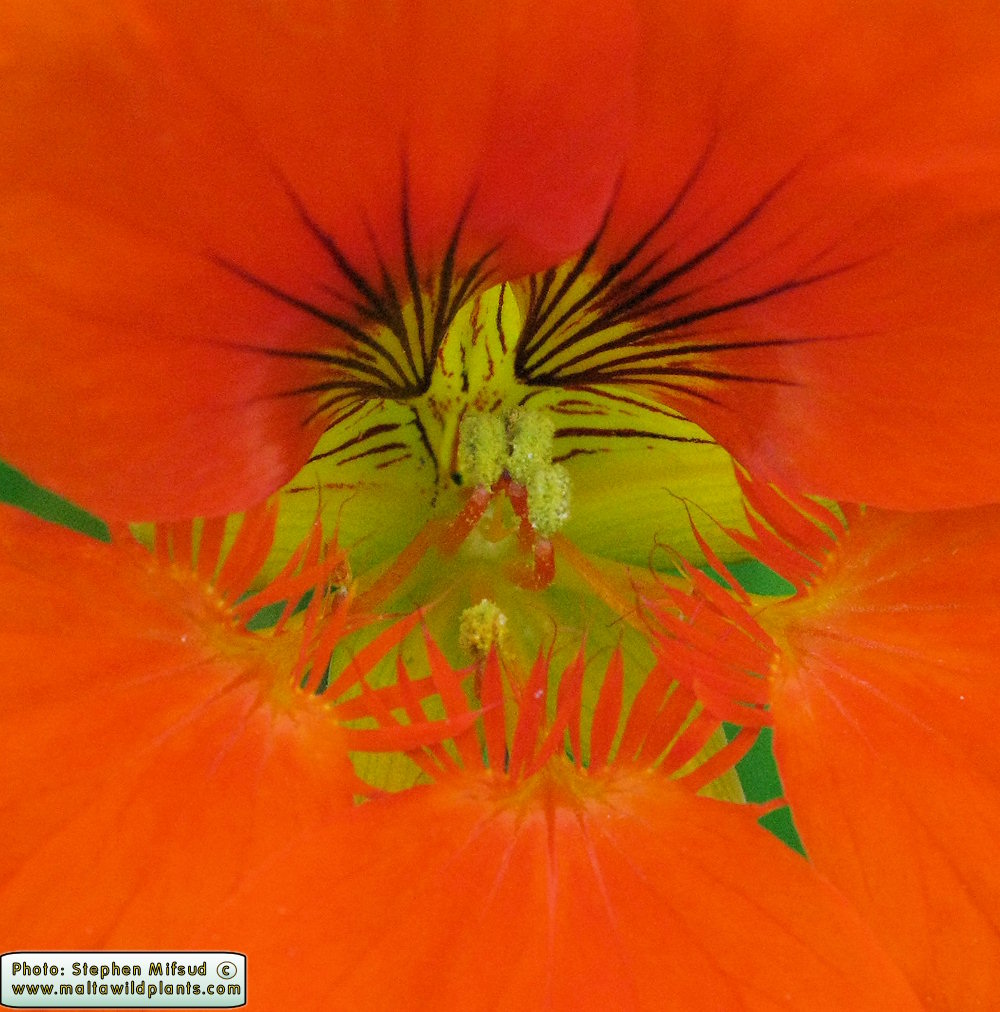
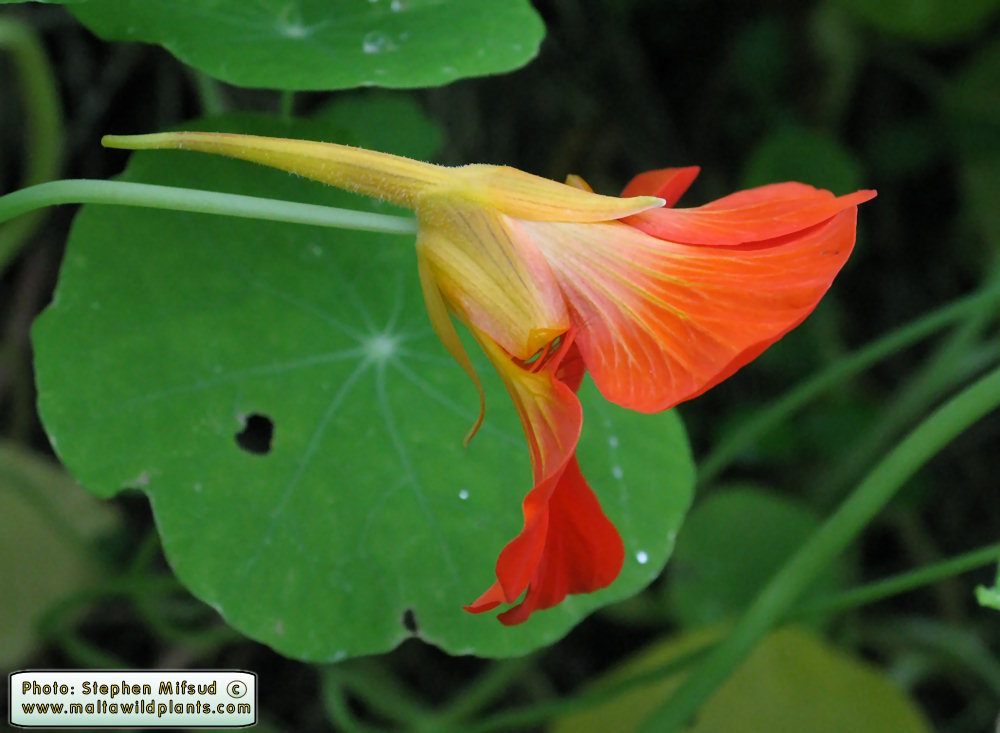
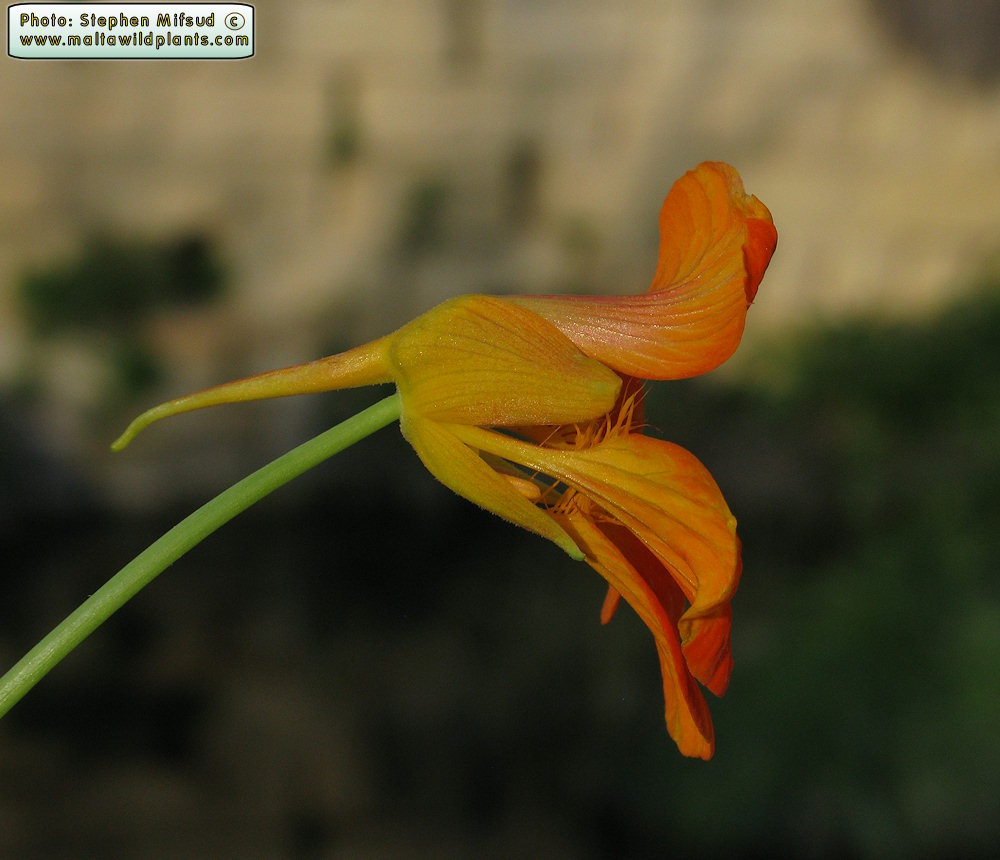
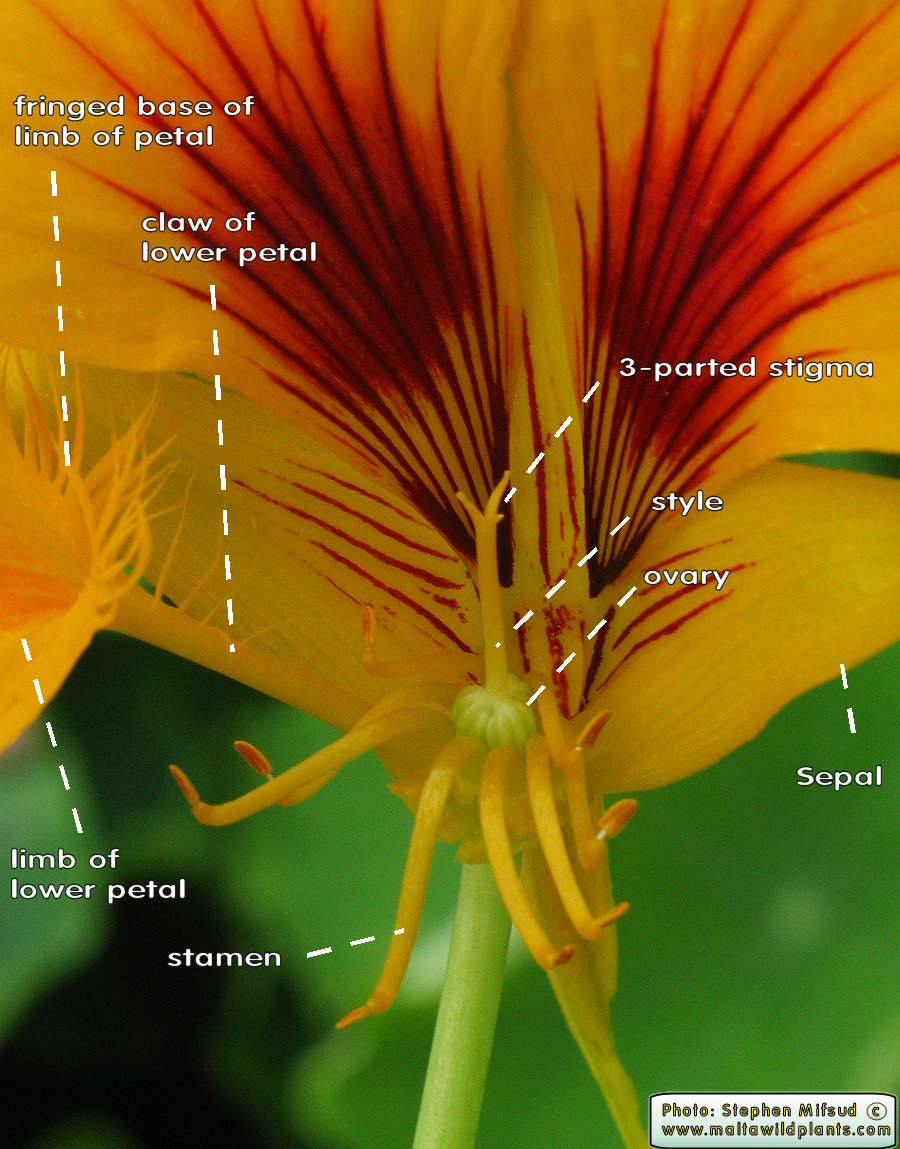
The flowers can be pollinated by hummingbirds. Hummingbirds insert their long bills into nasturtium flower spurs to sip the nutritious nectar. When they do this, they get some pollen on their faces and then they do the nasturtium's bidding by delivering the pollen to another flower. [WWW-186]
The seeds yield a high percentage of a drying oil that can be used in making paints, varnish etc.. [7]
The growing plant attracts aphids away from other plants. Research indicates that aphids flying over plants with orange or yellow flowers do not stop, nor do they prey on plants growing next to or above the flowers. [201]
An insecticide can be made from an infusion of leaves and soap flakes. [201]
The flowers have a very pleasing mild scent[245]. The Gleam Hybrid cultivars are more strongly scented[245].
Personal Observations
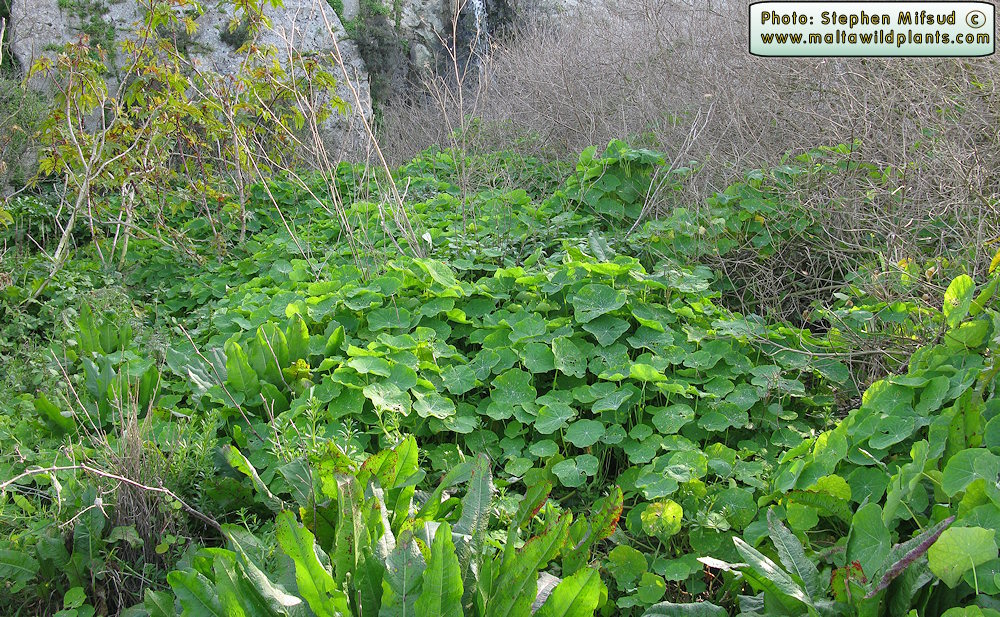
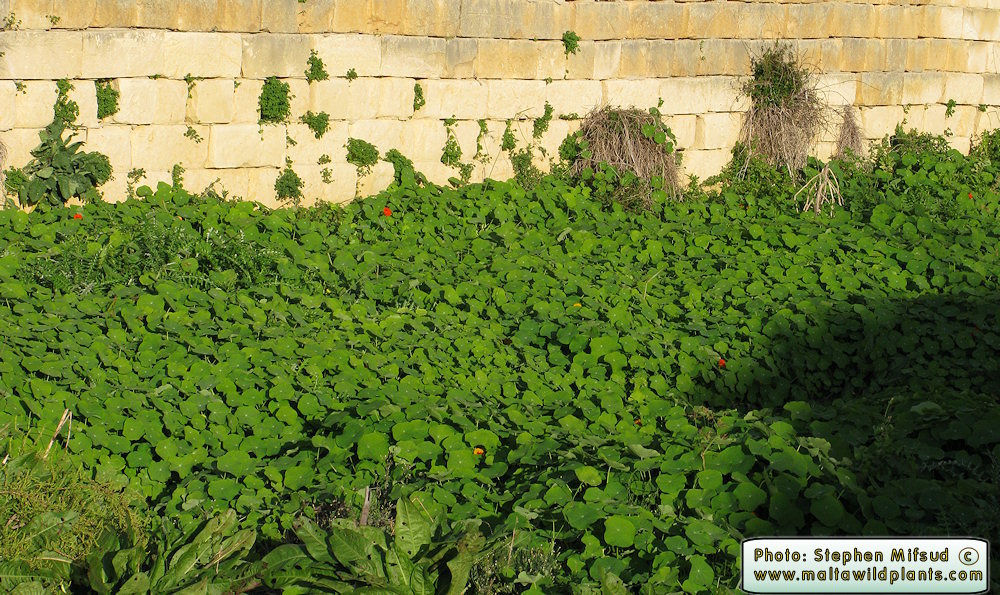
Tropaeolum majus - An invasive species in the Maltese Islands.
This species was not recorded in the Maltese flora by Borg in 1927, while it was mentioned in that of Haslam in 1977 [332] . Therefore T. majus should have been introduced in Malta some time between that period, probably more towards the 60-70's because since Haslam gives it as "Naturalised at waste ground in Salini and elsewhere" and not mentioning other stations and valleys, it can be assumed that at that time it was not yet so widespread.
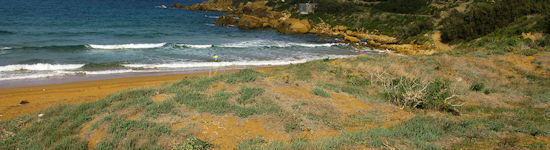
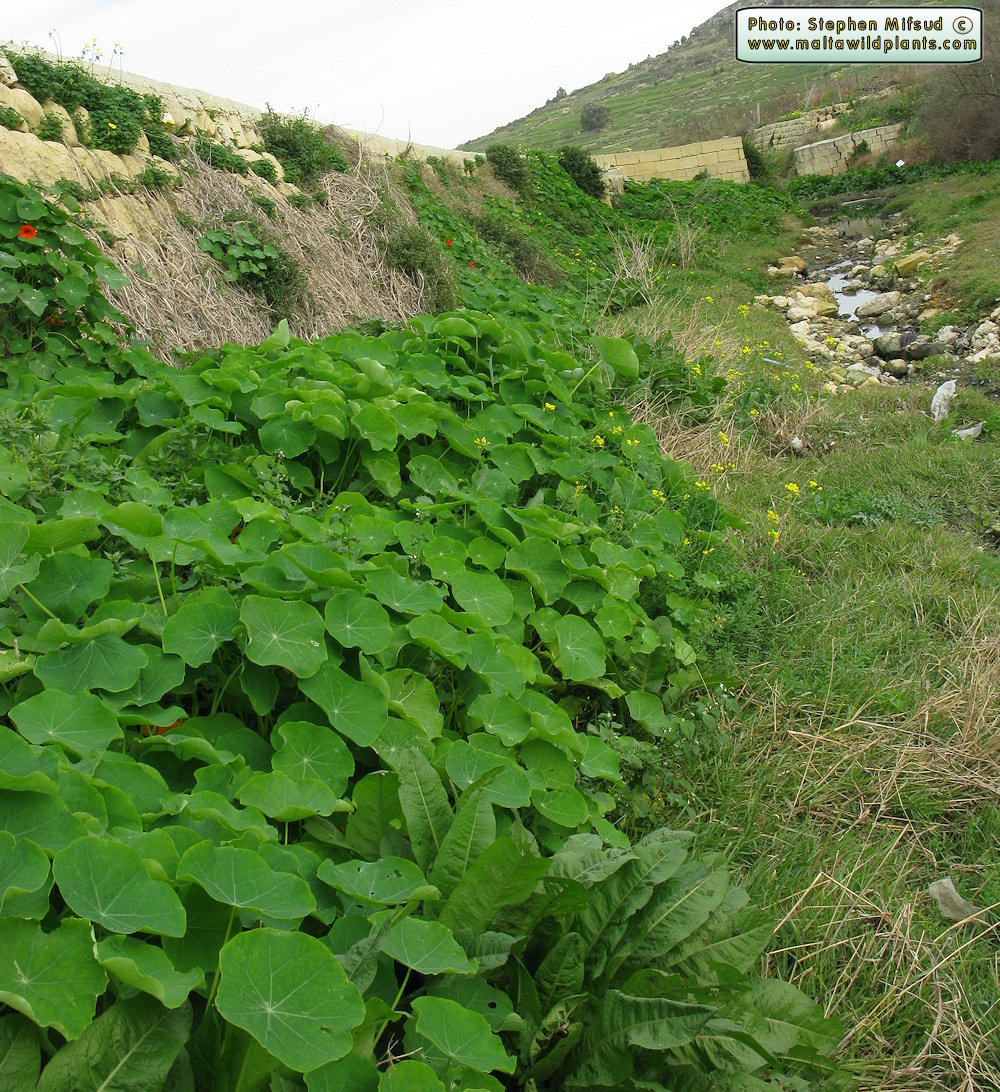
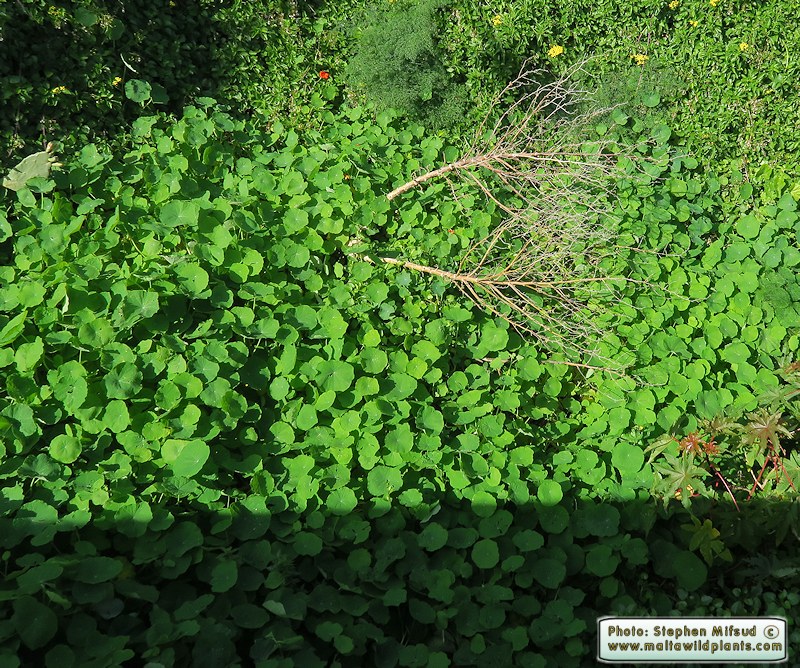
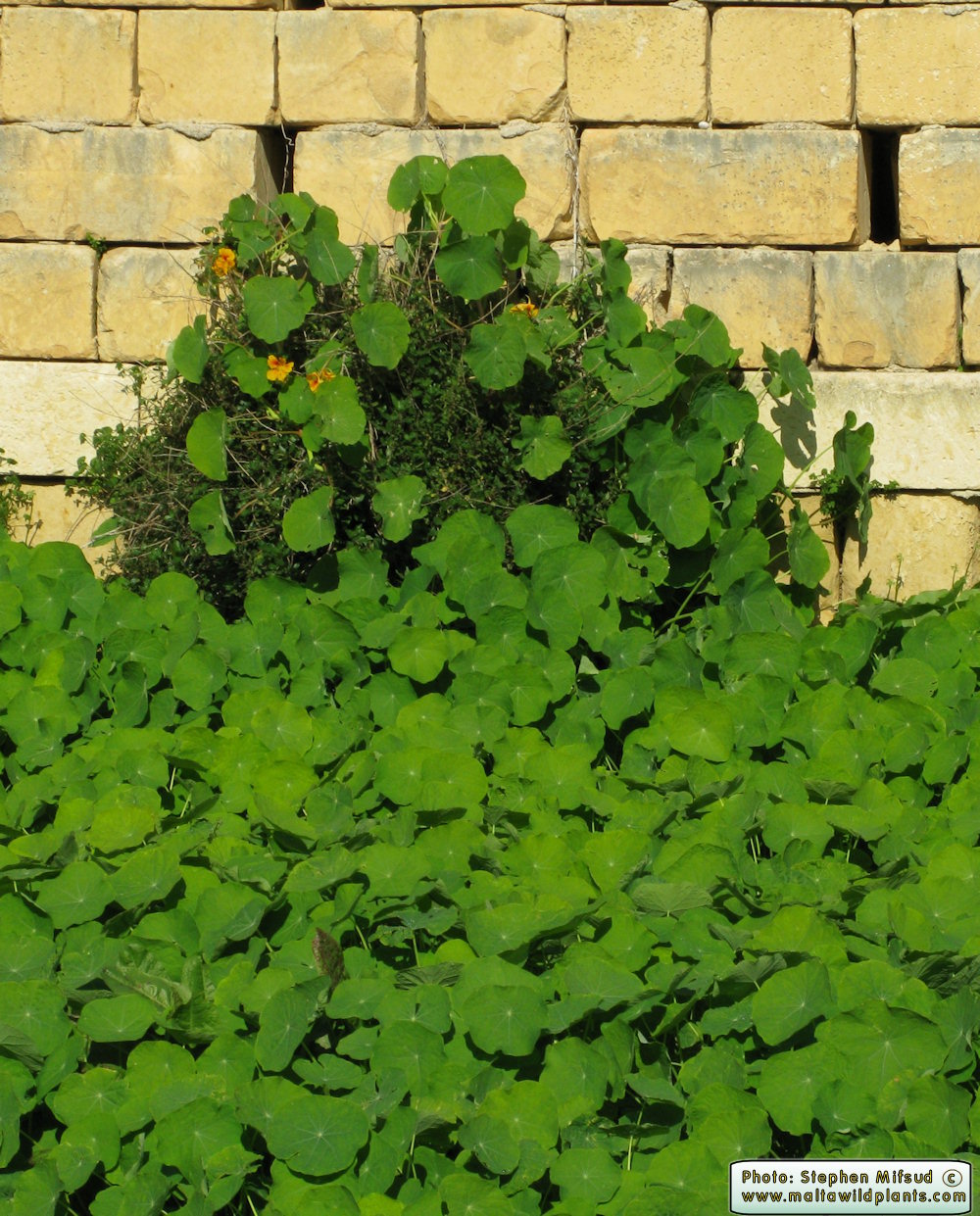
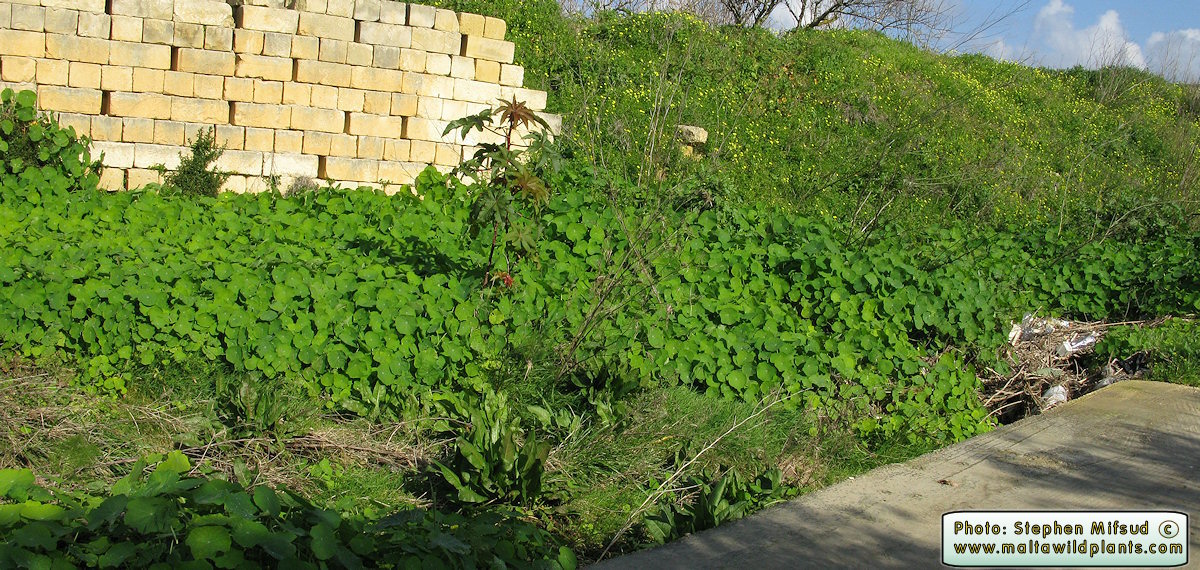
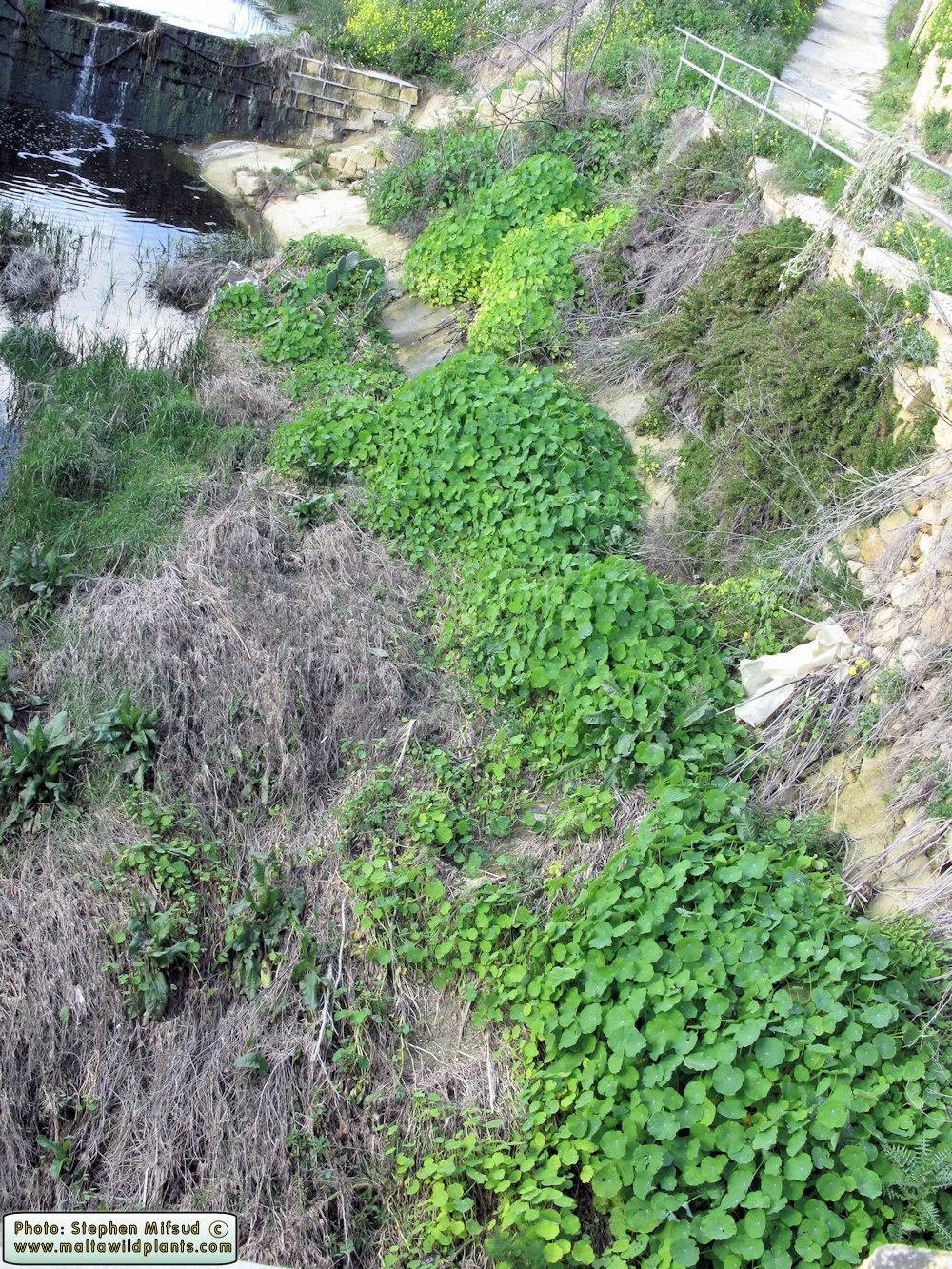
At present, the plant is found in numerous valleys around Malta and Gozo and undoubtfully have been introduced in these natural sites by man from horticulture (for example disposal of unwanted plants in valleys), and further widespread by seeds through water movement.
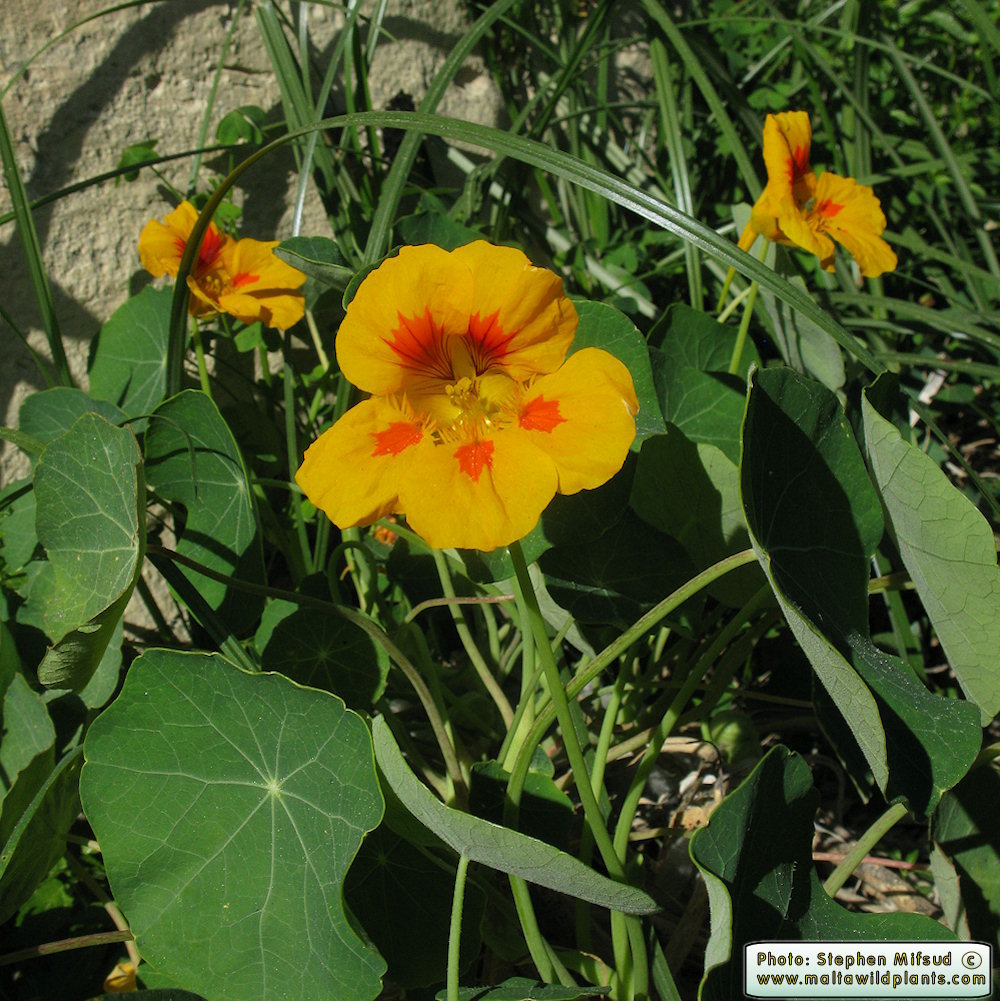
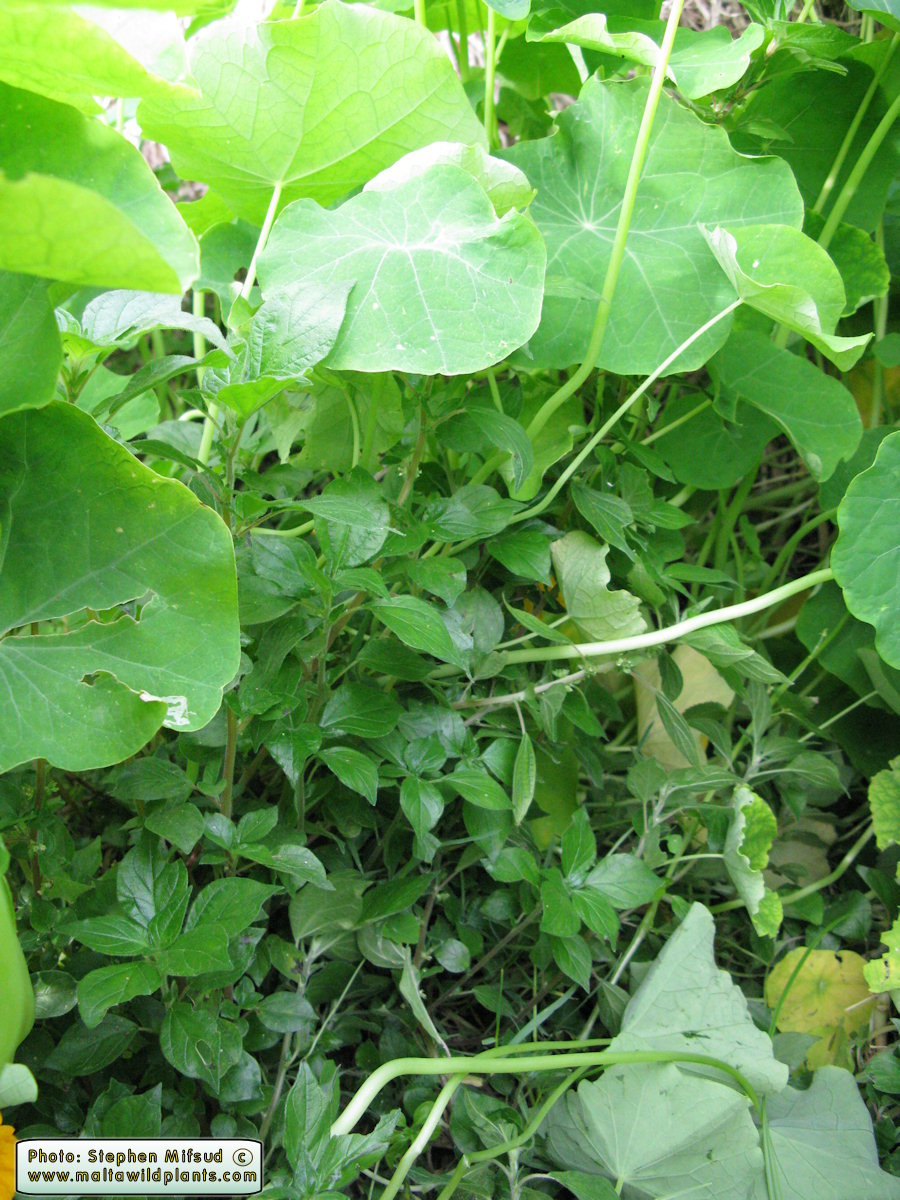
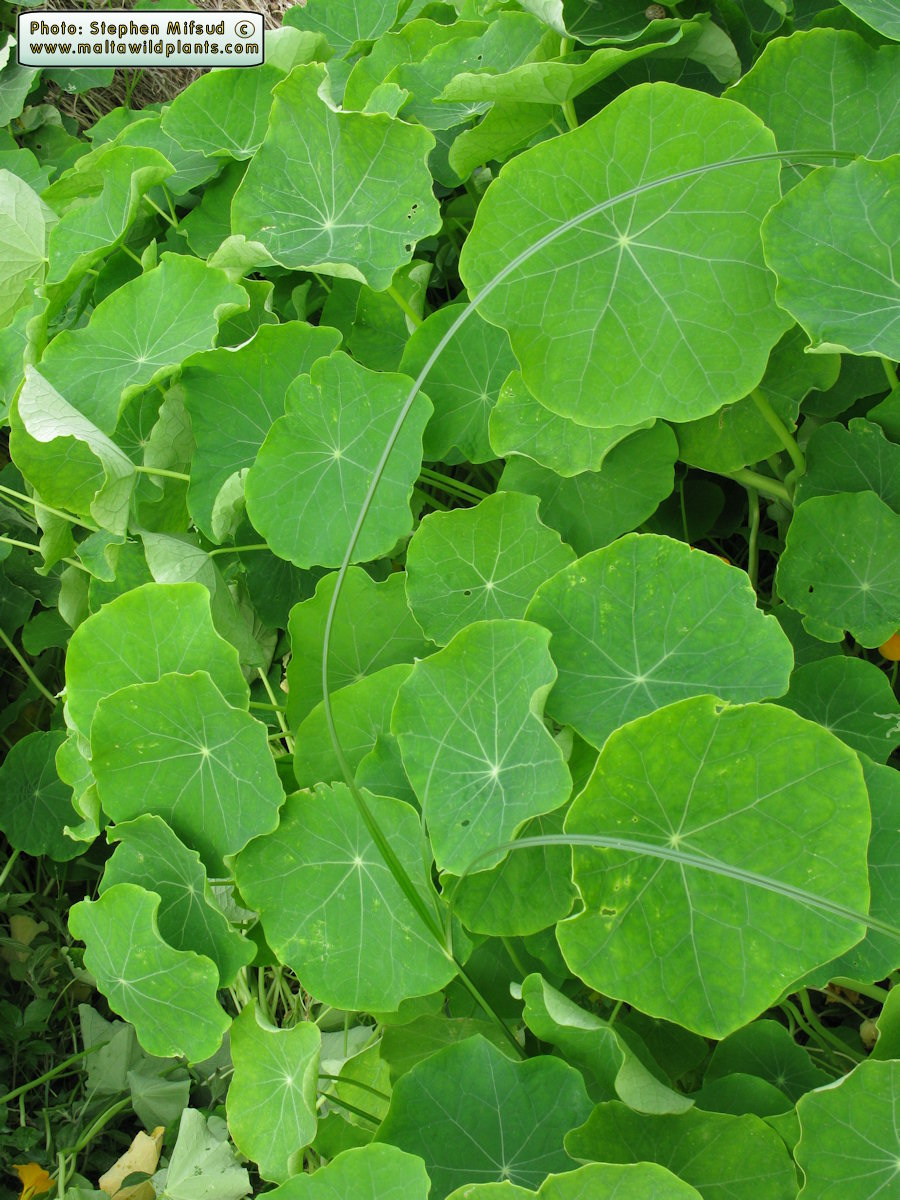
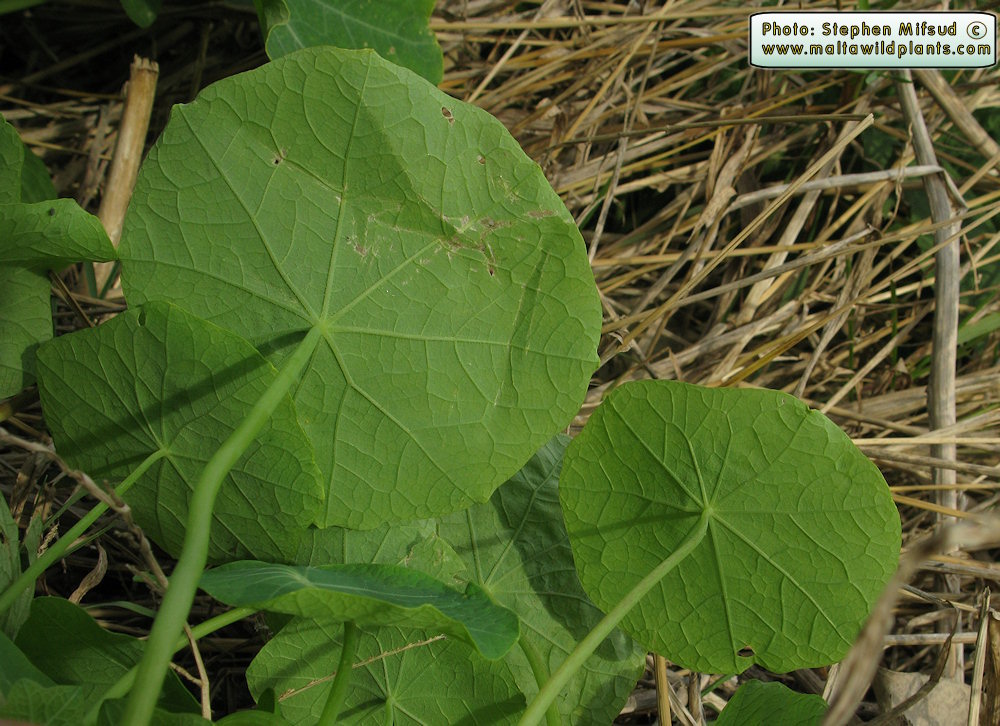
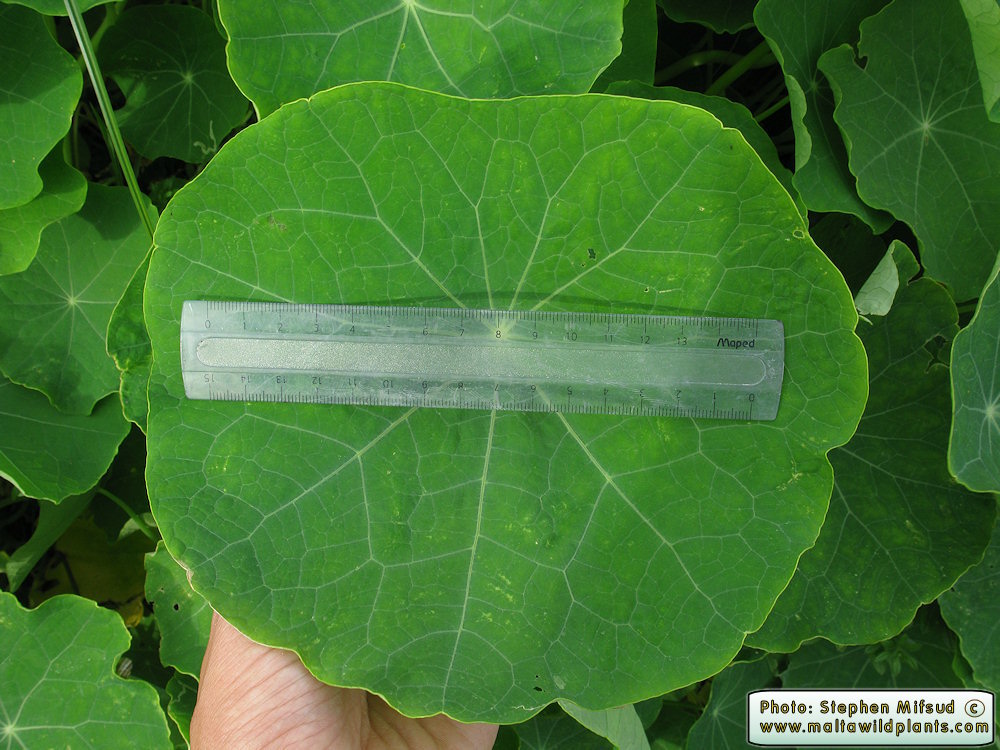
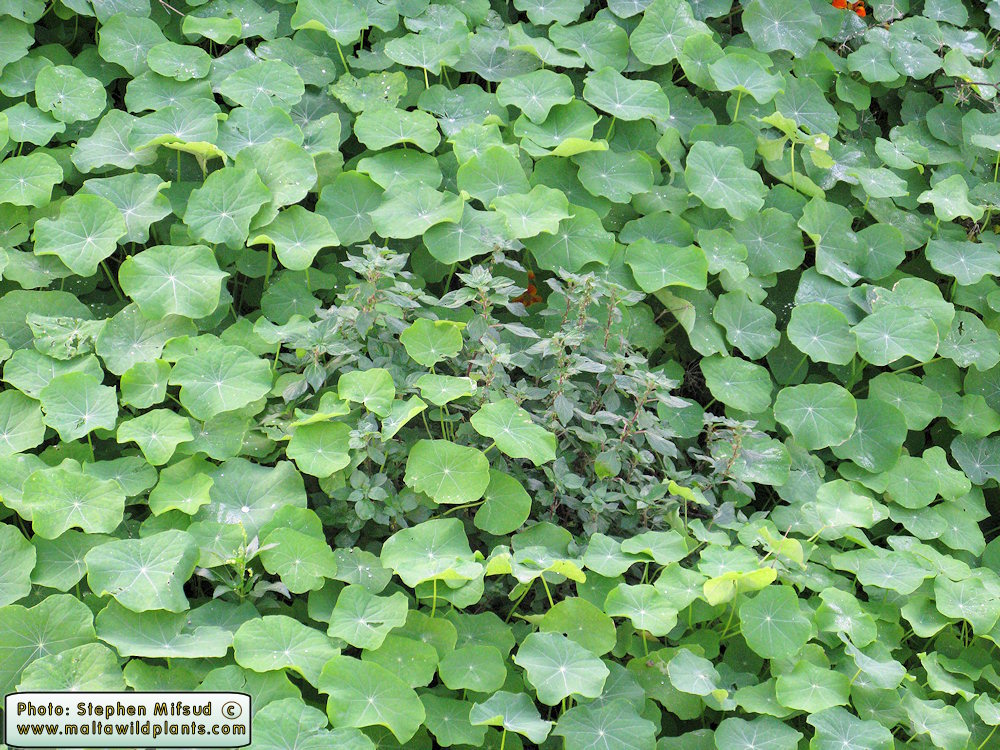
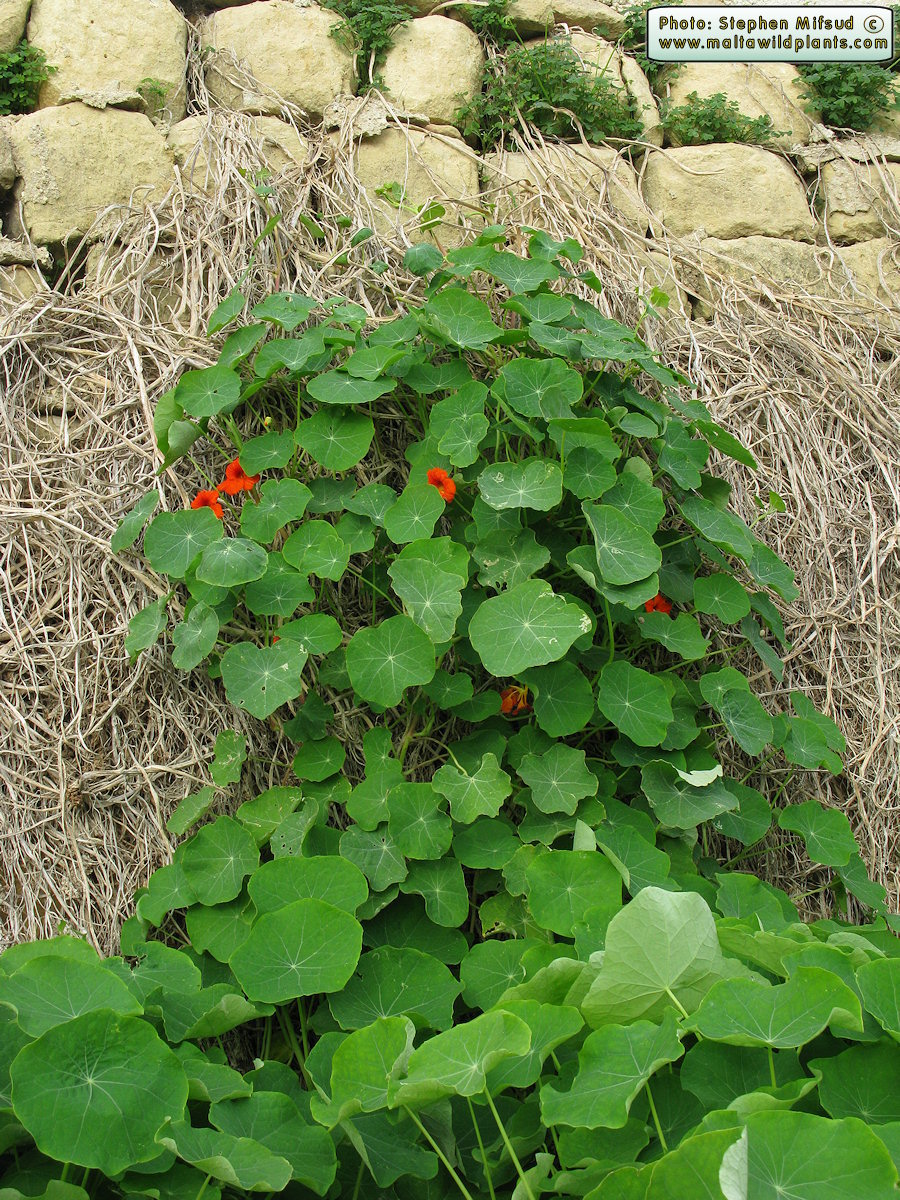
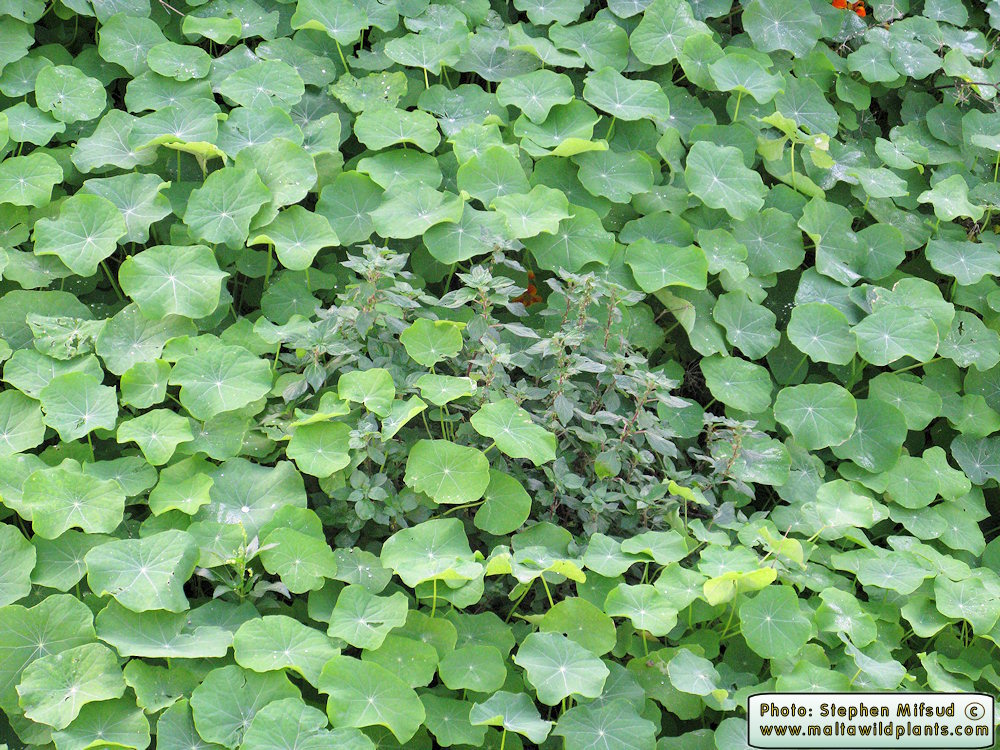
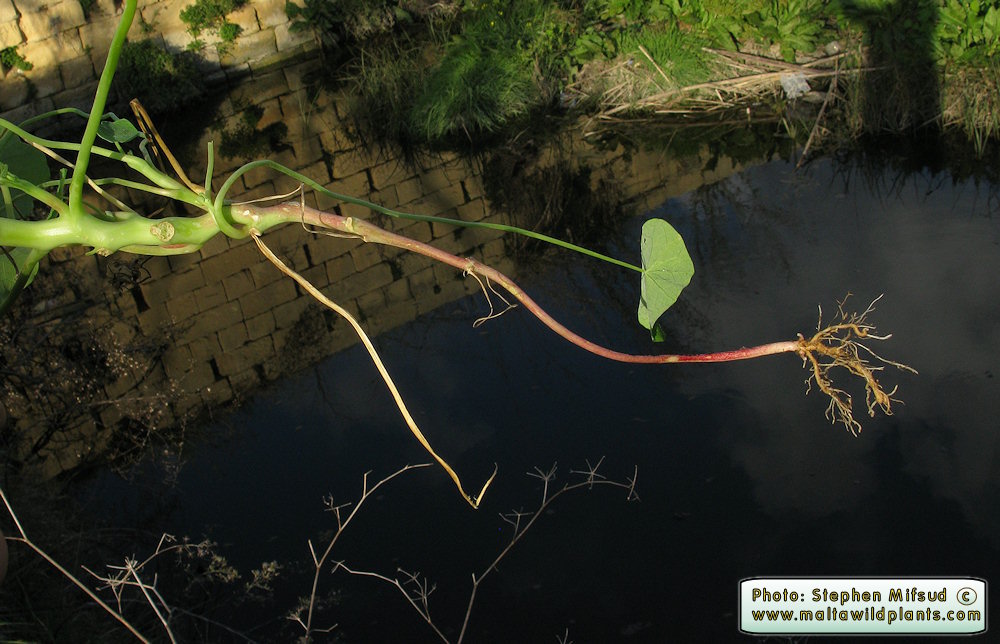
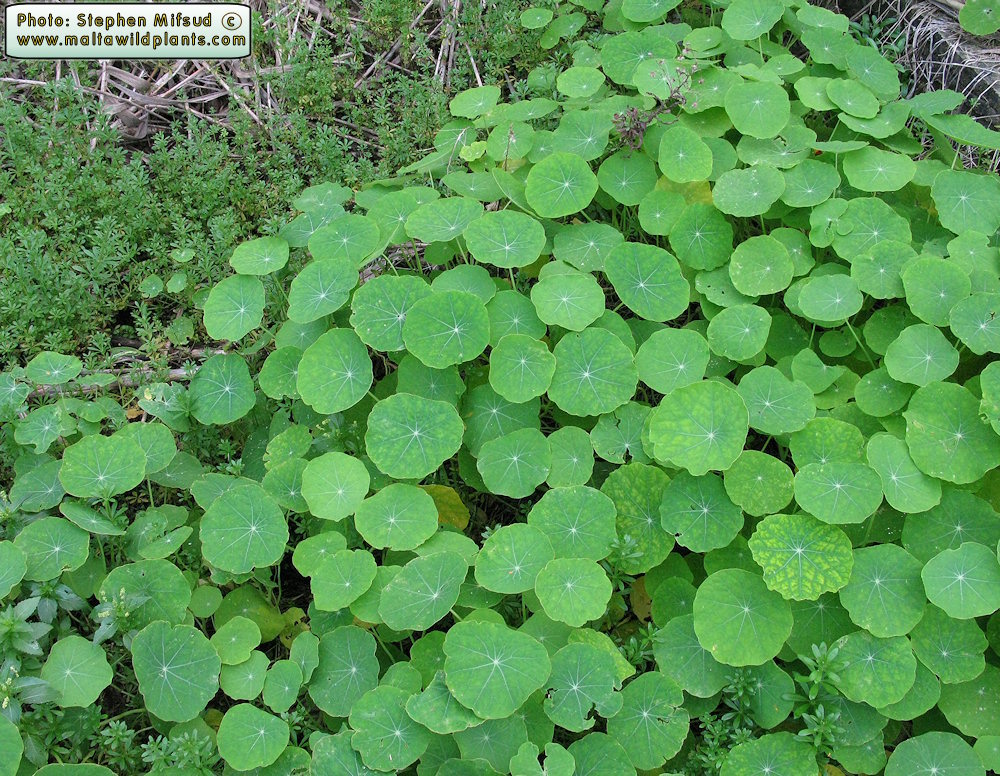
The plant forms populations reaching several metres in length - seen even in continuous stretches of up to 60m. It forms carpets of many medium-large leaves (5-15cm diameter) growing so close to each other that they shade entirely the ground below. The most common habitat that the species is found naturalised is at the margins of valley beds, where the water is not deep, and there is enough soil for the plant to root. Such habitat is usually found in shallow, exposed weedy valleys and water courses. They are more abundant in a sunny location, but have been observed also in shaded or semi-shaded parts of valleys.
The alien species can be of serious threat to native hydrophytes and valley species which grow in same habitats, especially to annuals and low growing plants. One can give the example of Damasonium bourgaei which was found in few localities to grow in such habitat. Nasturtium populations have been observed to replace patches of Parietaria judaica - a hardy and shrubby species of well established reputation in valley sides. The Nasturtium have a poor but still effective ability to climb higher plants and grow around and above them.
Despite the species is an annual, the population have a perennial habit since our climate seems to be adequate for the seeds to germinate any time of the year, and hence self-sowing is an ongoing process all year round. The plants are seen in flowers all year round with a peak in mid winter and Spring and a decline in the end of Summer.
a discussion about its invasiveness can be found in the forum of MaltaWildPlants forum [Click here]
Can one cut and eat this plant from the wild?
Definitely YES! Tropaeolum majus (Garden nasturtium) is NOT a protected species for Malta and by consuming this invasive plant, you will be helping the local flora. Above there are plenty of recipes to try out. It is a better substitute of capers when pickled because the buds are a bit larger. Always wash well the plants before consuming or using in the kitchen.
|
|